
United Kingdom Healthcare Parcel Last-mile Delivery Market Size and Share
Market Overview
| Study Period | 2020 - 2031 |
|---|---|
| Forecast Data Period | 2026 - 2031 |
| Base Year Market Size (2025) | USD 648.30 Million |
| Market Size (2026) | USD 692.45 Million |
| Market Size (2031) | USD 928.58 Million |
| Growth Rate (2026 - 2031) | 6.04 % |
| Market Concentration | Medium |
Major Players *Disclaimer: Major Players sorted in no particular order Image © Mordor Intelligence. Reuse requires attribution under CC BY 4.0. | |
United Kingdom Healthcare Parcel Last-mile Delivery Market Analysis by Mordor Intelligence
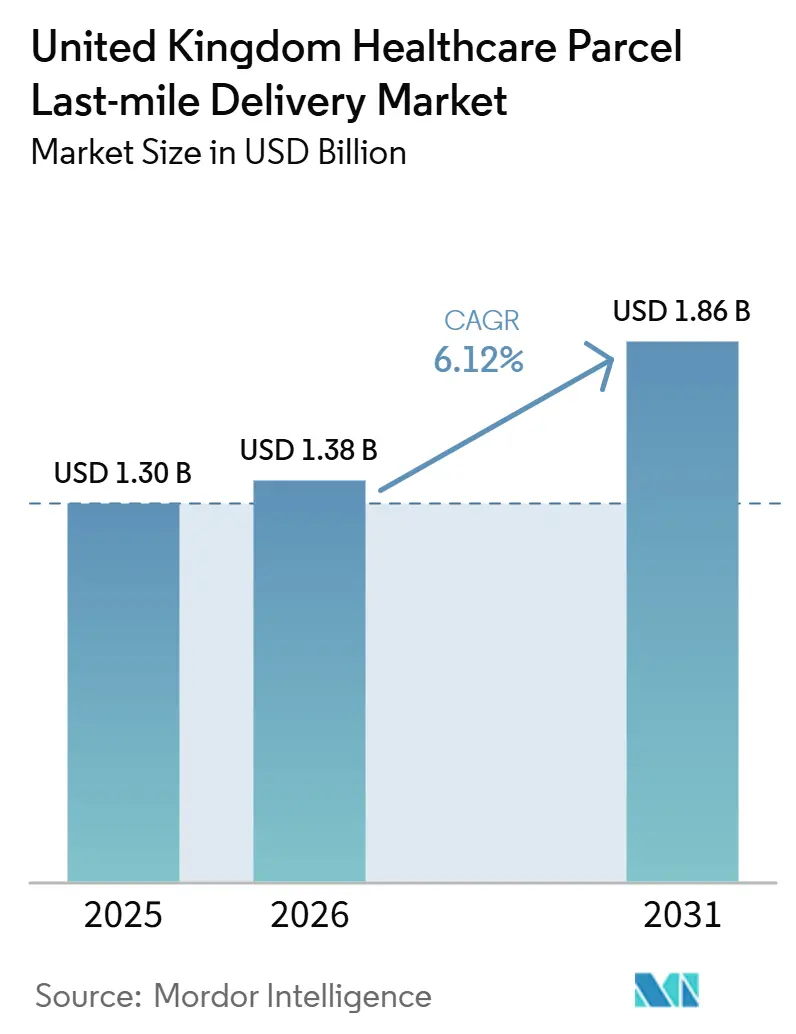
The United Kingdom Healthcare Parcel Last-mile Delivery Market size is expected to grow from USD 648.30 million in 2025 to USD 692.45 million in 2026 and is forecast to reach USD 928.58 million by 2031 at 6.04% CAGR over 2026-2031.
Growth in the United Kingdom healthcare parcel last-mile delivery market reflects a steady shift away from centralized dispensing toward parcel-led distribution that reaches patients at home, in pharmacies, and in care settings with tighter service requirements. NHS prescription volumes remain very large, with community pharmacies in England dispensing nearly 1.2 billion items in FY 2025, which keeps delivery demand broad even before higher-acuity homecare services are added to the mix. Service expectations are also rising as digital tools make parcel visibility more commonplace for patients and pharmacy partners, increasing pressure on operators to provide reliable tracking and faster handoffs. Competitive advantage in the United Kingdom healthcare parcel last-mile delivery market is increasingly tied to cold-chain discipline, regulatory compliance, and NHS contract capability rather than simple parcel scale, which favors firms that already operate validated healthcare networks. The market also retains room for expansion because outsourcing, home care growth, and direct-to-patient dispensing continue to create recurring delivery demand, even while route inflation and chain-of-custody risk remain difficult operating constraints.
Key Report Takeaways
- By delivery type, standard delivery accounted for 54.46% of the United Kingdom healthcare parcel last-mile delivery market share in 2025, while same-day delivery is projected to grow at a 7.85% CAGR through 2031.
- By temperature type, non-temperature-controlled parcels accounted for 60.42% of the United Kingdom healthcare parcel last-mile delivery market size in 2025, while temperature-controlled parcels are forecast to expand at a 6.62% CAGR through 2031.
- By product type, pharmaceuticals accounted for 42.44% of the United Kingdom healthcare parcel last-mile delivery market share in 2025, while cell and gene therapy is expected to record the highest CAGR of 9.39% through 2031.
- By delivery model, B2C accounted for 54.68% of the United Kingdom healthcare parcel last-mile delivery market size in 2025 and is also projected to post the fastest CAGR of 6.38% through 2031.
- By end user, hospitals and clinics accounted for 33.04% of the United Kingdom healthcare parcel last-mile delivery market share in 2025, while direct-to-patient deliveries recorded the fastest projected CAGR at 7.09% through 2031.
- By region, England led with 81.88% share in 2025, while Northern Ireland is forecast to expand at an 7.31% CAGR through 2031.
Note: Market size and forecast figures in this report are generated using Mordor Intelligence’s proprietary estimation framework, updated with the latest available data and insights as of January 2026.
United Kingdom Healthcare Parcel Last-mile Delivery Market Trends and Insights
Drivers Impact Analysis*
| Driver | (~) % Impact on CAGR Forecast | Geographic Relevance | Impact Timeline |
|---|---|---|---|
| Rising Same-Day and Next-Day Demand for Time-Critical Healthcare Parcels | +1.5% | England, with spillover into Scotland | Short term (≤ 2 years) |
| Expansion of Home-Based Care and Direct-to-Patient Delivery | +1.2% | National, led by NHS England trust catchment areas | Medium term (2-4 years) |
| Cold Chain Compliance Pressure Across Clinical and Pharmaceutical Parcels | +0.9% | National, with added complexity in Northern Ireland and Scotland | Medium term (2-4 years) |
| NHS and Private Provider Outsourcing of Non-Core Logistics | +0.8% | England-wide, extending across NHS-linked networks | Long term (≥ 4 years) |
| Higher Parcel Traceability Expectations for Regulated Healthcare Shipments | +0.7% | National priority under regulated medicines handling | Short term (≤ 2 years) to Medium term (2-4 years) |
| Growing Cross-Channel Fulfillment by E-Pharmacies and Omnichannel Pharmacies | +0.5% | England first, expanding into Scotland and Wales | Short term (≤ 2 years) |
| Source: Mordor Intelligence | |||
Rising Same-Day and Next-Day Demand for Time-Critical Healthcare Parcels
Urgency in regulated dispensing means that same-day and next-day delivery are increasingly treated as core service tiers in the United Kingdom healthcare parcel last-mile delivery market rather than premium add-ons. This shift is reinforced by digital prescription visibility, as the NHS App prescription tracker launched in 2025 and covered around 1,650 pharmacies, including every Boots store in England, which raises expectations for clearer parcel status and tighter delivery windows. Large prescription volumes also support this service need, as England's community pharmacies dispensed nearly 1.2 billion items in FY 2025, leaving a broad base of routine and urgent shipments moving through pharmacy and patient channels. As a result, operators in the United Kingdom healthcare parcel last-mile delivery market that can maintain tighter cut-off times, provide live visibility, and handle exceptions more effectively are better placed to win recurring healthcare flows. The effect is most visible first in urban areas, but the service standard set there tends to shape procurement expectations across the wider market.
Expansion of Home-Based Care and Direct-to-Patient Delivery
Home-based care is becoming a larger operating model for the United Kingdom healthcare parcel last-mile delivery market, as NHS-linked care pathways increasingly rely on treatment outside hospital settings. Clinical home care can reduce unnecessary hospital visits, free up acute care capacity, and maintain comparable outcomes, supporting a broader shift toward home delivery and coordinated patient services[1]Sciensus, “Bringing the Connected Care Report to the UK Parliament,” Sciensus, sciensus.com. Each shift from site-based dispensing to home care creates a more recurring parcel relationship that often needs scheduling discipline, patient communication, and, in some cases, nurse-coordinated delivery windows. That changes the role of parcel operators from simple transport vendors to service partners that help maintain treatment continuity in the United Kingdom healthcare parcel last-mile delivery market. It also supports stronger long-run demand because once a patient is enrolled in a home-based pathway, delivery becomes part of an ongoing care routine rather than a one-time shipment.
Cold Chain Compliance Pressure Across Clinical and Pharmaceutical Parcels
Cold chain control has become a stronger source of differentiation in the United Kingdom healthcare parcel last-mile delivery market, as a larger share of healthcare products now requires validated handling and clearer documentation. FedEx secured an IATA CEIV Pharma corporate certificate in 2025, covering over 90% of its global healthcare volume through certified facilities, demonstrating that certification has become a baseline signal of healthcare capability rather than a niche feature. Kuehne+Nagel also expanded its own-controlled Inspire air freight network in June 2026 by adding Frankfurt to its wider rotation, improving connectivity for time-sensitive pharmaceutical cargo feeding European and United Kingdom healthcare flows. In practice, this favors operators in the United Kingdom healthcare parcel last-mile delivery market that already manage validated temperature ranges, regulated documentation, and tighter monitoring across different handoff points. It also raises the barrier for generalist parcel carriers because healthcare shippers are less willing to trade compliance depth for lower transport cost on sensitive shipments.
NHS and Private Provider Outsourcing of Non-Core Logistics
Outsourcing remains a major structural driver of the United Kingdom healthcare parcel last-mile delivery market, as healthcare systems are pushing more logistics activity toward specialist operators. NHS Supply Chain awarded GXO Logistics a GBP 2.5 billion (USD 3.38 billion) contract in 2025 for logistics services across eight distribution centers, and a fleet of more than 300 vehicles, and Polar Speed was selected within that arrangement for NHS home delivery services. GXO then expanded its NHS England relationship in March 2026, when it was appointed as the managed service provider for the bowel cancer screening FIT home testing program in partnership with Polar Speed[2]Source: GXO Logistics, “GXO Expands Partnership with NHS England,” Nasdaq, nasdaq.com. Sciensus also described its home care model as one built alongside NHS teams across dispensing, delivery, and complex medicines support, which shows how delivery services are being folded more directly into patient pathways. This pattern gives the United Kingdom healthcare parcel last-mile delivery market a durable demand base, as contract wins in healthcare often extend into multi-year operating relationships rather than short-cycle spot volumes.
Restraints Impact Analysis*
| Restraint | (~) % Impact on CAGR Forecast | Geographic Relevance | Impact Timeline |
|---|---|---|---|
| Last-Mile Cost Inflation in Low-Drop Density Healthcare Routes | -1.0% | Rural England, Northern Scotland, Northern Ireland, and Wales | Medium term (2-4 years) |
| Chain-of-Custody Risk in Multi-Hand-Off Healthcare Deliveries | -0.8% | National, especially for the United Kingdom and EU-linked flows | Short term (≤ 2 years) to Medium term (2-4 years) |
| Packaging and Temperature Excursion Losses for Sensitive Parcels | -0.7% | National, the highest in biologics and cell therapy flows | Short term (≤ 2 years) to Medium term (2-4 years) |
| Fragmented Service Requirements Across NHS, Private, and Consumer-Directed Deliveries | -0.6% | National, most acute in England | Long term (≥ 4 years) |
| Source: Mordor Intelligence | |||
Last-Mile Cost Inflation in Low-Drop Density Healthcare Routes
Low-density delivery routes remain a meaningful brake on the United Kingdom healthcare parcel last-mile delivery market because regulated healthcare parcels are harder to consolidate than standard e-commerce volumes. Deliveries often require stronger identity checks, tighter timing, and, in some cases, controlled-temperature conditions, which limit the use of cheaper drop models and flexible consolidation points. That burden is more visible in rural England, Wales, Northern Ireland, and parts of Scotland, where travel time per successful healthcare drop tends to be structurally higher. The result is a margin gap in the United Kingdom healthcare parcel last-mile delivery market between dense urban routes, which can support faster service, and remote routes, which require greater operational effort per parcel. Unless those routes gain better commissioning support or denser healthcare demand, cost inflation is likely to remain a persistent commercial pressure.
Chain-of-Custody Risk in Multi-Hand-Off Healthcare Deliveries
Chain-of-custody risk limits the United Kingdom healthcare parcel last-mile delivery market because a healthcare parcel can lose value if any handoff weakens documentation, timing, or temperature control. This matters most where pharmaceutical shippers, warehouses, national networks, and local couriers each touch the same shipment before it reaches a patient or clinic. Community Pharmacy Scotland documented courier disruption in January 2026 during the Royal Mail and Parcelforce integration process, which showed how network changes in general parcel systems can directly affect prescription delivery continuity[3]Source: Community Pharmacy Scotland, “Important Update on Courier Collections, January 2026,” Community Pharmacy Scotland, cps. scot. That episode strengthened the case for more dedicated healthcare handling in the United Kingdom healthcare parcel last-mile delivery market, especially for regulated and time-sensitive items. The longer or more fragmented the handoff chain becomes, the more healthcare buyers tend to value specialist operators with clearer accountability from dispatch to final receipt.
*Our forecasts treat driver/restraint impacts as directional, not additive. The impact forecasts reflect baseline growth, mix effects, and variable interactions.
Segment Analysis
By Delivery Type: Same-Day Services Redefine the Urgency Baseline
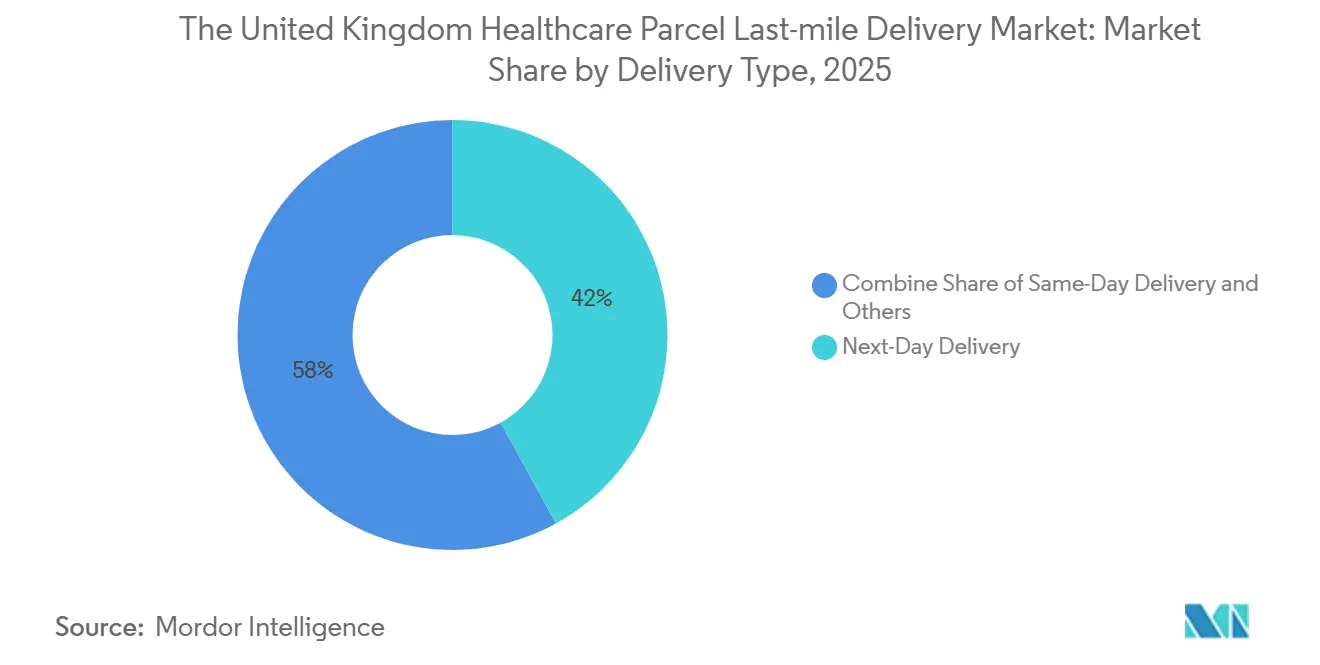
Standard delivery held 54.46% of the United Kingdom healthcare parcel last-mile delivery market share in 2025, making it the largest delivery type, as overnight replenishment still aligns with the operating rhythms of wholesalers, pharmacies, and NHS-linked ordering cycles. In the United Kingdom healthcare parcel last-mile delivery market, next-day services remain the practical middle ground between routine scheduled supply and urgent point-to-point dispatch. This segment benefits from predictable routing, repeat-delivery patterns, and a broad base of ambient and regulated healthcare products that require reliable delivery without incurring full emergency costs. It also remains important because many healthcare buyers still balance service quality with procurement discipline, and next-day networks are well placed to do that at scale.
Same-day delivery is the fastest-growing segment, and it is projected to expand at a 7.85% CAGR through 2031. The strongest signal behind that shift came in April 2026, when Matternet launched NHS drone operations in Central London to move diagnostic samples, laboratory specimens, and pharmaceuticals between two major hospital campuses in minutes. This does not remove the role of road-based couriers, but it shows that high-acuity healthcare demand is moving toward shorter delivery windows and more specialized route design.



By Temperature Type: Cold Chain Pressure Elevates Temperature-Controlled Economics
Non-temperature-controlled parcels accounted for 60.44% of the United Kingdom healthcare parcel last-mile delivery market size in 2025, making them the largest temperature segment, as high-volume ambient medicines, devices, and home healthcare supplies still represent the broadest parcel base. Much of this flow depends on reliability, timing, and parcel visibility rather than advanced thermal infrastructure. The segment also benefits from easier route planning and lower handling complexity compared with chilled or cryogenic transport.
Temperature-controlled delivery is smaller in volume, but the United Kingdom healthcare parcel last-mile delivery market for this segment is forecast to grow at a 6.62% CAGR through 2031 as biologics, biosimilars, and advanced therapies claim a larger share of healthcare logistics demand. FedEx strengthened this part of the market in 2025 through its IATA CEIV Pharma corporate certificate, which extended certified handling to more than 90% of its global healthcare volume. Kuehne+Nagel expanded its own-controlled network in June 2026, improving reliability for time-sensitive pharmaceutical cargo moving through European gateways, supporting the United Kingdom's supply chains.
By Product Type: Cell and Gene Therapies Drive Premium Logistics Demand
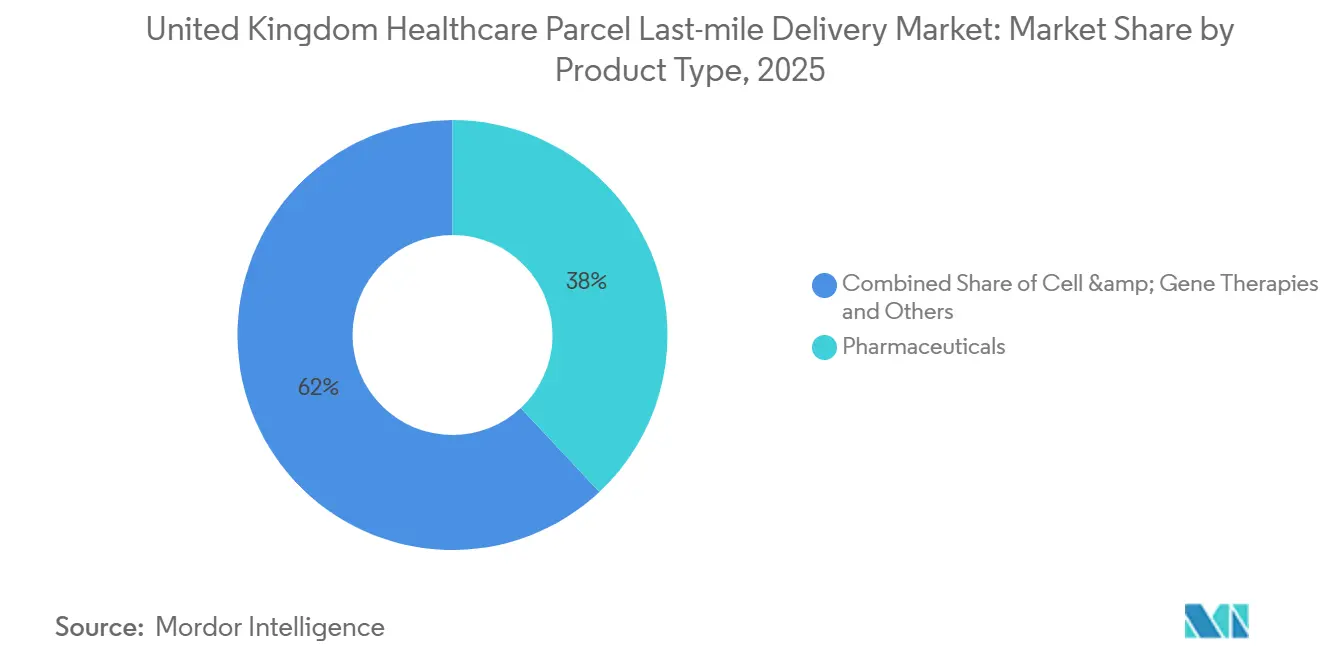
Pharmaceuticals captured 42.44% of the United Kingdom healthcare parcel last-mile delivery market in 2025, making them the largest product segment. Prescription, specialty, and over-the-counter medicines still move in much higher daily volumes than any other product class. England community pharmacies dispensed nearly 1.2 billion prescription items in FY 2025, underscoring the scale of the underlying medicines flow, even before hospital and homecare channels are added. Other categories, such as vaccines, clinical trial materials, medical devices, and diagnostic products, add complexity, but not the same broad parcel count. This keeps pharmaceuticals at the center of route planning, pharmacy replenishment, and repeat patient delivery.
Cell and gene therapy is the fastest-growing product type, registering a 9.39% CAGR through 2031. Marken stated that Polar Speed delivers directly to NHS patients across more than 80 NHS Trusts, manages over 800 prescriptions per day through two GPhC-registered pharmacy locations, and supports eight therapy areas, which shows the operating depth required for advanced therapy homecare logistics[4]Source: NHS Business Services Authority, “Prescription Cost Analysis England,” NHS Business Services Authority, nhsbsa.nhs.uk. In this segment, the parcel is often part of a much tighter clinical pathway, which means timing, patient coordination, and controlled handling matter more than broad network reach. General parcel systems are less suited to that task because advanced therapies allow less room for handoff error or route variability. This is one reason the United Kingdom healthcare parcel last-mile delivery market increasingly rewards specialist operators that can combine pharmacy compliance, patient support, and secure final delivery.
By Delivery Model: B2C Consolidates as the Structural Growth Engine
B2C accounted for 54.68% of the United Kingdom healthcare parcel last-mile delivery market in 2025, making it the leading delivery model as dispensing activity shifts toward patient homes rather than hospital and clinic collection points. This reflects a broader redesign of care delivery, where convenience, continuity, and remote access are becoming increasingly important. The B2C model also aligns well with repeat prescriptions, chronic therapy support, and home-based care services that generate recurring parcel demand. In contrast, B2B still matters for wholesale and institutional replenishment, but it behaves more like a stable backbone than the main growth engine.
B2C is also the fastest-growing delivery model, with an expected 6.38% CAGR through 2031 in the United Kingdom healthcare parcel last-mile delivery market. Healthera partnered with Uber Eats in December 2025 to launch quick medicine delivery from local pharmacies, first across major cities, with a wider rollout planned for 2026, demonstrating how consumer delivery expectations are entering healthcare channels. At the same time, Sciensus continued to frame home care as a care model that can reduce hospital visits and support treatment continuity, which reinforces the higher-acuity side of B2C delivery. These two tracks are not identical: one focuses on convenience and quick access, while the other focuses on managed therapy support and regulated handoffs. Together, they widen the role of B2C across the United Kingdom healthcare parcel last-mile delivery market and draw more parcel activity into patient-centered channels.
By End User: Direct-to-Patient Surge Challenges Hospital-Centric Incumbents
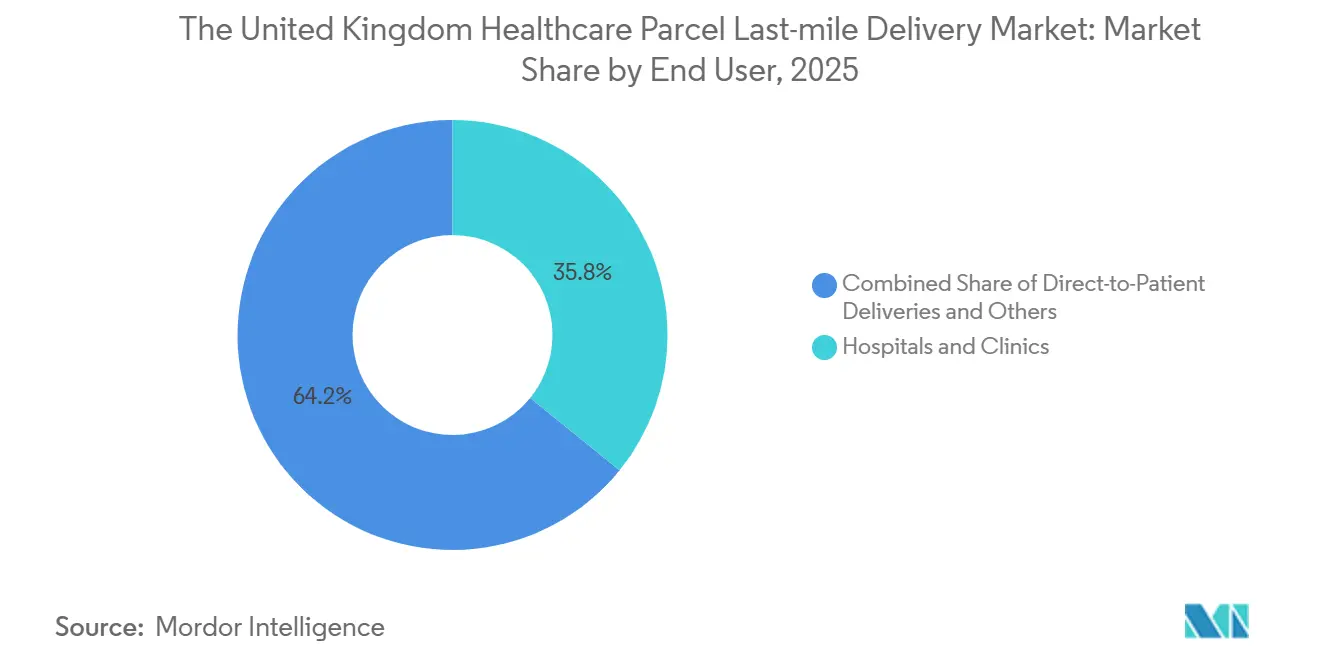
Hospitals and clinics held 33.04% of the United Kingdom healthcare parcel last-mile delivery market share in 2025, making them the largest end-user group, as acute care settings still require steady delivery of medicines, diagnostic products, and high-priority supplies. These sites depend on reliable replenishment cycles and remain a major source of time-sensitive dispatch. They also anchor many of the relationships that large logistics providers have built with NHS-linked healthcare networks. Even so, their lead is being challenged as parcel channels spread into more patient-facing care models.
Direct-to-patient deliveries are projected to rise at a 7.09% CAGR through 2031, making them the fastest-growing end-user segment in the United Kingdom healthcare parcel last-mile delivery market. Sciensus stated in 2026 that clinical home care can achieve comparable outcomes while reducing unnecessary hospital visits, further strengthening the case for therapy delivery in patients' homes. Marken also showed how this operates at scale through Polar Speed, which serves NHS patients directly across a broad trust network and multiple therapy areas. E-pharmacies and community pharmacy channels provide further support, as the NHS App prescription tracker has expanded parcel visibility at the patient end of dispensing. The combined effect is that the United Kingdom healthcare parcel last-mile delivery market is moving from a hospital-led delivery structure toward a more mixed model, in which direct patient service becomes a larger share of operational value.
Geography Analysis
England accounted for 81.88% of the United Kingdom's healthcare parcel last-mile delivery market size in 2025, making it the clear national center for healthcare parcel demand. This lead reflects England's larger prescription base, deeper concentration of NHS institutions, and stronger density of pharmacy and healthcare distribution activity. England community pharmacies dispensed nearly 1.2 billion prescription items in FY 2025, which alone supports a much broader parcel base than the other nations. England also remains the main contract market because NHS Supply Chain's 2025 logistics award to GXO covered eight distribution centers and more than 300 vehicles, and Polar Speed was included for NHS home delivery services. In March 2026, GXO further expanded its NHS England work through the bowel cancer screening FIT home testing program, which deepened England's role as the core volume market for managed healthcare logistics.
Northern Ireland is projected to grow at a 7.31% CAGR through 2031, making it the fastest-growing sub-region in the United Kingdom healthcare parcel last-mile delivery market. That growth points to stronger catch-up demand outside the largest southern logistics clusters and a wider spread of healthcare parcel infrastructure over time. England is also the first area where new service expectations become visible, as the NHS App prescription tracker covered around 1,650 pharmacies in 2025 and helped normalize parcel-level status tracking for patients. As those expectations spread, operators that already run compliant healthcare networks across England are likely to gain from both scale and familiarity with services.
Community Pharmacy Scotland reported courier disruption in January 2026 during the Royal Mail and Parcelforce integration process, which showed how devolved delivery frameworks can face direct continuity risks when generic parcel systems change. Wales offers growth potential through dispersed patient demand and the practical need for dependable direct delivery over longer local distances. Northern Ireland remains more complex because healthcare parcel operations there operate in a more sensitive compliance context, tied to cross-border movement and regulated medicines handling. That means specialist operators with stronger governance and traceability can be better positioned outside England even when parcel volumes are lower.
Competitive Landscape
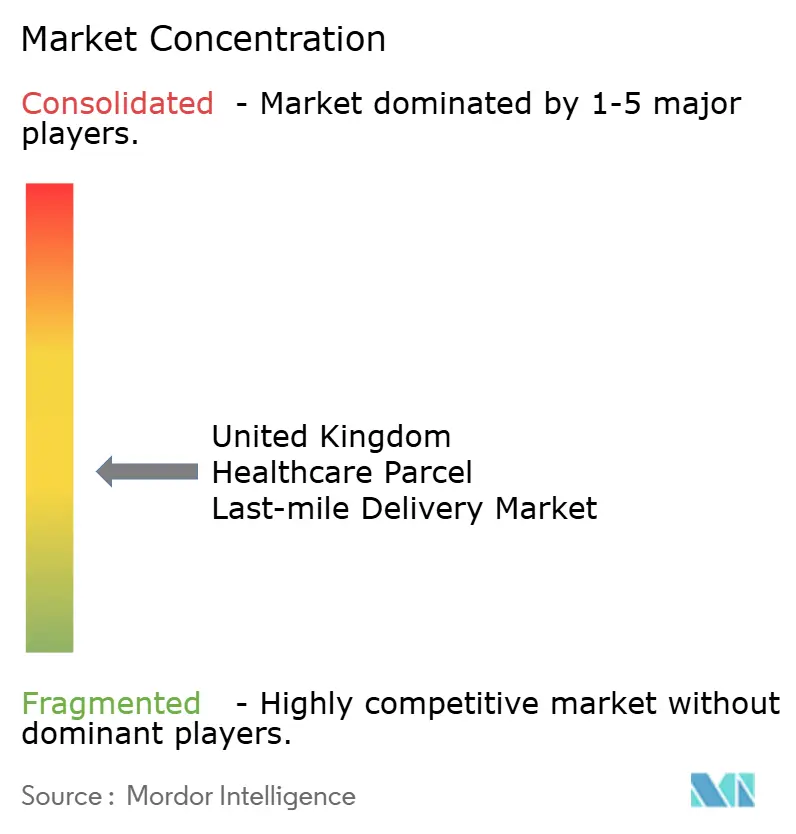
The United Kingdom healthcare parcel last-mile delivery market remains moderately fragmented, with large global integrators and NHS-embedded specialists competing on different strengths. Global firms such as DHL Supply Chain, UPS Healthcare, FedEx, and Kuehne+Nagel bring international healthcare networks, cold chain discipline, and broader manufacturer relationships. Domestic and specialist names such as Sciensus, Polar Speed, CitySprint, Alliance Healthcare, Phoenix Healthcare Distribution, and AAH Pharmaceuticals compete more directly on local route execution, NHS familiarity, and patient-facing service models. This mix means the United Kingdom healthcare parcel last-mile delivery market does not behave like a generic parcel sector, because regulatory depth and clinical process knowledge carry real weight in vendor selection. It also means competition is shaped as much by therapy complexity and compliance capability as by absolute parcel volume.
Several strategic moves in 2025 and 2026 show where competition is heading in the United Kingdom healthcare parcel last-mile delivery market. NHS Supply Chain's large logistics award to GXO, together with Polar Speed's role in NHS home delivery, showed that scale contracts can still flow toward operators that combine national infrastructure with specialist healthcare execution. Yusen Logistics completed the acquisition of Walden Group subsidiaries, including Movianto, in December 2025, creating a broader pan-European healthcare logistics platform with warehousing, last-mile delivery, control tower, and digital services. Kuehne+Nagel added Frankfurt to its own-controlled Inspire air freight network in June 2026, a move that strengthens time-sensitive pharmaceutical flows into European healthcare corridors that matter for the United Kingdom. These moves show that leading firms are investing across both domestic healthcare fulfillment and upstream international connectivity.
Technology and service design are also becoming more central to competition in the United Kingdom healthcare parcel last-mile delivery market. FedEx's 2025 IATA CEIV Pharma corporate certificate showed how quality assurance and validated handling are now part of competitive signaling for healthcare shippers. Phoenix Healthcare Distribution worked with RELEX Solutions in 2025 to deploy AI-driven inventory management across twelve distribution centers serving 7,100 pharmacies, dispensing practices, and outpatient customers, thereby improving synchronization between upstream inventory and downstream delivery activity. Healthera's pharmacy delivery partnership with Uber Eats also showed that fast consumer platforms are pushing speed expectations lower in patient-facing medicine delivery. As a result, the United Kingdom healthcare parcel last-mile delivery market is likely to reward companies that can combine regulated healthcare performance with stronger digital visibility and more flexible fulfillment models.
United Kingdom Healthcare Parcel Last-mile Delivery Industry Leaders
Sciensus
DHL Group
United Parcel Service, Inc. (UPS Healthcare)
Cencora, Inc.
NYK Line (Including Yusen Logistics and Movianto)
- *Disclaimer: Major Players sorted in no particular order

Recent Industry Developments
- June 2026: Kuehne+Nagel expanded its own-controlled Inspire air freight network by adding Frankfurt to its transatlantic rotation, Chicago-Frankfurt-Atlanta, directly linking two major pharmaceutical production hubs and improving speed and reliability for time-sensitive United Kingdom healthcare cargo imports.
- March 2026: GXO Logistics, in partnership with Polar Speed, was appointed by NHS England as the managed service provider for the bowel cancer screening FIT home testing program, managing supply and distribution of Fecal Immunochemical Test kits to eligible participants across England.
- February 2026: Uniphar Logistics United Kingdom announced the strategic merger between Uniphar Clinical and BMclinical, strengthening global clinical trial supply services, including storage, distribution, packaging, and labeling for pharmaceutical and biotech companies.
- December 2025: Yusen Logistics (Europe) B.V. completed the acquisition of Walden Group subsidiaries, including Movianto, Eurotranspharma, Transpharma International, and Walden Digital, effective December 10, 2025. The deal creates a dedicated pan-European healthcare logistics platform that combines end-to-end services, warehousing, last-mile delivery, a control tower, and digital solutions, under Yusen Logistics' mid-term FY2026-2028 investment plan targeting high-growth healthcare logistics.


United Kingdom Healthcare Parcel Last-mile Delivery Market Report Scope
The United Kingdom Healthcare Parcel Last-Mile Delivery Report is Segmented by Delivery Type (Standard, Same-Day, Next-Day), by Temperature Type (Temperature Controlled, and Non-Temperature Controlled), by Product Type (Pharmaceuticals, Vaccines, and More), by Delivery Model (B2C, and B2B), by End User (Hospitals and Clinics, and More), and by Geography (England, and More). The Market Forecasts are Provided in Terms of Value (USD).
| Standard Delivery |
| Same-Day Delivery |
| Next-Day Delivery |
| Temperature Controlled |
| Non-Temperature Controlled |
| Pharmaceuticals | Prescription and Specialty Drugs |
| OTC Drugs | |
| Biopharmaceuticals (Biologics and Biosimilars) | |
| Vaccines | |
| Clinical Trial Materials | |
| Cell and Gene Therapies | |
| Medical Devices | |
| Veterinary Medicine | |
| Blood, Plasma and Blood Components | |
| Diagnostic and Laboratory Products | |
| Home Healthcare Supplies | |
| Others |
| B2C |
| B2B |
| Hospitals and Clinics |
| E-Pharmacies and Pharmacies |
| Diagnostic Laboratories |
| Home Healthcare Providers |
| Direct-to-Patient Deliveries |
| Others |
| England |
| Scotland |
| Wales |
| Northern Ireland |
| By Delivery Type | Standard Delivery | |
| Same-Day Delivery | ||
| Next-Day Delivery | ||
| By Temperature Type | Temperature Controlled | |
| Non-Temperature Controlled | ||
| By Product Type | Pharmaceuticals | Prescription and Specialty Drugs |
| OTC Drugs | ||
| Biopharmaceuticals (Biologics and Biosimilars) | ||
| Vaccines | ||
| Clinical Trial Materials | ||
| Cell and Gene Therapies | ||
| Medical Devices | ||
| Veterinary Medicine | ||
| Blood, Plasma and Blood Components | ||
| Diagnostic and Laboratory Products | ||
| Home Healthcare Supplies | ||
| Others | ||
| By Delivery Model | B2C | |
| B2B | ||
| By End User | Hospitals and Clinics | |
| E-Pharmacies and Pharmacies | ||
| Diagnostic Laboratories | ||
| Home Healthcare Providers | ||
| Direct-to-Patient Deliveries | ||
| Others | ||
| By Geography | England | |
| Scotland | ||
| Wales | ||
| Northern Ireland | ||


Key Questions Answered in the Report
What is the 2031 value outlook for healthcare parcel last-mile delivery in the United Kingdom?
The United Kingdom healthcare parcel last-mile delivery market is forecast to reach USD 928.58 million by 2031, rising from USD 692.45 million in 2026 at a 6.04% CAGR.
Which delivery type is expanding the fastest in healthcare parcels across the United Kingdom?
Same-day delivery is the fastest-growing delivery type, with a projected 7.85% CAGR through 2031.
Why is B2C becoming more important for healthcare parcel operators in the United Kingdom?
B2C held a 54.68% share in 2025 and is also the fastest-growing delivery model, with an 6.38% CAGR, supported by home care, repeat prescriptions, and patient-centered fulfillment.
Which product category creates the most demanding last-mile requirements?
Cell and gene therapy is the fastest-growing product segment, with a 9.39% CAGR, because these shipments require tighter timing, traceability, and controlled handling than standard medicine parcels
Which part of the United Kingdom leads healthcare parcel demand?
England led with 81.88% of total revenue in 2025 because it has the largest prescription base, the deepest NHS infrastructure, and the broadest healthcare logistics activity.
What are the main risks affecting healthcare parcel delivery performance in the United Kingdom?
The main risks are cost inflation on low-density routes and chain-of-custody issues in multi-hand-off delivery networks, both of which can reduce service reliability and margin quality.
Page last updated on:





