
United Kingdom Factory Automation And Industrial Control Systems Market Size and Share
Market Overview
| Study Period | 2020 - 2031 |
|---|---|
| Forecast Data Period | 2026 - 2031 |
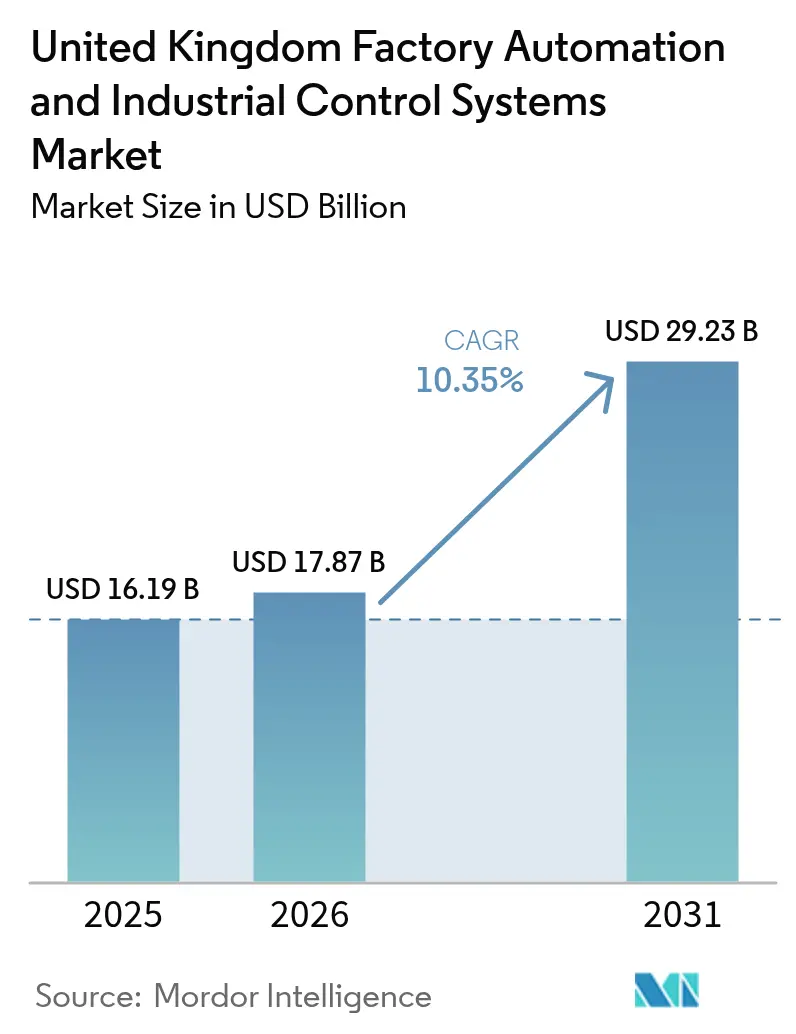
| Base Year Market Size (2025) | USD 16.19 Billion |
| Market Size (2026) | USD 17.87 Billion |
| Market Size (2031) | USD 29.23 Billion |
| Growth Rate (2026 - 2031) | 10.35 % |
| Market Concentration | Medium |
Major Players *Disclaimer: Major Players sorted in no particular order Image © Mordor Intelligence. Reuse requires attribution under CC BY 4.0. | |
United Kingdom Factory Automation And Industrial Control Systems Market Analysis by Mordor Intelligence
The United Kingdom factory automation and industrial control systems market size is expected to grow from USD 16.19 billion in 2025 to USD 17.87 billion in 2026 and is forecast to reach USD 29.23 billion by 2031 at 10.35% CAGR over 2026-2031. The outlook reflects a convergence of labor shortages, government-backed digitalization programs, rising energy prices, and the push for low-carbon production, all of which sharpen the economic rationale for end-to-end automation. Strong fiscal signals, such as the Modern Industrial Strategy’s USD 4.3 billion commitment to advanced manufacturing grants and R&D, reinforce private-sector momentum, while the scheduled 25% reduction in industrial electricity costs from 2027 materially improves the payback profile for capital-intensive automation projects.[1]Department for Science, Innovation & Technology, “AI Opportunities Action Plan,” GOV.UK, gov.ukFactory owners also attribute Brexit-related supply chain volatility to the acceleration of investment in autonomous systems that buffer against cross-border staffing and logistics risks, as evidenced by a 72% increase in imported industrial robots over the past two years. Concurrently, the Product Security and Telecommunications Infrastructure Act raises the compliance bar for connectable devices, catalyzing demand for secure-by-design control platforms and opening service opportunities for cybersecurity-focused integrators. Against this backdrop, the United Kingdom factory automation and industrial control systems market is transitioning from isolated hardware upgrades toward holistic, software-defined architectures that fuse operational technology (OT) with information technology (IT).
Key Report Takeaways
- By type, industrial control systems led with 58.15% revenue share in 2025 in the United Kingdom factory automation and industrial control systems market, while field devices are projected to expand at a 11.87% CAGR through 2031.
- By end-user, the automotive and transportation sector commanded 28.33% of the United Kingdom's factory automation and industrial control systems market share in 2025; the pharmaceutical and life sciences sector is advancing at a 13.77% CAGR through 2031.
- By component, automation hardware accounted for 46.85% of the United Kingdom factory automation and industrial control systems market size in 2025, and automation software is growing at an 12.7% CAGR over the forecast horizon.
- By industrial communication network, industrial Ethernet held a 43.25% share in the United Kingdom factory automation and industrial control systems market in 2025, while private 5G/LTE is poised for an 12.73% CAGR through 2031.
Note: Market size and forecast figures in this report are generated using Mordor Intelligence’s proprietary estimation framework, updated with the latest available data and insights as of 2026.
United Kingdom Factory Automation And Industrial Control Systems Market Trends and Insights
Drivers Impact Analysis*
| Driver | (~) % Impact on CAGR Forecast | Geographic Relevance | Impact Timeline |
|---|---|---|---|
| Government incentives via United Kingdom "Made Smarter" programme | +1.8% | National, with early gains in North West, West Midlands, Yorkshire | Medium term (2-4 years) |
| Labour-shortage-led automation demand | +2.1% | National, concentrated in manufacturing regions | Short term (≤ 2 years) |
| Industrial IoT and Industry 4.0 uptake | +1.6% | England core, spill-over to Scotland and Wales | Medium term (2-4 years) |
| Energy-efficiency and decarbonisation goals | +1.4% | National, with emphasis on electricity-intensive sectors | Long term (≥ 4 years) |
| Private 5G campus networks for real-time control | +1.2% | England manufacturing corridors, selective Scotland deployment | Medium term (2-4 years) |
| Surge in pharma and battery gigafactory CAPEX | +0.9% | England South West, West Midlands, selective Northern Ireland | Long term (≥ 4 years) |
| Source: Mordor Intelligence | |||
Government incentives via United Kingdom “Made Smarter” programme
Made Smarter has evolved from a regional pilot into a national policy instrument that lowers adoption risk for small and mid-sized manufacturers. The program delivered USD 242 million in net economic value in the North West alone and now supports more than 5,500 SMEs under the widened Industrial Strategy framework. Regional “technology translation” hubs diffuse best practices, helping firms trial digital twins, collaborative robots, and advanced analytics before committing significant capital. Peer-to-peer case studies published by hub leads shorten due-diligence cycles, while new procurement rules favor suppliers that demonstrate verifiable productivity or decarbonization gains. Together, these mechanisms compress payback periods and extend automation beyond large OEMs into the broader supply chain.
Labor-shortage-led automation demand
A persistent vacancy rate across British manufacturing has shifted board-level priorities toward immediate throughput improvements. Employers faced 55,000 unfilled shop-floor roles in 2025, prompting many to substitute hard-to-source labor with robotic welding, smart conveyors, and automated storage systems. Robot imports rose 72% post-Brexit as firms hedged against restricted EU labor flows. Apprenticeship starts in advanced manufacturing climbed 41% at Make United Kingdom member companies, signaling parallel investment in human capital. Yet the scarcity of certified automation engineers prolongs deployment cycles, driving demand for turnkey systems-integration services.
Industrial IoT and Industry 4.0 uptake
Maturing edge-compute platforms, coupled with local 5G networks, allow sub-10 millisecond response times essential for closed-loop motion control at flagship sites such as Jaguar Land Rover’s Solihull plant and Worcester Bosch’s boiler facility.[2]Manufacturing Technology Centre, “Private 5G Testbed Capabilities,” THE-MTC.ORG, the-mtc.org The AI Opportunities Action Plan allocates USD 2 billion for compute infrastructure and testbeds dedicated to industrial digital twins, reinforcing a pipeline of AI-driven manufacturing solutions. Open-source frameworks like Factory+ from the University of Sheffield’s AMRC standardize an enterprise-grade “unified namespace,” which reduces vendor lock-in and offers SMEs big-company data transparency at minimal cost.[3]University of Sheffield Advanced Manufacturing Research Centre, “AMRC Journal, Issue 18,” AMRC.CO.UK, amrc.co.uk As a result, factory operators gain plant-wide visibility, predictive maintenance insights, and rapid recipe changeovers.
Energy-efficiency and decarbonization goals
The Industrial Energy Transformation Fund injected USD 51.9 million into 25 projects that deploy variable-speed drives, heat recovery loops, and hydrogen-ready combustion systems. Eligible electricity-intensive manufacturers will see network charge discounts climb to 90% under the British Industrial Competitiveness Scheme from 2027, strengthening the business case for electrified robotics and regenerative braking. Procurement criteria are shifting: buyers now specify kWh per unit of output as tightly as cycle time, pushing vendors to integrate energy dashboards and AI-based load balancing into every proposal. Renewable intermittency further underscores the value of smart micro-grids and adaptive scheduling software that can align production with surplus green power.
Restraints Impact Analysis*
| Restraint | (~) % Impact on CAGR Forecast | Geographic Relevance | Impact Timeline |
|---|---|---|---|
| High CAPEX and ROI uncertainty for SMEs | -1.5% | National, concentrated in traditional manufacturing regions | Short term (≤ 2 years) |
| Automation-skills gap | -1.2% | National, acute in Scotland and Northern England | Medium term (2-4 years) |
| Legacy brown-field infrastructure fragmentation | -0.8% | England manufacturing corridors, selective Wales coverage | Medium term (2-4 years) |
| Cyber-security liability under PSTI Act | -0.6% | National, with emphasis on connectable device manufacturers | Short term (≤ 2 years) |
| Source: Mordor Intelligence | |||
High CAPEX and ROI uncertainty for SMEs
Many small manufacturers still hesitate to finance multi-year automation programs, especially amid elevated interest rates that tighten working-capital buffers. Although the British Business Bank has expanded lending facilities for Industrial Strategy sectors, risk-averse owner-managers remain wary of staking limited collateral on technologies with unfamiliar payback metrics. Fragmented supplier ecosystems and inconsistent performance benchmarks complicate procurement, leaving some firms locked in prolonged pilot phases. Made Smarter’s “test before invest” offering alleviates part of this friction, yet the reluctance persists until stronger evidence links automation to order-book growth rather than incremental cost savings.
Automation-skills gap
Universities and technical colleges currently graduate fewer automation engineers than demand requires, despite an additional USD 1.2 billion per year earmarked for digital and engineering courses by 2028-29. Existing curricula seldom integrate mechanical design, controls programming, and OT cybersecurity, forcing industry to assemble interdisciplinary teams through on-the-job cross-training. Brexit-related visa hurdles further constrain talent inflows from continental Europe. In response, OEMs and integrators offer remote commissioning services and low-code configuration tools that lower the competency threshold for plant personnel, but the systemic skills shortfall continues to elongate project lead times.
*Our forecasts treat driver/restraint impacts as directional, not additive. The impact forecasts reflect baseline growth, mix effects, and variable interactions.
Segment Analysis
By Type: Control systems anchor modernization
Industrial control systems accounted for 58.15% of total revenue in 2025, underscoring their centrality in orchestrating, ensuring safety, and facilitating regulatory traceability across both discrete and process plants. Replacement cycles are accelerating as operators retire legacy programmable logic controllers (PLCs), vulnerable to cyber intrusion and incompatible with unified namespace architectures. Manufacturers that replace aging supervisory control and data acquisition (SCADA) servers with modern, edge-ready units report double-digit reductions in scrap rates and shorter downtime. Field devices, namely articulated robots, machine-vision stations, and smart sensors, deliver the fastest momentum at an 11.87% CAGR, driven by demand for autonomous bin-picking, inline defect detection, and flexible packaging.
The United Kingdom factory automation and industrial control systems market benefits from hybrid control designs in which PLCs execute deterministic logic locally while cloud analytics tune parameters for energy or quality optimization. Augmented-reality human-machine interfaces now project live KPIs onto safety goggles, enabling line operators to diagnose variances without losing focus on their production tasks. Manufacturing execution systems (MES)aree heavilyutilized in highly regulated domain,s such asthe pharmaceutical industrys, where serialized batch records and electronic signatures are mandatory. The University of Sheffield’s AMRC recently demonstrated vision-guided robotic disassembly cells co-developed with Siemens that recognize product geometry and dynamically sequence toolpaths. These successes validate the swing toward perception-driven robotics that minimizes fixture complexity and adapts to variant-rich product families.




By End-User Industry: Pharma propels next-wave adoption
Automotive and transportation retained 28.33% revenue share in 2025 on the strength of long-running robotic welding, paint, and drivetrain assembly lines. Yet pharmaceutical and life sciences now set the growth pace at a 13.77% CAGR to 2031, buoyed by post-pandemic investments in sterile fill-finish, vaccine, and cell-therapy facilities. Clean-room automation demands closed-environment robots, automated guided vehicles (AGVs) for materials transfer, and granular MES capable of regulatory batch release. The forthcoming Somerset battery gigafactory, budgeted at USD 4 billion, demonstrates how adjacent sectors, such as electric mobility, feed into life-sciences-grade quality protocols.
Food and beverage processors are expanding the use of robotic palletizing and hygienic conveyance to offset high turnover in manual roles, while chemical and petrochemical sites are targeting advanced process control to reduce energy intensity. Oil and gas producers leverage remote supervisory systems for hazardous offshore platforms, integrating real-time vibration analytics to avert unplanned downtime. Power utilities deploy distributed control systems to stabilize grids saturated with renewable inputs, further bolstering software-defined automation. Electronics, metals, and aerospace producers round out the demand profile, each seeking flexible manufacturing systems that permit high-mix, low-volume production with minimal retooling.
By Component: Software shapes competitive edge
Automation hardware still contributes 46.85% of sector turnover, reflecting persistent demand for robots, drives, and sensors. However, software leads strategy deliberations as manufacturers acknowledge that differentiated value now lies in data orchestration and AI-driven decision loops. Cloud-native MES and edge-analytic platforms are projected to capture a 12.7% CAGR as plants adopt predictive quality, energy dispatch optimization, and digital twin simulations. The AI Opportunities Action Plan allocates funding to industrial inference chips and regulatory sandboxes, thereby lowering the entry hurdles for algorithm-centric vendors.
Services, including project integration, lifecycle maintenance, and cybersecurity hardening, have become indispensable, particularly for SMEs without in-house controls teams. Outcome-based service contracts, where providers guarantee throughput or energy savings, gain favor and shift capital outlays to operating budgets. Hardware suppliers respond with modular servo packs, reconfigurable gripper kits, and standard OPC UA interfaces that curtail commissioning time. The United Kingdom factory automation and industrial control systems market size related to software is projected to climb sharply as license subscriptions and analytics dashboards replace one-off hardware margins.

By Industrial Communication Network: Private 5G redefines latency
Industrial Ethernet maintained 43.25% market share in 2025, its determinism and broad vendor support securing first-choice status for backbone connectivity. Private 5G/LTE is expected to register the fastest expansion at a 12.73% CAGR to 2031, driven by sub-10 millisecond latency and network-slicing features that are pivotal for autonomous mobile robots and AR service routines. Jaguar Land Rover’s Solihull plant and the Manufacturing Technology Centre’s Coventry facility both utilize campus-scale 5G, which orchestrates guided vehicles, high-definition inspection cameras, and edge servers in real-time.
Legacy fieldbus systems persist in deep brownfield zones where deterministic cycles outweigh bandwidth needs. Wi-Fi 6, ISA100, and WirelessHART serve sensor swarms and handheld devices, provided traffic is segmented behind zero-trust gateways mandated by forthcoming PSTI enforcement. Edge nodes now host time-sensitive networking (TSN) features that merge IT and OT realms without sacrificing jitter control, solidifying the route toward converged but secure plant networks.
Geography Analysis
England underpins nearly three-quarters of the United Kingdom's factory automation and industrial control systems market, owing to the concentration of automotive clusters in the West Midlands, pharmaceutical production in the South East, and a dense ecosystem of integrators spanning from Cambridge to Manchester. The Halewood electric-vehicle project, budgeted at USD 500 million, alone deploys 750 industrial robots and next-generation paint lines that slash volatile organic compound emissions by 30%. Research corridors, such as the Catapult High-Value Manufacturing network and the West Midlands 5G testbed, accelerate the time-to-deployment for pilot projects. Foreign direct investors, such as Schneider Electric, have recently committed USD 42 million to scale smart-factory output in Scarborough, signaling confidence in England’s automation infrastructure.
Scotland commands specialized capabilities in offshore energy, food processing, and precision medicine. Make United Kingdom confirms Scottish output has rebounded above pre-pandemic peaks, supported by condition-monitoring systems for North Sea platforms and robotics for salmon processing. Renewables integration drives demand for sophisticated supervisory control that manages wind-farm intermittency alongside conventional grids. Enterprise agencies channel grants toward industrial digital tech adoption, while academic centers in Glasgow and Aberdeen nurture control engineering talent.
Wales exhibits resilience through high-mix aerospace and automotive sub-assemblies in South Wales corridors, where AGVs and collaborative robots lift line ergonomics and throughput. Energy-efficiency mandates spur upgrades to variable-speed drives and smart metering across metal fabrication sites. Northern Ireland leverages cross-border supply chains, investing in AI-oriented R&D labs in Belfast and Derry that co-develop vision systems and digital twins for local dairy, composites, and pharmaceutical exporters. Collectively, these regional initiatives ensure that growth in the United Kingdom factory automation and industrial control systems market is not confined to England but radiates across the devolved administrations.
Regulatory Landscape
The United Kingdom regulatory environment for factory automation and industrial control systems is being shaped by machinery safety reform and tighter cyber requirements for connected operational technology. In February 2026, the UK government published its response to the Machinery Call for Evidence, signaling updates to Great Britain’s Supply of Machinery (Safety) Regulations 2008. For OEMs and integrators, this direction increases scrutiny on high-risk machinery and safety-related software functions that incorporate AI or machine learning. In parallel, Health and Safety Executive (HSE) guidance on cybersecurity for industrial automation and control systems is increasingly used as a practical reference point for securing PLCs, HMIs, SCADA, and remote access pathways in plant environments.
Cybersecurity regulation is also moving from best practice toward formal obligations across critical supply chains. In November 2025, the UK government outlined a designation regime for critical suppliers under the Network and Information Systems (NIS) framework, extending cyber requirements into essential and digital service supply chains that underpin industrial operations. In June 2026, Ofgem consulted on applying a Cyber Assessment Framework approach for large load controllers, reinforcing governance and assurance expectations for control systems that can materially affect grid stability and industrial electricity demand management.
Value Chain Analysis
The value chain covers automation hardware and device OEMs (robots, drives, sensors, safety systems), control and software suppliers (PLC, DCS, SCADA, MES, HMI, PLM, edge platforms), distributors and panel builders, systems integrators and OT cybersecurity specialists, and end users across automotive, food and beverage, pharmaceuticals, energy, and process industries. In the United Kingdom, integrators and channel partners are a key implementation layer, packaging multi-vendor solutions, commissioning brownfield upgrades, and providing lifecycle services. The local ecosystem includes distributors such as BPX and integrators such as AR Controls and UK Industrial Control Systems.
Public-sector programs and applied R&D institutions influence upstream roadmaps and downstream adoption. The Modern Industrial Strategy (launched June 2025, with a one-year update in July 2026) and the Advanced Manufacturing Sector Plan (up to GBP 4.3 billion, including GBP 2.8 billion for R&D over five years) support a pipeline from testbeds to scaled deployments. The AI Adoption Plan: Advanced Manufacturing also formalizes a Scan-Pilot-Scale pathway that pulls more software, data integration, and validation services into delivery models. Work at the AMRC on AI-enabled supply-chain mapping and digital thread tooling in 2026 reflects a practical focus on de-risking dependencies and bottlenecks that can delay automation projects.
Competitive Landscape
The market remains moderately fragmented, with tier-one multinationals, Siemens, ABB, Schneider Electric, Rockwell Automation, still controlling broad hardware portfolios and entrenched service networks. Their leadership is challenged by software-native entrants specializing in AI-enabled quality control, cybersecurity orchestration, and private 5G network management. Strategic acquisitions illustrate convergence: traditional PLC makers are snapping up edge-analytics startups, while industrial cloud providers are buying robotics middleware firms to deliver vertically integrated stacks.
Vendors increasingly package sector-specific solutions. Pharmaceutical suites now ship with GMP-compliant e-batch records and automated cleaning-in-place sequencing, while automotive bundles embed welding-path optimization and energy recovery modules tailored to body-in-white lines. Cybersecurity compliance under the PSTI Act has created a whitespace for “secure-by-default” device firms that pre-install zero-trust firmware and provide lifetime patch services. Partnerships between OEMs and academia, such as Siemens’ joint work with the AMRC on automated disassembly cells, speed commercial rollout of circular-economy applications.
Service models also evolve. Integrators increasingly guarantee KPIs, uptime, energy usage, and OEE in lieu of fixed-fee builds, monetizing AI algorithms via monthly subscriptions rather than capex. As cloud support becomes mission-critical, hyperscalers are courting OT specialists to host real-time manufacturing workloads in sovereign data centers, addressing concerns about latency and data residency. Competitive intensity thus pivots from hardware differentiation to holistic digital-service ecosystems underpinning the United Kingdom factory automation and industrial control systems market.
United Kingdom Factory Automation And Industrial Control Systems Industry Leaders
Schneider Electric SE
Emerson Electric Company
Mitsubishi Electric Corporation
ABB Ltd.
Rockwell Automation, Inc.
- *Disclaimer: Major Players sorted in no particular order


Market Opportunities and Future Outlook
Named national programs and sector plans are creating actionable whitespace for vendors that can industrialize adoption beyond large OEM sites, particularly for SMEs that need validated pathways and turnkey delivery. From 2026, Made Smarter Adoption expansion funding (up to GBP 99 million) and the Advanced Manufacturing Sector Plan (up to GBP 4.3 billion, including R&D support) align with the government’s Scan-Pilot-Scale approach in the AI Adoption Plan: Advanced Manufacturing, which favors suppliers that combine controls modernization, data integration, and measurable outcomes. That alignment also increases demand for packaged solutions that reduce engineering effort in brownfield plants, including modular retrofit kits (sensors, drives, safety) combined with standardized connectivity and pre-built templates for MES and digital work instructions.
A second opportunity cluster sits at the intersection of robotics, cybersecurity, and critical infrastructure. The Smart Machines Strategy 2035 and the introduction of Robotics Adoption Hubs (GBP 40 million initial funding) expand on-the-ground mechanisms for robotics deployment. NIS-related initiatives, including the designation of critical suppliers and Ofgem’s consultation on cyber assurance for large load controllers, lift security-by-design expectations in connected control architectures. Providers that deliver secure remote access, asset visibility, and patch governance as part of control-system upgrades can turn compliance pressure into service revenue, particularly as plants add private networks and edge compute for real-time operations.
Recent Industry Developments
- July 2026: Schneider Electric signed a long-term lease for 18,555 sq ft of office space at 210 Birchwood Boulevard, Warrington. The agreement expands its UK footprint in a major industrial corridor and supports delivery capacity across automation, digitalization, and services for manufacturers and infrastructure customers.
- June 2026: Rockwell Automation announced the availability of FactoryTalk ResilientEdge, positioning a new execution architecture for more autonomous and scalable manufacturing operations. The release strengthens the edge-to-enterprise software layer that complements Allen-Bradley control systems and supports plants moving from point upgrades to standardized execution across sites.
- September 2025: Schneider Electric reported production start at its state-of-the-art manufacturing site in North Yorkshire, following its investment program in Scarborough. Adding UK-based capacity and modernization capabilities supports faster fulfillment for electrification and automation demand while improving resilience for customers managing supply-chain volatility.


Research Methodology Framework and Report Scope
Market Definition and Coverage
This market covers spending in the United Kingdom on factory automation and industrial control systems that monitor, control, and automate industrial operations, including control platforms, field devices, industrial networking, and related software and services used in production environments.
Scope exclusions: It excludes general consumer electronics and non-industrial IT tools that are not used to run or automate industrial processes.
Segmentation Overview
- By Type
- Industrial Control Systems
- Distributed Control System (DCS)
- Programmable Logic Controller (PLC)
- Supervisory Control and Data Acquisition (SCADA)
- Manufacturing Execution System (MES)
- Product Lifecycle Management (PLM)
- Human–Machine Interface (HMI)
- Field Devices
- Industrial Robotics
- Machine Vision
- Motors and Drives
- Safety Systems
- Sensors and Transmitters
- Industrial Control Systems
- By End-user Industry
- Automotive and Transportation
- Food and Beverage
- Pharmaceutical and Life-Sciences
- Oil and Gas
- Chemical and Petro-chemical
- Power and Utilities
- Other End-user Industries
- By Component
- Automation Hardware
- Automation Software
- Services (Integration, Maintenance, Consulting)
- By Industrial Communication Network
- Industrial Ethernet
- Fieldbus
- Wireless (Wi-Fi, ISA100, WirelessHART)
- Private 5G / LTE
Data Sources, Market Sizing, and Validation
Desk Research
Desk research was used to set the UK industrial backdrop and to anchor the key demand signals that automation budgets typically follow. We referenced public sources such as the UK Office for National Statistics for manufacturing output and investment indicators, HMRC trade statistics to sanity-check import and export direction for relevant equipment, and Bank of England releases for macro drivers that affect capital spending.
To keep the automation lens practical, we also reviewed sources such as the Health and Safety Executive for safety and compliance cues, UK government energy and industrial strategy publications for efficiency and modernization programs, and peer reviewed engineering journals for technology adoption direction (for example, industrial Ethernet and private cellular use in plants). Company annual reports, investor presentations, and credible industry press were used to understand product mix and service intensity, and paid subscriptions for company financials, news, and patent databases were used selectively to validate supplier exposure and product roadmaps. These desk sources are illustrative, and we also checked many other public and paid references to collect data, validate assumptions, and clarify open questions.
Primary Interviews and Surveys
Primary work focused on interviews and structured surveys with automation buyers, plant engineering teams, system integrators, and solution specialists who work across UK manufacturing sites. Their input helped confirm which categories were actively funded (for example, PLCs, SCADA, sensors, robotics, and safety systems), what typical upgrade cycles looked like, and how much services and software were being bundled into projects, which then tightened the model assumptions.
Distribution of primary research fieldwork respondents
| Company type | Respondent position |
|---|---|
| Top tier: 33% | CXOs: 17% |
| Mid tier: 46% | Functional/Unit leaders: 37% |
| Smaller Players: 21% | Managers: 46% |
Market-Sizing & Forecasting
Sizing started with a top-down reconstruction of the UK automation demand pool, where manufacturing activity, capital formation trends, and sector level production signals were translated into automation spend potential, and then mapped into the included system categories. To keep the outputs realistic, selective bottom-up checks were added, such as sampling supplier revenues tied to the UK, cross-checking typical project values through channel conversations, and testing implied volumes against common installation patterns.
Inputs used in the model included manufacturing output and investment direction in the UK, the pace of robotics and machine-vision adoption in factories, the share shift toward industrial communication networks (industrial Ethernet and wireless options), the software and services attachment rate to hardware projects, and upgrade cycles for control platforms and field devices. When a bottom-up view was incomplete, gaps were handled by using conservative penetration ranges that were validated in interviews and then applied only to the parts of the demand pool that clearly matched the scope.
For forecasting, scenario analysis was used because automation spending can shift quickly with energy costs, labor availability, and production expansion plans. Assumptions for price progression and mix shift were reviewed with industry participants so the forward curve reflected how hardware, software, and services typically change over a project lifecycle.
Data Validation & Update Cycle
Validation was handled through repeated triangulation between the modeled totals and independent signals, including manufacturing investment direction, trade movement for relevant equipment families, and the implied split between control systems and field devices. Outliers were flagged, then rechecked for unit errors, currency timing, or category overlap before the numbers were finalized, and a second analyst review was used to reduce avoidable variance.
Reports are refreshed annually, and interim updates are made when there is a material shift such as a major policy change, a sharp demand slowdown, or a step change in technology adoption. Before publication, we do a final pass of the key inputs and assumptions so clients receive the most current view that the available evidence can support.
Mordor Intelligence's United Kingdom Factory Automation and Industrial Controls Systems Market Size Measured Against Other Published Estimates
Published market sizes for UK factory automation and industrial controls can differ even when the topic label looks the same, because the included product set, the treatment of services, and the timing of currency and price assumptions are not aligned across studies. Differences also show up when one estimate is closer to "factory-only" automation, while another blends wider industrial automation spending across non-factory sites.
In our checks, the biggest gap drivers were whether industrial communication networks and automation services were counted as part of the market total, how control software like MES and PLM was handled, and whether the estimate relied mainly on a forward CAGR curve versus being tied back to UK manufacturing signals and practical upgrade cycles. The table below summarizes the spread that appears when those choices change.
Benchmark comparison
| Source | Market Size | Gaps in Research Methodology |
|---|---|---|
| Mordor Intelligence | USD 16.19 B (2025) | |
| Industry Research Publisher A | USD 17.63 B (2025) | This figure appears to include a broader solution bundle and may apply higher assumed attachment of services and software to hardware projects, which can lift the 2025 total versus a tighter control and field-device scope. |
| Market Listing B | USD 16.00 B (2024) | The value is stated as an approximate 2024 number with limited visible scope detail, so differences can come from the base-year choice, currency timing, and whether industrial networks and lifecycle services are included or left out. |
Overall, the spread is explained by what gets counted inside the solution stack and how base-year pricing and services are treated, not by one single growth assumption. By keeping control platforms, field devices, industrial networks, software, and services inside one consistent UK scope and then cross-checking the totals against manufacturing and upgrade signals, the 2025 estimate stays repeatable and less sensitive to hidden add-ons. This is the approach followed by Mordor Intelligence.


Key Questions Answered in the Report
What is the forecast value of the UK factory automation market by 2031?
The sector is projected to be worth USD 29.23 billion by 2031, expanding at a 10.35% CAGR.
Which segment holds the largest share in UK factory automation today?
Industrial control systems lead with 58.15% revenue share in 2025.
Which end-user industry is growing fastest in UK factory automation?
Pharmaceutical and life sciences are advancing at a 13.77% CAGR through 2031.
How will electricity-cost reductions influence automation adoption?
The British Industrial Competitiveness Scheme’s discounts from 2027 shorten payback periods, encouraging energy-intensive firms to accelerate projects.
Why are private 5G networks important for UK factories?
Campus-scale 5G provides the ultra-low latency needed for autonomous robots, augmented-reality maintenance, and real-time quality inspection.
Page last updated on:


 Your data is secure and never sold or shared.


