
Market Overview
| Study Period | 2021 - 2031 |
|---|---|
| Forecast Data Period | 2026 - 2031 |
| Base Year Market Size (2025) | USD 1.6 Billion |
| Market Size (2026) | USD 1.72 Billion |
| Market Size (2031) | USD 2.43 Billion |
| Growth Rate (2026 - 2031) | 7.22 % |
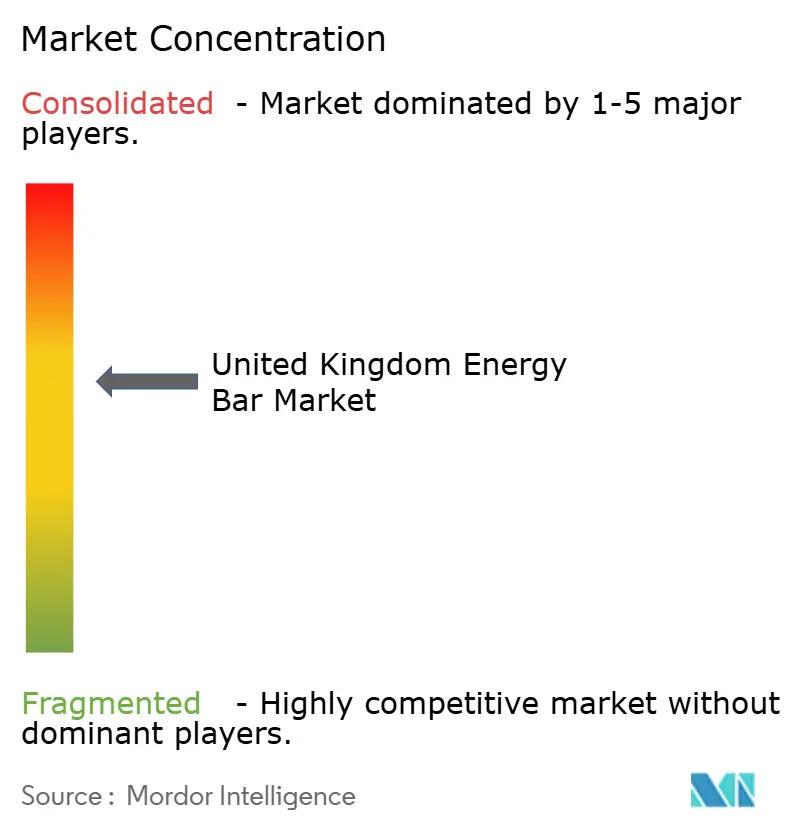
| Market Concentration | Medium |
Major Players *Disclaimer: Major Players sorted in no particular order Image © Mordor Intelligence. Reuse requires attribution under CC BY 4.0. | |
United Kingdom Energy Bar Market Analysis by Mordor Intelligence
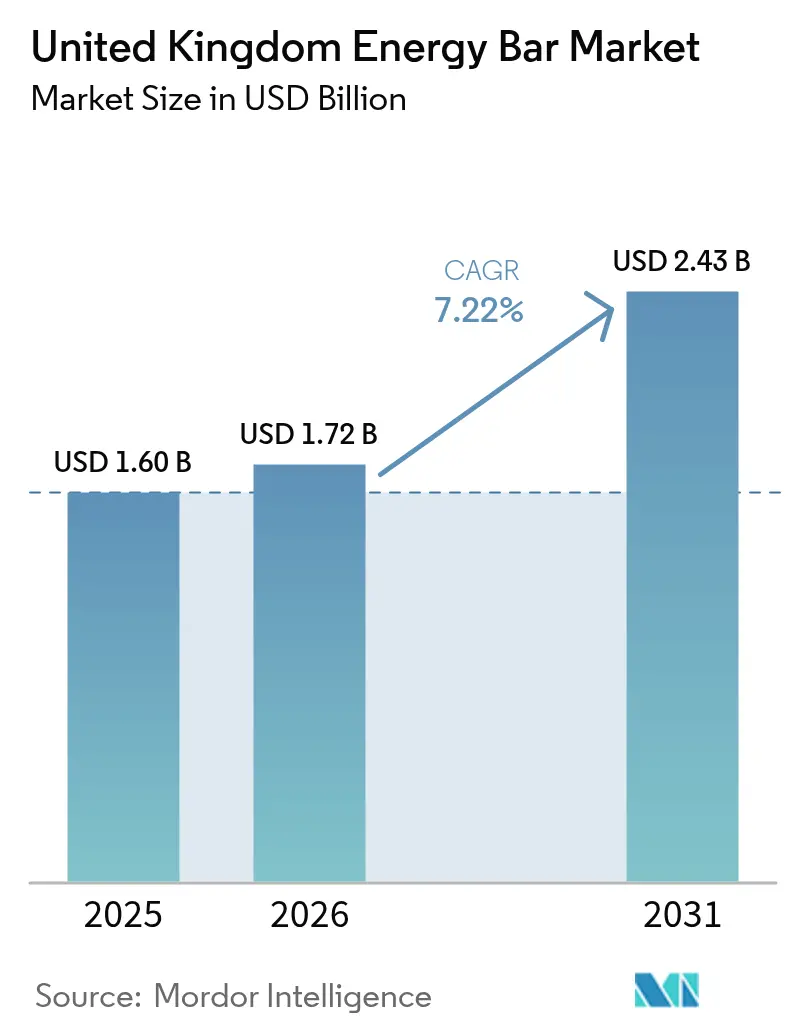
The UK energy bar market size is expected to grow from USD 1.6 billion in 2025 to USD 1.72 billion in 2026 and is forecast to reach USD 2.43 billion by 2031 at 7.22% CAGR over 2026-2031. Demand accelerates as HFSS legislation rewards low-sugar formulations, while a 16.9% national gym membership rate channels sports-nutrition habits into everyday snacking. Competitive rivalry intensifies as multinational food groups acquire specialist brands to secure compliant product pipelines and hedge against volatile cocoa and nut costs[1]. Digital-first business models and subscription bundles deepen consumer engagement, while sustainably sourced packaging gains momentum as the Plastic Packaging Tax rises to EUR 223.69 per tonne in 2025.
Key Report Takeaways
- By product type, cereal bars led with a 41.07% UK energy bar market share in 2025, and protein bars are projected to expand at a 7.44% CAGR through 2031.
- By distribution channel, supermarkets and hypermarkets held 64.11% of the UK energy bar market size in 2025, and online retail is poised for a 9.11% CAGR through 2031.
Note: Market size and forecast figures in this report are generated using Mordor Intelligence’s proprietary estimation framework, updated with the latest available data and insights as of 2026.
United Kingdom Energy Bar Market Trends and Insights
Drivers Impact Analysis*
| Driver | (~) % Impact on CAGR Forecast | Geographic Relevance | Impact Timeline |
|---|---|---|---|
| HFSS regulation accelerates demand for high-protein, low-sugar bars | +2.1% | England, Wales, Scotland, Northern Ireland | Short term (≤ 2 years) |
| On-the-go meal-replacement snacking culture | +1.8% | England core, spillover to Scotland, Wales | Medium term (2-4 years) |
| Growing sports & fitness participation | +1.5% | England, Scotland urban | Medium term (2-4 years) |
| Private-label price disruption in discounters | +1.3% | England, Scotland, Wales | Short term (≤ 2 years) |
| Creatine-infused multifunctional bars capture supplement spend | +0.9% | England, Scotland | Long term (≥ 4 years) |
| AI-driven D2C personalisation & subscription bundles | +0.8% | England, Scotland urban | Long term (≥ 4 years) |
| Source: Mordor Intelligence | |||
HFSS regulation accelerates demand for high-protein, low-sugar bars
HFSS curbs restrict non-compliant snacks from aisle-end and checkout displays, pushing manufacturers to reformulate energy bars so they score below 4 on the Nutrient Profiling Model[2]. Grenade and Trek have introduced naturally sweetened ranges boasting up to 47% sugar reduction yet maintaining sensory quality, preserving eligibility for both in-store promotions and post-2025 advertising. Formulators increasingly double protein content and add fibers or chicory-root inulin to improve satiety and glycaemic response. Brands also invest in high-intensity natural sweeteners such as stevia or monk-fruit to minimize total sugars without compromising taste. Ingredient suppliers report a double-digit rise in UK inquiries for soluble corn fiber, reflecting the rush to secure compliant bulking agents that support clean-label claims.
On-the-go meal-replacement snacking culture
Remote working and hybrid commuting patterns shorten lunch breaks, encouraging 70% of adults to purchase lunch outside the home at least occasionally[3]. Energy bars fit seamlessly into these new eating windows thanks to portability, portion control, and nutritional transparency. Brands target time-pressed Gen Z and millennial workers with “breakfast-to-desk” packs that bundle protein bars with ready-to-drink coffee. The growing popularity of high-protein breakfast biscuits signals further cross-category convergence that blurs lines between bars and bakery. Retailers capitalize by merchandising meal-replacement bars beside chilled smoothies, positioning the duo as a complete macro-balanced solution for commuters. Subscription platforms reinforce habitual consumption by auto-shipping thirty-count assortments calibrated to daily breakfast needs.
Growing sports & fitness participation
With 11.5 million gym memberships and sector revenue rising to GBP 5.7 billion in 2024, the UK fitness economy underpins regular usage occasions for performance-oriented bars6. Pre-workout consumers gravitate toward energy-dense bars featuring 3 g creatine and 200 mg caffeine, while recovery-focused users buy high-protein versions fortified with 3 g leucine. Partnerships between bar brands and fitness chains, such as Anytime Fitness stocking Grenade Carb Killa at reception desks, position products within arm’s reach of core users. E-commerce fitness retailers bundle bars with whey powder and shaker bottles to raise average order value. Activity-tracking apps integrate branded reward tokens redeemable for bars, stitching product trials into digital workout ecosystems.
Private-label price disruption in discounters
Discounters like Aldi and Lidl price their 15-g protein bars 25% below branded equivalents, driving a 9.4% value uplift in private-label snacking during 2024. Retailers leverage scale to secure long-term ingredient contracts, mitigating cocoa shocks and passing savings on to shoppers facing cost-of-living headwinds. Branded manufacturers respond by shrinking multipack sizes to hit key price points while preserving premium positioning through superior flavor and added vitamins. Some contract-manufacturers embrace a dual-supply model, producing both retailer exclusives and own brands, thereby hedging against cannibalization. The private-label advance presses leading players to intensify brand storytelling that emphasizes provenance, ethical sourcing, and functional superiority.
Restraints Impact Analysis*
| Restraint | (~) % Impact on CAGR Forecast | Geographic Relevance | Impact Timeline |
|---|---|---|---|
| Volatile nut & cocoa input costs | -1.7% | England, Scotland, Wales, Northern Ireland | Short term (≤ 2 years) |
| HFSS promotion & placement restrictions | -1.2% | England, Wales, Scotland, Northern Ireland | Medium term (2-4 years) |
| ‘Ultra-processed food’ backlash | -0.9% | England urban centers; Scotland & Wales emerging | Long term (≥ 4 years) |
| Plastic Packaging Tax & recycling-compliance costs | -0.6% | United Kingdom (nationwide) | Short term (≤ 2 years) |
| Source: Mordor Intelligence | |||
Volatile nut & cocoa input costs
Cocoa futures spiked to GBP 10,000 per tonne in April 2024, triple June 2023 levels, before stabilizing near GBP 7,600, squeezing gross margins on chocolate-coated bars. Almond and peanut markets face similar turbulence amid California droughts and Indian export levies. Brands with limited hedging capacity see unit costs rise 12% quarter-on-quarter, prompting either retail price hikes or reformulations that swap cocoa butter for palm kernel oil—steps that risk consumer backlash. Larger players diversify suppliers across West Africa, Latin America, and Southeast Asia while pre-buying inventory to lock in prices. Some launch SKUs featuring sunflower-seed or chickpea crisps to cut nut usage, retaining texture while moderating exposure to price swings.
HFSS promotion & placement restrictions
Since October 2022, HFSS items lost access to checkout and aisle-end displays, cutting impulse visibility by 32 percentage points in major grocers. Online ad bans commencing October 2025 will erase social-media retargeting for non-compliant bars, forcing a pivot to owned e-mail lists and influencer seeding. Brands face incremental design costs to fit “low-sugar” callouts onto smaller packs and trial QR-code storytelling to offset shelf-edge constraints. Retailers charge higher listing fees for compliant placements, transferring compliance economics downstream. The UK energy bar market expects a two-tier structure in which compliant SKUs enjoy promotional freedom and command premium pricing, while legacy recipes retreat to lower-traffic store zones.
*Our forecasts treat driver/restraint impacts as directional, not additive. The impact forecasts reflect baseline growth, mix effects, and variable interactions.
Segment Analysis
By Product Type: Protein Bars Drive Category Evolution
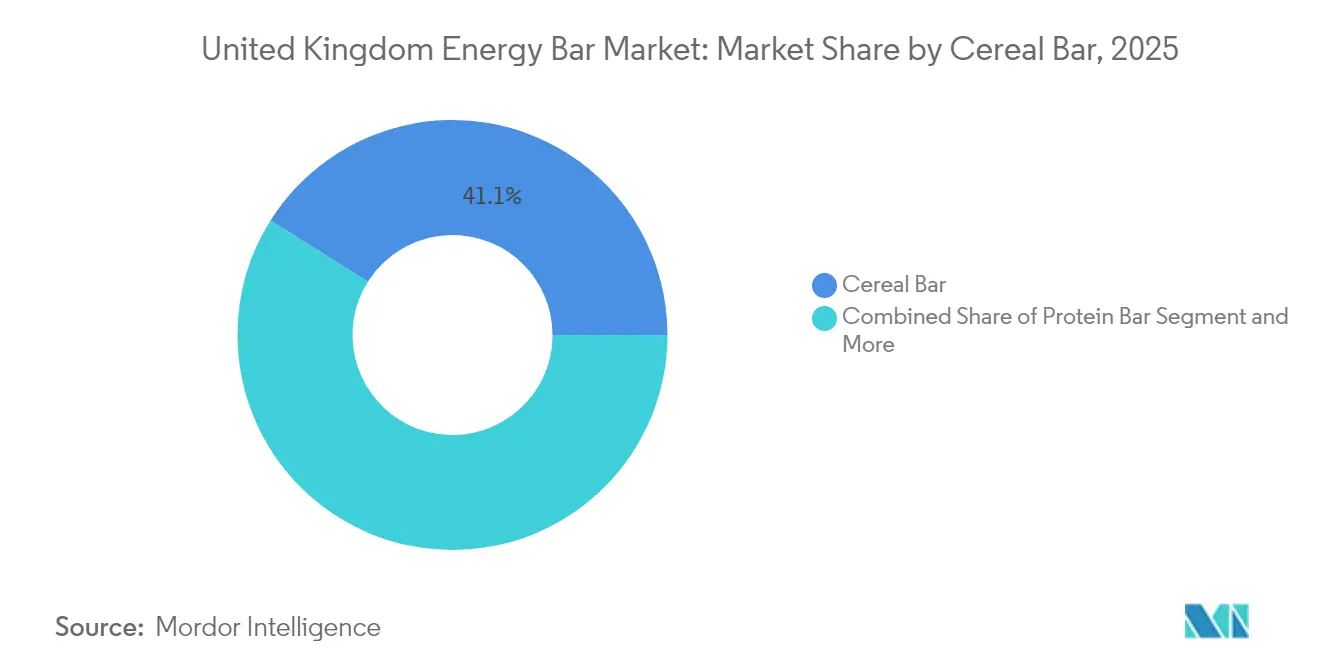
Cereal bars commanded 41.07% of UK energy bar market share in 2025, but protein bars are on track for a 7.44% CAGR that could lift their slice of UK energy bar market size from 35.00% in 2025 to more than 40.00% by 2031. The protein surge aligns with mainstream fitness culture and HFSS incentives that reward high-protein density. Cereal formats remain vital in family baskets where familiar flavors and price points resonate, yet they suffer promotional disadvantages without reformulation. Fruit-and-nut bars ride the clean-label wave, though costlier almonds and dates compress margins unless offset by premium positioning.
Manufacturers layer vitamins D and B12 into protein bars to claim immunity and energy benefits, differentiating beyond macronutrients. Grenade’s “Oreo White” limited edition sold 2 million units within six months, highlighting demand for indulgent taste wrapped in fitness credentials. Conversely, cereal bar reformulations grapple with fiber additions that can harden textures, triggering consumer complaints. R&D teams deploy enzymatic treatments to maintain chewiness. The UK energy bar market rewards brands that pair sensory indulgence with legitimate protein delivery, raising category expectations across all sub-types.

By Distribution Channel: Digital Transformation Accelerates
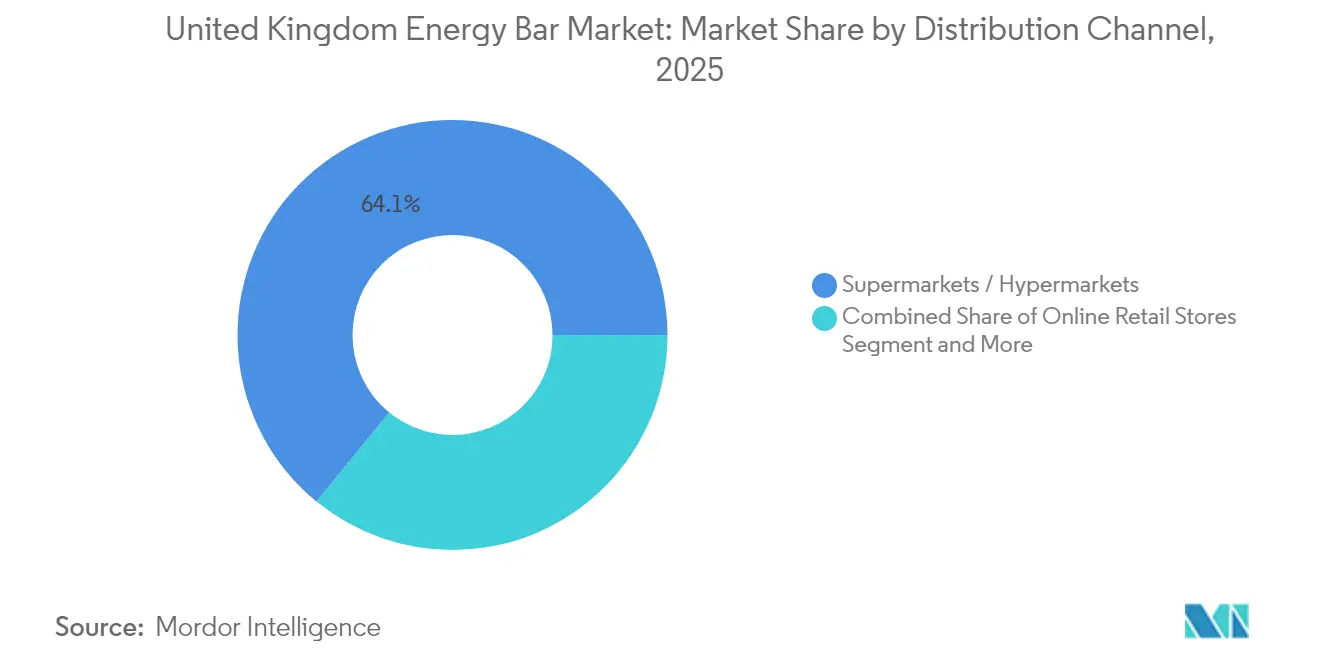
Supermarkets and hypermarkets held 64.11% of UK energy bar market size in 2025 courtesy of expansive shelf facings and multibuy promos. Yet online channels, growing at 9.11% CAGR, are forecast to surpass 15.00% penetration by 2031 as D2C boxes and grocery e-commerce mature. Retail tech improvements like predictive replenishment nudges keep pantry stocks topped without shopper effort.
Brick-and-mortar remains crucial for trial; 40% of first-time purchasers still discover bars via impulse grabs at checkout. Retailers experiment with nutritionally tiered planograms that segregate HFSS-compliant SKUs, helping shoppers navigate health claims. Convenience stores, benefiting from commuter footfall, adopt contactless micro-store formats in rail hubs, selling protein bars at breakfast peaks. The UK energy bar market thus sees channels blending: click-and-collect orders drive people in-store, where cross-promotions with bottled water stimulate incremental spend.
Geography Analysis
England leads the UK energy bar market, driven by a GBP 34,000 median disposable household income that supports premium purchases and subscriptions. Londoners consume energy bars twice weekly, compared to rural areas where consumption is biweekly. Greater Manchester mirrors London’s trends due to its growing tech sector and 24-hour convenience culture. England’s concentration of co-packing facilities reduces freight costs and enables quick limited-edition product launches. Scotland contributes a mid-single-digit market share, with Glasgow’s 15% annual growth in boutique gyms and the "Paths for All" initiative boosting demand for portable nutrition. Retailers in Scotland adapt to smaller household sizes by offering smaller multipacks.
Wales leverages sports sponsorships with rugby union clubs to enhance category visibility, while higher diabetes rates push retailers toward low-sugar assortments and HFSS-compliant products. The government’s goal to halve childhood obesity by 2030 accelerates innovation in snack formulations. Northern Ireland benefits from its compact geography, enabling efficient last-mile delivery for D2C businesses offering two-day shipping. A 28% rise in consumer preference for clean-label, oat-based bars highlights health-conscious trends, while cross-border price differences occasionally lead to "bar-runs," prompting retailers to align pricing strategies.
Regulatory Landscape
UK energy bars sold as prepacked foods fall under UK food information and labelling rules retained from Regulation (EU) No 1169/2011, including mandatory nutrition declarations and allergen communication. Nutrition and health claims used heavily in protein and functional bars are governed by Regulation (EC) No 1924/2006 and must match authorized claims on the GB Nutrition and Health Claims Register, including the common threshold for a "high protein" claim, where protein provides at least 20% of the food energy content.
HFSS-related promotion and placement restrictions have been reshaping merchandising since October 2022. Broader UK regulatory activity is also influencing adjacent functional positioning, including the Food Standards Agency (FSA) consultation launched in December 2025 on the market authorization of four regulated food products (response deadline 8 February 2026). In 2026, the FSA and Food Standards Scotland published additional guidance for novel food pathways, including February 2026 safety guidance on precision fermentation products and July 2026 outputs tied to the Cell-Cultivated Products Sandbox Programme. These steps can affect how future ingredient innovations are assessed before they enter mainstream snack formats.
Value Chain Analysis
The UK energy bar value chain begins with upstream inputs such as oats and cereals, whey and plant proteins, nuts, seeds, dried fruits, sweeteners, cocoa, and functional inclusions (fibers, vitamins, and performance ingredients). These are then processed and packaged, typically through specialist co-packers and contract manufacturers that run mixing, extrusion or sheeting, baking, cutting, enrobing, and primary and secondary packaging, followed by quality assurance and retailer compliance to standards such as BRC-aligned requirements used by UK food manufacturers.
In the midstream, UK-based operators support both branded and private-label supply. NutreeLife uses NIR-based checks for purity standards, while Petrow Food Group operates BRC-accredited sites in Haverhill and Perivale, London, using laser scanners and X-ray systems for quality control. Downstream, supermarkets and hypermarkets remain the dominant route to volume, while online, specialty sports nutrition, and convenience channels support trial, subscriptions, and targeted bundles. The chain stays sensitive to imported-ingredient exposure and logistics shocks highlighted in government food security reporting, which is pushing manufacturers and retailers toward supplier diversification, improved testing technology, and more robust storage of both ingredients and finished goods.
Competitive Landscape
The UK energy bar market, with a moderate concentration index of 6, balances between oligopoly and fragmentation. Mondelez International leads with Grenade’s 2024 value share growth, leveraging chocolate-bar expertise for HFSS-compliant protein formats. Kellogg Company re-entered in January 2025 with Special K Protein Bars, using brand heritage to secure supermarket listings. Fulfil Nutrition, majority-owned by Ferrero, is scaling rapidly through co-packed operations and out-of-store sampling. Meanwhile, Aldi and Lidl’s private-label lines near a combined double-digit market share, pushing branded players to focus on functional claims over price. Smaller disruptors like Tribe Foods are attracting venture capital to pioneer adaptogen-infused bars, reflecting investor interest in health-focused niches.
Ingredient suppliers are innovating with high-melt chocolate compounds to reduce shrinkage during summer logistics, while strategic partnerships are gaining traction. Glanbia supplies whey crisps to multiple brands, and Amazon sponsors virtual fitness events, bundling Prime vouchers with bar multipacks. Companies with in-house nutrition scientists are fast-tracking HFSS reformulations, gaining competitive advantages such as wider shelf space and advertising exemptions. The UK energy bar sector rewards both economies of scale and agile, science-driven innovation.
United Kingdom Energy Bar Industry Leaders
-
Mondelēz International, Inc.
-
Kellogg Company
-
General Mills, Inc
-
Unilever PLC
-
Glanbia PLC
- *Disclaimer: Major Players sorted in no particular order
Market Opportunities and Future Outlook
HFSS-driven reformulation and compliant merchandising create space for products that retain indulgent taste while meeting lower-sugar profiles, which keeps demand focused on fibers, alternative sweeteners, and protein systems that help brands clear in-store promotion and placement hurdles. Alongside this, there is an execution-led opportunity in upgrades to capacity and capabilities across UK snack and bar manufacturing, as contract production expands: Bakeit Food opened a GBP 3 million, 12,500 sq ft granola and snack production facility in Winchester in February 2026 with capacity for up to 220 tonnes per month, and Wholebake announced a multi-million-pound expansion and a new food-grade facility in Wrexham in October 2025 as its third manufacturing site.
Manufacturing automation and value-added processes also support better unit economics for both brands and private label in the context of volatile cocoa and nut costs. Nutrition Group reported investment in an automated wrapping and packing system that lifted bar line throughput by 25%, and Kestrel Foods announced a GBP 5 million investment in advanced chocolate coating and polishing technology and expanded storage at its Portadown facility in June 2026 (supported by Invest NI). Together, these upgrades in UK and Northern Ireland-based food manufacturing support faster limited-edition cadence, stronger summer logistics outcomes for coated formats, and more scalable supply for online bundles and retailer multibuys without relying only on overseas capacity.
Recent Industry Developments
- May 2026: Mondelēz International expanded the Zbar portfolio with Zbar Oat Bites and a new Strawberries 'n Creme flavored Zbar Protein snack bar. The update pushes bite-sized and higher-protein formats that broaden usage occasions beyond traditional full-size bars and supports differentiated shelf sets for family and kids-oriented snacking.
- April 2025: Trek launched a new high-protein, low-sugar range in the United Kingdom, positioned around naturally sourced ingredients without artificial sweeteners. The launch aligned product renovation with HFSS-led demand for lower-sugar formulations while keeping sports nutrition credentials central to brand differentiation.
- April 2024: Cocoa futures spiked to around GBP 10,000 per tonne, materially increasing cost pressure for chocolate-coated bar formulations. The shock accelerated reformulation and procurement actions across the category, including hedging, supplier diversification, and greater interest in alternative inclusions to reduce exposure to cocoa-heavy recipes.
Research Methodology Framework and Report Scope
Market Definition and Coverage
For this report, the market covers packaged energy bars sold in the United Kingdom through retail and online channels, counted on a value basis at the point of sale. It includes mainstream and organic offerings that are positioned for quick energy, active lifestyles, and on-the-go snacking.
Scope exclusions: We exclude homemade bars and unpackaged food counter items, and we also exclude broader snack bars that are not marketed or purchased as energy bars.
Segmentation Overview
- By Type
- Cereal/Granola Bars
- Protein-Rich Bars
- Fruit and Nut Bars
- By Distribution Channel
- Supermarkets/Hypermarkets
- Convenience Stores
- Specialty Stores
- Online Retail Stores
- Other Distribution Channels
Data Sources, Market Sizing, and Validation
Desk Research
Desk work started with building the demand context for energy bars in the UK, and then narrowing it to what is actually sold as an energy bar in stores and online. We leaned on public sources such as the UK Office for National Statistics for household spend patterns, HM Revenue and Customs for trade signals on relevant food categories, and guidance and publications from the Food Standards Agency and the Department of Health and Social Care for labeling and HFSS related context.
To keep assumptions realistic, we also reviewed industry and retail signals from sources such as association websites, large retailer category updates in reputable press, and company annual reports and investor presentations where product focus and UK exposure are discussed. Paid subscriptions were used selectively for company financials and news screening, and for patent databases to sense ingredient and claims activity that can influence pricing. The desk list above is not exhaustive, and many other public and reference sources were checked for data collection, validation, and research clarification.
Primary Interviews and Surveys
Primary discussions were used to verify what is counted as an energy bar in the UK shelf, how pricing moves by pack format, and how volumes split across supermarkets, convenience, specialty, and online. Respondent input also clarified what interviewees treat as the practical boundary between energy bars and adjacent nutritional bars, particularly when packaging uses functional wording. We spoke with a mix of brand-side managers, channel specialists, and industry advisors to pressure-test desk assumptions, and to confirm practical ranges for penetration, promotional intensity, and channel mix within England, Scotland, Wales, and Northern Ireland.
Distribution of primary research fieldwork respondents
| Company type | Respondent position |
|---|---|
| Top tier: 27% | CXOs: 12% |
| Mid tier: 58% | Functional/Unit leaders: 30% |
| Smaller Players: 15% | Managers: 58% |
Market-Sizing & Forecasting
The core model is built using a top-down demand pool, where national packaged snack spend signals are reconstructed into an energy bar value layer using channel presence and observed category positioning. Once that pool is set, we distribute value across channels by using expected shelf availability, online share, and the role of convenience retail for on-the-go purchases, and then we reconcile the totals to realistic price and volume behavior.
To make sure the number stays grounded, the output is corroborated with selective bottom-up approximations, mainly sampled average selling price by pack type multiplied by indicative consumption volumes, followed by supplier and retailer channel checks to correct any overstatement. Inputs used in the model include average unit pricing and promo cadence, pack format mix (single versus multipack), organic versus conventional share movement, distribution channel mix shifts, and demand cues linked to fitness and active lifestyle participation. For forecasting, scenario analysis is applied around pricing progression, channel growth, and the pace of health and labeling related changes, and then the chosen path is aligned with what interviewees view as the most likely year-to-year outcome. Where bottom-up signals are thin for smaller brands, we fill gaps using conservative price bands and channel-weighted proxies, and then re-test the total against the wider demand pool.
Data Validation & Update Cycle
Outputs are checked through triangulation across at least three independent signals, and then reviewed for variance by channel, price, and implied consumption patterns so obvious inconsistencies get caught early. If a channel mix looks off, or if pricing assumptions create unrealistic value jumps, we re-check the desk inputs and re-contact relevant experts to clarify what changed and when it changed.
Before sign-off, the model is reviewed in multiple steps, starting with an analyst self-check and followed by a second review focused on assumptions, math logic, and consistency with observed market behavior. The report is refreshed annually, and interim updates are made when there are material events such as sharp pricing moves, major channel shifts, or regulatory changes that can affect category demand. Right before delivery, a final pass is done so clients receive the latest updated view.
Mordor Intelligence's United Kingdom Energy Bar Market Sizing Compared With Other Published Estimates
Published market sizes for UK energy bars often do not line up, even when they sound like they are measuring the same thing. The differences usually come from how the product boundary is set, which channels are counted, what year is treated as the base, and how price growth is handled when promotions are common.
Retail channel mix signals and observed price points by pack format are the checks that keep Mordor Intelligence tied to the energy bar category sold through supermarkets, convenience, specialty retail, and online in the UK, rather than a wider nutritional bar bundle. Gaps also appear when a study mixes energy bars with meal replacement or general snack bars, or when it uses a narrower definition that effectively tracks only a subset like organic lines or selected pack types.
Benchmark comparison
| Source | Market Size | Gaps in Research Methodology |
|---|---|---|
| Mordor Intelligence | USD 1.60 B (2025) | |
| Industry Publisher A | USD 0.17 B (2026) | This estimate appears to use a much narrower counted universe and a later base year, which can understate value if large grocery and convenience sales are not fully captured or if the definition is limited by pack formats. |
| Industry Publisher B | USD 1.10 B (2025) | This figure is closer to a broader nutritional bar framing, which can shift totals depending on whether energy bars are separated cleanly from protein, meal replacement, and other functional snack bars. |
Looking across the table, the spread is mainly explained by scope boundaries and how channel coverage and pricing are treated in the base year. Our approach stays transparent because each step can be traced back to simple drivers like channel mix, pack pricing, and practical category definitions that can be re-checked and repeated.
Key Questions Answered in the Report
What is the current value of the UK energy bar market?
The category generated USD 1.72 billion in 2026.
How fast is the market expected to grow?
Forecasts indicate a 7.22% CAGR, taking value to USD 2.43 billion by 2031.
Which product segment is growing the quickest?
Protein bars are on track for a 7.44% CAGR through 2031.
Which sales channel is expanding the fastest?
Online retail is projected to post a 9.11% CAGR, lifted by subscriptions and D2C models.