
United Kingdom Chemical Logistics Market Size and Share
Market Overview
| Study Period | 2020 - 2031 |
|---|---|
| Forecast Data Period | 2026 - 2031 |
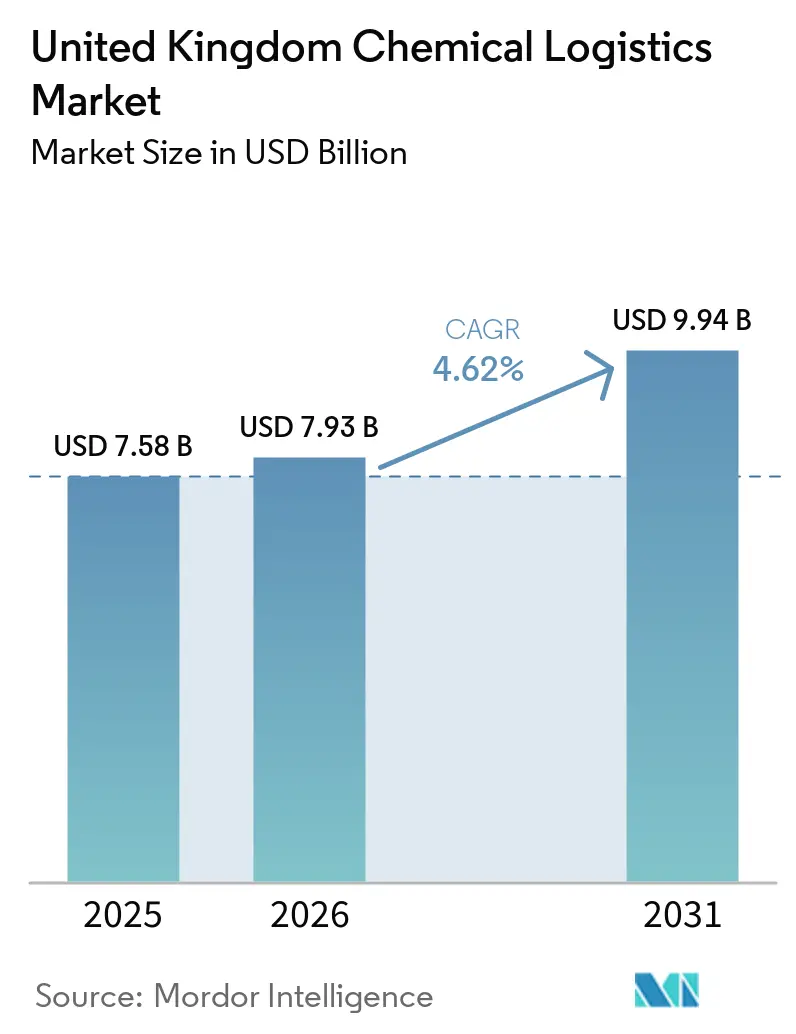
| Base Year Market Size (2025) | USD 7.58 Billion |
| Market Size (2026) | USD 7.93 Billion |
| Market Size (2031) | USD 9.94 Billion |
| Growth Rate (2026 - 2031) | 4.62 % |
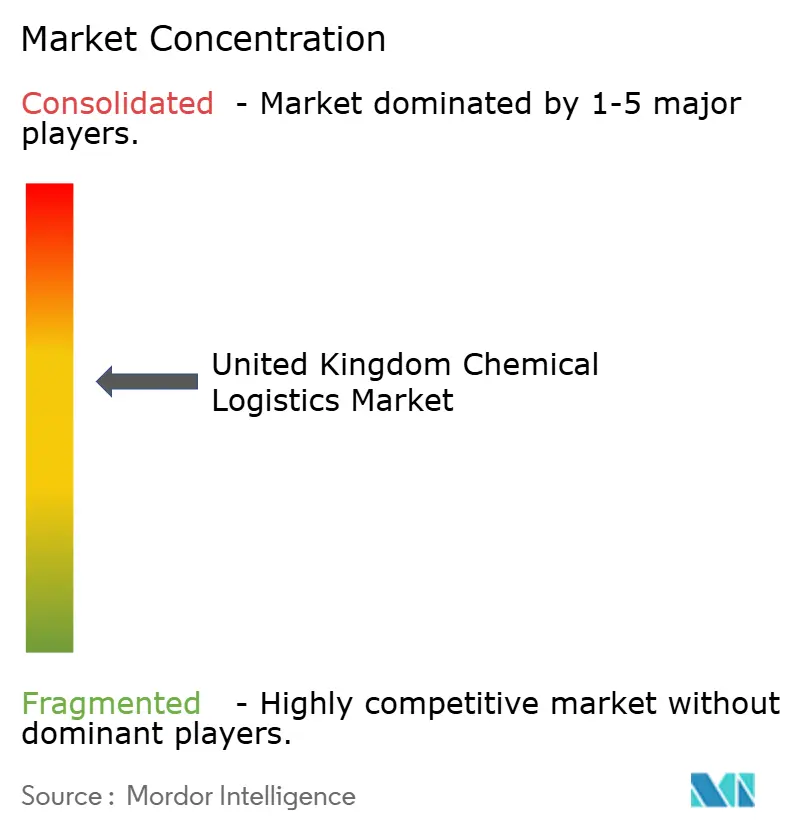
| Market Concentration | High |
Major Players *Disclaimer: Major Players sorted in no particular order Image © Mordor Intelligence. Reuse requires attribution under CC BY 4.0. | |
United Kingdom Chemical Logistics Market Analysis by Mordor Intelligence
The United Kingdom Chemical Logistics Market size is expected to increase from USD 7.58 billion in 2025 to USD 7.93 billion in 2026 and reach USD 9.94 billion by 2031, growing at a CAGR of 4.62% over 2026-2031.
The sector’s sturdy growth reflects a structural shift toward higher-value, specialist services that keep supply chains compliant, decarbonized, and temperature-stable. Rising demand for multimodal corridors serving the Teesside cluster, new hydrogen production projects, and post-Brexit regulatory divergence are all expanding the addressable base of premium logistics contracts. Capacity constraints at key Petrochemical ports, together with a critical shortage of ADR-qualified drivers, are prompting rapid investment in digital scheduling, real-time ADR platforms, and ISO tank fleets. Temperature-controlled transport, particularly for pharmaceutical input, remains the fastest-growing niche, posting an 8.32% growth rate during the forecast period.
Key Report Takeaways
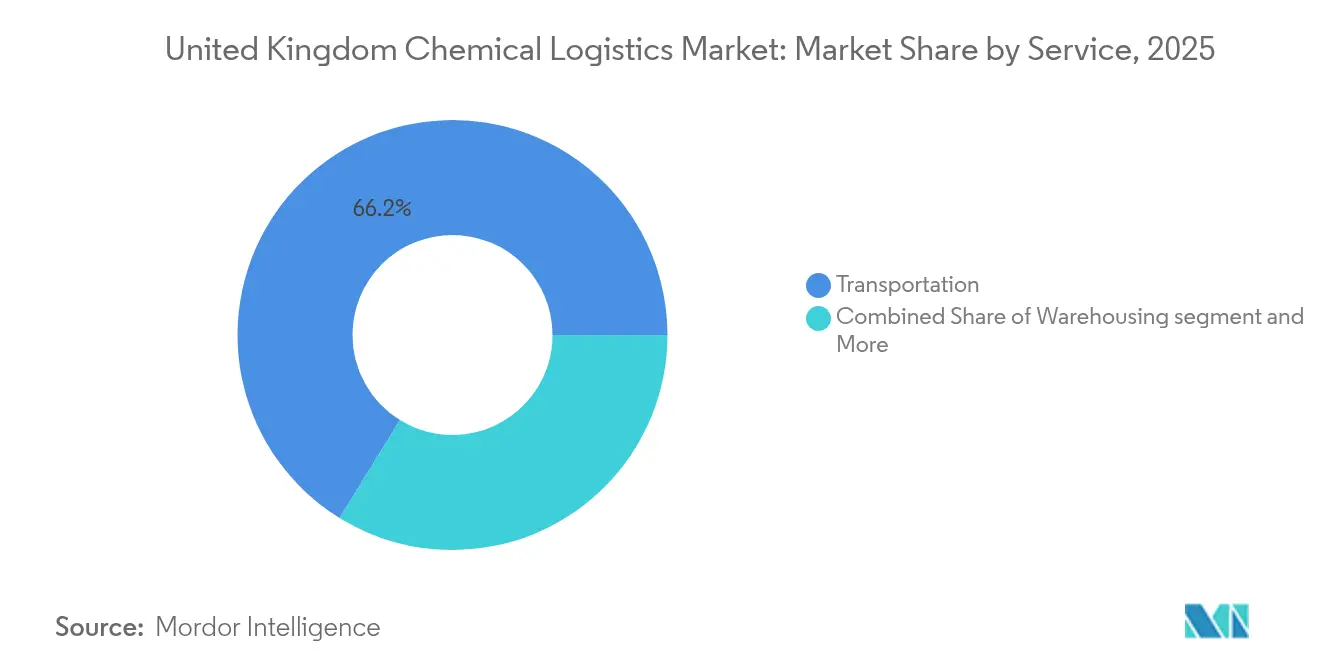
- By service, transportation commanded 66.20% revenue share of the United Kingdom chemical logistics market in 2025, while warehousing and distribution is forecast to grow at a 5.34% CAGR through 2031.
- By end-user industry, oil & gas held 30.40% share in 2025; pharmaceuticals are projected to expand at a 6.68% CAGR through 2031.
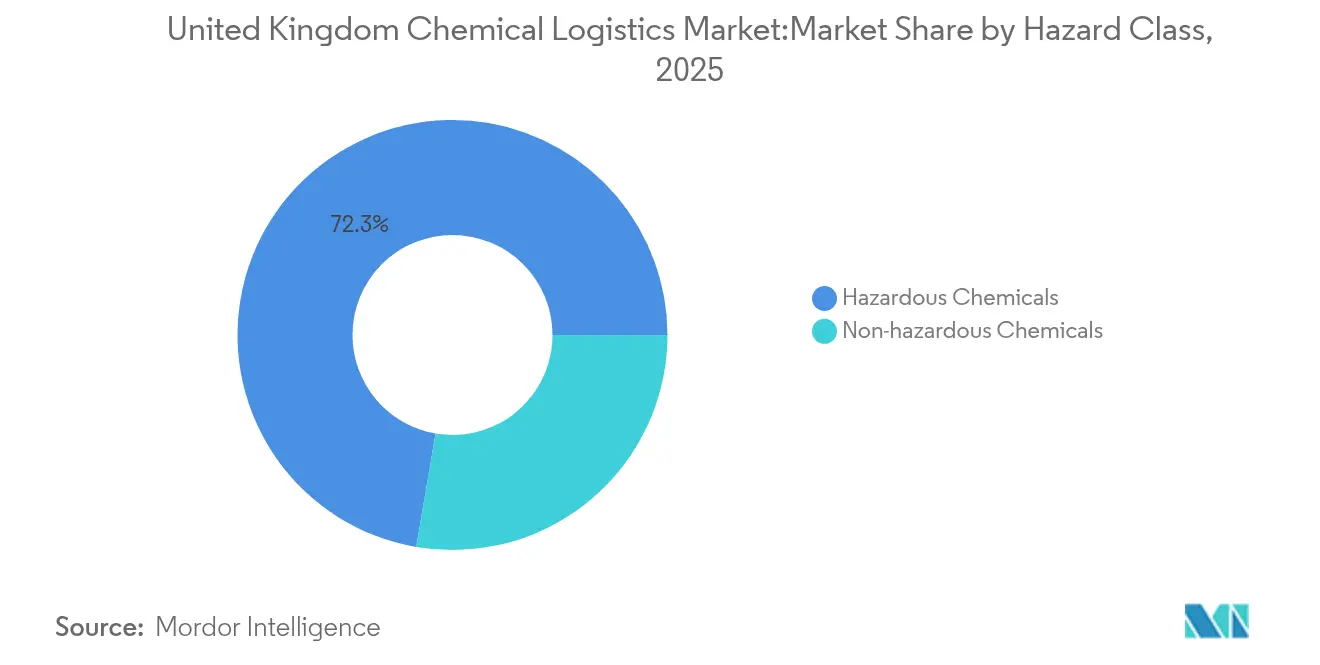
- By hazard class, hazardous chemicals accounted for 72.30% of the United Kingdom chemical logistics market share in 2025; the non-hazardous segment is on track for 7.21% CAGR through 2031.
- By temperature control, non-temperature-controlled logistics made up 60.40% of the United Kingdom chemical logistics market size in 2025, whereas temperature-controlled services are rising at an 8.32% CAGR through 2031.
- By geography, England led with 85.70% of the United Kingdom chemical logistics market in 2025; Scotland is the fastest-growing region, advancing at a 5.82% CAGR to 2031.
Note: Market size and forecast figures in this report are generated using Mordor Intelligence’s proprietary estimation framework, updated with the latest available data and insights as of 2026.
United Kingdom Chemical Logistics Market Trends and Insights
Drivers Impact Analysis*
| Driver | (~) % Impact on CAGR Forecast | Geographic Relevance | Impact Timeline |
|---|---|---|---|
| UK-centric Chemical Cluster Expansion in Teesside | +0.8% | England (Teesside), with spillover to Scotland | Medium term (2-4 years) |
| On-site Storage Capacity Constraints at Petro-Chem Ports | +0.7% | England (Southeast ports), Scotland (Aberdeen) | Short term (≤ 2 years) |
| Digital ADR Compliance Platforms Accelerating Turn-around | +0.6% | National | Medium term (2-4 years) |
| Growing Hydrogen Economy Demand for ISO-Tank Transport | +0.5% | Scotland, England (Teesside) | Long term (≥ 4 years) |
| Sharp Rise in Contract Packaging for Agri-chem Exports | +0.4% | England (East), Scotland | Medium term (2-4 years) |
| Post-Brexit Divergent REACH Rules Creating Logistics Demand | +0.3% | National | Short term (≤ 2 years) |
| Source: Mordor Intelligence | |||
UK-centric Chemical Cluster Expansion in Teesside
Teesside’s Net Zero Teesside and H2Teesside projects are consolidating chemical production and carbon capture infrastructure, creating specialized transport corridors for CO₂ and hydrogen. BP’s commitment to capture up to 4 million tons of CO₂ annually is stimulating new ISO-tank demand for liquefied CO₂ and blue hydrogen feedstocks. Integration with the East Coast Cluster is shifting traditional point-to-point trucking into circular flows that blend pipeline, rail, and road legs. Logistics providers are therefore investing in modular ISO-tank farms capable of switching between liquid CO₂, ammonia, and hydrogen. Coupled with Teesside’s direct deep-sea access, these capabilities position the region as a launchpad for low-carbon chemical exports. The ripple effect extends northwards as Scottish terminals re-gear to back-haul hydrogen and captured CO₂, reinforcing the United Kingdom chemical logistics market’s resilience.
On-site Storage Capacity Constraints at Petro-Chem Ports
Major terminals such as Immingham are running at 85-90% utilization, materially above the 70-75% efficiency benchmark. Dwell-time inflation has reached 15% since 2023, forcing shippers to split loads and accept 12-18% higher unit transport costs. COMAH zoning and planning rules restrict fast expansion, so operators are pivoting to hub-and-spoke designs backed by GBP 78 million (USD 99.29 million) of new intermediate storage in 2024 [1]. IoT-enabled inventory platforms have cut buffer stock needs by up to 12%, easing but not eliminating the bottleneck. Together, these factors keep warehousing services on a robust growth curve within the United Kingdom chemical logistics market.
Digital ADR Compliance Platforms Accelerating Turn-around
From January 2025, the ADR 2025 code will tighten training and classification rules, particularly for Class 8 and Class 6.1 cargo. Web-based compliance engines now autofill documents, push real-time regulatory updates, and link to truck telematics, reducing terminal turnaround by hours per load. Early adopters report 5-8% higher fleet utilization and markedly lower paperwork error rates. Data-rich journey profiles also unlock route optimization and emissions analytics, which help shippers meet Scope 3 reporting duties. These efficiency gains underpin the 0.6% positive contribution to forecast CAGR for the United Kingdom chemical logistics market.
Growing Hydrogen-Economy Demand for ISO-Tank Transport
Government ambitions for 10 GW domestic hydrogen capacity by 2030, and feasibility work on a low-carbon Iceland-Teesside corridor, are triggering orders for cryogenic ISO-tanks and new loading gantries. Hydrogen’s unique diffusion risk profile raises the bar for valve design, purging, and leak detection, so carriers are integrating fiber-optic sensors and predictive maintenance analytics. Logistics firms able to certify that equipment under ADR Chapter 3.3 Special Provision 653 can handle both cold-compressed and liquid hydrogen stand to gain long-term contracts. The build-up complements renewable exports from Scotland, reinforcing geographic diversification inside the United Kingdom chemical logistics market.
Restraints Impact Analysis*
| Restraint | (~) % Impact on CAGR Forecast | Geographic Relevance | Impact Timeline |
|---|---|---|---|
| Limited Rail-tanker Slots at Key Terminals | -0.5% | England (Industrial Corridors), Scotland | Medium term (2-4 years) |
| Driver Shortage for ADR Class 8 & 6.1 | -0.4% | National | Short term (≤ 2 years) |
| Strict CO₂-Based Road Tolls on M25 Corridor | -0.3% | England (Southeast) | Medium term (2-4 years) |
| Community Opposition to Bulk Chemical Warehousing | -0.2% | England (Urban/Suburban Areas) | Long term (≥ 4 years) |
| Source: Mordor Intelligence | |||
Limited Rail-tanker Slots at Key Terminals
Shared lines with passenger traffic and decades-old loading racks mean chemical trains frequently miss optimal departure windows. The resulting backlogs push shippers toward more road legs, elevating costs and carbon footprints. Digital allocation tools that pool slot requests across multiple operators have raised rail utilization modestly, yet a structural gap remains until new sidings are built. Forward-looking providers mix rail for trunk haul with road final mile to trim emissions while keeping schedules credible. Despite mitigation, the constraint clips 0.5 percentage points from the United Kingdom chemical logistics market’s potential CAGR.
Driver Shortage for ADR Class 8 & 6.1
A 24% deficit of qualified drivers lengthens booking lead times by 3.5 days on average. An ageing talent pool puts succession risk front and center, as 42% of license holders are over 50. In-house academies and simulator-based programs have trimmed certification cycles by 30%, but wage premiums of 18% erode carrier margins. Firms reporting the best retention blend pay increments with clear progression into fleet safety or training roles. Even so, the shortage subtracts 0.4 points from baseline growth in the United Kingdom chemical logistics market.
*Our forecasts treat driver/restraint impacts as directional, not additive. The impact forecasts reflect baseline growth, mix effects, and variable interactions.
Segment Analysis
By Service: Multimodal Integration Reshapes Transport Dominance
Transportation accounted for 66.20% of the United Kingdom chemical logistics market in 2025, a position underpinned by road haulage, which moves more than 70% of volumes. Warehousing, distribution and inventory management is the fastest-rising category, expanding at a 5.34% CAGR and steadily lifting its portion of the United Kingdom chemical logistics market size. Digitally orchestrated cross-docking, temperature-segmented bays and COMAH-compliant inert-gas storage convert warehouses into margin-rich service hubs.
Integrated service contracts are therefore blurring the lines between trucking and storage. Operators such as Bertschi run inland depots that splice rail spurs into tank-container yards, pairing line-haul decarbonization with just-in-time inventory. The model cuts handling steps and embeds value-added services like blending. As a result, transport’s share will moderate despite absolute growth, while warehousing and “other services” such as customs and regulatory consulting capture more revenue inside the United Kingdom chemical logistics market.

By End-user Industry: Pharmaceutical Segment Outpaces Traditional Leaders
Oil & gas retained a 30.40% share of the United Kingdom chemical logistics market in 2025, but the segment’s outlook is tempered by energy-transition dynamics and refiners’ efficiency drives. Pharmaceuticals, in contrast, are set to rise at a 6.68% CAGR thanks to persistently high R&D spend and stringent temperature specs for active ingredients. Temperature-validated packaging across ambient, refrigerated, frozen, and Cryo bands is now standard for the pharma supply chain.
Second-tier industries such as cosmetics and specialty chemicals lean heavily on flexible, smaller-lot deliveries aligned to rapid formulation changeovers. Logistics providers differentiate on GMP compliance and batch-traceability rather than pure hazard handling. Together, these shifts nudge the United Kingdom chemical logistics market toward nimbler, quality-assured services. Oil & gas players are responding by repurposing ADR tank farms for alternative fuels and carbon-capture intermediates, sustaining asset utilization while the fossil share of throughput declines.
By Hazard Class: Non-hazardous Growth Outpaces Traditional Segment
Hazardous cargo represented 72.30% of 2025 throughput, mirroring the United Kingdom chemical logistics market’s heritage in petrochemicals and corrosives. Non-hazardous materials, however, are forecast to expand 7.21% annually as specialty pharma, food additives, and cosmetic actives multiply. The United Kingdom chemical logistics market size linked to Class 8 and Class 6.1 shipments will keep growing, yet its proportional weight will ease.
ADR 2025 revises definitions, escalating documentation loads, and training intensity. Providers with digital rulesets embedded in booking portals and cab tablets win share by slashing error risk. In parallel, non-hazardous consignments benefit from route simplification and milder packaging, lifting margins slightly. The danger-goods sub-segment has responded with smarter composite IBCs and predictive-maintenance valve kits aimed at closing cost-gaps and improving safety.
By Temperature Control: Pharmaceutical Demand Drives Refrigerated Growth
Non-temperature-controlled services held a 60.40% share in 2025, but refrigerated and frozen lanes are rising at an 8.32% CAGR, supported by the expanding pharma pipeline . Validated 2-8 °C and controlled-room-temperature packaging now features single-use data loggers and real-time GPS. The United Kingdom chemical logistics market share attached to refrigerated moves is therefore widening, especially around the “golden triangle” connecting the Oxford-Cambridge-London R&D hubs.
Process-plant learnings are filtering into distribution: HRS Heat Exchangers’ active heating/cooling skid that cuts capsule production cooling from hours to under 60 minutes for Mayne Pharma is inspiring mobile tote-cooling units. Green initiatives, including reusable phase-change containers and solar-powered reefer units, align decarbonization goals with compliance. Over time, temperature-controlled service upgrades may compress spoilage risk and enhance brand value across life-science supply chains.
Geography Analysis
England captured 85.70% of the United Kingdom's chemical logistics market in 2025, anchored by mature clusters in the Northeast, Northwest, and Southeast. Teesside’s net-zero projects are intensifying north-south flows of CO₂, ammonia, and blue hydrogen, while London’s Ultra Low Emission Zone expansion compels carriers to adopt low-emission trucks . Eastern ports handle rising Agri-chemical volumes linked to a regional economy expected to reach GBP 220 billion (USD 280.06 million) by 2035. Persistent rail-tanker congestion and community pushback on tank farms, however, require tactical warehousing and resilient multimodal routing.
Scotland is the fastest-growing geography at 5.82% CAGR as offshore energy firms pivot towards hydrogen, CCS, and floating wind. Logistics synergies are compelling: 60-80% of oil-and-gas supply-chain skills transfer directly to low-carbon chemical handling. Court rulings on field licenses underscore growing regulatory oversight, yet public funding and cluster decarbonization initiatives offset policy risk. New ISO-tank yards around Aberdeen and Grangemouth are capturing repeated shuttle moves for hydrogen derivatives.
Wales and Northern Ireland together represent a modest share but hold strategic corridor roles. Northern Ireland’s dual-market status under the Windsor Framework requires agile document handling to reconcile UK and EU REACH filings. Wales benefits from deep-sea access and looser planning rules that expedite storage hub approvals. Both regions receive targeted digital-infrastructure grants aimed at lifting end-to-end shipment visibility, cementing their relevance inside an increasingly connected United Kingdom chemical logistics market.
Regulatory Landscape
The United Kingdom chemical logistics market operates under a layered safety and hazardous-goods regime led by the Health and Safety Executive (HSE) and the Department for Transport (DfT). Core frameworks include GB CLP (aligned to the UN GHS for classification and labelling) and the Carriage of Dangerous Goods and Use of Transportable Pressure Equipment Regulations 2009 (CDG09), which implement ADR for road movements and RID for rail. Operators must appoint a Dangerous Goods Safety Adviser (DGSA) and apply ADR/RID security provisions (Chapter 1.10) for high-consequence dangerous goods.
A compliance change with operational impact is The Chemicals (Health and Safety) (Amendment, Consequential and Transitional Provision) Regulations 2026, effective May 21, 2026, which removed the requirement to notify the HSE of classification and labelling for substances placed on the GB market. On the site and storage side, major-accident and packaged dangerous substance controls (including COMAH expectations and HSE guidance such as HSG71) shape depot design, zoning, and planning outcomes, influencing where tank farms, intermediate storage, and cross-dock facilities can be expanded.
Value Chain Analysis
The United Kingdom chemical logistics value chain starts with chemical producers, refiners, and pharmaceutical and specialty chemical manufacturers, followed by packaging and preparation (including IBCs, drums, and tank-container preparation). The chain then moves into primary transport and terminal handling. Road dominates execution, moving over 70% of chemical volumes, while rail and maritime legs support bulk liquids and export-import flows where tank terminals, loading racks, and port connectivity are in place. Key industrial corridors include Humber and Teesside, where multimodal connectivity concentrates storage and transload activity.
Value capture concentrates in specialist, compliance-heavy operations, with ADR governance and documentation controls (including DGSA oversight), temperature-controlled handling for pharma inputs, and COMAH-aligned warehousing for higher-hazard inventories. Shortages of ADR-qualified HGV drivers and limited rail-tanker access at key terminals elevate the role of scheduling, telematics-enabled compliance, and asset availability (ISO tanks, stainless-steel road tankers, and compliant depot capacity) in determining service reliability and pricing outcomes.
Competitive Landscape
The United Kingdom chemical logistics market shows moderate concentration. Suttons Group, Hoyer Group, and Den Hartogh collectively control a sizeable fleet of stainless-steel road tankers, ISO-tanks, and COMAH-graded depots, enabling end-to-end solutions for hazardous cargo. Suttons’ 2024 purchase of DHL’s UK bulk commodity chemical business expanded its tanker count and deepened its footprint near refineries. Incumbents differentiate via asset breadth, ADR driver pools, and proprietary compliance software that lowers risk for blue-chip shippers.
Meanwhile, temperature-controlled specialists target high-margin pharma flows by offering GDP-certified 2-8 °C services and cryogenic dry-ice replenishment. Digital start-ups leverage cloud booking engines to pool back-hauls, squeezing empty mileage and reducing emission intensity. The global ISO-tank fleet surpassed 882,000 units in January 2025, underscoring equipment scalability that benefits UK import-export circuits.
White-space opportunities include dedicated hydrogen transport and storage, where asset standards are still forming, and integrated customs-plus-storage packages that navigate divergent UK-EU REACH requirements. Competitive intensity is expected to tighten as generalist 3PLs penetrate specialty chemical niches, while established players invest in smart tank telemetry and predictive maintenance to defend margins within the United Kingdom chemical logistics market.
________________________________________
United Kingdom Chemical Logistics Industry Leaders
-
DHL
-
Suttons Group
-
Hoyer Group
-
Den Hartogh Logistics
-
Dachser
- *Disclaimer: Major Players sorted in no particular order
Market Opportunities and Future Outlook
Divergent UK-EU compliance requirements and tighter dangerous-goods governance are pushing shippers toward operators that bundle transport with documentation, classification, and security controls under ADR/RID and CDG09. The May 21, 2026 GB CLP change removing HSE notification for classification and labelling reduces one administrative step, but it increases the premium on internal governance and digital workflows to keep substance data accurate across multiple customers and lanes, particularly for high-consequence dangerous goods that trigger ADR Chapter 1.10 security provisions.
The most visible operational whitespace is where capacity and network constraints intersect with new demand centers. Teesside-linked low-carbon chemical flows and hydrogen-related projects increase the need for ISO-tank availability, compliant intermediate storage, and multimodal orchestration across road, rail, and port interfaces. This direction also fits the UK Future of Freight Plan focus on a National Freight Network to address bottlenecks across modes. Border and cross-channel efficiency is another lever for chemicals and adjacent regulated cargoes, supported by government work toward a mid-2027 sanitary and phytosanitary (SPS) agreement to reduce border-related delays and operating costs, which lifts the value of customs-plus-storage packages and digitally managed pre-clearance processes for time- and temperature-sensitive consignments.
Recent Industry Developments
- July 2026: HOYER Group announced improved sustainability performance, EcoVadis Gold Medal score 83 and SQAS scores 90+ across road, intermodal, and gas logistics operations. The strong ESG credentials strengthen competitive positioning with customers and regulators.
- May 2026: HOYER Group exhibited at CHEMUK 2026 in Birmingham, showcasing liquid logistics solutions for chemical and food industries. The exhibition demonstrates end-to-end capability and market-facing innovation, enhancing brand visibility and demand generation for premium liquid logistics services in the UK.
- January 2026: Suttons Group hosted Stolt-Nielsen leadership at the Widnes depot to integrate operations following the acquisition. Market consolidation enabling greater ISO tank and intermodal capacity. Accelerates integration benefits and capacity expansion post-acquisition, influencing UK chemical logistics dynamics.
Research Methodology Framework and Report Scope
Market Definition and Coverage
This market covers the paid logistics services used to move, store, and handle chemical products across the United Kingdom under relevant safety and handling rules, measured as revenue earned by logistics providers from chemical customers.
Scope exclusions: In-house chemical producer logistics, pure equipment sales, and standalone parcel and courier services not designed for chemical compliance are excluded.
Segmentation Overview
- By Service
- Transportation
- Road
- Rail
- Sea/Ocean
- Air
- Warehousing, Distribution & Inventory Management
- Other Services
- Transportation
- By End-user Industry
- Pharmaceuticals
- Cosmetics & Personal Care
- Oil & Gas
- Specialty Chemicals
- Other End-users
- By Hazard Class
- Hazardous Chemicals
- Non-hazardous Chemicals
- By Temperature Control
- Temperature-Controlled (Refrigerated/Heated)
- Non-Temperature-Controlled
- By Geography
- England
- Scotland
- Wales
- Northern Ireland
Data Sources, Market Sizing, and Validation
Desk Research
Desk research is used to set the market boundaries and run initial checks on demand, supply, and compliance needs. We mainly use UK trade and safety references such as Department for Transport guidance on dangerous goods, Health and Safety Executive publications, and Office for National Statistics industry output indicators. For trade and flow direction signals, we also refer to UK trade statistics, port and maritime releases, and relevant association material such as the Chemical Industries Association.
To convert these signals into a sizing-ready model, we use public company filings, investor presentations, and reputable press for pricing and operating context. We then add targeted checks using paid subscriptions for company financials, shipment-level import and export checks, and patent lookups when new handling solutions change the service mix. The desk research list is illustrative rather than exhaustive, since many additional references are used for data collection, validation, and clarification.
Primary Interviews and Surveys
Primary work is used to pressure-test what desk sources cannot fully show, especially the share of chemical-specific revenue inside broader transport and warehousing contracts. We speak with operators, chemical shippers, site logistics teams, and compliance and safety specialists, and we keep the discussion anchored in lane structure, contract terms, and how ADR handling needs change across Great Britain.
What typically gets clarified in interviews includes service attach rates (value-added handling and compliance), the pricing premium for dangerous goods and temperature-controlled moves, and where capacity limits are truly binding across ports, terminals, and depot networks.
Distribution of primary research fieldwork respondents
| Company type | Respondent position |
|---|---|
| Top tier: 36% | CXOs: 17% |
| Mid tier: 44% | Functional/Unit leaders: 34% |
| Smaller Players: 20% | Managers: 49% |
Market-Sizing & Forecasting
Sizing starts from a top-down reconstruction of the chemical logistics demand pool using UK chemical manufacturing output signals, trade and port flow direction, and the practical share of those flows that require compliant storage and transport (including dangerous goods handling). Once that demand pool is formed, it is translated into value using service mix weights and price markers that reflect road, rail, sea, and warehousing activities used for chemicals.
We then corroborate the totals with selective bottom-up approximations that are realistic to build, such as roll-ups of a sampled set of logistics operators with UK exposure, channel checks on typical per-ton and per-trip price bands for ADR compliant moves, and sanity checks using warehouse capacity utilization in chemical clusters. Where a supplier revenue split is not disclosed, the gap is handled through interview-led allocation keys and cross-checks against known end-use intensity patterns (for example, higher handling requirements for hazardous and temperature-controlled volumes).
Forecasting is run using scenario analysis supported by trend-linked drivers. We keep the variable set small enough to explain and repeat. Common inputs include chemical production momentum, import and export volumes, fuel and labor cost pressure, regulatory compliance intensity (training and certification availability), and the share of higher-value services like temperature control and packaged dangerous goods handling.
Data Validation & Update Cycle
Validation is done through several checks so the final number does not rely on one data stream. We compare model outputs against independent signals such as published trade patterns, port throughput context, and disclosed logistics revenue mixes. We then review differences until the drivers are understandable. When an assumption creates an unusual jump, the team re-checks the input series and re-contacts sources when the variance looks material.
Before sign-off, the model is reviewed in steps, starting with analyst peer review and then a final logic pass that re-tests scope boundaries and unit conversions. Reports are refreshed annually, and interim updates are made when material events affect costs, compliance requirements, or chemical production and trade conditions. Right before delivery, a fresh review is performed so clients receive the latest updated view.
Mordor Intelligence's United Kingdom Chemical Logistics Market Size Versus Other Published Estimates
Published market sizes for UK chemical logistics can look different even when the same label is used, because the service boundary, included chemical flows, and the pricing basis are not always aligned. Some estimates lean more on broad logistics revenues, while others start from chemical demand signals and then add logistics value using service-specific price logic.
UK trade flow direction, chemical manufacturing output indicators, and interview-confirmed contract premiums for ADR compliant moves are the checks that keep Mordor Intelligence's estimate tied to chemical-specific logistics revenue rather than broader hazardous freight or general contract logistics turnover.
Benchmark comparison
| Source | Market Size | Gaps in Research Methodology |
|---|---|---|
| Mordor Intelligence | USD 7.58 B (2025) | |
| Industry Association A | USD 6.40 B (2025) | Often excludes value-added handling and compliance-led warehousing premiums, which can understate chemical-specific spend in regulated storage and specialist transport. |
| Trade Journal B | USD 3.36 B (2023) | Tracks hazardous goods logistics broadly and may be anchored to a narrower definition that does not fully capture non-hazardous chemical flows and chemical-dedicated warehousing revenue. |
The spread is mainly explained by how much chemical-dedicated warehousing, compliance services, and non-hazardous chemical movements are counted, plus the year and pricing basis used for conversion to USD. Our approach stays traceable because each step is linked to observable demand signals and then verified through operator and shipper feedback before forecasting assumptions are locked.
Key Questions Answered in the Report
What is the current value of the United Kingdom chemical logistics market?
It stands at USD 7.93 billion in 2026 and is forecast to reach USD 9.94 billion by 2031.
Which service segment holds the largest share?
Transportation leads with 66.20% of revenue in 2025, supported by extensive road-tanker fleets.
Why is Scotland the fastest-growing region?
Large-scale hydrogen and carbon-capture investments are boosting specialist logistics demand, driving a 5.82% CAGR through 2031.
How are ADR 2025 regulations affecting logistics?
New digital compliance platforms slash paperwork errors and accelerate turnaround, improving fleet utilization by up to 8%.
What is the main challenge facing UK chemical logistics operators?
A 24% shortage of ADR-certified drivers is lengthening booking lead times and pressuring operating costs.
Where are the biggest growth opportunities?
Temperature-controlled pharmaceutical flows and emerging hydrogen transport corridors offer the highest growth and margin potential.