
India Defense Market Analysis by Mordor Intelligence
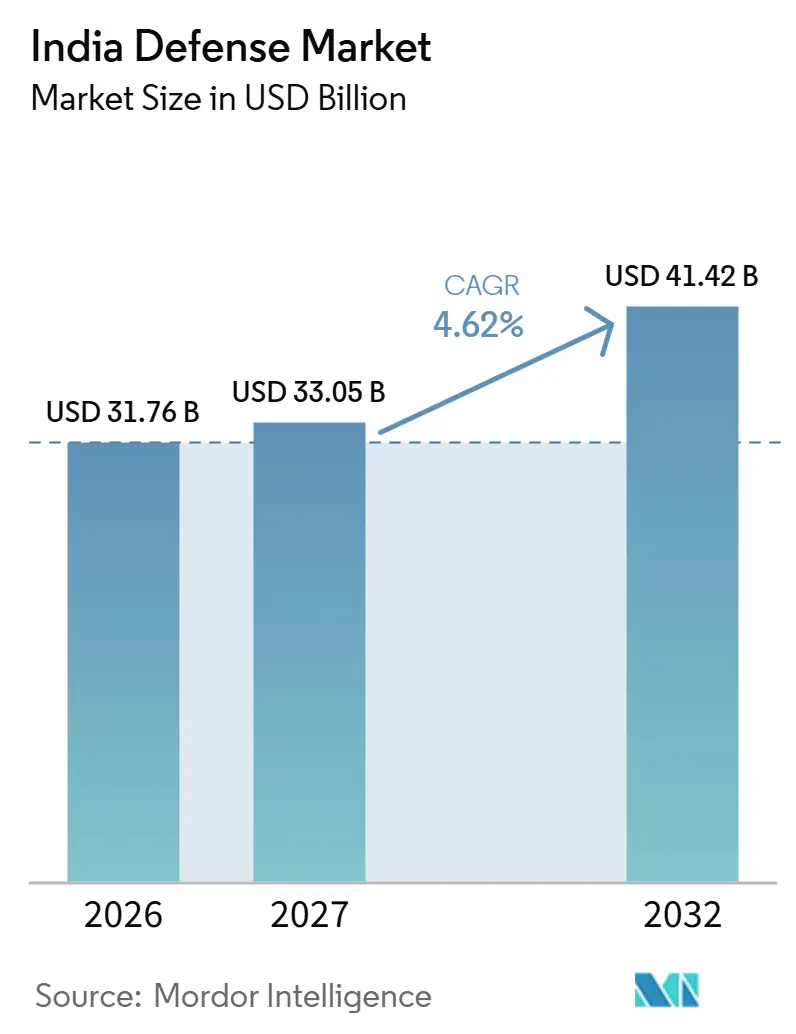
The India defense market size is expected to increase from USD 31.76 billion in 2026 to USD 33.05 billion in 2027 and reach USD 41.42 billion by 2032, growing at a CAGR of 4.62% over 2027-2032.
India's acquisition funding and domestic sourcing priorities expand manufacturers' opportunities, while border-security requirements direct equipment demand toward ammunition and drone-related capabilities. Combat helicopters and installed-platform upgrades create distinct routes for aircraft producers and specialized subsystem suppliers. Technology licensing and industrial partnerships connect research with production, widening participation beyond the original developer. Imported component dependence and acquisition delays can slow the conversion of those opportunities into delivered systems. Domestic procurement opportunities therefore favor suppliers combining licensed designs with dependable electronics sourcing, while emergency ammunition and drone demand puts a premium on rapid delivery.
Key Report Takeaways
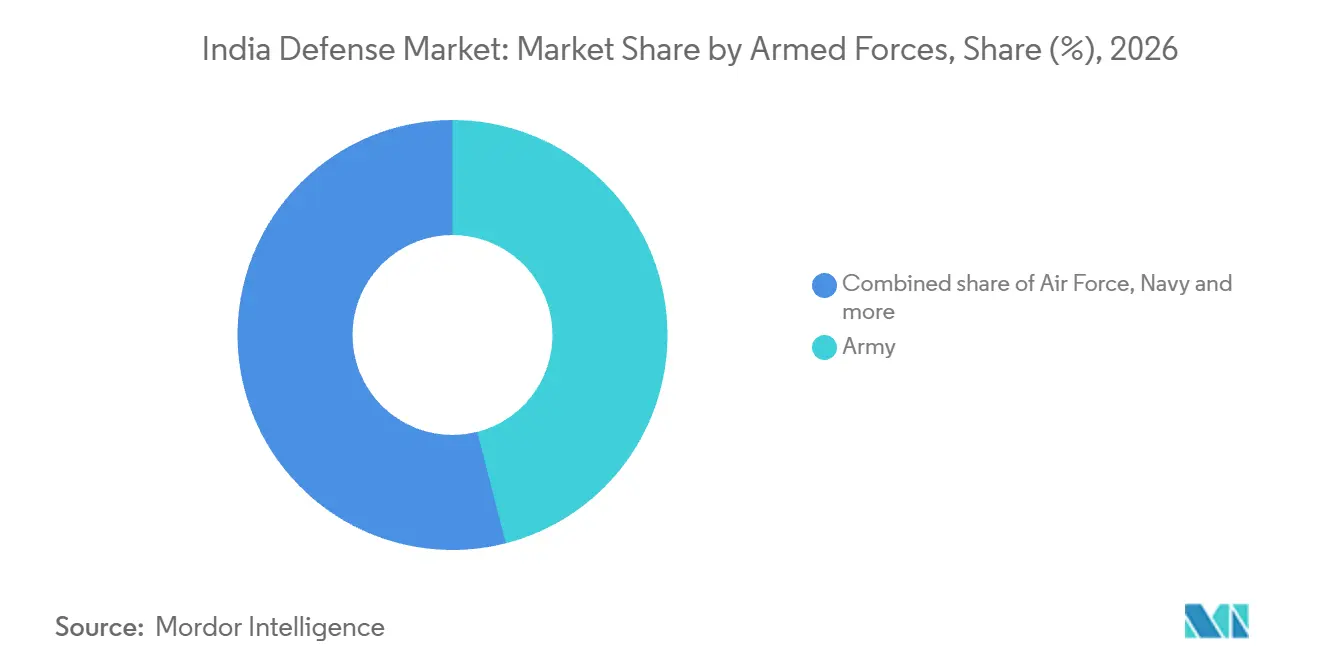
- By armed forces, the Army led with a 46.01% India defense market share in 2026, while the Navy is forecast to grow fastest at a CAGR of 5.5% over 2027-2032.
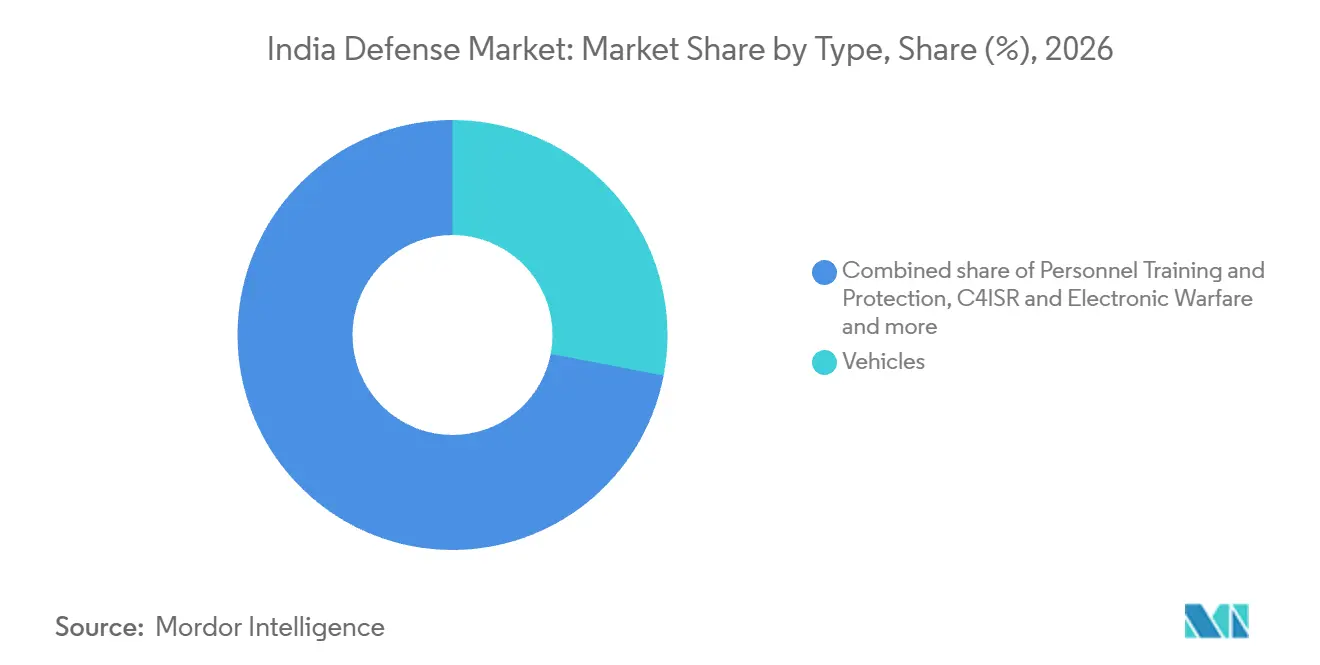
- Across equipment types, vehicles held a 28.02% share of the India defense market size in 2026, and unmanned systems are forecast to grow fastest at a CAGR of 7.45% over 2027-2032.
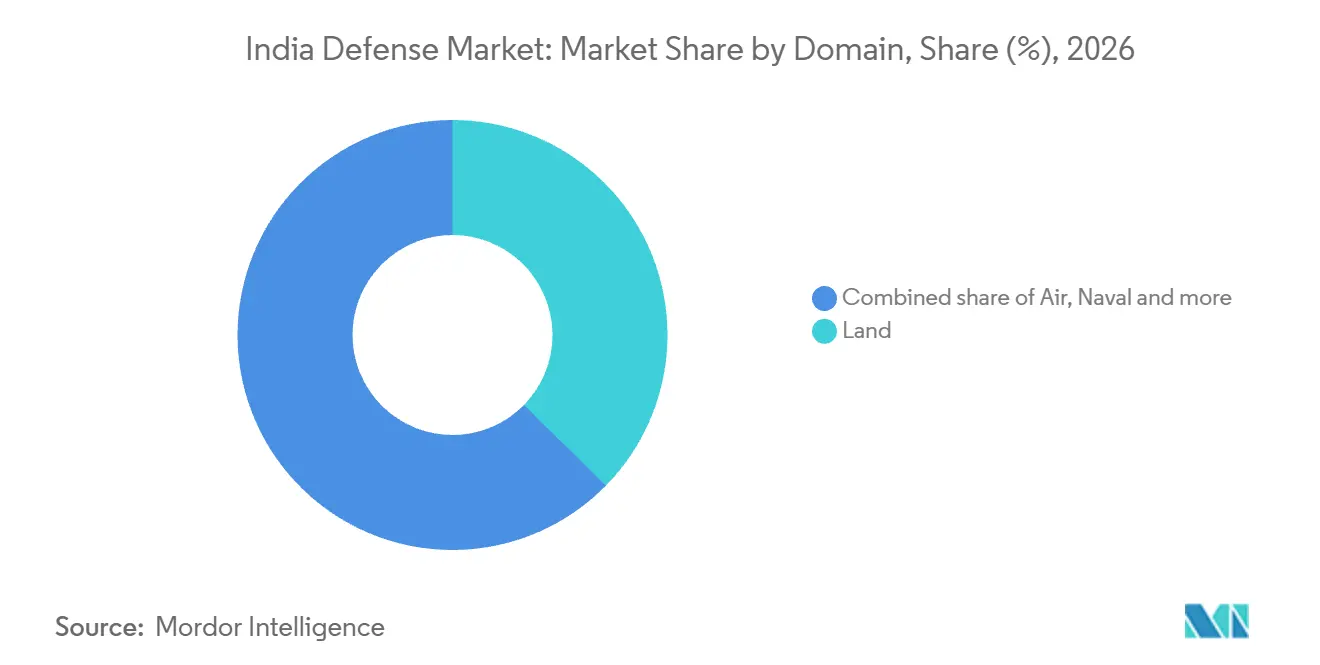
- Among operational domains, land led with a 37.35% share in 2026, while the cyber and electromagnetic spectrum segment is forecast to grow fastest at a CAGR of 6.98% over 2027-2032.
- By procurement nature, indigenous production led with a 61.82% share in 2026 and is forecast to grow fastest at a CAGR of 5.3% over 2027-2032.
Note: Market numbers in this report are based on Mordor Intelligence's proprietary estimation framework, which combines nine months of actuals with Q4 projections for base year 2026.
India Defense Market Trends and Insights
Drivers Impact Analysis*
| Driver | (~) % Impact on CAGR Forecast | Geographic Relevance | Impact Timeline |
|---|---|---|---|
| Expanding defense budget and localization drive | +2.1% | Nationwide | Medium term (2-4 years) |
| Accelerated investment in AI-enabled combat and autonomous swarm technologies | +1.3% | Nationwide | Medium term (2-4 years) |
| Escalating geopolitical tensions along the borders | +1.5% | Punjab and Rajasthan | Short term (≤ 2 years) |
| Emergence of dual-use space assets driving C4ISR capability demand | +1% | Nationwide | Long term (≥ 4 years) |
| Increased private sector participation enabled by liberalized FDI policies | +0.7% | Nationwide | Medium term (2-4 years) |
| Structural modernization of the Army, Navy, and Air Force | +0.6% | Nationwide | Long term (≥ 4 years) |
| Source: Mordor Intelligence | |||
Expanding defense budget and localization drive
Budget expansion strengthens equipment demand most directly when acquisition funding and domestic sourcing commitments move together. The Ministry of Defence's FY 2026-27 allocation was 15.19% higher than its FY 2025-26 Budget Estimates. Within that framework, the FY 2026-27 Capital Acquisition budget was approximately 24% higher than the corresponding FY 2025-26 budget. The Ministry of Defence earmarked 75% of the FY 2026-27 Capital Acquisition budget for procurement through domestic industries.[1] The earmark turns localization into a defined route to acquisition funding, giving domestic equipment producers a more specific opportunity than the headline defense allocation alone.
Accelerated investment in AI-enabled combat and autonomous swarm technologies
Defense development programs are creating specific opportunities for AI recognition and coordinated drone flight. At Aero India 2025, the Indian Air Force awarded development funds to each Mehar Baba Competition-II winning team for swarm-drone detection of foreign objects on aircraft operating surfaces, following the competition's July 29, 2024 conclusion. The Army's DISC 14 challenge launched on March 19, 2026, sought an AI module for unmanned aircraft systems' autonomous recognition, identification and targeting. Applications closed May 4, 2026, with results awaited. DRDO published a Technology Development Fund request for proposals on July 30, 2026, for close formation flying of multiple drones. These requirements give autonomy developers distinct opportunities in recognition and coordinated flight, extending development demand beyond the funded airfield-inspection application.
Escalating geopolitical tensions along the borders
Drone incursions give border-security spending a specific equipment focus. The Ministry of Defence's 2025-26 annual report recorded 863 drone intrusions along the India-Pakistan border, including 854 in Punjab and Rajasthan. By November 10, 2025, the Army had used its full Emergency Powers Revenue 2025 budget. Ammunition accounted for 78% of central procurement funds used, while 80% of Field Formations funds supported drone, counter-drone and strike capability. These spending patterns connect the security requirement with both centrally procured ammunition and capabilities acquired closer to operational formations. For suppliers, ammunition and drone-related equipment reach the Army through different spending channels, so the route to an order depends on the requirement's procurement level.
Emergence of dual-use space assets driving C4ISR capability demand
Dual-use space infrastructure creates a defense-relevant opportunity through communications capability as well as the spacecraft themselves. In April 2025, the Department of Space reported that India's operational communications-satellite fleet supported societal and strategic communications alongside telecommunications, broadband and broadcasting. The Ministry of Defence flagged off SANJAY, jointly developed by the Army and Bharat Electronics, on January 24, 2025. The battlefield surveillance system fuses ground and aerial sensor inputs over secure Army data and satellite communication networks. The announcement scheduled phased Army induction for March to October 2025. SANJAY's design routes the Army's fused battlefield sensor picture over satellite communication networks, tying C4ISR equipment requirements to space-based communications links.
Restraints Impact Analysis*
| Restraint | (~) % Impact on CAGR Forecast | Geographic Relevance | Impact Timeline |
|---|---|---|---|
| Vulnerabilities in critical alloy and semiconductor supply chains | -1.1% | Nationwide | Short term (≤ 2 years) |
| Inefficient and bureaucratic defense procurement framework | -0.8% | Nationwide | Medium term (2-4 years) |
| Cybersecurity breaches and IP theft are hindering indigenous R&D progress | -0.4% | Nationwide | Long term (≥ 4 years) |
| High pension and salary expenditures limiting capital investment | -0.3% | Nationwide | Long term (≥ 4 years) |
| Source: Mordor Intelligence | |||
Vulnerabilities in critical alloy and semiconductor supply chains
Local platform assembly cannot by itself remove exposure to interruptions in imported semiconductor supplies. In May 2026, NITI Aayog reported that many semiconductor parts used in Indian defense systems were produced abroad.[2] Its assessment identified dependence on semiconductor imports across electronic systems, unmanned aerial vehicles, and naval and airborne platforms. Disruption at major chip producers or natural disasters in supply centers such as Taiwan and China could therefore trigger shortages affecting these defense applications. Shared exposure can constrain several platform programs together, making reliable chip supply a condition for converting assembly capacity into completed defense equipment.
Inefficient and bureaucratic defense procurement framework
Acquisition delays can reduce the operational value of equipment even when the underlying military requirement has been recognized. In March 2026, the Standing Committee on Defence recommended delivery timelines, warning that excessive procurement delays could make technology and equipment obsolete. This risk makes the time between specifying a capability and receiving it commercially significant for suppliers of rapidly evolving systems. The Defence Procurement Manual 2025, effective from November 1, 2025, delegates revenue-procurement decisions to field-level financial authorities to speed approvals. Because capital acquisition follows the Defence Acquisition Procedure rather than that manual, suppliers of rapidly evolving capital equipment remain exposed to the potential loss of product relevance described by the committee.
*Our forecasts treat driver/restraint impacts as directional, not additive. The impact forecasts reflect baseline growth, mix effects, and variable interactions.
Segment Analysis
By Armed Forces: Platform Upgrades Sustain Army Demand
The Army accounted for a 46.01% share of the India defense market size in 2026, making it the largest segment. On September 21, 2026, the Ministry of Defence contracted Accurate Industrial Controls Private Limited to supply auxiliary power units for T-72 and T-90 tanks used by Army mechanized formations. These units provide an alternative electrical source for tank fire-control, firing, stabilization and ancillary systems. The requirement illustrates how an established platform can generate demand for specialized equipment without a purchase of replacement tanks, extending the commercial opportunity to subsystem manufacturers.
The Navy is the fastest-growing segment, with a forecast CAGR of 5.5% over 2027-2032. On October 15, 2026, the Ministry of Defence signed a contract with Bharat Dynamics Limited for Varunastra heavy-weight torpedoes for the Navy. The indigenous ship-launched anti-submarine weapon was developed by the Naval Science and Technological Laboratory, distinguishing the technology developer from the contracted production supplier. This separation creates a manufacturing opportunity around a defined naval mission, showing how growth can reach specialized weapons producers alongside the companies responsible for building the ships that carry such equipment.

By Type: Fleet Scale and Unmanned Procurement Create Different Opportunities
Vehicles represented a 28.02% India defense market share in 2026, making them the largest segment. On March 27, 2025, the Ministry of Defence signed a contract with Force Motors Ltd and Mahindra & Mahindra Ltd for around 5,000 light vehicles for the Armed Forces. The contracts used the Buy (Indian-Indigenously Designed Developed and Manufactured) category, connecting vehicle procurement with domestic design and production. The order connects indigenous-design eligibility with a substantial light-vehicle sales requirement, extending domestic procurement into fleet mobility.
Unmanned systems are the fastest-growing segment, with a forecast CAGR of 7.45% over 2027-2032. A 13-contract Army emergency-procurement package concluded on June 24, 2025, included remotely piloted aircraft, loitering munitions and several drone categories. Its breadth creates opportunities across different unmanned applications rather than one aircraft configuration. C4ISR and electronic warfare also create retrofit demand, illustrated by the April 7, 2025, contract with Bharat Electronics Ltd. for Mi-17 V5 helicopter electronic warfare suites, modification kits, installation and associated equipment. Retrofitting an installed aircraft creates business in modification and installation alongside equipment supply, giving electronics manufacturers an additional route to defense spending.
By Domain: Artillery Procurement and Spectrum Control Broaden Demand
Land was the largest domain segment, accounting for 37.35% of the market in 2026. On August 14, 2026, the Ministry of Defence signed contracts with Tata Advanced Systems Limited and NIBE Private Limited for loiter munition systems, munitions and accessories for Army artillery regiments. The acquisition used the Buy (Indian) category through the Fast Track Procedure. This combination of a specified artillery requirement and a domestic procurement route directs opportunity toward suppliers able to deliver a complete munition-system package, illustrating how land demand includes capabilities beyond conventional armored platforms.
The cyber and electromagnetic spectrum segment is the fastest-growing segment, with a forecast CAGR of 6.98% over 2027-2032. On June 10, 2026, the Ministry of Defence contracted Accord Software and Systems Private Limited for 20 enhanced-capability Global Navigation Satellite System jammers for the Navy, requiring at least 75% indigenous content. The equipment is designed to degrade adversary satellite-signal acquisition and tracking through spoofing or deceptive jamming. Signal-control suppliers face a domestic-content floor alongside the Navy's technical spectrum-denial requirement.
By Procurement Nature: Domestic Output Expands Within a Mixed Sourcing System
Indigenous production was the largest segment with a 61.82% share in 2026 and is forecast to be the fastest-growing segment at a CAGR of 5.3% over 2027-2032. Separately, India's annual defense production increased 15.6% from FY 2024-25 to a record high in FY 2025-26. Private producers contributed 24% of India's defense production in FY 2025-26, up from 22% in FY 2024-25. An indigenous-sourcing strategy can draw on public and private producers, with the latter gaining weight as national output expands.
Foreign procurement can connect imported military platforms with domestic integration and support work. India and France signed an agreement on April 28, 2025, for 26 Dassault Aviation Rafale-Marine aircraft for the Navy, comprising 22 single-seaters and 4 twin-seaters. The agreement included technology transfer for integrating indigenous weapons and separately covered additional equipment for the Air Force's existing Rafale fleet. It also provided for establishing Indian fuselage-production and maintenance, repair and overhaul facilities for engines, sensors and weapons. These provisions give domestic suppliers opportunities around an overseas platform's adaptation and support, making foreign acquisition compatible with local industrial participation.
Geography Analysis
Northern and eastern frontier states and Ladakh bring military access and forward support into the geography of equipment demand. On December 7, 2025, the Ministry of Defence dedicated 125 completed Border Roads Organisation projects across Ladakh, Jammu and Kashmir, and 7 states, including Arunachal Pradesh and Sikkim. The works included roads and bridges intended to improve connections to remote villages and forward military locations. Improved road and bridge access can make equipment delivery more feasible across dispersed frontier posts, connecting suppliers with forward military users.
The Arabian Sea and Bay of Bengal form connected operating areas within a broader Indian Ocean theater. The Navy's TROPEX-25 exercise ran from January to March 2025 across that theater, bringing ships, submarines and aircraft into a coordinated operational setting. Off the western seaboard, the Indian Navy and Royal Navy began KONKAN-25 on October 5, 2025, with anti-air, anti-surface and anti-submarine drills planned for its sea phase. These exercises connect equipment needs to anti-air, anti-surface and anti-submarine capability, giving specialist systems a role alongside coordination across ships, submarines and aircraft.
Manufacturing around Lucknow in Uttar Pradesh's Lucknow-Kanpur belt and at Kattupalli in Tamil Nadu illustrates different production models. On October 18, 2025, the defense minister and Uttar Pradesh's chief minister flagged off the first batch of BrahMos missiles manufactured at the Lucknow integration and testing facility. That facility performed assembly, integration and testing, connecting several missile-production activities at one location. Under the Navy's 5-ship contract with Hindustan Shipyard Limited, Larsen & Toubro Ltd. was subcontracted to part-build 2 ships at Kattupalli and held steel cutting for the third ship on February 20, 2025. At Kattupalli, subcontracting opens a production role beneath the Navy's prime contractor, while Lucknow groups the missile's assembly-to-testing sequence within one facility.
Regulatory Framework and Outlook
This comparison of selected jurisdictions assesses India and Uttar Pradesh from the perspective of a licensed defense manufacturer considering a qualifying Anchor or Mega Anchor project. National safeguards apply when licensed defense items are manufactured, while Uttar Pradesh offers corridor-specific land support for defined aerospace and defense units. Investment attractiveness therefore combines the obligations attached to licensed production with the conditions governing a particular industrial location.
Regulatory Table
| Decision factor | India | Uttar Pradesh |
|---|---|---|
| Primary authority | Department of Defence Production | UPEIDA, the nodal implementing agency |
| Key instruments or direction | Security Manual 2025 for licensed defense industries | 2024 aerospace and defense policy, first amendment |
| Commercial effect | Security safeguards for manufacturing license-covered defense items | Mega Anchor and Anchor aerospace and defense units receive a 25% rebate on gross land sale price in the Defence Corridor |
| Current policy attractiveness | Medium | High |
| Future direction of policy attractiveness | No change | No change |
| Source: Mordor Intelligence | ||
National attractiveness is Medium because licensed producers must sustain baseline safeguards when manufacturing the defense items covered by their licenses. That baseline supports a continuity outlook, while contracting agencies may specify higher cybersecurity requirements for particular projects based on their risk assessments. Uttar Pradesh merits High attractiveness for the specified investor because the eligible corridor-land rebate improves site economics alongside the national production obligations. The state policy's 5-year term from notification, ending earlier if a replacement policy is notified, supports continuity within that incentive framework.
Value Chain Stages
The comparison follows equipment manufacture, platform integration and life-cycle support to show where suppliers capture value. On March 26, 2025, the Ministry of Defence contracted Bharat Forge Limited for Advanced Towed Artillery Gun Systems and Tata Advanced Systems Limited for 6x6 gun-towing vehicles for the Army. Separate gun and towing-vehicle contracts make delivery coordination part of providing a usable artillery capability, because the Army needs both pieces of equipment.
Value Chain Analysis Table
| Primary activity | Key participants | Value capture | Bottleneck | Resilience response |
|---|---|---|---|---|
| Equipment manufacture | Artillery producers such as Bharat Forge Limited; military-vehicle producers such as Tata Advanced Systems Limited | Gun and vehicle sales | Aligning deliveries from separate equipment producers | Coordinate gun and vehicle delivery schedules |
| Platform integration | Sensor and weapon integrators such as Tata Advanced Systems Limited | Integrated platform sales | Sensor and weapon interface mismatches | Resolve interfaces before platform acceptance |
| Maintenance and sustainment | Contracted life-cycle support providers such as Larsen & Toubro Ltd. | Bundled deployment, maintenance and sustainment consideration | Dependence on original platform design knowledge | Secure design assistance alongside local support |
| Source: Mordor Intelligence | ||||
On November 19, 2025, Larsen & Toubro Ltd. announced an Army contract to produce BvS10 Sindhu vehicles in Hazira.[3] The contract included integrated logistics support for initial deployment, maintenance and life-cycle sustainment. BAE Systems Hägglunds, the original platform manufacturer, was to provide technical and design support. This arrangement links local manufacturing with design access and continuing support, extending supplier value beyond the vehicle sale while making those supporting capabilities part of the delivery proposition.
Competitive Landscape
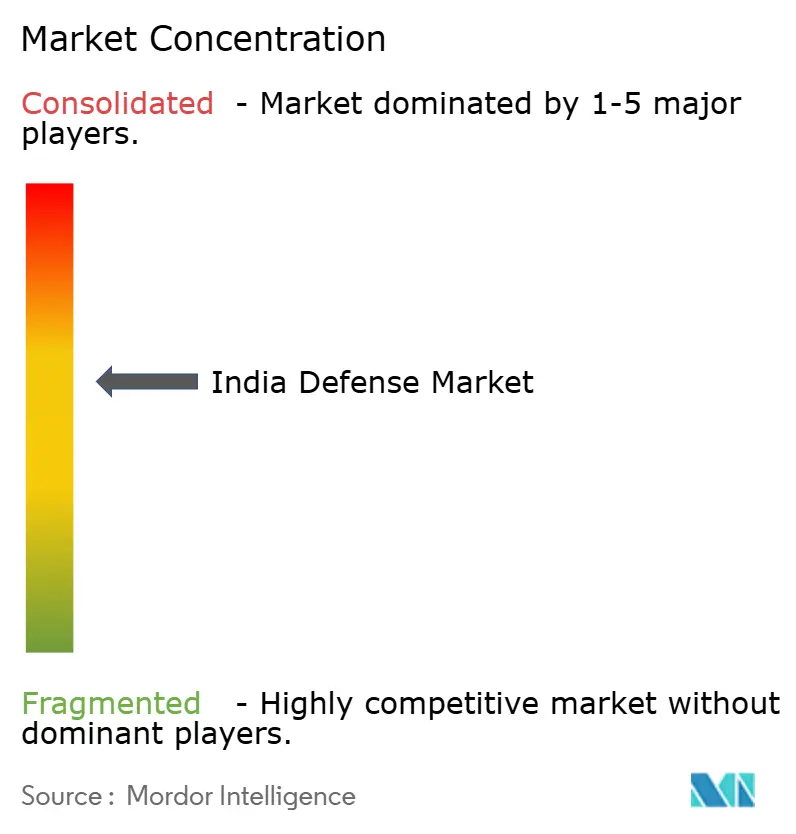
The leading suppliers form a specialized core spanning aircraft platforms and defense electronics. Hindustan Aeronautics Limited (HAL) secured 2 Ministry of Defence contracts on March 28, 2025, to supply 156 Prachand Light Combat Helicopters, comprising 66 for the Air Force and 90 for the Army. Deliveries were scheduled to begin in the third year and continue over 5 years. Bharat Electronics Ltd. was contracted to supply Army air-defense fire-control radars under the Buy (Indian-Indigenously Designed Developed and Manufactured) category.
The Defence Research & Development Organisation (DRDO) handed over 12 technology-transfer licensing agreements covering 8 products to industry partners on October 29, 2025. Bharat Electronics Ltd. received the D-29 electronic warfare suite in Bengaluru and the NATSAT handheld and mini satellite-terminal technologies in Panchkula, linking different specialist operations to the transfer. Licensing can expand an industrial partner's technical scope without requiring that partner to originate every technology itself. With Bharat Dynamics Limited also receiving the laser-guidance technology licensed to Bharat Electronics, production and integration capability can distinguish suppliers drawing on the same DRDO design.
Tata Advanced Systems Limited (Tata Group) co-designed WhAP with DRDO, while Larsen & Toubro Ltd. is a contracted vehicle producer supported by BAE Systems Hägglunds. On November 24, 2025, Bharat Electronics and Safran Electronics and Defence agreed to a proposed 50:50 Indian venture to manufacture, supply and maintain HAMMER precision-guided air-to-ground weapons for the Air Force and Navy. Phased production transfer envisaged BEL leading final assembly, testing and quality assurance, with localization rising progressively up to 60%. February 2026 Ministry notices confirmed Defence Acquisition Procedure 2020 remained in force pending approval of draft DAP 2026, with Buy (Indian-IDDM) ranked above Buy (Indian). Buy (Indian-IDDM) requires indigenous design and development, so the proposed HAMMER venture's local assembly would not by itself establish eligibility for that highest-priority procurement category.
India Defense Industry Leaders
-
Hindustan Aeronautics Limited (HAL)
-
Bharat Electronics Ltd.
-
Defence Research & Development Organisation (DRDO)
-
Tata Advanced Systems Limited (Tata Group)
-
Larsen & Toubro Ltd.
- *Disclaimer: Major Players sorted in no particular order
Key Opportunities for Market Participants
The comparison identifies opportunities in naval radar replacement, warship propulsion and Army mobility. On September 7, 2026, the Defence Acquisition Council granted in-principle approval for Arudhra radars, marine gas-turbine development and subsequent procurement for the Navy, and High Mobility Vehicles for the Army. These in-principle approvals identify service requirements around which suppliers can prepare development or equipment proposals.
Market Opportunities Table
| Opportunity | Why now | Buyer / lead segment | Recommended play | Main barrier | Likely beneficiaries |
|---|---|---|---|---|---|
| Naval air-station radar replacement | Arudhra is intended to replace existing air-route surveillance radars | Indian Navy | Prepare radar replacement and integration packages | Maintaining the surveillance function during equipment transition | Radar manufacturers and systems integrators |
| Indigenous warship propulsion | Approved pathway includes turbine design, development and subsequent procurement | Indian Navy | Develop propulsion capability around the stated naval requirement | Completing development before production procurement | Marine propulsion developers and manufacturers |
| Army high-mobility equipment | Approved vehicle requirement creates a procurement pipeline | Indian Army | Match an established mobility platform to the future acquisition requirement | Aligning vehicle capability with Army mobility requirements | Military-vehicle suppliers, potentially Tata Advanced Systems Limited |
| Source: Mordor Intelligence | |||||
Indigenous propulsion is the central strategic opening because the Ministry of Defence release on the approval states that marine gas turbines are expected to reduce dependence on foreign vendors. Tata Advanced Systems' High Mobility Vehicle portfolio provides a relevant capability base for the Army opportunity. Radar replacement offers the more direct prospect for earlier equipment revenue because the turbine pathway first requires design and development under the in-principle approval.
Recent Industry Developments
- Oct 2026: The Ministry of Defence signed a contract with Bharat Dynamics Limited for Varunastra ship-launched anti-submarine torpedoes for the Indian Navy on October 15.
- Sep 2026: The Ministry of Defence signed a contract with Accurate Industrial Controls Private Limited for auxiliary power units for T-72 and T-90 tanks on September 21.
- Jul 2026: Adani Defence & Aerospace broke ground on an integrated missile manufacturing project in Shivpuri, Madhya Pradesh, on July 5.
Research Methodology Framework and Report Scope
Market Definition and Coverage
The India defense market covers military equipment and systems procured for India's defense needs, including upgrades and modernization. Its value is the annual defense spending on these procurements in India, measured in USD.
Scope exclusions: Defense personnel salaries and pensions, routine operation, maintenance, and overhaul services sold separately, training services sold without training equipment, and civilian or commercial equipment and systems not procured for India's defense needs are excluded.
Segmentation Overview
- By Armed Forces
- Air Force
- Army
- Navy
- By Type
- Personnel Training and Protection
- C4ISR and Electronic Warfare
- Vehicles
- Weapons and Ammunition
- Unmanned Systems
- Space and Cyber Systems
- By Domain
- Land
- Air
- Naval
- Space
- Cyber and Electromagnetic Spectrum
- By Procurement Nature
- Indigenous Production
- Foreign Procurement
Data Sources, Market Sizing, and Validation
Desk Research
The Ministry of Defence's Union Budget 2026-27 release and the Union Budget demand schedules provide allocation and capital-acquisition context, while Ministry of Defence Annual Report 2024-25 material and Press Information Bureau procurement releases such as the 2025 Army emergency-procurement notice help track equipment categories, contracts, and procurement timing.
Company filings and investor materials can supplement supplier-level context, while reputable business press can help cross-check announced orders and delivery developments. These sources are not exhaustive, and further sources inform collection, validation and clarification.
Primary Interviews and Surveys
The research design would seek interviews or structured surveys with India-focused procurement, program, finance, and product leaders at defense suppliers, integrators, and relevant industry bodies. Their informed estimates can test the interpretation of public budget, acquisition, delivery, and supplier evidence, including which activities belong within equipment procurement and upgrade spending. Where evidence is incomplete or inconsistent, analysts can document the open item, seek clarification from another qualified respondent or source, and triangulate it against independent procurement and company indicators.
Distribution of primary research fieldwork respondents
| Company type | Respondent position | Region |
|---|---|---|
| Top tier: 30% | CXOs: 20% | |
| Mid tier: 50% | Functional/Unit leaders: 35% | |
| Smaller Players: 20% | Managers: 45% |
Market-Sizing & Forecasting
The estimate starts from India's annual defense equipment procurement expenditure, including foreign purchases and recognized upgrades, and uses a top-down allocation of that spend across armed forces, equipment types, operating domains, and indigenous or foreign procurement. Budget allocations and revised estimates indicate the funding envelope, acquisition approvals and signed contracts show the timing and category of demand, the domestic sourcing share distinguishes procurement channels, and supplier disclosures and announced deliveries help test the pace at which spending becomes equipment supply, while contract prices and platform mix help explain value changes. Analysts can use scenario analysis to forecast the procurement envelope and segment shares, varying acquisition funding, localization, delivery timing, and the mix of platforms and systems, with expert input used to challenge the direction and timing of those variable-level assumptions. Selective bottom-up checks can compare sampled contract values and supplier roll-ups with the top-down totals. Where disclosed values or delivery timing are incomplete, the analyst can retain a documented range, test it against comparable contracts and budget schedules, and avoid treating an unsupported residual as measured spending.
Data Validation & Update Cycle
Analysts triangulate budget schedules, acquisition approvals, signed contracts, supplier disclosures, and independent delivery or production signals, then investigate unusual changes in totals, segment shares, prices, or timing against the underlying records. A second review checks scope consistency, arithmetic, units, years, and whether each observation is procurement expenditure rather than a personnel or separately sold service cost. Analysts re-contact a qualified respondent or source owner when a material gap, conflict, or unexplained variance remains. The series is refreshed annually, reviewed between cycles when a material budget, policy, or procurement event changes the outlook, and given a fresh pre-delivery review, with unresolved anomalies held for review before sign-off.
Mordor Intelligence's India Defense Market Size Compared Against Other Published Estimates
Defense estimates can differ when equipment procurement is combined with personnel expenditure or separately sold support services. The study measures equipment and systems procured for India's defense needs, including recognized upgrades and modernization, while keeping salaries, pensions and the stated standalone service exclusions outside the total.
Key Gap Drivers include the procurement boundary and when approved funding becomes equipment supply. Budget allocations establish the funding envelope, acquisition approvals and contracts indicate demand, and supplier disclosures and deliveries help check the timing and mix of spending.
Benchmark comparison
| Source | Market Size | Gaps in Research Methodology |
|---|---|---|
| Mordor Intelligence | USD 33.05 B (2027) | |
| Regional Consultancy A | USD 35.84 B (2027) | At its 2027 base, this estimate is 8.4% above this report's 2027 value of USD 33.05 B. Its supplier-accessible base includes maintenance, defense R&D, and border or coastal security procurement beyond equipment acquisitions and upgrades. |
| Regional Consultancy B | USD 23.13 B (2023) | At its 2023 base, this estimate is 30.0% below this report's 2027 value of USD 33.05 B, 4 years later. Its estimate is a 2023 base preceding four years of the stated 2024-2030 growth outlook. |
Mordor Intelligence ties the baseline to procurement rather than treating the entire defense budget as equipment demand. The funding, contract and delivery checks help buyers assess the equipment opportunity on a consistent basis.
Key Questions Answered in the Report
What is the India defense market size and growth outlook?
Size is projected at USD 33.05 billion in 2027 and USD 41.42 billion by 2032, with a CAGR of 4.62% over 2027-2032.
What is driving defense equipment demand in India?
The FY 2026-27 Capital Acquisition budget earmarked 75% for procurement through domestic industries, reinforcing local manufacturing opportunities.
Which armed force is the largest buyer segment?
The Army held the largest share at 46.01% in 2026.
Which organizations shape the defense supplier landscape?
Hindustan Aeronautics Limited, Bharat Electronics Ltd., the Defence Research & Development Organisation, Tata Advanced Systems Limited and Larsen & Toubro Ltd. are key participants.
What is a major execution risk for defense manufacturers?
Dependence on imported semiconductor parts exposes Indian defense systems to global supply disruptions, as NITI Aayog reported in May 2026.
How do defense industrial roles differ across India?
Lucknow's first BrahMos batch in October 2025 and naval ship steel cutting at Kattupalli, Tamil Nadu, in February 2025 illustrate missile integration and ship-construction roles.