
United Kingdom Built To Rent Residential Market Size and Share
Market Overview
| Study Period | 2020 - 2031 |
|---|---|
| Forecast Data Period | 2026 - 2031 |
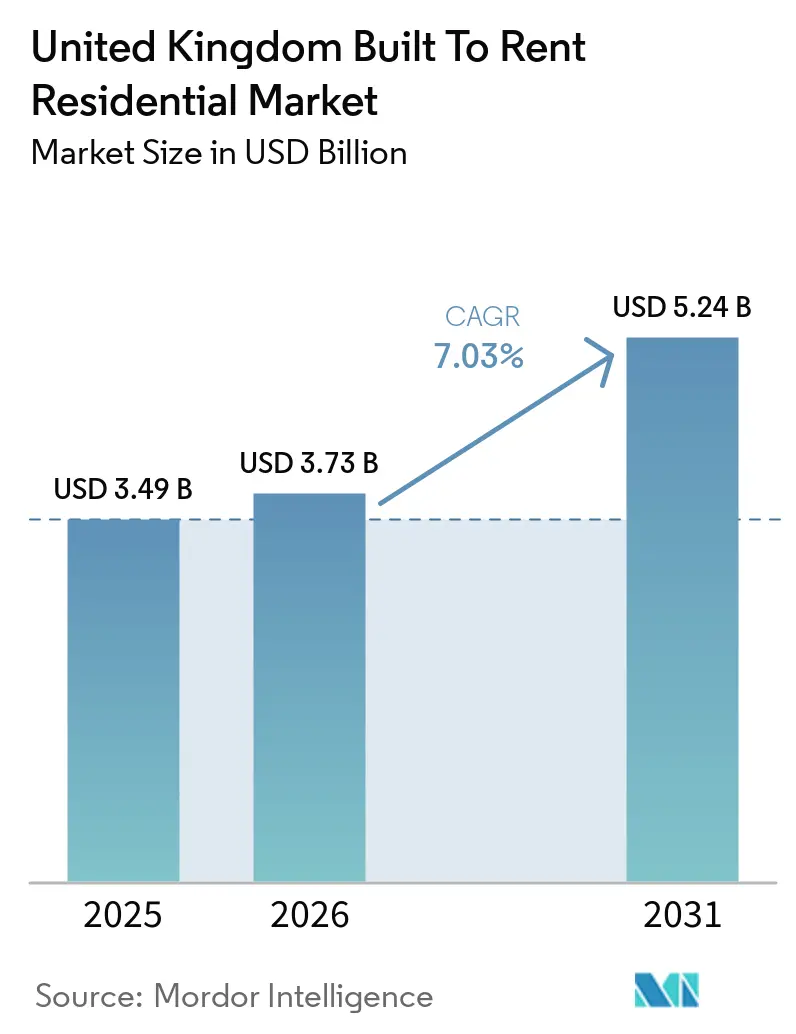
| Base Year Market Size (2025) | USD 3.49 Billion |
| Market Size (2026) | USD 3.73 Billion |
| Market Size (2031) | USD 5.24 Billion |
| Growth Rate (2026 - 2031) | 7.03 % |
| Market Concentration | Medium |
Major Players *Disclaimer: Major Players sorted in no particular order Image © Mordor Intelligence. Reuse requires attribution under CC BY 4.0. | |
United Kingdom Built To Rent Residential Market Analysis by Mordor Intelligence
The United Kingdom Built To Rent Residential Market size is expected to increase from USD 3.49 billion in 2025 to USD 3.73 billion in 2026 and reach USD 5.24 billion by 2031, growing at a CAGR of 7.03% over 2026-2031.
The United Kingdom built to rent market is supported by a housing shortage that has extended renting for many households and increased the need for professionally managed homes. England’s private rented sector lost 354,000 homes between 2022 and 2025, while built to rent and single-family housing added 55,000 homes, which points to a continued shortage of managed rental supply. Capital is moving toward stabilized homes, suburban rental communities, and schemes that can meet affordability needs without relying on high-cost amenities. The United Kingdom built to rent market also faces slower new construction because high-rise projects must navigate building-safety approvals, while rent rules raise the value of established management systems. Operators that can demonstrate reliable operating data, energy performance, and resident service standards are better placed to attract long-term capital.
Key Report Takeaways
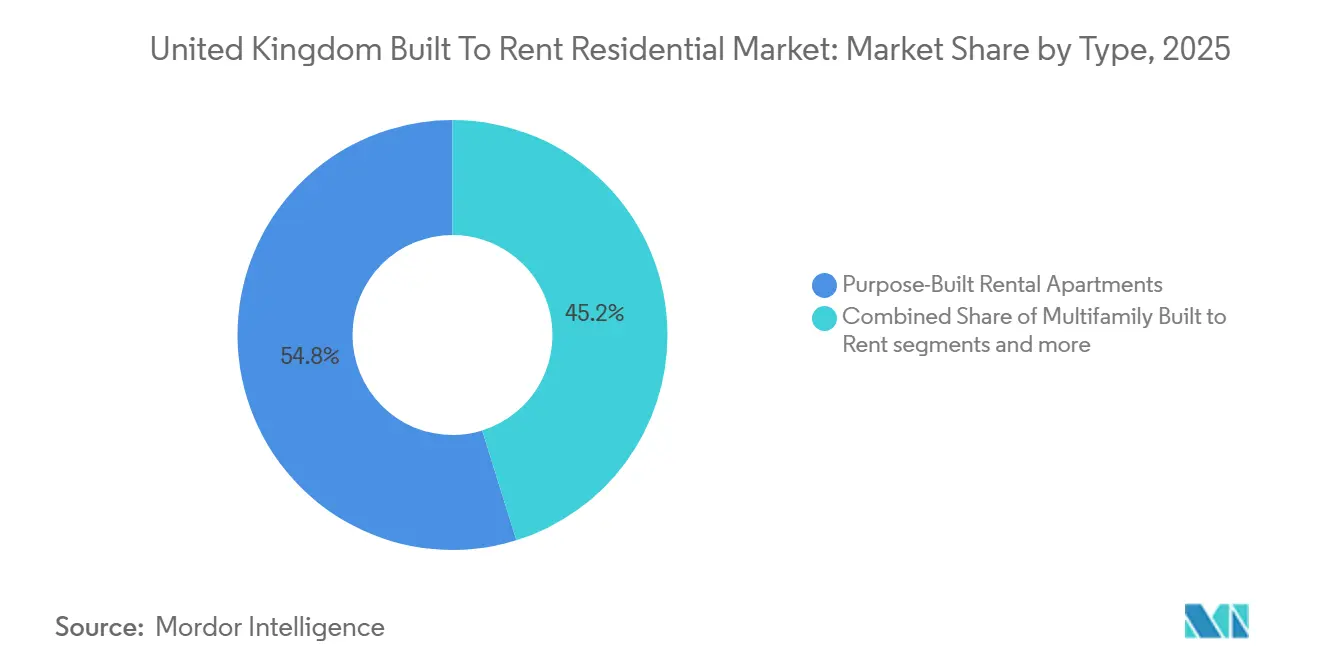
- By type, purpose-built rental apartments held 54.8% of the United Kingdom built to rent market share in 2025, while single-family built to rent / built to rent communities are projected to grow at an 8.4% CAGR through 2031.
- By management model, third-party operators held 62.7% of the United Kingdom built to rent market size in 2025, while hybrid management is forecast to grow at an 8.0% CAGR through 2031.
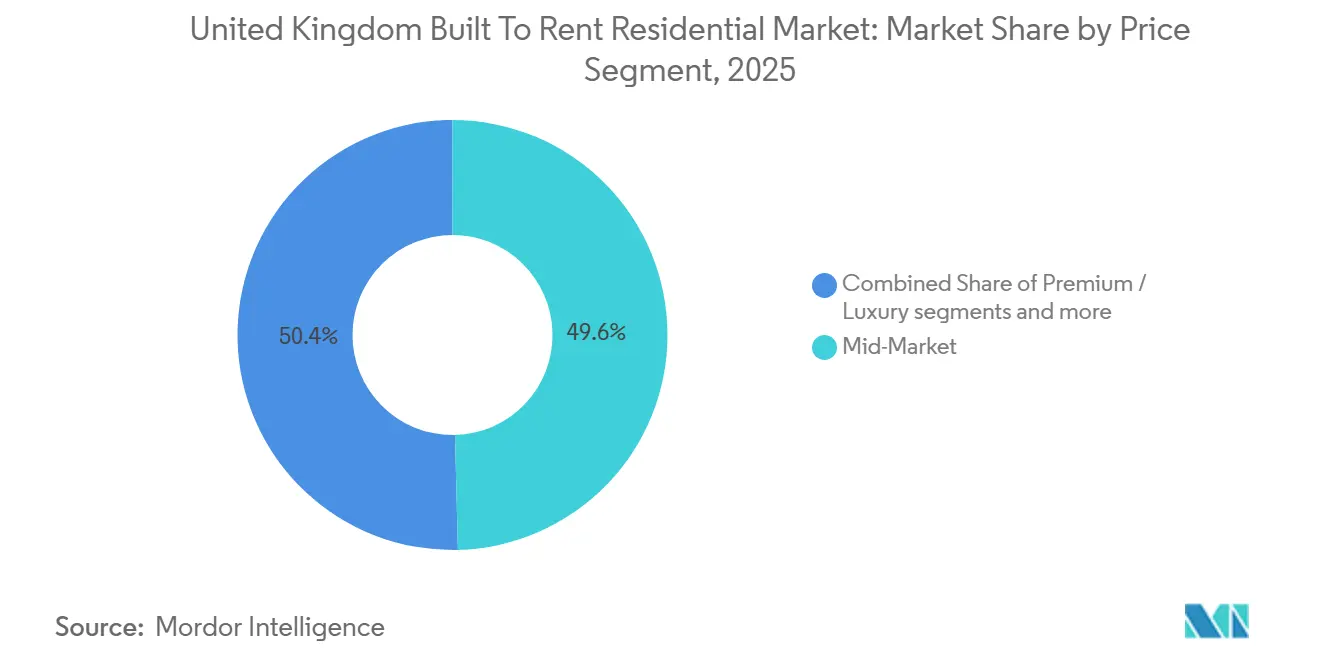
- By price segment, mid-market held 49.6% in 2025, while affordable & workforce housing are forecast to grow at an 8.6% CAGR through 2031.
- By geography, England held 85.4% in 2025, while Scotland is forecast to grow at a 7.8% CAGR through 2031.
Note: Market size and forecast figures in this report are generated using Mordor Intelligence’s proprietary estimation framework, updated with the latest available data and insights as of January 2026.
United Kingdom Built To Rent Residential Market Trends and Insights
Drivers Impact Analysis*
| Drivers | (~) % Impact on CAGR Forecast | Geographic Relevance | Impact Timeline |
|---|---|---|---|
| Housing Affordability Challenges Increase Built to Rent Demand | +1.6% | National, strongest in London, South East England, and Scottish cities | Long term (≥ 4 years) |
| Institutional Capital Shifts Accelerate Built to Rent Investment | +1.3% | National, concentrated in London, Manchester, and Birmingham | Medium term (2-4 years) |
| Single-Family Rental Expansion Boosts Suburban Built to Rent Development | +1.1% | South East, East of England, East Midlands, and North West | Long term (≥ 4 years) |
| Demand for Professionally Managed Rentals Supports Market Growth | +0.8% | National, with early outperformance in major urban centers | Medium term (2-4 years) |
| Brownfield Redevelopment and Transit-Oriented Planning Expand Built to Rent Supply | +0.6% | National, strongest in London, Bristol, Birmingham, and Manchester | Long term (≥ 4 years) |
| Operational Data Improves Energy Efficiency and Resident Cost Management | +0.4% | National, with early adoption in large institutional portfolios | Short term (≤ 2 years) |
| Source: Mordor Intelligence | |||
Housing Affordability Challenges Increase Built to Rent Demand
Households in the private rented sector spent an average 36% of gross income on rent in 2025, limiting their ability to build deposits for home purchases. Rental costs rose faster than house prices over the 5 years to 2025, which sustained demand for housing that can serve tenants over longer periods. The United Kingdom built to rent market addresses part of this demand through housing with institutional ownership and professional management. England’s private rented sector contracted by 354,000 homes from 2022 to 2025, whereas built to rent and single-family housing supplied 55,000 homes over the same period. Demand has become stronger for mid-market and workforce homes as premium rents face more resistance from tenants. This favors schemes that protect service quality while keeping rents within the income range of local households.
Institutional Capital Shifts Accelerate Built to Rent Investment
Institutional investors continued to treat rental housing as a long-term income asset, even as development conditions remained difficult. The United Kingdom built to rent market attracted GBP 5.2 billion (USD 6.6 billion) in investment during 2025, and investment totaled GBP 2.76 billion (USD 3.56 billion) in the first half of 2026. Pension investors have become more visible because they can hold stabilized rental assets over long periods. The acquisition of Private Rented Sector (PRS) REIT by Northern Local Government Pension Scheme (LGPS) and Local Pensions Partnership Investments showed the scale at which public pension capital can participate in rental housing. This has separated strategies between investors seeking completed income-producing portfolios and investors willing to carry development risk. Operators with verified operating records, sound governance, and usable ESG data have become more relevant to both groups.
Single-Family Rental Expansion Boosts Suburban Built to Rent Development
Single-family housing received GBP 3.17 billion (USD 4.0 billion) of investment in 2025, representing 59% of all United Kingdom built to rent investment that year. The format has benefited from demand for family homes in suburban areas and from lower exposure to high-rise building safety requirements. Suburban private-renting households grew 24% between the 2011 Census and 2023, compared with 19% growth for urban rental households. Single-family schemes now operate in nearly 40% of the United Kingdom local authorities, and 1 third of those authorities received their first such homes in 2025. The United Kingdom built to rent market is therefore becoming less concentrated in high-rise city projects and more connected to housebuilder partnerships. Sales to long-term rental investors can reduce sales-rate uncertainty for housebuilders and improve returns across major development sites.
Demand for Professionally Managed Rentals Supports Market Growth
Professional management is more important as tenants remain in rented homes for longer and as landlords face more detailed compliance duties. The Renters’ Rights Act changed the operating environment in England by moving tenants onto periodic arrangements and limiting rent increases to 1 review each year. These requirements favor operators with consistent systems for tenancy administration, repairs, resident communication, and rent reviews. Larger platforms can spread the cost of those systems across more homes, while smaller landlords may find the same duties harder to manage. Energy-use records and building-performance data also support better resident cost management and investor reporting. The United Kingdom built to rent market can use these capabilities to distinguish professionally operated homes from unmanaged private rentals.
Restraints Impact Analysis*
| Restraints | (~) % Impact on CAGR Forecast | Geographic Relevance | Impact Timeline |
|---|---|---|---|
| High Development and Financing Costs Reduce Project Viability | -1.6% | National, most acute in London and major cities | Medium term (2-4 years) |
| Building Safety Approval Delays Slow Project Delivery | -1.3% | England, for high-rise schemes above 18 meters | Short term (≤ 2 years) |
| Planning Regulations and Affordable Housing Requirements Increase Development Complexity | -0.9% | National, most onerous in Greater London and Scottish cities | Long term (≥ 4 years) |
| Rent Regulations and Rising Operating Costs Pressure Investment Returns | -0.8% | England and Scotland | Medium term (2-4 years) |
| Source: Mordor Intelligence | |||
High Development and Financing Costs Reduce Project Viability
Higher construction costs and debt pricing have made many urban multifamily projects harder to fund. Built to rent starts fell 79% nationally in the year to June 2026, while homes under construction declined 21% in the second quarter of 2026 from the same period in 2025. Affordable housing obligations and planning requirements add further pressure where local rents cannot support higher development costs. Forward funding remained 71% of transactions in the first half of 2026, which shows that investors still support projects but are selective about timing and delivery risk. Capital has shifted toward completed assets, which limits additions to the new-home pipeline. The United Kingdom built to rent market could face lasting regional supply pressure because starts outside London fell 84% in the year to June 2026.
Building Safety Approval Delays Slow Project Delivery
Gateway 2 approval is required before construction begins on high-rise residential projects above 18 meters in England. Approval times averaged 36 weeks in the first quarter of 2025 against a statutory target of 12 weeks, and 1,276 applications were awaiting decisions. The Building Safety Regulator has introduced a faster review route, added staffing, and engaged weekly with the Construction Leadership Council to improve processing. Delays create holding costs and reduce confidence in development timetables, especially for complex urban towers. This favors lower-rise single-family schemes, but it does not resolve the shortage of rental homes in central urban locations. The United Kingdom built to rent market will need more predictable approvals before the current pipeline can translate into a sustained increase in city supply.
*Our forecasts treat driver/restraint impacts as directional, not additive. The impact forecasts reflect baseline growth, mix effects, and variable interactions.
Segment Analysis
By Type: Purpose-Built Rental Apartments Lead Market Share, While Single-Family Built to Rent Grows Faster
Purpose-built rental apartments held 54.8% of the United Kingdom built to rent market size in 2025 and remained the largest format in the sector. London, Manchester, and Birmingham have attracted much of the completed multifamily pipeline because these cities have deep rental demand and established institutional investment. Completed built to rent stock reached 166,359 homes in the second quarter of 2026, and multifamily projects represented 75% of the construction pipeline by volume. Apartments support large-scale delivery near jobs, services, and transport. Their operating model also supports centralized building services and a consistent resident experience.
Single-family built to rent / built to rent communities are forecast to grow at an 8.4% CAGR through 2031, making them the fastest-growing type. Investment in this format more than doubled between 2022 and 2025 as investors focused on suburban families and lower-rise delivery. Housebuilders indicated that 50% planned to sell more than 15% of new deliveries to single-family investors in 2026 to 2031. Purpose-Built Rental Houses and Townhomes serve regional areas where demand for managed family homes is increasing. The United Kingdom built to rent market is likely to retain apartments as its largest stock base while single-family communities receive more new capital.



By Management Model: Third-Party Operator Scale Widens, Hybrid Management Approaches Find Momentum
Third-party operators held 62.7% of the United Kingdom built to rent market size in 2025, reflecting asset owners’ preference for specialist operating teams. These operators manage leasing, resident services, facilities, and compliance across portfolios owned by institutions. Scale can reduce unit-level operating costs and give owners consistent reporting across multiple locations. Greystar expanded its third-party management presence by acquiring Native Communities in 2025, adding 37 residential assets and more than 9,000 homes across England, Scotland, and Wales[1]Greystar, “Greystar Acquires Native Communities as It Scales Third-Party Property Management Across Europe,” Greystar Newsroom, greystar.com. The transaction shows why investors value platforms that can combine local delivery with broader systems.
Hybrid management is projected to grow at an 8.0% CAGR through 2031. In this model, an owner keeps strategic control over the portfolio but assigns selected functions to specialists. The approach can give investors better visibility over asset decisions without losing access to operating expertise. Sigma Capital moved the lettings and property management of its London portfolio in-house through Simple Life Management during 2025, while also positioning the platform for external work. The United Kingdom built to rent market continues to reward platforms that can deliver quality service across large and geographically dispersed portfolios.
By Price Segment: Mid-Market Dominates, Affordable & Workforce Housing Tier Outpaces Premium
Mid-market schemes accounted for 49.6% of the United Kingdom built to rent market share in 2025, making them the largest price segment. This position reflects the need to balance investor returns with the income levels of renters in regional cities. Mid-market homes can serve a broad tenant base without the high capital and operating costs associated with luxury amenities. Rental growth had moderated most sharply at the premium end by 2025, while more affordable segments showed greater resilience. Developers are reducing operating costs by placing more emphasis on essential services.
Affordable & workforce housing is projected to expand at an 8.6% CAGR through 2031. Planning policy supports this format, while workers need longer-term rental options near employment centers. It gives operators a way to match unit sizes, amenities, and rent levels more closely to local incomes. Premium and Luxury schemes remain relevant in connected parts of London where rents can support higher capital values. The United Kingdom built to rent market is shifting its design and pricing emphasis toward homes that can support stable occupancy over a longer period.
Geography Analysis
England accounted for 85.4% of national built to rent activity in 2025, supported by stock and pipeline concentration in Greater London, Greater Manchester, and the West Midlands. London and Tier 1 cities produced 1 half of all completions in the first half of 2026. Tier 2 cities, including Nottingham, Liverpool, and Sheffield, represented 14% of completions, while smaller regional and suburban areas contributed another 14%. England offers the largest pool of institutional-quality assets, but new development has become harder to deliver. The Renters’ Rights Act applies in England and makes professional tenancy systems more important for operators.
Scotland is forecast to grow at a 7.8% CAGR through 2031, the fastest rate among the United Kingdom regions. The Private Housing Rent Control (Exempt Property) (Scotland) Regulations 2026 came into force in April 2026 and exempt qualifying built to rent and mid-market rental homes from Scotland’s rent-control framework. This change improves the basis for investment in qualifying schemes and may encourage developers to revisit consented projects. Scotland delivered more than 5,200 built to rent homes to date, which leaves room for growth in Glasgow and Edinburgh. The Scottish framework has created a more differentiated investment setting than England, particularly for investors seeking diversification beyond higher-cost English cities.
Wales and Northern Ireland represent a smaller part of national built to rent activity, but land costs and planning timelines can compare favorably with major English cities. Cardiff and Swansea are emerging locations for multifamily projects aimed at young professionals and key workers. Belfast has rental demand linked to financial services, professional services, and technology employment. Developers need to adapt schemes to the distinct planning rules, affordable housing requirements, and design standards in each nation.
Competitive Landscape
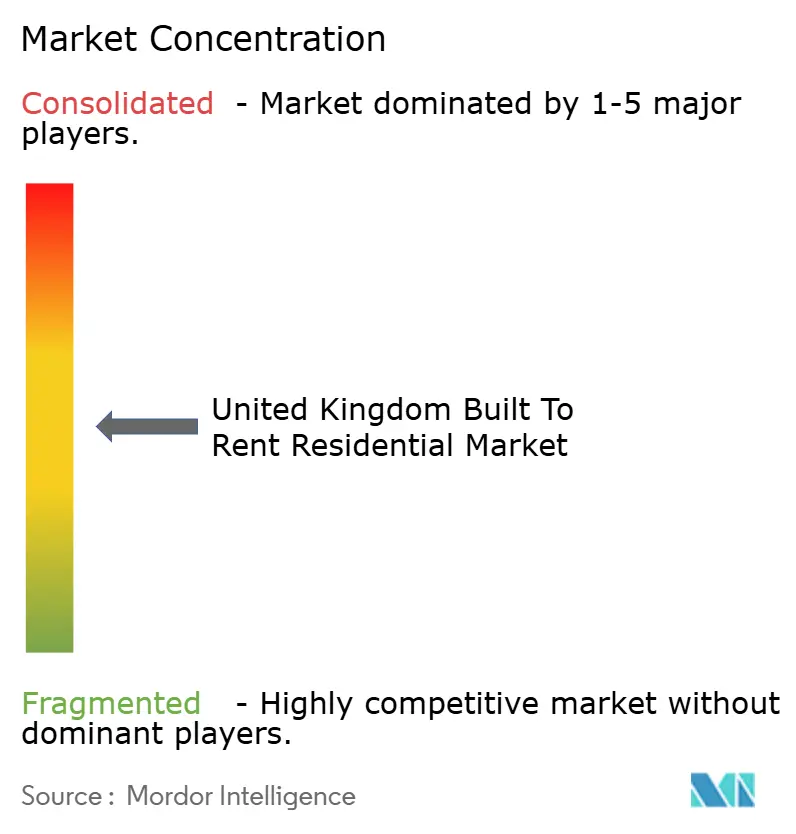
The United Kingdom built to rent market has moderate concentration among large institutional platforms and a fragmented group of smaller local operators. The leading operators combine development, investment, and management, which helps them control delivery standards and resident services. Greystar, Grainger plc, and Quintain Living have built platforms that can support those functions across multiple cities. Greystar’s 2025 acquisition of Native Communities expanded its European third-party management strategy and added more than 9,000 homes to the United Kingdom platform. Large operators can also manage the tenancy and compliance requirements that now apply more consistently across English private renting.
Grainger plc and Places for London forward-funded a 195-home Chiswick project through their Connected Living London joint venture in 2026, and the scheme had secured Gateway 2 approval before construction. Quintain Living announced in June 2026 that it would open its management platform to third-party institutional landlords and aimed to more than double the platform through external mandates[2]Quintain, “Quintain Living Celebrates 10 Years of Leadership in Build to Rent,” Quintain, quintain.co.uk. These actions show that the United Kingdom built to rent market is not defined only by land acquisition or construction capacity. Management technology, reliable service delivery, and portfolio data are central parts of the competitive position. Operators that can provide verified energy and ESG reporting may have an advantage when institutional investors assess acquisitions.
Smaller operators, including Placefirst, Dandara Living, and Gatehouse Living, compete through local knowledge, tenant focus, and specialized formats. Gatehouse Living uses a Sharia-compliant model to serve a tenant group that is not fully addressed by standard products. Mid-market suburban single-family housing remains an opportunity in local authority areas with limited institutional rental stock. Competition is likely to remain strongest among platforms that can combine disciplined operations with housing formats that respond to local demand.
United Kingdom Built To Rent Residential Industry Leaders
Greystar
Grainger plc
Get Living
Quintain Living
Moda Living
- *Disclaimer: Major Players sorted in no particular order

Recent Industry Developments
- June 2026: Grainger plc and Places for London, Transport for London’s property subsidiary, forward-funded a 195-home Built to Rent (BTR) scheme in Chiswick through their Connected Living London joint venture for GBP 68.4 million (USD 88.2 million), including 95 discounted market rent homes and pre-secured Gateway 2 approval. Construction is expected to commence in 2026.
- April 2026: The Private Housing Rent Control (Exempt Property) (Scotland) Regulations 2026 came into force, formally exempting qualifying build to rent and mid-market rental schemes from Scotland’s rent control framework.
- March 2025: Lendlease received planning approval from Birmingham City Council for a 408-unit Built to Rent (BTR) scheme as Phase 1 of a GBP 1.9 billion (USD 2.45 billion) Smithfield regeneration project adjacent to New Street station.


United Kingdom Built To Rent Residential Market Report Scope
| Multifamily Built to Rent |
| Single-Family Built to Rent / Built to Rent Communities |
| Purpose-Built Rental Apartments |
| Purpose-Built Rental Houses / Townhomes |
| In-house Operator |
| Third-party Operator |
| Hybrid Management |
| Premium / Luxury |
| Mid-Market |
| Affordable & Workforce Housing |
| England |
| Scotland |
| Wales |
| Northern Ireland |
| By Type | Multifamily Built to Rent |
| Single-Family Built to Rent / Built to Rent Communities | |
| Purpose-Built Rental Apartments | |
| Purpose-Built Rental Houses / Townhomes | |
| By Management Model | In-house Operator |
| Third-party Operator | |
| Hybrid Management | |
| By Price Segment | Premium / Luxury |
| Mid-Market | |
| Affordable & Workforce Housing | |
| By Geography | England |
| Scotland | |
| Wales | |
| Northern Ireland |


Key Questions Answered in the Report
What is the projected value of the United Kingdom built to rent sector by 2031?
The sector is projected to reach USD 5.2 billion by 2031, from USD 3.7 billion in 2026, at a 7.0% CAGR.
Which housing type is growing fastest in the United Kingdom built to rent?
Single-family built to rent / built to rent communities are projected to grow at an 8.4% CAGR through 2031.
Why are investors shifting toward suburban rental communities?
Family-rental demand, housebuilder partnerships, and lower exposure to high-rise approval requirements support this shift.
Which United Kingdom geography has the strongest forecast growth for built to rent?
Scotland is projected to grow at a 7.8% CAGR through 2031 after qualifying schemes received an exemption from rent controls in April 2026.
Page last updated on:





