
United Arab Emirates Real Estate Market Size and Share
Market Overview
| Study Period | 2020 - 2031 |
|---|---|
| Forecast Data Period | 2026 - 2031 |
| Base Year Market Size (2025) | USD 193.55 Billion |
| Market Size (2026) | USD 208.11 Billion |
| Market Size (2031) | USD 299.10 Billion |
| Growth Rate (2026 - 2031) | 7.52 % |
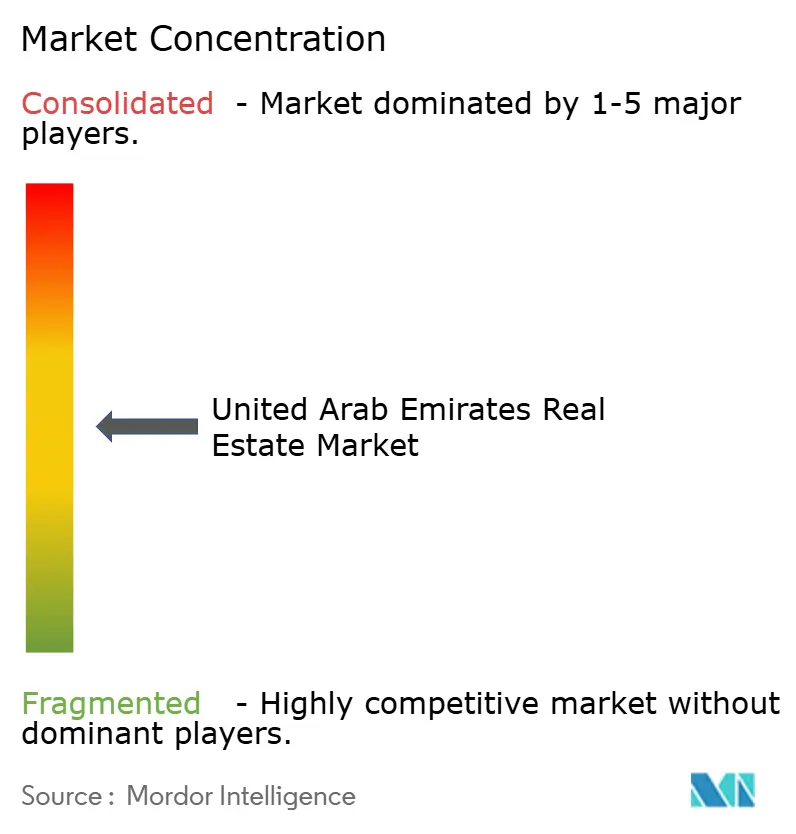
| Market Concentration | Medium |
Major Players *Disclaimer: Major Players sorted in no particular order Image © Mordor Intelligence. Reuse requires attribution under CC BY 4.0. | |
United Arab Emirates Real Estate Market Analysis by Mordor Intelligence
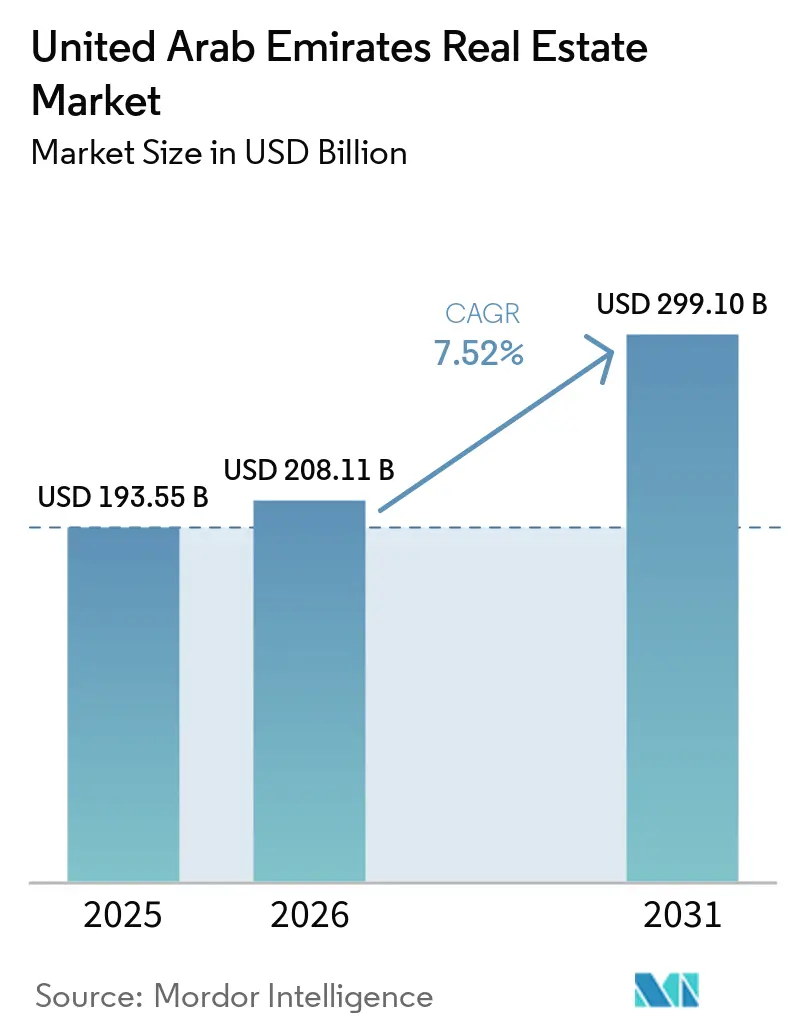
The United Arab Emirates Real Estate Market size is projected to be USD 193.55 billion in 2025, USD 208.11 billion in 2026, and reach USD 299.10 billion by 2031, growing at a CAGR of 7.52% from 2026 to 2031.
Economic diversification, population growth, and policy changes that support residency and ownership continue to support demand. The United Arab Emirates real estate market also benefits from public investment that improves transport links and creates new development areas. Demand is spreading beyond central Dubai as buyers assess opportunities in Abu Dhabi, Ras Al Khaimah, Sharjah, and other emirates. Developers are responding through larger master-planned projects, branded homes, and partnerships with government-linked landowners. The United Arab Emirates real estate market faces a more uneven supply outlook, however, because apartment-heavy communities have much larger scheduled deliveries than villa and townhouse locations.
Key Report Takeaways
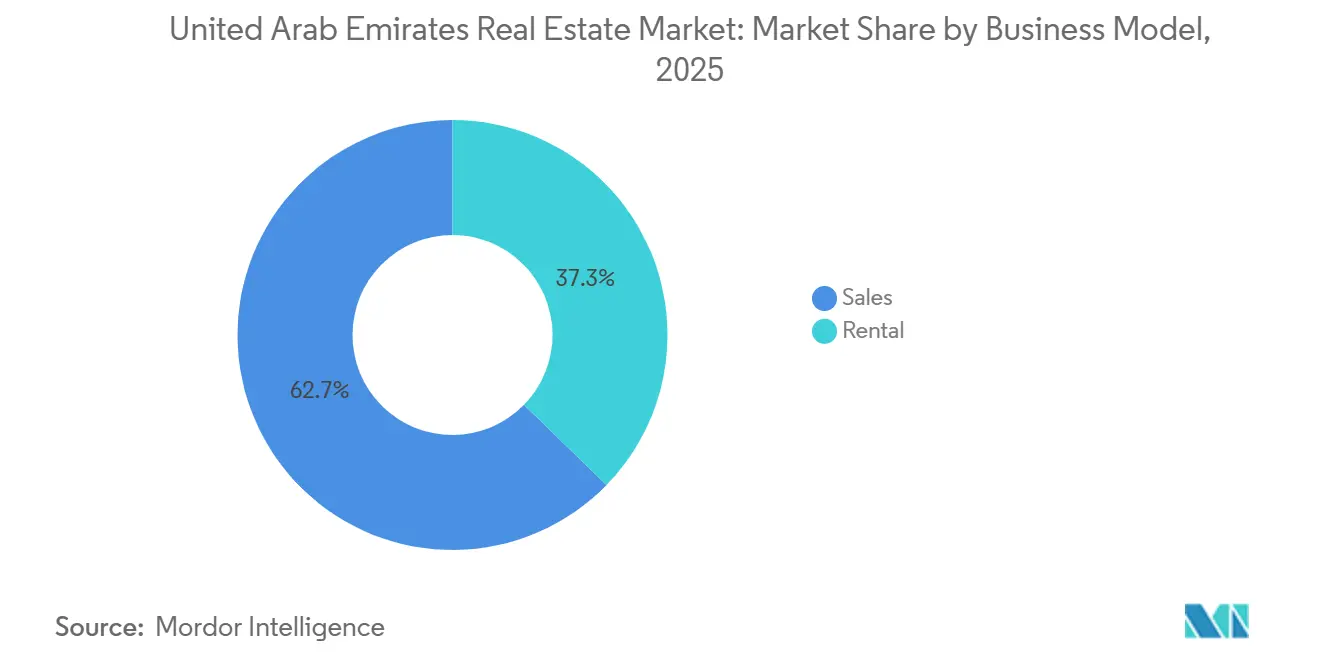
- By business model, sales accounted for 62.7% of the United Arab Emirates real estate market share in 2025, representing the largest share of market value, while rental is projected to be the fastest-growing segment, with a CAGR of 8.15% through 2031.
- By property type, residential property accounted for 68.8% of the United Arab Emirates real estate market share in 2025 and is forecast to grow at an 8.71% CAGR through 2031.
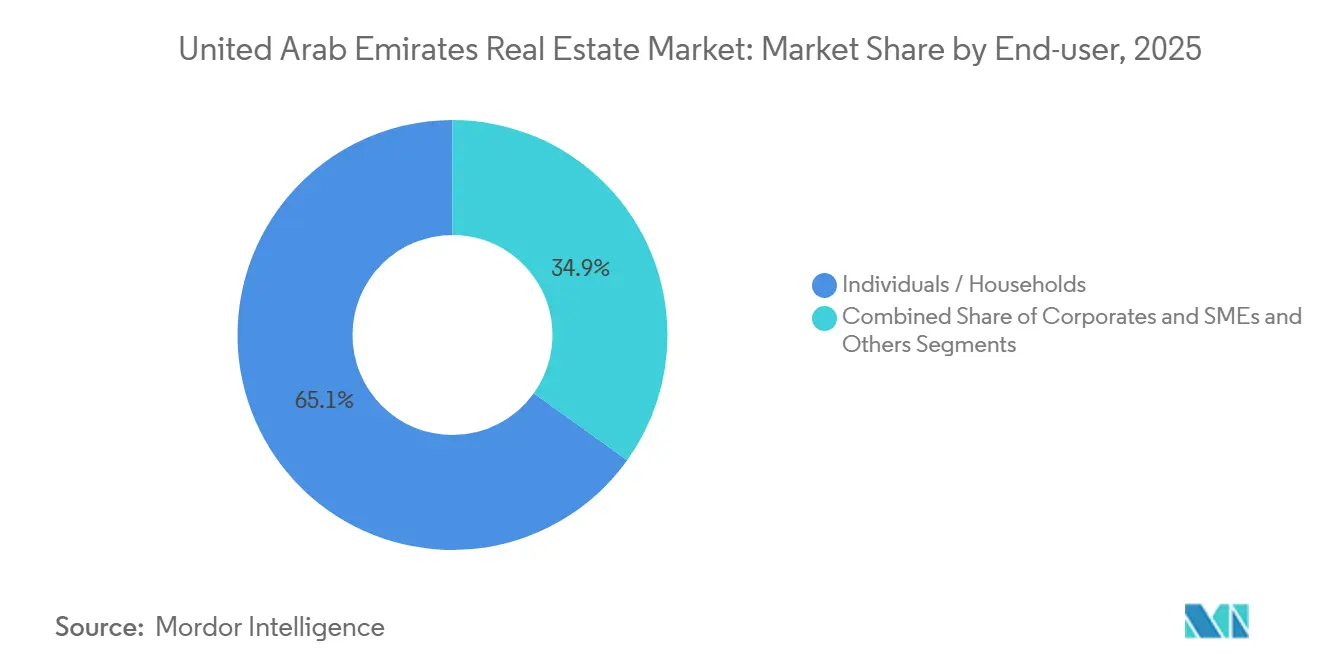
- By end-user, individuals / households accounted for 65.1% of the United Arab Emirates real estate market share in 2025, making them the largest end-user segment, while corporates and small and medium-sized enterprises are projected to grow at the fastest CAGR of 8.22% through 2031.
- By emirate, Dubai held 51.5% of the United Arab Emirates real estate market share in 2025, while Ras Al Khaimah recorded the highest projected CAGR at 9.15% through 2031.
Note: Market size and forecast figures in this report are generated using Mordor Intelligence’s proprietary estimation framework, updated with the latest available data and insights as of January 2026.
United Arab Emirates Real Estate Market Trends and Insights
Drivers Impact Analysis*
| Drivers | (~) % Impact on CAGR Forecast | Geographic Relevance | Impact Timeline |
|---|---|---|---|
| Golden Visa, Retirement Visa, and Foreign-Ownership Reforms Boost Property Demand | +2.0% | Global, with a focus on Dubai and Abu Dhabi | Short term (≤ 2 years) |
| Population Growth and High-Net-Worth Expatriate Migration Increase Housing Demand | +1.8% | Dubai, Abu Dhabi, and Sharjah | Short term (≤ 2 years) |
| Tourism, Hospitality, and Corporate Relocation Support Real Estate Growth | +1.3% | Dubai, Abu Dhabi, and Ras Al Khaimah | Medium term (2-4 years) |
| Infrastructure Investment and Economic Diversification Drive Property Development | +1.2% | UAE-wide, with focus on Abu Dhabi and Dubai | Long term (≥ 4 years) |
| Smart Home Adoption and Dubai 2040 Requirements Support Modern Property Demand | +0.5% | Dubai, with Abu Dhabi secondary | Medium term (2-4 years) |
| E-Commerce Logistics Hubs and Peripheral Corridors Expand Real Estate Development | +0.5% | Dubai South, Khalifa Economic Zones, Abu Dhabi, and Northern Emirates corridors | Medium term (2-4 years) |
| Source: Mordor Intelligence | |||
Golden Visa, Retirement Visa, and Foreign-Ownership Reforms Boost Property Demand
A February 2026 change allows an off-plan purchase to count toward the USD 0.5 million Golden Visa threshold from Oqood registration, Dubai’s system for registering off-plan property sales. The rule removes the previous 50% off-plan equity requirement and broadens the pool of eligible buyers. Dubai also removed the minimum property value requirement for its standard Property Visa and introduced a first-time homebuyer program in 2026[1]Khaleej Times, “Population Growth, Visa Reforms to Drive Dubai Property Market in H2 2026,” Khaleej Times, khaleejtimes.com.. These measures give foreign purchasers a clearer route to long-term residency through property ownership. Developers can align off-plan releases with buyers seeking both a home and visa eligibility.
Population Growth and High-Net-Worth Expatriate Migration Increase Housing Demand
Dubai surpassed 4 million residents in 2025 and added more than 208,000 residents during the year. The United Arab Emirates also received a net inflow of 9,800 millionaires in 2025, strengthening demand for premium homes[2]Forbes Middle East, “Record Millionaire Migration Reshapes UAE Economy,” Forbes Middle East, forbesmiddleeast.com.. Resident expatriates and nonresident foreign buyers represented 62% of Abu Dhabi residential unit sales in 2025[3]Abu Dhabi Real Estate Centre, “Abu Dhabi Real Estate Centre Releases 2025 Real Estate Records,” Abu Dhabi Real Estate Centre, adrec.gov.ae.. Resident foreign buyers accounted for 69% of the growth in Abu Dhabi residential sales from 2022 to 2025. This buyer base supports demand from households making longer-term residence decisions.
Tourism, Hospitality, and Corporate Relocation Support Real Estate Growth
Dubai received 19.6 million visitors in 2025, 5% more than in 2024. The United Arab Emirates hotel establishments hosted 23.3 million guests in the first 9 months of 2025, and average occupancy reached 79.2%. The Dubai Chamber of Commerce registered 53,000 new companies in the first 9 months of 2025. Corporate relocation can add demand for employee housing, family accommodation, office space, and related services. Tourism also supports holiday homes and properties that combine residential and hospitality uses.
Infrastructure Investment and Economic Diversification Drive Property Development
Abu Dhabi is advancing USD 57 billion of infrastructure investment across 500 projects. Dubai approved the USD 9 billion Gold Line metro project in April 2026, with completion targeted for 2032. Abu Dhabi agencies also announced USD 15 billion of public-private partnership projects for 2026 and 2027 delivery. The National Investment Strategy 2031 seeks to raise foreign direct investment to USD 65.3 billion by 2031 from USD 30.5 billion in 2023. New rail, airport, and metro connections can raise the attractiveness of land in peripheral corridors.
Restraints Impact Analysis*
| Restraints | (~) % Impact on CAGR Forecast | Geographic Relevance | Impact Timeline |
|---|---|---|---|
| Mortgage Rates and Affordability Pressures Limit Buyer Demand | -1.2% | UAE-wide, with the greatest effect in Dubai mid-market areas | Short term (≤ 2 years) |
| Oversupply Risks in High-Rise and Mid-Market Apartments Pressure Absorption | -1.0% | Dubai and Abu Dhabi | Medium term (2-4 years) |
| Cross-Emirate Regulatory and Transaction Differences Increase Market Complexity | -0.5% | UAE-wide, especially the Northern Emirates | Medium term (2-4 years) |
| Title Deed and Final Documentation Delays Slow Property Transactions | -0.3% | Dubai and Abu Dhabi off-plan projects | Short term (≤ 2 years) |
| Source: Mordor Intelligence | |||
Mortgage Rates and Affordability Pressures Limit Buyer Demand
The Central Bank of the United Arab Emirates's base rate remained at 3.7% through April 2026. The 3-month Emirates Interbank Offered Rate was 3.9% in June 2026. Fixed mortgage rates ranged from 3.8% for 1-year products to 5% for longer fixed terms. Overseas buyers faced rates of 4.5% to 5.5% and loan-to-value caps of 50%. Higher borrowing costs can redirect affordability-sensitive demand toward lower-priced communities.
Oversupply Risks in High-Rise and Mid-Market Apartments Pressure Absorption
Dubai had more than 110,500 residential units scheduled for delivery in 2026. This compares with a 10-year annual average of 27,000 units. Studios and 1-bedroom apartments accounted for 66% of the planned pipeline. Five Dubai districts held 45% of the stock under construction. The concentration points to local supply pressure rather than one uniform correction across the country.
*Our forecasts treat driver/restraint impacts as directional, not additive. The impact forecasts reflect baseline growth, mix effects, and variable interactions.
Segment Analysis
By Property Type: Residential Leads Market Share and Records Faster Growth
The sales model held 62.7% of the United Arab Emirates real estate market share in 2025. The result reflected a strong preference among investors and residents for ownership, including off-plan ownership. Off-plan transactions represented 73% of Dubai residential deals in 2025. Off-plan property represented 89% of Abu Dhabi residential sales value in the first half of 2026. The rental model is the faster-growing business model, with a forecast CAGR of 8.15% through 2031. This growth reflects the expanding stock of investor-owned completed homes that can be offered to tenants.
More than 271,000 tenancy contracts were registered in Dubai during the first half of 2026. Average gross rental yields reached 6.6% during the period. As projects due for delivery from 2026 to 2028 are completed, some off-plan stock will enter the rental pool. This may improve tenant choice in high-pipeline apartment communities. It may also moderate rental yield pressure in these locations. Purpose-built rental housing remains limited, leaving a gap for developers that can provide professionally managed communities for corporate tenants.



By Property Type: Residential Demand Remains the Core of Activity
Residential property held 68.8% of the United Arab Emirates real estate market size in 2025. It is also the fastest-growing property category, with a forecast CAGR of 8.71% through 2031. Villa and townhouse demand has shown greater resilience than apartment demand because new supply is more constrained. Dubai apartment rents fell 4% in the second quarter of 2026, while villa rents declined 2% as additional homes entered the market. Premium villa pricing remained more stable because family-oriented demand continued to exceed available supply. This contrast shapes product planning across the United Arab Emirates real estate market.
Commercial real estate continues to face a limited supply in selected prime locations. Dubai prime office rents rose 16% year over year through the second quarter of 2026, while occupancy was 94%. Dubai Grade A logistics warehouse rents reached USD 134 per square meter in 2025, after a 17% annual increase, while prime vacancy remained below 1%. Branded residence transaction volume increased 26% in the first 9 months of 2025, and transaction value rose 51%. Buyers paid a 64% premium on average for branded residences over comparable non-branded properties. These formats connect residential, hospitality, logistics, and commercial demand within the broader property base.
By End-User: Individuals / Households Lead as Corporate and Small and Medium-Sized Enterprise Occupancy Expands
Individuals and households accounted for 65.1% of the United Arab Emirates' real estate market share in 2025. United Arab Emirates nationals and resident expatriates both supported this ownership base. Buyers from more than 100 nationalities participated in Abu Dhabi residential sales in 2025. The United Arab Emirates residents represented 75.5% of Engel & Völkers’ buyer base in 2025, while nonresidents represented 24.5%. The strongest nonresident interest came from the United Kingdom, Germany, India, and France. This breadth reduces reliance on a single overseas buyer group.
Corporates and small and medium-sized enterprises are forecast to grow at an 8.22% CAGR through 2031. Corporate occupiers in the United Arab Emirates are expected to expand their floor area, with many seeking amenity-led and purpose-built offices. Prime office occupancy in Dubai was 95% in early 2026. Government entities and institutional funds also support co-development projects. The Aldar and Dubai Holding partnership had generated USD 5.9 billion in sales since 2023. Corporate leasing demand can therefore support commercial property even as household ownership expands.
Geography Analysis
Dubai held 51.5% of the United Arab Emirates real estate market share in 2025. It recorded USD 61.7 billion in residential sales during the first half of 2026. The Dubai 2040 Urban Master Plan directs development toward designated growth corridors and supports mixed-use, walkable areas. Office occupancy was 94% in the second quarter of 2026, while prime rents were 16% higher year over year. Abu Dhabi recorded USD 31.9 billion in real estate transactions during the first half of 2026. Its USD 57 billion infrastructure pipeline and larger foreign investor base provide further support.
Ras Al Khaimah is forecast to grow at a CAGR of 9.15% through 2031. Its price index rose 13.8% in the first half of 2025, with villas increasing 15% and apartments increasing 13.2%. The emirate offers lower land costs than Dubai and a growing branded residential pipeline. Wynn Al Marjan Island is a USD 5.1 billion development scheduled for 2027 and is expected to add hospitality infrastructure and jobs. Ras Al Khaimah Economic Zone also gives the emirate a manufacturing and industrial tenant base. These conditions broaden the United Arab Emirates' real estate market beyond investment-led waterfront demand.
Sharjah recorded USD 5 billion in transaction value during the first quarter of 2026, an increase of 40.7% from the first quarter of 2025. Its proximity to Dubai and more competitive home prices support demand from end users. Ajman’s USD 2.94 billion in first-half 2026 transactions also shows broader participation outside the two largest hubs. Passenger rail links between Fujairah and Abu Dhabi can improve access to less-developed locations. Fujairah, Umm Al Quwain, and Al Ain are attracting interest from developers seeking lower land-cost entry points. Better connectivity may help these locations gain residential and logistics activity over time.
Competitive Landscape
The United Arab Emirates real estate market is moderately concentrated, with government-linked master developers holding significant market positions. In contrast, mid-tier and boutique developers contribute to a more fragmented competitive landscape. Emaar Properties and Aldar Properties have scale, established delivery records, and access to large land banks. These characteristics can make large master developments more difficult for smaller competitors to replicate. Emaar Development reported USD 6.1 billion in property sales and USD 1.8 billion in net profit during the first half of 2026. Its USD 34.8 billion presales backlog provides visibility across future delivery periods.
Aldar Properties PJSCand Dubai Holding expanded their joint venture in February 2026. The partnership added land for 14,000 homes with a gross development value of over USD 10.4 billion. The arrangement combines land access, development capability, and branding. Dubai Holding also acquired a 22.27% stake in Emaar Properties in May 2026. Its total shareholding in Emaar reached 29.73% after the transaction.
Technology and brand partnerships are becoming more visible across the United Arab Emirates real estate market. Developers are using digital leasing platforms, property tokenization, and smart-home functions as product features. Dubai Land Department recorded USD 1.2 billion in tokenized real estate transactions in May 2026. Purpose-built rental housing remains limited despite corporate demand for professionally managed communities. Arada Developments, Binghatti Developers, and RAK Properties are pursuing demand beyond Dubai’s established premium locations.
United Arab Emirates Real Estate Industry Leaders
Emaar Properties PJSC
Aldar Properties PJSC
DAMAC Properties
Nakheel
Azizi Developments
- *Disclaimer: Major Players sorted in no particular order

Recent Industry Developments
- August 2026: Emaar Development PJSC reported AED 22.4 billion (USD 6.1 billion) in property sales and a 43% increase in net profit to AED 6.7 billion (USD 1.8 billion) for H1 2026, supported by a pre-sales backlog of AED 127.7 billion (USD 34.8 billion) and 84,000+ residential units delivered since 2002, per the company's official press release. The results demonstrate strong demand resilience and suggest the company is well-positioned to absorb near-term supply cycle volatility.
- June 2026: Emaar Properties announced Dubai Estate, a AED 200 billion (USD 55 billion) megaproject in southeast Dubai designed to house approximately 150,000 people across residential towers, villas, and commercial assets, developed jointly with Meraas under the Dubai Hills joint venture. The project is among the largest single master-plan commitments in the United Arab Emirates' history.
- May 2026: Binghatti Developers launched Tilal Binghatti, its first horizontal master-planned community spanning 13 million square feet in Al Rowaiyah, Dubailand, recording 4,430 unit bookings within 3 hours of launch, per Binghatti Developers' official communication. The project reflects strong investor absorption capacity for mid-market community living formats outside central Dubai.


United Arab Emirates Real Estate Market Report Scope
| Residential | Apartments & Condominiums |
| Villas & Landed Houses | |
| Commercial | Office |
| Retail | |
| Logistics | |
| Others (Industrial, Hospitality, etc.) |
| Individuals / Households |
| Corporates and Small and Medium-Sized Enterprises |
| Others |
| Dubai |
| Abu Dhabi |
| Sharjah |
| Ras Al Khaimah |
| Rest of the United Arab Emirates |
| By Property Type | Residential | Apartments & Condominiums |
| Villas & Landed Houses | ||
| Commercial | Office | |
| Retail | ||
| Logistics | ||
| Others (Industrial, Hospitality, etc.) | ||
| By End-User | Individuals / Households | |
| Corporates and Small and Medium-Sized Enterprises | ||
| Others | ||
| By Emirate | Dubai | |
| Abu Dhabi | ||
| Sharjah | ||
| Ras Al Khaimah | ||
| Rest of the United Arab Emirates | ||


Key Questions Answered in the Report
What is the United Arab Emirates real estate market forecast through 2031?
The United Arab Emirates real estate market is projected to reach USD 299.1 billion by 2031, growing at a 7.52% CAGR from 2026. The outlook reflects continued residential demand, infrastructure spending, visa reforms, and activity in both the largest cities and emerging emirates. Dubai remains the largest location, but growth is becoming less concentrated in one emirate.
Which property type is growing fastest in the United Arab Emirates?
Residential property is forecast to grow at an 8.71% CAGR through 2031 and held 68.8% of the value in 2025. Villas & landed houses have shown more resilience than apartments because family demand remains firm and their new supply pipeline is more constrained. Offices and logistics space also have support from low vacancy in selected locations.
Which emirate is growing fastest for property investment?
Ras Al Khaimah is projected to grow at a 9.15% CAGR through 2031. Its outlook is supported by lower land costs, waterfront and branded residential projects, the planned 2027 opening of Wynn Al Marjan Island, and an expanding tourism and industrial base. Sharjah and Ajman also reported stronger transaction activity during 2026.
What is driving housing demand in the United Arab Emirates?
Visa reforms, population growth, foreign buyer participation, tourism, corporate relocation, and infrastructure investment support demand. These factors affect both ownership and leasing, while also shifting attention toward communities close to schools, employment centers, transport, and hospitality destinations. Off-plan sales benefit where buyers can connect property ownership to longer-term residency eligibility.
What are the main risks for the United Arab Emirates property developers?
Higher mortgage costs and the large pipeline of mid-market apartments can slow absorption in selected Dubai communities. The risk is concentrated in districts with substantial studio and 1-bedroom deliveries, while lower-supply villa and townhouse locations have a different demand and supply balance. Developers must consider location, unit mix, pricing, and likely rental competition.
Page last updated on:





