
Market Overview
| Study Period | 2020 - 2031 |
|---|---|
| Forecast Data Period | 2026 - 2031 |
| Historical Data Period | 2020 - 2024 |
| Market Size (2026) | USD 3.10 Billion |
| Market Size (2031) | USD 3.87 Billion |
| Growth Rate (2026 - 2031) | 4.53 % |
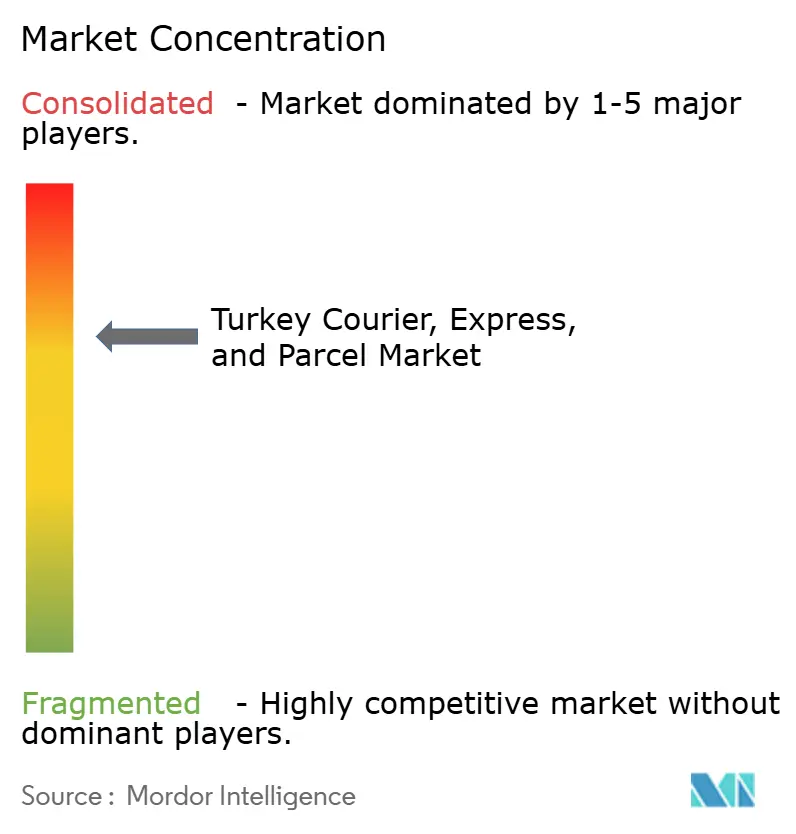
| Market Concentration | Medium |
Major Players *Disclaimer: Major Players sorted in no particular order Image © Mordor Intelligence. Reuse requires attribution under CC BY 4.0. | |
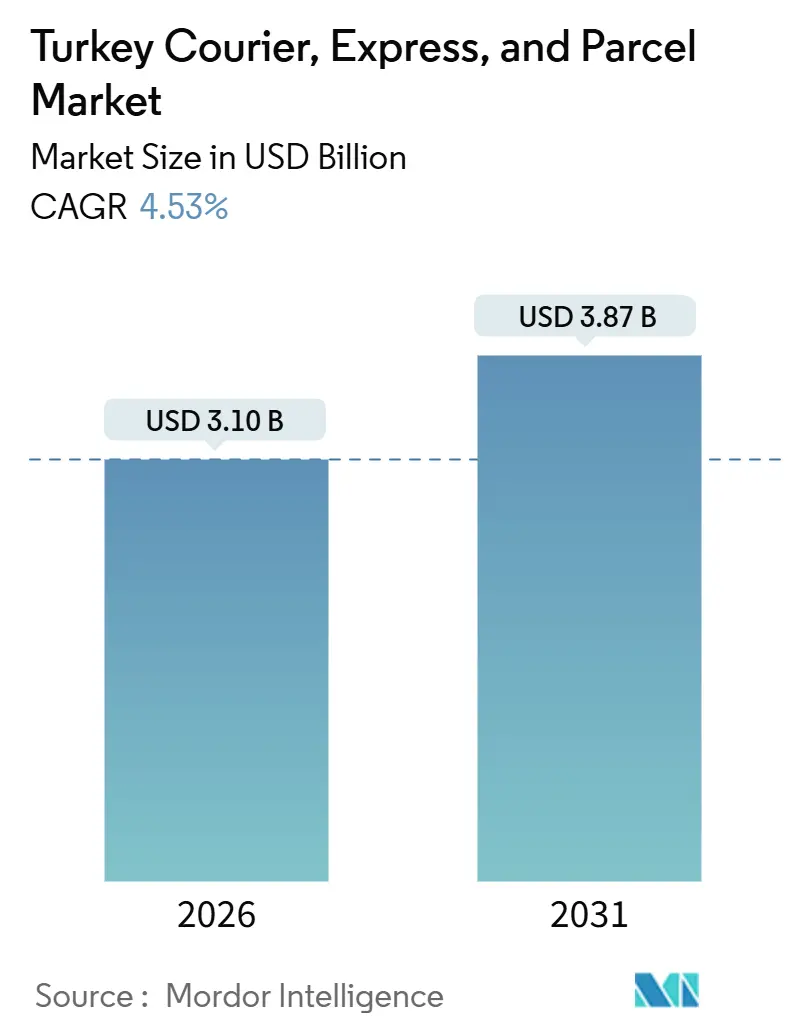
Turkey Courier, Express, And Parcel Market Analysis by Mordor Intelligence
The Turkey courier, express, and parcel market size is estimated at USD 3.10 billion in 2026, and is expected to reach USD 3.87 billion by 2031, at a CAGR of 4.53% during the forecast period (2026-2031). The trajectory reflects a powerful mix of doubling e-commerce volumes, Istanbul Airport’s emergence as Europe’s busiest cargo hub, and rising demand for same-day services in densely populated metros. Domestic deliveries dominate current volumes, yet international flows are expanding faster as customs processes go digital and near-shoring tightens links with European buyers. Operators are investing in automated hubs, electric fleets, and route-optimization software to offset fuel inflation, lira depreciation, and urban congestion. These dynamics are sharpening competition between global integrators, cash-rich incumbents, and technology-first entrants across the Turkey courier express and parcel market.
Key Report Takeaways
- By destination, domestic shipments held 76.53% of the Turkey courier express and parcel market share in 2025, while international flows are forecast to grow at a 4.82% CAGR between 2026-2031.
- By speed of delivery, non-express services led with 83.31% revenue share in 2025; express offerings are projected to advance at a 5.64% CAGR between 2026-2031.
- By business model, B2C accounted for 53.44% of the Turkey courier express and parcel market size in 2025 and is projected to expand at a 5.91% CAGR between 2026-2031.
- By shipment weight, light weight parcels under 5 kg commanded a 74.96% share in 2025 and are expected to grow at a 4.99% CAGR between 2026-2031.
- By mode, road transport retained a 69.10% share in 2025, whereas multimodal alternatives are expected to rise at a 5.67% CAGR between 2026-2031.
- By end user industry, e-commerce generated 38.42% revenue share in 2025 and is advancing at a 4.95% CAGR between 2026-2031.
Note: Market size and forecast figures in this report are generated using Mordor Intelligence’s proprietary estimation framework, updated with the latest available data and insights as of January 2026.
Turkey Courier, Express, And Parcel Market Trends and Insights
Drivers Impact Analysis*
| Driver | (~) % Impact on CAGR Forecast | Geographic Relevance | Impact Timeline |
|---|---|---|---|
| E-commerce volume surge | +1.2% | National, with concentration in Istanbul, Ankara, Izmir metropolitan areas | Short term (≤ 2 years) |
| Istanbul Airport as regional hub | +0.7% | National for domestic consolidation; international for cross-border flows to EU, Central Asia, Middle East | Medium term (2-4 years) |
| Customs-process digitalization | +0.5% | National, with spillover to cross-border corridors (EU, Georgia, Azerbaijan) | Medium term (2-4 years) |
| Near-shoring driven B2B flows | +0.4% | National, with early gains in Marmara, Aegean industrial zones | Long term (≥ 4 years) |
| Same-day/on-demand delivery demand | +0.6% | Urban cores (Istanbul, Ankara, Izmir, Bursa) | Short term (≤ 2 years) |
| Cross-border e-commerce initiatives | +0.5% | National, with emphasis on Istanbul Airport gateway and land corridors to EU | Medium term (2-4 years) |
| Source: Mordor Intelligence | |||
E-Commerce Volume Surge
Turkey’s online spending doubled to TRY 1.85 trillion (USD 52.38 billion) in 2023 and climbed to TRY 3.16 trillion (USD 89.47 billion) in 2024, generating 476 million parcels in 4Q 2024 alone. Mobile commerce captured 50% of transactions, favoring lightweight, high-frequency orders. Roughly 220,000 e-commerce firms operate in Istanbul, concentrating last-mile demand where couriers execute 50-80 stops per day. Quick-commerce grocery sales reached TRY 126 billion (USD 3.56 billion) in 2023, further slicing delivery windows. Micro-fulfillment centers and automated hubs are proliferating as operators seek to compress cycle times without proportional labor. These forces underpin the growth premium visible across the Turkey courier express and parcel market[1]“E-Commerce Statistics 2024,” Turkish Statistical Institute, TURKSTAT.GOV.TR.
Istanbul Airport as Regional Hub
The airport handled 1.97 million tons of cargo in 2024, up 39.6% year-on-year, vaulting it to the top of the European rankings. FedEx opened a 25,300 m² hub in September 2025 capable of 7,000 packages per hour. UPS, DHL, and Turkish Cargo anchor additional flights that stitch Istanbul into overnight networks touching Cologne, Paris, and Dubai. Planned rail-highway corridors to the Persian Gulf will further consolidate flows. As a result, international parcels are set to outpace domestic growth within the Turkey courier express and parcel market.
Customs-Process Digitalization
A reduction in simplified-clearance thresholds from EUR 1,500 (USD 1,562.34) to EUR 30 (USD 31.24) in August 2024 sped electronic pre-clearance, even while adding duty costs for many inbound parcels. The Single Window platform links 22 agencies, cutting border dwell times by roughly 20%. Turkey also signed the eTIR roadmap with neighboring states, digitizing transit guarantees and trimming road-freight delays by 30%. Together, these reforms add velocity to cross-border flows and boost the competitiveness of the Turkey courier express and parcel market[2]“E-Commerce Merchant Registry 2024,” Turkish Ministry of Trade, TRADE.GOV.TR.
Same-Day/On-Demand Delivery Demand
Penetration of sub-24-hour delivery in Istanbul, Ankara, and Izmir is escalating as platforms promise groceries in under 30 minutes and general merchandise in 2-4 hours. Getir’s strategic retreat to its home market underlines the focus on rapid fulfillment. HepsiJet’s patented route-optimization cut fleet kilometers by 8% in 2024 and pairs with a growing electric-vehicle fleet to serve dense urban routes. Congestion, however, remains acute, pressing firms to invest in micro-depots within 5 km of demand clusters, an approach dominating capital plans across the Turkey courier express and parcel market.
Restraints Impact Analysis*
| Restraint | (~) % Impact on CAGR Forecast | Geographic Relevance | Impact Timeline |
|---|---|---|---|
| Volatile fuel costs | -0.8% | National, with acute impact on long-haul road operators serving eastern provinces | Short term (≤ 2 years) |
| Urban congestion and delivery windows | -0.5% | Istanbul, Ankara, Izmir, Bursa metropolitan areas | Medium term (2-4 years) |
| Lira depreciation vs imported assets | -0.6% | National, affecting operators reliant on imported vehicles, sorting equipment, IT systems | Medium term (2-4 years) |
| Driver-workforce shortage | -0.4% | National, with concentration in urban cores where turnover exceeds 40% annually | Short term (≤ 2 years) |
| Source: Mordor Intelligence | |||
Volatile Fuel Costs
Diesel prices surged 44% in 2024, lifting transport costs by up to 35% for road-based carriers. With road still at 69.10% modal share, any 10% hike in diesel raises per-parcel costs 3-4% for operators lacking hedges. Investments in rail-road intermodal routes and initial deployments of electric vans are tactical shields, yet high upfront capital and sparse charging infrastructure hinder rapid scaling[3]“eTIR Implementation Roadmap 2024,” International Road Transport Union, IRU.ORG .
Urban Congestion and Delivery Windows
Istanbul ranks second globally for traffic, costing residents 105 lost hours a year. Off-peak vehicle restrictions in historic districts push delivery activity into costly night shifts. Although a 31-km North Marmara bypass is due by 2027, capacity relief will not arrive soon enough to ease the near-term margin squeeze within the Turkey courier express and parcel market[4]“Fuel Price Index 2024,” Turkish Energy Market Regulatory Authority, EPDK.GOV.TR.
*Our forecasts treat driver/restraint impacts as directional, not additive. The impact forecasts reflect baseline growth, mix effects, and variable interactions.
Segment Analysis
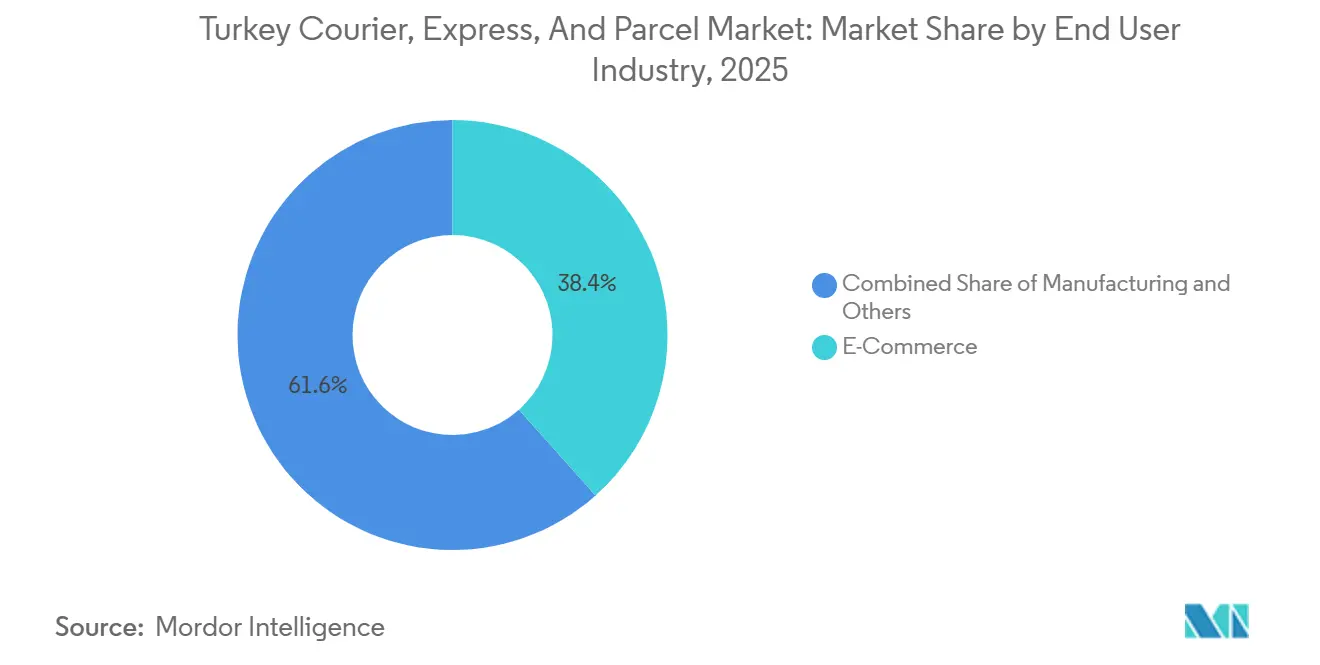
By End-User Industry: E-Commerce Leads, Manufacturing Rises
E-commerce contributed 38.42% of total revenue generated in 2025 and is expected to grow at a 4.95% CAGR (2026-2031). Manufacturing follows as automotive output hit 1.4 million units in 2024, requiring just-in-time spares for EU plants.
Pharmaceuticals and banking add niche demand for temperature-controlled and secure document services, offering margin diversification for operators willing to invest in specialized capabilities.



By Destination: International Volumes Outrun a Large Domestic Base
Domestic shipments delivered 76.53% of parcels in 2025, reflecting Turkey’s 85 million population and dense e-commerce activity in western metros. Still, international parcels are forecast to rise at a 4.82% CAGR between 2026-2031 as Istanbul Airport accelerates cross-border sortation and A.TR automation streamlines EU-bound exports. The Turkey courier express and parcel market size for international flows is projected to capture a growing slice of total revenue as outbound sellers tap European and Central Asian demand. Longer-haul yields cushion operators against same-day cost pressures felt on domestic routes, underscoring the strategic pivot toward cross-border capacity.
The EU attracts 55% of outbound parcels, while the eTIR framework cuts clearance frictions on east-bound corridors. Truck-to-rail conversion in Eastern Anatolia promises margin uplift once freight capacity scales. Conversely, inbound B2C parcels cool after the new EUR 30 (USD 31.24) threshold imposed duties of 30%-60%, encouraging shoppers to favor local platforms.
By Speed of Delivery: Express Accelerates on Time-Critical Demand
Non-express services held 83.31% 2025 share, yet express is on track for a 5.64% CAGR (2026-2031), the fastest of any segment. Istanbul residents expect 2-4-hour fulfillment, pushing merchants to pay premiums for time-definite capacity. FedEx’s USD 130 million hub and UPS’s daily Cologne flight underline the rush to enlarge express capacity. Higher margins from spare parts and fabric-sample traffic also lift express economics inside the Turkey courier express and parcel market.
Despite elevated fuel and labor costs, algorithmic routing and parcel-locker rollouts anchor productivity gains. Standard three-day services remain vital for price-sensitive merchants, but their growth lags as consumer expectations shift.
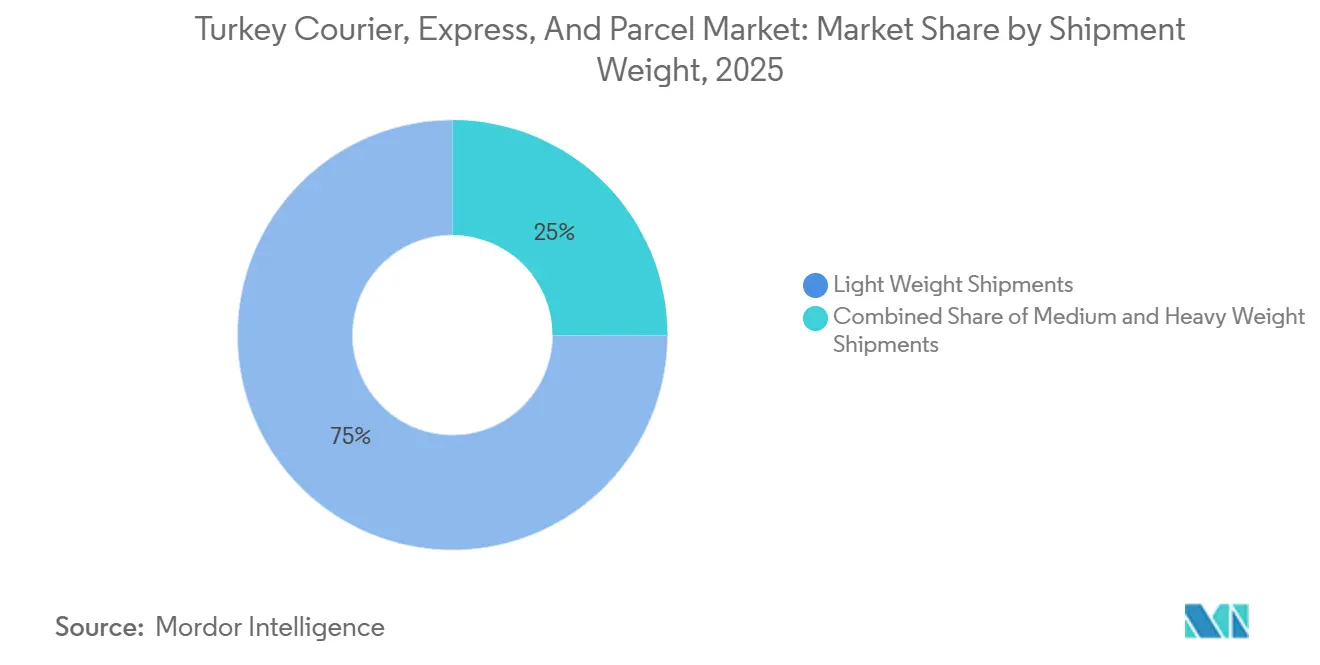
By Shipment Weight: Light Parcels Dominate the Mix
Light parcels under 5 kg captured 74.96% of revenue generated in 2025, mirroring fashion, electronics, and cosmetics baskets favored online. The Turkey courier, express, and parcel market size for this weight band is projected to increase at a 4.99% CAGR (2026-2031), supported by mobile-first buying patterns and locker networks optimized for small cartons.
Medium and heavy parcels, tied to white-goods and furniture deliveries, grow more slowly due to narrow streets and congestion hurdles in old city centers.
By Mode of Transport: Road Still Rules, but Multimodal Gains Traction
Road transport retained a 69.10% revenue share in 2025, but rail-linked corridors are growing at a 5.67% CAGR (2026-2031) as diesel inflation bites. The Eastern Turkey middle-corridor railway will elevate capacity twenty-six-fold by 2028, tilting bulk B2B parcels toward intermodal services.
Air freight underpins express expansion, with Istanbul Airport adding rapid-sort capacity that feeds premium lanes across the Turkey courier express and parcel market.
By Model: B2C Sustains Growth Leadership
B2C accounted for 53.44% of the Turkey courier express and parcel market share in 2025 and is advancing at a 5.91% CAGR between 2026-2031, propelled by mobile-commerce sales now equal to half of all online purchases. Quick-commerce volumes augment parcel density and keep van fill rates high. B2B traffic, led by automotive and textile exporters, yields superior per-parcel revenue yet expands more slowly. C2C remains the smallest niche but benefits from Turkey’s young, digitally savvy consumers trading via marketplaces.
Technology investments such as HepsiJet’s route-optimization engine are critical for B2C players juggling thin margins and stringent delivery windows. Platforms betting on algorithmic efficiency are set to capture incremental share within the Turkey courier express and parcel market.
Geography Analysis
Marmara, Aegean, and Central Anatolia regions together generated roughly 60% of 2025 domestic volumes, buoyed by Istanbul’s 220,000 e-commerce firms and Ankara’s strategic distribution location. The North Marmara Highway, due by 2027, will shave an estimated 20% off rush-hour delays, improving delivery predictability within the Turkey courier express and parcel market.
Aegean’s textile clusters spur rapid B2B turnaround, while Eastern Anatolia benefits from a USD 1.615 billion railway upgrade that multiplies freight capacity to 20 million t by 2028. Mediterranean ports enable Ro-Ro and coastal shipping, relieving pressure on long-haul trucks after diesel rose 44% in 2024.
Internationally, the EU captures 55% of outbound parcels thanks to A.TR duty advantages, Central Asia absorbs up to 20% on the back of eTIR digitalization, and the Middle East holds 25% aided by geographic proximity. The forthcoming Development Road to the Gulf will funnel additional B2B flows and reinforce Turkey’s bridge status between three continents.
Regulatory Landscape
Turkey's courier, express, and parcel activity is governed primarily under Postal Services Law No. 6475 and overseen by the Information and Communication Technologies Authority (BTK). Operators providing postal services, including acceptance, collection, processing, transport, distribution, and delivery, must obtain a BTK authorization certificate, making licensing and service obligations a key compliance gate for incumbent parcel networks and newer e-commerce-led delivery providers.
A second layer of oversight comes from road-transport rules. In May 2025, an amendment to the Road Transport Regulation (Official Gazette No. 32901) updated terminology from "distribution business" to "courier business" and added segment-specific operational requirements, tightening the link between courier operations and broader road-transport licensing. In June 2025, an amendment to the Regulation on Freight Forwarders (Official Gazette No. 32931) prohibited foreign-plated vehicles from domestic transport and foreign-flagged vessels from cabotage, reinforcing local-compliance requirements across parcel line-haul and multimodal legs that connect hubs, ports, and airports.
Value Chain Analysis
The Turkey CEP value chain starts with shipment creation from e-commerce marketplaces and merchants, along with B2B shippers. Parcels then go through induction at pickup points, retail counters, lockers, or merchant warehouses, followed by first-mile collection, sorting at urban and intercity hubs, trunk transport (road-dominant, with air used for express and selective multimodal links), and last-mile delivery supported by route planning and delivery confirmation. Istanbul is the main national aggregation node, with Ankara, Izmir, Antalya, and Kocaeli also serving as key volume and distribution points. Hub investments at Istanbul Airport further support air-linked cross-border processing for integrators.
Service delivery also relies on enabling layers such as digital documentation, tracking and trace platforms, and payment and returns workflows. Digital compliance requirements, including e-invoice and e-archive usage thresholds affecting logistics firms, reinforce formalization and data capture across shipper onboarding and billing. As volumes scale, peak management and reverse logistics become operational priorities, supported by record campaign-period throughput reported by operators, such as Sürat Kargo’s 900,000 daily deliveries during November campaigns. Capacity adds in warehousing and distribution facilities also continue, for example Ekol Logistics’ EUR 250 million high-tech hub investment in Sekerpinar, Kocaeli, scheduled for initial operation by mid-2026.
Competitive Landscape
Competition is moderately consolidated, with the top three domestic firms plus four global integrators accounting for about 75-80% of handled parcels. FedEx’s USD 130 million hub, DHL’s takeover of MNG Kargo, and Austrian Post’s investment in Aras Kargo highlight a capital-intensive race to automate and densify networks.
Technology-centric entrants like HepsiJet and Kolay Gelsin chase niche gains through electric fleets and AI-based routing, trimming fleet kilometers and fuel spend.
Regulation remains permissive, yet labor volatility and lira depreciation widen performance gaps between cash-rich multinationals and lira-denominated local operators. Parcel-locker ecosystems and healthcare cold-chain projects are emerging battlegrounds poised to reshape share distribution inside the Turkey courier express and parcel market.
Turkey Courier, Express, And Parcel Industry Leaders
Aras Kargo
PTT Kargo
Yurtici Kargo
DHL Group
United Parcel Service of America, Inc. (UPS)
- *Disclaimer: Major Players sorted in no particular order

Market Opportunities and Future Outlook
Cross-border and intercity capability upgrades stand out as a practical whitespace, even as road transport remains dominant. Infrastructure programs that add rail capacity can shift trunk transport economics for parcel line-haul and dense west-east flows. A concrete anchor is the World Bank approval in March 2026 of USD 2 billion financing for the Istanbul North Rail Crossing Project (INRAIL), framed to lift rail freight capacity across the Bosphorus from 3 million to 50 million tonnes annually. That change supports new rail line-haul options for time-sensitive cross-border movements and export-linked B2B traffic. Parallel corridor and node projects reinforce the build-out, including the Baku-Tbilisi-Kars railway operating at full capacity (June 2026, per industry reporting) and the Kayseri rail logistics center reaching 70% completion (April 2026). Together, these projects support CEP operators and 3PLs in packaging rail-connected, time-definite offerings for manufacturers and cross-border sellers.
E-commerce-led network build-outs and new entrants are also expanding service layers beyond standard parcel delivery into fulfillment, returns, and sector-specialized handling. Arvato opening a 50,000 m2 logistics facility in Cayirova, Kocaeli (June 2026) points to demand for scalable fashion and e-commerce fulfillment close to Marmara consumption and production clusters. International parcel competition is also widening, with GLS announcing a GLS Turkiye joint venture (July 2026), adding another brand pursuing national coverage and cross-border connectivity. With Turkey recording record postal cargo volumes in 2025 and BTK reporting a regulated operator base, opportunity centers on automation, pickup-and-drop-off networks including lockers, and returns management that reduces last-mile friction in congested metros while improving service quality and traceability.
Recent Industry Developments
- July 2026: GLS announced the establishment of GLS Turkiye through a joint venture with local investors, marking a direct entry into the Turkish parcel market. The move adds a new international-branded operator to domestic networks and increases competitive intensity around service quality, coverage build-out, and cross-border connectivity.
- September 2025: FedEx opened a 25,300 m2 express hub at Istanbul Airport backed by USD 130 million of investment and designed for 7,000 packages per hour. This strengthens time-definite and international sortation capacity at Turkey's key air gateway, supporting overnight lanes into European and regional networks.
- October 2024: UPS expanded its footprint to 18 hubs across Turkey and supported this network with a daily Istanbul-Cologne flight. The expansion improves frequency and consolidation options for export parcels and time-sensitive B2B shipments on EU-linked corridors.


Research Methodology Framework and Report Scope
Market Definition and Coverage
For this methodology, the market covers paid courier, express, and parcel delivery services within Turkey, including domestic and international shipments handled by organized operators and priced as a logistics service.
Scope exclusions: Postal letter mail, freight forwarding for bulk cargo, and in-house delivery fleets run only for a single retailer are excluded where they are not sold as a standalone CEP service.
Segmentation Overview
- Destination
- Domestic
- International
- Speed of Delivery
- Express
- Non-Express
- Model
- Business-to-Business (B2B)
- Business-to-Consumer (B2C)
- Consumer-to-Consumer (C2C)
- Shipment Weight
- Heavy Weight Shipments
- Light Weight Shipments
- Medium Weight Shipments
- Mode of Transport
- Air
- Road
- Others
- End User Industry
- E-Commerce
- Financial Services (BFSI)
- Healthcare
- Manufacturing
- Primary Industry
- Wholesale and Retail Trade (Offline)
- Others
Data Sources, Market Sizing, and Validation
Desk Research
Desk research sets the factual base for what is moving, how it is priced, and where demand is coming from. We relied on public statistics and reference series such as TurkStat indicators, the Central Bank of the Republic of Turkey releases, the Ministry of Trade publications, and international trade and transport series from sources such as UPU and UN Comtrade.
To link demand with delivery activity, we also reviewed e-commerce and parcel related disclosures from sources such as the Turkish Informatics Industry Association style sector notes, customs and cross-border commerce updates, and academic papers on last-mile and urban delivery. Company filings, investor materials, and reputable press were used to understand network expansion, service launches, and pricing behavior. Where helpful, paid subscriptions that support company financials and shipment level trade visibility were used only to cross-check direction and scale. These examples are not exhaustive, and many other sources were referred to for data collection, validation, and clarification.
Primary Interviews and Surveys
Primary work focused on confirming what drives volumes and pricing in Turkey, and then stress testing the model outputs against how operators are describing market change. Interviews covered carrier side leaders, 3PL and broker contacts, large shipper logistics managers, and selected online sellers, to validate the domestic versus international mix, express share, and practical price floors.
Distribution of primary research fieldwork respondents
| Company type | Respondent position |
|---|---|
| Top tier: 27% | CXOs: 15% |
| Mid tier: 57% | Functional/Unit leaders: 37% |
| Smaller Players: 16% | Managers: 48% |
Market-Sizing & Forecasting
The sizing starts with a top-down demand pool build using Turkey shipment activity and parcel intensity signals, which are then translated into service value using observed pricing ranges. In practice, domestic parcel flows, cross-border small parcel movement, and e-commerce shipment indicators were treated as the core demand anchors, followed by adjustments for service mix.
We corroborated the totals with selective bottom-up checks, such as rolling up a sample of operator revenues, sanity checking implied parcels per capita, and testing ASP x shipment volume combinations that are consistent with how discounts and surcharges work in the local market. Key inputs used in the model include domestic versus international share, express versus standard mix, e-commerce order growth, fuel and labor cost pressure, and TRY to USD conversion timing because it can shift reported value even when parcel counts are stable.
For forecasting, scenario analysis was applied around macro demand drivers and pricing pass-through, and then refined using expert feedback on what networks and hubs can realistically deliver over the period. When bottom-up pieces were missing for smaller or private operators, gaps were handled using peer benchmarks tied to route density and service footprint, and then blended back into the top line so the final number remains traceable.
Data Validation & Update Cycle
Outputs were checked against independent signals, including trade activity, e-commerce momentum, and logistics cost movements, before final sign-off. When results looked out of line, we revisited the unit assumptions first, and then re-contacted sources to confirm whether mix shifts or pricing changes explained the variance.
A multi-step internal review is followed so the model logic, units, and conversions remain consistent across years. Reports are refreshed annually, and interim updates are made when material events occur, such as sharp currency moves, regulatory changes affecting cross-border flows, or major capacity additions. Before delivery, a fresh pass is completed so clients receive the latest updated view.
Mordor Intelligence's Turkey Courier Express and Parcel Market Sizing Compared With Other Published Estimates
Published values for Turkey CEP can look far apart because the market is sensitive to pricing, currency conversion timing, and what each publisher counts as CEP versus adjacent logistics services. Differences also come from how domestic and international shipments are mixed, and whether standard delivery is blended with faster products under one average price.
In this study, the annual refresh step is tied to the latest TRY to USD rate window and a re-check of average selling price ladders by service speed and destination, which keeps Mordor Intelligence from overstating value during volatile periods when nominal revenue rises faster than real delivery activity.
Benchmark comparison
| Source | Market Size | Gaps in Research Methodology |
|---|---|---|
| Mordor Intelligence | USD 3.10 B (2026) | |
| Industry Data Portal A | USD 2.30 B (2024) | Uses an earlier base year and may lean more on historical revenue totals without fully re-bucketing express versus standard pricing, which can pull down the implied ASP when service mix is shifting. |
| Market Insights Publisher B | USD 2.00 B (2025) | Focuses on courier services revenue with a different study window, and the currency conversion timing is not always aligned with the periods where domestic fuel and wage surcharges materially changed pricing. |
The spread mainly reflects timing and pricing logic, not only demand. By keeping shipment activity checks in place and updating FX timing and ASP assumptions each cycle, we get a balanced view that can be repeated and explained with clear steps.


Key Questions Answered in the Report
How large is the Turkey courier express and parcel market in 2026?
The Turkey courier express and parcel market size stands at USD 3.10 billion in 2026.
What is the expected growth rate through 2031?
What is the expected growth rate through 2031?
Which delivery speed segment is growing fastest?
Which delivery speed segment is growing fastest?
How dominant are domestic deliveries?
How dominant are domestic deliveries?
Which region contributes most parcel traffic?
Which region contributes most parcel traffic?
Who are the leading players?
Aras Kargo, Yurtici Kargo, PTT Kargo, DHL, FedEx, and UPS are among the leading operators by handled volume.
Page last updated on:


 Your data is secure and never sold or shared.


