
Travel Intermediaries Business Market Size and Share
Market Overview
| Study Period | 2022 - 2031 |
|---|---|
| Market Size (2026) | USD 98.93 Billion |
| Market Size (2031) | USD 145.67 Billion |
| Growth Rate (2026 - 2031) | 8.05 % |
| Fastest Growing Market | Middle East and Africa |
| Largest Market | Asia-Pacific |
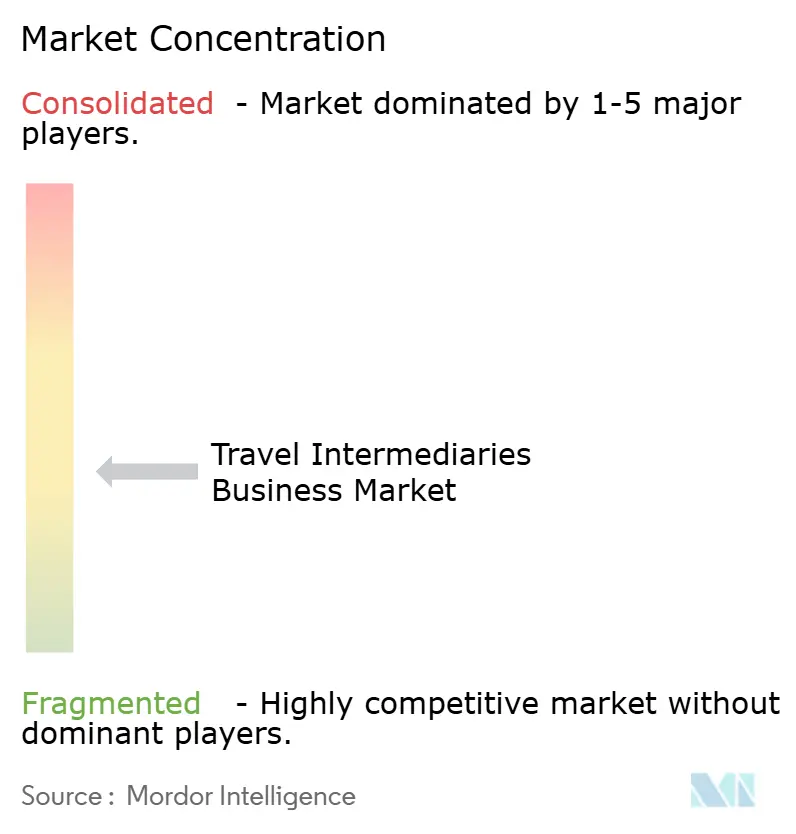
| Market Concentration | Medium |
Major Players *Disclaimer: Major Players sorted in no particular order Image © Mordor Intelligence. Reuse requires attribution under CC BY 4.0. | |
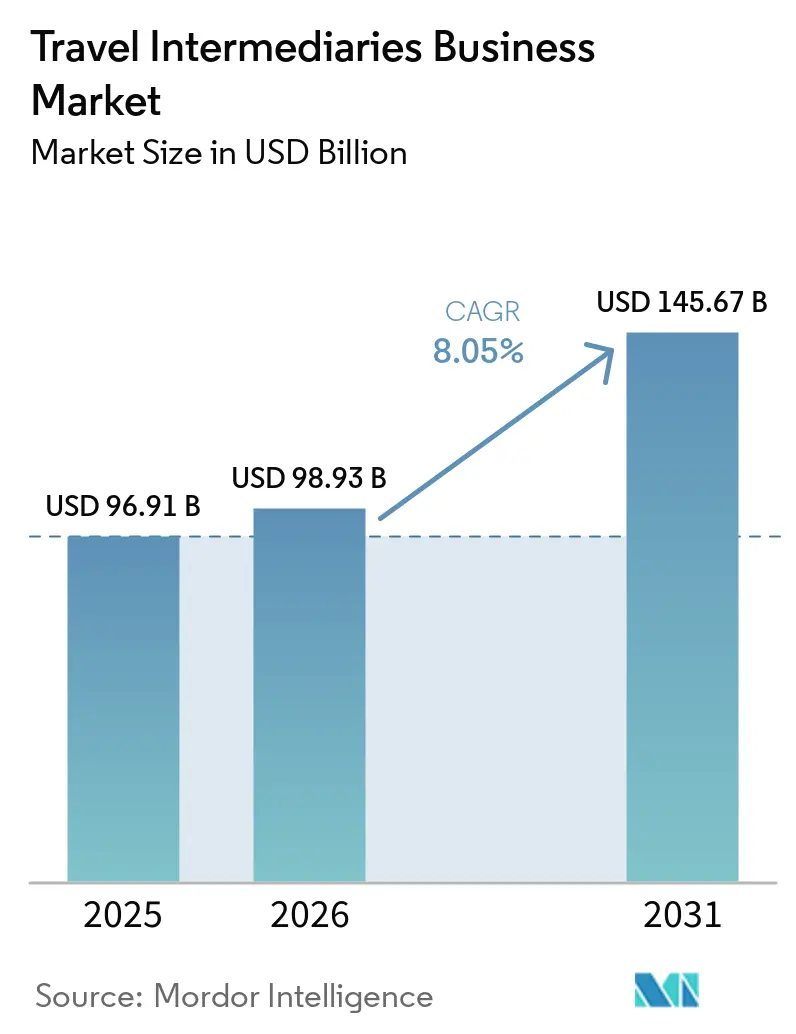
Travel Intermediaries Business Market Analysis by Mordor Intelligence
The Travel Intermediaries Business Market size is expected to grow from USD 96.91 billion in 2025 to USD 98.93 billion in 2026 and is forecast to reach USD 145.67 billion by 2031 at 8.05% CAGR over 2026-2031.
Scaled platforms continue to hold a strong position in the travel intermediaries market because travelers still value having one place to compare inventory, prices, and trip components across multiple suppliers. Booking Holdings reported USD 186.1 billion in gross bookings, and Expedia Group reported USD 119.6 billion in gross bookings in 2025. The travel intermediaries market is also being shaped by the broader adoption of connected trip models, B2B distribution platforms, and bundled travel offers that increase the value of each transaction beyond a single booking. Demand remains supported by rising mobile wallet use in travel and by steady recovery in business travel, especially where intermediaries can connect booking, payments, and post-booking service in the same journey. The strongest competitive advantage now sits with companies that can combine supply breadth, traveler data, loyalty tools, and direct technology partnerships without losing execution speed across regions such as India and the rest of Asia-Pacific.[1]
Key Report Takeaways
- By intermediary type, online travel agencies held 48.63% of the market in 2025, while destination management companies are projected to grow at a 9.84% CAGR through 2031.
- By booking channel, online held 68.41% of the market in 2025, and is projected to grow at a 9.19% CAGR through 2031.
- By customer type, leisure travelers accounted for 72.14% of the market in 2025, while business travelers are projected to expand at a 8.97% CAGR through 2031.
- By service type, accommodation booking accounted for 39.82% of the travel intermediaries market size in 2025, while ancillary services are projected to grow at a 10.24% CAGR through 2031.
- By geography, Asia-Pacific held 32.68% of the travel intermediaries market share in 2025, while the Middle East and Africa is projected to grow at a 9.95% CAGR through 2031.
Note: Market size and forecast figures in this report are generated using Mordor Intelligence’s proprietary estimation framework, updated with the latest available data and insights as of January 2026.
Global Travel Intermediaries Business Market Trends and Insights
Drivers Impact Analysis*
| Drivers | (~) % Impact on CAGR Forecast | Geographic Relevance | Impact Timeline |
|---|---|---|---|
| Rising Demand for Seamless Multi-Supplier Trip Comparison | +1.3% | Global, concentrated impact in Asia-Pacific and North America | Medium term (2-4 years) |
| Expansion of Mobile-First and Super-App Booking Behavior | +1.6% | Asia-Pacific core, spillover to the Middle East and Africa, and South America | Short term (≤ 2 years) |
| Higher Adoption of AI-Powered Trip Personalization and Rebooking | +1.5% | Global | Medium term (2-4 years) |
| Growth in Cross-Border Leisure and Bleisure Travel | +1.2% | North America, Europe, Asia-Pacific | Short-term (≤ 2 years) and medium-term (2-4 years) |
| Supplier Reliance on Intermediary Demand Generation for Niche Inventory | +0.8% | Global, strongest in the Middle East and Africa, and emerging markets | Long term (≥ 4 years) |
| Increasing Monetization of Ancillary Services and Bundled Travel Offers | +1.1% | Global | Medium term (2-4 years) and Long term (≥ 4 years) |
| Source: Mordor Intelligence | |||
Rising Demand for Seamless Multi-Supplier Trip Comparison
The travel intermediaries market continues to benefit from the fact that comparison across suppliers has become a basic traveler expectation rather than a premium feature. Sabre noted that agencies now manage multiple content connections, including NDC direct connects, GDS feeds, low-cost carrier APIs, and aggregators, which raises execution demands and favors platforms with stronger technology and integration capabilities. That operating reality matters in the travel intermediaries market because large platforms can absorb the complexity of connections and still present a simple booking path to travelers. Booking Holdings’ Connected Trip strategy showed this in 2025, with flight ticket volume rising 37% and attractions ticket volume rising 80%, which indicates that breadth across trip components now supports both conversion and repeat use. In practical terms, companies that can combine lodging, flights, ground transport, and activities into a single flow are better placed to hold share as travelers look for fewer handoffs and clearer trip planning.
Expansion of Mobile-First and Super-App Booking Behavior
The travel intermediaries market continues to benefit from the fact that comparison across suppliers has become a basic traveler expectation rather than a premium feature. Sabre noted that agencies now manage multiple content connections, including NDC direct connects, GDS feeds, low-cost carrier APIs, and aggregators, which raises execution demands and favors platforms with stronger technology and integration capabilities. That operating reality matters in the travel intermediaries market because large platforms can absorb the complexity of connections and still present a simple booking path to travelers. Booking Holdings’ Connected Trip strategy showed this in 2025, with flight ticket volume rising 37% and attractions ticket volume rising 80%, which indicates that breadth across trip components now supports both conversion and repeat use. In practical terms, companies that can combine lodging, flights, ground transport, and activities into a single flow are better placed to hold share as travelers look for fewer handoffs and clearer trip planning.
Higher Adoption of AI-Powered Trip Personalization and Rebooking
The travel intermediaries market is moving toward a service model in which personalization, itinerary support, and booking changes are handled with far less friction than before. Amadeus found that 74% of travelers in 2026 wanted personalized hotel experiences, which shows that tailored travel selling is now part of mainstream demand rather than an early-stage feature. This trend supports the travel intermediaries market because intermediaries typically hold richer cross-trip and cross-category data than single suppliers, especially when the same traveler books lodging, transport, and extras on a single platform. Booking Holdings continued to expand its Connected Trip model in 2025, and Expedia also moved deeper into an integrated offer through activities and ground transport acquisitions, which shows that major platforms are building around full-journey relevance rather than one-time booking conversion. As these capabilities improve, rebooking, upselling, and service recovery are likely to become stronger retention tools for scaled intermediaries.
Growth in Cross-Border Leisure and Bleisure Travel
The travel intermediaries market is supported by the continued normalization of cross-border leisure trips and by business travel that increasingly includes leisure extensions. GBTA stated that global business travel spending reached USD 1.57 trillion in 2025 and is projected to grow by 8.1% in 2026, keeping demand strong for platforms that can manage both business and blended trip needs. Amadeus also highlighted that business travel remains shaped by travelers who want more flexibility, easier servicing, and more relevant trip options, which raises the value of intermediaries that can combine policy, convenience, and choice. In the travel intermediaries market, this matters because a traveler extending a work trip often needs extra nights, local transport, or activities that are easier to add through an intermediary than through separate direct channels. The same dynamic supports Indian and broader Asia-Pacific demand because regional travel flows are expanding alongside stronger airline capacity and greater digital booking comfort, even as travelers shift between business and leisure purposes on a single journey.
Restraints Impact Analysis*
| Restraints | (~) % Impact on CAGR Forecast | Geographic Relevance | Impact Timeline |
|---|---|---|---|
| Supplier Direct Booking Incentives Reduce Intermediary Dependence | -1.0% | Global, concentrated in North America and Europe | Short term (≤ 2 years) and Medium term (2-4 years) |
| Search Algorithm Volatility Raises Customer Acquisition Costs | -0.9% | Global | Short term (≤ 2 years) |
| Commission Compression From Rate Parity Erosion and Low-Yield Segments | -0.8% | North America and Europe | Medium term (2-4 years) |
| Content Fragmentation Across NDC and Supplier Direct Channels | -0.7% | Asia-Pacific, North America, Europe | Medium term (2-4 years) and Long term (≥ 4 years) |
| Source: Mordor Intelligence | |||
Supplier Direct Booking Incentives Reduce Intermediary Dependence
The travel intermediaries market faces pressure from suppliers that continue to strengthen direct booking channels through loyalty programs, exclusive offers, and closer ownership of customer data. This matters most in hotel and airline categories where suppliers can reserve certain benefits, pricing structures, or post-booking control for direct channels. Booking Holdings reported that its direct traffic share remained in the mid-60% range in 2025, underscoring the importance of direct relationships across travel demand generation more broadly. In the travel intermediaries market, stronger supplier direct channels can narrow commission opportunities, especially for standardized inventory where travelers do not need comparison across many moving parts. The effect is less severe in complex trips, packages, and experience-led travel, but it remains a clear restraint in mature lodging and air distribution.
Search Algorithm Volatility Raises Customer Acquisition Costs
The travel intermediaries market is also exposed to customer-acquisition risk because much of the digital demand still depends on external platforms and changing discovery paths. When search behavior shifts, intermediaries must spend more on brand, app engagement, partnerships, or performance marketing to defend the same volume of traffic. Booking Holdings and Expedia both continue to invest heavily in technology and broad ecosystem capabilities, suggesting that leading players are trying to reduce dependence on any single traffic source by building more direct, repeat usage across the journey. For the travel intermediaries market, this creates a wider gap between large platforms and smaller operators that cannot support the same level of brand and product investment. In India, where mobile-led travel demand continues to deepen, app retention and cross-category engagement are more important than one-time traffic acquisition.
*Our forecasts treat driver/restraint impacts as directional, not additive. The impact forecasts reflect baseline growth, mix effects, and variable interactions.
Segment Analysis
By Intermediary Type: Scale Platforms And Experience Specialists Continue To Pull The Market In Different Directions
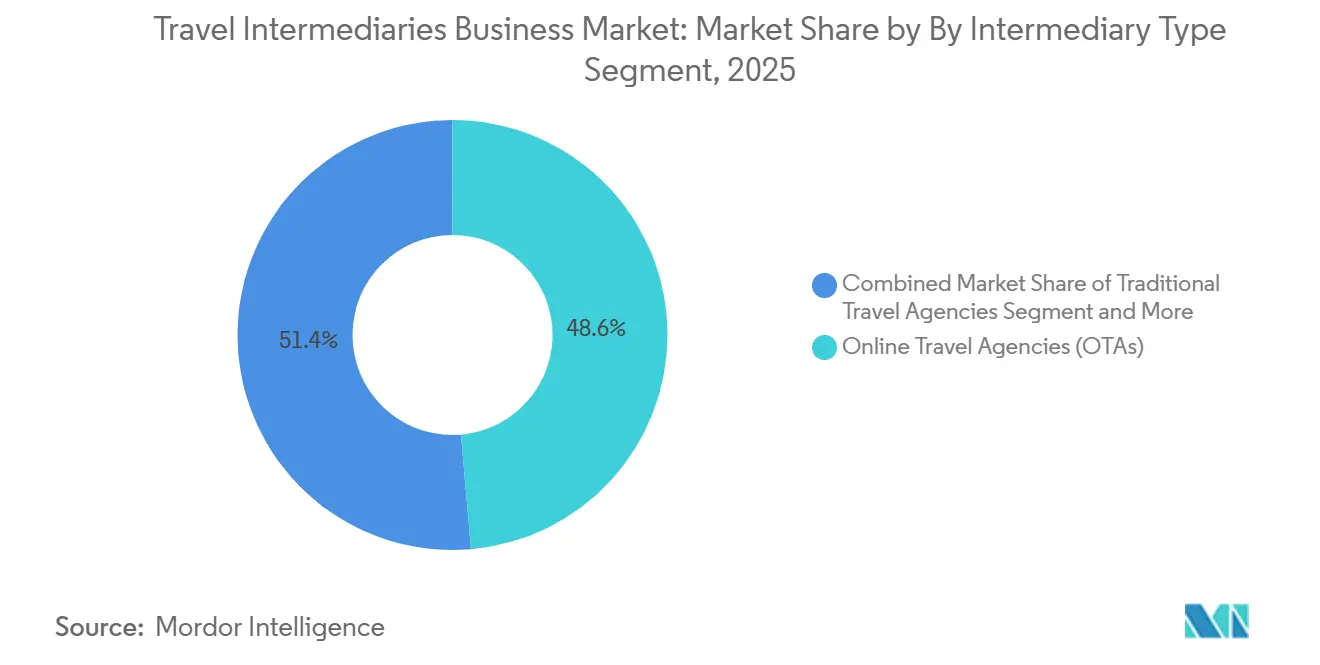
Online travel agencies held 48.6% of the market in 2025 and remain the largest intermediary type because they offer broad comparisons, faster discovery, and stronger cross-category merchandising in a single interface. In the travel intermediaries market, this scale advantage is strengthened by the data and loyalty loops that larger OTAs can build over repeated bookings. Booking Holdings stated that Genius members at levels 2 or 3 accounted for a high-50% share of room nights in 2025, up from the mid-50% range in 2024, which shows that OTA loyalty is becoming more important for retention and spend depth. That matters for the travel intermediaries industry because loyalty now supports not only lodging repeat rates but also cross-sell into flights, attractions, and trip servicing. Traditional agencies still hold relevance where itinerary complexity, group coordination, or offline trust remains important, even if their share is lower in a digital-first booking environment.
Destination management companies are projected to grow at a 9.8% CAGR through 2031, which makes them the fastest-growing intermediary type in the current structure. The travel intermediaries market benefits from the rise of event-led, group-led, and locally managed travel, which requires deeper operational coordination than a standard OTA flow can provide. Uniqueworld Global stated that more than half of all corporate travel budgets in 2026 are being directed toward group gatherings rather than individual trips, which supports demand for DMC capabilities around planning, logistics, and on-ground execution. This part of the travel intermediaries industry is especially relevant in India, the Middle East, and parts of Asia-Pacific, where corporate events, destination weddings, and managed group movements continue to drive demand beyond pure self-serve booking. The result is a market in which large OTAs dominate standardized trip comparison, while DMCs gain ground in high-touch and event-linked travel.

By Booking Channel: Online Strengthens Its Lead While Offline Retains Value In Complex Demand Pockets
The online channel accounted for 68.4% of the market in 2025, confirming that digital booking remains the primary route to scale in the travel intermediaries market. This lead is supported by faster comparison, app-based servicing, wider inventory display, and stronger opportunities to attach ancillaries and payment services during checkout. GBTA’s 2025 data on mobile wallet use reinforces this direction, especially in Asia-Pacific, where digital payments already support a more continuous booking flow from inspiration to payment. In India, online travel platforms have been expanding into adjacent categories through acquisitions and service expansions, indicating that channel leadership is increasingly tied to ecosystem depth rather than a single booking function. The online route, therefore, remains the main engine of volume, data capture, and repeat engagement in the travel intermediaries market.
The offline channel still has strategic value even though its aggregate share is lower. This is most visible in complex leisure plans, corporate group travel, high-value assisted sales, and markets where customers still want human support before purchase or during trip disruption. The travel intermediaries market keeps room for this channel because not every booking decision is simple, especially when travel includes multiple destinations, special events, or policy-sensitive corporate arrangements. Webjet Group’s acquisition of Locomote and its relaunch as Webjet Business Travel in FY2026 demonstrate that managed corporate travel continues to benefit from service models that combine digital efficiency with consultant-backed support. The offline channel is therefore shrinking as a share of routine volume, but it remains commercially relevant in segments where advice, assurance, and servicing are as important as price comparison.
By Customer Type: Leisure Continues To Drive Volume While Business Travel Supports Higher-Service Demand
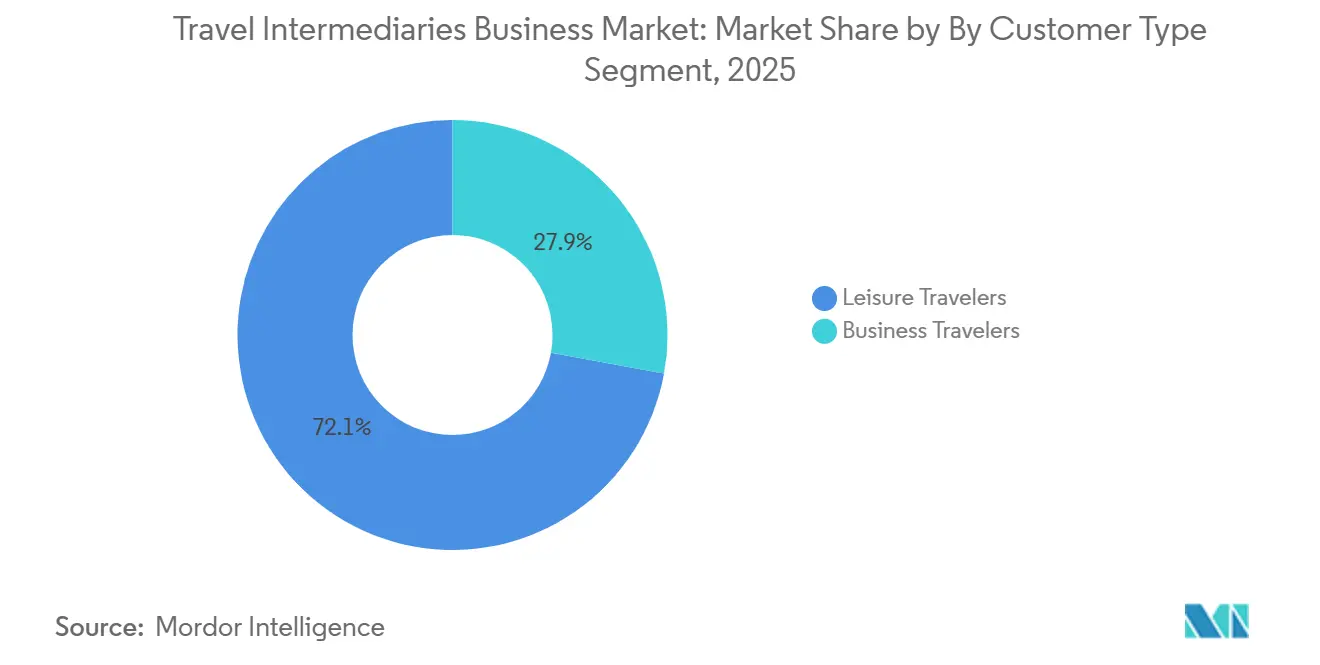
Leisure travelers accounted for 72.1% of the market in 2025, making them the largest customer group in the travel intermediaries market. This segment remains the volume base because vacation demand spans accommodation, transport, activities, and seasonal packages, all of which fit well within intermediary-led comparison and bundling models. Booking Holdings’ 2025 volume growth in room nights, flights, and attractions shows how leisure demand increasingly moves through platforms that can connect the full trip rather than one component at a time. Leisure travelers also respond well to dynamic packaging, flexible planning, and inspiration-led merchandising, which strengthen the role of intermediaries that can surface many options without making the purchase path more complex. In the travel intermediaries market, this means leisure volume still funds much of the investment that larger platforms are making in data, loyalty, and product breadth.
Business travelers are projected to grow at a 9% CAGR through 2031, making them the fastest-growing customer type in the current outlook. GBTA expects global business travel spending to grow 8.1% in 2026 after reaching USD 1.57 trillion in 2025, underscoring the importance of the corporate channel to intermediaries that can combine policy control with easier traveler servicing. Amadeus also showed that business travelers increasingly want smoother, more personalized journeys, which supports intermediaries that can integrate booking, support, and changes more effectively than fragmented direct channels. In India, this customer group remains important because corporate travel demand is increasingly linked with digital expense workflows, managed hotel programs, and regional trip frequency across major and emerging commercial cities. The business segment is therefore growing not only because travel volumes are recovering, but also because the service expectations around each trip are becoming more demanding.[2]
By Service Type: Accommodation Remains The Revenue Core While Ancillaries Gain More Strategic Weight
Accommodation booking accounted for 39.8% of the market in 2025 and remained the largest service type in the travel intermediaries market. Lodging holds this position because it is central to most trip-planning flows and often serves as the anchor around which transport, activities, and local services are added. Booking Holdings processed 1.235 billion room nights in 2025, underscoring how lodging continues to dominate booking volume even as platforms diversify into other categories. In the travel intermediaries market, accommodation also supports strong merchandising because the stay usually defines location, duration, and the rest of the trip basket. Transportation and holiday packages remain important, but accommodation still sits at the center of both traveler intent and intermediary economics.
Ancillary services are projected to grow at a 10.2% CAGR through 2031, making them the fastest-growing service type in the current forecast. The travel intermediaries market is moving this way because add-ons such as experiences, transfers, insurance-linked services, and related trip components can be added after the primary booking without creating a new customer-acquisition cycle. Expedia’s moves into Tiqets and CarTrawler, along with Travelport’s focus on personalized ancillary access for Webjet, show that intermediaries are investing in these layers as a core part of revenue design. This pattern is relevant in India as well, where bundled value and a smoother checkout can help intermediaries increase conversion in a highly price-sensitive travel environment. As a result, ancillary services are becoming less of a side category and more of a core growth lever for the travel intermediaries market.
Geography Analysis
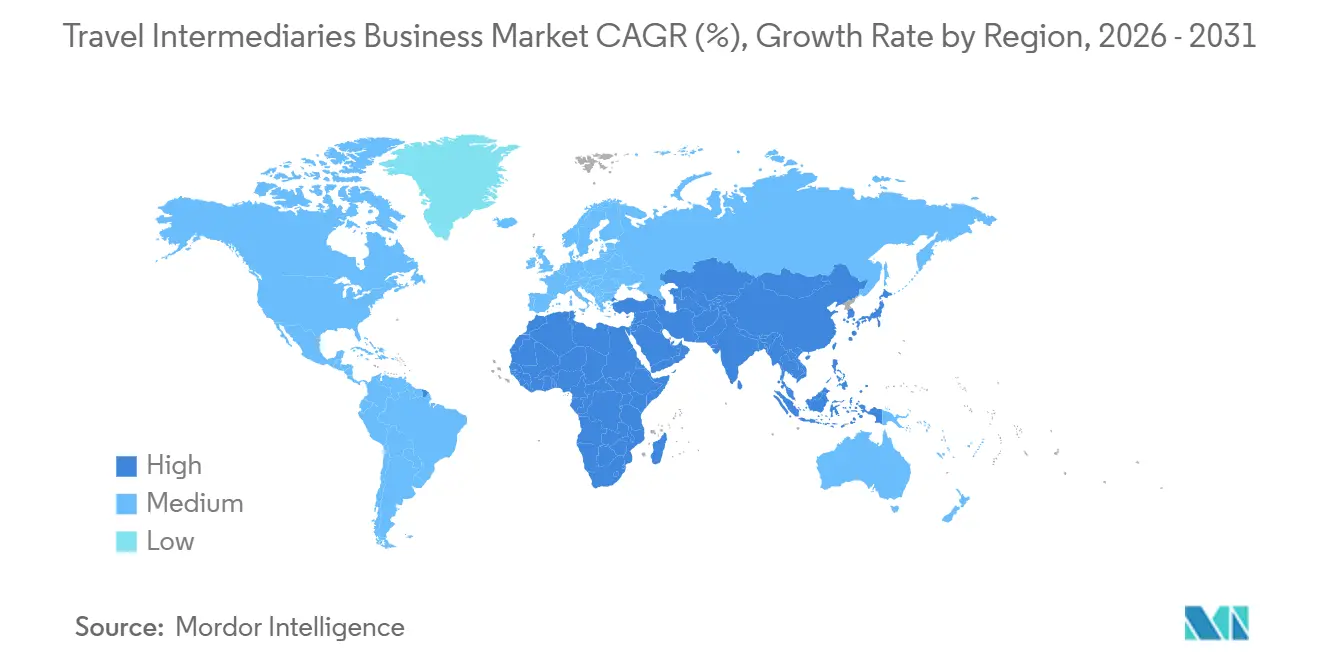
Asia-Pacific accounted for 32.7% of the market in 2025, making it the largest regional block in the travel intermediaries market. The region combines fast digital payment adoption, large mobile-first traveler bases, and strong intra-regional travel flows, which keep intermediary usage broad across both leisure and business bookings. GBTA’s travel payment data showed the highest mobile wallet penetration in Asia-Pacific, which supports a booking environment well-suited to app- and platform-led travel intermediation. India remains one of the clearest examples of this pattern because travel demand is spreading across metros and smaller cities. At the same time, large online platforms continue to expand their service mix through adjacent acquisitions and product expansion. The Asia-Pacific position in the travel intermediaries market is therefore supported by both structural demand growth and by a user base that is comfortable completing more of the travel journey inside digital ecosystems.
North America and Europe remain major revenue anchors for the travel intermediaries market, even though their growth rates are lower than those of some emerging regions. GBTA reported that the United States accounted for USD 395.4 billion of global business travel spending in 2025, underscoring the importance of mature corporate demand for intermediary volumes. These regions also have a well-developed intermediary base across OTAs, TMCs, and specialist travel operators, which keeps competition intense and raises the importance of technology differentiation. Expedia’s 2025 and 2026 acquisition activity shows that large companies still see room to deepen travel distribution in mature markets by improving B2B connectivity and expanding product offerings. Even so, mature market conditions also make direct supplier competition, content fragmentation, and commission pressure more visible than in many newer travel corridors.
The Middle East and Africa are projected to grow at a 10% CAGR through 2031, making it the fastest-growing region in the travel intermediaries market. WTTC stated that the Middle East travel and tourism sector grew 5.3% in 2025, ahead of the global average of 4.1%, and that Saudi Arabia grew 7.4%, pointing to strong regional travel momentum. This growth matters for the travel intermediaries market because expanding destination investment, new business events, and stronger international air links typically increase the need for distribution, packaging, and trip servicing. The region also benefits from rising interest in destination-led and event-led travel, which supports intermediaries that can handle group movement, mixed-purpose trips, and supplier coordination across several components. Africa is still at an earlier stage within the regional mix, but improving connectivity and rising outbound demand in selected markets can add a longer-term layer of growth to the travel intermediaries market.[3]
Competitive Landscape
The travel intermediaries market is moderately consolidated at the top, with Booking Holdings and Expedia Group continuing to set the pace on scale, breadth, and technology spending. Booking Holdings reported USD 186.1 billion in gross bookings in 2025, while Expedia Group reported USD 119.6 billion, which confirms that the largest platforms still hold a strong position in global travel distribution. In the travel intermediaries market, this scale matters because it supports technology reinvestment, broader supply relationships, stronger loyalty programs, and better resilience against traffic or margin pressure. Booking’s Connected Trip model, cost discipline efforts, and cross-category booking growth show a strategy focused on increasing the value of each customer relationship rather than only growing traffic. Expedia is moving in a similar direction with a more comprehensive B2B travel platform that can serve airlines, banks, loyalty partners, and agencies via a broader API-led stack.
Competition below the top tier is more regional and specialized, keeping the travel intermediaries market active across many business models rather than just global OTAs. In India, MakeMyTrip’s agreement to acquire a majority stake in Flamingo Transworld in March 2026 shows how regional leaders are strengthening packaged holiday capabilities and expanding deeper into offline-assisted and organized travel demand. HBX Group’s acquisition of full ownership of PerfectStay in April 2026 and Bridgify in May 2026 shows another route, where B2B specialists are using packaging and AI-enabled experiences to widen their role in the value chain. These moves show that the travel intermediaries market is not only about consumer-facing apps, but it is also about the infrastructure and merchandising tools behind embedded travel distribution. The strongest challengers are therefore the ones that can own a distinct layer of value, whether that is packaged holidays, B2B supply, corporate travel workflows, or destination services.
Strategic moves in 2025 and 2026 also show that the travel intermediaries market is becoming more tightly linked to ecosystems rather than stand-alone booking portals. Expedia’s Tiqets agreement added experiences to its stack, and the later CarTrawler agreement added ground transport and insurtech, broadening its relevance throughout the trip. Travelport and Webjet extended their multi-year partnership in 2026, with a focus on NDC content and personalized ancillary access, underscoring how content quality and service capabilities remain central to competitive positioning. Klook’s 2026 expansion into sports and live events also points to a wider definition of travel-related demand, where experiences and premium inventory can raise both engagement and spend. Overall, the travel intermediaries market remains led by a few large companies, while growth opportunities remain open for players with strong regional positioning or specialized product depth.
Travel Intermediaries Business Industry Leaders
-
Booking Holdings Inc.
-
Airbnb, Inc.
-
Trip.com Group Limited
-
MakeMyTrip Limited
-
Expedia Group, Inc.
- *Disclaimer: Major Players sorted in no particular order
Recent Industry Developments
- May 2026: Visa and Trip.com Group formalized a strategic partnership aimed at optimizing payment ecosystems and driving consumer engagement across the Asia-Pacific region. Under this agreement, Trip.com Group integrates into the Visa Destinations framework as a global Anchor Partner. The initiative fuses Trip.com’s comprehensive online travel booking network with Visa's secure digital payment infrastructure. This unlocks localized promotional offers, curated travel packages, and high-security frictionless transactional paths directly inside the intermediary platform.
- March 2026: Booking Holdings announced a major corporate restructuring to merge its disparate commercial arms. The initiative consolidates the strategic partnership and business-to-business (B2B) operational divisions of its primary subsidiaries Booking.com, Priceline, and Agoda under a single, unified global structure.
- December 2025: Expedia Group announced an agreement to acquire Tiqets. The Amsterdam-based activities and experiences platform is expected to strengthen Expedia’s B2B API offering for activities and broaden its supply position across the travel journey.
- January 2025: American Express GBT successfully finalized its acquisition of rival Travel Management Company (TMC), CWT. This horizontal acquisition absorbs CWT's extensive corporate portfolio and specialized logistics software into Amex GBT's software suite.
Global Travel Intermediaries Business Market Report Scope
| Online Travel Agencies |
| Traditional Travel Agencies |
| Destination Management Companies (DMCs) |
| Corporate Travel Management Companies (TMCs) |
| Online |
| Offline |
| Leisure Travelers |
| Business Travelers |
| Accommodation Booking |
| Transportation Booking |
| Holiday Packages |
| Ancillary Services |
| North America | United States |
| Canada | |
| Mexico | |
| South America | Brazil |
| Peru | |
| Chile | |
| Argentina | |
| Rest of South America | |
| Europe | United Kingdom |
| Germany | |
| France | |
| Spain | |
| Italy | |
| BENELUX (Belgium, Netherlands, and Luxembourg) | |
| NORDICS (Denmark, Finland, Iceland, Norway, and Sweden) | |
| Russia | |
| Rest of Europe | |
| Asia-Pacific | India |
| China | |
| Japan | |
| Australia | |
| South Korea | |
| South East Asia (Singapore, Malaysia, Thailand, Indonesia, Vietnam, and Philippines) | |
| Rest of Asia-Pacific | |
| Middle East and Africa | United Arab Emirates |
| Saudi Arabia | |
| South Africa | |
| Nigeria | |
| Rest of Middle East and Africa |
| By Intermediary Type | Online Travel Agencies | |
| Traditional Travel Agencies | ||
| Destination Management Companies (DMCs) | ||
| Corporate Travel Management Companies (TMCs) | ||
| By Booking Channel | Online | |
| Offline | ||
| By Customer Type | Leisure Travelers | |
| Business Travelers | ||
| By Service Type | Accommodation Booking | |
| Transportation Booking | ||
| Holiday Packages | ||
| Ancillary Services | ||
| By Geography | North America | United States |
| Canada | ||
| Mexico | ||
| South America | Brazil | |
| Peru | ||
| Chile | ||
| Argentina | ||
| Rest of South America | ||
| Europe | United Kingdom | |
| Germany | ||
| France | ||
| Spain | ||
| Italy | ||
| BENELUX (Belgium, Netherlands, and Luxembourg) | ||
| NORDICS (Denmark, Finland, Iceland, Norway, and Sweden) | ||
| Russia | ||
| Rest of Europe | ||
| Asia-Pacific | India | |
| China | ||
| Japan | ||
| Australia | ||
| South Korea | ||
| South East Asia (Singapore, Malaysia, Thailand, Indonesia, Vietnam, and Philippines) | ||
| Rest of Asia-Pacific | ||
| Middle East and Africa | United Arab Emirates | |
| Saudi Arabia | ||
| South Africa | ||
| Nigeria | ||
| Rest of Middle East and Africa | ||
Key Questions Answered in the Report
What is the current size of the travel intermediaries market?
The travel intermediaries market was valued at USD 96.9 billion in 2025 and is estimated at USD 98.9 billion in 2026. It is forecast to reach USD 145.7 billion by 2031, growing at an 8.1% CAGR over 2026-2031.
Which booking channel leads travel intermediary revenue?
The online channel led with a 68.4% share in 2025. Its lead is supported by app-based booking, wider supplier comparison, and stronger cross-sell opportunities across travel services.
Which intermediary type holds the largest share?
Online travel agencies held the largest share at 48.6% in 2025. Their strength comes from broad inventory aggregation, easier price comparison, and growing loyalty-led repeat usage.
Which customer segment is growing the fastest?
Business travelers are the fastest-growing customer segment, with a projected 9% CAGR through 2031. This growth is supported by recovery in corporate travel and rising demand for integrated booking and expense tools.
Which service category is expected to grow the fastest?
Ancillary services are projected to grow at a 10.2% CAGR through 2031. This reflects stronger monetization of add-ons such as experiences, transfers, and other trip-related services.
Which region offers the strongest growth opportunity?
Middle East and Africa is expected to grow the fastest, at a 10% CAGR through 2031. Asia-Pacific remained the largest region in 2025 with a 32.7% share, supported by strong digital adoption and mobile-first booking behavior.