
Transaction Banking Market Size and Share
Market Overview
| Study Period | 2020 - 2031 |
|---|---|
| Market Size (2026) | USD 1.5 Trillion |
| Market Size (2031) | USD 2.10 Trillion |
| Growth Rate (2026 - 2031) | 7.50 % |
| Fastest Growing Market | Asia-Pacific |
| Largest Market | Asia-Pacific |
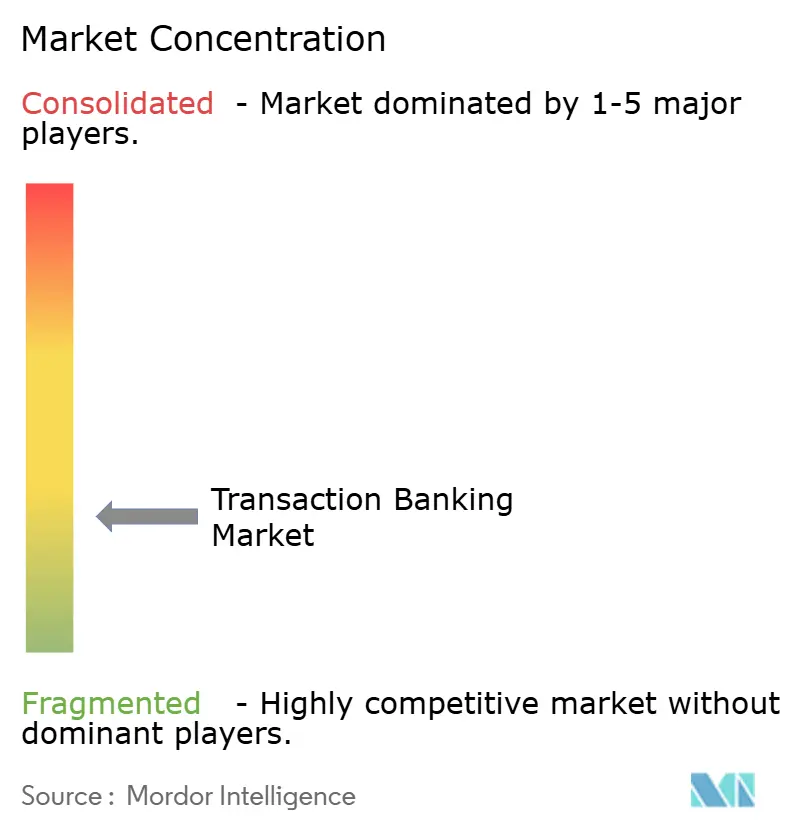
| Market Concentration | Low |
Major Players *Disclaimer: Major Players sorted in no particular order Image © Mordor Intelligence. Reuse requires attribution under CC BY 4.0. | |
Transaction Banking Market Analysis by Mordor Intelligence
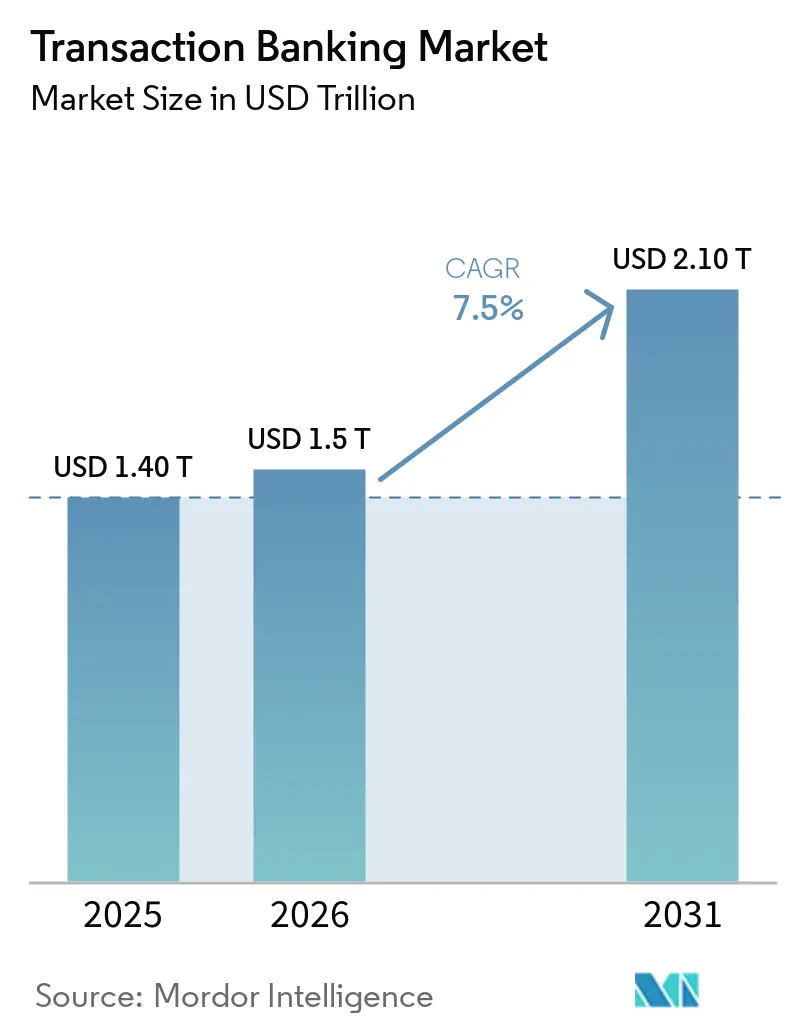
The transaction banking market size was valued at USD 1.4 trillion in 2025 and is expected to increase from USD 1.5 trillion in 2026 to USD 2.1 trillion by 2031, registering a CAGR of 7.5% over 2026-2031. The transaction banking market is moving toward fee-based services as banks place greater emphasis on payments, trade finance, and liquidity management. Corporate clients increasingly expect funds to move and be visible throughout the day, rather than through end-of-day processes. This is increasing the value of payment connectivity, cash visibility, and data-rich reporting. Banks are responding with application programming interfaces, integrated treasury tools, and services tailored to cross-border supply chains. The transaction banking market also faces pressure from lower payment prices, legacy technology, and more demanding compliance requirements.
Key Report Takeaways
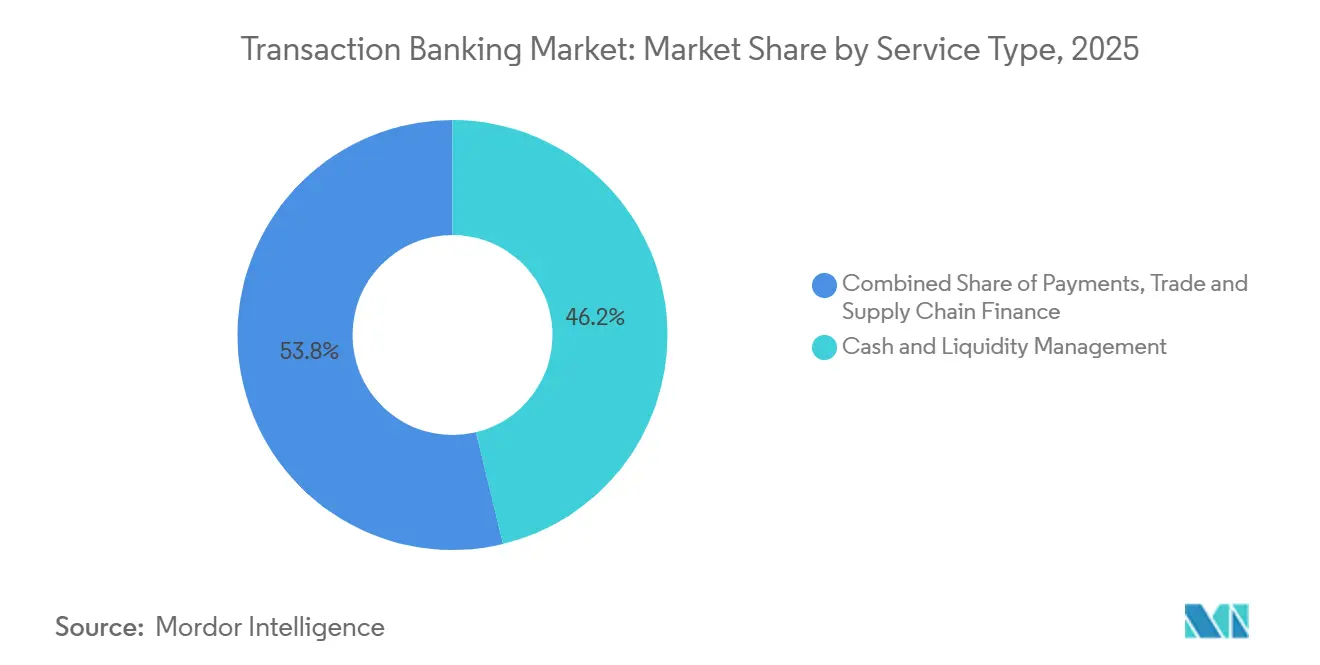
- By service type, cash & liquidity management held 46.2% of the transaction banking market share in 2025, while payments is forecast to expand at an 8.8% CAGR through 2031.
- By client type, large corporates held 58.0% of the transaction banking market share in 2025, while SMEs recorded the highest projected CAGR at 9.2% through 2031.
- By primary service channel, relationship-manager-led and hybrid channels held 62.4% of the transaction banking market share in 2025, while digital and platform-led channels recorded the highest projected CAGR at 10.6% through 2031.
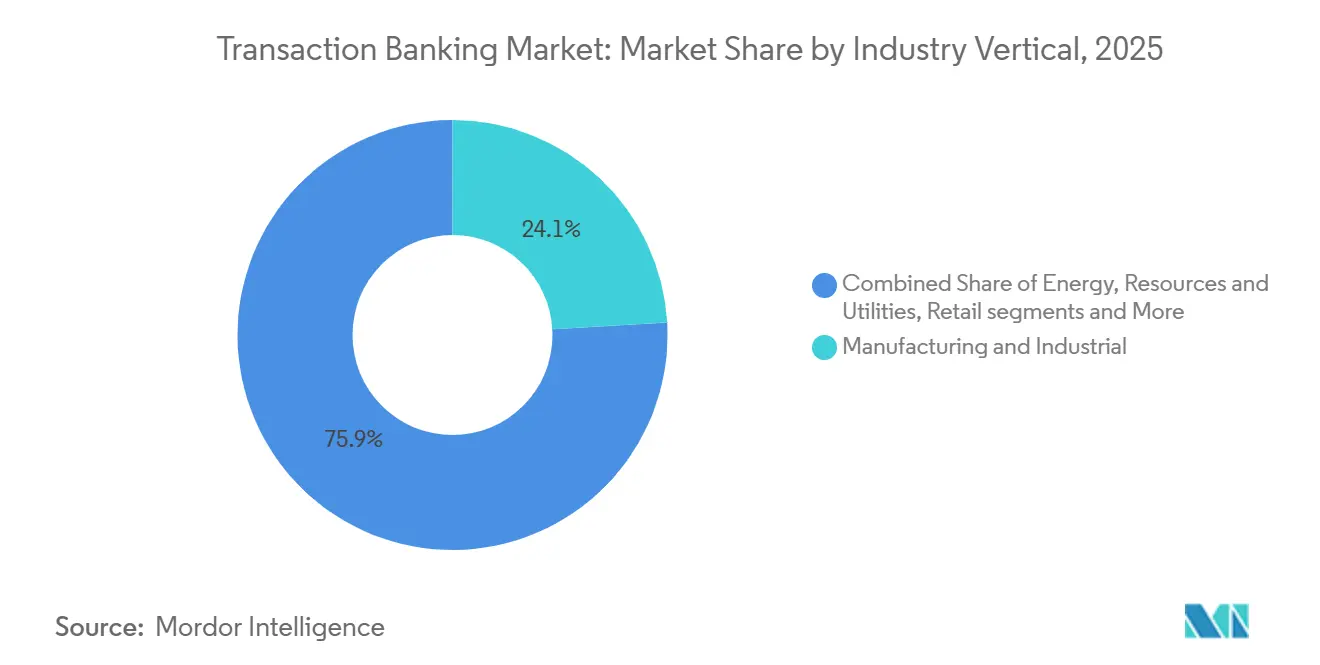
- By industry vertical, manufacturing and industrial accounted for 24.1% of the transaction banking market share in 2025, while technology, media, and telecommunications is advancing at a 9.0% CAGR through 2031.
- By geography, Asia-Pacific held 37.8% of the transaction banking market share in 2025 and is forecast to grow at an 8.6% CAGR through 2031.
Note: Market size and forecast figures in this report are generated using Mordor Intelligence’s proprietary estimation framework, updated with the latest available data and insights as of January 2026.
Global Transaction Banking Market Trends and Insights
Drivers Impact Analysis*
| Driver | (~) % Impact on CAGR Forecast | Geographic Relevance | Impact Timeline |
|---|---|---|---|
| Real-Time Corporate Payments and Cash Management | +1.5% | Global, with the strongest activity in Europe, Asia-Pacific, and North America | Short-term (≤ 2 years) |
| ISO 20022 Adoption and Cross-Border Payment Efficiency | +0.8% | Global, with particular relevance for EMEA and Asia-Pacific payment corridors | Medium term (2-4 years) |
| API-Led Treasury Connectivity and Embedded Banking | +1.2% | North America, Europe, and Asia-Pacific | Medium term (2-4 years) |
| Cross-Border Working Capital and Liquidity Optimization | +1.0% | Asia-Pacific, Middle East and Africa, and South America | Medium term (2-4 years) |
| Virtual Accounts and Centralized Cash Management | +0.6% | Global, particularly multinational business centers | Medium term (2-4 years) |
| Digital Onboarding And Straight-Through Processing | +0.4% | Asia-Pacific, South America, and Middle East and Africa | Long-term (≥ 4 years) |
| Source: Mordor Intelligence | |||
Accelerating Demand for Real-Time, Always-On Corporate Payments and Cash Management
The transaction banking market is being shaped by a move toward payment settlement that operates throughout the day and night. This change requires treasurers to monitor intraday liquidity, funding positions, and payment exceptions more closely. The European instant payments framework requires payment service providers to make euro credit transfers available within 10 seconds, which extends real-time payment use beyond consumer transfers[1]European Commission, “Instant Payments,” European Commission, europa.eu. Banks can use these services to improve payment tracking and cash visibility for corporate clients. BBVA Directa supports immediate availability for payments into Spain from international banks, showing how payment speed can distinguish corridor-specific services. Bank of America plans a cross-border real-time payment service through SWIFT and CashPro for commercial and institutional clients, including users with frequent international payouts.
ISO 20022 Adoption Enabling Richer Data, Automation and Cross-Border Payment Efficiency
ISO 20022 adoption is changing the information that travels with a payment in the transaction banking market. Structured data can support faster reconciliation, clearer cash-position reporting, and stronger controls over payment details. SWIFT states that its corporate cash reporting work uses ISO 20022 messages to provide account balances and transaction information across banks[2]Society for Worldwide Interbank Financial Telecommunication, “How We’re Enabling a Seamless Payments Experience for Corporates Around the Globe,” SWIFT, swift.com. The transition also makes data quality more important for companies that send cross-border payment instructions. BAFT noted that ISO 20022 migration can affect sanctions and compliance processes because richer message fields require reliable screening practices. This makes structured payment information a practical requirement for corporate treasury operations, not only a bank technology project. Banks that turn better data into reporting and exception-management services can strengthen their position in the transaction banking market.
API-Led Treasury Connectivity and Embedded Banking Expanding Transaction Banking Usage
API connections are moving payment and cash-management functions from bank portals into enterprise resource planning and treasury systems. BMO introduced Payment APIs in December 2025 to let businesses embed real-time payments in enterprise and customer-facing applications across Canada and the United States. Huntington Bank introduced an API-first treasury connectivity ecosystem with more than 500 interfaces and capacity for more than 10 million transaction events each day. These connections reduce manual entry and make payment services part of existing business processes. Standard Chartered and Finmo linked global currency accounts with API-driven treasury connectivity across Singapore, the United Arab Emirates, Hong Kong, and the United Kingdom in 2025[3]Standard Chartered, “A New Blueprint for Resilient Supply Chain Finance,” Standard Chartered, sc.com. Once a bank service is embedded in a corporate system, replacing it can require changes to operating workflows, which supports longer client relationships in the transaction banking market.
Growing Corporate Demand for Cross-Border Working Capital, Virtual Accounts, and Digital Access
Companies are seeking cash-management and financing services that support changing supply chains and a wider set of trading partners. The Asian Development Bank reported a USD 2.5 trillion global trade finance gap and found that 90% of surveyed providers expected demand to rise as firms adjusted their trading relationships. This creates demand for working-capital structures, open-account trade services, and supplier financing. Standard Chartered found that 56% of surveyed companies ranked geographic supply chain realignment among their leading resilience priorities. Virtual accounts can improve visibility by separating balances and receivables without requiring a separate physical account for each purpose. Digital onboarding and straight-through processing can also reduce the cost of providing treasury services to smaller businesses. These developments broaden access to the transaction banking market while increasing the need for consistent operational controls.
Restraints Impact Analysis*
| Restraint | (~) % Impact on CAGR Forecast | Geographic Relevance | Impact Timeline |
|---|---|---|---|
| Legacy Banking Infrastructure and Slow Product Modernization | -1.2% | Global, particularly North America and Europe | Medium term (2-4 years) |
| Fee Compression and FinTech Competition | -0.9% | Global, with early margin pressure in Asia-Pacific and South America | Short term (≤ 2 years) |
| Fragmented AML, Sanctions, and Regulatory Requirements | -0.5% | Global, especially multi-jurisdiction corridors involving USD clearing | Medium term (2-4 years) |
| Rising Fraud and Cybersecurity Risks In Real-Time Payments | -0.3% | Global, especially countries with high instant-payment usage | Short term (≤ 2 years) |
| Source: Mordor Intelligence | |||
Legacy Banking Infrastructure Increasing Integration Costs and Slowing Product Modernization
Legacy systems can delay the changes banks need to make for real-time payments, APIs, and richer payment data. The issue is most acute when payment processing, compliance checks, and client reporting rely on separate older systems. Modernization projects can also disrupt core processes, so banks must balance service continuity against the need for change. The transaction banking market requires infrastructure that can process payments quickly while maintaining controls across multiple jurisdictions. Older systems make it harder to provide a consistent experience across channels and countries. This can slow product releases and raise the cost of integrating corporate technology platforms with bank services.
Fee Compression, Compliance Complexity, and Fraud Risks Pressuring Margins
Digital payment providers are competing for lower-value and small-business cross-border flows with simpler digital experiences and lower prices. This puts pressure on banks to show value through network coverage, liquidity services, trade capability, and compliance support. Cross-border activity also requires banks to manage varying anti-money-laundering and sanctions requirements across jurisdictions. ISO 20022 can improve the information available for these checks, but it does not remove the need for reliable data and controls. Fraud and cybersecurity risks add further complexity as payments settle faster and leave less time for manual intervention. The transaction banking market therefore depends on operational resilience as much as payment speed.
*Our forecasts treat driver/restraint impacts as directional, not additive. The impact forecasts reflect baseline growth, mix effects, and variable interactions.
Segment Analysis
By Service Type: Cash and Liquidity Management Supports Revenue, While Payments Expand Faster
Cash and liquidity management held 46.2% of the transaction banking market share in 2025, making it the largest service type. This part of the transaction banking industry is central to how corporate groups control balances across entities, currencies, and operating locations, using deposit balances, pooling arrangements, sweeping services, and day-to-day cash visibility. These capabilities create a base for related payment and trade services. At the same time, JPMorgan’s virtual netting approach allows group treasuries to settle intercompany obligations in the invoice currency and reduce physical cash movements between entities. SAP Fioneer states that its virtual account management offering can reduce manual reconciliation work by up to 60%[4]SAP Fioneer, “Virtual Account Management,” SAP Fioneer, sapfioneer.com. It states that deployment can take as little as 120 days.
Payments are projected to be the fastest-growing service type at an 8.8% CAGR through 2031. Domestic payments, cross-border transfers, collections, and the shift toward real-time settlement are supporting the transaction banking market size for payments. Corporate users need payment initiation and status updates inside their operating systems, which creates demand for payment APIs, tracking tools, and automated reconciliation. Trade and Supply Chain Finance remains important for companies that manage supplier payment terms and trade-related risk. The CGI and BAFT 2025 survey reported that supply chain finance is expected to increase from 26% to more than 32% of the trade finance mix over the coming years, shifting the service mix toward liquidity support for suppliers and buyers.



By Client Type: Large Corporates Hold Revenue, While SMEs Expand Digital Demand
Large corporates held 58.0% of the transaction banking market share in 2025, the highest client-type share. These clients require multicurrency payment services, complex cash structures, trade solutions, and support across several jurisdictions. Their requirements make service reliability and network coverage important, and the transaction banking market serves them through integrated packages rather than isolated payment products. Relationship teams remain useful where a client needs tailored liquidity structures, product documentation, or support in several countries. Corporate treasurers also expect bank services to connect with enterprise systems, making connectivity and reporting core to the service offered to large organizations.
SMEs are forecast to grow at a 9.2% CAGR through 2031, the fastest rate among client types. The transaction banking industry can serve this group more efficiently when onboarding, payment setup, and reporting are delivered digitally. BBVA reported in May 2026 that 58% of its new SME loans were arranged digitally and that its digital SME customer base exceeded 2.8 million. This operating model can lower the effort involved in delivering payment and cash-management tools, while SMEs also need cross-border payment and collection services as they sell online and work with overseas suppliers. Financial Institutions remain a separate client group with correspondent banking and institutional cash-management needs. Their role may change as direct settlement networks reduce some traditional intermediary steps.
By Primary Service Channel: Hybrid Delivery Leads, While Platform-Led Services Grow
Relationship-manager-led and hybrid channels held 62.4% of the transaction banking market share in 2025. This leadership reflects the continued need for human support in complex treasury structures, multi-entity arrangements, and trade-related discussions. The transaction banking market share of these channels also reflects the importance of local knowledge and client service during payment exceptions. Larger companies may use digital tools for routine activity while relying on relationship teams for design and problem resolution, which lets banks connect digital execution with specialist support. This model is particularly relevant where a treasury function manages many currencies, legal entities, or banking relationships, and human support remains valuable as more transactions move to digital systems.
Digital and platform-led channels are forecast to grow at a 10.6% CAGR from 2026 to 2031. These channels are expanding as bank services are integrated directly into enterprise resource planning, treasury, and financial platforms. Users may not need a separate bank portal when payment initiation, reporting, and approvals are embedded in a familiar system, lowering processing effort and helping banks serve more clients. Huntington’s connectivity ecosystem shows how banks are building this type of integration through large libraries of APIs. Digital channels can support straight-through screening and exception workflows, but banks must retain strong controls because faster flows can increase exposure to fraud and operational errors.
By Industry Vertical: Manufacturing Holds Share, While TMT Requires Faster Treasury Services
Manufacturing and industrial held 24.1% of the transaction banking market share in 2025, the largest industry-vertical share. Manufacturers require trade services, supplier financing, collections, and working-capital support across complex supply chains. The transaction banking market is relevant to this sector because goods movement creates recurring payment, documentation, and currency-management needs. Supply chain diversification can create additional demand when companies add suppliers or establish new routes, and Standard Chartered found that 56% of surveyed companies identified geographic supply chain realignment as a leading resilience strategy. Energy, Resources, and Utilities generate significant cash and commodity-related payment requirements, while Retail, Consumer, and Wholesale Trade require high-volume collections and supplier payments.
The technology, media, and telecommunications segment is forecast to grow at a 9.0% CAGR through 2031. Platform businesses often manage high payment volumes, multicurrency collections, marketplace settlements, and frequent payouts. These needs favor real-time payment capabilities and API-based treasury connectivity. The transaction banking market must support this activity with tools that handle volume, provide data quickly, and fit into platform workflows. Healthcare and Life Sciences need reliable receivables management and payment operations, while Public Sector and Government users can require centralized disbursement and treasury arrangements. Digital tools can help these users process large volumes while retaining visibility and control, which makes sector expertise an important part of the service model.
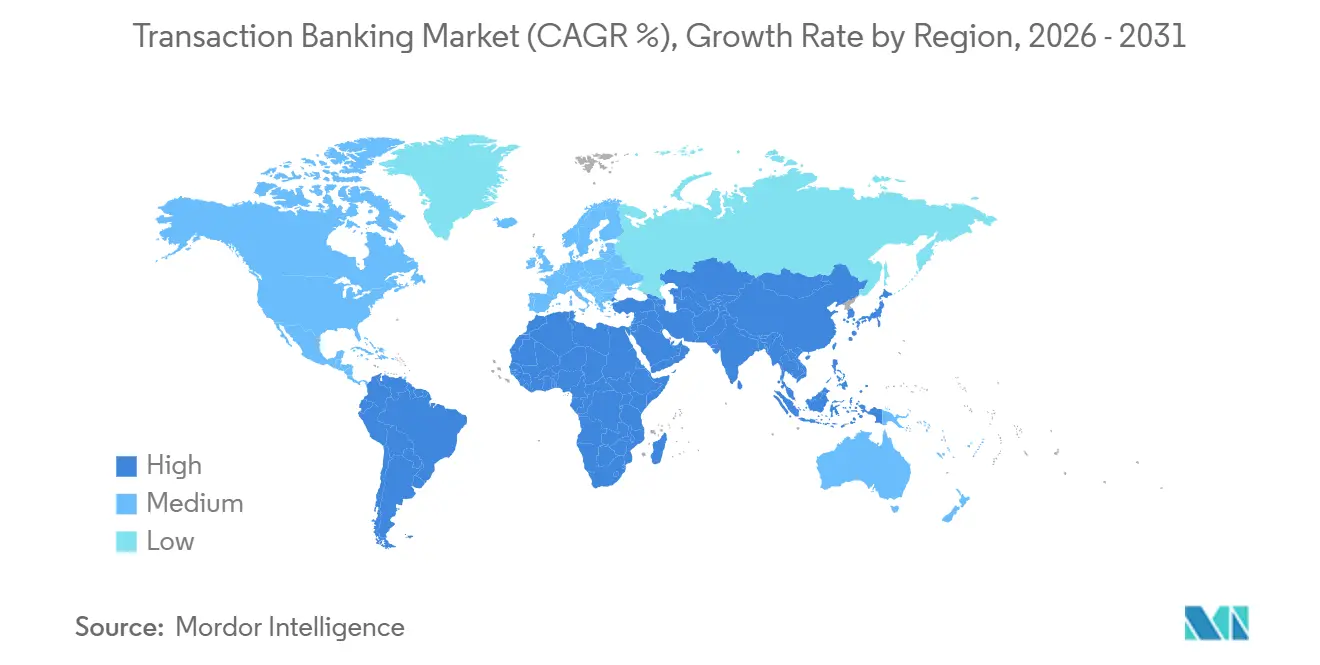
Geography Analysis
Geography Analysis
Asia-Pacific held 37.8% of the transaction banking market share in 2025 and is projected to grow at an 8.6% CAGR through 2031. The region combines major trade corridors with widespread investment in instant payments and corporate digitalization, which supports demand for faster cross-border settlement, liquidity control, and digital payment connections in the transaction banking market. OCBC entered a partnership with SCCCI and CCCME in May 2026 to support Greater China and ASEAN trade, investment, and financial flows, and it stated that the number of Chinese companies it supported in ASEAN rose 50% year over year in 2025. DBS and Banque Saudi Fransi also partnered in 2025 to strengthen trade finance and payment flows between Asia and Saudi Arabia.
North America and Europe remain important centers for large-corporate cash management, correspondent banking, and trade finance. In North America, banks are expanding real-time payment access and integrating payment tools into corporate systems, as shown by Bank of America’s planned cross-border real-time payment service. In Europe, instant payment rules and payment-data standards are changing compliance processes and client expectations. The Bank of England launched its renewed Real-Time Gross Settlement system in April 2025 for approximately USD 572.1 million (GBP 431 million), providing modern settlement infrastructure for future payment innovation. Banque de France reported that French corporate financing rose 3.7% year over year in February 2026, including 4.6% growth in investment credit, supporting demand for payment, cash-management, and financing services.
The Middle East and Africa, and South America, offer expansion potential as payment infrastructure and trade links develop. The transaction banking market can address demand through local payment access, regional currency support, and services for cross-border trade. The G20 roadmap focuses on cost, speed, access, and transparency, providing a shared direction for payment-system improvement. The transaction banking market in these regions depends on stronger connections between payment systems and trade routes. Deutsche Bank was appointed by the People’s Bank of China as an RMB clearing bank for Europe in August 2026, supporting direct clearing and settlement of cross-border RMB transactions in Frankfurt.

Competitive Landscape
Competitive Landscape
The transaction banking market has a group of large international banks and a wider set of regional competitors. JPMorgan, Citi, HSBC, and BNY have broad networks and substantial transaction-banking operations, while DBS, OCBC, Standard Chartered, Deutsche Bank, and BNP Paribas compete through local reach, corridor knowledge, and sector coverage. Competition is not uniform because clients value different combinations of payment reach, cash-management tools, trade services, and relationship support. Large banks can invest heavily in technology, compliance, and global operations, while regional banks can compete where they have strong domestic payment access or close links to specific trade routes.
Product strategy is becoming more important as clients compare bank platforms with digital payment providers. Citi combined Citi Token Services with 24/7 USD Clearing in a live transaction with Siam Commercial Bank in 2026, showing how banks are testing new settlement tools while preserving corporate banking roles. Deutsche Bank’s Scaling the Global Hausbank strategy for 2026-2028 targets approximately USD 5.65 billion (EUR 5 billion) in incremental revenue by 2028, including growth in payments and servicing. Deutsche Bank also expanded its PayPal mandate across the United States, Europe, and Asia-Pacific in January 2026. These actions show that payment infrastructure, trade connections, and digital integration are central competitive priorities.
Banks also face competition from treasury software providers and digital payment firms that give companies a bank-agnostic view of payments and cash. These providers can weaken traditional relationship lock-in when a client uses one interface to manage several banks, so the transaction banking market rewards services that are easy to integrate and use. Supply chain finance is another area where banks and platforms can work together to reach suppliers beyond the first tier. Smaller cross-border payments remain contested because users are sensitive to price and ease of use, and banks can respond through their networks, compliance capability, and liquidity services rather than price alone. This will remain a central competitive issue in the transaction banking market.
Transaction Banking Industry Leaders
JPMorgan Chase
Citigroup (Citi)
HSBC
Bank of America
BNP Paribas
- *Disclaimer: Major Players sorted in no particular order

Recent Industry Developments
- August 2026: Deutsche Bank was designated by the People’s Bank of China to serve as a Renminbi clearing bank for Europe in Frankfurt, enabling direct end-to-end clearing and settlement of cross-border RMB transactions. Deutsche Bank becomes the first foreign bank to receive this designation in Europe, marking a significant expansion of its role as a bridge between Chinese and European financial markets and opening new transaction banking revenue from China-Europe trade corridors.
- June 2026: Citi launched the Citi Consolidate trade digitization solution, powered by Infor Nexus, to digitize invoice approval, purchase order, and payables processes for buyers and suppliers within a single platform. The solution is initially live in the United States and Canada, with global expansion planned, and Citi commenced as a Financing Service Provider on Infor Nexus, eliminating the need for clients to manage multiple platforms.
- June 2026: Bank of America announced plans to launch a cross-border real-time payments solution via SWIFT and CashPro for corporate, commercial, and financial institution clients, offering real-time payment tracking, full principal preservation, and lower costs. The service targets high-volume, low-value international flows, including international remittances, gig-worker payouts, and e-commerce marketplace vendor payments.
- May 2026: OCBC entered a strategic partnership with the Singapore Chinese Chamber of Commerce & Industry and the China Chamber of Commerce for Import and Export to accelerate cross-border trade, investment, and financial flows between Greater China and ASEAN. In 2025, the number of Chinese companies OCBC supported in ASEAN rose by 50% year over year.


Global Transaction Banking Market Report Scope
The transaction banking market refers to the range of banking services that help businesses, financial institutions, and governments manage their day-to-day financial operations, including domestic and cross-border payments and collections, cash and liquidity management, deposits and treasury services, trade and supply-chain finance, and working-capital solutions, delivered through digital platforms, relationship managers, or hybrid channels across major industry sectors.
The Transaction Banking Market Report is Segmented by Service Type (Payments, Cash & Liquidity Management, Trade & Supply Chain Finance), Client Type (Large Corporates, SMEs, Financial Institutions), Primary Service Channel (Digital/Platform-led, Relationship-Manager-led/Hybrid), Industry Vertical (Manufacturing & Industrial, Energy Resources & Utilities, Retail Consumer & Wholesale Trade, Healthcare & Life Sciences, TMT, Public Sector & Government, Others), and Geography (North America, South America, Europe, Asia-Pacific, Middle East and Africa). The Market Forecasts are Provided in Terms of Value (USD).
| Payments (Domestic & Cross-border, including Collections) |
| Cash & Liquidity Management (Accounts, Deposits, Pooling, Sweeping, Overdrafts, Treasury Services) |
| Trade & Supply Chain Finance (Documentary Trade + Open-Account / Working Capital Solutions including SCF) |
| Large Corporates |
| Small & Medium-Sized Enterprises (SMEs) |
| Financial Institutions |
| Digital/Platform-led |
| Relationship-Manager-led/Hybrid |
| Manufacturing & Industrial |
| Energy, Resources & Utilities |
| Retail, Consumer & Wholesale Trade |
| Healthcare & Life Sciences |
| Technology, Media & Telecommunications |
| Public Sector & Government |
| Other Industry Verticals |
| North America | United States |
| Canada | |
| Mexico | |
| South America | Brazil |
| Argentina | |
| Rest of South America | |
| Europe | United Kingdom |
| Germany | |
| France | |
| Italy | |
| Spain | |
| Rest of Europe | |
| Asia-Pacific | China |
| Japan | |
| India | |
| South Korea | |
| Australia | |
| Indonesia | |
| Thailand | |
| Malaysia | |
| Singapore | |
| Vietnam | |
| Rest of Asia-Pacific | |
| Middle East and Africa | Saudi Arabia |
| United Arab Emirates | |
| Turkey | |
| South Africa | |
| Egypt | |
| Rest of Middle East and Africa |
| By Service Type | Payments (Domestic & Cross-border, including Collections) | |
| Cash & Liquidity Management (Accounts, Deposits, Pooling, Sweeping, Overdrafts, Treasury Services) | ||
| Trade & Supply Chain Finance (Documentary Trade + Open-Account / Working Capital Solutions including SCF) | ||
| By Client Type | Large Corporates | |
| Small & Medium-Sized Enterprises (SMEs) | ||
| Financial Institutions | ||
| By Primary Service Channel | Digital/Platform-led | |
| Relationship-Manager-led/Hybrid | ||
| By Industry Vertical | Manufacturing & Industrial | |
| Energy, Resources & Utilities | ||
| Retail, Consumer & Wholesale Trade | ||
| Healthcare & Life Sciences | ||
| Technology, Media & Telecommunications | ||
| Public Sector & Government | ||
| Other Industry Verticals | ||
| By Geography | North America | United States |
| Canada | ||
| Mexico | ||
| South America | Brazil | |
| Argentina | ||
| Rest of South America | ||
| Europe | United Kingdom | |
| Germany | ||
| France | ||
| Italy | ||
| Spain | ||
| Rest of Europe | ||
| Asia-Pacific | China | |
| Japan | ||
| India | ||
| South Korea | ||
| Australia | ||
| Indonesia | ||
| Thailand | ||
| Malaysia | ||
| Singapore | ||
| Vietnam | ||
| Rest of Asia-Pacific | ||
| Middle East and Africa | Saudi Arabia | |
| United Arab Emirates | ||
| Turkey | ||
| South Africa | ||
| Egypt | ||
| Rest of Middle East and Africa | ||


Key Questions Answered in the Report
What is the projected value of the transaction banking market by 2031?
The transaction banking market is forecast to reach USD 2.10 trillion by 2031, growing at a 7.5% CAGR from 2026.
Which service type has the largest transaction banking revenue?
Cash and liquidity management led with 46.2% of revenue in 2025. Payments is forecast to grow faster at an 8.8% CAGR through 2031.
Why are real-time payments important for corporate treasurers?
Real-time payment systems improve payment tracking and cash visibility, while requiring closer management of intraday liquidity and exceptions.
Which client group is expanding most quickly?
SMEs are projected to grow at a 9.2% CAGR through 2031 as digital onboarding and embedded tools make treasury services more accessible.
Which region leads transaction banking activity?
Asia-Pacific held 37.8% of revenue in 2025 and is forecast to grow at an 8.6% CAGR through 2031.
How are banks responding to competition from digital payment providers?
Banks are building APIs, integrating services with enterprise systems, and using their payment networks, liquidity capabilities, and compliance expertise to differentiate their offerings.
Page last updated on:





