
Tokenized Money Market Fund Market Size and Share
Market Overview
| Study Period | 2020 - 2031 |
|---|---|
| Market Size (2026) | USD 11.70 Billion |
| Market Size (2031) | USD 41 Billion |
| Growth Rate (2026 - 2031) | 28.50 % |
| Fastest Growing Market | Asia-Pacific |
| Largest Market | North America |
| Market Concentration | High |
Major Players *Disclaimer: Major Players sorted in no particular order Image © Mordor Intelligence. Reuse requires attribution under CC BY 4.0. | |
Tokenized Money Market Fund Market Analysis by Mordor Intelligence
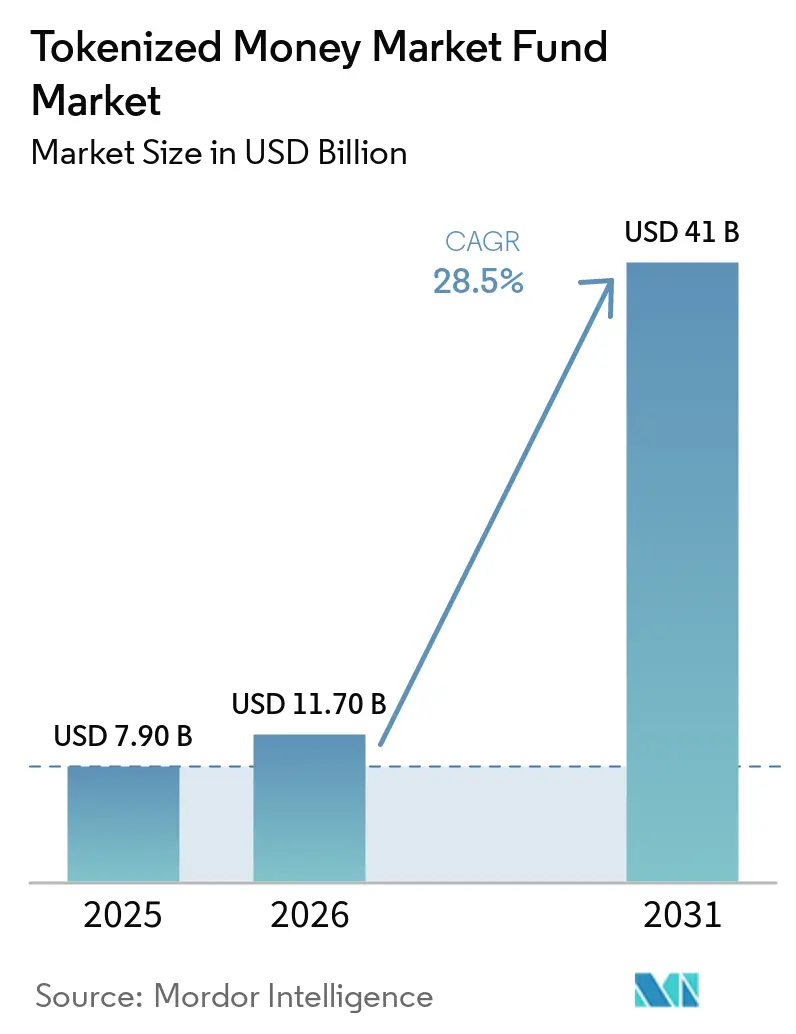
The Tokenized Money Market Fund Market size is expected to grow from USD 7.90 billion in 2025 to USD 11.70 billion in 2026 and is forecast to reach USD 41 billion by 2031 at 28.5% CAGR over 2026-2031.
The Tokenized money market fund market is being shaped by institutional demand for on-chain cash instruments that can earn income while retaining short-duration government securities exposure. The GENIUS Act, signed on July 18, 2025, recognizes government money market fund shares as eligible stablecoin reserve assets, which has made these products more relevant to stablecoin issuers. The European Central Bank reported that global tokenized money market fund capitalization increased 110% in 2025 and reached EUR 7 billion (USD 7.6 billion) by February 2026. Product providers are competing through distribution channels, custody arrangements, settlement features, and compatibility with regulated digital-asset infrastructure. The tokenized money market fund market also faces unresolved rulemaking, redemption timing differences, and limits on investor access that could slow wider adoption.
Key Report Takeaways
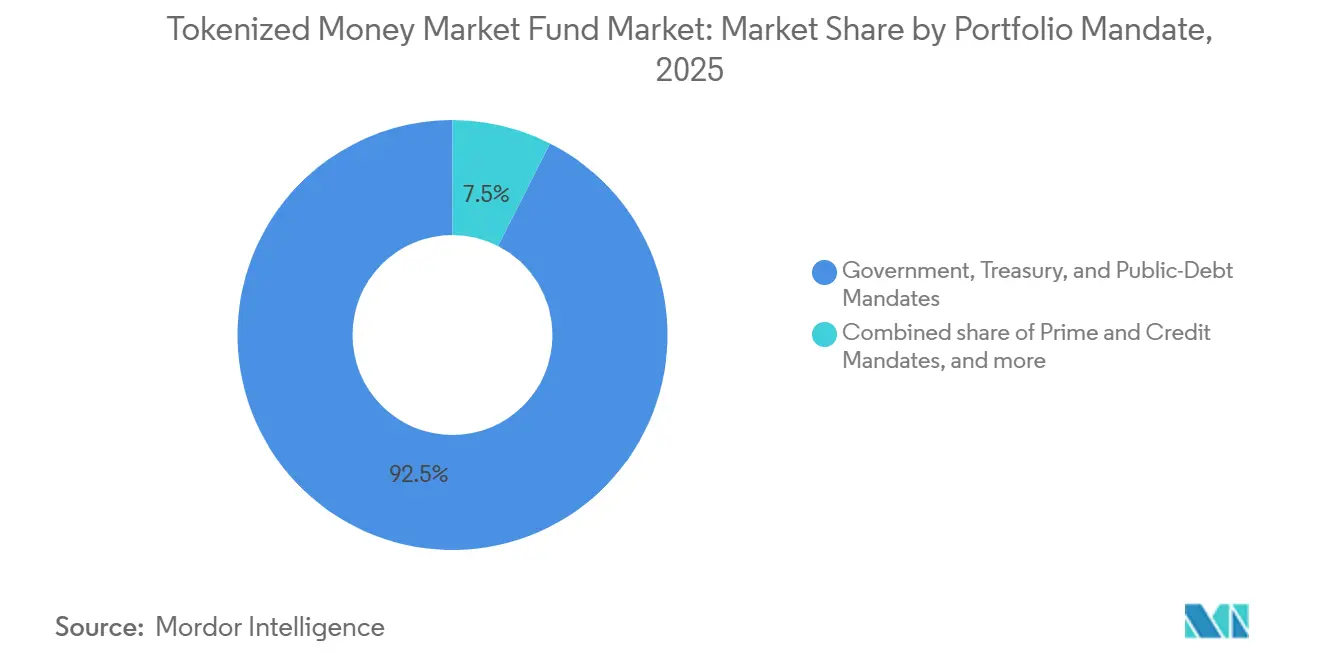
- By portfolio mandate, government, treasury, and public-debt mandates captured 92.5% of the tokenized money market fund market share in 2025, while prime and credit mandates are projected to grow at a 35.8% CAGR through 2031.
- By distributed-ledger architecture, public-network issuance captured 88.4% of the tokenized money market fund market share in 2025, while permissioned or private distributed-ledger technology issuance is projected to grow at a 38.7% CAGR through 2031.
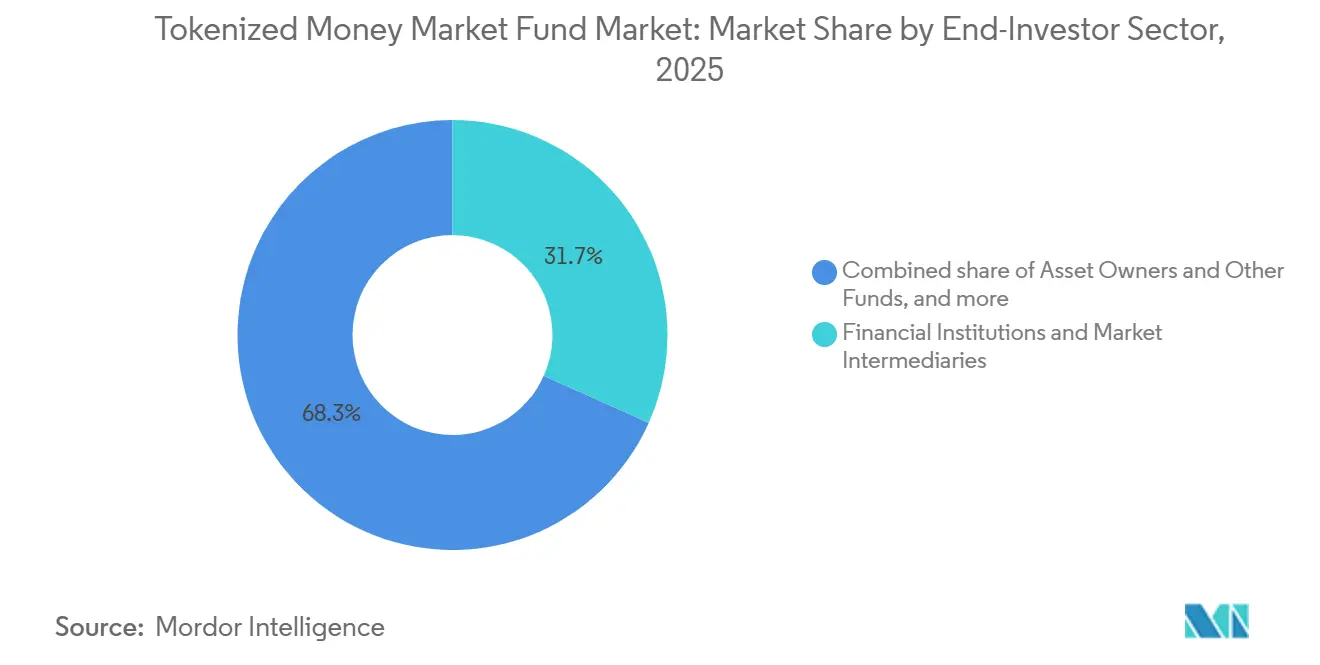
- By end-investor sector, financial institutions and market intermediaries captured 31.7% of the tokenized money market fund market in 2025, while stablecoin and digital-money issuers are projected to grow at a 40.1% CAGR through 2031.
- By primary use of the holding, cash and liquidity management captured 42.2% of the tokenized money market fund market in 2025, while collateral, margin, and securities financing are projected to grow at a 36.3% CAGR through 2031.
- By geography, North America captured 68.3% of the tokenized money market fund market in 2025, while Asia-Pacific is the fastest-growing regional market through 2031.
Note: Market size and forecast figures in this report are generated using Mordor Intelligence’s proprietary estimation framework, updated with the latest available data and insights as of January 2026.
Global Tokenized Money Market Fund Market Trends and Insights
Drivers Impact Analysis*
| Driver | (~) % Impact on CAGR Forecast | Geographic Relevance | Impact Timeline |
|---|---|---|---|
| Demand for Yield-Bearing On-Chain Cash Management | +7.5% | Global, concentrated in North America and Europe | Short term (≤ 2 years) |
| Institutional Adoption of Tokenized Cash and Treasury Management | +6% | North America, Europe, Asia-Pacific | Medium term (2-4 years) |
| Expansion of Stablecoin-Funded On-Chain Investment Activity | +5.5% | Global, with early gains in North America | Short term (≤ 2 years) |
| Use of Tokenized Fund Shares as On-Chain Collateral | +4% | North America, Asia-Pacific, and Europe | Medium term (2-4 years) |
| Demand for Faster Settlement and Programmable Fund Transfers | +2.5% | Global | Long term (≥ 4 years) |
| Expansion of Institutional Digital-Asset Infrastructure and Distribution | +2% | Asia-Pacific and North America | Long term (≥ 4 years) |
| Source: Mordor Intelligence | |||
Demand for Yield-Bearing On-Chain Cash Management
Institutional treasuries that hold stablecoins do not receive income on those balances, while tokenized money market funds can provide 4% to 5% annual returns from comparable government-securities exposure. This difference supports demand for income-producing on-chain cash management. J.P. Morgan Asset Management launched JLTXX on Ethereum in May 2026 with USD 100 million at launch. The fund reached USD 694.95 million within 1 month, with demand linked to stablecoin issuers seeking eligible reserve assets. Goldman Sachs and BNY launched a tokenized money market fund solution in July 2025 that enabled direct transfers of fund shares between parties without a cash liquidation step[1]Goldman Sachs, “BNY and Goldman Sachs Launch Tokenized Money Market Funds Solution,” Goldman Sachs Pressroom, goldmansachs.com. This arrangement can reduce reinvestment friction in institutional cash workflows and supports the Tokenized money market fund market.
Institutional Adoption of Tokenized Cash and Treasury Management Solutions
Institutional participation has moved beyond product announcements toward larger deployments and dedicated reserve products. State Street Investment Management entered the segment in June 2026 with its Stablecoin Reserves Money Market Fund. Anchorage Digital was the initial investor, and State Street reported more than USD 5 trillion in assets under management as of March 31, 2026[2]State Street Investment Management, “State Street Investment Management Accelerates Digital and Tokenization Innovation with Launch of State Street Stablecoin Reserves Money Market Fund,” State Street Press Release, statestreet.com. Legal & General Asset Management tokenized USD 68 billion across its liquidity fund range on Ethereum through the Calastone Tokenized Distribution Network in April 2026. J.P. Morgan Asset Management launched MONY in December 2025 on public Ethereum, with access through the Morgan Money platform. Connections to existing transfer-agent infrastructure can lower operational change for institutions entering the tokenized money market fund market.
Expansion of Stablecoin-Funded On-Chain Investment Activity
The GENIUS Act reserve structure links stablecoin issuance with demand for government money market fund shares. State Street cited a Citi Institute projection that global stablecoin issuance could reach USD 1.9 trillion to USD 4 trillion by 2030. This potential reserve demand is much larger than current tokenized fund assets. BlackRock launched BRSRV on August 3, 2026, as a government money market fund designed for stablecoin issuers and available on Ethereum and Solana. The fund carried an S&P Global AAAm principal stability rating[3]RedStone Finance, “RedStone Powers Onchain NAV for BlackRock’s BRSRV Fund,” RedStone Finance, redstone.finance. Reliance on USDC for subscriptions and redemptions remains a concentration issue, as the European Central Bank identified this as a potential channel for shock transmission.
Use of Tokenized Fund Shares as On-Chain Collateral
The use of tokenized fund shares as collateral is broadening the role of the Tokenized money market fund market beyond cash placement. Calais Digital Assets deployed UBS Asset Management’s uMINT as off-exchange settlement collateral on Bybit in June 2026[4]Calais Becomes 1st Quantitative Hedge Fund to Deploy UBS uMINT as OES Collateral via Bybit, ByCustody & DigiFT - Unchained, unchainedcrypto.com. The arrangement allowed assets posted as margin to continue earning income. Ethena allocated USD 250 million to Securitize’s STAC for the collateral base of USDe in June 2026. This use case shows that tokenized money market fund shares can support digital-asset capital structures while providing yield. IOSCO stated in November 2025 that secondary-market liquidity remained limited because many permissioned products used traditional transfer-agent redemption processes rather than on-chain secondary pools.
Restraints Impact Analysis*
| Restraint | (~) % Impact on CAGR Forecast | Geographic Relevance | Impact Timeline |
|---|---|---|---|
| Regulatory and Cross-Jurisdictional Compliance Complexity | -3.5% | Global | Short term (≤ 2 years) |
| Limited Secondary-Market Liquidity and Restricted Investor Access | -2.5% | North America and Europe | Medium term (2-4 years) |
| Incomplete On-Chain Fund Operations and Underlying Asset Integration | -1.5% | Global | Long term (≥ 4 years) |
| Blockchain, Smart Contract, and Operational Infrastructure Risks | -1% | Global | Long term (≥ 4 years) |
| Source: Mordor Intelligence | |||
Regulatory and Cross-Jurisdictional Compliance Complexity
The tokenized money market fund operates across regulatory frameworks that are still developing. The effective date is the earlier of January 18, 2027, or 120 days after final implementing regulations are issued by the relevant federal banking regulators. The European Union applies the Money Market Fund Regulation to underlying instruments and has separate requirements for digital-asset service providers. The European Union Distributed Ledger Technology Pilot Regime provides a framework for tokenized securities settlement, and the European Securities and Markets Authority is reviewing its future status. The European Commission’s MiCA 2.0 consultation closed on August 31, 2026. Different rules for funds, custody, distribution, and settlement can make cross-border deployment more difficult.
Limited Secondary-Market Liquidity and Restricted Investor Access
Secondary-market liquidity remains a material constraint for the Tokenized money market fund market. The European Central Bank identified a mismatch between tokenized shares that may appear redeemable at all times and underlying funds that retain business-hour redemption cutoffs. This mismatch could create redemption pressure if digital-asset markets move when underlying markets are closed. The Federal Reserve Bank of New York also noted that secondary trading can create new channels for shocks from unrelated digital-asset markets. IOSCO reported that expected secondary-market liquidity benefits had not yet been fully delivered. Minimum investment requirements also restrict access, including USD 5 million for BUIDL and qualified-purchaser limitations for MONY and JLTXX.
*Our forecasts treat driver/restraint impacts as directional, not additive. The impact forecasts reflect baseline growth, mix effects, and variable interactions.
Segment Analysis
By Portfolio Mandate: Government Mandates Lead Through Reserve Rules
Government, treasury, and public-debt mandates accounted for 92.5% of the tokenized money market fund market in 2025. The GENIUS Act recognizes government money market fund shares invested in short-duration United States Treasuries and overnight Treasury repos as eligible stablecoin reserve assets. The law sets a 93-day maturity ceiling for qualifying Treasury exposure. Corporate credit and commercial paper do not meet the same reserve eligibility. BlackRock’s BUIDL and BRSRV, J.P. Morgan’s MONY and JLTXX, and State Street’s SSCXX hold United States Treasuries, cash, and government-collateralized repurchase agreements. These product structures show how reserve rules have influenced the portfolio mix.
Prime and credit mandates are projected to grow at 35.8% CAGR through 2031. The tokenized money market fund market size for this mandate starts from a smaller base. Institutional allocators may seek higher-yielding alternatives as regulatory parameters become clearer. Amundi and Spiko launched the Spiko Amundi Overnight Swap Fund in March 2026. The fund had EUR 100 million (USD 108 million) in committed assets and used fully collateralized total-return swaps with Tier 1 banking counterparties. The fund operates under UCITS rules and French AMF regulation.


By Distributed-Ledger Architecture: Public Networks Lead While Private Rails Grow
Public-network issuance held 88.4% of the tokenized money market fund market in 2025. Ethereum supports the largest share because of its established smart-contract environment and custodial integrations. BlackRock’s BUIDL operates across 7 chains, while Franklin Templeton’s BENJI covered 8 networks by mid-2026. J.P. Morgan launched JLTXX and MONY on public Ethereum. Public deployment does not remove investor controls because major products use approved wallet addresses and transfer restrictions. Traditional transfer-agent records often remain the authoritative ownership register.
Permissioned or private distributed-ledger technology issuance is projected to grow at 38.7% CAGR through 2031. These networks can embed eligibility and compliance checks at the network level. Goldman Sachs’ GS DAP platform supports the BNY and Goldman Sachs solution that launched in July 2025. The platform uses a private ledger and mirrored token representations. J.P. Morgan’s Kinexys Digital Assets platform also provides a permissioned compliance layer on Ethereum. This approach responds to institutional requirements for controlled transfers and established servicing processes.
By End-Investor Sector: Financial Institutions Lead as Stablecoin Issuers Expand
Financial institutions and market intermediaries held 31.7% of the tokenized money market fund market in 2025. Their demand reflects the use of on-chain income accrual, approved peer-to-peer transfers, and fund transfer capabilities outside conventional settlement cycles. MONY and JLTXX are available through the Morgan Money platform for qualified institutional investors. The platform combines conventional liquidity tools with on-chain assets. This structure targets institutions that already manage significant liquidity balances. Minimum requirements continue to limit participation by smaller investors.
Stablecoin and digital-money issuers are projected to grow at 40.1% CAGR through 2031. Their reserve holdings are directly linked to the GENIUS Act framework for eligible assets. J.P. Morgan stated in July 2026 that demand for JLTXX was primarily driven by stablecoin issuers. State Street cited a potential USD 1.9 trillion to USD 4 trillion global stablecoin issuance range for 2030. Households and private individuals remain a small investor group because of investment thresholds. Franklin Templeton and ADDX introduced a MAS-approved retail offering in Singapore in November 2025.
By Primary Use of the Holding: Liquidity Management Leads While Collateral Use Advances
Cash and liquidity management represented 42.2% of the tokenized money market fund market in 2025. The primary purpose is to move idle on-chain reserves from non-income stablecoin balances into money market instruments. The October 2024 MMF reforms introduced a mandatory liquidity fee framework for institutional prime and institutional tax-exempt MMFs under specified conditions, but it is misleading to say they have simply been “required to charge mandatory liquidity fees since October 2024. This regulatory structure may increase the relative attractiveness of government MMFs for some liquidity-management use cases. Digital-money reserve and backing-asset use is the second-largest category. Stablecoin issuers use qualifying fund shares as reserve assets under the GENIUS Act.
Collateral, margin, and securities financing is projected to grow at 36.3% CAGR through 2031. The tokenized money market fund market size for this use case is supported by the ability to earn income while collateral is posted. Calais Digital Assets used UBS Asset Management’s uMINT as live off-exchange settlement collateral on Bybit in June 2026. Symbiotic introduced T+0 USDC redemptions for Janus Henderson and New York Life Investment Management funds in August 2026. The funds covered USD 1.6 billion in tokenized assets under management. These functions connect fund holdings with margin and settlement activity in digital-asset trading.
Geography Analysis
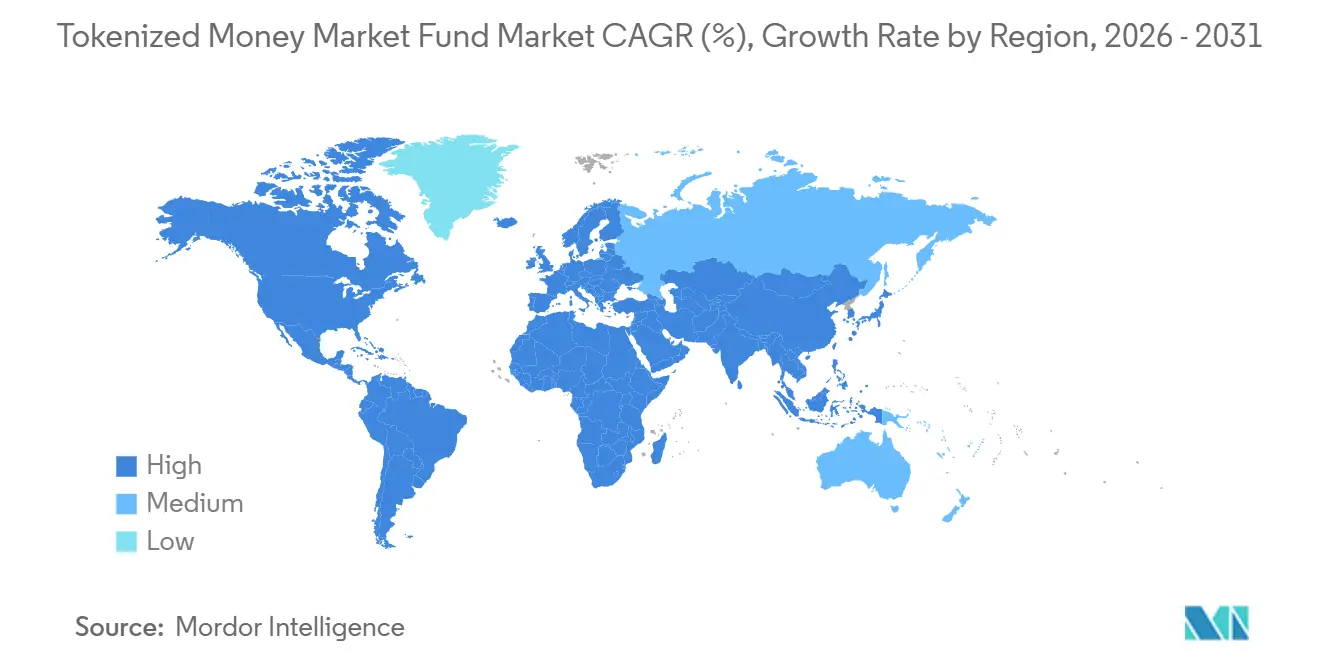
North America held 68.3% of the tokenized money market fund market in 2025. The United States leads the region because of its large money market fund sector and the concentration of Securities and Exchange Commission-registered product activity. The GENIUS Act was signed on July 18, 2025, and established reserve composition standards for payment stablecoins. BlackRock, J.P. Morgan, State Street, Morgan Stanley, Franklin Templeton, and Invesco had entered or filed for related products by August 2026. Securities and Exchange Commission Rule 2a-7 provides rules for money market fund composition, maturity, and liquidity requirements. These rules provide an established structure for United States product design.
Europe held a different position within the Tokenized money market fund market. European Union-domiciled tokenized money market funds had EUR 725 million (USD 753 million) in net asset value as of December 31, 2025. EUTBL had EUR 440 million (USD 457 million), and USTBL had EUR 121 million (USD 126 million) at that date. Legal & General Asset Management tokenized USD 68 billion across its liquidity fund range on Ethereum in April 2026. Amundi and Spiko launched SAFO in March 2026 with EUR 100 million (USD 104 million) in committed assets. The European Union Distributed Ledger Technology Pilot Regime and UCITS Directive shape the regional compliance framework.
Asia-Pacific is the fastest-growing region in the tokenized money market fund market. Singapore’s Monetary Authority of Singapore approved the Franklin Templeton and ADDX tokenized United States dollar short-term money market fund for retail investors in November 2025. DBS Bank distributed the fund through its wealth platform. Hong Kong’s Securities and Futures Commission approved tokenized fund structures under its Open-Ended Fund Company framework. CPIC Investment Management Hong Kong launched a tokenized USD money market fund under that framework in March 2025. South America remains at an early stage, while the United Arab Emirates' financial centers are exploring real-world asset tokenization under local financial center frameworks.

Competitive Landscape
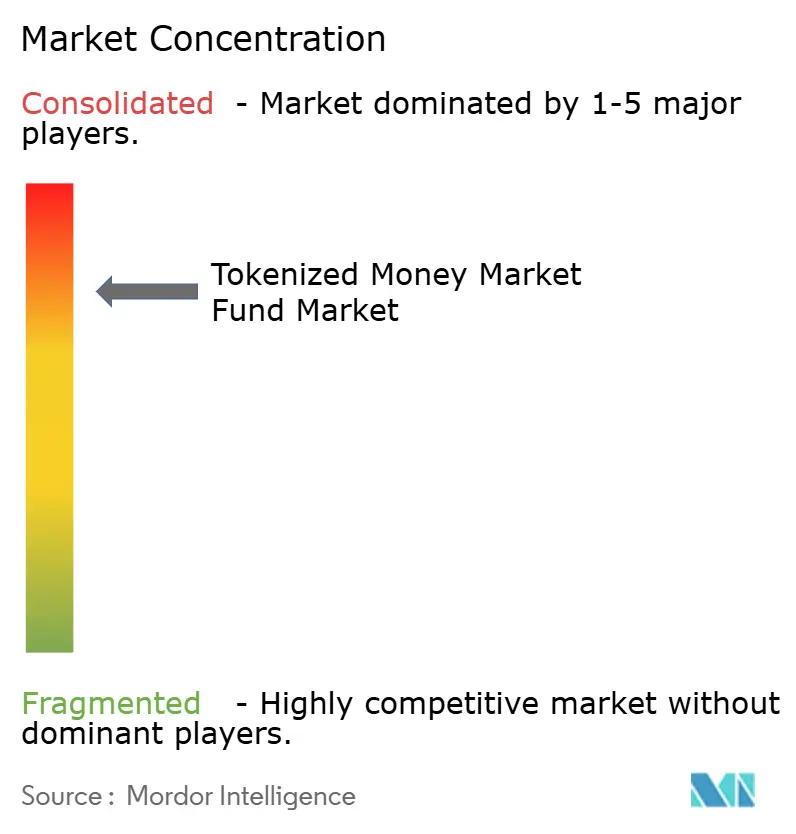
The tokenized money market fund market is consolidated at the product level. The 10 largest products accounted for more than 90% of global market capitalization in 2026. BlackRock’s BUIDL held 40% of the tokenized Treasury and money market segment at its mid-2026 peak. The fund then recorded USD 400 million in outflows over 2 weeks in July 2026 as assets shifted toward new stablecoin reserve products. This change shows that early product leadership can be affected by new launches. Competition is also shaped by distribution, custody, and settlement links.
Goldman Sachs and BNY launched their tokenized fund solution in July 2025 through BNY LiquidityDirect. BlackRock, Fidelity Investments, Federated Hermes, and Goldman Sachs Asset Management participated at launch. BlackRock launched BRSRV in August 2026 as a stablecoin reserve vehicle available on Ethereum and Solana. State Street launched SSCXX in June 2026 as a Rule 2a-7 government money market fund designed for stablecoin reserve use. These moves reflect a focus on reserve eligibility and institutional distribution. The tokenized money market fund market is also attracting providers that offer technology and servicing functions to multiple managers.
Superstate, Securitize, Calastone, and DigiFT provide tokenization or distribution infrastructure for asset managers. Their models differ from the proprietary platform approaches used by J.P. Morgan Kinexys and Goldman Sachs GS DAP. Invesco filed for a United States-registered stablecoin reserve fund in 2026 using Superstate as a sub-transfer agent. Spiko reported more than USD 1 billion in assets under management within 18 months and set a subscription minimum of EUR 1 (USD 1.08). This approach differs from products with high institutional minimums. Product design, investor eligibility, and distribution partnerships remain central competitive factors.
Tokenized Money Market Fund Industry Leaders
BlackRock, Inc.
Circle Internet Group, Inc. / Hashnote
Franklin Resources, Inc.
WisdomTree, Inc.
Superstate
- *Disclaimer: Major Players sorted in no particular order

Recent Industry Developments
- September 2026: RedStone Finance integrated T+0 exit mechanics via Dutch auction for New York Life Investment Management’s USD 838 billion assets under management tokenized HYB fund on Centrifuge, enabling instant USDC liquidity against a T+3 underlying redemption cycle and unlocking decentralized finance composability for institutional credit.
- August 2026: Symbiotic launched Liquid Lane, providing T+0 USDC redemptions to Janus Henderson’s JAAA and JTRSY funds and New York Life Investment Management’s HYB fund on Centrifuge, collectively covering USD 1.6 billion in tokenized assets under management through atomic on-chain settlement.
- August 2026: BlackRock launched the BlackRock Daily Reinvestment Stablecoin Reserve Vehicle. The government money market fund was designed for stablecoin issuers under the GENIUS Act and was available on Ethereum and Solana.
- June 2026: State Street Investment Management launched the State Street Stablecoin Reserves Money Market Fund. The Rule 2a-7 government money market fund had USD 121 million in early assets under management and a 3.51% yield.


Global Tokenized Money Market Fund Market Report Scope
| Government, Treasury, and Public-Debt Mandates |
| Prime and Credit Mandates |
| Tax-Exempt and Residual Mandates |
| Public-Network Issuance |
| Permissioned or Private DLT Issuance |
| Financial Institutions and Market Intermediaries |
| Asset Owners and Other Funds |
| Non-Financial Corporate Treasuries |
| Stablecoin and Digital-Money Issuers |
| Other Crypto-Native Treasuries and Protocol Entities |
| Households and Private Individuals |
| Cash and Liquidity Management |
| Digital-Money Reserve and Backing Assets |
| Collateral, Margin, and Securities Financing |
| Settlement, Delivery-versus-Payment, and Transaction Liquidity |
| North America | United States |
| Canada | |
| Mexico | |
| South America | Brazil |
| Argentina | |
| Rest of South America | |
| Europe | United Kingdom |
| Germany | |
| France | |
| Italy | |
| Spain | |
| Rest of Europe | |
| Asia-Pacific | China |
| Japan | |
| India | |
| South Korea | |
| Australia | |
| Indonesia | |
| Thailand | |
| Malaysia | |
| Singapore | |
| Vietnam | |
| Rest of Asia-Pacific | |
| Middle East and Africa | Saudi Arabia |
| United Arab Emirates | |
| Turkey | |
| South Africa | |
| Egypt | |
| Rest of Middle East and Africa |
| By Portfolio Mandate | Government, Treasury, and Public-Debt Mandates | |
| Prime and Credit Mandates | ||
| Tax-Exempt and Residual Mandates | ||
| By Distributed-Ledger Architecture | Public-Network Issuance | |
| Permissioned or Private DLT Issuance | ||
| By End-Investor Sector | Financial Institutions and Market Intermediaries | |
| Asset Owners and Other Funds | ||
| Non-Financial Corporate Treasuries | ||
| Stablecoin and Digital-Money Issuers | ||
| Other Crypto-Native Treasuries and Protocol Entities | ||
| Households and Private Individuals | ||
| By Primary Use of the Holding | Cash and Liquidity Management | |
| Digital-Money Reserve and Backing Assets | ||
| Collateral, Margin, and Securities Financing | ||
| Settlement, Delivery-versus-Payment, and Transaction Liquidity | ||
| By Geography | North America | United States |
| Canada | ||
| Mexico | ||
| South America | Brazil | |
| Argentina | ||
| Rest of South America | ||
| Europe | United Kingdom | |
| Germany | ||
| France | ||
| Italy | ||
| Spain | ||
| Rest of Europe | ||
| Asia-Pacific | China | |
| Japan | ||
| India | ||
| South Korea | ||
| Australia | ||
| Indonesia | ||
| Thailand | ||
| Malaysia | ||
| Singapore | ||
| Vietnam | ||
| Rest of Asia-Pacific | ||
| Middle East and Africa | Saudi Arabia | |
| United Arab Emirates | ||
| Turkey | ||
| South Africa | ||
| Egypt | ||
| Rest of Middle East and Africa | ||


Key Questions Answered in the Report
What is the projected value of tokenized money market funds by 2031?
The sector is projected to reach USD 41 billion by 2031, growing at a 28.5% CAGR from 2026 to 2031.
Why are stablecoin issuers using tokenized money market funds?
Eligible government fund shares can support reserve management under the GENIUS Act while allowing reserve assets to earn income.
Which portfolio mandate leads tokenized money market fund assets?
Government, treasury, and public-debt mandates led with 92.5% of assets in 2025.
Which end-investor group is growing fastest?
Stablecoin and digital-money issuers are projected to expand at a 40.1% CAGR through 2031.
Which region has the largest tokenized money market fund presence?
North America held 68.3% of global share in 2025, supported by United States fund infrastructure and regulatory activity.
What is limiting broader adoption of tokenized money market funds?
Key limitations include incomplete rulemaking, limited secondary-market liquidity, investor eligibility limits, and operational infrastructure risks.
Page last updated on:





