
Thermally Conductive Plastics Market Size and Share
Market Overview
| Study Period | 2021 - 2031 |
|---|---|
| Market Size (2026) | USD 240.88 Million |
| Market Size (2031) | USD 479.65 Million |
| Growth Rate (2026 - 2031) | 14.77 % |
| Fastest Growing Market | Asia-Pacific |
| Largest Market | North America |
| Market Concentration | Medium |
Major Players *Disclaimer: Major Players sorted in no particular order Image © Mordor Intelligence. Reuse requires attribution under CC BY 4.0. | |
Thermally Conductive Plastics Market Analysis by Mordor Intelligence
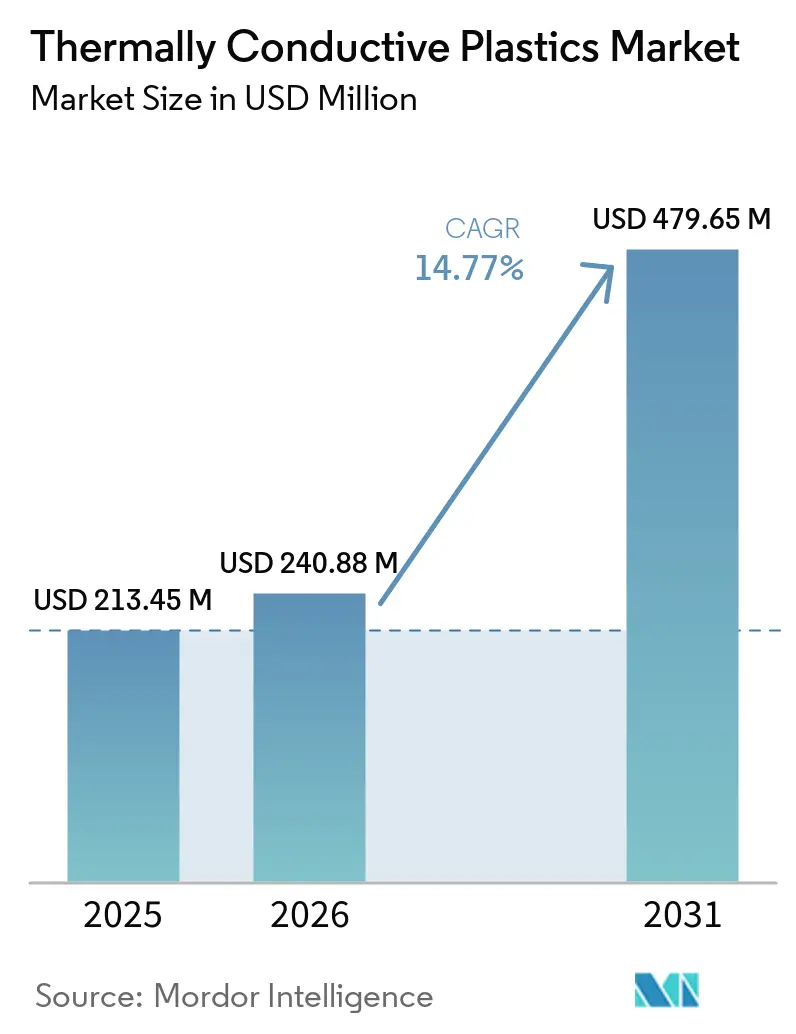
The thermally conductive plastics market was valued at USD 213.45 million in 2025 and is projected to grow from USD 240.88 million in 2026 to USD 479.65 million by 2031, at a CAGR of 14.77% during the forecast period (2026-2031). Demand is increasing as vehicle electrification and digital infrastructure raise heat loads in compact components. Unfilled polymers typically offer thermal conductivity of approximately 0.2 W/m·K, limiting their application in areas where heat must be safely dissipated from sensitive electronic components[1]SABIC, “LNP KONDUIT Compound,” SABIC, sabic.com .
Consequently, the thermally conductive plastics market is shifting toward compounds that enable lightweight parts, complex molded geometries, and electrical insulation. Producers are leveraging co-development initiatives and simulation tools to reduce qualification timelines for automotive and electronics customers. The greatest opportunity lies in applications where a molded plastic component can replace multiple metal and insulating parts without compromising safety or thermal performance.
Key Report Takeaways
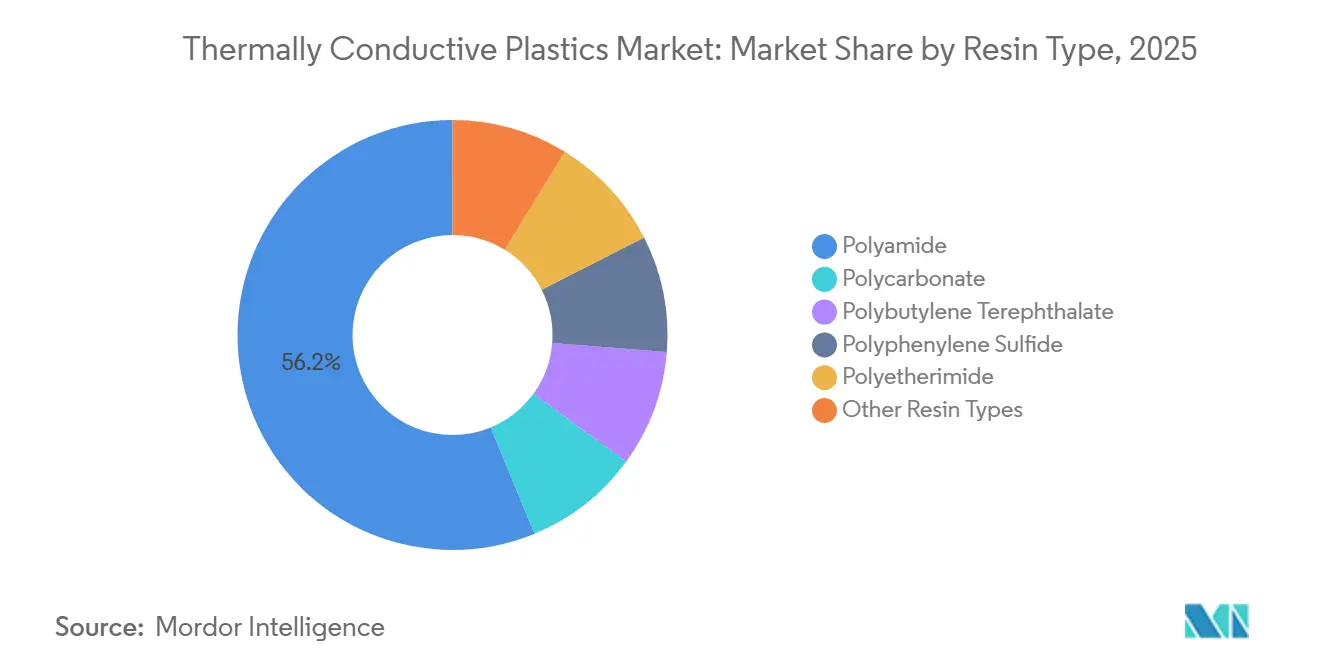
- By resin type, polyamide held 56.22% of the thermally conductive plastics market share in 2025, and is expected to grow at the fastest-growing CAGR of 14.67% through 2031.
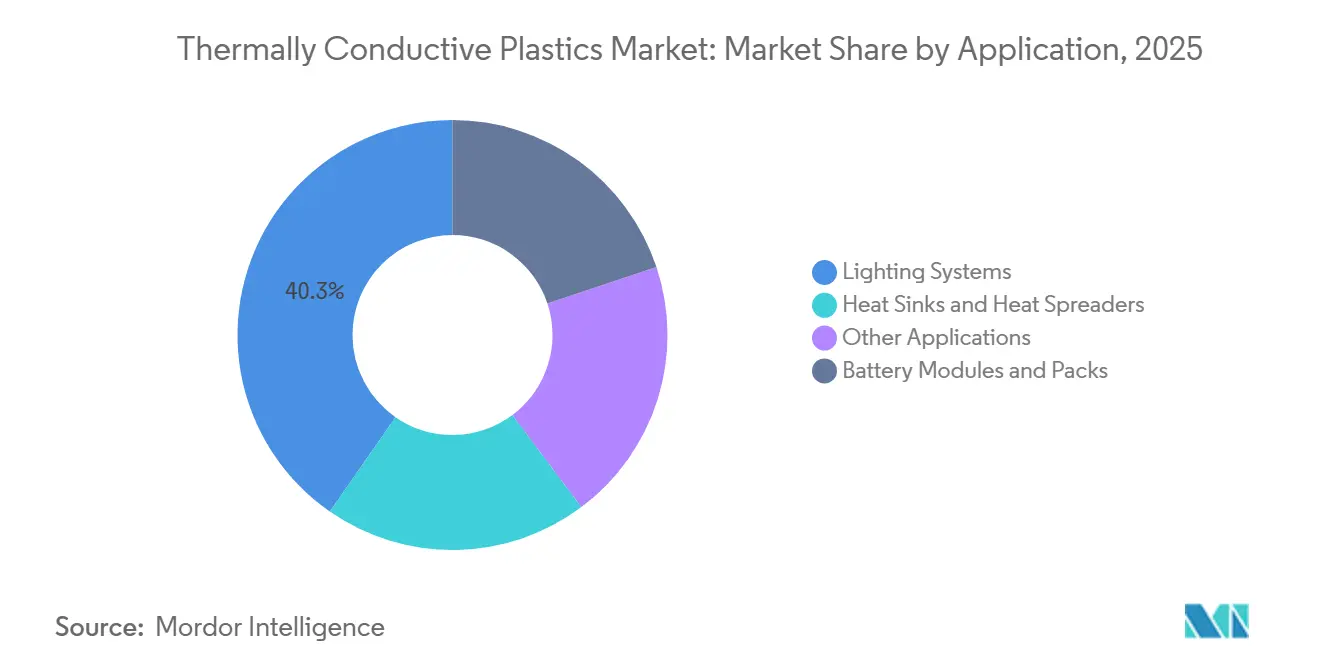
- By application, lighting systems held 40.34% of the thermally conductive plastics market size in 2025, while the battery modules and packs segment is expected to have the highest projected CAGR at 15.45% through 2031.
- By end-use industry, electrical and electronics held 36.13% of the thermally conductive plastics market share in 2025, while the automotive segment is expected to grow at the highest projected CAGR at 14.91% through 2031.
- By geography, North America held 38.78% of the thermally conductive plastics market share in 2025, while Asia Pacific is expected to grow at the highest projected CAGR of 14.89% through 2031.
Note: Market size and forecast figures in this report are generated using Mordor Intelligence’s proprietary estimation framework, updated with the latest available data and insights as of January 2026.
Global Thermally Conductive Plastics Market Trends and Insights
Drivers Impact Analysis*
| Driver | (~) % Impact on CAGR Forecast | Geographic Relevance | Impact Timeline |
|---|---|---|---|
| Miniaturization Of Electronic Components | +2.5% | Global, highest intensity in Asia-Pacific and North America | Medium term (2-4 years) |
| Electric Vehicle Battery Thermal Management | +3.8% | Global, concentrated in China, Germany, and the United States | Medium term (2-4 years) |
| Lightweight Metal Replacement In Thermal Components | +3.2% | North America, Europe, and Asia-Pacific core markets | Long term (≥ 4 years) |
| AI, 5G, IoT, And High-Power Electronics | +2.8% | Global, concentrated in North America and Asia-Pacific | Short term (≤ 2 years) |
| Recycled-Filler And Electrically Insulating Formulation Innovation | +1.2% | Europe and Asia-Pacific | Long term (≥ 4 years) |
| Source: Mordor Intelligence | |||
Miniaturization Of Electronic Components Compressing Thermal Budgets
Rising transistor density increases chip power per unit area as component footprints continue to shrink. Processors used in AI infrastructure generate localized heat, requiring nearby plastics to maintain dimensional stability, electrical insulation, and thermal diffusivity[2]BASF SE, “Solving AI Infrastructure Challenges: The Role of High-Performance Materials,” BASF Plastics-Rubber, plastics-rubber.basf.com . The thermally conductive plastics market benefits from this trend, as thinner walls require more efficient heat-transfer pathways. Formulators use boron nitride platelets, hybrid boron nitride-graphene networks, and liquid-crystal polymer substrates for applications requiring higher performance. These materials command a higher value than standard enclosure resins because they must balance thermal management capabilities with molding performance. UL 94 V-0 and IEC 60695 requirements further increase formulation complexity and favor established specialty producers.
Electric Vehicle Battery Thermal Management Driving Materials Convergence
Battery-module compounds must deliver bulk thermal conductivity of 1.0–5.0 W/m·K and dielectric strength above 20 kV/mm. They must also meet Comparative Tracking Index requirements for PLC 0 or PLC 1 while complying with stringent vehicle weight limits. This combination of requirements supports growth in the thermally conductive plastics market, as metals cannot provide all these properties in a single molded component. Premium electric vehicles with 800V architectures are expanding the use of PPS and PA grades in drivetrain and DC-DC converter housings. In June 2026, Envalior is set to introduce Xytron M5080ET, an impact-modified PPS grade for EV busbars that offers a UL 94 V-0 classification at 2 mm. The company reports that the material provides more than 70% greater stress-crack resistance than comparable materials in thermal-shock tests ranging from −50°C to +180°C. This focus on application-specific performance is raising the standards for qualified materials used in battery and powertrain components.
Lightweight Metal Replacement In Thermal Components Redefining OEM Material Choices
Metal-to-plastic conversion is becoming a key procurement consideration for OEM thermal components. In June 2026, Avient is expected to expand its Therma-Tech portfolio with eight natural graphite-based grades for lighting, automotive heat sinks, and heat-exchange systems. These grades will include options containing post-industrial recycled content and will be positioned as alternatives to synthetic graphite systems. Injection-moldable compounds can integrate heat-sink, housing, and electrical-insulation functions into a single component, reducing secondary assembly steps. In May 2026, Trinseo is expected to present a thermoplastic PC UD tape battery top cover that meets UL 2596 thermal-runaway and China’s GB 38031 bonfire requirements at wall thicknesses of 1.0 mm and 1.5 mm. In 2025, SABIC is expected to introduce a laser-weldable, flame-retardant PBT compound for EV control-unit covers, providing manufacturers with another option to replace metal stampings.
AI, 5G, IoT, And High-Power Electronics Expanding Addressable Scope
AI data centers are driving sustained demand for heat-density management solutions in racks, PCB-adjacent components, and power-distribution equipment. Covestro offers material solutions for thermal management and protection in AI data center systems. Thermally conductive polycarbonate can be overmolded directly onto printed circuit boards, providing flame retardancy, thin-wall molding capabilities, and impact strength. This processing approach supports the thermally conductive plastics market in applications where metal enclosures would increase weight or require additional assembly steps. 5G circuit board substrates generate related demand for materials that combine low dielectric loss with heat dissipation. A 2025 study reported that hexagonal boron nitride and liquid-crystal polymer composite films achieved thermal conductivity 3.3 times higher than pristine LCP, while maintaining dielectric constants below 3.4 at frequencies of 0.4–1 GHz.
Restraints Impact Analysis*
| Restraint | (~) % Impact on CAGR Forecast | Geographic Relevance | Impact Timeline |
|---|---|---|---|
| Lower Thermal Conductivity Than Metals | -1.4% | Global | Long term (≥ 4 years) |
| High Filler And Processing Costs | -1.2% | India, ASEAN, and South America | Medium term (2-4 years) |
| Filler Dispersion And Anisotropic Conductivity Challenges | -0.7% | Global | Long term (≥ 4 years) |
| Source: Mordor Intelligence | |||
Lower Thermal Conductivity Than Metals Constrains High-Power Interfaces
Aluminum offers thermal conductivity of approximately 200 W/m·K, while advanced commercial thermally conductive plastic grades provide substantially lower conductivity. SABIC lists LNP KONDUIT grades with thermal conductivity of up to 18 W/m·K. This performance gap limits the use of polymers in direct chip-contact interfaces, high-current busbars without overmolding, and extreme-duty industrial heat exchangers. Consequently, the thermally conductive plastics market will continue to support many applications through hybrid metal-plastic designs. OEMs can retain aluminum or copper in high-load zones while using plastics for secondary heat-spreading and insulated structural functions. This division of roles maintains the relevance of polymers without overstating their suitability for all thermal interface applications.
High Filler And Processing Costs Limiting Adoption In Cost-Sensitive Segments
Thermally conductive compounds often require filler loadings of 30–60 wt%, increasing material costs and processing complexity. High filler levels can accelerate equipment wear, reduce melt fluidity, and narrow the cycle-time window. They may also require specialized screw and barrel configurations during compounding or molding. Qualification testing under ISO 22007 and third-party certification further increase costs for each new program. While high-volume automotive production can absorb these costs more readily, smaller industrial and medical programs face greater cost constraints. This challenge is particularly significant in South and Southeast Asian manufacturing hubs, where established aluminum die-casting supply chains remain cost-competitive.
*Our forecasts treat driver/restraint impacts as directional, not additive. The impact forecasts reflect baseline growth, mix effects, and variable interactions.
Segment Analysis
By Resin Type: Polyamide Holds A Broad Qualification Base
Polyamide held a 56.22% share of the thermally conductive plastics market in 2025 and is expected to grow at a CAGR of 14.67% through 2031. Its leading position stems from its processing versatility, broad operating-temperature range, and established compatibility with boron nitride, graphite, and mineral filler systems. Polyamide can achieve thermal conductivity of 1–5 W/m·K while maintaining electrical insulation, making it suitable for high-voltage automotive and power electronics applications. These properties are particularly valuable where dielectric strength is as critical as heat transfer. In June 2025, BASF introduced Ultramid Advanced N3U42G6, a non-halogenated PA9T grade for high-voltage EV connectors and automotive battery systems. This introduction reflects the market’s shift toward electrification-specific requirements.
Other resin types serve specialized applications in the thermally conductive plastics market. Polycarbonate is used in 5G connectivity enclosures and data center PCB overmolding applications, where impact strength and RF performance requirements complement thermal management needs. PPS is gaining traction in 800V powertrain overmolding applications due to its high-temperature stability and resistance to automotive fluids. Envalior introduced Xytron M5080ET for EV busbar applications; the material carries a UL 94 V-0 rating at a thickness of 2 mm. PBT supports EV control-unit covers through laser-weldable, flame-retardant grades. PEI remains a premium material for aerospace and medical housings requiring continuous-use temperatures above 180°C.



By Application: Lighting Retains Volume While Battery Packs Grow Fastest
Lighting systems accounted for 40.34% of the thermally conductive plastics market size in 2025. The market benefits from LED upgrades that replace die-cast aluminum reflectors with injection-moldable thermally conductive polyamide housings. The battery modules and packs segment is expected to grow at a CAGR of 15.45% through 2031, driven by rising EV production and increasingly intensive thermal management requirements in larger battery-pack designs. The shift toward cell-to-pack architectures is also changing the thermal requirements for enclosures and cooling components. In 2025, BASF and Welion presented a next-generation solid-state battery pack incorporating Ultramid PA side-cooling plates and battery-cover materials.
The thermally conductive plastics market also benefited from the reported battery pack, which reduced weight by 50% compared with metal alternatives while maintaining thermal management and safety performance. Heat sinks and heat spreaders are emerging application areas in AI server hardware. Covestro’s material development for AI data centers includes solutions designed to meet the stringent thermal and electrical requirements of these systems. Thermally conductive compounds can also enable direct PCB overmolding in selected designs. IEC 62368-1 and UL 508A requirements underscore the importance of qualified materials in these applications. Motor housings, industrial-drive enclosures, and telecom base-station modules provide additional incremental demand for the thermally conductive plastics market.
By End-Use Industry: Electrical And Electronics Leads While Automotive Expands Fastest
Electrical and electronics accounted for 36.13% of the thermally conductive plastics market share in 2025. This segment includes LED drivers, consumer electronics, data center equipment, and power supplies, each with distinct thermal requirements. Lower-cost mineral-filled polyamide serves select consumer devices, while boron nitride-filled and graphene-loaded grades meet the more demanding requirements of server and power-conversion equipment. The automotive segment is forecast to grow at a CAGR of 14.91% through 2031, driven by the increasing use of thermally conductive plastics in battery modules, motor housings, IGBT packages, and high-voltage charging connectors for electric vehicles.
In 2025, Renault Group included LATI in its A-PMR materials panel for EV thermal management applications. The company certified its LATICONTHER PA6 compounds and PPS grades for applications with and without electrical insulation requirements. Industrial applications in the thermally conductive plastics market include variable-frequency drives, motor housings, and automation power electronics. Aerospace remains a high-value niche due to its longer qualification cycles. Healthcare presents an emerging opportunity as wearable and implantable devices continue to miniaturize. Telecommunications demand is also supported by the ongoing deployment of 5G infrastructure and requirements for flexible circuit boards.
Geography Analysis
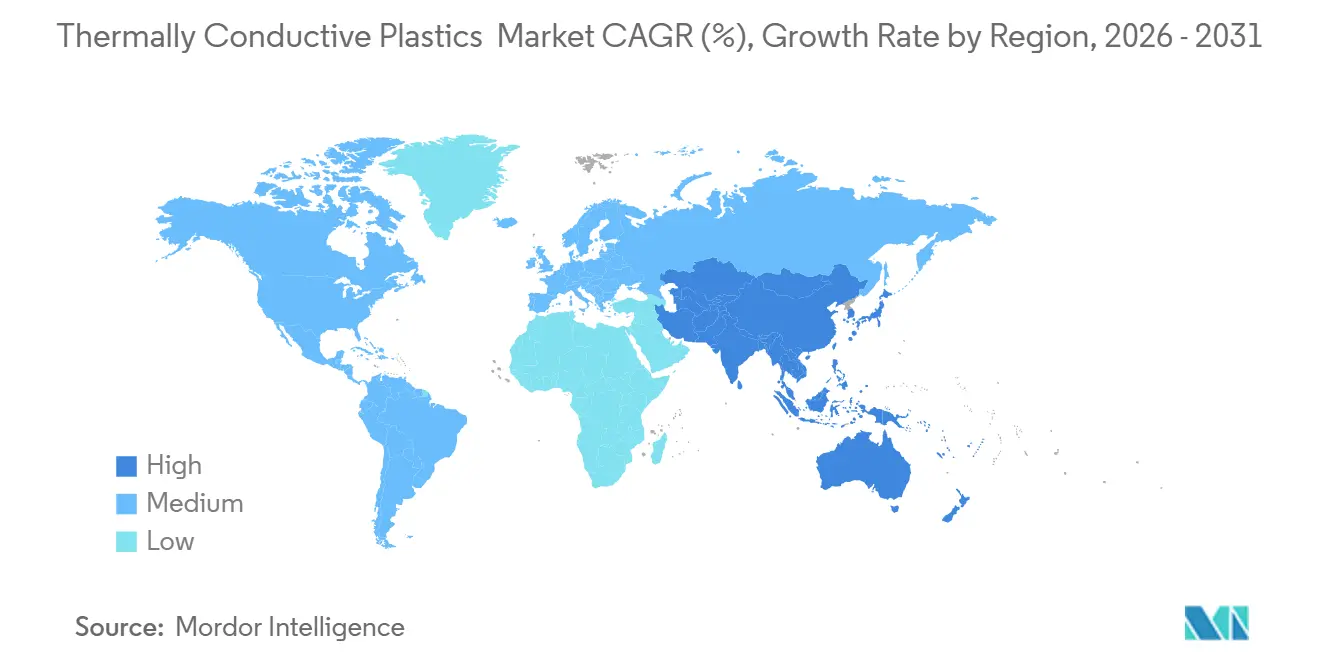
North America accounted for 38.78% of the thermally conductive plastics market in 2025. Hyperscale data centers, an established EV supply chain, and lighting upgrades driven by energy-efficiency requirements support regional demand. OEM production in the United States and Canada also drives demand for qualified automotive compounds. Mexico’s expanding role in EV assembly is further increasing demand for thermally conductive plastics across border-state manufacturing operations. Avient’s planned June 2026 Therma-Tech expansion is expected to support applications in lighting, automotive heat sinks, and heat-exchange systems.
Asia-Pacific is forecast to expand at a CAGR of 14.89% through 2031, representing the highest regional growth rate. China’s EV production base, Japan’s electronics ecosystem, and South Korea’s investments in semiconductor packaging support this outlook. According to the supplied draft, China’s new-energy vehicle penetration is expected to exceed 35% of new vehicle sales in 2025. Japanese producers are also targeting applications that combine electrical insulation with thermal management. In January 2026, Sumitomo Bakelite is expected to announce the adoption of its BLA-6051 heat-dissipating insulating sheet in resin-insulated substrates for DENSO automotive inverters. India and ASEAN countries are expected to generate incremental demand as electronics and automotive manufacturing capacity expands.
Europe generates significant demand for thermally conductive plastics, supported by Germany’s automotive OEM base and the concentrated research and development capabilities of major polymer suppliers. REACH compliance and End-of-Life Vehicles Directive requirements are encouraging the reformulation of compounds using halogen-free and low-VOC materials. In 2025, Envalior began PPS compounding production at its Uerdingen facility for Xytron grades used in EV water-pump housings, high-temperature connectors, and thermal assemblies. South America, the Middle East, and Africa account for smaller volumes in the thermally conductive plastics market. Brazil’s automotive cluster, Saudi Arabia’s industrial diversification initiatives, and South Africa’s mining-electronics applications represent the primary demand centers. These regions remain dependent on imported specialty compounds and have limited local distribution infrastructure.

Competitive Landscape
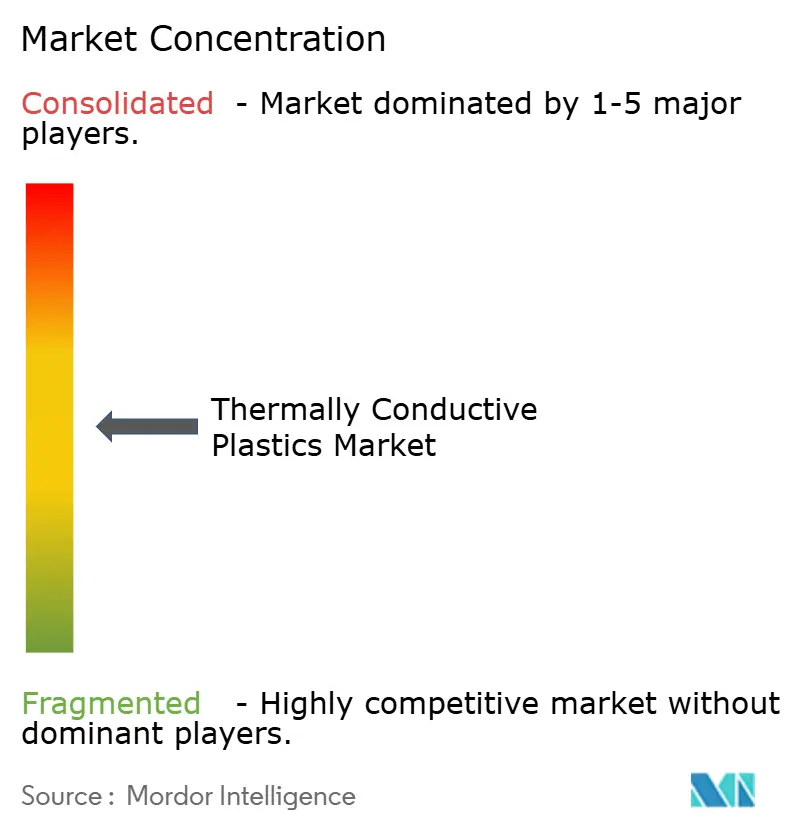
The thermally conductive plastics market is moderately concentrated among compound suppliers. BASF, SABIC, Covestro, and Celanese offer broad portfolios and maintain co-development relationships with Tier-1 automotive suppliers. Their simulation tools can reduce customer qualification timelines. Avient, Ensinger, RTP Company, LATI, Kaneka, Sumitomo Bakelite, Toray, and Mitsubishi Engineering-Plastics compete through formulation customization, application expertise, and reliable regional supply. The first group holds an advantage in applications where computational material design can optimize filler networks before physical prototyping. This capability can reduce formulation lead times and support early entry into demanding applications.
Envalior’s planned June 2026 launch of Xytron M5080ET illustrates competition in qualified EV busbar overmolding applications. The grade has received approval from multiple automotive customers and offers improved stress-crack resistance during thermal-shock testing. Avient’s planned 2026 natural graphite expansion represents another strategic move toward lighter thermal components and recycled-content options. Sumitomo Bakelite’s BLA-6051 adoption in DENSO inverter substrates demonstrates the value of insulating materials designed for power-module heat management. These developments target performance requirements that broadly available compounds often cannot meet.
Competitive opportunities in the thermally conductive plastics market remain in through-plane conductivity and circular-content grades. Filler orientation during molding limits through-plane performance in many commercial materials. Suppliers that improve this balance could access applications in which heat must transfer vertically toward cooling plates. Covestro’s bio-circular attributed polycarbonate compounds and Avient’s recycled graphite grades highlight the growing relevance of circular material options. Research on graphene-enabled polymer composites has also demonstrated simultaneous improvements in thermal conductivity and fire retardancy. However, the scale-up economics of laboratory-stage filler architectures remain uncertain. Established suppliers are better positioned to convert validated formulations into qualified commercial products.
Thermally Conductive Plastics Industry Leaders
Celanese Corporation
SABIC
BASF
Avient Corporation
Envalior
- *Disclaimer: Major Players sorted in no particular order

Recent Industry Developments
- June 2026: Envalior launched Xytron M5080ET, a PPS compound for EV busbars. This impact-modified grade contains 50 wt% glass fiber and mineral reinforcement and delivers more than 70% higher stress-crack resistance than comparable PPS materials in thermal-shock tests ranging from −50°C to +180°C. It also achieves a UL 94 V-0 rating at 2 mm. Multiple automotive customers have approved the compound for series-production busbar overmolding applications in EV powertrains and battery packs.
- June 2026: Avient Corporation expanded its Therma-Tech portfolio with eight natural graphite-based thermally conductive grades. These grades target LED lighting, automotive heat sinks, and heat-exchange systems. Select grades include post-industrial recycled content and offer cost-efficient alternatives to synthetic graphite-based systems. They also serve as drop-in replacements for aluminum heat sinks using standard injection-molding equipment.


Global Thermally Conductive Plastics Market Report Scope
Thermally conductive plastics are specialized polymers engineered to transfer heat 50 to 100 times more effectively than standard plastics. Standard polymers typically have low thermal conductivity, ranging from approximately 0.15 to 0.25 W/m·K (watts per meter-kelvin). By combining a base resin with specialized additives, thermally conductive plastics can achieve thermal conductivity of up to 30 W/m·K. These materials provide lightweight and flexible alternatives to metals, such as aluminum, in electronics and automotive components.
The thermally conductive plastics market is segmented by resin type, application, end-use industry, and geography. By resin type, the market is segmented into polyamide, polycarbonate, polybutylene terephthalate, polyphenylene sulfide, polyetherimide, and other resin types. By application, the market is segmented into lighting systems, battery modules and packs, heat sinks and heat spreaders, and other applications. By end-use industry, the market is segmented into electrical and electronics, automotive, industrial, aerospace, healthcare, telecommunications, and other end-use industries. By geography, the market is segmented into Asia Pacific, North America, Europe, South America, Middle East and Africa. The report also covers the thermally conductive plastics market size and forecasts for the thermally conductive plastics market in 15 countries across major regions. For each segment, the market sizing and forecasts have been done on the basis of value (USD).
| Polyamide |
| Polycarbonate |
| Polybutylene Terephthalate |
| Polyphenylene Sulfide |
| Polyetherimide |
| Other Resin Types |
| Lighting Systems |
| Battery Modules and Packs |
| Heat Sinks and Heat Spreaders |
| Other Applications |
| Electrical and Electronics |
| Automotive |
| Industrial |
| Aerospace |
| Healthcare |
| Telecommunications |
| Other End-Use Industries |
| Asia-Pacific | China |
| India | |
| Japan | |
| South Korea | |
| ASEAN Countries | |
| Rest of Asia-Pacific | |
| North America | United States |
| Canada | |
| Mexico | |
| Europe | Germany |
| United Kingdom | |
| France | |
| Italy | |
| NORDIC Countries | |
| Rest of Europe | |
| South America | Brazil |
| Argentina | |
| Rest of South America | |
| Middle East and Africa | Saudi Arabia |
| South Africa | |
| Rest of Middle East and Africa |
| By Resin Type | Polyamide | |
| Polycarbonate | ||
| Polybutylene Terephthalate | ||
| Polyphenylene Sulfide | ||
| Polyetherimide | ||
| Other Resin Types | ||
| By Application | Lighting Systems | |
| Battery Modules and Packs | ||
| Heat Sinks and Heat Spreaders | ||
| Other Applications | ||
| By End-Use Industry | Electrical and Electronics | |
| Automotive | ||
| Industrial | ||
| Aerospace | ||
| Healthcare | ||
| Telecommunications | ||
| Other End-Use Industries | ||
| By Geography | Asia-Pacific | China |
| India | ||
| Japan | ||
| South Korea | ||
| ASEAN Countries | ||
| Rest of Asia-Pacific | ||
| North America | United States | |
| Canada | ||
| Mexico | ||
| Europe | Germany | |
| United Kingdom | ||
| France | ||
| Italy | ||
| NORDIC Countries | ||
| Rest of Europe | ||
| South America | Brazil | |
| Argentina | ||
| Rest of South America | ||
| Middle East and Africa | Saudi Arabia | |
| South Africa | ||
| Rest of Middle East and Africa | ||


Key Questions Answered in the Report
What is the forecast growth rate for thermally conductive plastics?
The sector is forecast to expand at a 14.77% CAGR from 2026 to 2031, reaching USD 479.65 million by 2031 growing from USD 240.88 million in 2026.
Which resin type had the largest share in 2025?
Polyamide led resin types with a 56.22% share in 2025 because of its filler compatibility, processing flexibility, and insulation performance.
Which application is growing fastest through 2031?
Battery modules and packs are forecast to grow at a 15.45% CAGR through 2031 as EV battery systems require more thermal management.
Which region is expected to grow fastest?
Asia-Pacific is forecast to grow at a 14.89% CAGR through 2031, supported by EV production, electronics, and semiconductor packaging investment.
Page last updated on:





