
Thermal Conductive Polymer Material Market Size and Share
Market Overview
| Study Period | 2021 - 2031 |
|---|---|
| Market Size (2026) | USD 224.70 Million |
| Market Size (2031) | USD 386.37 Million |
| Growth Rate (2026 - 2031) | 11.45 % |
| Fastest Growing Market | Asia-Pacific |
| Largest Market | North America |
| Market Concentration | Low |
Major Players *Disclaimer: Major Players sorted in no particular order Image © Mordor Intelligence. Reuse requires attribution under CC BY 4.0. | |
Thermal Conductive Polymer Material Market Analysis by Mordor Intelligence
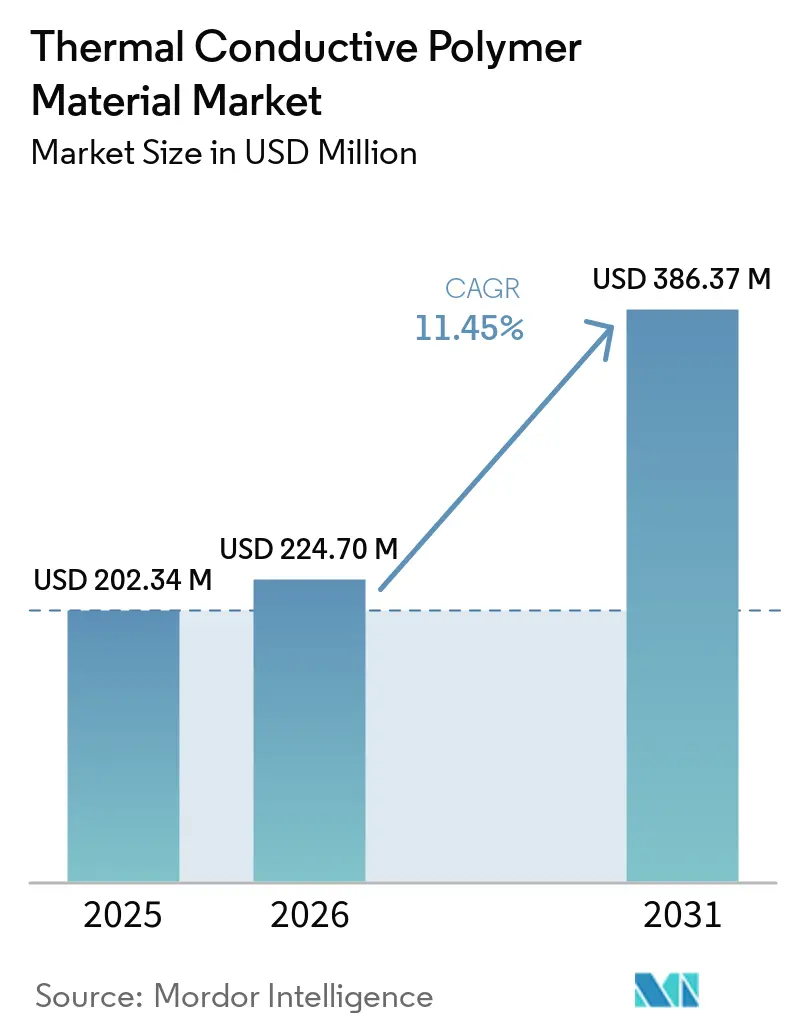
The thermal conductive polymer material market size was estimated at USD 202.34 million in 2025 and is estimated to grow from USD 224.70 million in 2026 to USD 386.37 million by 2031, at a CAGR of 11.45% during the forecast period (2026-2031). The thermal conductive polymer material market is driven by rising heat loads in electronics, electric vehicles, and data center equipment. These polymers provide heat transfer, electrical insulation, and lower component weight. Filled engineering polymers offer thermal conductivity of 2-25 W/m·K and can replace metal or ceramic assemblies in selected applications. AI-optimized racks operate at more than 100 kW per rack, increasing demand for thermal management materials in power distribution and server assemblies. Suppliers develop formulations with flame retardancy, dimensional stability, filler dispersion, and recyclability to meet OEM qualification requirements. Cell-to-pack battery designs also require materials that provide structural and thermal management functions.
Key Report Takeaways
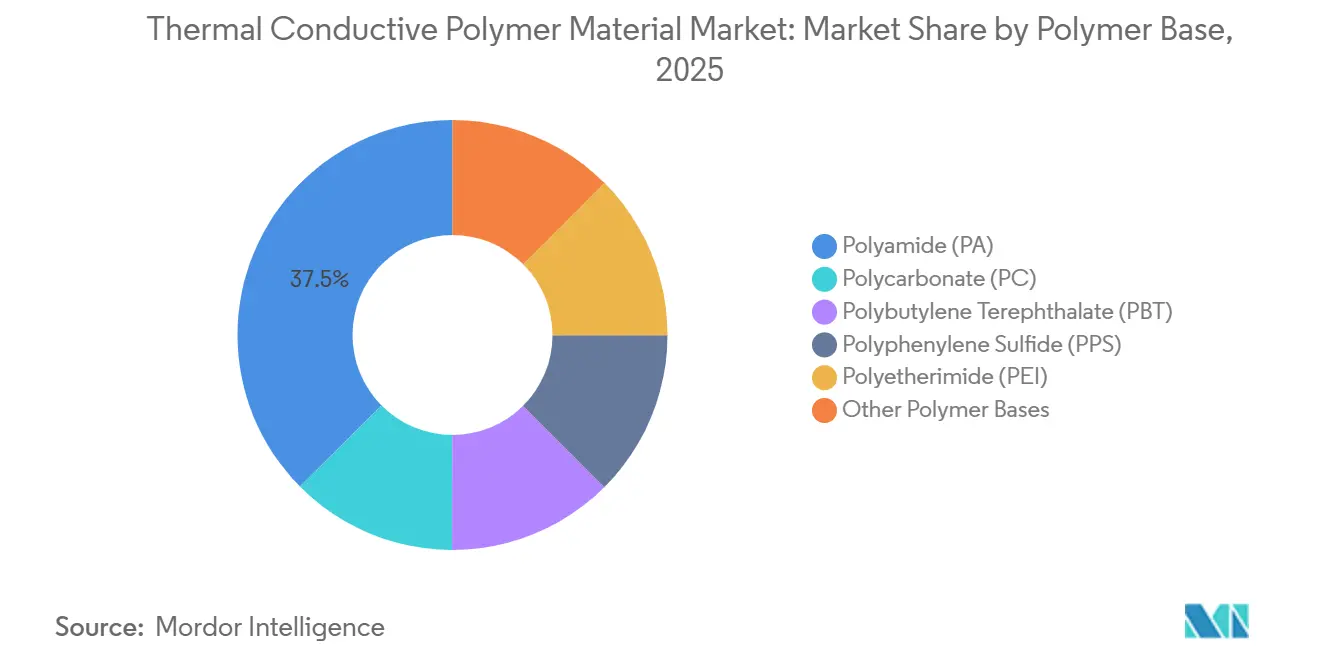
- By polymer base, Polyamide (PA) held 37.45% of the thermal conductive polymer material market share in 2025 and is forecast to grow at a 13.12% CAGR through 2031.
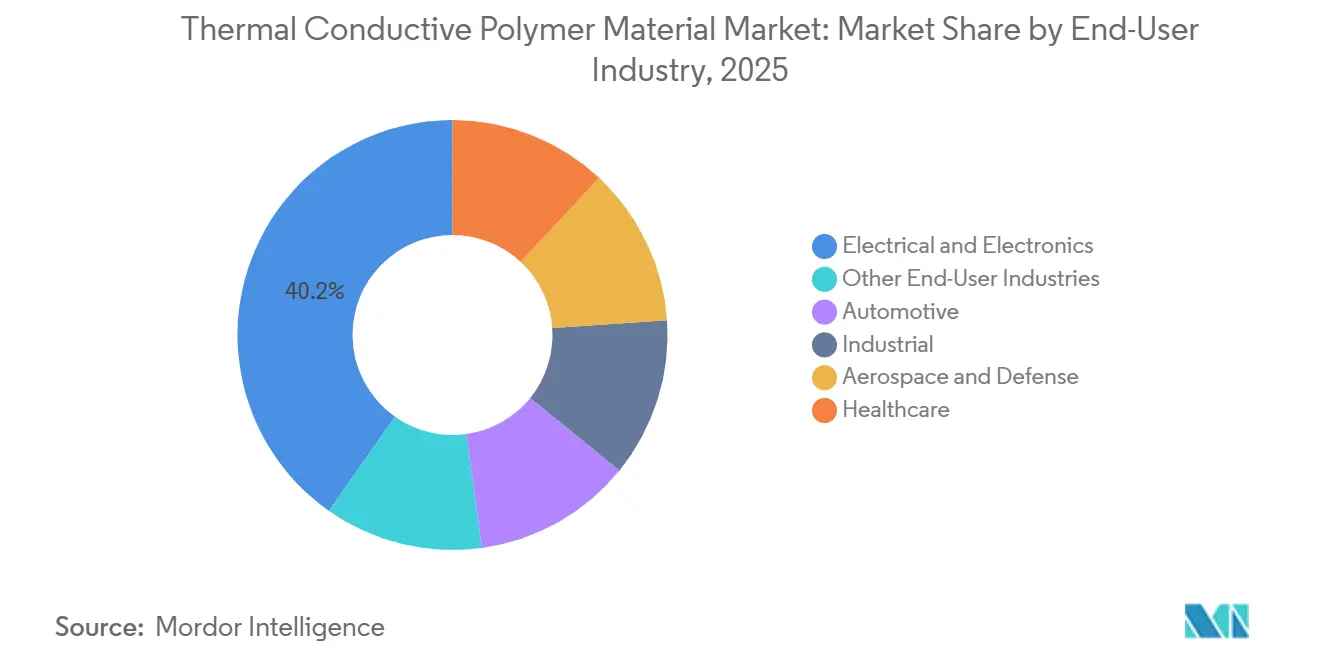
- By end-user industry, Electrical and Electronics accounted for 40.24% of the thermal conductive polymer material market share in 2025, while Automotive is forecast to grow at a CAGR of 13.56% through 2031.
- By geography, North America held 42.82% of the thermal conductive polymer material market share in 2025, while Asia-Pacific is forecast to grow at a CAGR of 12.05% through 2031.
Note: Market size and forecast figures in this report are generated using Mordor Intelligence’s proprietary estimation framework, updated with the latest available data and insights as of January 2026.
Global Thermal Conductive Polymer Material Market Trends and Insights
Drivers Impact Analysis*
| Drivers | (~) % Impact on CAGR Forecast | Geographic Relevance | Impact Timeline |
|---|---|---|---|
| Electronics Miniaturization and Rising Heat Flux | +2.8% | Global, the highest intensity in North America and East Asia | Short term (≤ 2 years) |
| Electrification of Vehicles and Battery Thermal Management | +2.5% | Global, the greatest near-term concentration in China and the EU | Medium term (2-4 years) |
| Metal Replacement Through Lightweight Molded Components | +1.8% | North America and Europe, the automotive supply chain core | Medium term (2-4 years) |
| Mainstream Adoption of Electrically Insulating Heat-Dissipation Materials | +1.5% | North America, Japan, and South Korea | Short term (≤ 2 years) |
| AI Data Centers, Power Electronics, and High-Density Computing | +1.6% | North America, the EU, and Taiwan | Short term (≤ 2 years) |
| Source: Mordor Intelligence | |||
Electronics Miniaturization and Rising Heat Flux
Semiconductor packaging increasingly focuses on heat-flux management, as thermal conditions affect system life. Unfilled polymers have thermal conductivity below 0.5 W/m·K. Engineered networks comprising boron nitride, graphene, and carbon-based structures can achieve in-plane thermal conductivity above 25 W/m·K while maintaining electrical insulation[1]Jia Li, Mengmeng Qin, and Wei Feng, “Recent Advances In The Thermal Management Performance Of Polymer-Based Composite Materials,” Materials Horizons, pubs.rsc.org. The thermally conductive polymer materials market includes ultra-high-conductivity grades for high-heat-flux applications. Mid-range compounds for LED and power-module housings face greater price pressure. As a result, margins are higher in the high-conductivity segment, supporting supplier investment in next-generation filler systems.
Electrification of Vehicles and Battery Thermal Management
The transition from 400 V to 800 V electric vehicle architectures increases thermal loading at cell tabs and connector interfaces. Materials must withstand thermal cycling and maintain dielectric performance over their service life. In May 2026, Henkel launched Loctite TLB 9270APS, a polyurethane-based thermally conductive adhesive with a thermal conductivity of 2 W/m·K for cell-to-pack battery designs. The product provides structural bonding, electrical insulation, and heat transfer to aluminum cooling plates. BASF developed Ultramid Advanced T1000 grades validated for continuous operation in ethylene glycol and water mixtures for 3,000 hours, supporting a 25,000-hour vehicle-life target. ISO 16232 and IATF 16949 requirements extend qualification timelines and favor suppliers with established automotive portfolios.
Metal Replacement Through Lightweight Molded Components
Injection-molded thermally conductive polymer components can integrate heat dissipation, structural housing, snap-fit features, and thin-walled geometries in a single manufacturing step. This enables the thermally conductive polymer materials market to compete with machined and die-cast metal parts through functional consolidation rather than material price alone. A 2025 SAE technical paper reported that hybrid polymer composites can match or exceed the performance of aluminum alloys in nonstructural automotive components while improving corrosion resistance and reducing lifecycle weight. New formulations are expanding opportunities for aluminum replacement across additional applications. OEMs also consider recycled content in procurement programs targeting Scope 3 emissions.
AI Data Centers, Power Electronics, and High-Density Computing
AI workloads are increasing data center thermal requirements beyond those of conventional electronics. AI-optimized racks are expected to exceed 100 kW in 2026, while GPU hot spots can reach temperatures 10-30°C above adjacent circuit board areas. These conditions can create mechanical stress and increase the risk of failure in materials designed for conventional server loads. In 2026, Covestro presented Makrolon TC, a thermally conductive polycarbonate, at COMPUTEX. The material supports direct molding over printed circuit boards to improve heat dissipation and simplify assembly. Research by Northeastern University and the U.S. Army Research Laboratory demonstrated a 3D-printable ceramic-polymer composite that conducted heat more effectively than stainless steel at one-quarter of its density. Additive manufacturing can enable complex thermal management geometries that were previously limited to machined metal parts.
Restraints Impact Analysis*
| Restraints | (~) % Impact on CAGR Forecast | Geographic Relevance | Impact Timeline |
|---|---|---|---|
| Thermal Conductivity Gap Versus Metals and Ceramics | -1.2% | Global, most acute in high-power applications in North America and East Asia | Long term (≥ 4 years) |
| High Filler Loading and Processing Complexity | -0.9% | Global, compounded in ASEAN and South America, with limited advanced tooling infrastructure | Medium term (2-4 years) |
| Cost Volatility of Specialty Fillers and Engineering Resins | -0.7% | Global, most exposed in North America and Europe | Short term (≤ 2 years) |
| Source: Mordor Intelligence | |||
Thermal Conductivity Gap Versus Metals and Ceramics
Thermally conductive polymers have lower thermal conductivity than metals and ceramics. Copper has a thermal conductivity of 385 W/m·K, and aluminum has 205 W/m·K. Commercial polymer composites with vertically aligned boron nitride networks exhibit a through-plane thermal conductivity of 19 W/m·K at 37% filler loading. This difference limits adoption in high-heat semiconductor applications. Design teams may select metal interfaces when lower junction temperatures support component life. Laboratory composites with aligned graphene and carbon-fiber networks have achieved a through-plane thermal conductivity of more than 260 W/m·K. However, injection-molding-grade materials still fall short of laboratory-scale performance. This constraint is expected to continue through 2031.
High Filler Loading and Processing Complexity
Ceramic filler loadings needed to achieve thermal conductivity above 5 W/m·K increase manufacturing costs. Viscosity increases sharply above 50-60% filler loading, affecting mold filling in thin-wall sections and weld-line strength. Aluminum nitride and silicon carbide fillers can increase tooling wear and complicate surface-finish control. These requirements require coordination among material developers, compounders, injection molders, and end users. They extend qualification cycles and increase switching costs, particularly for smaller original equipment manufacturers (OEMs) with limited materials-engineering resources. They also limit the number of molders and toolmakers that can process highly filled compounds at acceptable yields.
*Our forecasts treat driver/restraint impacts as directional, not additive. The impact forecasts reflect baseline growth, mix effects, and variable interactions.
Segment Analysis
By Polymer Base: PA Holds Leadership While PPS Gains Use in Harsh Environments
PA accounted for 37.45% of the thermal conductive polymer material market in 2025 and is projected to grow at the fastest CAGR of 13.12% through 2031. Its compatibility with boron nitride, aluminum nitride, and natural graphite fillers supports varied thermal requirements. Established PA compounding and injection-molding capabilities across automotive and electronics supply chains support the adoption of qualified grades. BASF offers over 50 compounded injection-molding and extrusion grades in its Ultramid Advanced portfolio, including PA9T, PA6T/6I, PA6T/66, and PA66/6T chemistries. These grades meet the requirements for thermal performance, hydrolysis resistance, flame retardancy, and mechanical strength.
BASF Performance Materials reported global sales of EUR 6.8 billion (~USD 7.87 billion) in 2024. PC is the second-largest polymer base in the thermal-conductive polymer materials market, supported by thin-wall flame retardancy and optical clarity in illuminated assemblies. PC grades also support thermal management in data center electrical assemblies. At CES 2025, Covestro introduced a patent-pending micromechanics simulation suite for Makrolon TC to optimize heat management in thermally conductive polycarbonates. PPS is used in high-temperature and chemically demanding applications. PBT serves cost-sensitive connector and relay housings, while PEI supports aerospace and medical applications above 180°C.



By End-User Industry: Automotive Records the Fastest Growth
Automotive is projected to record a CAGR of 13.56% through 2031, the highest among end-user industries in the thermal conductive polymer material market. EV electrification and the shift from 400 V to 800 V architectures increase thermal exposure in inverters, DC-DC converters, on-board chargers, and battery management systems. Thermally conductive polymers transfer heat while providing electrical insulation, supporting smaller module designs, and reducing risks from conductive metal proximity. Cell-to-pack designs also use adhesive systems to bond cells to cooling structures and manage interfacial heat flow. This structural and thermal function differentiates polymer formulations from conventional preformed cooling components.
Electrical and electronics accounted for 40.24% of the thermal conductive polymer material market in 2025. LED drivers, power modules, and compact consumer electronics support demand, with polymer heat sinks replacing aluminum in selected applications. Thinner smartphones and laptops increase demand for thermally conductive adhesive films and gap pads where conventional heat-sink attachment is impractical. These composites distribute heat across a wider surface area. UL 94 and IEC 60112 tracking-index requirements influence housing qualification. Procurement programs increasingly specify halogen-free grades in response to RoHS, REACH, and per- and polyfluoroalkyl substances (PFAS) restrictions. Industrial applications form the third-largest demand cluster, while aerospace, defense, and healthcare are specialized end-user industries for weight-efficient enclosures, diagnostic instruments, and imaging-device power electronics.
Geography Analysis
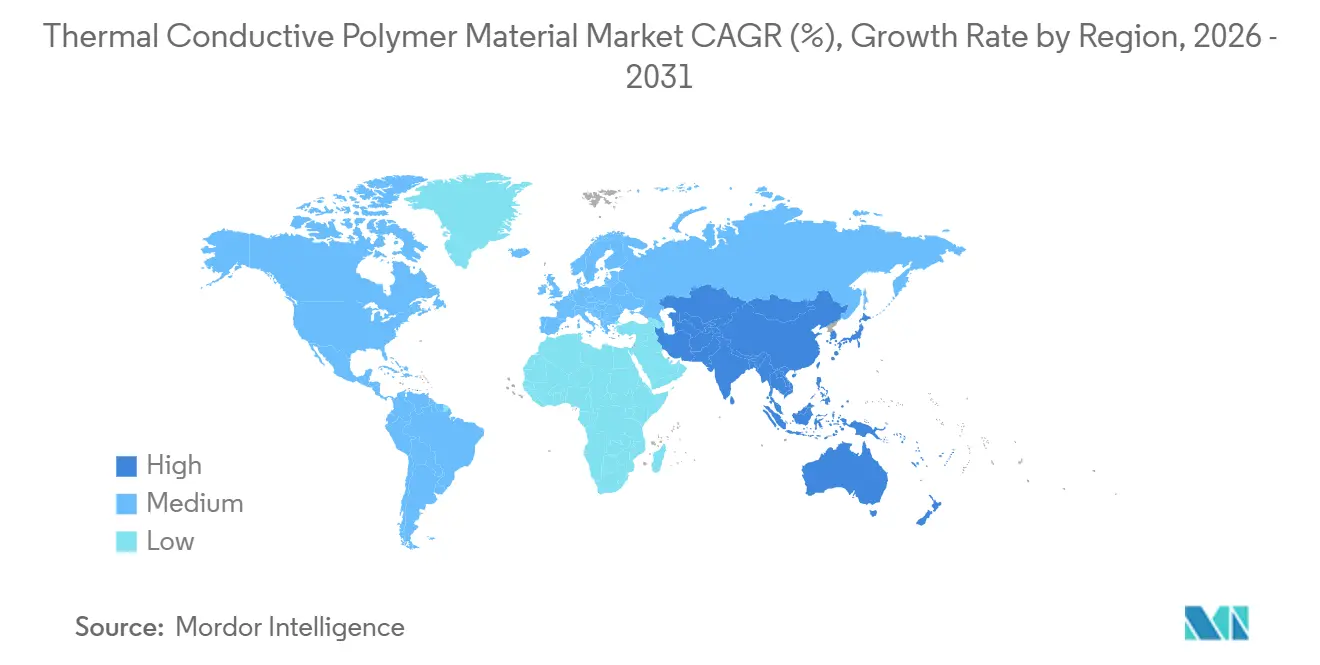
North America held 42.82% of the thermal conductive polymer material market in 2025, supported by U.S. hyperscale data centers, automotive electrification, and semiconductor OEM activity. The five largest global cloud operators have committed over USD 200 billion in capital expenditure for AI infrastructure in 2026, supporting demand for polyamide (PA) and polycarbonate (PC) compounds in server cooling assemblies and power distribution units. Canada and Mexico support the region through the USMCA automotive supply chains, in which regional content requirements promote polymer component qualification for locally produced EV powertrains. North American demand links electronics infrastructure, vehicle manufacturing, and material qualification activities.
Asia-Pacific is projected to grow at a CAGR of 12.05% through 2031, the highest regional growth rate in the thermal conductive polymer material market. China’s new energy vehicle (NEV) mandates, and the Yangtze River Delta’s EV battery and electronics base are reducing qualification timelines for thermal polymer grades. Taiwan accounts for over 60% of global advanced semiconductor manufacturing output in 2026, supporting demand for high-performance packaging substrates and overmold materials. AI server shipments to the United States from Taiwan-based manufacturers nearly doubled year over year in 2025, linking Asian production with North American data center demand. Japan and South Korea provide materials capabilities for consumer electronics and automotive export supply chains.
Europe includes BASF, Covestro, LANXESS, and Envalior across the regional engineering polymer value chain. Envalior began polyphenylene sulfide (PPS) compounding production at its Uerdingen facility in Germany in 2025, adding capacity for Xytron PPS compounds used in EV water-pump housings, high-temperature connectors, and thermal assemblies[2]Envalior, “Envalior To Build New Polyphenylene Sulfide Compounding Facility In Germany,” Envalior, envalior.com. EU REACH compliance and end-of-life vehicle requirements are driving reformulation toward halogen-free grades with lower volatile organic compound (VOC) content. India and ASEAN offer long-term potential as electronics and automotive manufacturing increases. South America and the Middle East and Africa remain smaller markets, with activity concentrated in Brazil’s automotive industry, Saudi Arabia’s industrial diversification, and South Africa’s aerospace and mining electronics sectors. These regions rely on imported specialty compounds and may expand as domestic manufacturing capacity achieves qualification.

Competitive Landscape
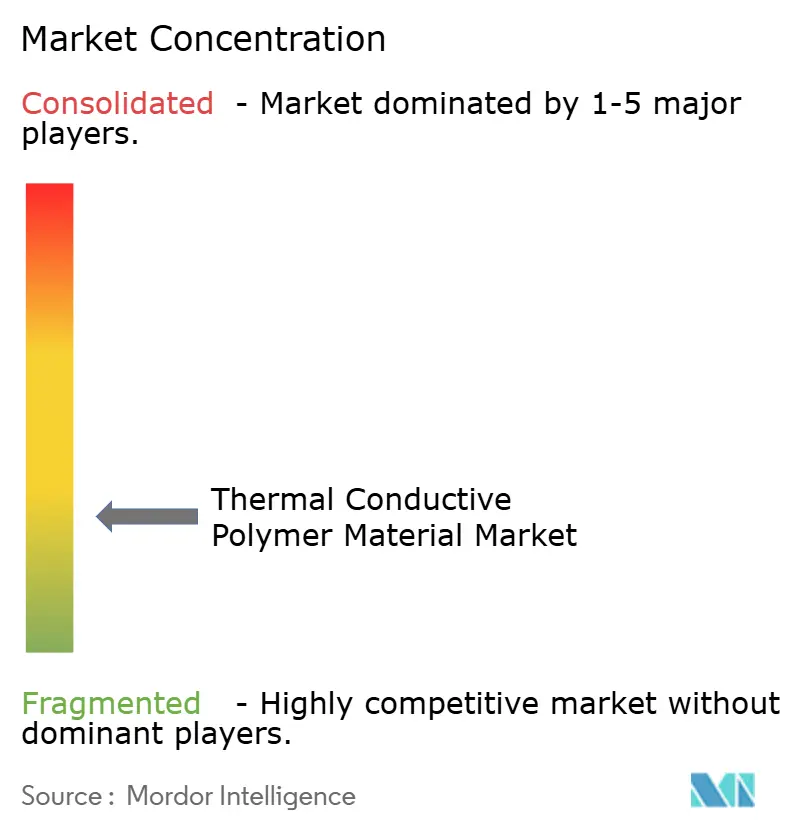
The thermally conductive polymer material market is fragmented. BASF, Covestro, Celanese, and DuPont compete through broad formulation portfolios, application engineering, and established OEM qualification relationships. Avient Corporation, RTP Company, and Ensinger focus on faster development cycles, lower minimum order quantities, and customized solutions for mid-market applications. Large chemical suppliers offer broad portfolios, while specialty compounders focus on responsive product development. After an automotive supplier qualifies a thermal PA grade for an inverter housing, the vehicle program typically specifies the base polymer, filler loading, and colorant system for its lifecycle.
This qualification process creates switching costs and supports multi-year supplier revenue after a grade passes thermal, electrical, and processing evaluations. In June 2025, BASF introduced Ultramid Advanced N3U42G6, a non-halogenated, flame-retardant PA9T grade that achieved UL 94 V-0 at 0.25 mm. KOSTAL Kontakt Systeme adopted the grade for its KS22 Class 4 high-voltage connector, supporting miniaturization in inverter and DC-DC converter assemblies. At COMPUTEX 2026, Covestro presented Makrolon TC solutions for AI data center infrastructure, including direct PCB overmolding for server and power distribution assemblies. These developments address requirements beyond thermal conductivity.
Flame retardancy, dimensional stability, filler dispersion, and recyclability influence OEM material qualification. Polyplastics commercially launched Durafide rG-PPS, a 40%-glass-filled recycled PPS, in December 2025. Recyclable thermally conductive grades and additive-manufacturing-compatible formulations remain areas of supplier differentiation. Chinese mid-market compounders are entering export markets with grades using domestically sourced boron nitride fillers, increasing price competition in markets where European and North American suppliers set performance benchmarks. UL 94 and IEC 60112 requirements remain barriers to entry, as suppliers with pre-certified grade libraries can complete qualification processes faster. BASF’s Ultramid Advanced T1000 portfolio shows how test data and regulatory documentation can create competitive barriers.
Thermal Conductive Polymer Material Industry Leaders
Celanese Corporation
SABIC
DuPont
Avient Corporation
BASF
- *Disclaimer: Major Players sorted in no particular order

Recent Industry Developments
- May 2026: Covestro presented Makrolon TC thermally conductive polycarbonate solutions for AI data center infrastructure at COMPUTEX 2026 in Taipei. The solutions support direct printed circuit board (PCB) overmolding for server and power distribution assemblies in racks operating at power densities above 100 kW.
- June 2025: BASF introduced Ultramid Advanced N3U42G6, a PA9T polyphthalamide with a non-halogenated flame retardant that achieves UL 94 V-0 at 0.25 mm. KOSTAL Kontakt Systeme adopted the grade for its KS22 Class 4 high-voltage connector for inverter and DC-DC converter assemblies.


Global Thermal Conductive Polymer Material Market Report Scope
Thermally conductive polymer materials are specialized plastic composites designed to transfer heat away from hot components. Unlike standard plastics, which act as thermal insulators, these materials combine a base polymer resin with thermally conductive fillers, such as graphite, ceramic, or metal particles, to dissipate thermal energy safely.
The thermal conductive polymer material market is segmented by polymer base, end-user Industry, and geography. By polymer base, the market is segmented into polyamide (PA), polycarbonate (pc), polybutylene terephthalate (PBT), polyphenylene sulfide (PPS), polyetherimide (PEI), and other polymer bases. By end-user industry, the market is segmented into electrical and electronics, automotive, industrial, aerospace and defense, healthcare, and other end-user industries. The report also covers market size and forecasts for thermal conductive polymer material across 15 countries in major regions. The market sizes and forecasts are provided in terms of value (USD).
| Polyamide (PA) |
| Polycarbonate (PC) |
| Polybutylene Terephthalate (PBT) |
| Polyphenylene Sulfide (PPS) |
| Polyetherimide (PEI) |
| Other Polymer Bases |
| Electrical and Electronics |
| Automotive |
| Industrial |
| Aerospace and Defense |
| Healthcare |
| Other End-User Industries |
| Asia-Pacific | China |
| India | |
| Japan | |
| South Korea | |
| ASEAN Countries | |
| Rest of Asia-Pacific | |
| North America | United States |
| Canada | |
| Mexico | |
| Europe | Germany |
| United Kingdom | |
| France | |
| Italy | |
| NORDIC Countries | |
| Rest of Europe | |
| South America | Brazil |
| Argentina | |
| Rest of South America | |
| Middle East and Africa | Saudi Arabia |
| South Africa | |
| Rest of Middle East and Africa |
| By Polymer Base | Polyamide (PA) | |
| Polycarbonate (PC) | ||
| Polybutylene Terephthalate (PBT) | ||
| Polyphenylene Sulfide (PPS) | ||
| Polyetherimide (PEI) | ||
| Other Polymer Bases | ||
| By End-User Industry | Electrical and Electronics | |
| Automotive | ||
| Industrial | ||
| Aerospace and Defense | ||
| Healthcare | ||
| Other End-User Industries | ||
| By Geography | Asia-Pacific | China |
| India | ||
| Japan | ||
| South Korea | ||
| ASEAN Countries | ||
| Rest of Asia-Pacific | ||
| North America | United States | |
| Canada | ||
| Mexico | ||
| Europe | Germany | |
| United Kingdom | ||
| France | ||
| Italy | ||
| NORDIC Countries | ||
| Rest of Europe | ||
| South America | Brazil | |
| Argentina | ||
| Rest of South America | ||
| Middle East and Africa | Saudi Arabia | |
| South Africa | ||
| Rest of Middle East and Africa | ||


Key Questions Answered in the Report
What is current market size of Thermal Conductive Polymer Material Market?
The thermal conductive polymer material market size was estimated at USD 202.34 million in 2025 and is estimated to grow from USD 224.70 million in 2026 to USD 386.37 million by 2031, at a CAGR of 11.45% during the forecast period (2026-2031).
Which polymer base leads to thermal conductive polymer materials?
Polyamide (PA) led with a 37.45% share in 2025 and is projected to grow at a 13.12% CAGR through 2031.
Which end-user sector grows fastest for thermal conductive polymer materials?
Automotive is forecast to grow at a 13.56% CAGR through 2031 as 800 V EV designs require more thermal management.
Which region has the largest demand for thermal conductive polymer materials?
North America held a 42.82% share in 2025, supported by data centers, automotive electrification, and semiconductor activity.
Page last updated on:





