
Market Overview
| Study Period | 2021 - 2031 |
|---|---|
| Forecast Data Period | 2026 - 2031 |
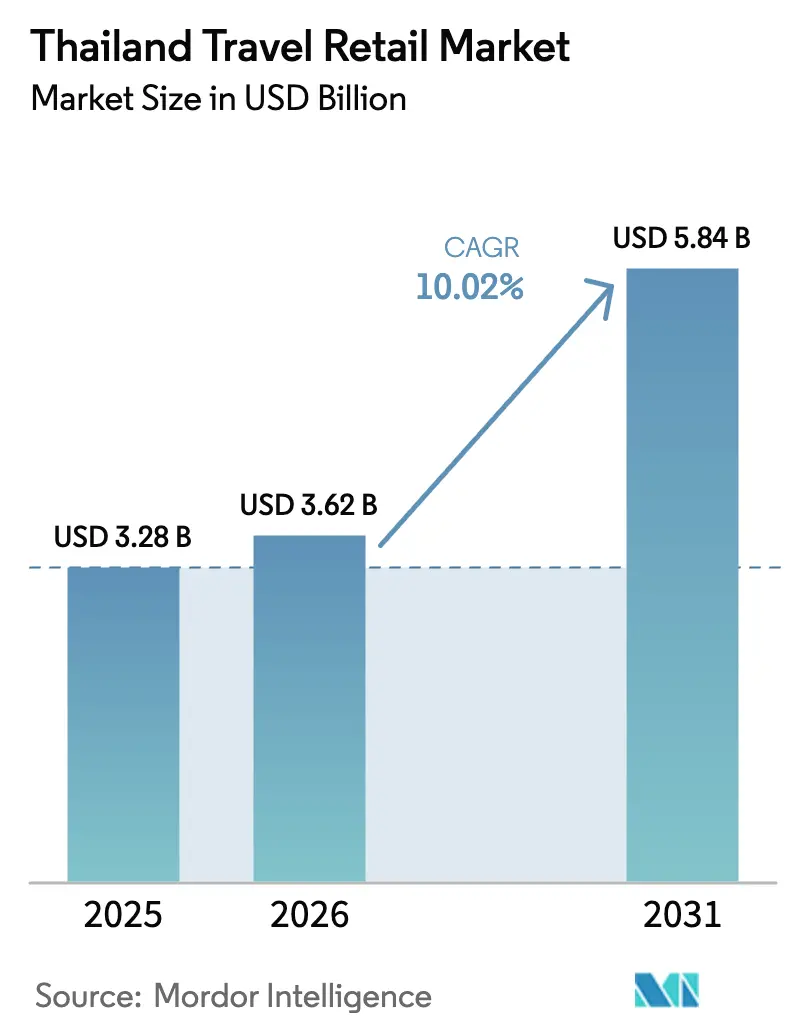
| Base Year Market Size (2025) | USD 3.28 Billion |
| Market Size (2026) | USD 3.62 Billion |
| Market Size (2031) | USD 5.84 Billion |
| Growth Rate (2026 - 2031) | 10.02 % |
| Market Concentration | High |
Major Players *Disclaimer: Major Players sorted in no particular order Image © Mordor Intelligence. Reuse requires attribution under CC BY 4.0. | |
Thailand Travel Retail Market Analysis by Mordor Intelligence
The Thailand Travel Retail Market size was valued at USD 3.28 billion in 2025 and is estimated to grow from USD 3.62 billion in 2026 to reach USD 5.84 billion by 2031, at a CAGR of 10.02% during the forecast period (2026-2031).
The upturn is supported by passenger recovery across Airports of Thailand’s network and by targeted policy measures that keep Thailand competitive among regional tourism hubs. The August 2024 closure of all inbound duty-free shops redirected spend toward departure-side stores and downtown formats, which concentrates volume in core locations where operators can drive higher-value conversion. Visa-policy liberalization for priority origin markets, including the mutual visa-free regime with China from March 2024, is widening the pool of free independent travelers who exhibit a stronger propensity to buy premium goods at airports. Chinese arrivals remained below pre-pandemic benchmarks in 2025, which shifts sales mix toward long-haul and high-value cohorts while pressuring operators to improve basket size through curated assortments and omnichannel pre-order.
Key Report Takeaways
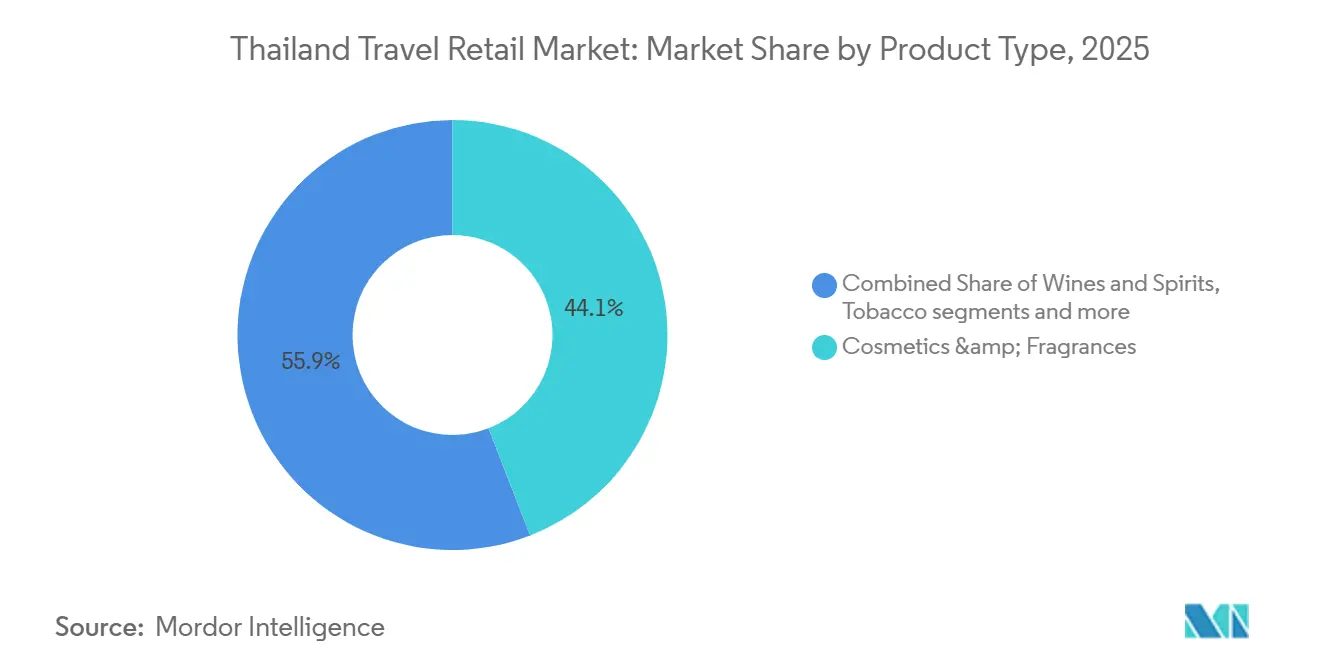
- By product type, Cosmetics & Fragrances led with 44.12% in 2025, while Wines & Spirits is forecast to expand at a 9.11% CAGR through 2031.
- By distribution channel, Airports held a 65.42% share in 2025, while Airports are projected to post the highest CAGR at 9.18%.
- By geography, Central Thailand accounted for a 60.25% share in 2025, while Northern Thailand is projected to grow at a 9.63% CAGR through 2031.
Note: Market size and forecast figures in this report are generated using Mordor Intelligence’s proprietary estimation framework, updated with the latest available data and insights as of January 2026.
Thailand Travel Retail Market Trends and Insights
Drivers Impact Analysis*
| Driver | (~) % Impact on CAGR Forecast | Geographic Relevance | Impact Timeline |
|---|---|---|---|
| Tourism rebound post-pandemic & tourist-visa liberalisation | +2.1% | Global, with concentration in Northeast Asia, South Asia, and Eastern Europe | Medium term (2-4 years) |
| Airport capacity expansion (Suvarnabhumi East, Don Mueang T3, Phuket) | +1.8% | Central Thailand, Southern Thailand, Northern Thailand, with spill-over to regional hubs | Long term (≥ 4 years) |
| Premium beauty & personal-care boom among inbound visitors | +1.4% | Asia-Pacific core with spill-over from Middle East visitors in Phuket | Medium term (2-4 years) |
| Luxury tax and wine duty reforms stimulate duty-free spending | +1.2% | National, with particular strength in Bangkok, Phuket, and Chiang Mai | Short term (≤ 2 years) |
| Cancellation of arrival duty-free shifts spent on departures/downtown | +0.8% | National, concentrated in major airports and selected downtown flagships | Short term (≤ 2 years) |
| Omnichannel pre-order & e-wallet integration lifts conversion rates | +0.9% | Global, with early gains in Bangkok, Phuket, and Chiang Mai; strongest among Chinese travelers using cross-border QR payments | Short term (≤ 2 years) |
| Source: Mordor Intelligence | |||
Tourism Rebound Post-Pandemic & Tourist-Visa Liberalisation
Thailand’s visa policies have been a clear tailwind since 2024, including the mutual visa-free arrangement with China that took effect in March 2024 and broader visa measures to support source-market recovery. Total international arrivals in 2025 remained in a stabilized range, with changes in source-market mix that elevate the share of long-haul and high-spending visitors for the Thailand travel retail market. The performance of the Thailand travel retail market is increasingly tied to dwell time and ticket size, which tend to be higher for independent travelers planning pre-orders and luxury purchases[1]. Digital payment readiness, including cross-border QR interoperability, reduces frictions at checkout and helps the Thailand travel retail market convert intent into transactions more consistently.
Airport Capacity Expansion (Suvarnabhumi East, Don Mueang T3, Phuket)
Airports of Thailand is executing a multi-year capacity program that raises long-run passenger throughput and the platform’s ability to capture non-aeronautical revenue, with upgrades at Bangkok’s dual-airport system and in Phuket backed by defined timelines. Non-aeronautical revenue already accounts for a material share of AOT’s total revenue, reinforcing the strategic role of commercial yield management in the Thailand travel retail market. Expansion phases occasionally require flow redesigns and space reconfiguration, but the long-term effect is to enlarge airside commercial canvases and staff productivity per square meter for the Thailand travel retail market[2]. The August 2024 policy closure of inbound duty-free consolidated spend at departures and in selected downtown hubs that emphasize curated experiences and pre-order pickup. Infrastructure improvements, paired with optimized concessions, strengthen the tie between passenger growth and retail receipts, which should accrue to the Thailand travel retail market over the forecast horizon.
Premium Beauty & Personal-Care Boom Among Inbound Visitors
The T-Beauty phenomenon, where Thai cosmetics captured 97.62% of Thailand's beauty imports into China and Bangkok Cosmoprof 2025 attracted 23,000+ visitors (+20% year-on-year), has elevated Thailand from a sourcing backwater to a must-stock destination for international travelers, yet this shift's travel retail implications extend far beyond stocking Mistine and Cathy Doll[3]. Regulatory oversight by Thailand’s Food and Drug Administration assures product authenticity and compliance, which sustains trust at the point of sale for the Thailand travel retail market. Digital payments and loyalty tie-ins help move beauty shoppers from browsing to basket confirmation, which supports margin mix through premium lines for the Thailand travel retail market. These operational and regulatory pillars strengthen conversion and repeat purchases in a category that already leads overall travel retail demand in Thailand.
Luxury-Tax and Wine-Duty Reforms Stimulate Duty-Free Spending
Wine import duty elimination and excise adjustments implemented in early 2024 altered Thailand’s price architecture and encouraged broader participation in the category. The reforms expand the addressable base for wines and premium spirits while inviting duty-free operators to differentiate through exclusive allocations, limited releases, and pre-order commitments. As price parity narrows with domestic retail, airport operators are emphasizing assortment uniqueness, giftability, and traveler services to sustain category leadership within the Thailand travel retail market[4]. Duty-free allowances on liquor remain relevant to purchase planning, and integration of pre-order windows with flight itineraries supports considered, higher-value purchases. Category momentum, coupled with service design and inventory privileges, points to the continued relevance of wines and spirits in the Thailand travel retail market.
Restraints Impact Analysis*
| Restraint | (~) % Impact on CAGR Forecast | Geographic Relevance | Impact Timeline |
|---|---|---|---|
| Dependence on volatile Chinese tourist flows | -1.6% | National, with acute impact in Bangkok, Phuket, and Pattaya | Medium term (2-4 years) |
| High concession fees & minimum-guarantee burdens | -1.3% | National, concentrated at AOT gateways where major concessions are operated. | Long term (≥ 4 years) |
| King Power liquidity crisis/contract renegotiation risk | -1.0% | National, systemic exposure given the concentration of airport duty-free operations | Medium term (2-4 years) |
| E-commerce price transparency erodes price advantage | -1.1% | National, mitigated by the January 2026 removal of low-value duty exemptions. | Short term (≤ 2 years) |
| Source: Mordor Intelligence | |||
Dependence on Volatile Chinese Tourist Flows
The recovery of Chinese visitors remained uneven in 2025 despite visa facilitation, which keeps the outlook sensitive for operators exposed to this cohort. Segment volatility affects airport locations with merchandise mixes that historically skewed toward Chinese tour-group preferences. Operators have accelerated diversification across other source markets, which changes category priorities and language capabilities at frontline counters for the Thailand travel retail market. The mix shift increases the weight of long-haul travelers who buy premium categories, but it requires sustained investment in service design to stabilize conversion over time. Policy efforts remain supportive, yet demand-side caution reinforces the need for omnichannel and loyalty levers to balance the revenue base of the Thailand travel retail market.
High Concession Fees & Minimum-Guarantee Burdens
Thailand’s airport concessions operate under revenue-sharing and minimum-guarantee frameworks that require operators to balance fixed commitments with variable demand. As non-aeronautical income rises in importance for airport operators, commercial terms are structured to protect the public landlord, which compresses margin flexibility for retailers during slowdowns in the Thailand travel retail market. Contract revisions have focused on continuity and yield protection while aligning timelines with major infrastructure projects. This environment benefits operators with sufficient capital, technology, and loyalty infrastructure, and it raises entry barriers for new players considering Thailand’s large hubs. The aggregate effect is to strengthen the incentive for superior execution while limiting price-based competition in the Thailand travel retail market.
*Our forecasts treat driver/restraint impacts as directional, not additive. The impact forecasts reflect baseline growth, mix effects, and variable interactions.
Segment Analysis
By Product Type: Cosmetics Dominance Meets Spirits Revival
Cosmetics & Fragrances commanded 44.12% of Thailand's travel retail market share in 2025, and this leadership reflects consistent buyer interest in premium beauty, curated sets, and travel-exclusive lines. The category benefits from pre-trip discovery and event-led visibility, which positions operators to capture demand through pre-order, collection timing, and loyalty benefits. Beauty, authenticity, and safety regulation under Thailand’s Food and Drug Administration help preserve confidence at the point of sale, which underpins conversion in high-velocity airport environments. Wines & Spirits is the fastest-growing product group with a projected 9.11% CAGR through 2031, supported by 2024 tax reforms that broadened category participation and encouraged premium trading-up. Duty-free operators are leaning into exclusivity, limited releases, and concierge service to keep the Thailand travel retail market competitive, where domestic prices have moved closer to duty-free levels.
The wider luxury ecosystem is reinforcing high-aspiration purchasing through experiential concepts, visible in watch and jewelry showcases within flagship locations that add traffic and dwell to neighboring categories. Curated horology and fine jewelry help anchor premium positioning for the Thailand travel retail market, and they complement beauty and spirits in multi-category baskets. Tobacco remains managed by a tight regulatory regime and enforcement against prohibited products, which preserves clarity for compliant retail operations. Food & Confectionery maintains steady traveler appeal through gifting and impulse formats, and operators use seasonal assortments to support conversion among family and group travelers. Taken together, the breadth of assortment, exclusivity, and compliance underpin product strength and help sustain a premium mix within the Thailand travel retail market.

By Distribution Channel: Airports Reign, Downtown Retreats
Airports accounted for 65.42% of sales in 2025 and are projected to post a 9.18% CAGR, reaffirming their primacy as the most efficient channel for scale, conversion, and logistics in the Thailand travel retail market. Airports of Thailand’s sustained investment in capacity and the rising share of non-aeronautical revenue underscore the strategic importance of commercial yield across the network. In-flight duty-free on national carriers complements airside retail by adding pre-order windows and on-seat delivery that can capture specific segments, such as fragrance and gifting. Digital payments and secure checkout processes reduce friction and support larger basket values, especially for pre-committed purchases. These factors keep airport formats central to shopper journeys and sustain channel expansion in the Thailand travel retail market.
Downtown duty-free has evolved toward flagship and experiential concepts that serve urban residents and free independent travelers with curated zones and assisted pickup for airport-bound items. The August 2024 end of inbound duty-free activity steered residual purchase intent to departure-side and downtown units, which reinforced the shift toward premium experiences and pre-order conversion. Airlines are introducing subscription and loyalty constructs that keep frequent travelers in branded ecosystems while reinforcing ancillary spending touchpoints. Airport e-commerce integration and click-to-collect programs have extended the shopping window, which aligns with omnichannel strategies now standard in the Thailand travel retail market. The cumulative effect is a more deliberate shopper journey that privileges convenience, authenticity, and exclusivity over pure price comparison in Thailand’s travel retail.

Geography Analysis
Central Thailand is the commercial core of the Thailand travel retail market, led by Bangkok’s dual-airport system and strong luxury retail infrastructure, and it accounted for a 60.25% share in 2025. International passenger recovery has been firm, with Airports of Thailand reporting surging throughput that supports the base for airside retail. Departure-side concentration after the policy shift on inbound duty-free has benefited Bangkok gateways, where curated formats and pre-order collection are easiest to scale. Supporting systems, including duty-free e-commerce touchpoints and loyalty integration, are densest in Central Thailand, which magnifies its lead within the Thailand travel retail market. These advantages position the region to sustain growth as capacity expansions continue.
Northern Thailand is the fastest-growing region at a projected 9.63% CAGR through 2031, with Chiang Mai’s expansion plan a key enabler of future capacity. Infrastructure roadmaps anticipate significant upgrades that align with cultural and experiential travel patterns that favor this region. The visitor mix tends to skew toward independent travelers who prefer longer stays and curated purchases, which fits well with pre-order models for the Thailand travel retail market. Northern gateways also serve as diversification valves for national networks where Bangkok faces peak constraints. Consistent policy support for regional tourism development improves the medium-term outlook for retail growth at airports in the North.
Southern Thailand remains a pivotal luxury and resort corridor, with Phuket Airport on a defined upgrade path to raise installed capacity and improve service levels. The mix of long-haul visitors and premium resort traffic supports watches, jewelry, spirits, and beauty categories within the Thailand travel retail market. Airfield and terminal improvements in the South are expected to convert into higher non-aeronautical yields as airside layouts are optimized for retail. Forward infrastructure planning in Eastern Economic Corridor nodes adds optionality for the regional dispersion of passenger flows. Collectively, these geographic dynamics reinforce the concentration of value in Central Thailand, the velocity advantage in the North, and the premium mix in the South across the Thailand travel retail market.
Regulatory Landscape
Thailand travel retail is governed primarily by the Thai Customs Department under the Customs Act framework, including licensing and control of duty-free zones and bonded operations, alongside passenger import rules at ports of entry. Allowance enforcement (red/green channel) anchors compliance for categories central to travel retail, including alcohol (1 liter) and tobacco limits (200 cigarettes or 250 g of tobacco products), with a total value threshold for arriving passengers (THB 20,000) shaping what travelers can legally bring in.
On the tax side, product-category rules and excise treatment remain material for wines and spirits under Thailand's Excise Act B.E. 2560. At the same time, the broader price-comparison dynamic has been influenced by the Customs policy change effective 1 January 2026, which removed the import duty exemption for low-value shipments previously below THB 1,500. This shifts the duty-paid alternative for travelers and strengthens the role of compliant, customs-controlled travel retail channels for passengers seeking certainty on authenticity, labeling, and tax treatment at purchase and exit.
Value Chain Analysis
Thailand's travel retail value chain is concession-led at the airport level, with Airports of Thailand (AOT) as the principal airport landlord structuring commercial space access through revenue-share and/or minimum-guarantee terms, and King Power as the dominant duty-free operator across major gateways (Suvarnabhumi, Don Mueang, Phuket, Chiang Mai, and Hat Yai). Brand owners and authorized distributors supply assortments, notably cosmetics, fragrances, and premium alcohol, while logistics flows run through customs-controlled warehousing and delivery to airside stores. Inventory planning for flight peaks and traveler mix supports downstream execution.
Recent structural changes reshaped downstream execution: the 1 August 2024 cessation of inbound duty-free at key AOT airports shifted demand capture toward departures and selected downtown concepts, changing space utilization and staffing models and raising the importance of pre-order and pickup orchestration. Upstream, operators increasingly emphasize supplier compliance and procurement governance, for example, King Power's supply-chain standards aligned to ISO 20400 principles. The 1 January 2026 removal of low-value import duty exemptions increases the relative friction of cross-border e-commerce, which reinforces the need for integrated data, payment, and fulfillment processes across the travel retail ecosystem.
Competitive Landscape
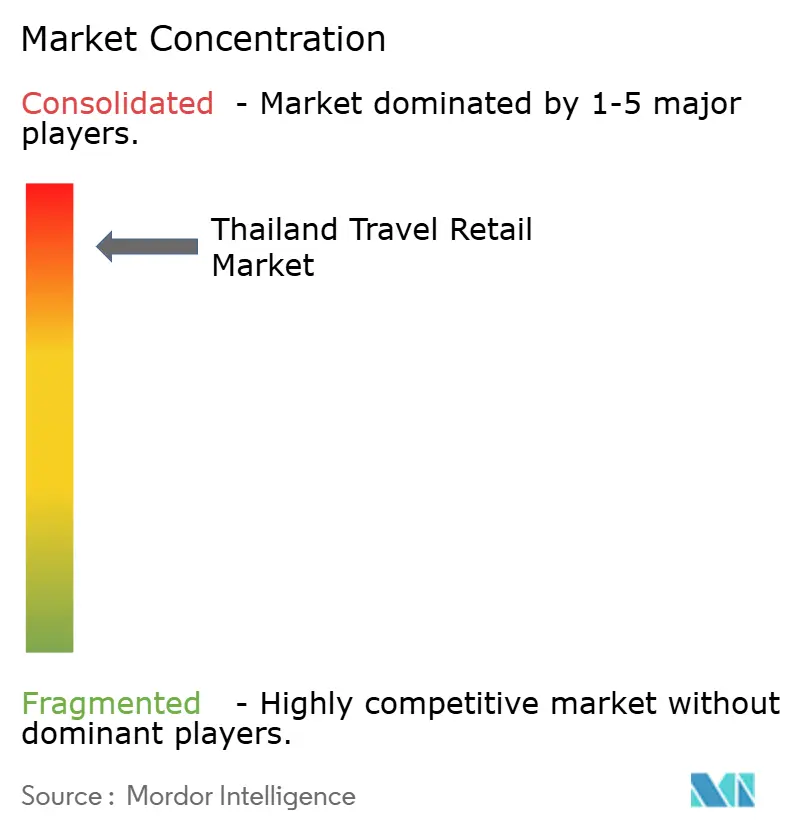
Airport concessions in Thailand are highly concentrated, with a single incumbent operating across major AOT-managed gateways and shaping category execution and loyalty integration for the Thailand travel retail market. Post-pandemic renegotiations aimed to balance continuity with higher yield capture for the public landlord, and they aligned contract windows with long-horizon infrastructure plans. The concentration of airside operations rewards scale players that can sustain capital, inventory, and technology requirements while meeting service standards. This structure is a core context for strategic moves by incumbents and partners in the Thailand travel retail market. Partnership models that combine global loyalty ecosystems with local retail footprints have become central to value creation.
Operators are investing in experiential downtown formats that complement airport stores, with flagship concepts that organize high-value categories into curated zones and provide assisted airport collection for restricted items. The role of omnichannel has expanded from basic pre-order to journey-wide engagement, which integrates product discovery, price transparency, loyalty rewards, and pickup logistics for the Thailand travel retail market. In-flight duty-free on national carriers remains a relevant extension for select categories, and it provides additional pre-order and delivery options around long-haul schedules. Airline subscription and lounge programs create recurring engagement points that can influence incidental purchases. Together, these tactics improve conversion along a traveler’s path and reinforce ecosystem stickiness in Thailand’s travel retail.
Global partners are strengthening technology utility across borders, including mobile app features, local currency pricing, and connectivity improvements for Chinese travelers who expect seamless digital journeys. Airport-side digitization and compliance fundamentals, including payment security and data protection standards, remain table stakes as baskets shift to higher-value categories in the Thailand travel retail market. Operators are also aligning with regulatory and customs frameworks on allowances and labeling, which assures a consistent traveler experience at exit points. Capacity upgrades and longer concession horizons support the business case for sustained investment in brand boutiques and exclusive allocations. The overarching pattern is a consolidation of capability around scale, loyalty, compliance, and experiential formats in the Thailand travel retail market.
Thailand Travel Retail Industry Leaders
-
King Power International Group
-
Airports of Thailand PLC
-
Central Pattana
-
Lotte Duty Free
-
The Shilla Duty Free
- *Disclaimer: Major Players sorted in no particular order
Market Opportunities and Future Outlook
The post-arrivals-duty-free environment creates whitespace to monetize departure-side journeys and to use airport commercial space more intensively, particularly at AOT-managed hubs where airports already account for 65.42% of 2025 travel retail sales. AOT's approved BKK Development Master Plan (2025 edition), including a South Terminal, a fourth runway, and an automated people mover targeting 120 million passengers annual capacity, provides a concrete runway for expanding retail canvases and re-optimizing store adjacencies, passenger flows, and click-and-collect pickup points.
Commercial model and demand-mix shifts also open execution opportunities for operators and brands. Revised AOT duty-free concession agreements approved in December 2025 to maintain continuity with King Power, alongside AOT's monitoring of non-aeronautical revenue performance through FY2026, sharpen the focus on conversion, basket size, and category productivity rather than footprint alone. On the demand side, the March 2024 mutual visa-free regime with China broadens the independent-traveler pool, while the already-dominant Cosmetics and Fragrances category (44.12% share in 2025) provides room for travel-exclusive assortments, authenticated local beauty storytelling, and omnichannel pre-order tied to cross-border payment interoperability at checkout.
Recent Industry Developments
- May 2026: Airports of Thailand (AOT) reported softer duty-free concession performance in its non-aeronautical revenue trend update for the six-month period ended 31 March 2026. The disclosure reinforced operators focus on conversion-led levers, including assortment, pricing architecture, and pre-order, as airports manage commercial yield under revised concession terms.
- December 2025: Airports of Thailand (AOT) approved revised duty-free concession agreements with King Power Duty Free across Suvarnabhumi, Don Mueang, Phuket, Chiang Mai, and Hat Yai airports. The decision secured operating continuity at the countrys core gateways and supported a more workable framework for concession payments and commercial planning.
- August 2024: Thailand implemented a policy eliminating inbound duty-free shops at major international airports, with AOT confirming the cessation at key airports and reclaiming about 2,250 sq m of space. The change redirected purchase intent toward departure-side retail and alternative formats, altering how operators allocate space, inventory, and staff across the travel retail network.
Research Methodology Framework and Report Scope
Market Definition and Coverage
For this report, the market covers traveler-focused retail sales in Thailand that happen through travel touchpoints where passengers shop during a trip, including duty-free and duty-paid travel retail formats across key transport-linked locations.
Scope exclusions: Regular domestic retail that is not linked to a travel journey (such as city malls and neighborhood stores) is excluded.
Segmentation Overview
- By Product Type
- Fashion & Accessories
- Jewelry & Watches
- Wines & Spirits
- Food & Confectionery
- Cosmetics & Fragrances
- Tobacco
- Other Product Types (Stationery, Electronics, etc.)
- By Distribution Channel
- Airports
- Airlines
- Ferries
- Other Channels (Railway Stations, Border Shops, Downtown)
- By Geography
- Central Thailand
- Northern Thailand
- Northeastern Thailand (Isan)
- Eastern Thailand
- Western Thailand
- Southern Thailand
Data Sources, Market Sizing, and Validation
Desk Research
Desk work started by building a clean demand context for Thailand travel flows and spend behavior, and then mapping that to travel retail exposure points. We leaned on public travel and aviation indicators such as Airports of Thailand traffic releases, the Tourism Authority of Thailand updates, Bank of Thailand macro series, and Immigration Bureau arrival statistics to sense-check passenger volumes and mix.
To shape category and shopper behavior assumptions, we also reviewed open publications such as UNWTO dashboards, World Bank data tables, and trade association or airport retail commentary that discusses duty-free rules and channel changes. Company filings, investor presentations, and credible business press were used to understand store footprints, concession structures, and pricing moves. Where needed, we referenced paid subscriptions for company financials and intelligence, and for shipment-level import export context on select product groups sold in travel retail. These desk sources are illustrative only, and many other public materials were also reviewed to collect data, validate inputs, and clarify open questions.
Primary Interviews and Surveys
Primary work focused on interviews and short surveys with airport and non-airport travel retail stakeholders, plus brand-side and distributor-side contacts who understand volumes, margins, and shopper mix. We also spoke with channel specialists linked to airports, airlines, and ferry-linked retail so that assumed conversion rates and spend per traveler could be checked against what is seen on the ground.
Distribution of primary research fieldwork respondents
| Company type | Respondent position |
|---|---|
| Top tier: 38% | CXOs: 12% |
| Mid tier: 47% | Functional/Unit leaders: 42% |
| Smaller Players: 15% | Managers: 46% |
Market-Sizing & Forecasting
The sizing model begins with a top-down build where passenger flows and travel touchpoints are used to reconstruct the addressable shopping pool, and then typical spend patterns are applied by channel and basket type. When the totals were taking shape, we cross-checked them using selective bottom-up approximations such as sampled sales productivity by store format, mix-led average selling price logic for key baskets, and channel checks on airport versus non-airport contribution, which then helped adjust assumptions where gaps showed up.
Inputs used in the model include international and domestic passenger volumes through major gateways, tourism arrivals and seasonality, airport retail penetration (share of travelers who purchase), average spend per buying traveler, and category mix signals such as the relative weight of cosmetics and fragrances versus wines and spirits. We also tracked changes that can shift near-term demand, including duty-free rule changes, concession resets, and flight capacity normalization on key routes. Forecasting relied mainly on scenario analysis tied to travel volume recovery paths and spend per passenger progression, with assumptions refined through expert feedback so the pace of growth stayed realistic year to year.
Where direct bottom-up data points were missing for smaller channels, gaps were handled by using proxy productivity ranges from comparable Thai hubs and then narrowing them through primary feedback, before being rolled into the final totals.
Data Validation & Update Cycle
Validation was done through repeated cross-checks between the model outputs and independent signals, such as passenger throughput direction, tourism arrival trends, and category performance narratives heard in interviews. Outliers were flagged, re-worked, and then reviewed again so that unusual jumps in spend, mix, or channel share were explained and not left as simple carryovers.
Before sign-off, we run a multi-step review where another analyst challenges the key inputs and tests sensitivity on the main drivers. If a variance cannot be explained cleanly, respondents are re-contacted to confirm the assumption and the model is updated. Reports are refreshed annually, and we also make interim updates when material events occur, followed by a final pre-delivery pass so clients receive the latest updated view.
Mordor Intelligence's Thailand Travel Retail Market Size Versus Other Published Estimates
Published market sizes for Thailand travel retail often look different because sources do not always count the same sales locations, traveler types, and product baskets, even when the titles sound similar. Differences in the base year, currency timing, and the assumed spend per passenger can also widen the spread, especially in a market that is sensitive to travel rebounds.
Downtown retail not tied to a travel journey sits outside Mordor Intelligence's scope, but some publications blend it into travel-linked retail when discussing tourist spending, which can inflate totals. Another recurring gap comes from whether airline and ferry sales are treated as meaningful revenue pools or kept small due to limited assortment, and then how duty-free versus duty-paid purchases are handled inside airports. Finally, refresh cadence matters because policy shifts around arrivals duty-free and concession changes can move the near-term run rate quickly.
Benchmark comparison
| Source | Market Size | Gaps in Research Methodology |
|---|---|---|
| Mordor Intelligence | USD 3.28 B (2025) | |
| Regional Consultancy A | USD 5.00 B (2024) | Uses a broader travel retail view that can blend airport-linked sales with other traveler shopping locations, and it anchors to a different base year with less clarity on duty-free versus duty-paid treatment. |
| Trade Journal B | USD 0.08 B (2023) | Narrowly reflects arrivals duty-free shop sales only, which excludes departures shopping and most travel retail categories, thereby understating the full Thailand travel retail value pool. |
The spread is mainly explained by what is counted as travel retail and how tightly the numbers are tied to traveler-touchpoint sales rather than wider tourist spending. When scope is kept consistent and the inputs are checked against passenger flow and channel reality, the final market size becomes easier to trace, repeat, and update as travel conditions change.
Key Questions Answered in the Report
What is the current size and growth outlook for the Thailand travel retail market?
The Thailand travel retail market size was USD 3.62 billion in 2026 and is projected to reach USD 5.84 billion by 2031 at a CAGR of 10.02%.
Which product categories lead sales in Thailand’s airport and duty-free ecosystem?
Cosmetics & Fragrances lead the mix, and Wines & Spirits is the fastest-growing category on the back of 2024 tax reforms and premiumization.
How important are airports as a channel in Thailand’s travel retail?
Airports accounted for 65.42% of 2025 sales and are projected to post the highest channel CAGR, supported by capacity upgrades and a non-aeronautical revenue focus.
What policy shifts are shaping traveler purchases in Thailand?
The mutual visa-free regime with China, the August 2024 closure of inbound duty-free, and the January 2026 end of low-value duty exemptions are key drivers of channel dynamics and pricing.
Which regions within Thailand are poised for the fastest growth?
Northern Thailand is projected to grow the fastest through 2031 as capacity plans and experiential tourism patterns align, while Central Thailand remains the largest base.