
Thailand Solid Waste Management Market Size and Share
Market Overview
| Study Period | 2020 - 2031 |
|---|---|
| Forecast Data Period | 2026 - 2031 |
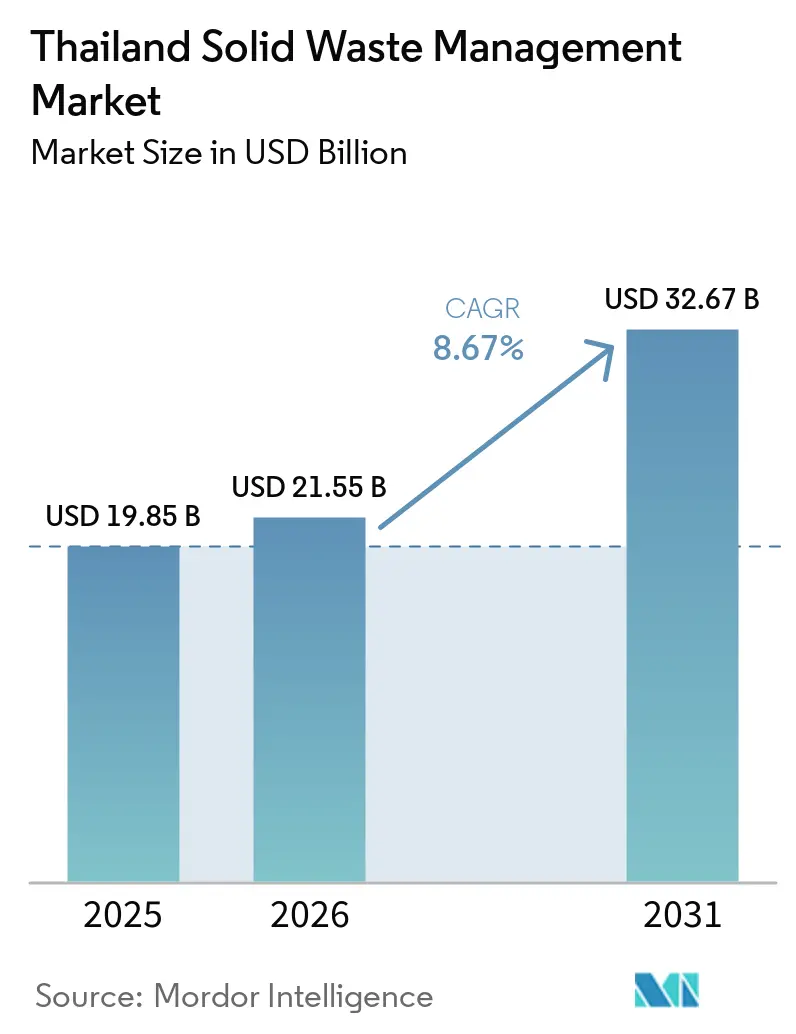
| Base Year Market Size (2025) | USD 19.85 Billion |
| Market Size (2026) | USD 21.55 Billion |
| Market Size (2031) | USD 32.67 Billion |
| Growth Rate (2026 - 2031) | 8.67 % |
| Market Concentration | Medium |
Major Players *Disclaimer: Major Players sorted in no particular order Image © Mordor Intelligence. Reuse requires attribution under CC BY 4.0. | |
Thailand Solid Waste Management Market Analysis by Mordor Intelligence
The Thailand Solid Waste Management Market size is expected to increase from USD 19.85 billion in 2025 to USD 21.55 billion in 2026 and reach USD 32.67 billion by 2031, growing at a CAGR of 8.67% over 2026-2031.
Thailand generated an estimated 27.5 million tonnes of municipal solid waste in 2025, supporting sustained demand for collection, transportation, recycling, treatment, and final disposal services. The government's Bio-Circular-Green (BCG) Economy Model, together with its carbon neutrality (2050) and net-zero emissions (2065) commitments, continues to direct public and private investment toward circular resource use, engineered landfills, waste-to-energy (WtE) facilities, and higher-value material recovery. The Thailand solid waste management market also continues to face a shortage of compliant treatment capacity. In 2025, fewer than 7% of more than 2,100 registered waste processing facilities fully complied with national environmental and operational standards, limiting the availability of licensed treatment capacity for industrial and hazardous waste. This compliance gap strengthens the competitive position of certified operators capable of meeting increasingly stringent environmental, traceability, and ESG reporting requirements. In addition, the planned implementation of Extended Producer Responsibility (EPR) for packaging, expansion of waste-to-energy projects under the Alternative Energy Development Plan (AEDP), and stronger enforcement against illegal waste disposal are expected to increase investment in permitted recycling, treatment, and resource recovery assets over the forecast period.
Key Report Takeaways
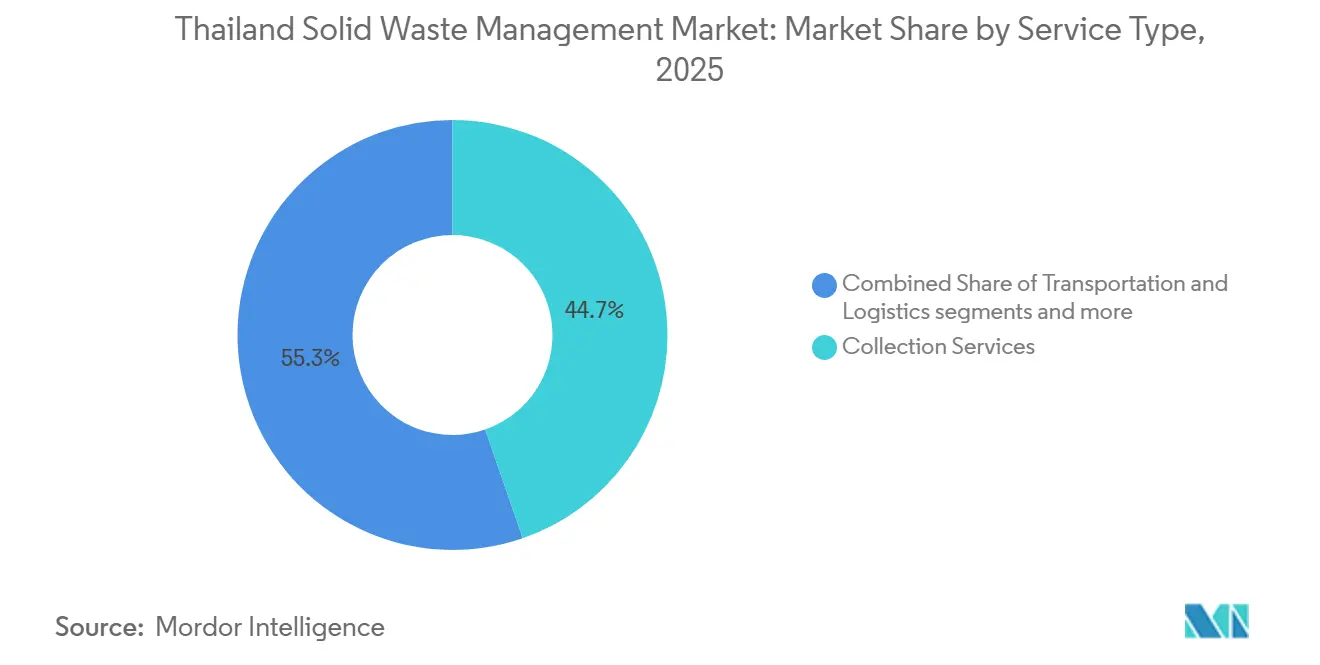
- By service type, collection services accounted for 44.7% of Thailand's solid waste management market size in 2025, while recycling and material recovery are forecast to expand at an 11.5% CAGR through 2031.
- By waste type, municipal solid waste accounted for 57.4% of the Thailand solid waste management market share in 2025, while medical waste is projected to grow at an 11.2% CAGR through 2031.
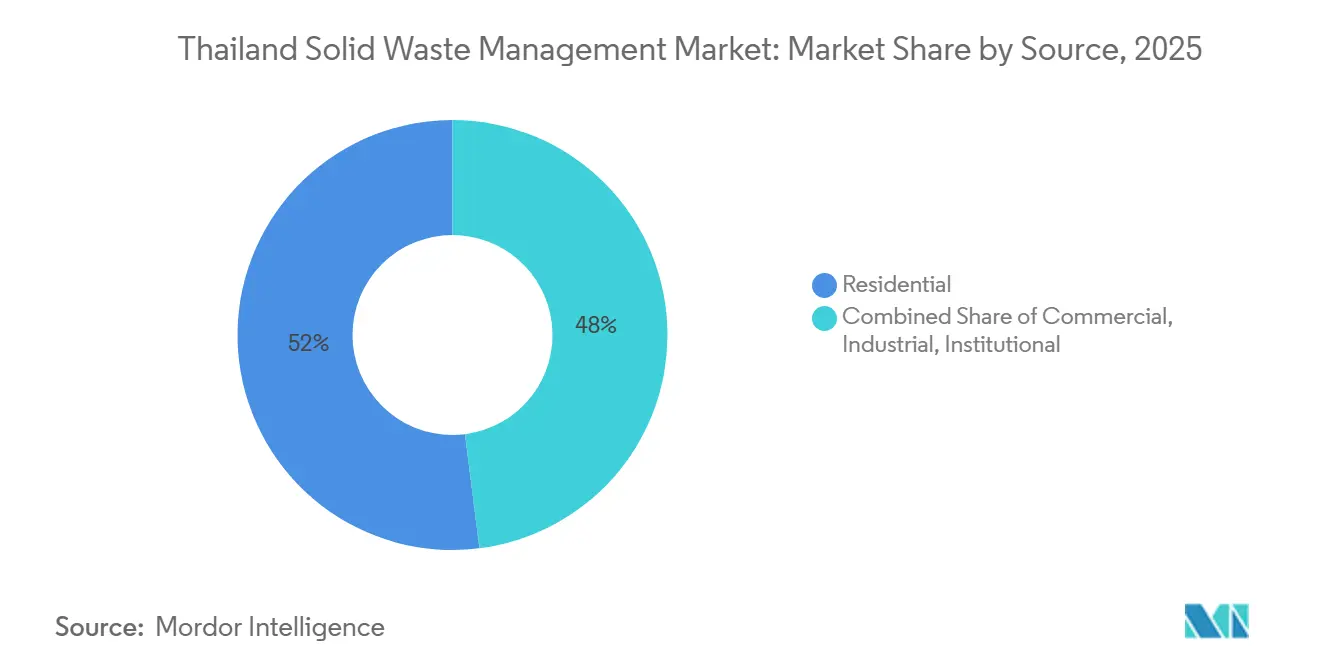
- By source, residential waste accounted for 52% of the Thailand solid waste management market in 2025, while industrial waste is projected to grow at a 10.2% CAGR through 2031.
Note: Market size and forecast figures in this report are generated using Mordor Intelligence’s proprietary estimation framework, updated with the latest available data and insights as of January 2026.
Thailand Solid Waste Management Market Trends and Insights
Drivers Impact Analysis*
| Driver | (~) % Impact on CAGR Forecast | Geographic Relevance | Impact Timeline |
|---|---|---|---|
| National Roadmap on Plastic Waste Management Accelerating Recycling Infrastructure | +2.1% | National, with early gains in Bangkok, Rayong, and Chonburi | Medium term (2-4 years) |
| Expansion of Waste-to-Energy Projects Under Thailand's Alternative Energy Development Plan (AEDP) | +1.8% | National, with projects concentrated in the Central and Eastern regions | Long term (≥ 4 years) |
| Eastern Economic Corridor (EEC) Industrial Expansion Driving Hazardous and Industrial Waste Management Demand | +1.5% | Eastern region, including Chonburi, Rayong, and Chachoengsao, with spillover to Central Thailand | Short term (≤ 2 years) to medium term (2-4 years) |
| Rapid Tourism Growth Increasing Municipal and Commercial Solid Waste Generation | +1.2% | Southern destinations, Pattaya, and Bangkok | Short term (≤ 2 years) to medium term (2-4 years) |
| Government Promotion of Community-Based Waste Segregation and Recycling Programs | +1.0% | National, with early gains in Bangkok and provincial capitals | Medium term (2-4 years) |
| Rising Investments in RDF (Refuse-Derived Fuel) Production for the Cement and Power Industries | +0.8% | Central and Eastern regions, including Saraburi and EEC industrial zones | Short term (≤ 2 years) |
| Source: Mordor Intelligence | |||
National Roadmap on Plastic Waste Management: Accelerating Recycling Infrastructure
Thailand’s Action Plan on Plastic Waste Management Phase 2 for 2023-2027 targets diverting 5 priority plastic types from landfills. It also targets a 50% reduction in marine plastic leakage by 2027 and proper management of 80% of municipal solid waste.[1]Organisation for Economic Co-operation and Development, “Regional Plastics Outlook for Southeast and East Asia,” OECD, oecd.org These goals support new sorting and mechanical recycling capacity in the Thailand solid waste management market. A 2025 material-flow study found that Thailand generated 4.4 million tons of plastic waste each year, with 27% released to the environment.[2]A Novel Approach to Characterizing Plastic Waste Releases from Land-Based Sources Using Material Flow Analysis, The Case of Thailand,” Waste Management & Research, doi.org The same study found that uncontrolled and controlled landfill sites accounted for 85% of these releases. As landfill restrictions become more binding, certified sorting and recycling facilities can obtain stronger pricing for targeted material streams.
Expansion of Waste-to-Energy Projects Under Thailand’s Alternative Energy Development Plan
Thailand’s Alternative Energy Development Plan 2024 targets 900 MW of installed waste-to-energy capacity by 2037. The National Energy Plan 2024 also sets targets of 975 MW of electricity and 495,000 tons of oil equivalent of heat from waste energy. These targets strengthen the long-term project pipeline in the Thailand solid waste management market. Waste-to-energy facilities can provide a regulated outlet for material that would otherwise be landfilled or openly dumped. Long-term power purchase arrangements can provide operators with more predictable revenue than spot disposal. The draft Power Development Plan 2026 is expected to place waste-to-energy within longer-term electricity planning aligned with Thailand’s net-zero objective.[3]Thailand Government, “Waste-To-Energy Drives Thailand’s Clean Power Shift,” Thailand Government Official Website, thailand.go.th
Eastern Economic Corridor Industrial Expansion Driving Hazardous and Industrial Waste Management Demand
The Eastern Economic Corridor (EEC), comprising Chonburi, Rayong, and Chachoengsao, remains Thailand's leading hub for advanced manufacturing and industrial investment. In 2025, the Eastern region continued to account for the country's highest concentration of hazardous and industrial waste generators, while treatment capacity remained constrained, with approximately 13 waste generators for every certified industrial waste processor. This persistent capacity imbalance supports strong demand for licensed industrial and hazardous waste treatment services in Thailand's solid waste management market. At the national level, Thai authorities intensified enforcement against illegal waste imports, detecting 714 containers carrying more than 4,504 tonnes of illegally imported waste at the ports of Laem Chabang and Bangkok between April 2025 and March 2026. The stricter enforcement environment is encouraging manufacturers and waste generators to rely on certified domestic treatment and disposal providers while increasing the importance of compliance, traceability, and environmental reporting for operators serving multinational industrial customers.
Rapid Tourism Growth Increasing Municipal and Commercial Solid Waste Generation
Tourism creates concentrated waste volumes in Bangkok, Pattaya, Phuket, Koh Samui, and other high-visitor areas. Thailand launched its Green Tourism Collections initiative in July 2025, setting sustainability standards across 10 designated Green Cities and 20 travel routes. This program increases the need for hotels and tourism businesses to improve waste separation and collection practices. A 2025 peer-reviewed study found that tourism-driven demand shocks materially affect municipal solid-waste emissions in Thailand. The study projected that a business-as-usual path could increase waste-sector emissions to 19.9 MtCO2e by 2050 without intervention. These conditions create demand for specialized collection fleets, island logistics, and decentralized treatment systems in the Thailand solid waste management market.
Restraints Impact Analysis*
| Restraint | (~) % Impact on CAGR Forecast | Geographic Relevance | Impact Timeline |
|---|---|---|---|
| High Capital Requirements for Advanced Recycling and Waste-to-Energy Facilities | -1.3% | National, with greater constraints in provincial municipalities outside Bangkok | Long term (≥ 4 years) |
| Low Source Segregation Rates Limiting High-Quality Material Recovery | -1.0% | National, with severe gaps in rural communities and island municipalities | Medium term (2-4 years) |
| Inadequate Waste Collection Infrastructure Across Rural and Island Communities | -0.8% | Northern provinces, Southern islands, and rural areas | Short term (≤ 2 years) to medium term (2-4 years) |
| Illegal Dumping and Open Burning Continuing Outside Major Urban Centers | -0.6% | EEC periphery, peri-urban areas, and Northern agricultural regions | Short term (≤ 2 years) |
| Source: Mordor Intelligence | |||
High Capital Requirements for Advanced Recycling and Waste-to-Energy Facilities
Advanced recycling, material recovery, and waste-to-energy (WtE) facilities require substantial upfront investment that many provincial municipalities continue to struggle to finance on their own. Thailand's waste management policy recognizes that low waste collection and disposal fees often fail to recover the full cost of environmentally compliant treatment infrastructure, reducing the financial viability of replacing open dumping with sanitary landfills, engineered treatment facilities, and resource recovery plants. As a result, the Thailand solid waste management market continues to face a significant gap between the cost of compliant infrastructure and the fees many local governments and waste generators are able or willing to pay. High capital requirements for lined landfill cells, leachate and landfill gas management systems, air pollution control equipment, continuous environmental monitoring, hazardous waste treatment units, and advanced material recovery technologies further increase project costs. Limited municipal budgets, uneven access to long-term financing, and lower waste generation volumes outside major urban centers continue to delay infrastructure upgrades, leaving many smaller municipalities and private operators dependent on lower-standard disposal practices.
Low Source Segregation Rates Limiting High-Quality Material Recovery
Collection systems across much of Thailand continue to rely on mixed municipal waste collection, making downstream separation more costly and reducing the quality of recyclable materials. In 2025, Thailand generated an estimated 27.5 million tonnes of municipal solid waste, yet source segregation remained inconsistent across municipalities, limiting the recovery of high-value recyclable materials. Mixed collection contaminates paper, plastics, glass, and organic waste, reducing their market value and increasing processing costs for recycling facilities. Although community recycling initiatives, waste banks, and household segregation campaigns have expanded, recovery efficiency remains constrained when separated materials are combined during collection or transport. Plastic packaging continues to represent one of the largest challenges because contamination and inadequate sorting reduce recycling yields despite growing demand for recycled resin. Expanding dedicated source-separated collection systems, investing in modern material recovery facilities, improving public participation, and strengthening municipal collection practices will be essential to increase recycling rates, improve feedstock quality, and support Thailand's transition toward a circular economy.
*Our forecasts treat driver/restraint impacts as directional, not additive. The impact forecasts reflect baseline growth, mix effects, and variable interactions.
Segment Analysis
By Service Type: Recycling Leads Revenue While Waste-to-Energy Records the Fastest Growth
Collection services accounted for 44.7% of Thailand's solid waste management market by service type in 2025. Municipal contracts provide recurring demand across Bangkok and provincial areas. Tiered household fees introduced in Bangkok in 2025 strengthened the link between waste separation and the economics of collection. The collection base remains important for transporting waste to certified facilities for sorting, treatment, and disposal. Thailand’s 2025 taxonomy identifies sorting, material recovery, waste-to-energy, and hazardous waste treatment as activities that can qualify for green finance instruments.
Recycling and material recovery are forecast to grow at an 11.5% CAGR between 2026 and 2031, making it the fastest-growing service type. The Thailand solid waste management market size for recovery services benefits from policy support for circular material use. Better separation can improve the quality and value of materials sent to recovery facilities. Transport and logistics are becoming more important, as enforcement requires waste to reach certified facilities rather than nearby informal sites. The Thailand solid waste management market is likely to reward operators that combine collection networks with material sorting, treatment, and recovery outlets.



By Waste Type: Municipal Solid Waste Leads While Medical Waste Grows Fastest
Municipal solid waste accounted for 57.4% of Thailand's solid waste management market by waste type in 2025. The country generates 25.7 million tons of municipal solid waste annually. Organic material dominates this stream, supporting opportunities for anaerobic digestion and biogas recovery. Single-use plastics accounted for 11.25% of total municipal solid waste by volume, supporting refuse-derived-fuel supply for cement and power uses.
Medical waste is forecast to grow at an 11.2% CAGR between 2026 and 2031, the highest rate among waste types. Healthcare expansion and tighter biological-waste controls support demand for specialized handling. Industrial waste is generated at 19.82 million tons annually, including 1.13 million tons of hazardous industrial waste, and requires complex certified treatment. Construction and demolition waste is increasing due to infrastructure and industrial estate activity. Proposed circular-economy rules could formalize waste classification and producer responsibilities, making price differences between waste types more distinct.
By Source: Residential Sources Lead Market Value While Industrial Demand Grows Fastest
Residential sources accounted for 52% of Thailand's solid waste management market by source in 2025. Bangkok manages residential waste across 50 administrative districts, each with different densities and service conditions. Household separation programs can improve the quality of residential materials when collection systems keep those streams separate. Residential volumes make collection coverage, transfer capacity, and household participation important operating issues. A 2024 journal study found that hospitality establishments generated 1.06 kilograms of solid waste per occupied room-night.
Industrial sources are forecast to grow at a 10.2% CAGR between 2026 and 2031, making this the fastest-growing source segment. Expansion across EEC manufacturing estates supports this outlook. Automotive components, food processing, electronics, and data centers generate distinct hazardous and non-hazardous materials that require certified handling. Thailand’s WEEE Integrated Action Plan for 2022-2026 called for collection, dismantling, and recycling systems, including at least 1 environmentally sound management plant by 2026. These source categories require distinct collection practices, documentation, and treatment routes.
Geography Analysis
Bangkok and the Eastern Economic Corridor (EEC) remained the primary centers of service demand and infrastructure investment in the Thailand solid waste management market in 2025. The Bangkok Metropolitan Region, with an estimated 10.9 million residents in 2025, handles the country's largest municipal waste volumes through the Bangkok Metropolitan Administration (BMA) collection network and several transfer stations and waste treatment facilities. Rapid urbanization, expanding commercial activity, and rising consumption continue to increase pressure on collection, transfer, recycling, and disposal infrastructure. Bangkok's annual average PM2.5 concentration remained above the WHO guideline level, underscoring the need to reduce open waste burning and landfill emissions. The city is therefore accelerating investments in waste-to-energy facilities, smart collection systems, landfill gas utilization, and stricter source-segregation programs to improve resource recovery and reduce dependence on landfill disposal.
The Eastern Economic Corridor (EEC), comprising Chonburi, Rayong, and Chachoengsao, continues to be Thailand's largest hub for industrial waste generation due to its concentration of automotive, electronics, petrochemical, and advanced manufacturing facilities. In 2025, treatment infrastructure remained constrained relative to industrial waste generation, with around 13 waste generators for every certified industrial waste processor, highlighting the need for additional licensed treatment capacity. Demand is increasing for hazardous waste treatment, solvent recovery, industrial recycling, secure landfilling, and waste traceability solutions as manufacturers strengthen ESG reporting and comply with tighter environmental regulations. Continued domestic and foreign investment in the EEC is expected to support expansion of certified waste treatment facilities and digital waste tracking systems over the forecast period.
Southern provinces and tourism-dependent islands continue to experience the largest gap between waste generation and local waste management capacity. Popular destinations such as Koh Samui, Phuket, and Krabi generate substantially higher waste volumes during peak tourist seasons, placing considerable strain on existing collection, recycling, and disposal infrastructure. Koh Samui alone generates around 30 tonnes of plastic waste per day, while limited recycling capacity and transportation constraints increase reliance on landfill disposal. A 2025 assessment of Libong Island identified understaffed collection services, aging equipment, and continued open burning caused by inadequate infrastructure and funding limitations. In addition, agricultural regions remain significant contributors to waste-related emissions, with rice residue burning generating an estimated 473,554 tCO₂e annually, highlighting opportunities for biomass utilization and agricultural waste recovery. Community-based waste banks operating in provinces such as Surat Thani and Songkhla continue to improve household material recovery and are being replicated in northern municipalities through circular economy initiatives. However, disparities in municipal budgets, infrastructure investment, and technical capacity continue to create uneven waste management performance across Thailand, supporting the need for greater private-sector participation and public-private partnerships in underserved regions.
Competitive Landscape
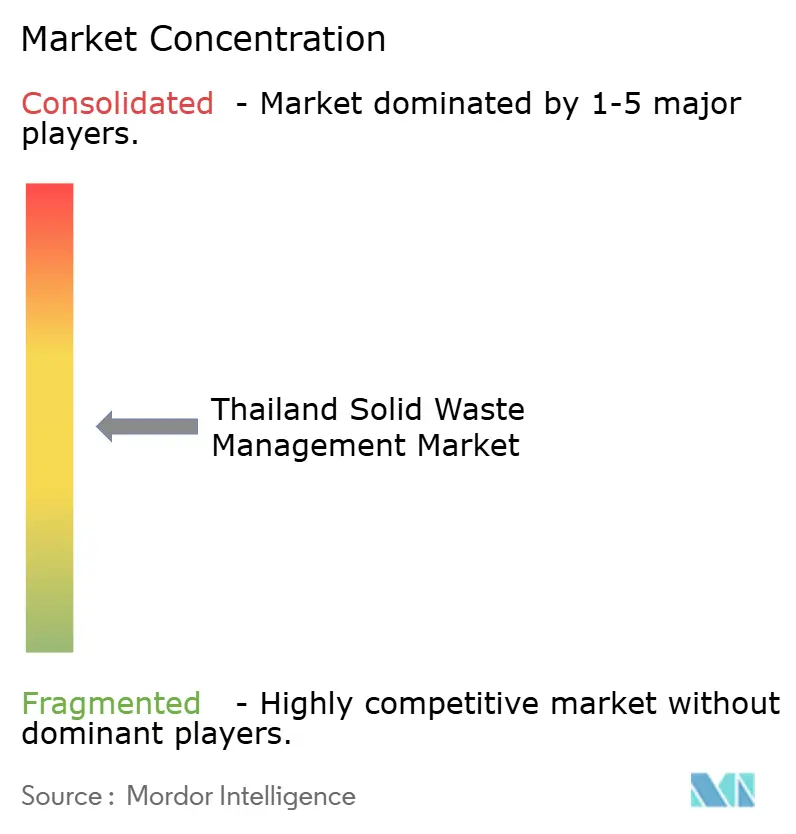
The Thailand solid waste management market exhibits a medium level of market concentration. SET-listed domestic specialists, integrated Thai groups, international operators, smaller licensed businesses, and informal junk-shop networks serve different parts of the value chain. Domestic specialists compete on permit coverage, hazardous-waste classifications, and long-term intake capacity. Better World Green, Earth Tech Environment, Akkhie Prakarn, and TPIPP are among the domestic operators active in permitted waste services. This structure supports competition for licensed capacity without implying that a small group controls most of the activity.
Veolia expanded its position in September 2025 by acquiring a 66.6% majority stake in Chonburi Clean Energy. The facility generated 65,072 MWh in 2024, achieved 92% availability, and avoided 24,294 tons of CO2. The acquisition gives Veolia a stronger position in non-hazardous industrial waste-to-energy services within the EEC. SCGC and the Bangkok Metropolitan Administration launched a condominium waste-sorting pilot in February 2026. The pilot uses advanced recycling technology to produce certified circular polyolefin resins for food-contact applications.
Technology and platform integration are becoming more important in collection and recovery operations. Digital verification of segregation can support municipal compliance monitoring, while coordinated industrial networks can improve material traceability. Consistent calorific value and chlorine content remain important challenges for refuse-derived fuel supplied to cement kilns. Proposed industrial-waste rules could raise minimum facility requirements and encourage consolidation among smaller operators.
Thailand Solid Waste Management Industry Leaders
Better World Green Public Company Limited (BWG)
Wongpanit International Co., Ltd.
Earth Tech Environment Public Company Limited
Akkhie Prakarn Public Company Limited (AKP)
GENCO Public Company Limited
- *Disclaimer: Major Players sorted in no particular order

Recent Industry Developments
- July 2026: SCG Cleanergy announced the successful commercial operation of a 20.96 MW solar rooftop project at Seagate Technology's Nakhon Ratchasima facility, designated the largest solar rooftop in Northeastern Thailand. The project generates 29 million kWh of clean electricity annually and reduces emissions by 14,500 tCO2e per year, reflecting how industrial estate operators are pursuing integrated clean energy and waste alternative-fuel strategies.
- April 2026: REPCO NEX, B.Grimm Power, and SCG Cleanergy announced a partnership to develop a 247 MWp utility-scale solar project across Kamphaeng Phet, Nakhon Sawan, and Saraburi provinces, targeting commercial operations in 2027 and projected to cut GHG emissions by up to 200,000 tCO2e per year. The project signals further convergence of clean energy and waste alternative-fuel strategies within industrial conglomerates.
- February 2026: SCGC and the Bangkok Metropolitan Administration launched a pilot for household waste sorting in Bangkok condominiums, aligned with the BMA's "No Mixed Waste" policy and the Danish Environmental Protection Agency, targeting a closed-loop plastic recycling model using Advanced Recycling Technology to produce Certified Circular Polyolefin resins for food-contact applications.


Thailand Solid Waste Management Market Report Scope
The Thailand Solid Waste Management Market is Segmented by Service Type (Collection Services, Transportation & Logistics, Recycling & Material Recovery, Treatment & Disposal, Waste-To-Energy, Others), by Waste Type (Municipal Solid Waste, Industrial Waste, Hazardous Waste, Agricultural Waste, and More), and by Source (Residential, Commercial, Industrial, and Institutional). The Market Forecasts are Provided in Terms of Value (USD).
| Collection Services |
| Transportation & Logistics |
| Recycling & Material Recovery |
| Treatment & Disposal |
| Waste-to-Energy |
| Others |
| Municipal Solid Waste |
| Industrial Waste |
| Hazardous Waste |
| Construction & Demolition Waste |
| Agricultural Waste |
| Medical Waste |
| Others |
| Residential |
| Commercial |
| Industrial |
| Institutional |
| By Service Type | Collection Services |
| Transportation & Logistics | |
| Recycling & Material Recovery | |
| Treatment & Disposal | |
| Waste-to-Energy | |
| Others | |
| By Waste Type | Municipal Solid Waste |
| Industrial Waste | |
| Hazardous Waste | |
| Construction & Demolition Waste | |
| Agricultural Waste | |
| Medical Waste | |
| Others | |
| By Source | Residential |
| Commercial | |
| Industrial | |
| Institutional |


Key Questions Answered in the Report
What is the projected value of Thailand solid waste management market by 2031?
Thailand solid waste management market is projected to reach USD 32.67 billion by 2031, growing at a 8.67% CAGR from 2026.
Which service is growing fastest in Thailand solid waste management market?
Recycling and material recovery are the fastest-growing service types, supported by plastic-management policy, green-finance eligibility, and demand for better material quality.
What limits recycling performance in Thailand?
Mixed-waste collection and low source segregation reduce material quality and increase sorting costs.
What role does waste-to-energy play in Thailand?
Thailand’s Alternative Energy Development Plan 2024 targets 900 MW of installed waste-to-energy capacity by 2037.
Which areas have the greatest infrastructure gaps?
Southern islands face high volumes of tourism-related waste and limited recycling capacity, while Northern areas face pressures from municipal waste and agricultural burning.
Page last updated on:


 Your data is secure and never sold or shared.


