
Terahertz Industrial Inspection Systems Market Size and Share
Market Overview
| Study Period | 2020 - 2031 |
|---|---|
| Market Size (2026) | USD 229.62 Million |
| Market Size (2031) | USD 560.76 Million |
| Growth Rate (2026 - 2031) | 19.55 % |
| Fastest Growing Market | Asia-Pacific |
| Largest Market | North America |
| Market Concentration | Low |
Major Players *Disclaimer: Major Players sorted in no particular order Image © Mordor Intelligence. Reuse requires attribution under CC BY 4.0. | |
Terahertz Industrial Inspection Systems Market Analysis by Mordor Intelligence
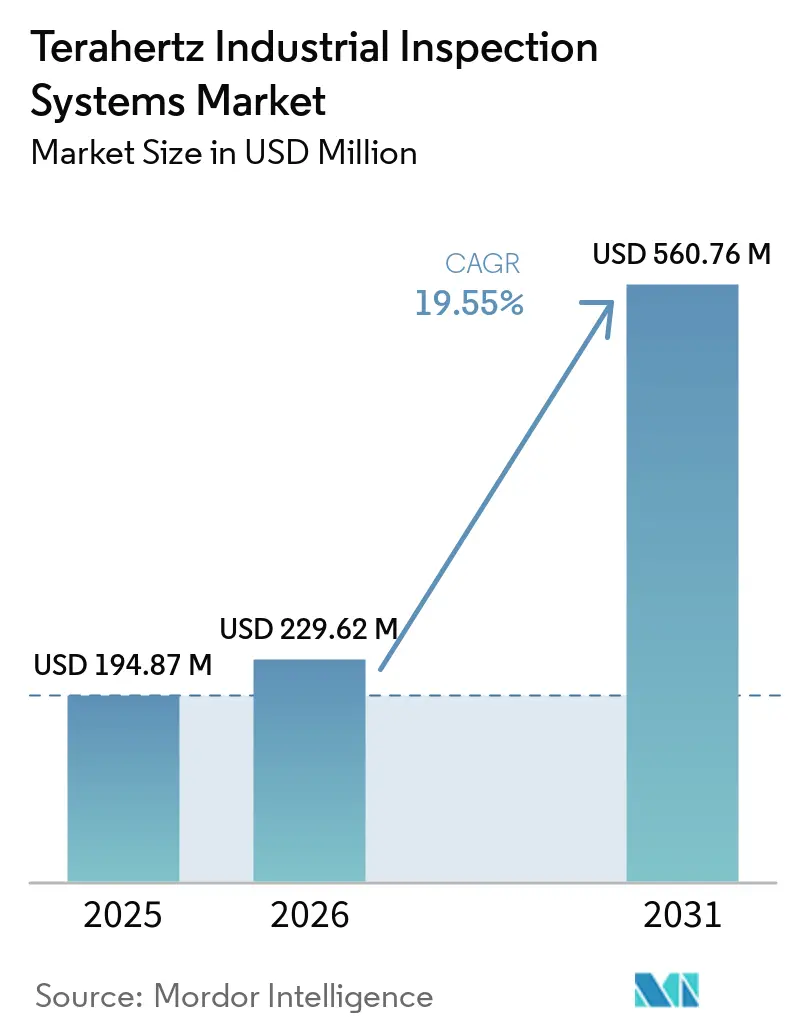
The Terahertz Industrial Inspection Systems Market size was valued at USD 194.87 million in 2025 and estimated to expand from USD 229.62 million in 2026 to reach USD 560.76 million by 2031, at a CAGR of 19.55% during the forecast period (2026-2031). Demand is moving beyond laboratory trials because manufacturers need fast, noncontact inspection for complex materials and high-value production. Frequency-modulated continuous-wave systems remove mechanical scanning and support rapid data capture on production lines. Software that classifies defects also helps operators use inspection data without slowing the line. Semiconductor packaging and automotive paint inspection have begun to generate repeat purchases, which supports a more established commercial base for the Terahertz Industrial Inspection Systems Market.
Key Report Takeaways
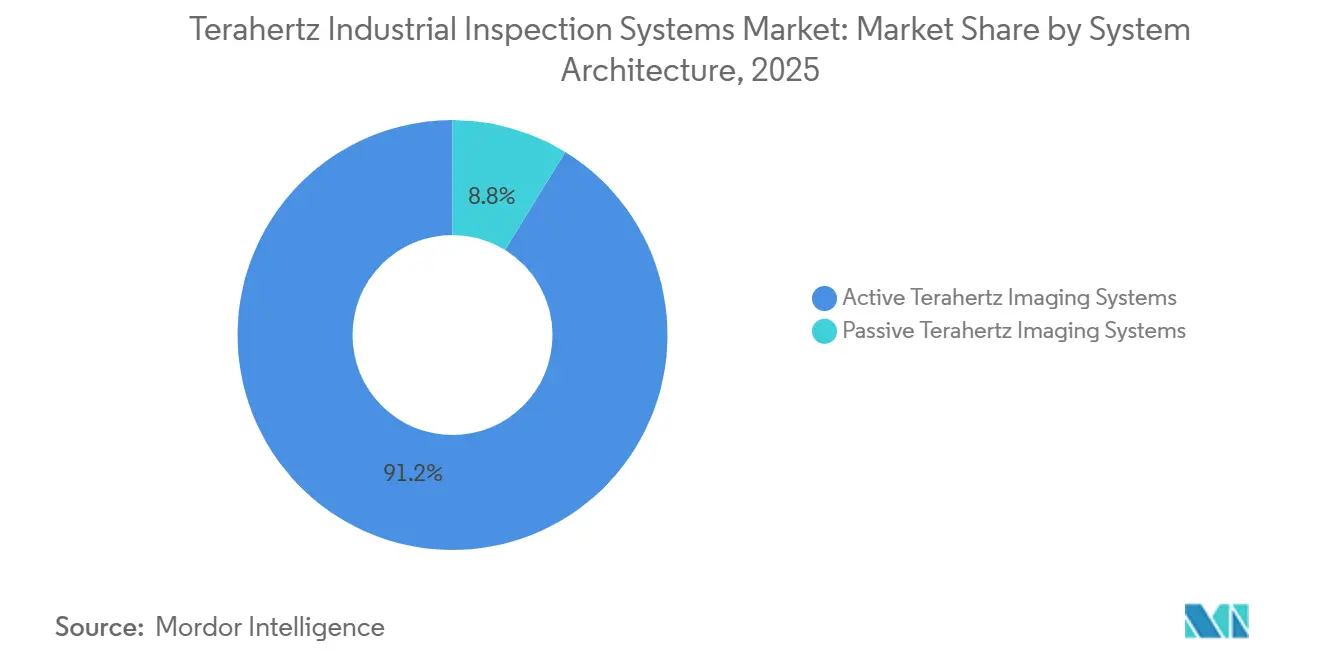
- By system architecture, active terahertz imaging systems held 91.21% of the Terahertz Industrial Inspection Systems Market share in 2025 and are expected to expand at a 21.26% CAGR through 2031.
- By technology, pulsed THz led with 42.67% revenue share in 2025, while continuous-wave THz is projected to record the highest CAGR of 21.89% through 2031.
- By inspection function, defect detection accounted for 24.89% share in 2025 and is projected to expand at a 22.31% CAGR through 2031.
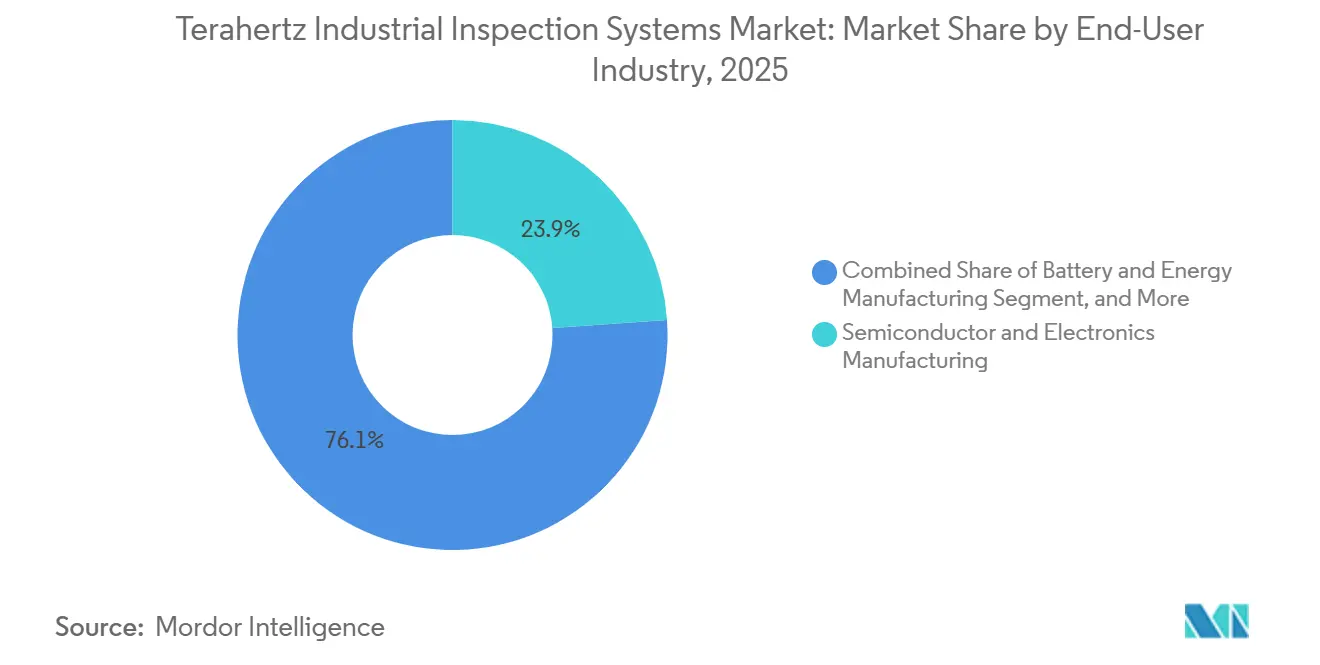
- By end-user industry, semiconductor and electronics manufacturing held 23.89% share in 2025, while battery and energy storage manufacturing is expected to record a 23.12% CAGR through 2031.
- By deployment, in-line production inspection held 34.45% share in 2025, while at-line inspection is projected to expand at a 21.69% CAGR through 2031.
- By geography, North America held 34.21% share in 2025, while Asia-Pacific is projected to expand at a 20.98% CAGR through 2031.
Note: Market size and forecast figures in this report are generated using Mordor Intelligence’s proprietary estimation framework, updated with the latest available data and insights as of January 2026.
Global Terahertz Industrial Inspection Systems Market Trends and Insights
Drivers Impact Analysis*
| Driver | (~) % Impact on CAGR Forecast | Geographic Relevance | Impact Timeline |
|---|---|---|---|
| Rising Demand for Non-Destructive Testing in High-Value Manufacturing | +5.5% | Global, with early concentration in North America and Europe | Short term (≤ 2 years) |
| Inline Quality Control for Coatings, Foils, and Multilayer Structures | +3.8% | Asia-Pacific core, China and South Korea, with spillover to Europe and North America | Short term (≤ 2 years) |
| Semiconductor and Advanced Electronics Yield-Improvement Requirements | +3.2% | North America and Asia-Pacific, especially South Korea, Taiwan, and Japan | Medium term (2-4 years) |
| AI-Enabled Defect Detection and Traceable Quality Data | +2.6% | Global | Medium term (2-4 years) |
| Non-Ionizing Inspection Substitution for Selected X-Ray and Contact Methods | +2.1% | Europe and North America | Medium term (2-4 years) |
| Battery Electrode and Next-Generation Material Process Control | +1.8% | Asia-Pacific core, with spillover to Europe | Long term (≥ 4 years) |
| Source: Mordor Intelligence | |||
Rising Demand for Non-Destructive Testing in High-Value Manufacturing
Non-destructive testing requirements in aerospace, semiconductor, and composite manufacturing are creating a clear entry point for the Terahertz Industrial Inspection Systems Market. THz inspection can replace ultrasonic C-scan methods for some fiberglass composite applications because it does not require a coupling medium. That distinction is useful in dry-assembly settings where fluid handling adds time and complexity to the process. Fraunhofer ITWM demonstrated scanners that identified defective joints, foreign bodies, air bubbles, and paint-layer variations in aircraft fiberglass panels without fluid contact. Its inline pipe system also performed 50 scans per second for wall-thickness measurement and defect mapping during continuous plastic-pipe production. These use cases strengthen the case for systems capable of inspecting composites and packaging structures while maintaining production speed.
Inline Quality Control for Coatings, Foils, and Multilayer Structures
The Terahertz Industrial Inspection Systems Market benefits from the need for coating and thickness measurement on continuous production lines. Fraunhofer ITWM reported up to 5,000 measurements per second for coating characterization and 1,600 measurements per second for multilayer structures. The reported systems cover thicknesses from 10 µm to the millimeter scale and can support applications that previously relied on contact or X-ray methods. Automotive users can use continuous paint-thickness readings to adjust spray settings during production rather than relying on manual spot checks. das-Nano installed a contactless, nondestructive paint-thickness system for plastic trim parts at BMW Group Plant Leipzig in 2026, reporting ±1 µm accuracy, 5% less material waste, and a 15% reduction in total cost. TOPTICA stated that its 8-channel T-SWEEPER configuration can provide up to 500 thickness values per second per channel, supporting broad-area inspection without a proportional increase in system footprint.
Semiconductor and Advanced Electronics Yield-Improvement Requirements
Advanced packaging is a key demand driver for the Terahertz Industrial Inspection Systems Market because defects in high-bandwidth memory and AI accelerator assemblies can affect device yield. Void formation in densely interconnected stacks can create failures that affect the wider chiplet assembly. TeraView secured additional orders from a major HBM provider and confirmed an expansion at a Singapore site in March 2026 for HBM3 and HBM4 inspection. Electro-optical terahertz pulse reflectometry can create inspection records for GPU-to-HBM interconnects during qualification. Advantest offers automated THz metrology for nondestructive, noncontact semiconductor mold-layer verification across wafer- and panel-level packaging formats. As packaging designs add more inspection points, demand for equipment can rise even when output volume does not increase at the same rate.
AI-Enabled Defect Detection and Traceable Quality Data
AI-supported image processing helps the Terahertz Industrial Inspection Systems Market meet production-floor requirements for speed and defect classification. Models trained with amplitude and phase information can distinguish delamination, inclusions, moisture pockets, and other internal conditions that threshold-based tools may treat alike. This reduces unnecessary rejection of acceptable parts and makes the value of inspection software more visible to plant operators. The same systems can generate lot-level defect maps that support structured quality records without adding a separate inspection step. Suppliers that provide usable data outputs, rather than only pass-or-fail signals, can become more closely integrated with customers' quality workflows. This increases the value of software and application support as hardware pricing becomes more competitive.
Restraints Impact Analysis*
| Restraint | (~) % Impact on CAGR Forecast | Geographic Relevance | Impact Timeline |
|---|---|---|---|
| High System and Integration Cost for Early Adopters | -4.2% | Global, most acute in emerging economies and mid-market manufacturers | Short term (≤ 2 years) |
| Limited Penetration Through Conductive and Highly Absorptive Materials | -2.8% | Global | Medium term (2-4 years) |
| Calibration, Reference-Standard, and Application-Engineering Complexity | -2.1% | Global, with the highest friction where THz application engineers are limited | Medium term (2-4 years) |
| Inconsistent Plant-Level ROI Evidence Outside Premium Manufacturing Lines | -1.5% | Global, most acute in South America and the Middle East and Africa | Long term (≥ 4 years) |
| Source: Mordor Intelligence | |||
High System and Integration Cost for Early Adopters
High system and integration costs continue to limit adoption in the Terahertz Industrial Inspection Systems Market. A production-ready installation combines a THz source, detector array, motion control, processing equipment, and plant integration. First installations can also require custom fixtures, optical-path design, and links to manufacturing execution systems. These costs can match or exceed the price of the inspection instrument itself. das-Nano reported a 1.5-year return on investment, 5% lower material waste, and 3% fewer reworks for automotive deployments. Such results are most relevant to mature, high-volume lines, whereas plants with lower throughput or varied products may face longer, less certain payback periods.
Limited Penetration Through Conductive and Highly Absorptive Materials
Material limitations narrow the practical scope of inspection for the Terahertz Industrial Inspection Systems Market. Metallic surfaces reflect THz radiation, while water-rich materials, some carbon-fiber composites, thick rubber, elastomers, and metal-loaded coatings can reduce signal strength. Suppliers, therefore, need to verify material compatibility before a customer makes a capital commitment. HÜBNER describes its T-SENSE FMI system as using amplitude and phase analysis to inspect nonmetallic parts for foreign bodies, flaws, and cavities. Metallic fasteners and structures in the field of view can create artifacts that are not consistently resolved across all combinations of materials and thicknesses. Hybrid systems can address some gaps, but adding near-infrared or ultrasonic channels also raises complexity and cost.
*Our forecasts treat driver/restraint impacts as directional, not additive. The impact forecasts reflect baseline growth, mix effects, and variable interactions.
Segment Analysis
By System Architecture: Active Systems Define the Commercial Mainstream
Active terahertz imaging systems accounted for 91.21% of 2025 revenue and are expected to grow at a 21.26% CAGR through 2031. Their lead reflects the stronger resolution and signal-to-noise performance required for subsurface industrial inspection. Active systems use controlled illumination and programmable acquisition settings, which help operators adapt inspections to different materials and products. Pulsed time-domain, FMCW, and continuous-wave configurations are all included within this architecture. TOPTICA reported that its 8-channel FMCW platform can deliver up to 500 thickness values per second per channel.
Passive systems remain relevant for security and personnel screening where ambient thermal contrast can be sufficient. Their lack of an active source can reduce hardware cost and simplify the system. However, passive sensing has lower spatial resolution and slower acquisition for many production-floor tasks. It also provides less flexibility to adjust signal conditions for different materials. Passive systems are likely to remain a narrower option than active configurations for industrial process control during the forecast period.


By Technology: Pulsed THz Holds Ground as CW Narrows the Gap
Pulsed THz held 42.67% share of the Terahertz Industrial Inspection Systems Market in 2025, supported by broadband coverage and depth-resolved time-domain data. This technology remains useful for material characterization, multilayer delamination mapping, and pharmaceutical tablet coating assessment. Menlo Systems reported that its TeraSmart platform achieved more than 125 traces per second with a 50-picosecond time window. The platform also delivered more than 6 THz bandwidth and more than 100 dB dynamic range for demanding near-line applications. Broadband THz remains relevant where spectral fingerprints are needed for chemical and pharmaceutical identification.
Continuous-wave THz is projected to expand at a 21.89% CAGR through 2031, making it the fastest-growing technology type. Its simpler architecture does not require a femtosecond laser, which can lower cost and improve suitability for field deployment. Continuous-wave and FMCW systems fit high-speed inline tasks where a coating or thickness reading is the required output. Pulsed systems remain more suitable for detailed qualification and complex materials where spectral depth is important. This complementary pattern favors suppliers that support more than 1 technology family within the Terahertz Industrial Inspection Systems Industry.
By Inspection Function: Defect Detection Commands Both Scale and Velocity
Defect detection accounted for 24.89% of the Terahertz Industrial Inspection Systems Market in 2025 and is projected to expand at a 22.31% CAGR through 2031. The combination of leading share and the highest forecast rate reflects a broad use case across semiconductor packaging, aerospace composites, and battery electrode production. In these settings, an undetected defect can lead to warranty exposure, field failures, or costly production losses. Fraunhofer ITWM reported that its THz-TDS pipe inspection system can perform 50 scans per second for wall-thickness measurement and defect mapping in continuous production. The result shows that defect detection can operate at production speed rather than only in laboratory inspection.
Thickness measurement is the second most established function, supported by automotive paint-thickness programs. Material characterization is also important in pharmaceutical tablet coating and specialty chemical process control, where spectral information can guide production decisions. Coating inspection, moisture mapping, and structural integrity checks are early-stage applications. Their use is expanding in construction materials testing and civil infrastructure assessment. Vendors, therefore, need application engineering that addresses specific inspection needs across the Terahertz Industrial Inspection Systems Market.
By End-User Industry: Semiconductors Lead, Batteries Accelerate
Semiconductor and electronics manufacturing held 23.89% share in 2025, the largest end-user position in the Terahertz Industrial Inspection Systems Market. This position reflects the high value of chip-level inspection and the sector's experience with advanced metrology in yield-management programs. Semiconductor buyers use THz tools to examine packaging structures without contact or destructive preparation. TeraView announced repeat orders and capacity expansion at a Singapore HBM manufacturing site in March 2026. The orders show continued movement from qualification activity toward production-capacity investment.
Battery and energy storage manufacturing is projected to expand at a 23.12% CAGR through 2031, the highest rate among end-user industries. This demand is tied to electrode-coating uniformity checks on gigafactory lines, where manual sampling cannot capture the full production output. THz systems can provide noncontact readings for coating and thickness applications. Automotive production remains a mature user of inline paint-thickness inspection, especially at European original equipment manufacturers. Aerospace, defense, chemical, pharmaceutical, food, and packaging applications can add volume as suppliers demonstrate performance in each setting.

By Deployment: In-Line Dominates, At-Line Accelerates
In-line production inspection held 34.45% share in 2025, the largest deployment mode in the Terahertz Industrial Inspection Systems Market. It is used in continuous coating and thickness programs that require production integration. Automotive and specialty film manufacturing are important examples of this operating model. In-line equipment can generate readings while material moves through the process. Fraunhofer ITWM's reported high measurement rates for coatings and multilayer structures show the performance needed for such deployment.
At-line inspection is projected to expand at a 21.69% CAGR through 2031, the highest rate among deployment modes. These semi-integrated cells are located near the production line and enable rapid lot sampling without a full inline installation. This can reduce initial capital spending and integration risk for first-time users. Research and laboratory inspection supplies an earlier-stage pipeline for applications that can later move into production. Offline quality control remains relevant for aerospace maintenance, repair, and overhaul work, where low production volume and high part value favor detailed.
Geography Analysis
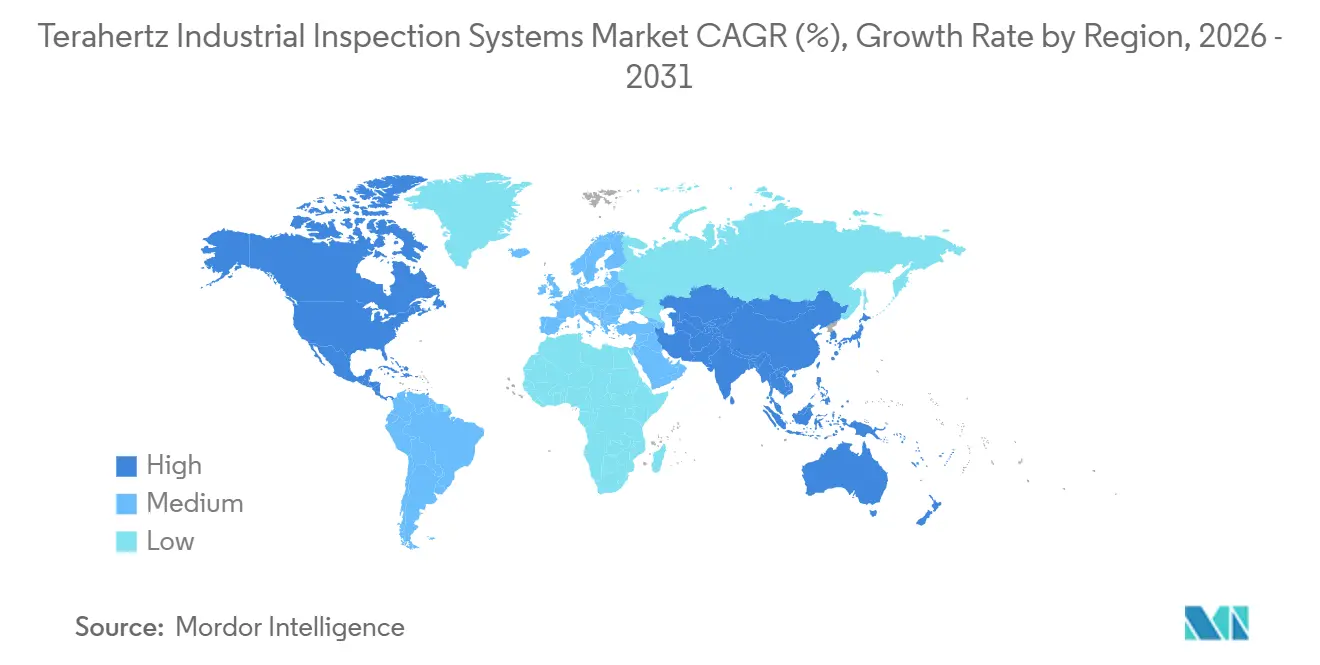
North America held 34.21% of the global Terahertz Industrial Inspection Systems Market share in 2025. The regional base includes United States semiconductor fabrication, aerospace prime contractors, and defense programs that evaluate new metrology tools. In February 2026, TeraView announced new orders and repeat support contracts from a major semiconductor foundry and a leading smartphone provider. Canada supports demand through aerospace composite maintenance and its supplier links with Bombardier and Airbus, while Mexico is emerging as electronics nearshoring encourages multinational manufacturers to apply United States and European inspection standards.
Asia-Pacific is projected to expand at a 20.98% CAGR through 2031, the fastest regional rate. China is building battery manufacturing capacity and investing in domestic semiconductor capability, which supports demand for process metrology. South Korea has a concentrated HBM and advanced packaging base, making it a significant market for THz inspection. TeraView received Korean patent protection for its automated EOTPR 4500 probing system in January 2026, and a major South Korean HBM provider expanded EOTPR capacity at its Singapore site in March 2026. Japan and ASEAN drive demand for automotive electronics and precision manufacturing, while India can gain prominence as electronics exports require dedicated quality infrastructure.
Europe has a strong position in automotive, aerospace, and chemical manufacturing, where process quality is a major purchasing consideration. Germany leads regional use through original equipment manufacturers and suppliers that are integrating paint-thickness measurement into quality systems, as das-Nano's BMW Group Plant Leipzig installation shows. The United Kingdom includes a THz research and commercial cluster centered on TeraView, which completed paid trials and an initial TeraCota sale to European aerospace and defense partners in March 2026. South America is at an earlier stage, with Brazil and Argentina providing demand through automotive and chemical subsidiaries. The Middle East and Africa offer near-term potential in defense composites and oil-and-gas pipeline inspection.

Competitive Landscape
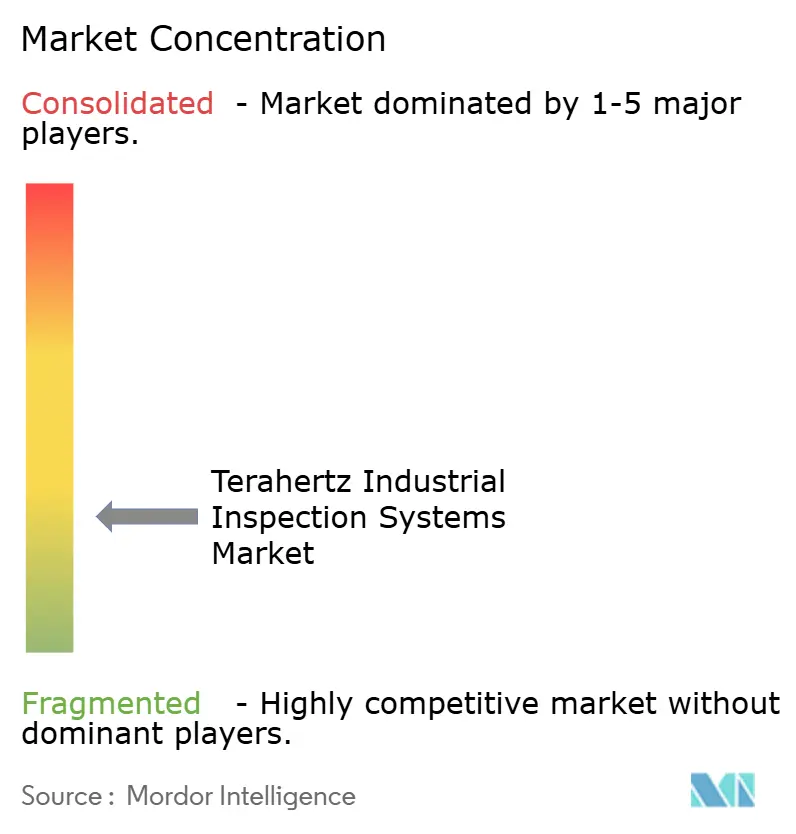
The Terahertz Industrial Inspection Systems Market is fragmented, as no single supplier dominates every application or end-user field. TOPTICA Photonics AG, Menlo Systems GmbH, and Thorlabs, Inc. offer broad portfolios of photonic instruments, while TeraView Limited focuses on semiconductor and defense applications and das-Nano on automotive inspection. Fraunhofer ITWM supports application development and provides benchmarks that influence system requirements. Competition is shifting toward integrated systems that combine sources, detectors, motion control, processing software, and application support.
TeraView secured Korean patent protection for its automated EOTPR 4500 probing system in January 2026, strengthening its position in HBM and AI chip inspection. The company also completed trials and an initial sale of its TeraCota coating platform for aerospace and defense uses in March 2026. das-Nano's 2026 installation at BMW Group Plant Leipzig shows how suppliers are moving from instruments to embedded production solutions. TOPTICA's multichannel platform supports a similar strategy by offering higher inspection throughput within a compact configuration. These moves can strengthen customer relationships when suppliers provide both measurement capability and process data.
Civil infrastructure and high-volume food and packaging inspection remain open areas of research because suppliers have not yet assembled complete autonomous systems for these environments. Such a system needs a source, detector, motion control, software, and documentation that fit the customer's operating requirements. Suppliers are embedding image-processing software into hardware platforms to make defect data more useful, while application-specific intellectual property supports defined inspection workflows. Compliance documentation and qualification evidence remain important where customers need systems to meet sector-specific requirements. The Terahertz Industrial Inspection Systems Industry is therefore likely to reward suppliers that combine hardware performance with demonstrated application knowledge.
Terahertz Industrial Inspection Systems Industry Leaders
das-Nano
Luna Innovations Incorporated
TeraSense Group
TiHive
Fraunhofer Institute for Industrial Mathematics ITWM
- *Disclaimer: Major Players sorted in no particular order

Recent Industry Developments
- March 2026: TeraView announced the successful completion of paid trials and an initial sale of its TeraCota THz coating characterization platform to major European aerospace and defense partners for stealth materials and propulsion platform applications. This represents the first confirmed commercial THz coating inspection deployment for defense stealth characterization in Europe, opening a high-value vertical with recurring measurement contracts for the company.
- March 2026: TeraView secured a repeat order from a major HBM memory provider to expand EOTPR inspection capacity at its Singapore manufacturing site, specifically targeting HBM3 and HBM4 device qualification. The capacity expansion confirms that THz inspection is now embedded in the production qualification workflow for high-bandwidth memory used in AI accelerators and data-center GPUs.
- February 2026: TeraView disclosed new orders from a major semiconductor foundry and a leading smartphone provider, both manufacturing AI chips. The foundry extended an EOTPR support contract ahead of a planned automated EOTPR deployment in Q2 2026, marking THz's transition from qualification metrology to automated inline production inspection at a tier-1 foundry level.
- January 2026: TeraView received additional HBM and AI chip inspection orders and secured Korean patent protection for its automated EOTPR 4500 probing system. Patent protection in South Korea is strategically significant given the country's concentration of HBM production capacity and the competitive intensity of the advanced packaging metrology market.


Global Terahertz Industrial Inspection Systems Market Report Scope
Terahertz Industrial Inspection Systems utilize non-ionizing electromagnetic radiation in the terahertz frequency range to perform non-destructive testing and analysis, enabling detection of internal defects, precise thickness measurements, and material characterization through opaque materials such as plastics, composites, and ceramics without damaging the inspected items.
The Terahertz Industrial Inspection Systems Market Report is Segmented by System Architecture (Active Terahertz Imaging Systems and Passive Terahertz Imaging Systems), Technology (Pulsed THz, Continuous-Wave THz, Broadband THz, and Narrowband and Tunable THz), Inspection Function (Defect Detection, Thickness and Layer Measurement, Material Characterization, Coating and Adhesive Inspection, Moisture and Contamination Detection, Structural and Dimensional Inspection, and Other Inspection Functions), End-User Industry (Semiconductor and Electronics Manufacturing, Automotive Manufacturing, Aerospace and Defense Manufacturing, Battery and Energy Storage Manufacturing, Chemical and Pharmaceutical Manufacturing, Food and Agriculture Processing, Building Products and Infrastructure, and Other End-User Industries), Deployment (Laboratory and R&D, Offline Quality Control, At-Line Inspection, and In-Line Production Inspection), and Geography (North America, South America, Europe, Asia-Pacific, Middle East and Africa). The Market Forecasts are Provided in Terms of Value (USD).
| Active Terahertz Imaging Systems |
| Passive Terahertz Imaging Systems |
| Pulsed THz |
| Continuous-Wave THz |
| Broadband THz |
| Narrowband and Tunable THz |
| Defect Detection |
| Thickness and Layer Measurement |
| Material Characterization |
| Coating and Adhesive Inspection |
| Moisture and Contamination Detection |
| Structural and Dimensional Inspection |
| Other Inspection Functions |
| Semiconductor and Electronics Manufacturing |
| Automotive Manufacturing |
| Aerospace and Defense Manufacturing |
| Battery and Energy Storage Manufacturing |
| Chemical and Pharmaceutical Manufacturing |
| Food and Agriculture Processing |
| Building Products and Infrastructure |
| Other End-User Industries |
| Laboratory and R&D |
| Offline Quality Control |
| At-Line Inspection |
| In-Line Production Inspection |
| North America | United States | |
| Canada | ||
| Mexico | ||
| South America | Brazil | |
| Argentina | ||
| Rest of South America | ||
| Europe | Germany | |
| United Kingdom | ||
| France | ||
| Italy | ||
| Spain | ||
| Rest of Europe | ||
| Asia-Pacific | China | |
| Japan | ||
| India | ||
| South Korea | ||
| Rest of Asia-Pacific | ||
| Middle East and Africa | Middle East | Saudi Arabia |
| Turkey | ||
| United Arab Emirates | ||
| Rest of the Middle East | ||
| Africa | South Africa | |
| Kenya | ||
| Rest of Africa | ||
| By System Architecture | Active Terahertz Imaging Systems | ||
| Passive Terahertz Imaging Systems | |||
| By Technology | Pulsed THz | ||
| Continuous-Wave THz | |||
| Broadband THz | |||
| Narrowband and Tunable THz | |||
| By Inspection Function | Defect Detection | ||
| Thickness and Layer Measurement | |||
| Material Characterization | |||
| Coating and Adhesive Inspection | |||
| Moisture and Contamination Detection | |||
| Structural and Dimensional Inspection | |||
| Other Inspection Functions | |||
| By End-User Industry | Semiconductor and Electronics Manufacturing | ||
| Automotive Manufacturing | |||
| Aerospace and Defense Manufacturing | |||
| Battery and Energy Storage Manufacturing | |||
| Chemical and Pharmaceutical Manufacturing | |||
| Food and Agriculture Processing | |||
| Building Products and Infrastructure | |||
| Other End-User Industries | |||
| By Deployment | Laboratory and R&D | ||
| Offline Quality Control | |||
| At-Line Inspection | |||
| In-Line Production Inspection | |||
| By Geography | North America | United States | |
| Canada | |||
| Mexico | |||
| South America | Brazil | ||
| Argentina | |||
| Rest of South America | |||
| Europe | Germany | ||
| United Kingdom | |||
| France | |||
| Italy | |||
| Spain | |||
| Rest of Europe | |||
| Asia-Pacific | China | ||
| Japan | |||
| India | |||
| South Korea | |||
| Rest of Asia-Pacific | |||
| Middle East and Africa | Middle East | Saudi Arabia | |
| Turkey | |||
| United Arab Emirates | |||
| Rest of the Middle East | |||
| Africa | South Africa | ||
| Kenya | |||
| Rest of Africa | |||


Key Questions Answered in the Report
What is the size of the Terahertz Industrial Inspection Systems Market?
The market was valued at USD 194.87 million in 2025, is estimated at USD 229.62 million in 2026, and is projected to reach USD 560.76 million by 2031 at a 19.55% CAGR.
Which system architecture leads terahertz industrial inspection?
Active terahertz imaging systems held 91.21% share in 2025 and are expected to expand at a 21.26% CAGR through 2031.
Why do manufacturers use THz inspection systems?
Manufacturers use THz inspection for noncontact checks of coatings, multilayer structures, composites, and semiconductor packaging where internal defects matter.
Which end-user sector is expected to expand fastest?
Battery and energy storage manufacturing is projected to expand at a 23.12% CAGR through 2031, supported by electrode-coating measurement needs.
Which region is expected to record the highest rate?
Asia-Pacific is projected to expand at a 20.98% CAGR through 2031, driven by battery, semiconductor packaging, and electronics manufacturing activity.
What limits wider use of THz inspection equipment?
High installation costs and weak signal penetration through conductive or highly absorptive materials can limit use, especially for first-time buyers.
Page last updated on:


 Your data is secure and never sold or shared.


