
Telecom Site Acquisition Intelligence Market Size and Share
Market Overview
| Study Period | 2020 - 2031 |
|---|---|
| Market Size (2026) | USD 454.59 Million |
| Market Size (2031) | USD 718.11 Million |
| Growth Rate (2026 - 2031) | 9.58 % |
| Fastest Growing Market | Asia-Pacific |
| Largest Market | North America |
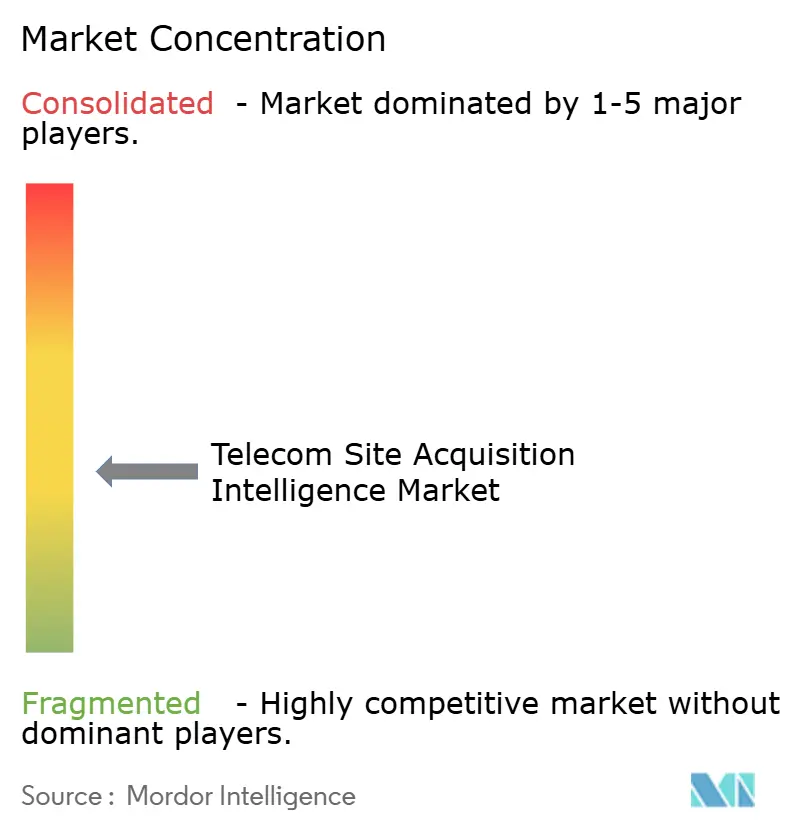
| Market Concentration | Medium |
Major Players *Disclaimer: Major Players sorted in no particular order Image © Mordor Intelligence. Reuse requires attribution under CC BY 4.0. | |
Telecom Site Acquisition Intelligence Market Analysis by Mordor Intelligence
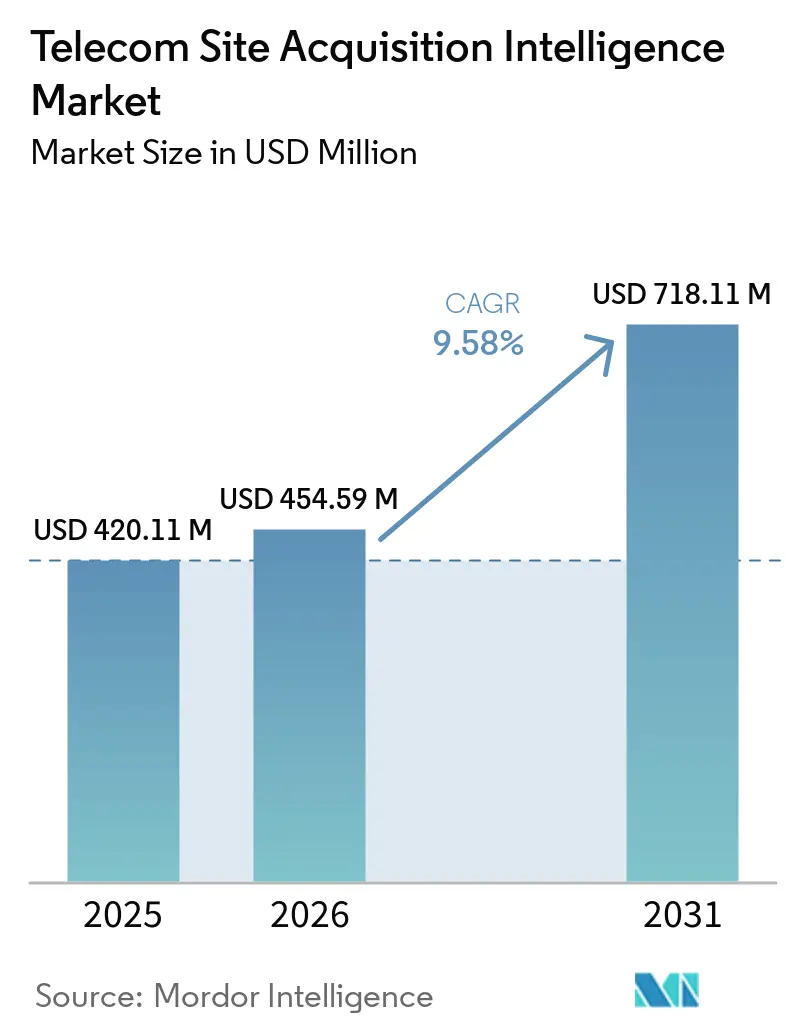
The Telecom site acquisition intelligence market size was valued at USD 420.11 million in 2025 and estimated to expand from USD 454.59 million in 2026 to reach USD 718.11 million by 2031, at a CAGR of 9.58% during the forecast period 2026-2031. The Telecom site acquisition intelligence market is being shaped by 5G densification, fiber deployment, edge data center activity, and private-network programs. Operators and tower companies are moving away from manual spreadsheets because they manage large numbers of sites, leases, zoning, and deployment activities at the same time. Cloud platforms are becoming central to this work because they bring project, asset, and lease information into a shared operating view. Tower portfolio densification and active network-sharing agreements also require platforms to manage multi-operator co-location records alongside single-tenant lease activity. These conditions widen the difference between general project-management software and systems designed for site acquisition workflows, creating replacement opportunities as standalone 5G deployment expands.
Key Report Takeaways
- By offering, Site Selection and Feasibility Intelligence held 27.22% of the Telecom site acquisition intelligence market share in 2025, while Zoning and Permit Intelligence is projected to expand at a 9.77% CAGR through 2031.
- By deployment model, cloud-based deployment accounted for 62.34% of the Telecom site acquisition intelligence market size in 2025, while mobile-first deployment is projected to expand at a 9.84% CAGR through 2031.
- By end user, mobile network operators held 30.26% share in 2025, while government and municipal connectivity authorities are projected to expand at a 10.21% CAGR through 2031.
- By organization size, large enterprises held 64.68% share in 2025, while small enterprises are projected to expand at a 10.13% CAGR through 2031.
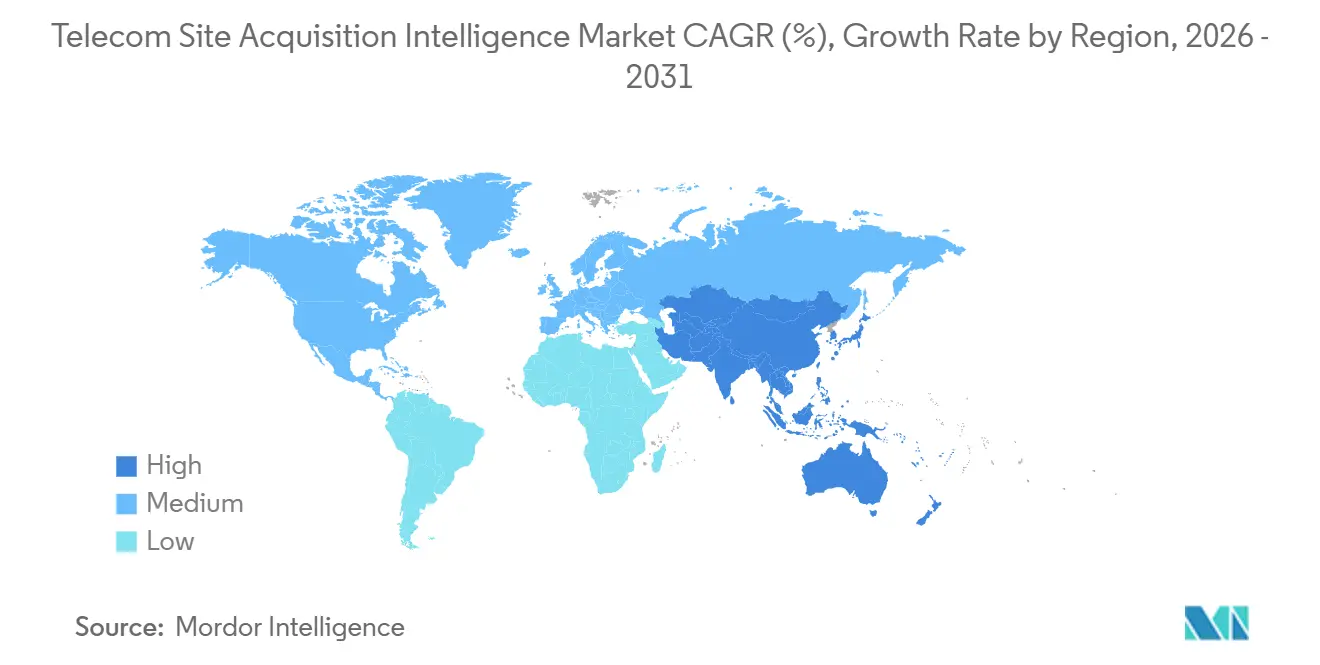
- By geography, North America held 32.44% share in 2025, while Asia-Pacific is projected to expand at a 10.16% CAGR through 2031.
Note: Market size and forecast figures in this report are generated using Mordor Intelligence’s proprietary estimation framework, updated with the latest available data and insights as of January 2026.
Global Telecom Site Acquisition Intelligence Market Trends and Insights
Drivers Impact Analysis*
| Driver | (~) % Impact on CAGR Forecast | Geographic Relevance | Impact Timeline |
|---|---|---|---|
| 5G Network Densification and Small-Cell Rollouts | +3.1% | Global, concentrated in North America, Europe, and East Asia | Short term (≤ 2 years) |
| Fiber, Edge Data Center, and Private-Network Expansion | +2.0% | North America and Europe core, with spill-over to Asia-Pacific | Medium term (2-4 years) |
| Infrastructure Sharing and Tower Portfolio Expansion | +1.5% | Global, with early gains in Europe and Sub-Saharan Africa | Medium term (2-4 years) |
| Rising Demand for Cloud-Based Site Lifecycle Visibility | +1.2% | Global, strongest in North America and Western Europe | Short term (≤ 2 years) |
| AI-Assisted Candidate-Site Scoring and Permit Risk Prediction | +0.9% | North America and Europe, with emerging adoption in Asia-Pacific | Long term (≥ 4 years) |
| Digitized Jurisdiction and Landlord Negotiation Records | +0.6% | National, with early gains in the United States, Germany, and Japan | Long term (≥ 4 years) |
| Source: Mordor Intelligence | |||
5G Network Densification and Small-Cell Rollouts
The shift from broad 5G coverage to urban densification makes site acquisition a continuing operating activity rather than a periodic capital project. A substantial number of operators have launched 5G networks, while many others are investing in the technology. The Small Cell Forum projects continued growth in small-cell deployments through the end of the decade, while 5G standalone small cells are expected to expand rapidly. Each added node can also trigger amendments and modifications across existing portfolios. The Telecom site acquisition intelligence market, therefore, benefits from demand for lease abstraction, permit monitoring, and deficiency processing. Sitetracker launched Scout in April 2026 to automate these activities within critical-infrastructure workflows.[1]
Fiber, Edge Data Center, and Private-Network Expansion
Fiber and private-network programs create site categories that older telecom acquisition processes did not address.American Tower identified a substantial portfolio of land plots that it owns or holds under long-term lease, and that can host multi-megawatt edge data centers. The company directed significant discretionary capital in 2026 toward data centers, land purchases, and new towers in Europe. Fiber-to-the-home and edge projects need right-of-way, pole-attachment, and civil-permitting processes that differ from tower lease work. NATE supported the FCC’s June 2026 proposal for a 120-day wireline permit deadline, which makes permit tracking more important for platforms handling parallel applications.[2] This expands the value of the Telecom site acquisition intelligence market across wireless and wireline projects.
Infrastructure Sharing and Tower Portfolio Expansion
5G economics are encouraging tower companies and operators to use active infrastructure sharing. Helios Towers has committed discretionary capital over the medium term and aims to increase tenancy additions. The program responds to rising data demand across African and Middle Eastern markets. It also shows why multi-tenancy information, co-location activity, and cost allocation need to sit within the same workflow. Parallel Wireless launched GreenRAN Synergy in February 2026 with a commercial deployment in West Sussex under the United Kingdom’s Neutral Host Outdoor specification.[3] The Telecom site acquisition intelligence market has a clear need for systems that support shared infrastructure without losing control of tenant-specific lease records.
Rising Demand for Cloud-Based Site Lifecycle Visibility
Large portfolios expose the limits of on-premises systems, including delayed data updates, limited geographic integration, and disconnected project views. Accruent’s Siterra brings site, asset, project, and lease information into a single system of record.[4] Connect44 selected Sitetracker in March 2026 for fiber and wireless rollouts to link field data with reporting and invoicing workflows. IFS released Cloud 25R2 in November 2025 with tools for technician scheduling and field briefing generation. IFS Cloud delivery also supports geographic data interfaces with GIS systems and municipal permit portals that are difficult to maintain at an on-premises scale.
Restraints Impact Analysis*
| Restraint | (~) % Impact on CAGR Forecast | Geographic Relevance | Impact Timeline |
|---|---|---|---|
| Fragmented Zoning and Permitting Requirements | -1.8% | National, most acute across US jurisdictions, EU municipalities, and emerging-market regulatory bodies | Short term (≤ 2 years) |
| Complex OSS, BSS, GIS, and Field-System Integration | -1.1% | Global, more acute in markets with legacy OSS/BSS infrastructure | Medium term (2-4 years) |
| Inconsistent Historical Site and Lease Data | -0.7% | Global, worst in markets with low prior digitization | Medium term (2-4 years) |
| Limited Availability of Telecom-Specific Acquisition Specialists | -0.5% | Global, most acute in Sub-Saharan Africa and South Asia | Long term (≥ 4 years) |
| Source: Mordor Intelligence | |||
Fragmented Zoning and Permitting Requirements
Zoning and permitting rules determine whether a site intelligence platform produces an actionable result or only an early risk warning. USTelecom documented approval timelines ranging from a few days to more than 1 year in submissions to the FCC. The filings also cited North Carolina jurisdictions that exceeded the state’s 30-day review limit by 2-3 months. The FCC proposed a 120-day wireline permit deadline in June 2026 and would treat noncompliance as a violation of federal telecommunications law. NATE The rulemaking increases the need for systems that track application status across many jurisdictions. The Telecom site acquisition intelligence market must still accommodate rules that vary by authority and location.
Complex OSS, BSS, GIS, and Field-System Integration
Integration costs arise mainly from the loss of data integrity when systems use different proprietary data structures. Permit status, lease terms, GIS coordinates, and field-completion records can conflict when they remain in separate applications. The intelligence layer must reconcile those records before it can support a reliable site decision. Comarch has identified unified OSS and BSS and external data consolidation as prerequisites for AI-driven analytics. Rakuten Symphony presented RAFT AI Operations at MWC 2026 to consolidate fragmented operational data in real time. Legacy inventory structures and modern event-driven geographic data models remain difficult to align, slowing implementation in the Telecom site acquisition intelligence market.
*Our forecasts treat driver/restraint impacts as directional, not additive. The impact forecasts reflect baseline growth, mix effects, and variable interactions.
Segment Analysis
By Offering: Zoning Intelligence Outpaces a Diversified Software Stack
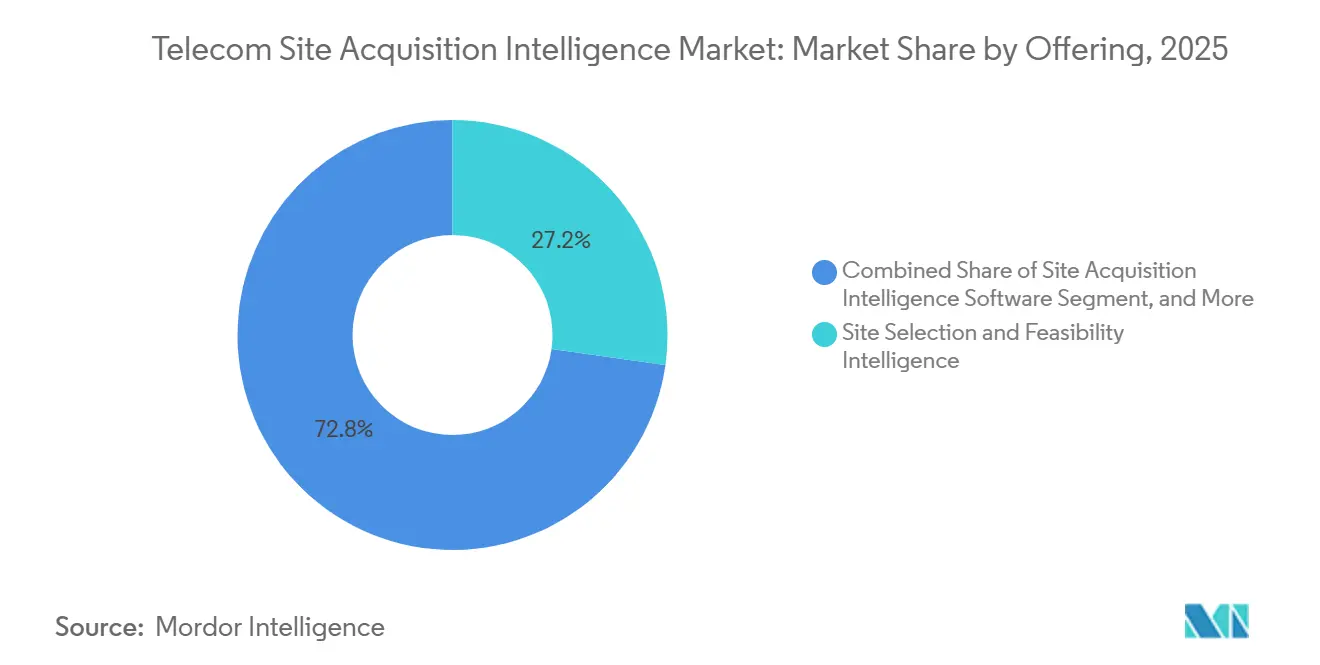
Site Selection and Feasibility Intelligence accounted for 27.22% of the Telecom site acquisition intelligence market share in 2025. This category is the entry point for a site program because operators need a qualified candidate list before lease negotiation or permitting can begin. Zoning and Permit Intelligence is projected to expand at a 9.77% CAGR from 2026 to 2031. The faster pace reflects rising regulatory complexity and the difficulty of moving a viable candidate through approval. Lease and Site-Control Intelligence and Project and Deployment Intelligence cover activities after selection and are increasingly automated through cloud-based systems.
Site Acquisition Intelligence Software is gaining acceptance among large enterprises that want to reduce the number of vendor relationships. An IEEE study on reinforcement-learning site selection reported 78% planning-to-construction consistency, compared with manual methods. That result supports the case for more structured candidate-site scoring. Sitetracker’s Scout platform addresses the approval gap through permit monitoring, lease abstraction, and deficiency processing. Other offerings, such as analytics and reporting layers, remain smaller but become more useful as operators combine outputs from several systems.

By Deployment Model: Mobile-First Closes the Gap on Cloud
Cloud-based deployment held 62.34% of the Telecom site acquisition intelligence market size in 2025. Its position reflects scalability and the ability to connect mapping, GIS, and permit-portal data through interfaces. Mobile-first deployment is projected to expand at a 9.84% CAGR from 2026 to 2031. This pace indicates that field-team productivity is now a purchasing consideration alongside core platform capability. On-premises systems remain relevant for large operators and government bodies that have data-sovereignty requirements.
MEC Communications adopted Sitetracker for 5G site acquisitions across Germany and Europe in November 2024. The deployment used GIS Link to align geographic data with active projects for rooftop and greenfield workflows. Mobile applications generally serve as the field layer of a cloud-hosted system of record instead of replacing cloud delivery. This arrangement is important for dispersed portfolios in Sub-Saharan Africa and rural North America, where offline field tools must synchronize with central records. European Union and Indian data-localization rules continue to support on-premises deployments in regulated accounts.
By End User: Government Connectivity Mandates Outpace MNO Growth
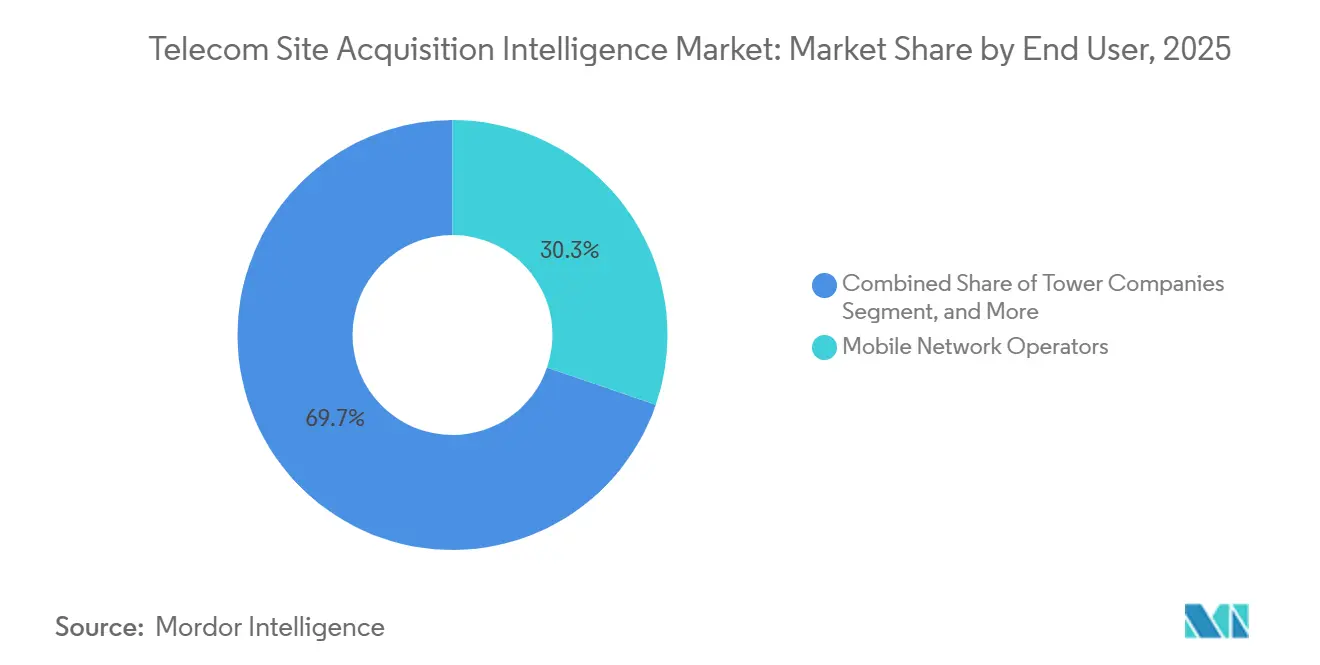
Mobile network operators held 30.26% of the Telecom site acquisition intelligence market in 2025. They manage the largest number of concurrent site programs and have a direct return on investment case for the platform. Government and municipal connectivity authorities are projected to expand at a 10.21% CAGR from 2026 to 2031. Broadband equity requirements, including the US Broadband Equity, Access, and Deployment program, require public agencies to manage site pipelines at a scale that was previously outsourced. Tower companies also need specialized functions for tenancy ratios, co-location pipelines, and lease escalation schedules.
Helios Towers managed 15,270 towers across 9 markets in the first half of 2026. Fiber and broadband providers are becoming important end users as fiber-to-the-home work expands. Enersense selected Sitetracker in December 2025 to replace legacy systems that support Finland's 5G and fiber programs. Private-network owners also need systems that connect spectrum-access data with tower-lease records. Anterix and Crown Castle introduced TowerX in November 2025 for utility private-network deployment using more than 40,000 US tower sites.
By Organization Size: Small Enterprises Accelerate as Platform Costs Fall
Large enterprises accounted for 64.68% of the Telecom site acquisition intelligence market size in 2025. Their position reflected implementation timelines and integration demands that historically favored major operators. Small enterprises are projected to expand at a 10.13% CAGR from 2026 to 2031, exceeding the overall forecast rate. Cloud-native modular systems and subscriptions linked to active site volume make adoption more accessible to smaller portfolios. Mid-sized enterprises often begin with point solutions before moving to integrated platforms as their site portfolios expand.
Comarch has moved toward cloud-native and Open Digital Architecture-compliant BSS and OSS capabilities. This positioning addresses the requirements of mid-sized and small enterprises for more flexible deployment. Mature tools for small enterprises can also give mid-market operators alternatives to scaled-down enterprise licenses. That pressure can limit premium-tier pricing for established providers. The Telecom site acquisition intelligence industry must therefore support simple initial adoption while retaining functions needed by larger portfolios.
Geography Analysis
North America held 32.44% share in 2025 and remains the most mature region for platform adoption. The Wireless Infrastructure Association reported substantial investment in US wireless infrastructure, along with a significant expansion of outdoor small-cell nodes. American Tower raised its property revenue outlook, citing sustained demand driven by mobile data consumption, cloud adoption, and AI workloads. Crown Castle completed the divestiture of its small-cell and fiber businesses, focusing its US operations on tower assets.
Asia-Pacific is projected to expand at a 10.16% CAGR from 2026 to 2031, making it the fastest-growing geography in the Telecom site acquisition intelligence market. India’s telecommunications service providers invested INR 4 trillion in 5G deployment (USD 47.3 billion), and achieved coverage across 99.9% of districts. Large site portfolios in the region increase the need for co-location tracking and replacement analysis. The European Commission highlighted that the share of 5G standalone stations among mobile base stations in the European Union remains lower than in the United States. This gap indicates a future need for dense upgrade, permit, and lease-modification programs across Europe.
Europe held the second-largest geographic share, supported by the European Electronic Communications Code and co-location activity across Cellnex’s extensive portfolio of sites across multiple countries. Cellnex reported revenue growth and an increase in the number of points of presence. South America remains a developing region, with Brazil supporting adoption. The Middle East is advancing through government-led connectivity programs in Saudi Arabia and the United Arab Emirates, while Africa offers long-term potential as data use expands. Helios Towers increased its capital expenditure commitment in the Democratic Republic of Congo, reflecting its focus on network expansion there.
Competitive Landscape
The Telecom site acquisition intelligence market is moderately fragmented, and no vendor dominates the complete workflow from candidate-site scoring to lease close and permit issuance. Sitetracker and Accruent compete in asset lifecycle management. Rakuten Symphony, Comarch, and IFS address integration with network operations systems. TRC Companies and Colliers Engineering and Design provide engineering and advisory services for operators that do not maintain full platform capabilities. This mix gives buyers a choice between specialized workflow tools and broader operational systems.
Sitetracker launched Scout in April 2026 to automate lease abstraction, permit monitoring, deficiency processing, and risk analysis. IFS released Cloud 25R2 in November 2025 with AI-supported field service functions for telecommunications network work. Parallel Wireless brought GreenRAN Synergy to a commercial neutral-host deployment in February 2026. These actions show vendors extending automation, field support, and shared-network capabilities. Competition is strongest in cloud delivery, where moderate switching costs can reduce the advantage held by older workflow systems.
Some providers expand across telecom, energy, and fiber to build scale, while others focus more narrowly on telecom site processes. Government workflows remain an opportunity because procurement requirements can slow adoption of commercial platforms. Private-network projects also need tools that connect spectrum access data with established tower lease records. GSMA launched its Agentic AI Testbed in March 2026 for real-world telecom network planning and capacity-management scenarios. The Telecom site acquisition intelligence market is likely to favor vendors that can meet these operational needs without adding separate systems for each site type.
Telecom Site Acquisition Intelligence Industry Leaders
-
Accruent, LLC
-
Sitetracker, Inc.
-
Tarantula International Limited
-
Rakuten Symphony Singapore Pte. Ltd.
-
IFS AB
- *Disclaimer: Major Players sorted in no particular order
Recent Industry Developments
- August 2026: American Tower reports strong Q2 2026 results and raises guidance. American Tower raised its full-year 2026 guidance for the second time, citing record leasing activity at CoreSite data centers and sustained tower leasing demand globally, with CEO Steve Vondran attributing growth to mobile data consumption, cloud adoption, and AI-driven workload expansion.
- July 2026: Helios Towers upgrades 2026 full-year guidance after record tenancy growth. Helios Towers raised its 2026 tenancy addition target to 3,500-4,000, adding 524 new sites in H1 2026 to reach a total portfolio of 15,270 towers across 9 markets, with midpoint adjusted EBITDA guidance of USD 527 million.
- May 2026: Helios Towers commits USD 110 million to the Democratic Republic of Congo. Helios Towers announced its largest single-market annual investment in the Democratic Republic of Congo in 5 years, targeting coverage expansion for 40 million people still outside mobile network reach.
- May 2026: Crown Castle completes USD 8.5 billion fiber and small-cell divestiture. Crown Castle completed the sale of its small-cells business to EQT Active Core Infrastructure and its fiber business to Zayo Group, becoming the sole publicly traded pure-play US tower company with 39,771 towers.
Global Telecom Site Acquisition Intelligence Market Report Scope
Telecom Site Acquisition Intelligence Market refers to geospatial data, software, and advisory solutions that help telecom operators, tower companies, and infrastructure developers identify, evaluate, and secure suitable sites for network infrastructure. It covers intelligence for cell towers, rooftops, small cells, fiber routes, data centers, rights-of-way, and other wireless and wireline locations.
The Telecom Site Acquisition Intelligence Market Report is Segmented by Offering (Site Acquisition Intelligence Software, Site Selection and Feasibility Intelligence, Lease and Site-Control Intelligence, Zoning and Permit Intelligence, and Project and Deployment Intelligence), Deployment (Cloud-Based, On-Premises, and Mobile-First), End User (MNOs, Tower Cos., Fiber, Private Network, Government, Engineering, Procurement, and Construction Firms, and Site Acquisition and Infrastructure Advisory Firms), Organization Size (Large, Mid-Sized, and Small), and Geography (North America, South America, Europe, Asia-Pacific, Middle East, and Africa). The Market Forecasts are Provided in Terms of Value (USD).
| Site Acquisition Intelligence Software |
| Site Selection and Feasibility Intelligence |
| Lease and Site-Control Intelligence |
| Zoning and Permit Intelligence |
| Project and Deployment Intelligence |
| Other Offerings |
| Cloud-Based Deployment |
| On-Premises Deployment |
| Mobile-First Deployment |
| Mobile Network Operators |
| Tower Companies |
| Fiber and Broadband Infrastructure Providers |
| Private-Network and Enterprise Infrastructure Owners |
| Government and Municipal Connectivity Authorities |
| Engineering, Procurement, and Construction Firms |
| Site Acquisition and Infrastructure Advisory Firms |
| Large Enterprises |
| Mid-Sized Enterprises |
| Small Enterprises |
| North America | United States |
| Canada | |
| Mexico | |
| South America | Brazil |
| Argentina | |
| Chile | |
| Rest of South America | |
| Europe | United Kingdom |
| Germany | |
| France | |
| Italy | |
| Russia | |
| Rest of Europe | |
| Asia-Pacific | China |
| India | |
| Japan | |
| South Korea | |
| Rest of Asia-Pacific | |
| Middle East | Saudi Arabia |
| United Arab Emirates | |
| Rest of Middle East | |
| Africa | South Africa |
| Nigeria | |
| Egypt | |
| Rest of Africa |
| By Offering | Site Acquisition Intelligence Software | |
| Site Selection and Feasibility Intelligence | ||
| Lease and Site-Control Intelligence | ||
| Zoning and Permit Intelligence | ||
| Project and Deployment Intelligence | ||
| Other Offerings | ||
| By Deployment Model | Cloud-Based Deployment | |
| On-Premises Deployment | ||
| Mobile-First Deployment | ||
| By End User | Mobile Network Operators | |
| Tower Companies | ||
| Fiber and Broadband Infrastructure Providers | ||
| Private-Network and Enterprise Infrastructure Owners | ||
| Government and Municipal Connectivity Authorities | ||
| Engineering, Procurement, and Construction Firms | ||
| Site Acquisition and Infrastructure Advisory Firms | ||
| By Organization Size | Large Enterprises | |
| Mid-Sized Enterprises | ||
| Small Enterprises | ||
| By Geography | North America | United States |
| Canada | ||
| Mexico | ||
| South America | Brazil | |
| Argentina | ||
| Chile | ||
| Rest of South America | ||
| Europe | United Kingdom | |
| Germany | ||
| France | ||
| Italy | ||
| Russia | ||
| Rest of Europe | ||
| Asia-Pacific | China | |
| India | ||
| Japan | ||
| South Korea | ||
| Rest of Asia-Pacific | ||
| Middle East | Saudi Arabia | |
| United Arab Emirates | ||
| Rest of Middle East | ||
| Africa | South Africa | |
| Nigeria | ||
| Egypt | ||
| Rest of Africa | ||
Key Questions Answered in the Report
What is the telecom site acquisition intelligence market size?
The Telecom site acquisition intelligence market is estimated at USD 454.6 million in 2026 and is forecast to reach USD 718.1 million by 2031 at a 9.58% CAGR. This Telecom site acquisition intelligence market outlook reflects continuing work across site selection, leases, permits, and deployment programs.
What is driving demand for telecom site acquisition intelligence platforms?
5G densification, small-cell deployment, fiber expansion, edge data centers, private networks, and the move from spreadsheets to connected site workflows are central demand factors. The Telecom site acquisition intelligence market also responds to the need for a shared record across site and field activities.
Which offering is expanding fastest?
Zoning and Permit Intelligence is projected to expand at a 9.77% CAGR from 2026 to 2031 as approval processes become more difficult to manage. Providers in the Telecom site acquisition intelligence market are responding with permit-monitoring and risk-analysis functions.
Why do operators use cloud-based site lifecycle systems?
Cloud platforms bring site, lease, asset, project, field, and geographic data into a shared view and can connect with GIS and permit portals. In the Telecom site acquisition intelligence market, this helps users replace separate project views with connected lifecycle records.
Which end users have the strongest need for these systems?
Mobile network operators were the largest end-user group in 2025, while government and municipal connectivity authorities are projected to expand fastest through 2031. The Telecom site acquisition intelligence market serves both commercial network programs and public connectivity pipelines. This Telecom site acquisition intelligence market use case also requires transparent records for public agencies.
Which region offers the fastest expansion outlook?
Asia-Pacific is projected to expand at a 10.16% CAGR from 2026 to 2031, supported by large-scale 5G deployment and high site portfolio requirements. This makes Asia-Pacific a significant demand area for the Telecom site acquisition intelligence market, especially where shared sites and replacement activity require structured portfolio records.