
Telecom Order Management Software Market Size and Share
Market Overview
| Study Period | 2020 - 2031 |
|---|---|
| Market Size (2026) | USD 1.61 Billion |
| Market Size (2031) | USD 2.87 Billion |
| Growth Rate (2026 - 2031) | 12.26 % |
| Fastest Growing Market | Asia-Pacific |
| Largest Market | North America |
| Market Concentration | Medium |
Major Players *Disclaimer: Major Players sorted in no particular order Image © Mordor Intelligence. Reuse requires attribution under CC BY 4.0. | |
Telecom Order Management Software Market Analysis by Mordor Intelligence
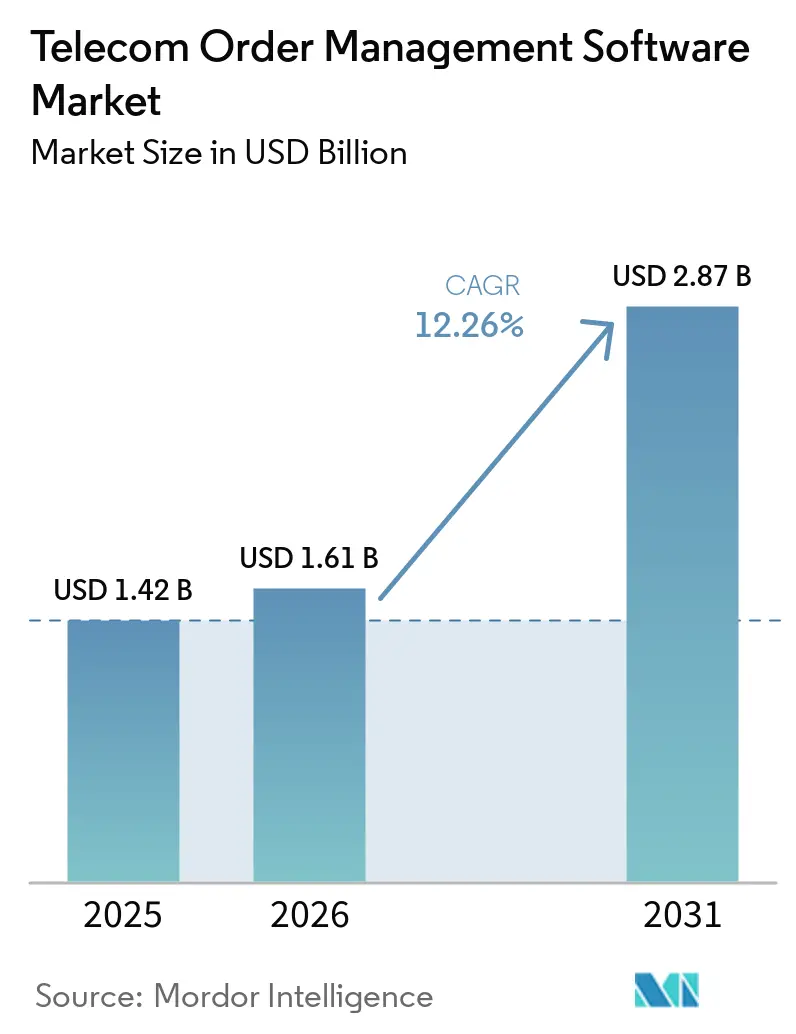
The Telecom order management software market size was valued at USD 1.42 billion in 2025 and estimated to expand from USD 1.61 billion in 2026 to reach USD 2.87 billion by 2031, at a CAGR of 12.26% during the forecast period (2026-2031). The telecom order management software market is being shaped by the simultaneous expansion of 5G, fiber-to-the-premises, IoT connectivity, and converged service bundles. These services require software that can coordinate order capture, catalog validation, provisioning, activation, and partner processes across separate network domains. Cloud-native architecture is also changing operator priorities because it supports API-led integration and real-time orchestration across previously separate business support systems. Enterprise demand for bandwidth on demand and Network-as-a-Service is making order flows more dynamic and increasing the need to translate customer requests into network and billing actions. Recent acquisitions by large platform providers indicate that scale in charging, billing, automation, and managed services is becoming more important in the telecom order management software market. Data-localization rules and weak product-catalog controls can limit the benefits of automation, particularly when AI tools depend on inconsistent service attributes.
Key Report Takeaways
- By component, solutions held 74.52% of the telecom order management software market share in 2025, while services are projected to expand at a 13.30% CAGR through 2031.
- By deployment, cloud-based platforms accounted for 62.11% of the telecom order management software market share in 2025 and are projected to expand at a 13.78% CAGR through 2031.
- By organization size, large organizations held 76.13% revenue share in 2025, while small and medium organizations are projected to expand at a 13.65% CAGR through 2031 in the telecom order management software market.
- By network type, wireless networks held 50.34% revenue share in 2025 and are projected to expand at a 13.87% CAGR through 2031 in the the telecom order management software market.
- By application, service order decomposition and orchestration held 22.56% revenue share in 2025, while wholesale and partner order management is projected to expand at a 13.52% CAGR through 2031.
- By end user, mobile network operators held 32.51% revenue share in 2025, while wholesale and neutral-host network providers are projected to expand at a 13.41% CAGR through 2031.
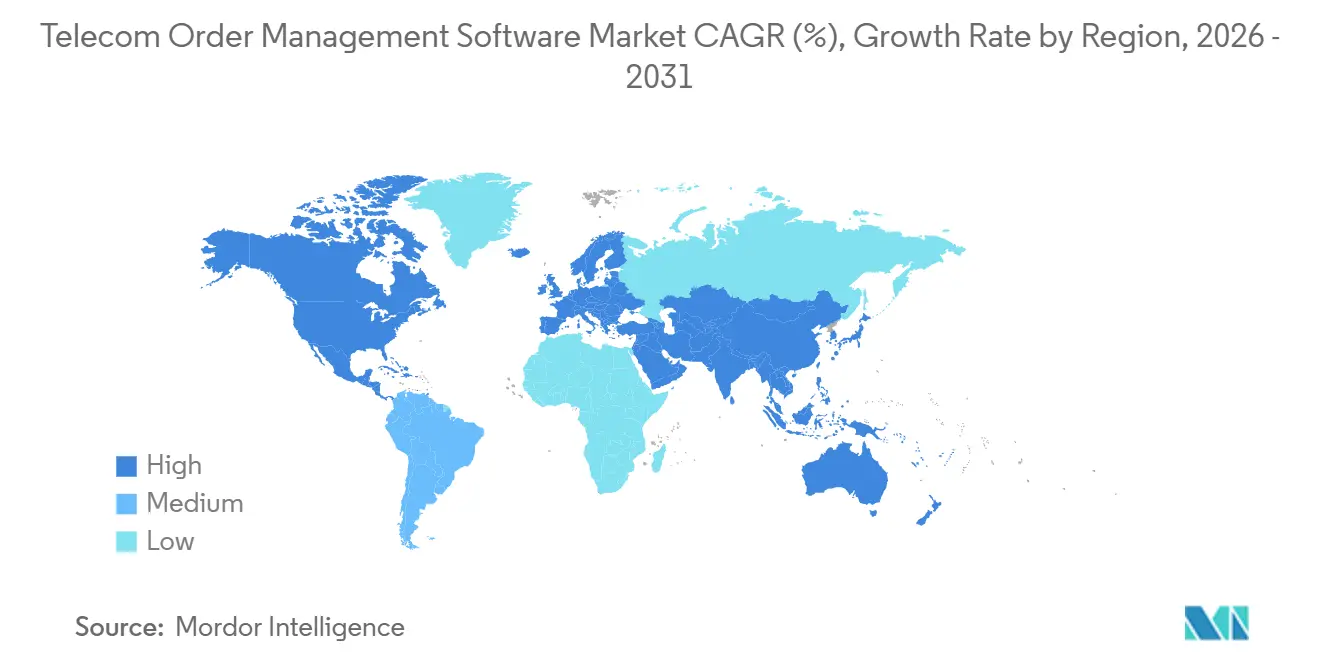
- By geography, North America held 34.96% revenue share in 2025, while Asia-Pacific is projected to expand at a 13.77% CAGR through 2031.
Note: Market size and forecast figures in this report are generated using Mordor Intelligence’s proprietary estimation framework, updated with the latest available data and insights as of January 2026.
Market Trends and Insights
Drivers Impact Analysis of Telecom Order Management Software Market*
| Driver | (~) % Impact on CAGR Forecast | Geographic Relevance | Impact Timeline |
|---|---|---|---|
| Rising Complexity of 5G, Fiber, IoT, and Multiplay Orders | +3.8% | Global | Medium term (2-4 years) |
| Cloud-Native OSS and BSS Modernization | +2.8% | Global, with highest concentration in North America and Europe | Medium term (2-4 years) |
| AI-Enabled Order Automation and Fallout Prevention | +2.0% | Global | Short term (≤ 2 years) |
| Accelerating Enterprise Network-as-a-Service Adoption | +1.0% | North America and Europe | Medium term (2-4 years) |
| Demand for Digital Self-Service and Faster Activation | +0.7% | Global | Short term (≤ 2 years) |
| Expansion of Wholesale, MVNO, and Partner-Led Connectivity Models | +0.5% | Global, with spillover to Middle East and Africa and South America | Long term (≥ 4 years) |
| Source: Mordor Intelligence | |||
Rising Complexity of 5G, Fiber, IoT, and Multiplay Service Orders
The rollout of 5G standalone networks, fiber-to-the-premises infrastructure, IoT links, and multiplay bundles is increasing the number of dependencies within a single service request. China had deployed 4.838 million 5G base stations by the end of 2025, equal to 34.4 stations per 10,000 people, which increased the need for scalable provisioning processes across commercial and enterprise services. A delayed task in one part of a bundle, such as an IoT SIM activation, can delay completion of the wider service package and postpone revenue recognition. This makes reliable decomposition and coordination material to commercial performance, not only to back-office efficiency. TM Forum reported that AI-assisted and catalog-driven orchestration using Open Digital Architecture standards reduced service launch timelines from months to minutes in controlled proof-of-concept work and reduced integration effort by 70% to 90%.[1]TM Forum, “Using AI and Standards to Transform Complex B2B Quoting and Ordering,” TM Forum Catalyst Proof of Concept, tmforum.org The telecom order management software market therefore favors platforms that resolve multi-domain dependencies with fewer manual handoffs.
Cloud-Native OSS and BSS Modernization
Cloud-native design is increasingly the baseline for new deployments in the telecom order management software market, although migration from monolithic systems remains difficult. Operators must identify undocumented business rules embedded in legacy applications before they can safely transfer order workflows to a modern platform. During the transition, a new cloud order engine often has to interact with older inventory and provisioning systems through adapters. That hybrid arrangement can introduce latency and additional error points until the older systems are replaced or fully integrated. TM Forum's Open Digital Architecture and Open API conformance program provide a common technical direction for this work. Cerillion achieved Diamond-Level TM Forum Open API certification in March 2026, with more than 50 certified APIs, which illustrates the competitive value placed on standards-based integration.[2]Cerillion, “Cerillion Achieves TM Forum Diamond-Level Open API Certification with Industry-Leading Real-World Deployments,” Cerillion Press Release, cerillion.com
AI-Enabled Order Automation and Fallout Prevention
AI-based automation is moving from pilots into production workflows for fallout detection, root-cause analysis, and order resubmission. Amdocs introduced CES26 in March 2026 with preemptive fallout detection, proactive self-healing, and parallel execution for complex changes within an order.[3]Amdocs, “Amdocs Unveils CES26, an Agent-Driven BSS-OSS-Network Suite,” Amdocs Press Release, amdocs.com These capabilities are intended to reduce manual intervention when a service request includes multiple technical actions. Nokia and Telenor demonstrated a related approach in which a language-based enterprise portal converts customer requirements into TMF921-compliant intent-based orders for 5G slice deployment, user provisioning, and activation. Historical fallout records need careful curation because an AI tool can reproduce earlier priorities or errors at greater scale. The telecom order management software market will reward vendors that pair AI functions with strong catalog governance, clear escalation rules, and traceable human oversight.
Accelerating Enterprise Network-as-a-Service Adoption
Enterprise Network-as-a-Service adoption is creating demand for order systems that can provision connectivity through APIs and maintain service-level commitments in near real time. Lumen stated in 2026 that it had more than doubled its Network-as-a-Service customer base to over 2,000 businesses since the third quarter of 2025, while extending Internet On-Demand availability to more than 10 million new locations. The resulting orders differ from conventional telecom transactions because customers expect changes to bandwidth, location, and service configuration without long manual cycles. Order platforms need to convert an intent-based request into resource reservations, service tasks, and billing records. This requirement also makes integration between product catalogs, network inventory, and charging systems more important. As NaaS use increases, telecom order management software market suppliers can compete on the speed and reliability of this translation process.
Restraints Impact Analysis of Telecom Order Management Software Market*
| Restraint | (~) % Impact on CAGR Forecast | Geographic Relevance | Impact Timeline |
|---|---|---|---|
| High Integration Costs and Legacy BSS and OSS Dependencies | -2.1% | Global | Long term (≥ 4 years) |
| Inaccurate Inventory and Product-Catalog Data | -1.2% | Global | Medium term (2-4 years) |
| Shortage of Telco-Grade Cloud, API, and AI Skills | -0.8% | Global | Medium term (2-4 years) |
| Cybersecurity, Data Sovereignty, and Autonomous-Provisioning Risks | -0.6% | Global | Medium term (2-4 years) |
| Source: Mordor Intelligence | |||
High Integration Costs and Legacy BSS and OSS Dependencies
Legacy BSS and OSS dependencies continue to slow modernization programs in the telecom order management software market. Large operators must preserve live services while changing order, inventory, billing, and provisioning links that may have accumulated over many years. Each added automation layer can carry forward stale data or incompatible attributes when underlying interfaces remain fragile. The result can be new fallouts rather than the reduction in fallouts that an automation program was designed to deliver. The United Kingdom's Telecommunications Security Code of Practice requires operators to demonstrate operational resilience and supply-chain risk management across relevant systems, which adds governance requirements to modernization work. Providers that can support phased integration and clear control points are better positioned where complete replacement is not commercially practical.
Inaccurate Inventory and Product-Catalog Data
Inaccurate inventory and product-catalog records can trigger technically undeliverable orders and create avoidable manual work. The problem becomes more serious as 5G, fiber, and bundled services create more relationships among products, network resources, prices, and service rules. When a catalog does not reflect current resource availability, the order engine may create tasks that cannot be completed. AI agents can amplify this problem if they repeatedly retry an order without identifying the data mismatch behind it. Continuous validation rules are therefore becoming more important than periodic catalog cleanup projects. TM Forum standards support semantic consistency among product, service, and resource layers, giving operators a framework for improving order data quality across the telecom order management software market.
*Our forecasts treat driver/restraint impacts as directional, not additive. The impact forecasts reflect baseline growth, mix effects, and variable interactions.
Telecom Order Management Software Market Segment Analysis
By Component:
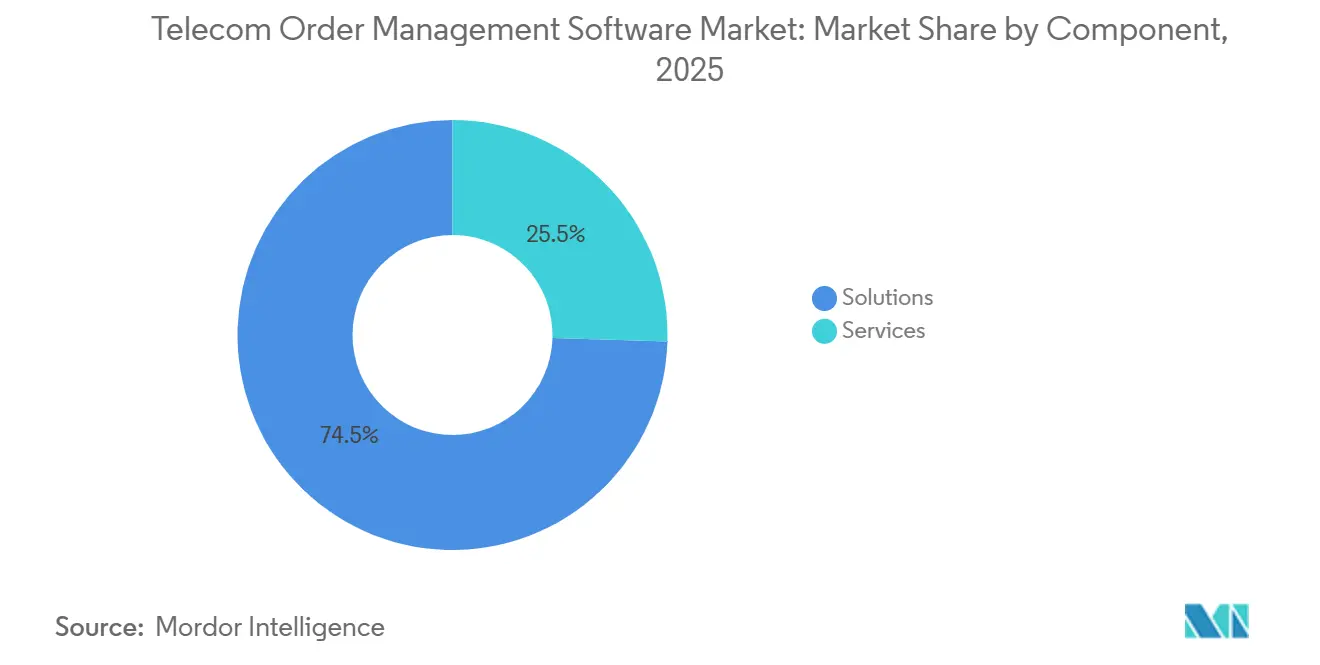
Solutions Define the Competitive Core and Services AccelerateSolutions held 74.52% of the telecom order management software market in 2025. Operators use these platforms for order orchestration, catalog management, and provisioning, which makes software capability central to service continuity. The large share reflects a preference for purpose-built systems rather than relying solely on extended service engagements. Incumbent platforms are often enhanced with AI-based fallout detection, catalog synchronization, and intent-based decomposition instead of being replaced outright. That approach can lengthen customer relationships because the software becomes embedded in operating processes. It can also preserve vendor-specific architectures that are difficult to separate from legacy environments.
Services are projected to expand at a 13.30% CAGR from 2026 to 2031 as operators manage cloud-native and hybrid migrations. Implementation, system integration, managed services, and consulting remain necessary when new order engines must coordinate with older systems. Amdocs reported managed-services revenue of USD 746 million in the first quarter of fiscal 2026, equal to 65% of its quarterly revenue, showing the scale of services-led relationships at large accounts. These engagements help operators manage operational continuity during transformation. They may also face margin pressure when customers use AI tools to review scope and service requirements at renewal. The telecom order management software industry consequently depends on both scalable software products and specialized implementation support.


By Deployment:
Cloud-Based Models Set the New Baseline for Order ArchitectureCloud-based deployment accounted for 62.11% of the market in 2025 and is projected to expand at a 13.78% CAGR through 2031. This dual position shows that cloud delivery has broad adoption while retaining room for further expansion. Public, private, and hybrid models offer different tradeoffs among scale, control, and local data handling. Hybrid environments are particularly relevant where national rules require data residency but operators still want access to elastic computing for analytics and AI workloads. Many operators are also seeking cloud-agnostic designs to reduce dependence on a single platform provider. These preferences make API compatibility and portability key parts of purchasing decisions in the telecom order management software market.
On-premises deployments remain relevant for Tier-1 operators with deeply customized systems. A full migration can require years of work and introduce substantial operational risk. However, new on-premises contracts represent a declining portion of contract value as operators prioritize flexible delivery models. TM Forum ODA conformance and ETSI MANO standards are helping to define common patterns for cloud-native network and order management. Standardization can reduce the integration burden that previously favored large, customized on-premises projects. The telecom order management software industry is therefore moving toward modular platforms, even where the operating environment remains partly local.
By Organization Size:
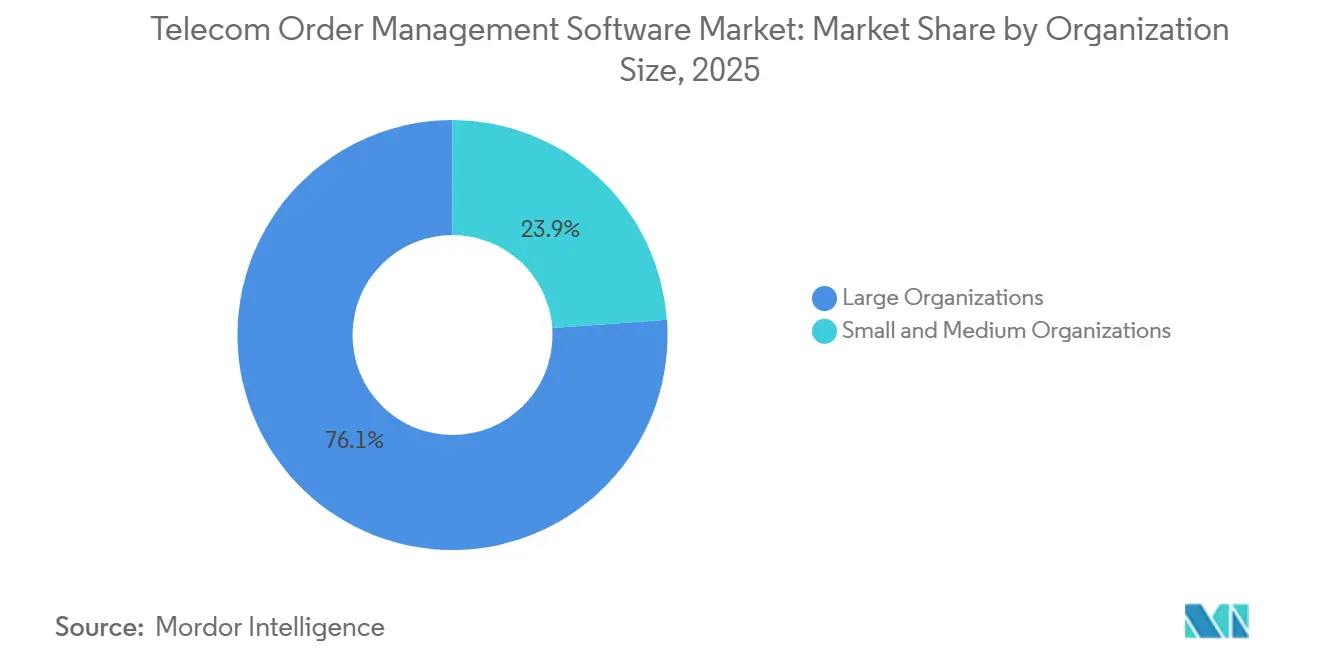
Large Operators Lead While SMB SaaS Models Reshape CompetitionLarge organizations accounted for 76.13% of market revenue in 2025. Tier-1 operators require platforms that can process very high order volumes across multiple network technologies and partner relationships. Their investments often focus on AI-assisted orchestration, catalog-driven decomposition, and wholesale management. At large scale, a lower cost per order can support operating margins and service quality. These operators also run complex environments and may take longer to migrate, which can support long-term contracts for established suppliers. Their installed base continues to anchor demand across the telecom order management software market.
Small and medium organizations are projected to expand at a 13.65% CAGR from 2026 to 2031. SaaS delivery lowers entry barriers for MVNOs, regional operators, and new digital carriers that do not want to build extensive internal infrastructure. Totogi and gaiia target this group with cloud-native charging and AI-oriented OSS and BSS platforms. gaiia raised USD 40 million in a Series B funding round in May 2026 to support AI agents, productized migrations, and customer capabilities for smaller communications service providers. Established vendors are responding with lighter SaaS tiers to build relationships with operators that could become larger accounts. This competitive change broadens the telecom order management software market beyond traditional Tier-1 deployments.
By Network Type:
Wireless Networks Drive Volume as Wireline Convergence IntensifiesWireless networks represented 50.34% of market revenue in 2025 and are projected to expand at a 13.87% CAGR through 2031. 5G subscriber additions, MVNO activity, and cloud-native mobile network launches are supporting this position. Mavenir enabled Tune Talk to become ASEAN's first fully cloud-native mobile network operator in February 2026 using cloud-native OSS and BSS solutions. Greenfield operators can avoid some legacy integration challenges and establish modern orchestration processes from the outset. Incumbent wireless operators face a different path because they must modernize active systems without disrupting established subscribers. Both groups need automated activation and service management as mobile offers become more flexible.
Wireline networks account for the remaining demand through fixed broadband, enterprise leased lines, and fiber services. Fiber deployments require coordination among field work, equipment provisioning, service activation, and billing. Fixed-mobile convergence is reducing the operational separation between wireline and wireless orders. Operators increasingly seek one orchestration layer that can coordinate both parts of a bundled service journey. The TM Forum TMF622 Order Management API supports interoperability across vendor ecosystems for these activities. This convergence expands the role of telecom order management software market platforms from network-specific workflow tools to enterprise-wide order coordination systems.
By Application:
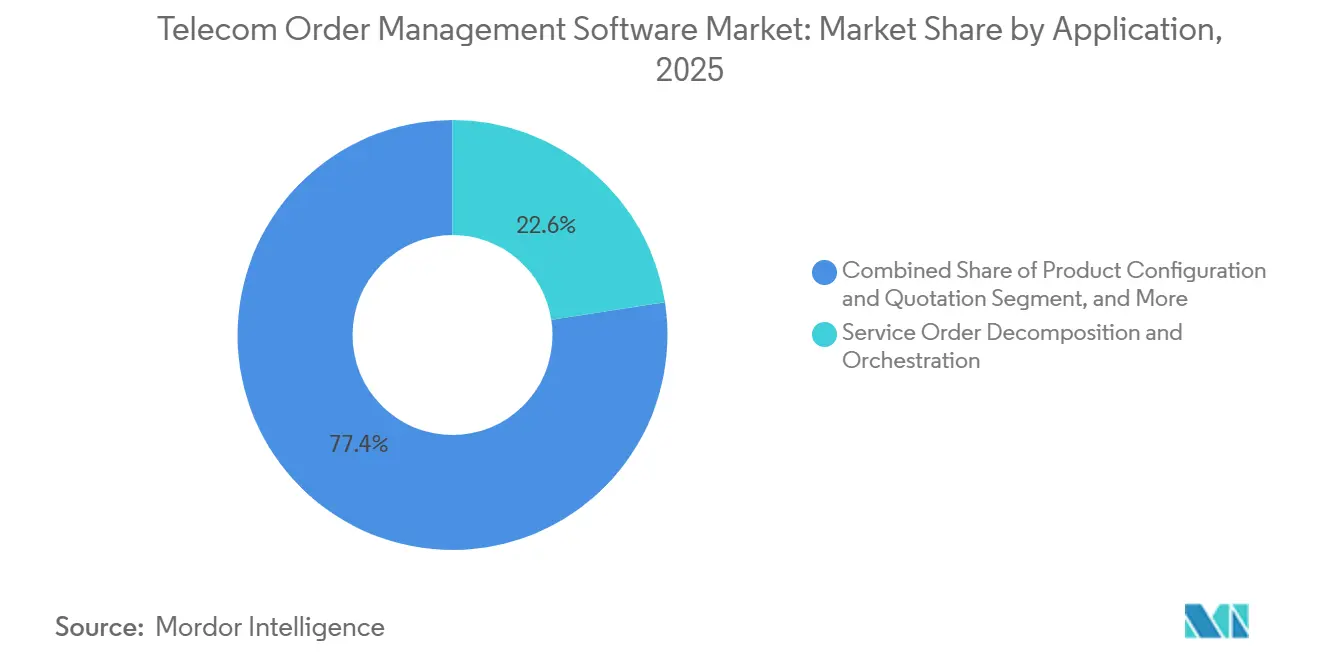
Orchestration Is at the Core and Wholesale Is at the FrontierService order decomposition and orchestration held 22.56% revenue share in 2025. The function converts a commercial order into technical tasks, coordinates parallel execution, monitors progress, and manages fallouts. Its importance rises with the number of service components and partner relationships included in an order. The ability to manage cross-domain dependencies without human intervention is a key differentiator in large-operator procurement. It also determines how effectively an operator can connect commercial offers to the systems that deliver them. For this reason, the telecom order management software market places significant weight on orchestration depth and reliability.
Wholesale and partner order management is projected to expand at a 13.52% CAGR through 2031. Growth is linked to MVNO ecosystems, neutral-host arrangements, and partner-delivered enterprise connectivity. Deutsche Telekom T Wholesale completed a full BSS transformation for its international lead-to-cash process, covering quoting, ordering, delivery, and billing and aligning with TM Forum and MEF LSO Sonata standards. Customer order capture and validation, product configuration and quotation, provisioning and change management, and inventory and fallout management are also receiving AI-based upgrades. These functions reduce manual touchpoints in workflows that have traditionally required considerable staff effort. As partner models expand, applications that coordinate external systems become more important across the telecom order management software industry.

By End User:
MNOs Anchor Demand as Neutral-Host Providers EmergeMobile network operators accounted for 32.51% revenue share in 2025. MNOs must coordinate prepaid, postpaid, 5G, and MVNO workloads within common orchestration environments. Their size makes them the principal buying group for broad platforms and managed-service arrangements. It also creates migration inertia because large MNOs operate some of the most complex order environments. Long transition cycles can support long-duration supplier contracts. Fixed network operators, internet service providers, cable network operators, satellite communication providers, and MVNOs make up the rest of demand in the telecom order management software market.
Wholesale and neutral-host network providers are projected to expand at a 13.41% CAGR from 2026 to 2031. Their growth is supported by neutral-host deployments in dense urban venues and by wholesale carriers serving enterprise private 5G. MVNOs are also a meaningful opportunity because hosted infrastructure and SaaS billing align with cloud-based order systems. Wider eSIM support creates a further need for digital activation processes that avoid physical SIM logistics. Providers must support faster subscriber onboarding while retaining accurate entitlement and billing data. These requirements favor flexible platforms that can coordinate multiple brands, partners, and access networks.
Geography Analysis
North America Telecom Order Management Software Market
North America accounted for 34.96% of revenue in 2025. Large 5G investment programs and advanced enterprise adoption of Network-as-a-Service support demand in the region. The United States remains the largest national market, where long-term managed-service agreements offer revenue visibility to platform providers. Amdocs reported a 12-month backlog of USD 4.25 billion as of December 2025 and announced a multiyear extension with T-Mobile in February 2026 that covers managed services, software development, and AI innovation. The company also stated that Fastweb expanded use of its OMS platform after integration with Vodafone Italy, showing how operator combinations can create demand for a unified order layer. Canada and Mexico add demand through fiber investment and regional modernization programs.
Europe and APAC Telecom Order Management Software Market
Europe is a major regional bloc in the telecom order management software market because fiber deployment continues across Germany, the United Kingdom, France, and Italy. Operators in the region require strong data sovereignty controls and audit trails as cybersecurity requirements develop. The United Kingdom's Telecommunications Security Code of Practice sets expectations for resilience and supply chain risk management. Asia-Pacific is projected to expand at a 13.77% CAGR through 2031. China had deployed 4.838 million 5G base stations by the end of 2025, increasing the need for high-volume provisioning capacity. NTT Docomo launched its commercial 5G core on AWS in February 2026, including AI-driven automated core network construction, providing a reference point for operators considering similar modernization efforts. Ericsson projected that India would have 970 million 5G users by 2030, equal to 74% of mobile subscribers.
APAC, MEA and South America Telecom Order Management Software Market
South Korea's dense 5G network supports procurement of advanced orchestration tools. Southeast Asia also has greenfield digital operators that can implement current systems without maintaining extensive legacy platforms. Tune Talk's cloud-native MNO launch in Malaysia illustrates this approach. The Middle East is receiving BSS and OSS investment through national digital transformation programs and operator efforts to broaden their technology roles. Cerillion secured a GBP 42.5 million (USD 57.1 million) contract with Omantel in April 2026 for a five-year BSS and OSS program hosted in Oman to meet data-sovereignty requirements. Netcracker reached production readiness with e& UAE in October 2025 for a BSS transformation covering catalog, CPQ, order capture, fulfillment, and over-the-top service management. South America and Africa remain earlier-stage opportunities tied to broadband expansion, mobile-data use, and lower-cost cloud delivery.

Competitive Landscape
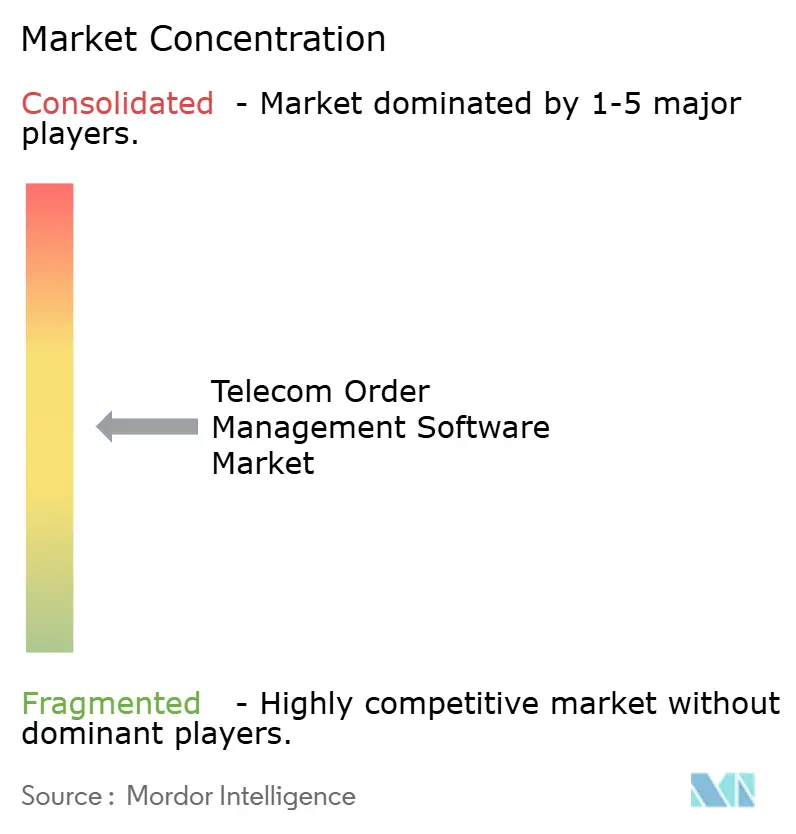
The telecom order management software market is moderately concentrated among leading suppliers. Amdocs and the combined Netcracker-CSG business account for a significant portion of Tier-1 operator revenue, while Cerillion, Hansen Technologies, Tecnotree, Comarch, Mavenir, and Etiya compete for targeted accounts and geographies. The May 2026 acquisition of CSG Systems by NEC through Netcracker, valued at approximately USD 2.9 billion, combined customer engagement, monetization, automation, order management, and cloud-native operations capabilities. Amdocs completed its acquisition of MATRIXX Software in December 2025 for approximately USD 197 million, adding charging and rating capabilities and 12 strategic operator accounts. These transactions give the largest suppliers broader product portfolios and managed-services capacity. Smaller providers must demonstrate clear technical or deployment advantages to compete.
Full-stack suppliers compete through scale, managed services, AI capability, and established Tier-1 relationships. Composable-platform specialists focus on ODA conformance, API-led design, and faster deployment for operators that do not want a multiyear replacement program. Cerillion used this approach through Diamond-Level TM Forum Open API certification and the introduction of Agent2Agent capabilities in its 26.1 release in April 2026. AI-native challengers focus on SMB and MVNO customers with SaaS models that can reduce time to deployment. Totogi reported that 2degrees had delivered more than 300 features and optimizations after operating its cloud-native charging platform for a year. This mix of supplier models creates competition around both breadth and speed.
Opportunities remain in autonomous MVNO enablement, AI-based catalog management, and sovereign-cloud order systems for regulated jurisdictions. The telecom order management software market also depends on whether vendors can show reliable operational results rather than only new product features. Ericsson announced Business Value Pathways for BSS and OSS modernization in August 2026, framing agentic AI around data transformation, product launch, service experience, and IT operations. The announcement reflects greater buyer scrutiny of practical outcomes from AI investments. Large suppliers can use their installed bases and service organizations to validate deployments. Specialists can respond through standards conformance, narrow operational expertise, and simpler cloud delivery. Available information does not provide combined top-player shares, so a numeric concentration score cannot be assigned without creating an unsupported estimate.
Telecom Order Management Software Industry Leaders
Amdocs Limited
Netcracker Technology Corporation
Cerillion plc
Comarch S.A.
Tecnotree Corporation
- *Disclaimer: Major Players sorted in no particular order
Telecom Order Management Software Market Companies Covered in this Report
- Amdocs Limited
- Netcracker Technology Corporation
- Cerillion plc
- Comarch S.A.
- Tecnotree Corporation
- CSG Systems, Inc.
- Hansen Technologies Limited
- MATRIXX Software, Inc.
- Optiva, Inc.
- Sigma Systems Canada, Inc.
- Mavenir, Inc.
- Nexign
- Etiya Bilgi Teknolojileri Yaz?l?m Sanayi ve Ticaret A.?.
- Whale Cloud Technology Co., Ltd.
- Qvantel Oy
- Totogi, Inc.
- Sterlite Technologies Limited
- Subex Limited
- Alepo Technologies Pvt. Ltd.
- Cerillion Service Manager

Recent Industry Developments in Telecom Order Management Software Market
- August 2026: Ericsson published its Business Value Pathways framework, reframing OSS/BSS modernization around agentic AI across four strategic paths, faster data transformation, zero-touch product launch, agentic AI service experience, and agentic AI for intelligent IT operations. The framework shifts industry discourse from technology capability claims to outcome-led deployment, directly challenging vendors whose AI propositions lack measurable operator impact.
- August 2026: Zain Jordan completed phase two of its cloud-native BSS overhaul with Ericsson, extending the stack to postpaid subscribers on Ericsson Billing deployed on a private Red Hat OpenShift environment and adding the Telco DataOps Platform as a real-time data layer. The deployment positions Zain Jordan as one of the first carriers in MENA to run a fully cloud-native BSS across its entire subscriber base, building on the prepaid phase completed with Ericsson in May 2025.
- May 2026: NEC Corporation, through wholly owned subsidiary Netcracker Technology, completed its approximately USD 2.9 billion acquisition of CSG Systems International, creating a combined entity spanning customer engagement, monetization, AI-driven automation, order management, and cloud-native operations. Netcracker assumed full responsibility for CSG integration, with Andrew Feinberg appointed Chairman and CEO of the combined organization.
- April 2026: Cerillion secured its largest-ever contract with Omantel, Oman's leading integrated telecoms operator, valued at GBP 42.5 million (approximately USD 57.1 million) over five years. The deployment covers the full Cerillion BSS/OSS Suite, including Service Manager, Convergent Charging System, Enterprise Product Catalogue, CRM Plus, and Network Inventory, hosted on Cerillion Cloud within Oman Data Park to meet national data-sovereignty requirements and support Oman Vision 2040.


Global Telecom Order Management Software Market Report Scope
The Telecom Order Management Software Market comprises software solutions and platforms designed to automate, manage, and optimize the end-to-end lifecycle of telecom service orders across communication service providers (CSPs), mobile network operators, broadband providers, and digital service providers.
The Telecom Order Management Software Market Report is Segmented by Component (Solutions and Services), Deployment (Cloud-Based [Public Cloud, Private Cloud, and Hybrid Cloud] and On-Premises), Organization Size (Large Organizations and Small and Medium Organizations), Network Type (Wireless Networks and Wireline Networks), Application (Customer Order Capture and Validation, Product Configuration and Quotation, Service Order Decomposition and Orchestration, Provisioning/Activation and Change Management, Inventory/Jeopardy and Fallout Management, and Wholesale and Partner Order Management), End User (Mobile Network Operators, Fixed Network Operators, Internet Service Providers, Cable Network Operators, Satellite Communication Providers, Wholesale and Neutral-Host Network Providers, and Mobile Virtual Network Operators), and Geography (North America, South America, Europe, Asia-Pacific, Middle East, and Africa). The Market Forecasts are Provided in Terms of Value (USD).
| Solutions |
| Services |
| Cloud-Based | Public Cloud |
| Private Cloud | |
| Hybrid Cloud | |
| On-Premises |
| Large Organizations |
| Small and Medium Organizations |
| Wireless Networks |
| Wireline Networks |
| Customer Order Capture and Validation |
| Product Configuration and Quotation |
| Service Order Decomposition and Orchestration |
| Provisioning, Activation and Change Management |
| Inventory, Jeopardy and Fallout Management |
| Wholesale and Partner Order Management |
| Mobile Network Operators |
| Fixed Network Operators |
| Internet Service Providers |
| Cable Network Operators |
| Satellite Communication Providers |
| Wholesale and Neutral-Host Network Providers |
| Mobile Virtual Network Operators |
| North America | United States |
| Canada | |
| Mexico | |
| South America | Brazil |
| Argentina | |
| Rest of South America | |
| Europe | Germany |
| United Kingdom | |
| France | |
| Italy | |
| Spain | |
| Russia | |
| Rest of Europe | |
| Asia-Pacific | China |
| Japan | |
| India | |
| South Korea | |
| Australia | |
| Rest of Asia-Pacific | |
| Middle East | Saudi Arabia |
| United Arab Emirates | |
| Turkey | |
| Rest of Middle East | |
| Africa | South Africa |
| Nigeria | |
| Egypt | |
| Rest of Africa |
| By Component | Solutions | |
| Services | ||
| By Deployment | Cloud-Based | Public Cloud |
| Private Cloud | ||
| Hybrid Cloud | ||
| On-Premises | ||
| By Organization Size | Large Organizations | |
| Small and Medium Organizations | ||
| By Network Type | Wireless Networks | |
| Wireline Networks | ||
| By Application | Customer Order Capture and Validation | |
| Product Configuration and Quotation | ||
| Service Order Decomposition and Orchestration | ||
| Provisioning, Activation and Change Management | ||
| Inventory, Jeopardy and Fallout Management | ||
| Wholesale and Partner Order Management | ||
| By End User | Mobile Network Operators | |
| Fixed Network Operators | ||
| Internet Service Providers | ||
| Cable Network Operators | ||
| Satellite Communication Providers | ||
| Wholesale and Neutral-Host Network Providers | ||
| Mobile Virtual Network Operators | ||
| By Geography | North America | United States |
| Canada | ||
| Mexico | ||
| South America | Brazil | |
| Argentina | ||
| Rest of South America | ||
| Europe | Germany | |
| United Kingdom | ||
| France | ||
| Italy | ||
| Spain | ||
| Russia | ||
| Rest of Europe | ||
| Asia-Pacific | China | |
| Japan | ||
| India | ||
| South Korea | ||
| Australia | ||
| Rest of Asia-Pacific | ||
| Middle East | Saudi Arabia | |
| United Arab Emirates | ||
| Turkey | ||
| Rest of Middle East | ||
| Africa | South Africa | |
| Nigeria | ||
| Egypt | ||
| Rest of Africa | ||


Key Questions Answered in the Report
What is the size of the telecom order management software sector?
The telecom order management software market size was USD 1.61 billion in 2026 and is projected to reach USD 2.87 billion by 2031, growing at a 12.26% CAGR. The estimate reflects demand for software that coordinates commercial orders with service delivery, provisioning, and billing activities.
What is driving demand for telecom order management software?
5G, fiber, IoT, converged services, cloud modernization, AI-based fallout management, and Network-as-a-Service (NaaS) are increasing the need for coordinated order processes. These services create more dependencies among customer requests, product data, network resources, and partner systems.
Which deployment model leads telecom order management software adoption?
Cloud-based deployment held 62.11% revenue share in 2025 and is projected to expand at a 13.78% CAGR through 2031. Public, private, and hybrid options enable operators to balance scalability, local data requirements, and integration with on-premises systems.
Which network type has the strongest outlook for order management platforms?
Wireless networks held 50.34% revenue share in 2025 and are projected to expand at a 13.87% CAGR through 2031, supported by 5G and MVNO activity. Demand is driven by faster digital activation, cross-domain order coordination, and efficient management of service changes.
Which region has the largest telecom order management software presence?
North America held 34.96% revenue share in 2025, supported by 5G investments and enterprise Network-as-a-Service adoption. The region also benefits from established managed-service relationships and modernization initiatives among large communication service providers.
What challenges slow modernization of telecom order processes?
Key challenges include legacy BSS/OSS dependencies, high integration costs, inaccurate inventory and catalog data, workforce skill shortages, and data sovereignty requirements. These factors can delay migration projects, increase manual intervention, and hinder AI-driven automation.
Page last updated on:





