
Telecom Billing Mediation Software Market Size and Share
Market Overview
| Study Period | 2020 - 2031 |
|---|---|
| Market Size (2026) | USD 4.27 Billion |
| Market Size (2031) | USD 6.27 Billion |
| Growth Rate (2026 - 2031) | 7.98 % |
| Fastest Growing Market | North America |
| Largest Market | Asia-Pacific |
| Market Concentration | Medium |
Major Players *Disclaimer: Major Players sorted in no particular order Image © Mordor Intelligence. Reuse requires attribution under CC BY 4.0. | |
Telecom Billing Mediation Software Market Analysis by Mordor Intelligence
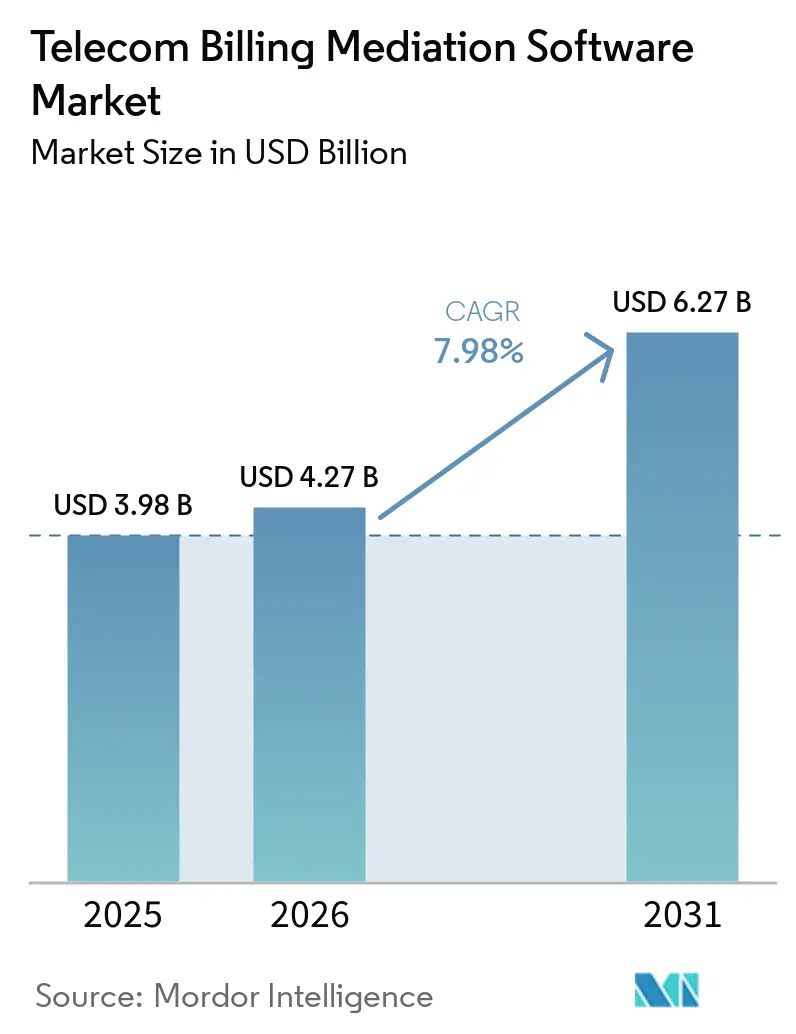
The telecom billing mediation software market size was valued at USD 3.98 billion in 2025 and estimated to expand from USD 4.27 billion in 2026 to reach USD 6.27 billion by 2031, at a CAGR of 7.98% during the forecast period (2026-2031). Operators are shortening platform upgrade cycles as 5G standalone networks create more detailed usage records and commercial network-slicing offers require billing at the slice level. Machine-generated traffic also raises the volume and frequency of usage events that mediation systems must collect, validate, enrich, and forward. These changes favor platforms that process events in real time rather than relying on overnight batch cycles. Cloud modernization, partner settlement, and satellite connectivity are widening the role of mediation beyond conventional subscriber charging. Vendors are responding with cloud-native platforms, tighter charging integration, and API-based commercial models.
Key Report Takeaways
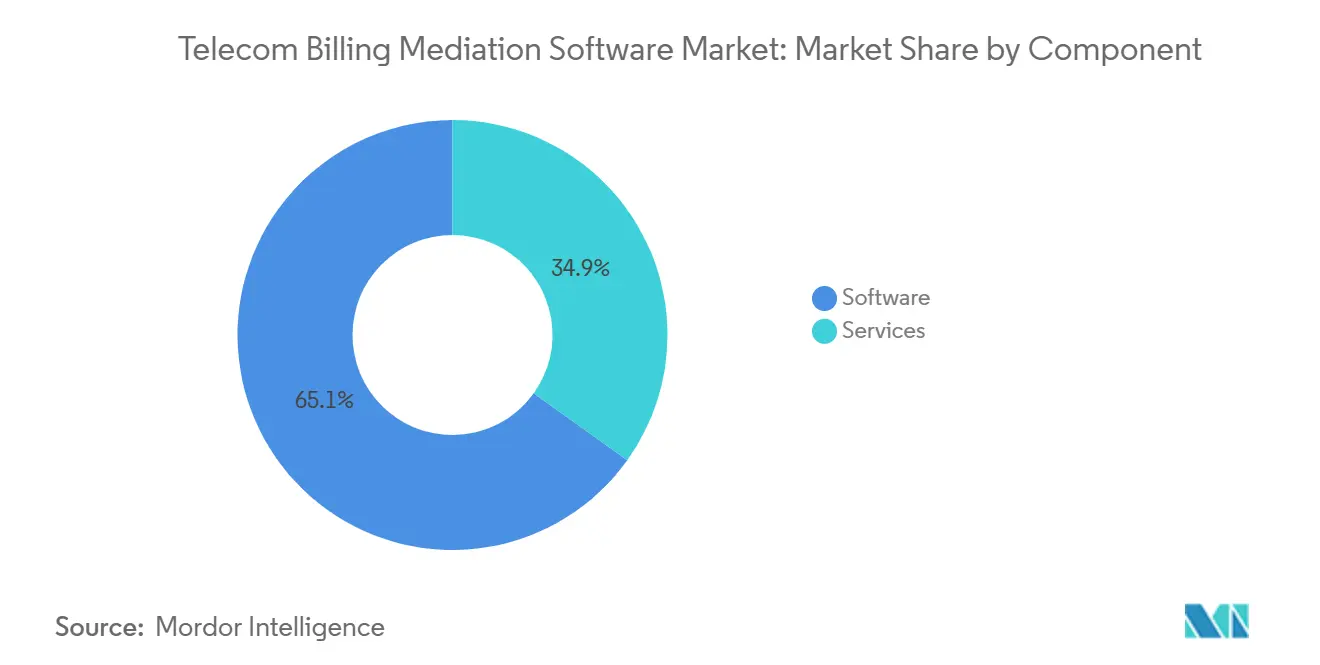
- By component, software held 65.11% of the telecom billing mediation software market share in 2025, while services are projected to expand at an 8.16% CAGR through 2031.
- By deployment, on-premises held 56.87% of the market share in 2025, while cloud deployment is projected to expand at a 9.56% CAGR through 2031.
- By network and service, mobile network mediation for 2G through 5G held 35.43% of the market share in 2025, while IoT, M2M, and connected-device mediation is projected to expand at an 8.65% CAGR through 2031.
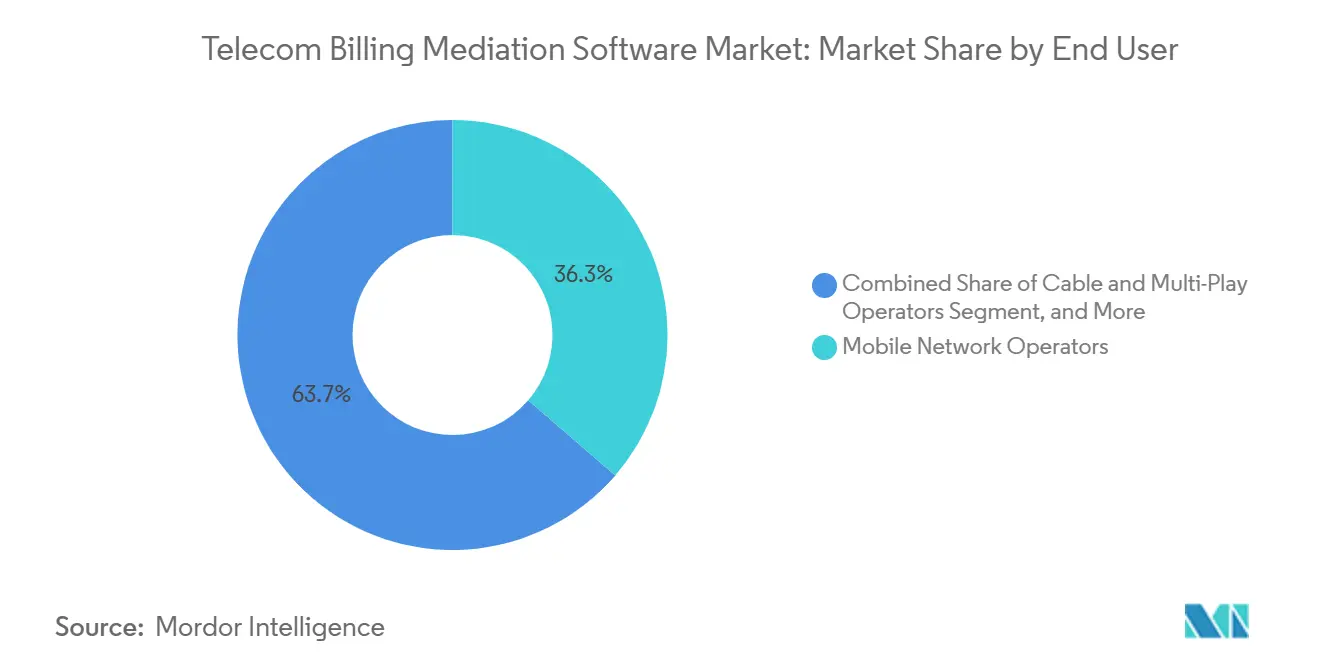
- By end user, mobile network operators held 36.33% of the market share in 2025, while satellite and NTN operators are projected to expand at a 9.13% CAGR through 2031in the telecom billing mediation software market.
- By organization size, Tier-1 operators held 55.13% of the market share in 2025, while MVNO, MVNE, and digital-only providers are projected to expand at an 8.43% CAGR through 2031.
- By geography, Asia-Pacific held 28.89% of the market share in 2025, while North America is projected to expand at a 9.44% CAGR through 2031 in the telecom billing mediation software market
Note: Market size and forecast figures in this report are generated using Mordor Intelligence’s proprietary estimation framework, updated with the latest available data and insights as of January 2026.
Global Telecom Billing Mediation Software Market Trends and Insights
Drivers Impact Analysis*
| DRIVER | (~) % IMPACT ON CAGR FORECAST | GEOGRAPHIC RELEVANCE | IMPACT TIMELINE |
|---|---|---|---|
| 5G Standalone and Network-Slice Monetization | +2.2% | Global, concentrated in Asia-Pacific, North America, and the Middle East | Short term (≤ 2 years) |
| Cloud Migration and BSS Stack Simplification | +1.8% | Global, strongest in Europe and North America | Medium term (2-4 years) |
| IoT, Private Networks, and Machine-to-Machine Usage Growth | +1.4% | Global, most intense in China, Asia-Pacific, and North America | Medium term (2-4 years) |
| Real-Time Partner Settlement and API-Economy Billing | +1.0% | North America and Europe, with spillover to the Asia-Pacific | Medium term (2-4 years) |
| AI-Enabled Revenue Assurance and Usage Anomaly Detection | +0.8% | Global | Long term (≥ 4 years) |
| Mediation Expansion Into Autonomous-Network Data Operations | +0.5% | Asia-Pacific and North America, with early gains in Europe | Long term (≥ 4 years) |
| Source: Mordor Intelligence | |||
5G Standalone and Network-Slice Usage Monetization
5G standalone architecture changes the records that a mediation platform must process. Network-slice charging uses records associated with individual devices, tenants, slice identifiers, quality-of-service settings, and service-level performance measures. The 3GPP specification defines network-slice charging management for the 5G system, giving operators a standards-based framework for this data exchange.[1]European Telecommunications Standards Institute, “TS 28.202 5G Charging Management,” ETSI, etsi.org Commercial slice offers require operators to link network performance and consumption data to the charging process with limited delay. This requirement makes the telecom billing mediation software market relevant to the commercial use of differentiated connectivity services. Early 5G-Advanced deployments add new device and usage categories, which increase the translation logic platforms need to maintain. Operators who defer mediation work when deploying standalone cores may face a larger integration task later.
Cloud Migration and BSS Stack Simplification
Cloud migration is changing the architecture used for charging and mediation operations. Operators continue to modernize systems that contain bespoke integrations and long-standing billing configurations. In January 2026, Proximus selected Nokia Converged Charging to migrate more than 1,000 products to a cloud-native charging environment on Red Hat OpenShift.[2]Nokia, “Proximus Selects Nokia to Modernize Its Charging System and Voice Core,” Nokia, nokia.com The project shows that product catalog migration and charging modernization often proceed together. A cloud-native charging environment can also support the streaming data flows used by automated network operations. This makes modernization relevant to both billing functions and network-data management. The telecom billing mediation software market, therefore, benefits when operators replace tightly coupled legacy stacks with configurable platforms.
IoT, Private Networks, and Machine-to-Machine Usage Growth
Connected devices generate numerous short and recurring usage events. Industrial IoT and private-network workloads can produce events at intervals that are not suitable for traditional batch processing. Mediation systems must classify these events, apply commercial rules, and send the resulting records to charging, settlement, or analytics applications. The telecom billing mediation software market supports this process by providing the usage-data layer between network systems and downstream business functions. Low revenue per connection places more emphasis on billing efficiency than on price increases. This need is strongest where operators manage large connected-device populations and a mix of enterprise service plans.
Real-Time Partner Settlement and API-Economy Billing
API-based connectivity models require operators to reconcile usage across multiple commercial parties. B2B2X arrangements can involve an operator, an intermediary, an enterprise customer, and a reseller for the same underlying service. DigitalRoute describes mediation for these models as a process of splitting, enriching, and routing usage records to downstream settlement systems.[3]DigitalRoute, “B2B2X Billing Mediation,” DigitalRoute, digitalroute.com Satellite and terrestrial services add another layer of partner settlement requirements. Sateliot and Syniverse introduced a GSMA-standardized billing framework for NTN connectivity in June 2025, based on the TAP and BCE standards.[4]Sateliot and Syniverse, “Sateliot and Syniverse Deliver First Standardized Billing Framework for NTN,” Sateliot, sateliot.space The framework gives operators a common basis for billing interoperability with NTN partners. As hybrid services become more common, native handling of these records becomes a practical procurement consideration.
Restraints Impact Analysis*
| RESTRAINT | (~) % IMPACT ON CAGR FORECAST | GEOGRAPHIC RELEVANCE | IMPACT TIMELINE |
|---|---|---|---|
| Legacy OSS/BSS Integration and Data-Cleansing Burden | -1.8% | Global, most acute in Europe and mature Asia-Pacific markets | Short term (≤ 2 years) |
| Data Sovereignty, Privacy, and Cross-Border Processing Constraints | -1.2% | Europe, Asia-Pacific, and the Middle East | Medium term (2-4 years) |
| Scarcity of Carrier-Grade Mediation Engineering Skills | -0.9% | Global, most acute in Africa and South America | Long term (≥ 4 years) |
| Operator Cost Optimization and Market Maturity | -0.7% | Europe and mature North American markets | Medium term (2-4 years) |
| Source: Mordor Intelligence | |||
Legacy OSS/BSS Integration and Data-Cleansing Burden
Legacy OSS and BSS integration remains a major constraint on modernization schedules. Operators often need to retain existing systems while introducing new cloud-native functions. Customer records, pricing rules, eligibility filters, and partner rate tables must be identified and reimplemented without interrupting billing continuity. The work can expose business logic that was not formally documented in older mediation configurations. Telenor Pakistan completed the migration of 90 million subscribers to a cloud-native charging and billing system in 2025, illustrating the scale of parallel operations required for a large transition. This burden can extend deployment schedules and defer new mediation purchases. It also directs spending toward integration and managed migration work before a platform replacement is complete.
Data Sovereignty, Privacy, and Cross-Border Processing Constraints
Data sovereignty rules affect where operators can process call-detail records and subscriber usage data. The EU Data Act became applicable in September 2025 and adds data access and data sharing requirements that complement existing European privacy obligations. Compliance can require regional hosting, stronger encryption, external key management, and additional controls over data transfers. Deutsche Telekom worked with Google Cloud on a sovereign data platform that used format-preserving encryption and external key management for processing sensitive data. These requirements can limit the scale benefits of centralized cloud deployments. They also increase the engineering work needed before a shared mediation platform can be used across countries.
*Our forecasts treat driver/restraint impacts as directional, not additive. The impact forecasts reflect baseline growth, mix effects, and variable interactions.
Segment Analysis
By Component: Software Retained The Largest Revenue Base
Software is projected to account for 65.11% of the telecom billing mediation software market share in 2025. This position reflects demand for configurable platforms that integrate with existing charging and billing environments. Operators often prefer pre-integrated software to avoid additional customization obligations during the contract period. Platform licensing also generates a larger revenue share for vendors than service-led implementation models. Modern releases support configuration changes through low-code or no-code tools, enabling operators to adjust pricing logic without engaging professional services teams for every revision.
Services are projected to expand at an 8.16% CAGR through 2031. The services segment of the telecom billing mediation software market is supported by the continued migration from legacy systems to cloud-based architectures. System integration, migration planning, data remediation, and managed operations remain important throughout these programs. Operators with highly customized deployments require support to extract and rebuild existing business logic. Therefore, demand for services is linked to the pace of replacement projects rather than a shift away from software platforms. The component mix combines recurring software licensing revenue with project-based implementation work.


By Deployment: Cloud Changes Mediation Infrastructure Economics
On-premises deployment is projected to account for 56.87% of the market share in 2025. This installed base reflects earlier infrastructure investment cycles and the operational caution associated with billing systems. Operators face high switching costs because they often run existing and new platforms in parallel during migration. While this approach protects billing continuity, it increases near-term operational requirements. On-premises installations also remain relevant where privacy regulations or internal policies favor local control. These factors continue to support established deployment models as modernization programs progress.
Cloud deployment is projected to expand at a 9.56% CAGR through 2031. The telecom billing mediation software market supports cloud adoption because cloud platforms can scale to meet real-time data processing needs as event volumes fluctuate. Cloud-native platforms can also provide common operating environments across charging, catalog, and data functions. Nokia's Proximus project is expected to cover cloud-native charging modernization on Red Hat OpenShift. Operators can use this approach to reduce dependence on fragmented billing components. However, the effort required to transfer data and business rules from existing systems remains the primary constraint. Consequently, cloud adoption is expected to advance alongside broader BSS simplification programs.
By Network and Service: Mobile Networks Remained The Largest Use Case
Mobile network mediation across 2G through 5G is projected to account for 35.43% of the market share in 2025. The segment remains significant because 4G LTE traffic continues to generate extensive daily usage processing, while standalone 5G introduces new event types. Mediation platforms must support both legacy and emerging network technologies during an extended transition period. This requirement increases the value of systems that normalize records across multiple network domains. Fixed, broadband, fiber, and FTTx mediation also remain important as operators upgrade infrastructure and service bundles. IMS, voice, messaging, and unified communications mediation face pressure from voice-over-IP substitution, although 5G Voice over New Radio introduces additional charging records.
IoT, M2M, and connected-device mediation is projected to expand at an 8.65% CAGR through 2031. The segment requires streaming systems capable of processing frequent usage data from connected devices. Google Cloud and DigitalRoute are expected to announce a 2026 collaboration involving reusable data pipelines that run the DigitalRoute Usage Engine on Google Kubernetes Engine. The collaboration illustrates the link between usage data management and AI-ready network data pipelines. Industrial deployments may require distinct rules for devices, sites, service levels, and enterprise customers. This diversity increases the importance of configurable mediation and provides the telecom billing mediation software market with exposure to private-network and enterprise-connectivity programs.
By End User: Mobile Network Operators Anchored Spending
Mobile network operators are projected to account for 36.33% of the telecom billing mediation software market share in 2025. Their position reflects the scale of spending required for 5G transformation, charging modifications, and enterprise-grade availability requirements. These operators are the primary buyers of platforms that support large subscriber populations across multiple network domains. ISPs and fixed operators represent a stable demand base but generally face slower growth in mature broadband markets. Cable and multi-play operators also manage the complexity of combined mobile, broadband, and video offerings. Cloud communications and digital service providers represent an emerging group with more API-oriented mediation requirements.
Satellite and NTN operators are projected to expand at a 9.13% CAGR through 2031. MATRIXX Software is expected to introduce dynamic billing support for satellite and NTN services in March 2025. Sateliot and Syniverse are also expected to establish a standardized NTN billing framework in June 2025. These developments address the commercial interface between satellite operators and mobile partners. MVNOs and MVNEs also increase demand by adopting cloud-native systems without assuming the same legacy migration burden as larger operators. Tecnotree is expected to secure a USD 19.58 million, five-year agreement with a Tier-1 MVNO in June 2025 for a multi-country BSS transformation. The agreement demonstrates that MVNO procurement can involve full-stack transformation rather than limited billing changes.

By Organization Size: Tier-1 Operators Sustained The Largest Share
Tier-1 operators are projected to account for 55.13% of the market share by organization size in 2025. Their share is supported by the capital requirements and multi-year contracts associated with enterprise-grade mediation systems. These customers commonly require dedicated support, specific service-level commitments, and input into product roadmaps. Such requirements provide incumbent vendors with a durable position in major accounts. Tier-2 and regional operators represent a more active mid-market group. They may favor pre-integrated offerings with shorter implementation timelines and lower initial complexity.
MVNOs, MVNEs, and digital-only providers are projected to expand at an 8.43% CAGR through 2031. These providers can deploy cloud-native platforms without first transferring large legacy billing environments. Subscription models can reduce initial capital requirements for carrier-grade functions. Amdocs introduced MVNO and GO in 2024 as a cloud-native BSS offering with real-time charging and partner integration. The offering reflects efforts by large vendors to address digital-operator requirements while retaining enterprise accounts. Faster deployment remains important for providers that frequently revise plans and partner arrangements. This cohort also contributes to price competition as its procurement influence increases.
Geography Analysis
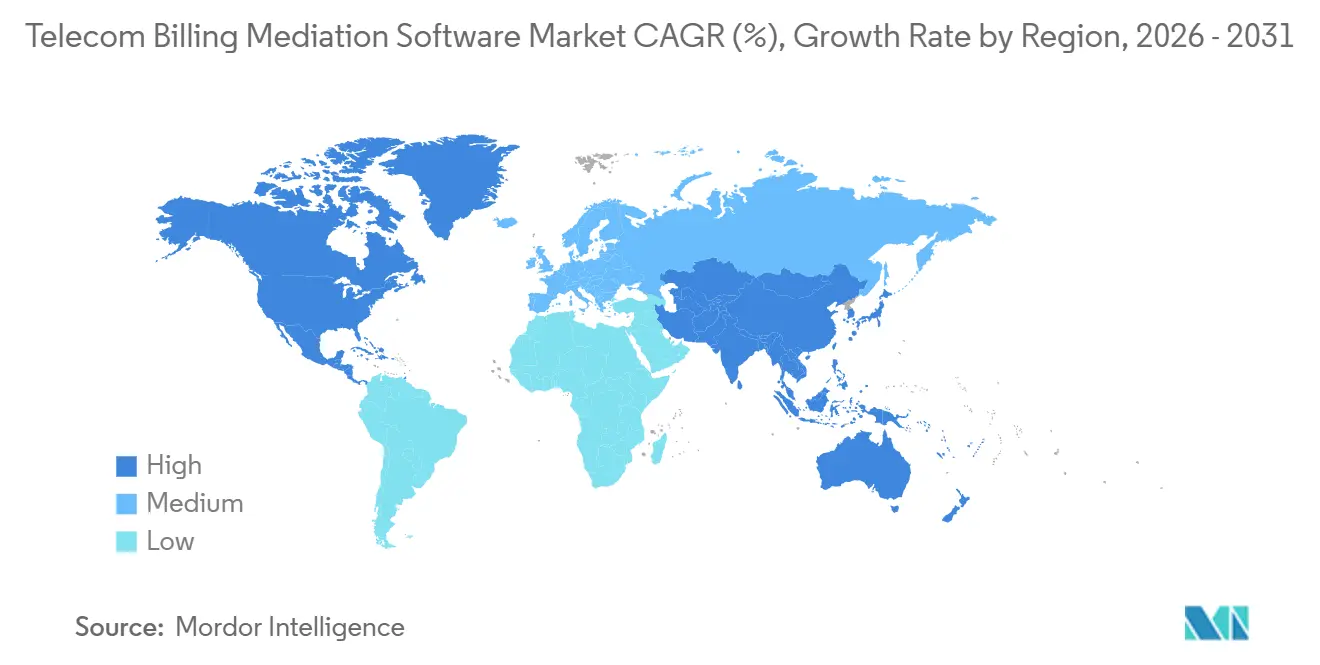
Asia-Pacific is projected to account for 28.89% of the telecom billing mediation software market in 2025. The region combines large cellular IoT populations with active standalone 5G programs in China, India, South Korea, Japan, and Australia. According to the research draft, China Mobile is expected to report 1.48 billion cellular IoT connections by the end of 2025. This scale requires systems capable of processing substantial volumes of usage events. Standalone 5G services also increase demand for charging and mediation solutions that support differentiated network services. South Korea's planned 2026 requirement for 5G base stations to connect to standalone core equipment further supports the need for immediate modernization. The region, therefore, generates demand from both established mobile networks and expanding connected-device deployments.
North America is projected to grow at a CAGR of 9.44% through 2031. Tier-1 carriers in the region are advancing 5G standalone core deployments and broader BSS modernization initiatives. CSG extended its engagement with Charter Communications through September 2031 and renewed its agreement with DISH Network through 2030 to provide cloud-native billing and payment services. These long-term agreements demonstrate the strategic importance of billing systems within carrier operating models. Europe also benefits from fiber rollouts and continued 5G investments. However, European operators must address GDPR and EU Data Act requirements when selecting cross-border data-processing architectures. These requirements drive demand for in-region hosting and compliant data management architectures.
The Middle East presents opportunities for real-time mediation investments as operators deploy standalone 5G for industrial IoT, smart-city, and enterprise services. Omantel is expected to begin a BSS and OSS transformation with Cerillion in April 2026. The deployment will be hosted within Oman Data Park to meet national data sovereignty requirements. South America offers a longer-term opportunity as standalone 5G coverage expands, although currency volatility and constrained capital budgets may moderate near-term spending. Africa remains an early-stage region for advanced mediation platforms. South Africa and Nigeria serve as key procurement centers, while mobile-first connectivity supports demand for lightweight, cloud-hosted tools. Regional deployment decisions depend on the balance among modernization objectives, local data requirements, and operator investment capacity.

Competitive Landscape
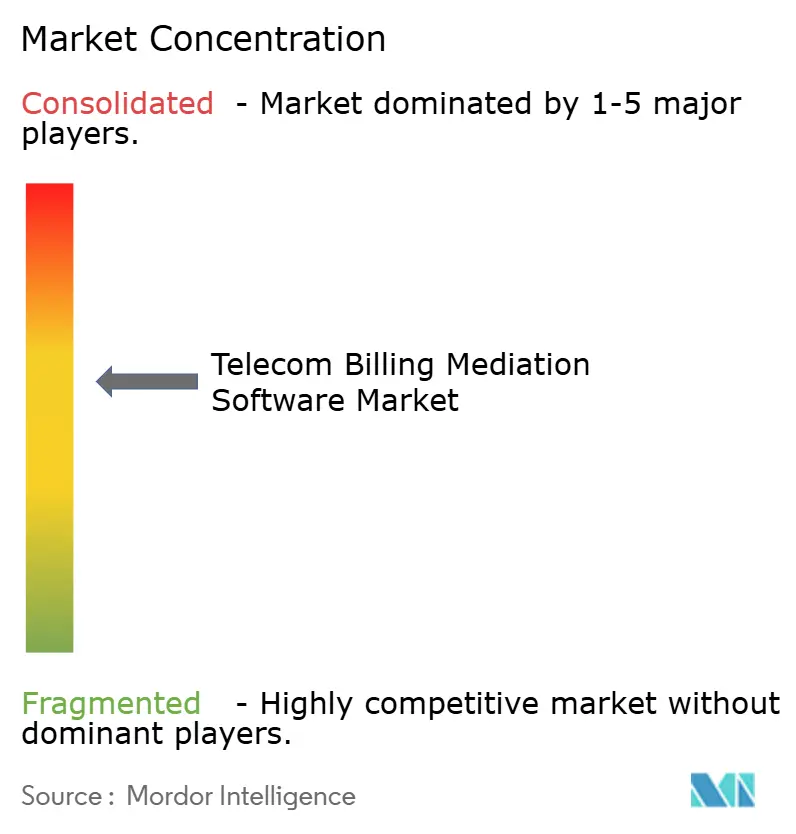
The telecom billing mediation software market is moderately consolidated, particularly among large Tier-1 operator accounts. Amdocs, Ericsson, Oracle, and Huawei hold established positions with major operators, while Cerillion, DigitalRoute, Optiva, and Nexign compete in specialized and mid-market opportunities. Large operators typically prioritize vendors with extensive implementation capabilities, long-term support commitments, and broad BSS portfolios. Specialized providers compete through focused usage-data management capabilities, faster deployment timelines, and regional support. This market structure provides incumbents with strong access to major accounts while creating opportunities for specialized providers. Procurement decisions increasingly evaluate cloud readiness, support for standards, and integration with charging platforms.
Amdocs is expected to complete its acquisition of MATRIXX Software for USD 197 million on December 23, 2025. The acquisition will add MATRIXX's cloud-native converged charging platform to Amdocs's monetization portfolio. In January 2026, Proximus is expected to select Nokia to modernize its charging and voice-core functions. Cerillion is also expected to begin a full BSS and OSS transformation for Omantel in April 2026. These developments demonstrate how suppliers are expanding platform breadth, pursuing cloud migration opportunities, and strengthening long-term operator relationships. The telecom billing mediation software market continues to favor vendors that can replace legacy systems with minimal disruption.
NTN billing and autonomous network data operations are areas where product positioning is still evolving. The standardized framework developed by Sateliot and Syniverse provides a common billing structure for satellite connectivity partners. Vendors are also positioning mediation systems as data pipelines that support analytics and automated network operations. Google Cloud and DigitalRoute's collaboration reflects this trend by using reusable pipelines for network data ingestion. TM Forum Open API conformance and 3GPP charging specifications are becoming baseline requirements in enterprise procurement. The market remains competitive because operators can choose between broad BSS providers and specialized vendors based on their transformation requirements. Pricing pressure is most evident in the mid-market segment, where customers prioritize deployment speed, configuration flexibility, and lower upfront commitments.
Telecom Billing Mediation Software Industry Leaders
Amdocs
Telefonaktiebolaget LM Ericsson
Huawei Technologies Co., Ltd.
Oracle Corporation
Nokia Corporation
- *Disclaimer: Major Players sorted in no particular order

Recent Industry Developments
- August 2026: Zain Jordan and Ericsson expanded BSS modernization to postpaid by deploying Ericsson Billing on Red Hat OpenShift, adding the Telco DataOps Platform for real-time analytics, and introducing catalog-driven order management, thereby completing a full cloud-native BSS covering prepaid and postpaid for 5G monetization.
- April 2026: Cerillion commenced a major BSS/OSS transformation for Omantel, replacing legacy systems with Cerillion's pre-integrated suite, including its Convergent Charging System, Revenue Manager, and Network Inventory, hosted on Cerillion Cloud within Oman Data Park for national data-sovereignty compliance under Oman Vision 2040.
- January 2026: Proximus selected Nokia Converged Charging to migrate its entire fixed and mobile customer base, covering more than 1,000 products, to a cloud-native charging solution on Red Hat OpenShift, replacing a competitor's existing system entirely and enabling new 5G monetization services.
- January 2026: CSG announced a multi-year contract extension with DISH Network to continue billing and payment services through 2030 using CSG's cloud-native SaaS platform for billing, customer care, and business optimization.


Global Telecom Billing Mediation Software Market Report Scope
The Telecom Billing Mediation Software Market Report is Segmented by Component (Software, and Services), Deployment (On-Premises, and Cloud), Network and Service (Mobile Network Mediation, 2G, 3G, 4G, and 5G, Fixed, Broadband, Fiber, and FTTx Mediation, IMS, Voice, Messaging, and Unified Communications, IoT, M2M, and Connected-Device Mediation, and Other Network and Services), End User (Mobile Network Operators, Internet Service Providers and Fixed Operators, MVNOs and MVNEs, Cable and Multi-Play Operators, Satellite and Non-Terrestrial Network Operators, and Cloud Communications and Digital Service Providers), Organization Size (Tier-1 Operators, Tier-2 and Regional Operators, and MVNO, MVNE, and Digital-Only Providers), and Geography (North America, South America, Europe, Asia-Pacific, and the Middle East and Africa). The Market Forecasts are Provided in Terms of Value (USD).
| Software |
| Services |
| On-Premises |
| Cloud |
| Mobile Network Mediation, 2G, 3G, 4G, and 5G |
| Fixed, Broadband, Fiber, and FTTx Mediation |
| IMS, Voice, Messaging, and Unified Communications |
| IoT, M2M, and Connected-Device Mediation |
| Other Network and Services |
| Mobile Network Operators |
| Internet Service Providers and Fixed Operators |
| MVNOs and MVNEs |
| Cable and Multi-Play Operators |
| Satellite and Non-Terrestrial Network Operators |
| Cloud Communications and Digital Service Providers |
| Tier-1 Operators |
| Tier-2 and Regional Operators |
| MVNO, MVNE, and Digital-Only Providers |
| North America | United States |
| Canada | |
| Mexico | |
| South America | Brazil |
| Argentina | |
| Rest of South America | |
| Europe | Germany |
| United Kingdom | |
| France | |
| Italy | |
| Rest of Europe | |
| Asia-Pacific | China |
| India | |
| Japan | |
| South Korea | |
| Australia | |
| Rest of Asia-Pacific | |
| Middle East | Saudi Arabia |
| United Arab Emirates | |
| Rest of Middle East | |
| Africa | South Africa |
| Nigeria | |
| Rest of Africa |
| By Component | Software | |
| Services | ||
| By Deployment | On-Premises | |
| Cloud | ||
| By Network and Service | Mobile Network Mediation, 2G, 3G, 4G, and 5G | |
| Fixed, Broadband, Fiber, and FTTx Mediation | ||
| IMS, Voice, Messaging, and Unified Communications | ||
| IoT, M2M, and Connected-Device Mediation | ||
| Other Network and Services | ||
| By End User | Mobile Network Operators | |
| Internet Service Providers and Fixed Operators | ||
| MVNOs and MVNEs | ||
| Cable and Multi-Play Operators | ||
| Satellite and Non-Terrestrial Network Operators | ||
| Cloud Communications and Digital Service Providers | ||
| By Organization Size | Tier-1 Operators | |
| Tier-2 and Regional Operators | ||
| MVNO, MVNE, and Digital-Only Providers | ||
| By Geography | North America | United States |
| Canada | ||
| Mexico | ||
| South America | Brazil | |
| Argentina | ||
| Rest of South America | ||
| Europe | Germany | |
| United Kingdom | ||
| France | ||
| Italy | ||
| Rest of Europe | ||
| Asia-Pacific | China | |
| India | ||
| Japan | ||
| South Korea | ||
| Australia | ||
| Rest of Asia-Pacific | ||
| Middle East | Saudi Arabia | |
| United Arab Emirates | ||
| Rest of Middle East | ||
| Africa | South Africa | |
| Nigeria | ||
| Rest of Africa | ||


Key Questions Answered in the Report
What is the size of the telecom billing mediation software market?
The telecom billing mediation software market was valued at USD 3.98 billion in 2025 and is estimated at USD 4.27 billion in 2026. It is forecast to reach USD 6.27 billion by 2031.
What is driving demand for telecom billing mediation software?
5G standalone networks, network slicing, cloud modernization, connected-device traffic, and API-based partner settlement are increasing the need for real-time usage-data processing.
Which component held the largest share in 2025?
Software held 65.11% share in 2025, reflecting operator demand for configurable and pre-integrated mediation platforms.
Which deployment model is projected to expand the fastest?
Cloud deployment is projected to expand at a 9.56% CAGR through 2031 as operators modernize charging and billing environments.
Which end user is projected to expand the fastest?
Satellite and NTN operators are projected to expand at a 9.13% CAGR through 2031, supported by new billing frameworks for satellite-mobile interoperability.
Which region is projected to expand the fastest through 2031?
North America is projected to expand at a 9.44% CAGR through 2031 as carriers modernize 5G cores and billing operations.
Page last updated on:





