
Taiwan Freight and Logistics Market Size and Share
Market Overview
| Study Period | 2020 - 2031 |
|---|---|
| Forecast Data Period | 2026 - 2031 |
| Base Year Market Size (2025) | USD 35.96 Billion |
| Market Size (2026) | USD 37.77 Billion |
| Market Size (2031) | USD 46.46 Billion |
| Growth Rate (2026 - 2031) | 4.23 % |
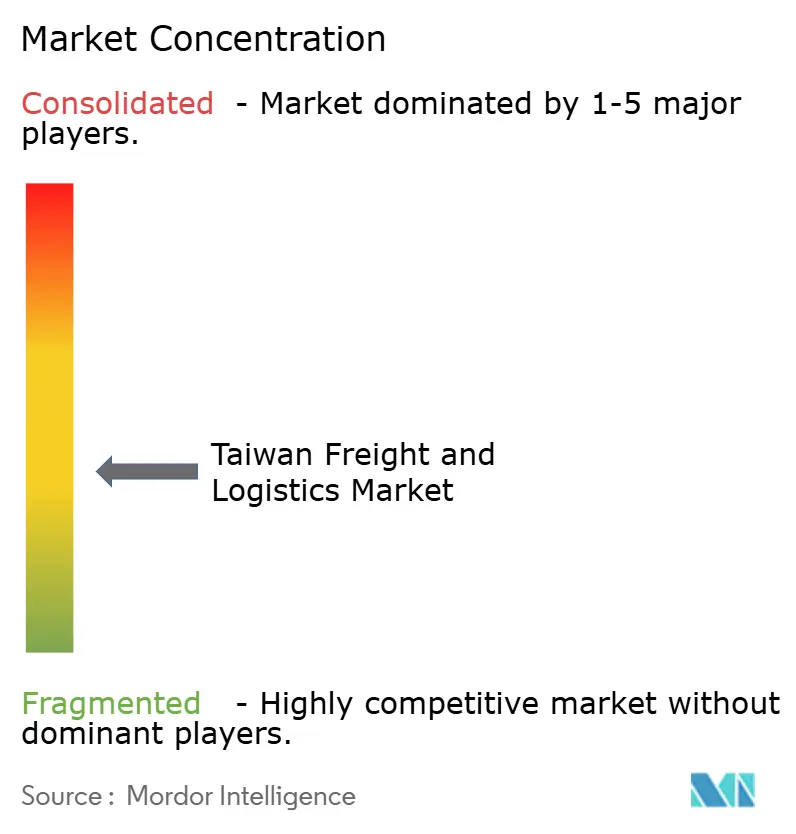
| Market Concentration | Medium |
Major Players *Disclaimer: Major Players sorted in no particular order Image © Mordor Intelligence. Reuse requires attribution under CC BY 4.0. | |
Taiwan Freight and Logistics Market Analysis by Mordor Intelligence
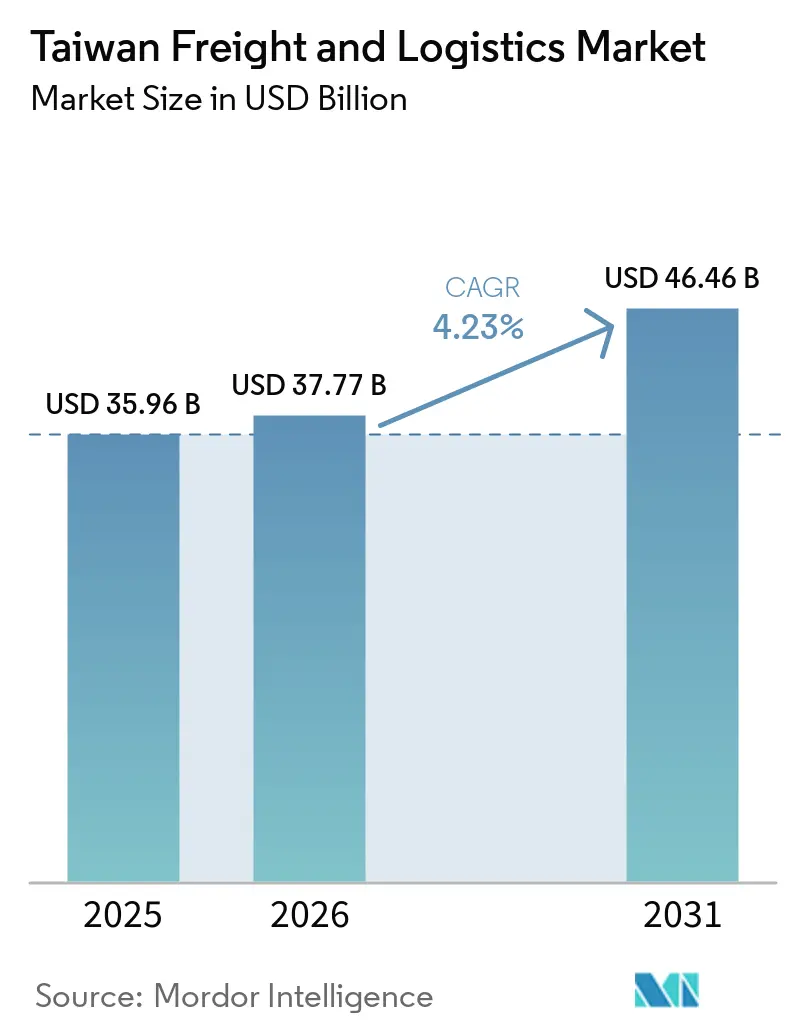
The Taiwan freight and logistics market size was valued at USD 35.96 billion in 2025 and estimated to grow from USD 37.77 billion in 2026 to reach USD 46.46 billion by 2031, at a CAGR of 4.23% during the forecast period (2026-2031).
The Taiwan freight and logistics market is supported by demand for semiconductors, advanced servers, and other high-value exports that require secure and time-sensitive handling. Manufacturing activity remains strong, with Taiwan’s manufacturing Purchasing Managers’ Index (PMI) rising to 62.5 in August 2026, up from 61.5 in July, which points to sustained pressure on supplier delivery schedules and freight networks. Investment is shifting toward air cargo, bonded facilities, automated warehousing, and integrated sea, air, and road services. At the same time, driver shortages, fuel costs, and uncertainty around the United States trade policy create operating risks for carriers and forwarders. The Taiwan freight and logistics market, favors providers with specialized handling capacity, digital tools, and established relationships with high-value shippers.
Key Report Takeaways
- By logistics function, freight transport held 59.27% of the Taiwan freight and logistics market share in 2025, while Courier, Express, and Parcel are forecast to grow at a 5.12% CAGR through 2031.
- By freight transport mode, road accounted for 60.84% of the Taiwan freight and logistics market size in 2025, while air freight is forecast to grow at a 4.98% CAGR through 2031.
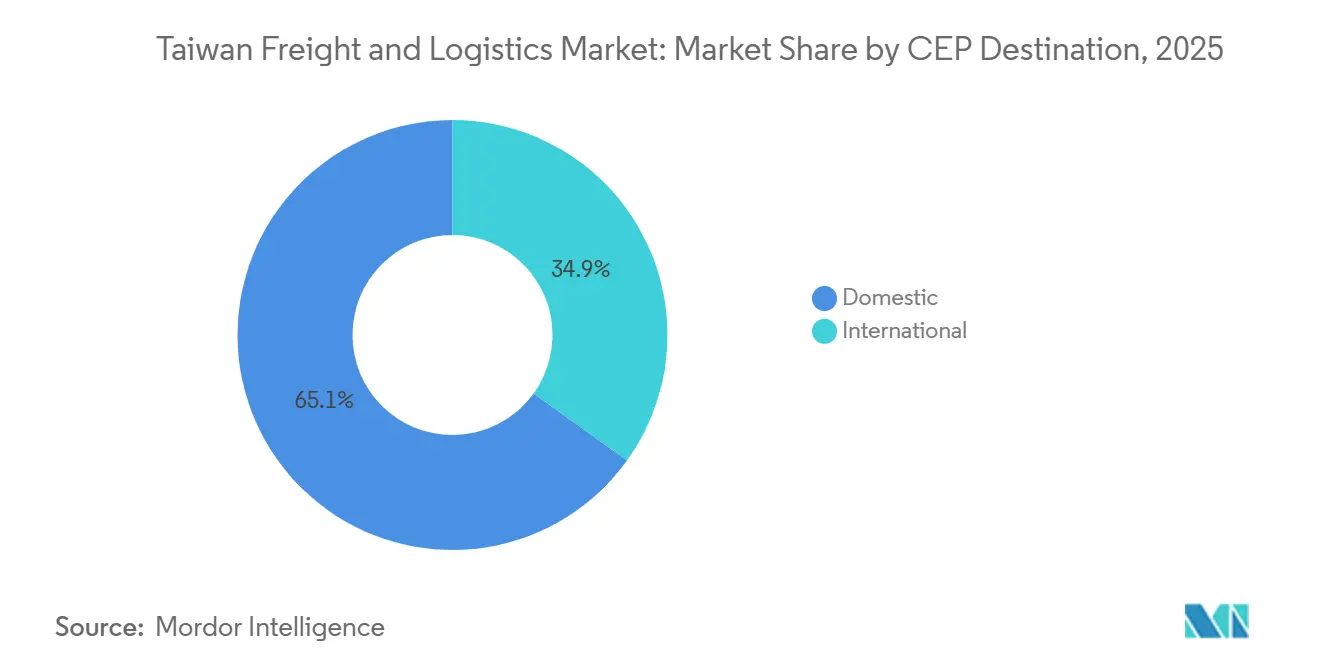
- By Courier, Express, and Parcel destination, domestic services held 65.07% of the Taiwan freight and logistics market share in 2025, while international services are forecast to grow at a 5.37% CAGR through 2031.
- By warehousing and storage, non-temperature-controlled facilities held 91.51% of the Taiwan freight and logistics market share in 2025, while temperature-controlled facilities are forecast to grow at a 4.00% CAGR through 2031.
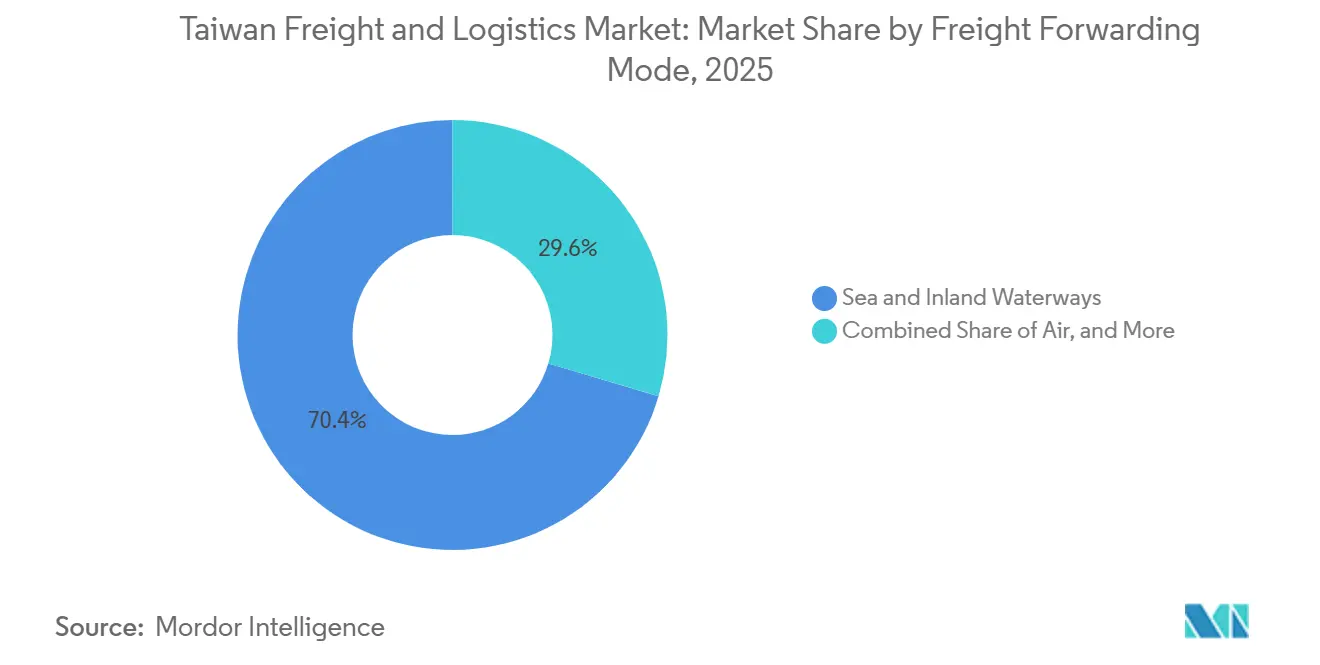
- By freight forwarding mode, sea and inland waterways held 70.41% of the Taiwan freight and logistics market size in 2025, while air forwarding is forecast to grow at a 5.07% CAGR through 2031.
- By end-user industry, manufacturing held 40.01% of the Taiwan freight and logistics market share in 2025, while wholesale and retail trade is forecast to grow at a 4.65% CAGR through 2031.
Note: Market size and forecast figures in this report are generated using Mordor Intelligence’s proprietary estimation framework, updated with the latest available data and insights as of January 2026.
Taiwan Freight and Logistics Market Trends and Insights
Drivers Impact Analysis*
| Driver | (~) % Impact on CAGR Forecast | Geographic Relevance | Impact Timeline |
|---|---|---|---|
| Semiconductor and AI-server exports accelerating high-value freight demand | +1.5% | National; concentrated in Taoyuan, Hsinchu, and Tainan corridors | Short term (≤ 2 years) |
| Supply chain globalization expanding international freight flows and driving integrated multimodal logistics demand | +0.7% | Global, with concentrated effects on Taiwan–United States and Taiwan–ASEAN trade lanes | Medium term (2–4 years) |
| E-commerce expansion is increasing parcel volumes and accelerating demand for flexible last-mile delivery networks | +0.6% | National, with strong spillover to suburban and southern Taiwan | Short term (≤ 2 years) |
| Government-led infrastructure development is improving freight connectivity and creating new logistics and warehousing capacity | +0.5% | National, with priority investments at Kaohsiung, Taoyuan, Keelung, and Taipei Port | Medium term (2–4 years) |
| Strategic location and deepening Asian trade ties position Taiwan as a critical regional logistics hub | +0.4% | Asia-Pacific core, with spillover to intra-Asia and Middle East corridors | Long term (≥ 4 years) |
| Source: Mordor Intelligence | |||
Semiconductor and Advanced Server Exports Increase High-Value Freight Demand
Taiwan’s advanced semiconductor and server exports are increasing demand for fast, secure, and precise freight services. Dimerco reported a 39% year-over-year revenue increase in May 2026, while its air freight volume rose nearly 30%, supported by semiconductor and advanced server customers. High-value shipments require controlled handling, shorter transit times, and reliable customs processes. This requirement supports the use of bonded warehousing, temperature-controlled storage, and expedited air services. Providers with established security and compliance capabilities can serve these shipments more effectively than general freight operators. The Taiwan freight and logistics market is consequently seeing greater demand for specialized services instead of standard freight capacity.
Supply Chain Globalization Strengthens Multimodal Demand
Supply chain adjustments are changing how freight moves through Taiwan. Manufacturers are seeking visibility across sea, air, and road movements instead of managing each stage separately. Dimerco increased the automated share of processes across its global operations from 17% in early 2025 to 27% in July 2026. The change covers rate management, shipment tracking, documentation, and cargo planning. These capabilities help forwarders coordinate shipments involving several origins and modes of transport. Integrated service is becoming important for corporate shippers that need predictable delivery and customs management. The Taiwan freight and logistics market is therefore creating openings for forwarders that can combine physical capacity with timely shipment information.
E-Commerce Expansion Raises Parcel and Last-Mile Requirements
E-commerce is increasing parcel volumes and raising expectations for delivery speed across Taiwan. The United States International Trade Administration reported a 7.9% growth for Taiwan's e-commerce in 2025[1]“Taiwan E-Commerce,” International Trade Administration, trade.gov. Momo increased its internal logistics capacity from 40% toward a 50% target in 2026 after opening a second automated logistics center and expanding its supporting warehouse network. This expansion increases pressure on third-party carriers that rely on large retail accounts. Convenience store collection points and parcel lockers reduce failed deliveries and support more efficient last-mile operations. The Taiwan freight and logistics market benefits from this volume growth, although operators must invest in sorting, route planning, and network density to retain contracts.
Government Infrastructure Investment Expands Network Capacity
Government investment is improving the physical base of the Taiwan freight and logistics market. The Ministry of Transportation and Communications announced a TWD 57.2 billion (USD 1.82 billion) port plan in June 2026, covering 34 projects at 7 international ports and 73 projects at 4 domestic ports. The plan supports a container throughput target of 15.5 million TEU by 2031. Kaohsiung Port is upgrading Terminal 3 for 18,000 TEU vessels by 2027, while Terminal 5 is planned to receive 24,000 TEU vessels by 2029. The program also includes alternative-fuel bunkering facilities at Taipei Port, Taichung Port, and Kaohsiung Port[2]Ministry of Transportation and Communications, “Ministry Announces Ports Upgrade Plan,” Ministry of Transportation and Communications, motc.gov.tw. These investments improve the conditions for larger vessel calls, transshipment activity, and related warehousing demand.
Restraints Impact Analysis*
| Restraint | (~) % Impact on CAGR Forecast | Geographic Relevance | Impact Timeline |
|---|---|---|---|
| United States tariff exposure and trade-policy uncertainty increasing risks across Taiwan's export-oriented logistics ecosystem | -0.7% | National; concentrated impact on export freight forwarding and air cargo lanes | Medium term (2–4 years) |
| Persistent skilled labor and driver shortages constraining logistics capacity and increasing operational pressure | -0.5% | National; most acute in urban delivery corridors in Taipei, Taichung, and Kaohsiung | Short term (≤ 2 years) |
| Fuel price volatility raising transportation costs and compressing logistics operators' operating margins | -0.4% | National, with amplified impact on road freight and air cargo operators | Short term (≤ 2 years) |
| Macroeconomic uncertainty and weaker business confidence moderating freight demand and logistics investment | -0.4% | National, with secondary spillover to regional trade partners | Medium term (2–4 years) |
| Rising insurance and geopolitical risk costs increasing expenses amid congestion and supply-chain disruptions | -0.3% | Global, with concentrated impact on Taiwan–United States and Taiwan–Middle East sea lanes | Medium term (2–4 years) |
| Source: Mordor Intelligence | |||
United States Tariff Uncertainty Creates Export Risk
United States trade policy remains important for freight flows from Taiwan. The United States and Taiwan finalized an agreement in February 2026 that set a 15% tariff on Taiwan's exports to the United States. The agreement gave exporters more clarity, but semiconductor-specific duties remained at risk. Manufacturers increased shipments before tariff deadlines, which temporarily supported export freight volumes. A larger movement of semiconductor production to United States facilities could reduce freight demand on high-value Taiwan-United States routes over time. Carriers and forwarders must therefore balance current air cargo demand with the possibility of changing production locations and trade rules.
Labor and Driver Shortages Limit Capacity Growth
Labor availability is a direct operational constraint for road freight and urban delivery. Transportation and warehousing employees averaged 169.3 working hours per month in 2026, indicating that existing workers face continued pressure. Automation can reduce work within warehouses, but it cannot fully replace drivers on road routes. The forward-looking risk is that the talent gap will widen as Taiwan's demographic structure ages and fewer young workers enter physically intensive transport occupations. Logistics operators that have invested in autonomous guided vehicles, route optimization software, and warehouse automation are partially insulating themselves from this constraint, but the road freight segment, which accounts for most of the freight volume, remains heavily labor-dependent. The Taiwan freight and logistics market remains exposed to cost pressure and service constraints, where labor-intensive transport is essential.
*Our forecasts treat driver/restraint impacts as directional, not additive. The impact forecasts reflect baseline growth, mix effects, and variable interactions.
Freight Rate Intelligence
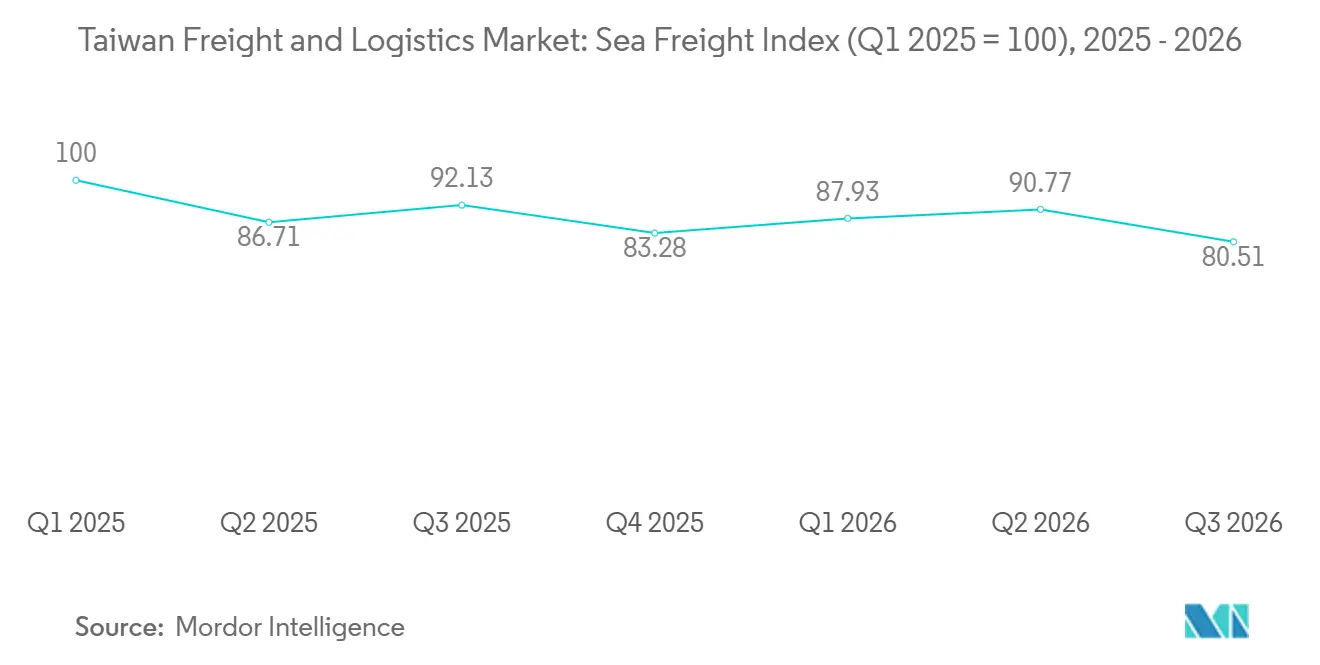
Over the past six quarters, Taiwan’s freight rate environment has experienced a clear rally-and-correction cycle. However, the pattern reflects a structural divide across the market rather than a uniform cycle. Transpacific corridors serving Taiwan’s AI server, high-performance computing, and advanced semiconductor exports have maintained a sustained premium over regional and intra-Asia routes in both air and sea freight.
This premium rose sharply during the first half of 2026, driven by front-loaded shipments and a structural imbalance between rapidly growing technology cargo demand and limited capacity. The broader market then entered a widespread correction in the latest available quarter. Notably, the transpacific corridors that led to the earlier increase were also the only segment to retain their gains during the correction. This trend indicates that the underlying demand is structural rather than speculative.
Regional and intra-Asia corridors have followed a different pattern. Freight rates on these routes weakened through most of 2025, increased briefly during the broader rally in early 2026, and then declined much more sharply than rates on transpacific lanes as the cycle reversed. During the same period, air freight rate corrections on regional routes were two to three times steeper than sea freight corrections.
Cross-border and short-sea corridors face an additional source of volatility. Operational disruptions, congestion, and geopolitical risk premiums intensify the underlying rate cycle, resulting in swings that are materially larger than the regional average. These factors also create a distinct risk component that shippers on these routes must assess separately from broader market conditions.
Two structural factors are particularly relevant for market participants evaluating Taiwan’s freight environment. First, air and sea freight rates are diverging in terms of volatility. Air freight rates on Taiwan’s most cargo-intensive corridors have moved by 30–40 index points within a few quarters, while comparable sea freight corridors have followed a slower cycle with lower volatility. This difference reflects the tighter balance between air cargo capacity and demand. Second, the transpacific segment has increasingly operated as a distinct sub-market, with pricing that has decoupled from the rest of Taiwan’s freight network. Demand in this segment remains supported by cargo that is largely insensitive to transit time and cannot readily shift to slower or lower-cost alternatives.
Note: Index reflects the average freight rates across Taiwan’s major trading partners.
Supply Chain Resilience and Risk
The External Forces Reshaping Logistics Markets
Taiwan's logistics market is being reshaped by a convergence of geopolitical, energy, and manufacturing forces that are raising the baseline level of risk carriers, forwarders, and shippers must now plan around. Energy security is a direct constraint on freight reliability: Taiwan sources 33.7% of its liquefied natural gas imports from Qatar, so disruption along routes such as the Strait of Hormuz threatens not just energy supply but the stable electricity that semiconductor fabrication depends on, with direct knock-on effects for related freight movements. Helium availability carries similar weight for chipmaking; short-term inventory buffers and helium recovery systems, now used by over 70% of Taiwanese fabs, reduce immediate exposure but not the underlying structural risk. Continuing United States-China trade tension compounds this: export controls and tariff measures are prompting exporters to shift shipment timing and origin points, raising the value of providers with strong compliance capability and multimodal, multi-country networks over simple, cost-based routing.
These pressures are accelerating a structural shift in Taiwan's semiconductor ecosystem, from a Taiwan-centered model to one combining domestic capability with a distributed international footprint. TSMC raised its 2026 equipment purchase forecast to 1.9 times its 2025 baseline by July, reflecting a sharp rise in capital equipment logistics that demand specialized handling and secure storage rather than standard cargo treatment. That capacity is increasingly international, spanning Arizona, Kumamoto, Germany, and Southeast Asia, with ASE also expanding in Malaysia. A single customer's supply chain can now span Taiwan, Japan, Southeast Asia, Europe, and the United States, favoring forwarders capable of end-to-end coordination over those managing isolated, bilateral routes.
Government policy is reinforcing this reconfiguration rather than resisting it. The February 2026 United States-Taiwan trade agreement set a 15% tariff on Taiwan's United States exports and committed Taiwan to USD 85 billion in United States purchases through 2029, including USD 44.4 billion of LNG and crude oil, generating additional long-haul bulk logistics demand. Domestically, a TWD 57.2 billion (USD 1.82 billion) five-year port development plan, including alternative-fuel bunkering, responds directly to carriers weighing emissions infrastructure and reliability when selecting transshipment locations. Diversifying LNG sourcing toward the United States and Australia, expanding strategic reserves, and redirecting manufacturing investment toward Vietnam, Thailand, and Mexico redistribute logistics demand across a wider set of routes rather than reducing it, rewarding providers with genuine multi-region coverage and resilient inventory strategies.
Sustainability requirements are now a structural cost and routing variable, not a compliance afterthought. Cape of Good Hope diversions add 10 to 14 days of transit time and 25 to 35% more fuel cost on affected services, while the EU Emissions Trading System's Phase 2 adds USD 40 to 80 per TEU on European-bound containers in 2026, materially changing total landed freight cost beyond the base ocean rate. Taiwan's port investment in LNG, hydrogen, and methanol bunkering at Kaohsiung, Taipei Port, and Taichung Port directly addresses this shift, positioning Taiwan's ports to remain attractive as shipping alliances adapt their fleets to lower-emission requirements.
Changing Logistics Landscape
Logistics Network Capacity and Infrastructure Readiness
Taiwan's logistics ecosystem is being restructured by three forces acting at once: a semiconductor and AI-driven export cycle that is redefining freight economics, a geopolitical and trade realignment that is redistributing where and how goods move, and a sustainability and technology agenda that is raising the operating bar for every mode. Together, these forces are shifting the market from cost-based, mode-siloed transport decisions toward integrated, resilient, and increasingly technology-enabled logistics networks.
The internationalization of Taiwan's semiconductor supply chain is creating increasingly complex logistics requirements. TSMC's 2026 equipment purchase forecast rose to 1.9 times its 2025 baseline, while its footprint, along with that of partners such as ASE, now spans Arizona, Kumamoto, Germany, and Southeast Asia. This requires specialized handling for lithography systems, chemical delivery equipment, and packaging machinery that general cargo networks cannot support. Broader manufacturing diversification toward Vietnam, Thailand, and Mexico is adding further freight legs and increasing the need for coordinated logistics across multiple jurisdictions.
This reconfiguration is directly reflected in freight-rate behavior. Air freight on Taiwan's most cargo-intensive corridors, carrying components whose value justifies premium speed and reliability, has sustained a structural rate premium even through recent market corrections, while broader regional and ocean freight rates move on a calmer, more conventional cycle. Sustainability requirements are also becoming embedded in this cost structure, with EU Emissions Trading System charges and longer-routing fuel costs increasingly forming part of total landed freight cost.
Infrastructure investment is only partially keeping pace with this demand. Air cargo capacity additions at Taoyuan, including new logistics centers from major integrators, have added meaningful throughput but have not fully relieved pressure on the busiest technology export corridors. Rising activity near Kaohsiung is also creating pressure on road and warehousing capacity. Port investment is better aligned with medium-term needs, with container throughput targeted to rise from 13.5 million to 15.5 million TEU by 2031 and major terminals being upgraded for larger vessels, alongside new alternative-fuel bunkering to support lower-emission shipping requirements. Across all modes, timely data exchange on vessel, container, and customs status is becoming as important as physical capacity itself in maintaining reliable throughput.
Building the Next Generation Supply Chain
Taiwan's supply chains are evolving beyond traditional bilateral trade flows toward more distributed and interconnected production networks. The shift in manufacturing investment from China toward Vietnam, Thailand, and Mexico, together with the February 2026 US-Taiwan trade agreement, is creating supply chains that span more jurisdictions and freight legs. This increasingly favors providers with genuine end-to-end coordination capabilities rather than those managing isolated routes.
Service models are evolving alongside this structural shift. E-commerce platforms are increasingly building their own delivery capacity, raising internal fulfillment share and narrowing the volumes available to traditional third-party road carriers. In response, logistics providers are strengthening automation, network density, returns handling, and cross-border parcel capabilities. Automation and robotics are becoming increasingly important to competitiveness, with warehouse operators reporting productivity and accuracy gains that can help offset persistent labor shortages, particularly among drivers.
Investment in cold chain and bonded, multi-temperature facilities is extending this evolution into premium logistics segments. These capabilities support higher-value pharmaceutical and semiconductor contracts that require specialized handling, compliance, and secure storage. As production networks become more distributed and customer requirements more demanding, logistics competitiveness is increasingly shifting toward integrated, resilient, technology-enabled, and compliance-capable supply-chain solutions.
Segment Analysis
By Logistics Function: Freight Transport Maintains the Largest Role
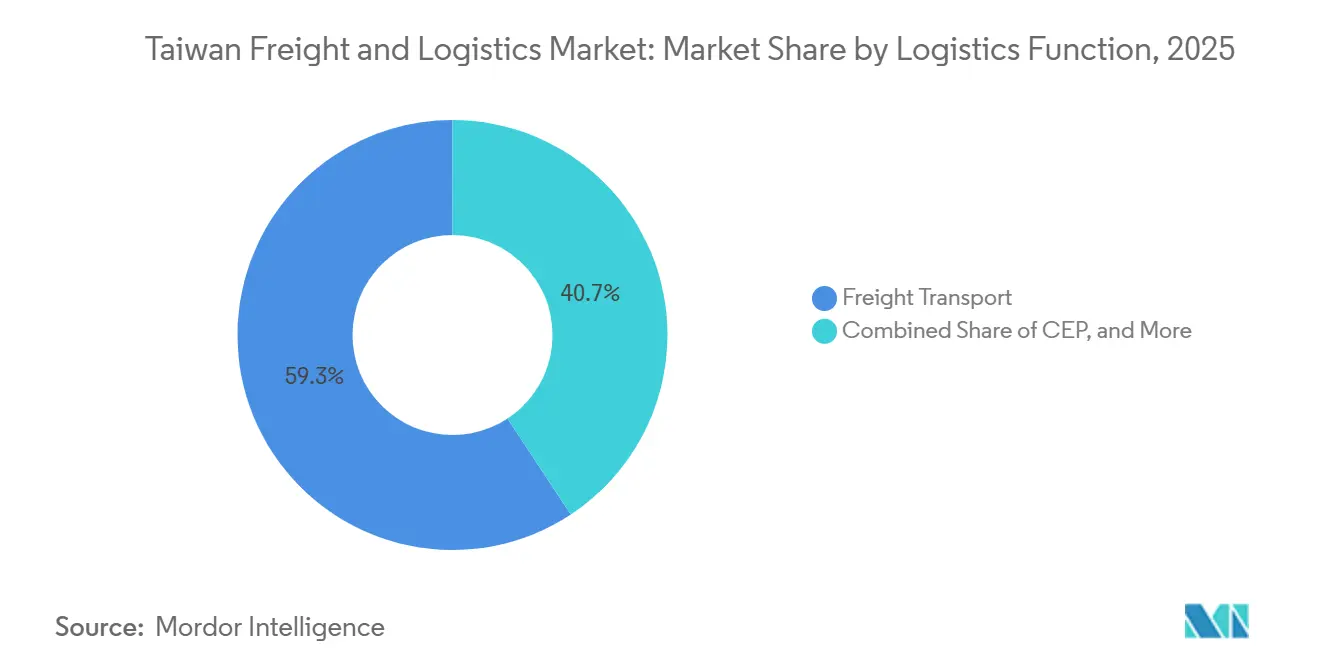
Freight transport held 59.27% of the Taiwan freight and logistics market share in 2025, supported by domestic trucking and international container flows. Manufacturing clusters in Hsinchu, Taichung, and Tainan require frequent links to ports, airports, and distribution centers. Courier, Express, and Parcel is the fastest-growing function, with a forecast CAGR of 5.12% through 2031. Its growth reflects e-commerce, cross-border parcels, and time-sensitive medical and electronics shipments. Warehousing and storage are receiving more automation investment as platforms and manufacturers seek to reduce manual handling. Freight forwarding benefits from more complex international flows, while standard sea routes can still face pricing pressure when capacity improves.
Other services include customs brokerage, supply chain management, and value-added logistics. These services become more relevant when shippers prefer bundled support instead of individual freight bookings. Taiwan’s manufacturing Purchasing Managers’ Index reached 61.4 in May 2026, which indicated faster industrial expansion and longer supplier delivery times. Authorized Economic Operator certification from Taiwan Customs supports faster customs clearance for qualified operators. International Air Transport Association CEIV certification is also relevant for pharmaceutical shipments requiring validated handling. The Taiwan freight and logistics industry is moving toward services that combine physical transport, documentation, and shipment visibility.



By Freight Transport Mode: Road Holds Scale While Air Grows Faster
Road transport accounted for 60.84% of the Taiwan freight and logistics market size in 2025, reflecting its role in linking industrial parks, airports, ports, and distribution centers. Taiwan’s road network provides practical connections across its 395-kilometer north-to-south corridor. The Ministry of Transportation and Communications reported 715 million metric tons of road freight in 2025, down 1.8% from 728 million metric tons in 2024. Lower construction materials and consumer goods volumes affected domestic road activity. Sea and inland waterways remain essential for bulk imports and container exports. Rail freight has a limited role, while pipelines serve petroleum and petrochemical cargo.
Air freight is forecast to grow at a 4.98% CAGR through 2031, which is faster than other transport modes. The Taiwan freight and logistics market size for air freight is supported by semiconductor and advanced server exports that require fast delivery. UPS opened a USD 100 million logistics center at Taoyuan in March 2026. FedEx expanded its Taoyuan center to 19,000 square meters with a sorting capacity of 9,000 packages per hour. Available dedicated air capacity remains tight on routes serving technology customers. This supports air freight yields but creates a service risk for shippers without secured capacity.
By Courier, Express, and Parcel Destination: Domestic Networks Lead, International Services Accelerate
Domestic Courier, Express, and Parcel services held 65.07% of the Taiwan freight and logistics market share in 2025. Dense urban areas and established express networks support next-day deliveries across much of the island. Black Cat Yamato, Kerry TJ Logistics, Taiwan Pelican Express, and HCT Logistics operate broad domestic coverage. Convenience store collection networks help reduce failed deliveries and make last-mile delivery more efficient. These networks also give consumers a choice beyond home delivery. Domestic scale remains important for retail, marketplace, and household parcel demand.
International Courier, Express, and Parcel services are forecast to grow at a 5.37% CAGR through 2031. Electronics components, health products, fashion, and urgent technology shipments support cross-border parcel demand. FedEx operates 40 weekly international flights from its Taoyuan center to the United States, Europe, and the Asia-Pacific. Cross-border e-commerce rules and export processing facilities at Taoyuan provide a supportive environment for international shipments. Sometimes, tolerant electronics cargo can move to expedited sea services when air capacity is limited. This creates a service category between standard ocean freight and express air delivery.
By Warehousing and Storage: Standard Capacity Leads While Cold Chain Expands
Non-temperature-controlled warehousing accounted for 91.51% of the warehousing and storage share in the Taiwan freight and logistics market size in 2025. General merchandise, electronics components, and industrial goods form the largest part of warehouse demand. Major industrial zones in Taoyuan, Taichung, and Kaohsiung have established standard warehouse capacity. Bonded and high-technology facilities are especially important near semiconductor supply chains. High utilization in these facilities can limit available space during periods of export growth. Operators are investing in automation to improve throughput and reduce dependence on manual processes.
Temperature-controlled warehousing is forecast to grow at a 4.00% CAGR through 2031. Pharmaceutical distribution, fresh food delivery, and frozen meal e-commerce require reliable temperature management. Xin-Ke Smart Logistics began Phase 2 construction of a multi-temperature cold chain warehouse at Taipei Port in September 2025, with TWD 4.2 billion (USD 134.03 million) of investment. Taiwan Food and Drug Administration Good Distribution Practice requirements raise the standard for handling temperature-sensitive medicines[3]“Good Distribution Practice Requirements,” Taiwan Food and Drug Administration, fda.gov.tw. Specialized operators with validated facilities are better placed to serve pharmaceutical customers. The Taiwan freight and logistics industry is therefore concentrating a larger share of cold-chain demand among qualified providers.
By Freight Forwarding Mode: Sea Carries Volume While Air Produces Higher Growth
Sea and inland waterways held 70.41% in freight forwarding share of the Taiwan freight and logistics market size in 2025. Taiwan exports containerized electronics, machinery, and petrochemicals, and imports energy, raw materials, and consumer goods. Taiwan International Ports Corporation reported 13.5 million TEU across Taiwan’s ports in 2025. Kaohsiung is the principal container hub within this network. Sea forwarding remains essential for large-volume cargo, even where air freight offers faster delivery. Forwarders need reliable relationships with carriers, terminals, and customs agencies to manage these flows.
Air freight forwarding is forecast to grow at a 5.07% CAGR through 2031. Dimerco reported that its air freight volume grew faster than its ocean freight volume in the first 5 months of 2026. High-value shipments can produce higher revenue per unit than standard sea cargo. Road and multimodal forwarding links with China and Southeast Asia are also gaining relevance as manufacturers diversify supply chains. The Taiwan freight and logistics market favors forwarders that can secure air capacity and coordinate cross-border movements. Formal requirements such as International Air Transport Association Cargo Accounts Settlement System participation and ISO 9001 compliance remain important for established forwarders.
By End-User Industry: Manufacturing is the Largest while Retail Trade Gains Pace
Manufacturing held 40.01% of the Taiwan freight and logistics market share in the end-user industry in 2025. Semiconductor fabrication, electronics assembly, machinery, and petrochemicals require regular and often time-sensitive movements of parts and finished goods. Just-in-time operating models increase the need for predictable transport and inventory management. Manufacturing logistics also requires connections among suppliers, production sites, ports, airports, and overseas customers. This base gives the Taiwan freight and logistics market a stable source of industrial demand. Manufacturing customers increasingly need secure facilities and rapid customs processes for high-value cargo.
Wholesale and retail trade is forecast to grow at a 4.65% CAGR through 2031. Omnichannel operations require store replenishment, online fulfillment, and returns management in the same distribution system. E-commerce strengthens this demand even though it is tracked separately as an end-user category. Agriculture, fishing, and forestry represent a smaller spending base but support specialized refrigerated container demand. Oil, gas, mining, and quarrying logistics remain tied to energy imports and tanker movements. Kerry TJ Logistics reported 2025 consolidated revenue of TWD 12.8 billion (USD 408.49 million), which shows the breadth of domestic demand served by integrated providers.
Geography Analysis
Taiwan’s port system handled 13.5 million TEU in 2025, with Kaohsiung serving as the principal sea freight node. The Taiwan freight and logistics market is organized around the northern Taoyuan-Keelung corridor, the central and southern manufacturing arc, and free trade port zones. Kaohsiung supports container trade with the United States, Japan, China, and Southeast Asia. The port development plan gives substantial priority to Kaohsiung and its ability to handle larger vessels. Keelung completed a major infrastructure upgrade in December 2025, improving operating reliability. Together, these ports support Taiwan’s containerized export and import system[4]“Making Impressive Headway Against Strong Headwinds, TIPC’s 2026 Game Plan,” Port Strategy, portstrategy.com.
Northern Taiwan is the highest-growth freight area in 2026 because Taoyuan International Airport is near semiconductor facilities, component suppliers, and global logistics infrastructure. UPS opened its Taoyuan center with a USD 100 million investment, and the site also serves as Applied Materials’ Asia distribution hub. FedEx expanded its Taoyuan transshipment center to serve international traffic. Southern Taiwan is attracting more logistics capacity as semiconductor activity develops around Kaohsiung and Tainan. Nippon Express opened the Tainan NEXT11 Warehouse in January 2026 to support the southern semiconductor supply chain. This movement broadens high-value freight activity beyond the northern corridor.
Taiwan has 7 free trade port zones at Keelung, Taipei Port, Taichung, Kaohsiung, Taoyuan Airport, Hsinchu, and Anping. These zones allow bonded warehousing, value-added processing, and re-export activities. They help Taiwan operate as a regional logistics hub rather than only an origin and destination. Alternative-fuel bunkering investments at key ports will matter as shipping lines respond to International Maritime Organization emissions requirements. The Taiwan freight and logistics market size for these locations will also depend on the availability of suitable industrial land and qualified logistics labor. Better road links between Taoyuan Airport, Taipei Port, and the national highway network remain necessary to reduce cross-modal dwell time. The planned Freeway No. 1-A extension is intended to improve this connection.
Competitive Landscape
The Taiwan freight and logistics market is moderately fragmented. Global integrators and international forwarders are strongest in air express and high-value forwarding. Domestic providers retain advantages in road freight, parcel delivery, and local last-mile coverage. This structure reflects the different skills required for global air networks and domestic distribution. Operators compete through facility location, air capacity access, customs capability, automation, and customer relationships. Competition is therefore based more on service specialization than on a reported dominant group share.
UPS opened its Taoyuan International Logistics Center in March 2026, which is its largest Asia-Pacific facility and focuses on high-technology cargo. FedEx opened its expanded Taoyuan Transshipment Center in March 2026 with an automated sorting capacity of 9,000 packages per hour. Nippon Express added its Tainan NEXT11 Warehouse to serve southern semiconductor customers. These moves show that global operators are placing assets near high-value technology cargo. Global forwarders also benefit when they can offer integrated sea, air, and road visibility. Mid-sized operators face a narrower opportunity where they lack bonded facilities or specialized handling capability.
Domestic providers are responding through acquisition and automation. Kerry TJ Logistics acquired Kerry International Logistics for TWD 2.6 billion (USD 82.97 million) in May 2026, combining domestic less-than-truckload operations with international resources. Dimerco increased the automated share of processes in its global operations to 27% in July 2026. An-Lian Express announced TWD 450 million (USD 14.36 million) for a smart logistics center in Taoyuan in April 2026. Dynamic pricing, real-time tracking, and automated planning are becoming more important in the Taiwan freight and logistics market. Operators that combine these systems with physical capacity and compliance credentials can compete for higher-value contracts. The Taiwan freight and logistics industry will continue to require both global network reach and local delivery capability.
Taiwan Freight and Logistics Industry Leaders
Dimerco Express Group
HCT Logistics (Hsinchu Logistics)
Kerry TJ Logistics Co., Ltd.
Evergreen Group
Chunghwa Post Co., Ltd.
- *Disclaimer: Major Players sorted in no particular order

Recent Industry Developments
- April 2026: Anshu Express announced a TWD 450 million (USD 14.36 million) investment for a smart logistics center in Zhongli, Taoyuan. The facility will include automated warehouse management systems, smart racking, and automated handling equipment for advanced server and semiconductor logistics customers.
- March 2026: UPS opened its Taoyuan International Logistics Center in northern Taiwan with a total investment of USD 100 million, making it the company’s largest logistics facility in the Asia-Pacific. The center serves Applied Materials as its Asian distribution hub and handles primarily high-tech semiconductor and electronics cargo, reflecting Taiwan’s role as a critical node in the global advanced computing supply chain.
- March 2026: FedEx opened its expanded Transshipment Center at Taoyuan International Airport on March 11, 2026, citing it as the largest single investment in its 35-year Taiwan history. The facility covers 19,000 square meters with automated sorting of up to 9,000 packages per hour and is supported by 40 weekly international flights to the United States, Europe, and the Asia-Pacific.
- January 2026: Nippon Express opened the Tainan NEXT11 Warehouse in southern Taiwan to support the expanding semiconductor sector in the south. The facility includes 24-hour security, platform loading docks, and air-conditioning systems aligned with high-technology cargo requirements.


Taiwan Freight and Logistics Market Report Scope
| Agriculture, Fishing, and Forestry |
| Construction |
| Manufacturing |
| Oil and Gas, Mining, and Quarrying |
| Wholesale and Retail Trade (Excluding E-commerce) |
| E-commerce/E-retail |
| Others |
| Courier, Express and Parcel (CEP) | By Destination | Domestic |
| International | ||
| Freight Forwarding | By Mode of Transport | Air |
| Sea and Inland Waterways | ||
| Others | ||
| Freight Transport | By Mode of Transport | Air |
| Pipelines | ||
| Rail | ||
| Road | ||
| Sea and Inland Waterways | ||
| Warehousing and Storage | By Temperature Control | Non-Temperature Controlled |
| Temperature Controlled | ||
| Other Services | ||
| By End-User Industry | Agriculture, Fishing, and Forestry | ||
| Construction | |||
| Manufacturing | |||
| Oil and Gas, Mining, and Quarrying | |||
| Wholesale and Retail Trade (Excluding E-commerce) | |||
| E-commerce/E-retail | |||
| Others | |||
| By Logistics Function | Courier, Express and Parcel (CEP) | By Destination | Domestic |
| International | |||
| Freight Forwarding | By Mode of Transport | Air | |
| Sea and Inland Waterways | |||
| Others | |||
| Freight Transport | By Mode of Transport | Air | |
| Pipelines | |||
| Rail | |||
| Road | |||
| Sea and Inland Waterways | |||
| Warehousing and Storage | By Temperature Control | Non-Temperature Controlled | |
| Temperature Controlled | |||
| Other Services | |||


Key Questions Answered in the Report
What does the Taiwan freight and logistics market size outlook mean for strategic planning?
The Taiwan freight and logistics market is expected to grow from USD 37.8 billion in 2026 to USD 46.5 billion by 2031, representing a 4.2% CAGR. The outlook supports targeted investment in specialized capacity, automation, and international network coverage rather than broad expansion in conventional freight services.
What are the key factors driving the growth of Taiwan’s freight and logistics market?
Growth is being driven by semiconductor and advanced server exports, e-commerce, and investment in ports, airports, and automated warehousing. Taiwan's Manufacturing PMI reached 61.5 in July 2026, marking its 10th consecutive month of expansion and signaling continued manufacturing-led freight demand.
How are changing global trade patterns and supply chain regionalization affecting Taiwan’s logistics market?
Manufacturers are increasingly connecting Taiwan with production and sourcing locations across ASEAN, Japan, Europe, and the United States. This is increasing demand for logistics providers that can coordinate customs, inventory, and multimodal transportation across multiple markets rather than manage individual trade routes.
How are freight rates evolving across Taiwan’s major trade corridors, and what is driving rate volatility?
Sea freight rates vary sharply by corridor. Intra-Asia routes can ease when congestion falls, and vessel space improves, while Taiwan-United States routes remain more exposed to tariff-driven shipment timing, blank sailings, port disruption, and limited space during peak periods. The planned port upgrades are intended to increase capacity and improve operating efficiency over time, but they will not remove short-term rate volatility.
How are infrastructure investments and technology reshaping Taiwan’s logistics landscape?
The Ministry of Transportation and Communications announced a TWD 57.2 billion (USD 1.82 billion) port investment plan in June 2026, covering 34 projects at 7 international ports and 73 projects at 4 domestic ports. Operators are pairing physical investment with automated handling, real-time tracking, and integrated port systems to improve throughput and service reliability.
Which capabilities should logistics providers prioritize to win high-value contracts?
Providers should build secured air capacity, compliant bonded and temperature-controlled facilities, real-time shipment visibility, and strong customs processes. For instance, Dimerco’s increase in automated processes from 17% in early 2025 to 27% in July 2026 shows the operational importance of digital tools in freight management.
Page last updated on:





