
Synthetic Identity Fraud Detection Market Size and Share
Market Overview
| Study Period | 2020 - 2031 |
|---|---|
| Market Size (2026) | USD 3.58 Billion |
| Market Size (2031) | USD 7.80 Billion |
| Growth Rate (2026 - 2031) | 16.88 % |
| Fastest Growing Market | Asia-Pacific |
| Largest Market | North America |
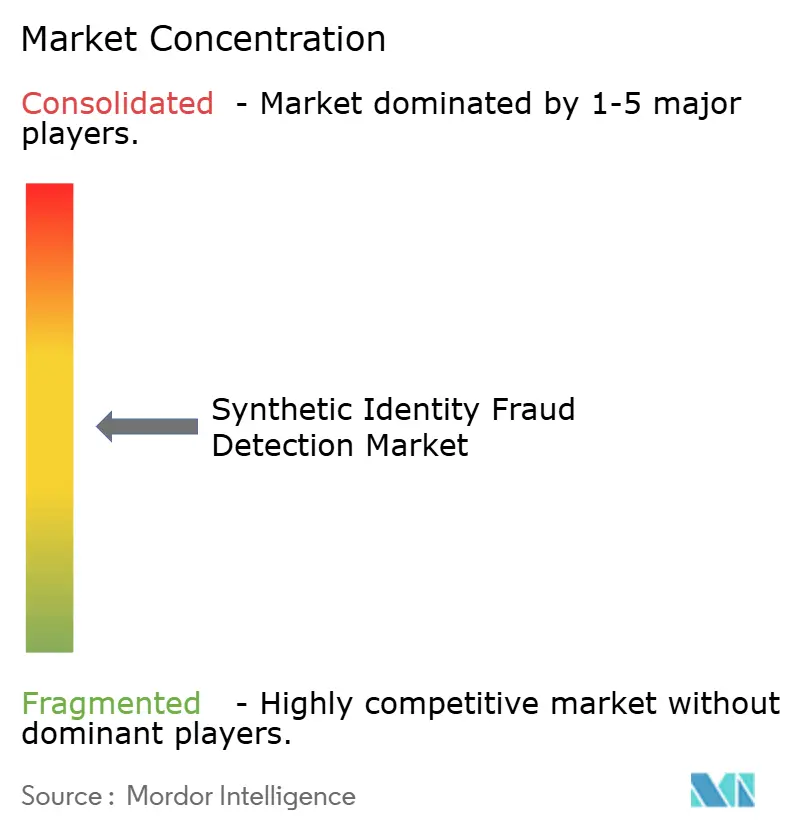
| Market Concentration | Medium |
Major Players *Disclaimer: Major Players sorted in no particular order Image © Mordor Intelligence. Reuse requires attribution under CC BY 4.0. | |
Synthetic Identity Fraud Detection Market Analysis by Mordor Intelligence
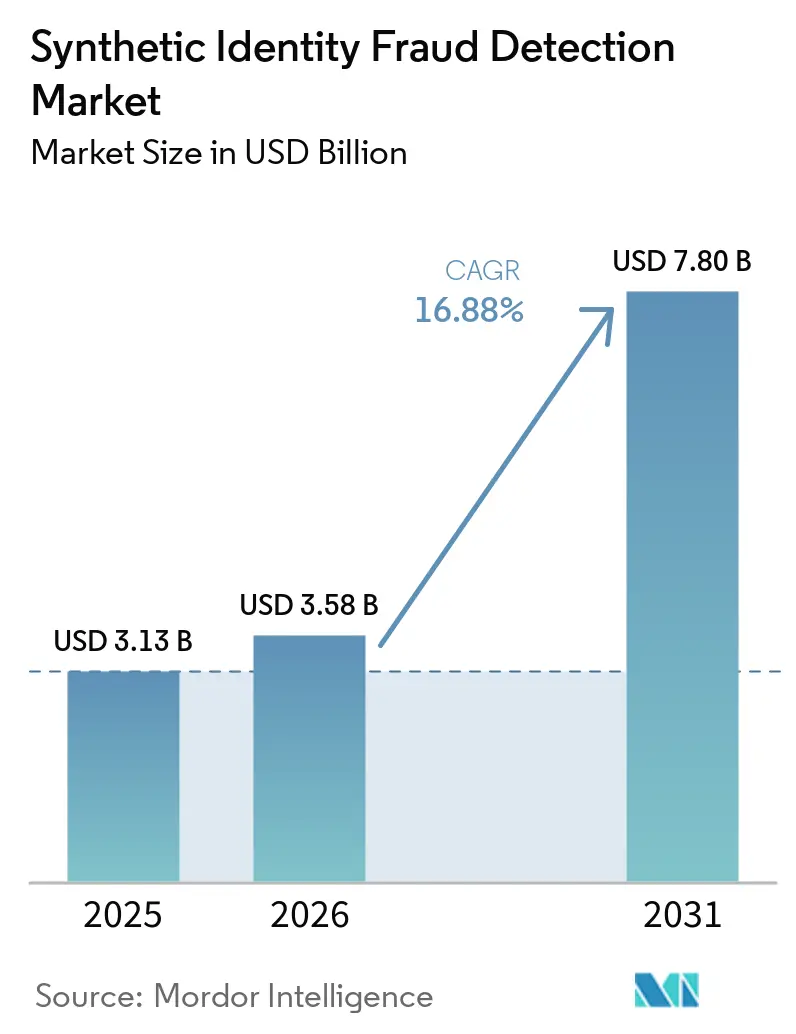
The Synthetic Identity Fraud Detection Market size was valued at USD 3.13 billion in 2025 and estimated to grow from USD 3.58 billion in 2026 to reach USD 7.80 billion by 2031, at a CAGR of 16.88% during the forecast period (2026-2031). Growing losses from fabricated identities are moving fraud controls from a narrow credit-risk function into broader compliance and operational planning. Generative AI is making false identity attributes, documents, and account behavior more credible across digital channels. Fully digital onboarding and embedded finance are increasing the number of account-opening flows requiring real-time decisions. Providers in the Synthetic Identity Fraud Detection Market are responding with connected tools that combine risk scoring, document review, behavioral signals, and investigation workflows. Privacy obligations and inconsistent loss classification remain important constraints because they restrict data sharing and reduce the number of confirmed fraud labels available for model training.
Key Report Takeaways
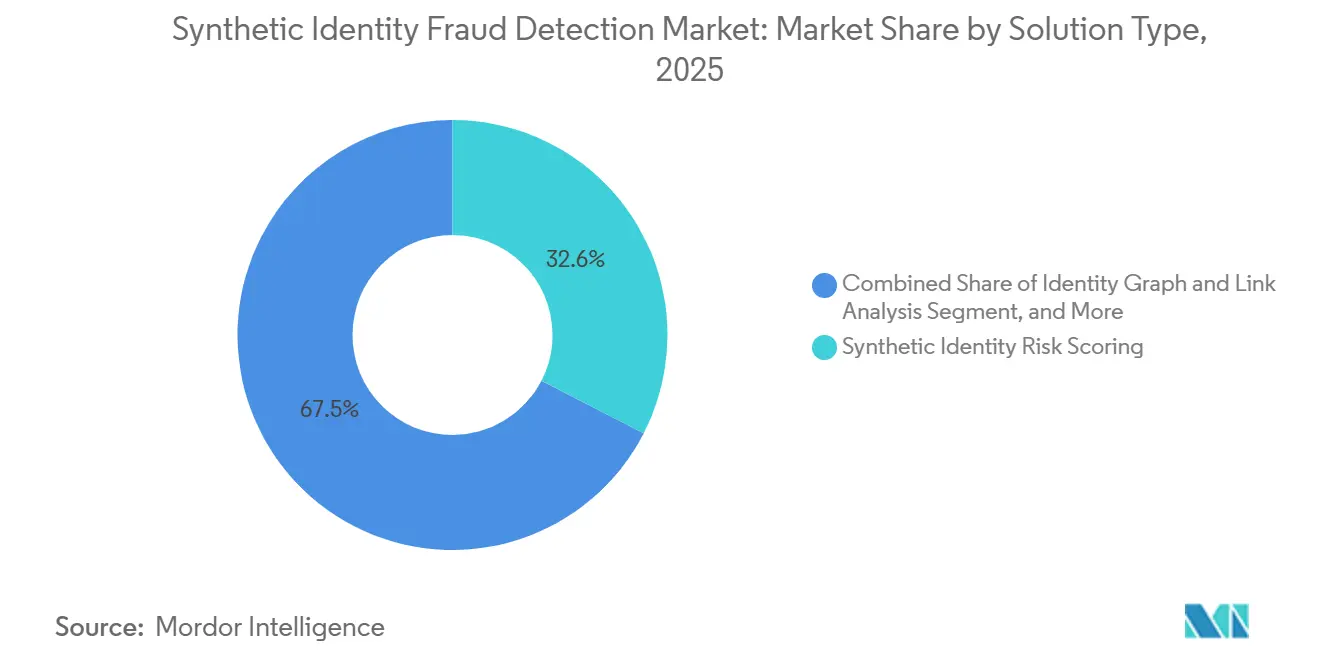
- By solution type, synthetic identity risk scoring held 32.55% of the Synthetic Identity Fraud Detection Market share in 2025, while consortium and network intelligence is projected to expand at a 17.80% CAGR through 2031.
- By deployment mode, cloud-based deployment held 68.12% of the Synthetic Identity Fraud Detection Market share in 2025, while hybrid deployment is expected to grow at an 18.51% CAGR through 2031.
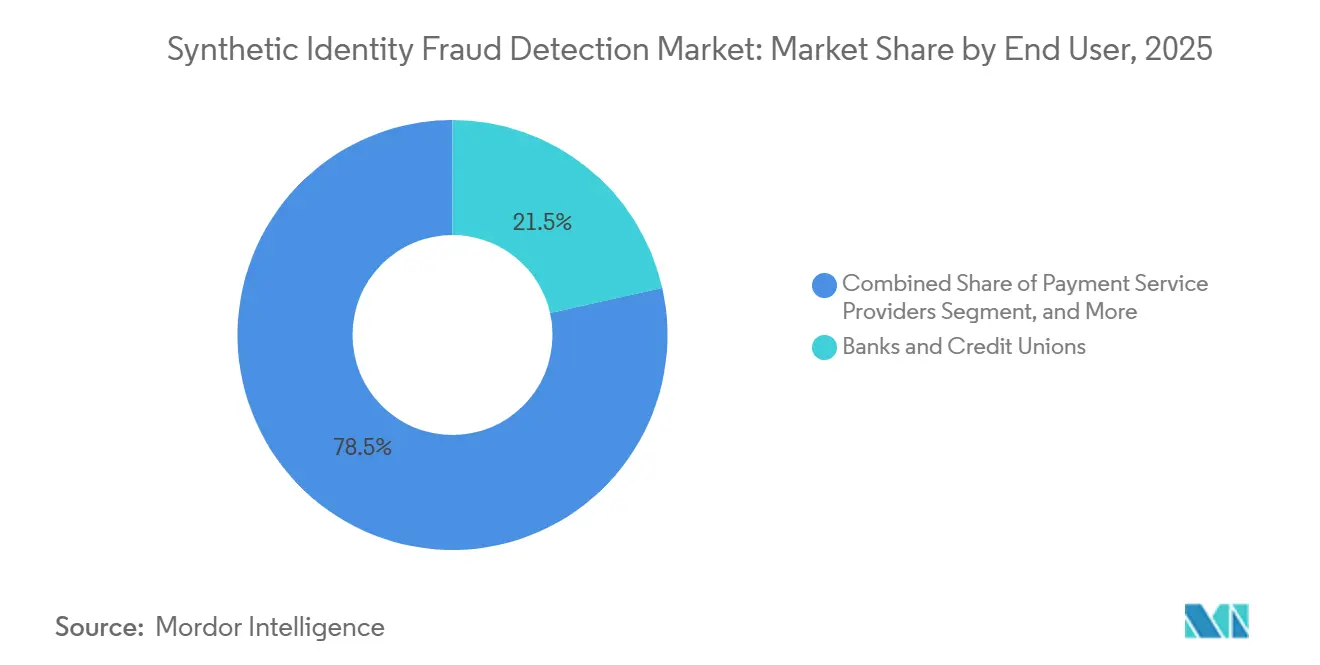
- By end user, banks and credit unions held 21.49% of the Synthetic Identity Fraud Detection Market share in 2025, while fintechs and neobanks are projected to advance at a 17.39% CAGR through 2031.
- By organization size, large enterprises held 71.20% of the Synthetic Identity Fraud Detection Market share in 2025, while small and medium-sized enterprises are projected to expand at an 18.76% CAGR through 2031.
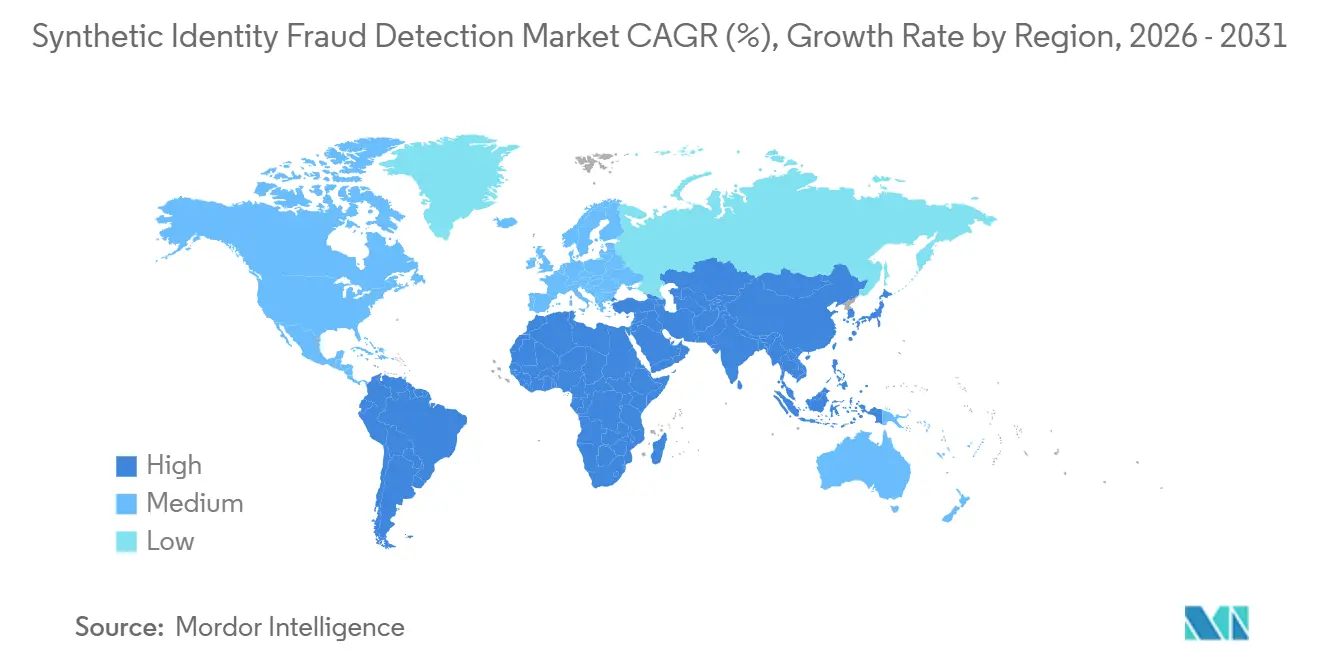
- By geography, North America held 36.78% of the Synthetic Identity Fraud Detection Market share in 2025, while Asia-Pacific is expected to grow at an 18.19% CAGR through 2031.
Note: Market size and forecast figures in this report are generated using Mordor Intelligence’s proprietary estimation framework, updated with the latest available data and insights as of January 2026.
Global Synthetic Identity Fraud Detection Market Trends and Insights
Drivers Impact Analysis*
| Driver | (~) % Impact on CAGR Forecast | Geographic Relevance | Impact Timeline |
|---|---|---|---|
| Generative AI-Enabled Identity Fabrication | +3.9% | Global, with acute impact in North America, Asia-Pacific, and Europe | Short term (≤ 2 years) |
| Rising Synthetic Identity Loss Exposure | +3.5% | North America primary, with spillover to Asia-Pacific and Europe | Medium term (2-4 years) |
| Expansion of Digital Account Opening and Embedded Finance | +2.7% | Global, with highest velocity in Asia-Pacific and South America | Medium term (2-4 years) |
| Regulatory and Board-Level Pressure to Reclassify Fraud Losses | +2.0% | North America and Europe, with expanding relevance in Asia-Pacific | Medium term (2-4 years) |
| Cross-Institution Identity Graphs and Privacy-Preserving Consortiums | +1.8% | North America, with early adoption in Europe and Asia-Pacific | Long term (≥ 4 years) |
| Detection for Thin-File and New-to-Country Customers | +1.4% | Asia-Pacific, South America, and Middle East and Africa | Long term (≥ 4 years) |
| Source: Mordor Intelligence | |||
Generative AI-Enabled Identity Fabrication
Generative AI has changed the cost and speed of creating synthetic personas that appear credible during onboarding. Fraud teams now need to evaluate documents, biometric checks, device activity, and behavior together rather than rely on any single control. This shift supports demand in the Synthetic Identity Fraud Detection Market for layered detection tools that can identify inconsistent signals across a customer journey. Socure stated that its Sigma V4.5 model used a transformer-based design to identify complex fraud patterns at production scale in 2026. The company reported an AUC of 99% at a false-positive rate of 1:2, which shows why model quality and calibration are becoming central to product differentiation.
Rising Synthetic Identity Loss Exposure
Losses in the Synthetic Identity Fraud Detection Market are becoming more visible as lenders review unsecured credit portfolios and fraud operations together. Mitek reported that U.S. unsecured credit losses linked to synthetic identities reached USD 2.94 billion in 2025 and were projected to exceed USD 3.10 billion in 2026. Equifax reported an average loss of USD 13,000 per confirmed synthetic identity, and the same persona can also enable deposit fraud and mule-account activity. The Association of Certified Fraud Examiners reported that auto lenders absorbed more than USD 15,000 per synthetic fraud event in charge-offs and that 500,000 accounts at major credit card issuers were flagged as possible synthetic identities in 1 year. When institutions record these events as credit losses rather than fraud, the exposure receives less attention in budget decisions and weakens the case for earlier controls.
Expansion of Digital Account Opening and Embedded Finance
Digital onboarding is changing the Synthetic Identity Fraud Detection Market by removing branch visits and manual document checks that once added friction to fraudulent applications. Embedded finance also extends account opening and credit decisions to platforms that may not have the same level of control or maturity as regulated financial institutions. The International Monetary Fund stated that governments and financial regulators need AI-supported monitoring and identity verification to address technology-driven financial crime across digital channels. The Synthetic Identity Fraud Detection Market, therefore, favors tools that can deliver a fast decision through an application programming interface without disrupting a checkout or credit-application flow. This requirement gives cloud-native providers an opportunity where older systems have slower integration methods.
Regulatory and Board-Level Pressure to Reclassify Fraud Losses
Regulatory activity is driving the widening use of verified third-party identity intelligence across the Synthetic Identity Fraud Detection Market. In July 2025, the Federal Reserve Board announced that bank regulators had granted banks flexibility to use an alternative method for collecting certain customer identification information. The related Customer Identification Program exemption order allowed banks to obtain Tax Identification Number information from third-party sources rather than directly from customers under specified circumstances.[1] These changes make evidence of source quality, audit trails, and identity verification workflows more important for providers serving banks. They also make spending on detection tools more resilient, as the purchase supports compliance documentation and loss prevention.
Restraints Impact Analysis*
| Restraint | (~) % Impact on CAGR Forecast | Geographic Relevance | Impact Timeline |
|---|---|---|---|
| Privacy, Data-Sharing, and Cross-Border Data-Sovereignty Constraints | -1.8% | Global, most acute for Europe, Asia-Pacific, and cross-border consortiums | Long term (≥ 4 years) |
| Fragmented Definitions and Inconsistent Fraud-Loss Classification | -1.4% | Global, most acute in North America and South America | Long term (≥ 4 years) |
| False Declines and Customer-Friction Trade-Offs | -1.0% | Global, concentrated in high-volume digital onboarding markets | Medium term (2-4 years) |
| Long Incubation Periods and Sparse Confirmed Fraud Labels | -0.8% | Global, most acute for machine-learning dependent specialist providers | Medium term (2-4 years) |
| Source: Mordor Intelligence | |||
Privacy, Data-Sharing, and Cross-Border Data-Sovereignty Constraints
Consortium and network intelligence in the Synthetic Identity Fraud Detection Market depends on the sharing of identity signals originating from real people. This creates a difficult balance between finding connected fraud patterns and meeting privacy requirements across different jurisdictions. The General Data Protection Regulation, India’s Digital Personal Data Protection Act, and China’s Personal Information Protection Law impose different rules for data processing and cross-border transfers. Research presented at NeurIPS 2025 showed that privacy-preserving fraud detection could be used in a South Korean banking setting, although performance differences from centralized models remained material. The Synthetic Identity Fraud Detection Market must therefore support designs that protect data while preserving enough signal quality for institutions to act on results.
Fragmented Definitions and Inconsistent Fraud-Loss Classification
The Synthetic Identity Fraud Detection Market lacks a universal legal or regulatory definition of synthetic identity fraud. Institutions consequently measure losses differently, making benchmarks and board reporting less consistent. A fraud event recorded only as a credit write-off does not create the confirmed label that detection models need for retraining. This issue is especially difficult for supervised models, which rely on verified outcomes to distinguish suspicious customers from legitimate applicants. ACAMS stated in its 2026 fraud outlook that institutions should document synthetic identity risk in formal risk assessments as scrutiny of fraud classification increases.
*Our forecasts treat driver/restraint impacts as directional, not additive. The impact forecasts reflect baseline growth, mix effects, and variable interactions.
Segment Analysis
By Solution Type: Risk Scoring Leads While Consortium Intelligence Grows Fastest
Synthetic identity risk scoring held 32.55% of the Synthetic Identity Fraud Detection Market share in 2025. It remains a practical starting point for institutions adding automated controls to established credit-risk workflows. The segment benefits from connections to credit bureau data and existing decisioning platforms. Those integrations reduce replacement pressure for established providers and support continued demand for scoring products. Identity graph and link analysis add a relationship-based view by connecting addresses, phone numbers, devices, and other attributes that appear across accounts. Jumio stated that its Identity Graph draws on data from tens of millions of verified and fraudulent identities across industries.[2] Document and biometric checks provide evidence during onboarding, while behavioral and device intelligence help identify activity that deviates from a legitimate customer pattern. Together, these capabilities allow providers to review a broader set of signals before approving an application. They also reduce the reliance on static identity details that can be fabricated or reused.
Consortium and network intelligence is projected to expand at a 17.80% CAGR through 2031, the fastest rate among solution types. The Synthetic Identity Fraud Detection Market size for this category is supported by the fact that no single lender can see the complete footprint of a synthetic identity. Cross-institution information can reveal linked activity that remains invisible within an individual institution’s data set. Unit21 stated that its Fraud Consortium covers more than 100 fintechs, banks, and crypto companies, as well as more than 80 million U.S. adults. Fraud decisioning and orchestration systems then integrate scoring, document review, behavioral intelligence, and investigative steps into a single workflow. Vendors are competing on the speed of those decisions, the clarity of the reason given, and compatibility with existing compliance tools. Requirements for explainable decisions under the Fair Credit Reporting Act and the European Union AI Act increase the value of transparent outputs. This can create an opening for smaller providers that explain their decisions more clearly than established black-box models. Privacy constraints still limit the ability to build global networks, which makes local implementation capability important.

By Deployment Mode: Cloud Leads While Hybrid Configurations Expand
Cloud-based deployment accounted for 68.12% of the market in 2025. High-frequency decisions benefit from infrastructure that can increase capacity when account-opening volumes rise. Many specialist providers, including Socure, SentiLink, Sardine, and SEON, were built for cloud delivery. Institutions selecting those products often adopt cloud deployment as part of the product design rather than as a separate infrastructure choice. On-premises systems continue to matter for sovereign wealth institutions, central banks, and large financial institutions with strict data residency rules. These buyers may prohibit cloud processing of customer information or apply conditions that make it more difficult. The continuing role of on-premise systems means providers need practical integration options rather than a single deployment approach. Audit trails and data-flow controls remain necessary across cloud, on-premise, and combined configurations. This need is especially important where customer identification obligations require institutions to document how data is handled.
Hybrid deployment is expected to grow at an 18.51% CAGR through 2031. It serves institutions that retain core banking systems on-premises but need cloud-based fraud controls for digital channels. The Synthetic Identity Fraud Detection Market size for hybrid tools reflects demand for an operating model that avoids duplicating sensitive data stores. The 2025 regulatory changes around third-party identity data support configurations in which cloud-based bureau application programming interfaces supplement internal decisioning systems. GBG introduced its GBG Go adaptive identity platform in April 2025 and reported 90 customer wins through April 2026. The product was designed for flexible deployment and low-code integration, which addresses a core requirement for regulated enterprise users. Providers that can connect these environments without disrupting existing workflows have a clearer path to adoption. The approach also lets institutions modernize individual digital touchpoints without replacing their full banking infrastructure. This supports a gradual migration model for buyers with complex legacy technology estates.
By End User: Banks and Credit Unions Lead While Fintechs and Neobanks Accelerate
Banks and credit unions held 21.49% of the market in 2025. Within the Synthetic Identity Fraud Detection Market, their large unsecured credit books and established ties to bureau-linked providers make them a major source of demand. Their procurement cycles are long because systems must meet compliance, model governance, and core-banking integration requirements. This favors vendors in the Synthetic Identity Fraud Detection Market that have documented controls and can support enterprise-scale operations. Banks also need to detect fraud beyond initial account opening because fabricated identities can mature over time. LexisNexis Risk Solutions reported that login-stage account takeover attacks rose 216% globally in 2025. This supports broader monitoring, including account activity and application review. Credit unions face similar exposure, although their technology budgets and internal fraud teams can be smaller. Provider models that package controls and investigations in a manageable form can help these institutions expand coverage.
Fintechs and neobanks are projected to grow at a 17.39% CAGR through 2031. Fully digital onboarding removes physical checks and exposes these firms to synthetic applications at the point of entry. Losses may initially appear as credit losses until a dedicated detection capability identifies the underlying fraud pattern. This makes early deployment important for digital-first providers that are scaling customer acquisition. Payment service providers, credit bureaus, and information service providers also need controls as synthetic identities move across payment and data products. Insurance companies face related risks in applications and claims, while government, e-commerce, IT, and telecom organizations have different use cases that rely on many of the same detection methods. VIDA introduced ID FraudShield in Indonesia in May 2026 for banks, multifinance companies, digital lenders, and insurance providers. The product combines biometric verification, device analysis, and identity graph capabilities, which reflects the need for multiple controls across adjacent sectors. Gaming and digital entertainment remain smaller end-user areas, but synthetic accounts in these services can support mule activity elsewhere.
By Organization Size: Large Enterprises Lead While Small and Medium-Sized Enterprises Grow Faster
Large enterprises held 71.20% of the market in 2025. These organizations have the data volumes needed to lead the Synthetic Identity Fraud Detection Market and to leverage scoring, specialist teams, and bureau relationships to integrate scoring and graph analytics. They can also absorb the governance work needed to test models, integrate data sources, and manage investigations. This creates a durable advantage in deployment capacity relative to smaller organizations. Their scale supports demand for tools that evaluate applicants and account activity across large portfolios. It also makes them important customers for suppliers building complex, connected fraud platforms. Established enterprises usually need products that can work alongside existing credit, compliance, and case-management systems. This encourages providers to prioritize interoperability and detailed documentation. Large buyers can still change vendors when model performance or integration speed does not meet their requirements.
Small and medium-sized enterprises are projected to expand at an 18.76% CAGR through 2031. The Synthetic Identity Fraud Detection Market is becoming more accessible to this group as subscription services replace large up-front software investments. Fraud-detection-as-a-service enables regional banks, smaller financial institutions, and fintech startups to add controls without having to build every component in-house. Annual subscriptions in the tens of thousands of dollars create a different purchasing model from historic on-premise programs with six-figure capital costs. SEON’s application programming interface-first design and Sardine’s modular platform approach address buyers seeking controls that can be used within weeks rather than months. Compliance expectations under Bank Secrecy Act requirements and the 2025 Customer Identification Program updates apply regardless of institution size. This creates demand tied to regulatory duties and loss prevention. The segment is also supported by growing digital customer bases, which can outpace smaller teams' ability to investigate activity manually. Providers that offer modular services and clear implementation support are better placed to serve this customer group.
Geography Analysis
North America held 36.78% share in 2025. The United States has a dense base of credit issuers and regulations that support spending on identity fraud controls. The 2025 Customer Identification Program exemption orders allowed banks to use third-party sources for certain Tax Identification Number information, creating a need for reliable external data and verification records.[3] Canada has comparable know-your-customer obligations, while Mexico’s digital banking growth is increasing exposure to online fraud. Equifax launched Synthetic Identity Risk in January 2026, showing continuing investment by established U.S. data providers.
Asia-Pacific is projected to grow at an 18.19% CAGR through 2031. Mobile banking, fragmented identity systems, and the expansion of digital-only financial providers support the Synthetic Identity Fraud Detection Market in Asia-Pacific. Sumsub reported that synthetic identity attempts in the region rose 142% year over year, with Vietnam and Japan identified as leading sources of deepfake incidents. India, China, South Korea, Singapore, and Thailand each add demand through digital lending, authentication programs, fraud research, or tighter financial crime measures. These national differences favor suppliers that can adapt workflows and documentation to each jurisdiction.
Europe combines demand from eIDAS 2.0 and open banking with limits on cross-border data pooling under the General Data Protection Regulation. Germany, the United Kingdom, and France anchor demand as financial data access expands to third parties. South America faces an acute fraud profile, with a 48.3% regional concentration of synthetic identity fraud reported for 2025, while Pix and Argentina’s fintech activity expand digital attack surfaces. The Middle East and Africa are at an earlier stage, but digital banking and mobile money are reaching people with thin credit histories and increasing the need for alternative risk assessment.
Competitive Landscape
The Synthetic Identity Fraud Detection Market is moderately concentrated among major providers and fragmented across specialist suppliers. Equifax, Experian, TransUnion, and LexisNexis Risk Solutions leverage data depth and established relationships with financial institutions in credit-origination workflows. Their embedded position can make replacement difficult because risk scores rely on integrated identity attributes and decision processes. Socure, SentiLink, Alloy, BioCatch, Sardine, and SEON compete through model performance, application programming interface integration, and coverage of digital-first customers. Competition increasingly centers on behavioral intelligence, biometric evidence, identity graphs, case management, and a single interface across several review stages.
Visa agreed to acquire BioCatch for USD 2.4 billion in August 2026, bringing behavioral fraud intelligence into the payment network’s capabilities. The transaction followed Visa’s acquisition of Featurespace and the integration of scoring and investigation capabilities into A2A Protect. It reduces the space for independent behavioral intelligence providers that depend on partnerships with larger networks. Socure announced a USD 5.2 billion valuation growth investment and acquired Fravity in August 2026, bringing identity verification, fraud scoring, and investigations closer together in RiskOS.[4] Providers without this breadth may need to specialize in a detection signal or integrate with an orchestration platform.
Consortium intelligence is important because synthetic identities can create linked activity across multiple lenders. Shared intelligence can find these patterns, but privacy obligations make a global network difficult to maintain and favor strong local compliance capabilities. Privacy-preserving cross-border consortia and fraud-as-a-service for smaller institutions remain open opportunities. Equifax and GBG expanded their U.S. partnership in May 2026 to integrate identity and fraud solutions into GBG Go, illustrating broader platform integration.
Synthetic Identity Fraud Detection Industry Leaders
-
Trulioo Information Services Inc.
-
GBG plc
-
Jumio Corporation
-
Socure, Inc.
-
Veriff OÜ
- *Disclaimer: Major Players sorted in no particular order
Recent Industry Developments
- September 2026: AU10TIX launched a comprehensive age assurance platform that combines document-based verification and biometric age estimation, and was recognized as a Sample Vendor in Gartner's Hype Cycle for Digital Identity 2026. The launch responded to growing regulatory mandates for age verification across gaming and digital platforms globally, expanding AU10TIX's addressable market beyond core identity fraud detection into the adjacent age-assurance compliance segment.
- August 2026: AU10TIX announced a partnership with NEO, a self-service terminal technology provider, to deploy real-time identity verification, age assurance, fraud prevention, and compliance capabilities in physical self-service environments across Australian gaming and hospitality venues, with plans for expansion into Asia, the United States, and Europe.
- August 2026: Visa signed a definitive agreement to acquire BioCatch, a behavioral-first fraud intelligence provider, from Permira and other shareholders for USD 2.4 billion in cash. The deal, expected to close by the end of Visa's fiscal second quarter of 2027, aims to strengthen Visa's fraud and risk capabilities across account takeover, scams, money mules, and application fraud.
- August 2026: Socure raised a strategic growth investment at a USD 5.2 billion valuation, led by Summit Partners with participation from Goldman Sachs Alternatives, Wells Fargo, and DocuSign, and simultaneously acquired Fravity, an agentic operations platform. Proceeds will support Socure's global expansion and integration of Fravity's first-party AI agent capabilities into the RiskOS platform.
Global Synthetic Identity Fraud Detection Market Report Scope
The Synthetic Identity Fraud Detection Market comprises solutions and platforms designed to identify, prevent, investigate, and mitigate synthetic identity fraud across digital onboarding, account origination, payments, lending, and customer lifecycle processes. These solutions combine identity verification, fraud analytics, behavioral intelligence, consortium data, machine learning, biometric authentication, device intelligence, and network-based fraud detection techniques to identify fabricated or manipulated identities that combine real and fictitious personal information. The market serves financial institutions, fintech companies, payment providers, insurers, credit bureaus, government agencies, e-commerce platforms, gaming providers, and other organizations seeking to reduce fraud losses, improve compliance, and strengthen trust in identity across digital channels.
The Synthetic Identity Fraud Detection Market Report is Segmented by Solution Type (Synthetic Identity Risk Scoring, Identity Graph and Link Analysis, Document and Biometric Fraud Detection, Behavioral and Device Intelligence, Fraud Decisioning and Orchestration, and Consortium and Network Intelligence), Deployment Mode (Cloud-Based, On-Premise, and Hybrid), End User (Banks and Credit Unions, Fintechs and Neobanks, Payment Service Providers, Credit Bureaus and Information Services Providers, Insurance Companies, IT and Telecom, Government and Public Administration, E-Commerce and Marketplaces, Gaming and Digital Entertainment, and Other End Users), Organization Size (Large Enterprises, and Small and Medium-Sized Enterprises), and Geography (North America, South America, Europe, Asia-Pacific, and Middle East and Africa). The Market Forecasts are Provided in Terms of Value (USD).
| Synthetic Identity Risk Scoring |
| Identity Graph and Link Analysis |
| Document and Biometric Fraud Detection |
| Behavioral and Device Intelligence |
| Fraud Decisioning and Orchestration |
| Consortium and Network Intelligence |
| Cloud-Based |
| On-Premise |
| Hybrid |
| Banks and Credit Unions |
| Fintechs and Neobanks |
| Payment Service Providers |
| Credit Bureaus and Information Services Providers |
| Insurance Companies |
| IT and Telecom |
| Government and Public Administration |
| E-Commerce and Marketplaces |
| Gaming and Digital Entertainment |
| Other End Users |
| Large Enterprises |
| Small and Medium-Sized Enterprises |
| North America | United States | |
| Canada | ||
| Mexico | ||
| South America | Brazil | |
| Argentina | ||
| Rest of South America | ||
| Europe | Germany | |
| United Kingdom | ||
| France | ||
| Italy | ||
| Spain | ||
| Rest of Europe | ||
| Asia-Pacific | China | |
| Japan | ||
| India | ||
| South Korea | ||
| Australia | ||
| Rest of Asia-Pacific | ||
| Middle East and Africa | Middle East | Saudi Arabia |
| United Arab Emirates | ||
| Rest of Middle East | ||
| Africa | South Africa | |
| Egypt | ||
| Rest of Africa | ||
| By Solution Type | Synthetic Identity Risk Scoring | ||
| Identity Graph and Link Analysis | |||
| Document and Biometric Fraud Detection | |||
| Behavioral and Device Intelligence | |||
| Fraud Decisioning and Orchestration | |||
| Consortium and Network Intelligence | |||
| By Deployment Mode | Cloud-Based | ||
| On-Premise | |||
| Hybrid | |||
| By End User | Banks and Credit Unions | ||
| Fintechs and Neobanks | |||
| Payment Service Providers | |||
| Credit Bureaus and Information Services Providers | |||
| Insurance Companies | |||
| IT and Telecom | |||
| Government and Public Administration | |||
| E-Commerce and Marketplaces | |||
| Gaming and Digital Entertainment | |||
| Other End Users | |||
| By Organization Size | Large Enterprises | ||
| Small and Medium-Sized Enterprises | |||
| By Geography | North America | United States | |
| Canada | |||
| Mexico | |||
| South America | Brazil | ||
| Argentina | |||
| Rest of South America | |||
| Europe | Germany | ||
| United Kingdom | |||
| France | |||
| Italy | |||
| Spain | |||
| Rest of Europe | |||
| Asia-Pacific | China | ||
| Japan | |||
| India | |||
| South Korea | |||
| Australia | |||
| Rest of Asia-Pacific | |||
| Middle East and Africa | Middle East | Saudi Arabia | |
| United Arab Emirates | |||
| Rest of Middle East | |||
| Africa | South Africa | ||
| Egypt | |||
| Rest of Africa | |||
Key Questions Answered in the Report
What is the size of the Synthetic Identity Fraud Detection Market?
The Synthetic Identity Fraud Detection Market was valued at USD 3.58 billion in 2026 and is forecast to reach USD 7.80 billion by 2031 at a 16.88% CAGR.
What is driving demand for synthetic identity fraud detection?
Rising unsecured credit losses, AI-enabled identity fabrication, digital onboarding, and stronger verification obligations are increasing adoption.
Which solution type is growing fastest?
Consortium and network intelligence is projected to grow at a 17.80% CAGR through 2031 because shared signals can identify linked fraud activity.
Which deployment model leads adoption?
Cloud-based deployment held 68.12% share in 2025, while hybrid deployment is expected to grow fastest at an 18.51% CAGR.
Which customers are expected to adopt these tools most quickly?
Fintechs and neobanks are projected to grow at a 17.39% CAGR, while small and medium-sized enterprises are forecast to expand at an 18.76% CAGR.
Which region is growing fastest?
Asia-Pacific is expected to grow at an 18.19% CAGR through 2031, supported by mobile banking, digital lending, and fragmented identity systems.