
Synthetic Fiber Market Size and Share
Market Overview
| Study Period | 2021 - 2031 |
|---|---|
| Market Size (2026) | USD 92.07 Billion |
| Market Size (2031) | USD 122.46 Billion |
| Growth Rate (2026 - 2031) | 5.87 % |
| Fastest Growing Market | Asia-Pacific |
| Largest Market | Asia-Pacific |
| Market Concentration | Medium |
Major Players *Disclaimer: Major Players sorted in no particular order Image © Mordor Intelligence. Reuse requires attribution under CC BY 4.0. | |
Synthetic Fiber Market Analysis by Mordor Intelligence
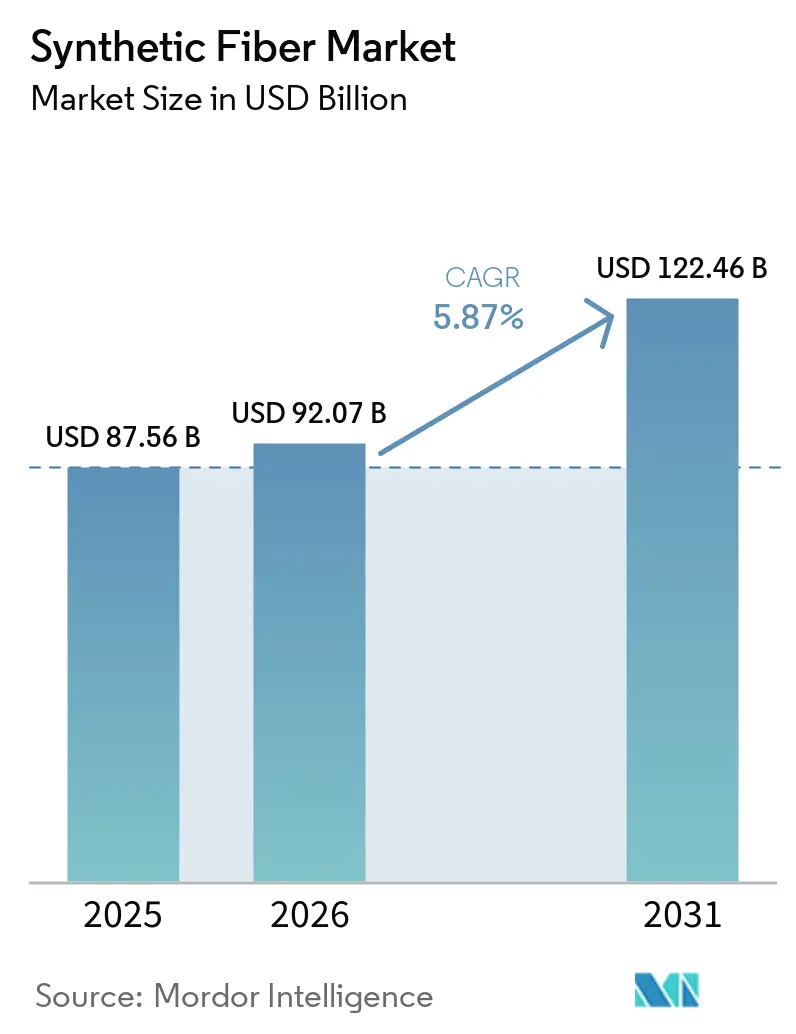
The Synthetic Fiber market size was valued at USD 87.56 billion in 2025 and is estimated to grow from USD 92.07 billion in 2026 to reach USD 122.46 billion by 2031, at a CAGR of 5.87% during the forecast period (2026-2031). Cost competitiveness relative to natural fibers continues to support broad use in apparel, furnishings, industrial textiles, and nonwovens. Demand is also growing in medical disposables, filtration media, electric vehicle components, and geotextiles, where material performance carries greater weight in purchase decisions. Recycled-content requirements are changing procurement practices and directing capital toward recycling technologies across the value chain. This combination of established, high-demand applications and specialized uses provides the synthetic fiber market with a broader base of demand during the forecast period.
Key Report Takeaways
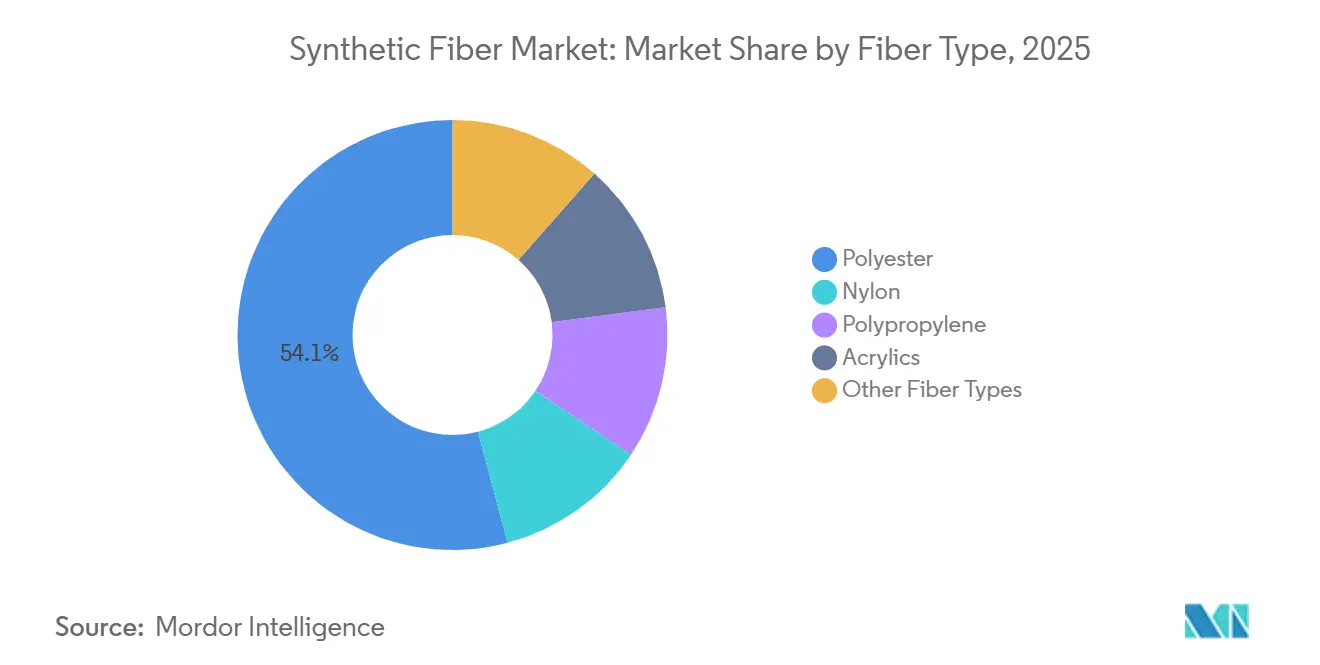
- By fiber type, polyester held 54.12% revenue share in 2025, while nylon is forecast to expand at a 6.34% CAGR through 2031.
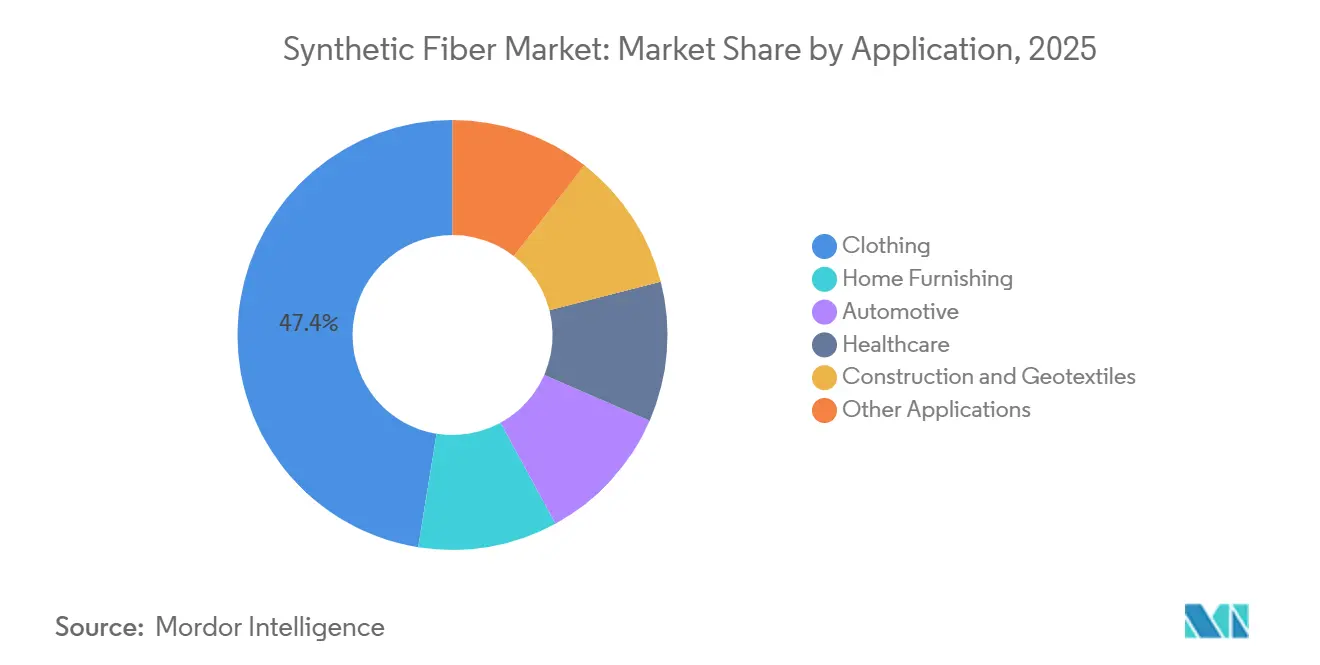
- By application, clothing accounted for 47.45% of revenue in 2025, while healthcare is forecast to expand at a 6.72% CAGR through 2031.
- By geography, Asia-Pacific accounted for 51.56% of revenue in 2025 and is forecast to expand at a 6.63% CAGR through 2031.
Note: Market size and forecast figures in this report are generated using Mordor Intelligence’s proprietary estimation framework, updated with the latest available data and insights as of January 2026.
Market Trends and Insights
Drivers Impact Analysis of Synthetic Fiber Market*
| Drivers | (~) % Impact on CAGR Forecast | Geographic Relevance | Impact Timeline |
|---|---|---|---|
| Cost and Performance Advantage Over Natural Fibers | +1.8% | Global, particularly South and Southeast Asia, and Sub-Saharan Africa | Short term (≤ 2 years) |
| Expansion of Nonwoven Hygiene, Filtration, and Medical Uses | +1.4% | Global, with strong relevance in South Asia, ASEAN, the Middle East, and Africa | Medium term (2-4 years) |
| Lightweighting Demand in Automotive and Electric Vehicles | +0.9% | North America, Europe, China, and South Korea | Long term (≥ 4 years) |
| Athleisure, Performance Wear, and E-Commerce-Enabled Apparel Demand | +1.2% | Global, led by North America, Western Europe, and the Asia-Pacific urban markets | Short term (≤ 2 years) |
| Recycled Content Mandates and Circular Procurement | +0.8% | Europe and North America, with spillover to ASEAN export supply chains | Medium term (2-4 years) |
| Source: Mordor Intelligence | |||
Cost and Performance Advantage Over Natural Fibers
Synthetic fibers retain a cost advantage over natural alternatives, particularly cotton. Cotton supply faces constraints related to water availability, climate variability, and competition for agricultural land. Polyester staple fiber has typically been priced at a 20-35% discount to comparable cotton grades, which supports purchasing decisions by garment producers and technical textile manufacturers. Consistent quality, repeatable tensile performance, and compatibility with high-speed machinery further support the selection of synthetic materials. These factors keep polyester and polypropylene central to applications in the synthetic fiber market, including apparel, home furnishings, and industrial nonwovens.
Expansion of Nonwoven Hygiene, Filtration, and Medical Uses
Medical and hygiene nonwovens account for a growing share of global synthetic fiber output. Demand in this segment is less exposed to apparel purchasing cycles and is driven by applications with strict performance requirements. Spunbond-meltblown-spunbond fabrics are used in surgical gowns, drapes, filtration media, and protective products. Stronger infection-control practices have sustained demand across hospitals and home healthcare settings. Healthcare expansion in Saudi Arabia, Nigeria, and Bangladesh is broadening fiber demand beyond markets previously led by apparel. Polypropylene remains widely used in hygiene nonwovens, while polyester and nylon are used in higher-barrier applications that require thermal stability and tensile strength.
Lightweighting Demand for Automotive and Electric Vehicles
Vehicle electrification is increasing interest in synthetic fiber composites for structural and semi-structural parts. Hybrid carbon- and glass-fiber composites can achieve a 45% weight reduction compared with conventional steel while maintaining structural strength[1]“Machine Learning-Accelerated Materials Genome Design of Hybrid Fiber Composites for Electric Vehicle Lightweighting,” Journal of Polymer and Composites, doi.org.. Lower vehicle mass can improve the range of battery-electric vehicles. Nylon is used in under-hood parts and transmission housings that require heat resistance. Polyester fiber composites are used in interior trim, acoustic insulation, and cargo-area linings. Kia's work with Bcomp on panels for the Concept EV2 reflects continued interest in fiber-based interior materials.
Athleisure, Performance Wear, and E-Commerce-Enabled Apparel Demand
Athleisure and casualwear continue to support demand for performance fabrics. Polyester and nylon are commonly used in moisture management, stretch, and durable apparel constructions. Online apparel sales favor fabrics that retain shape through storage, shipping, and repeated handling. Digital product information also provides brands with a direct channel to disclose recycled content, fiber origin, and care guidance, which can make traceable recycled yarns more useful for product positioning. Apparel demand, therefore, remains important to the synthetic fiber market, even as other applications grow more rapidly.
Restraints Impact Analysis of Synthetic Fiber Market*
| Restraints | (~) % Impact on CAGR Forecast | Geographic Relevance | Impact Timeline |
|---|---|---|---|
| Purified Terephthalic Acid (PTA), Monoethylene Glycol (MEG), And Petrochemical Feedstock Price Volatility | -0.6% | Global, with strong exposure in India, ASEAN, and Europe | Short term (≤ 2 years) |
| China-Led Capacity Expansion and Margin Compression | -0.5% | Global, with the strongest effects outside China and among non-integrated producers | Medium term (2-4 years) |
| Microfiber Shedding and Non-Biodegradability Concerns | -0.3% | Europe, North America, and Japan, with increasing awareness in the Asia-Pacific | Long term (≥ 4 years) |
| Source: Mordor Intelligence | |||
PTA, MEG, and Petrochemical Feedstock Price Volatility
Feedstock price volatility remains an immediate operating risk for synthetic fiber producers. PTA and MEG prices in India rose within two weeks in early 2026 following disruptions to petroleum flows through the Strait of Hormuz. Finished fiber prices tend to adjust more slowly than input costs, and this timing difference can result in inventory losses and pressure on conversion margins. Producers with refining or PTA integration have greater control over their cost base than standalone mills. Price volatility can therefore widen the profitability gap between integrated producers and smaller operators in India, Turkey, and Southeast Asia.
Microfiber Shedding and Non-Biodegradability Concerns
Microfiber shedding and non-biodegradability remain long-term concerns for conventional synthetic fibers. Policy attention around textile waste, microplastic release, and producer responsibility has increased. California's Responsible Textile Recovery Act of 2024 established a framework for textile collection, repair, reuse, and recycling[2]“Responsible Textile Recovery Act of 2024,” California State Legislature, leginfo.legislature.ca.gov.. Research has also examined production approaches that reduce microfiber release from polyester fabrics. These pressures could favor recycled, biodegradable, or lower-shedding material platforms and may require producers to invest in product design, testing, and material traceability.
*Our forecasts treat driver/restraint impacts as directional, not additive. The impact forecasts reflect baseline growth, mix effects, and variable interactions.
Synthetic Fiber Market Segment Analysis
By Fiber Type:
Polyester Scale Meets Nylon GrowthPolyester accounted for 54.12% of the synthetic fiber market share in 2025. Its position is supported by its established role in apparel, nonwoven hygiene products, filtration, and geotextiles. The material combines accessible cost, repeatable performance, and broad processing compatibility, leaving few direct alternatives in high-output applications. Producers are increasingly emphasizing differentiated grades, including ultrafine filament, flame-retardant products, and bio-based variants, reflecting a shift away from competing solely on tonnage and price.
Polypropylene serves distinct requirements in medical and hygiene nonwovens and construction geotextiles. Its low density and resistance to moisture absorption support efficient processing in those applications. Acrylic fibers continue to be used in home textiles and knitwear in colder climates, though their use is under pressure from polyester blends, which offer similar performance at a lower cost. Nylon is the fastest-growing fiber type, with its synthetic fiber market size projected to grow at a 6.34% CAGR through 2031. Demand comes from automotive textiles, industrial filtration, and performance apparel, where higher strength and heat resistance justify a price premium.



By Application:
Healthcare Broadens Demand Beyond ClothingClothing captured 47.45% of the synthetic fiber market share in 2025. The segment remains significant because high-performance polyester and nylon fabrics are well established in athleisure, casualwear, and fast-fashion supply chains. Digital retail supports materials that retain shape during multi-channel logistics and repeated handling. Home furnishings are another major application for polyester-filled bedding, upholstery yarns, and nylon carpet fibers, with replacement demand and household formation in South and Southeast Asia supporting this segment. Automotive use includes nylon airbag fabric, polyester seat padding, acoustic nonwovens, and fiber composites used in vehicle interiors and components.
Construction and geotextiles represent a further source of demand for polypropylene and polyester. Infrastructure development in the Middle East, Africa, and India supports use in soil stabilization, drainage, and erosion control. Healthcare is the fastest-growing application, with the synthetic fiber market size for this segment projected to advance at a 6.72% CAGR through 2031. Disposable nonwovens remain important in surgical, filtration, hygiene, and home healthcare uses. Higher-grade surgical fabrics and antimicrobial wound-care substrates achieve higher realizations than commodity polyester used in apparel. Biodegradable nonwovens, including polylactic acid-based materials, could gain relevance as health systems incorporate sustainability requirements into purchasing decisions.
Geography Analysis
APAC Synthetic Fiber Market
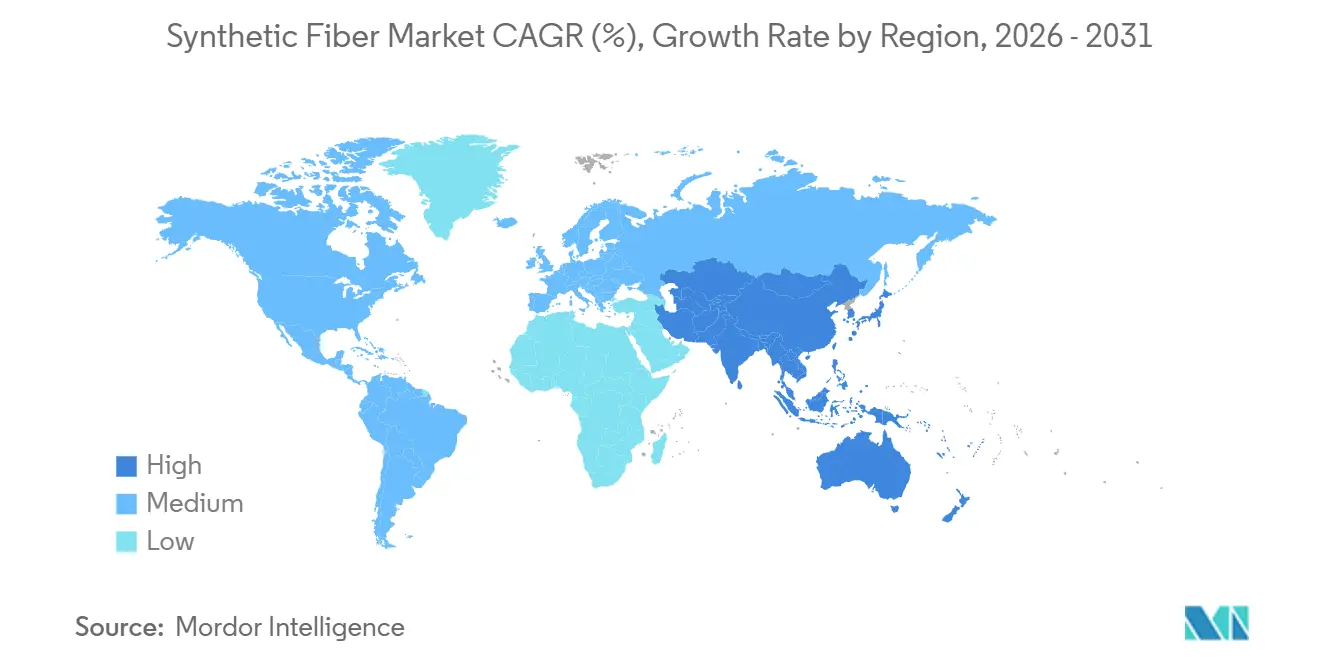
Asia-Pacific held 51.56% of global market value in 2025 and is projected to grow at a 6.63% CAGR through 2031. The region plays a central role in global supply and demand for polyester, nylon, polypropylene, and other synthetic fibers. China's strong integration across refining, petrochemical feedstocks, and fiber spinning supports a competitive cost base. India and ASEAN countries are adding capacity and meeting growing regional consumption needs. Changes in trade rules can redirect flows quickly within the region. South Korea and Japan retain important positions in specialty nylon, spandex, high-performance polyester, and composite materials.
APAC, North America and Europe Synthetic Fiber Market
Asia-Pacific's position in the synthetic fiber market is reinforced by its large apparel and industrial production base. Chinese producers are managing excess capacity through consolidation and an increased focus on differentiated grades. Indian producers are adding capacity ahead of expected growth in domestic apparel demand. Japanese companies continue to develop high-performance fibers and composite materials for automotive and industrial applications. North America and Europe are more focused on specialty grades and recycled materials than on high-output virgin fiber production. Higher energy and feedstock costs have reduced the competitiveness of some European upstream assets.
The Americas and MEA Synthetic Fiber Market
North America continues to generate demand for technical textiles, automotive applications, and recycled products. Mexico's nearshore role supports fiber demand across apparel and automotive supply chains serving US brands. South America, the Middle East, and Africa represent growing consumption areas despite limited domestic production capacity. Brazil combines apparel demand, agricultural geotextile use, and a developing recycled polyethylene terephthalate (PET) value chain. Saudi Arabia, Nigeria, and South Africa each contribute distinct sources of infrastructure, textile, and regional processing demand for the synthetic fiber market.

Competitive Landscape
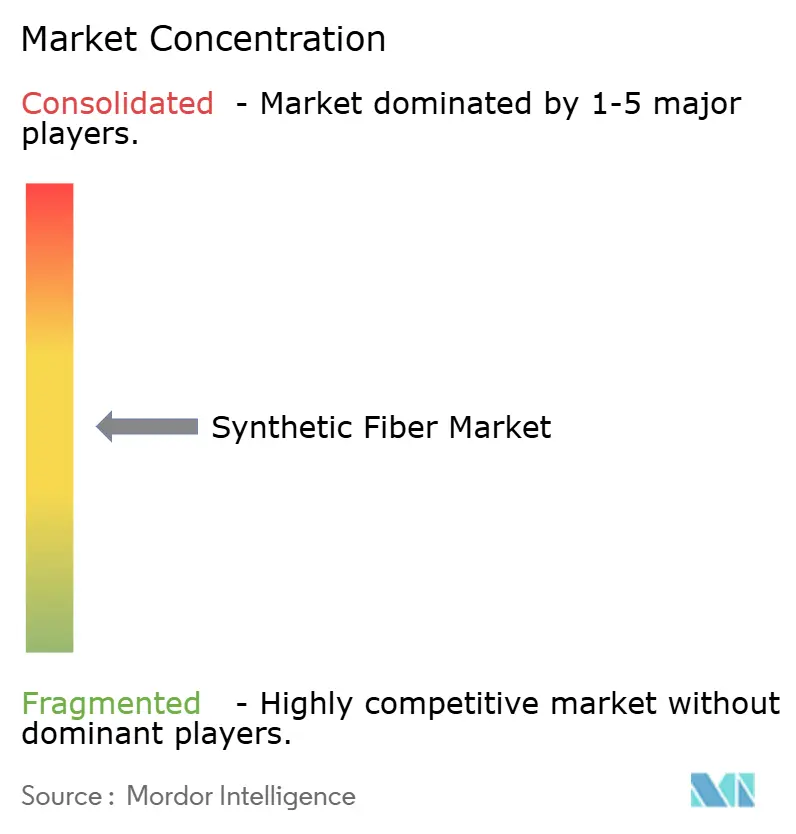
The synthetic fiber market is moderately fragmented. Hengli Group, Tongkun Holding, Indorama Ventures, Reliance Industries, and Toray Industries are among the integrated producers with significant access to feedstocks and manufacturing capabilities. Smaller mills often compete through conversion margins, local service, and product specialization. The competitive position of large producers is strengthened when refining, petrochemicals, polymer production, and fiber spinning are vertically linked. This integration can reduce exposure to feedstock price volatility and supply disruptions.
Competitive strategies increasingly focus on recycled content, bio-based materials, and application-specific technical development. Indorama Ventures and Jiaren Chemical Recycling formed a joint venture in November 2025 to expand textile-to-textile recycled PET capacity. UNIFI reported that its REPREVE platform recycled the equivalent of 1 billion T-shirts' worth of textile and yarn waste by fiscal year 2025. In May 2026, Toray Industries and PTT Global Chemical developed manufacturing technology for 100% bio-based nylon 66 using a bio-based feedstock route, with commercial textile products targeted for fiscal year 2028. These investments aim to address demand for circularity and improved material performance.
Chemical recycling for blended textiles remains technically difficult at an industrial scale, and fully bio-based, high-tenacity synthetic fibers have not yet been commercialized at scale. Biodegradable additive technologies represent another response to regulatory and customer concerns over microfiber pollution. UNIFI launched REPREVE with CiCLO technology in April 2025 for recycled polyester and nylon applications. These developments support differentiation in the synthetic fiber market while commodity capacity continues to shape price competition.
Synthetic Fiber Industry Leaders
Indorama Ventures Public Company Limited
China Petrochemical Corporation
Reliance Industries Limited
TORAY INDUSTRIES, INC.
Far Eastern New Century Corporation
- *Disclaimer: Major Players sorted in no particular order
Synthetic Fiber Market Companies Covered in this Report
- Alpek S.A.B. de C.V.
- China Petrochemical Corporation
- Far Eastern New Century Corporation
- Hengli Group Co., Ltd.
- HYOSUNG TNC
- Indorama Ventures Public Company Limited
- Kolon Industries, Inc.
- Reliance Industries Limited
- Shenghong Holding Group
- Teijin Limited
- Tongkun Holding Group
- TORAY INDUSTRIES, INC.
- TOYOBO CO., LTD.
- UNIFI, Inc.
- Xin Feng Ming Group

Recent Industry Developments in Synthetic Fiber Market
- August 2026: Hengyi Petrochemical announced plans to construct a 400,000-ton/year Polyamide 6 (PA6) melt direct-spinning project through its subsidiaries Guangxi Hengyi New Materials and Hangzhou Yizhijin New Materials. The project involves a total investment of CNY 4.87 billion (~USD 675 million) and an 18-month construction timeline, amid existing oversupply in the global PA6 market.
- May 2026: Toray Industries and PTT Global Chemical (GC) jointly developed a manufacturing technology for 100% bio-based nylon 66 (PA66) using bio-based adipic acid derived from cassava fermentation, with a commercial textile product launch targeted for FY2028, offering an alternative to petroleum-derived PA66 for premium textile applications.


Global Synthetic Fiber Market Report Scope
Synthetic fibers are man-made materials produced by linking small chemical units called monomers into long polymer chains, typically using petroleum or coal byproducts.
The synthetic fiber market is segmented by fiber type, application, and geography. By fiber type, the market is segmented into polyester, nylon, polypropylene, acrylics, and other fiber types. By application, the market is segmented into clothing, home furnishing, automotive, healthcare, construction, geotextiles, and other applications. The report also covers market size and forecasts for the synthetic fiber across 15 countries in major regions. The market sizes and forecasts are provided in terms of value (USD).
| Polyester |
| Nylon |
| Polypropylene |
| Acrylics |
| Other Fiber Types |
| Clothing |
| Home Furnishing |
| Automotive |
| Healthcare |
| Construction and Geotextiles |
| Other Applications |
| Asia-Pacific | China |
| India | |
| Japan | |
| South Korea | |
| ASEAN Countries | |
| Rest of Asia-Pacific | |
| North America | United States |
| Canada | |
| Mexico | |
| Europe | Germany |
| United Kingdom | |
| France | |
| Italy | |
| NORDIC Countries | |
| Rest of Europe | |
| South America | Brazil |
| Argentina | |
| Rest of South America | |
| Middle East and Africa | Saudi Arabia |
| South Africa | |
| Rest of Middle East and Africa |
| By Fiber Type | Polyester | |
| Nylon | ||
| Polypropylene | ||
| Acrylics | ||
| Other Fiber Types | ||
| By Application | Clothing | |
| Home Furnishing | ||
| Automotive | ||
| Healthcare | ||
| Construction and Geotextiles | ||
| Other Applications | ||
| By Geography | Asia-Pacific | China |
| India | ||
| Japan | ||
| South Korea | ||
| ASEAN Countries | ||
| Rest of Asia-Pacific | ||
| North America | United States | |
| Canada | ||
| Mexico | ||
| Europe | Germany | |
| United Kingdom | ||
| France | ||
| Italy | ||
| NORDIC Countries | ||
| Rest of Europe | ||
| South America | Brazil | |
| Argentina | ||
| Rest of South America | ||
| Middle East and Africa | Saudi Arabia | |
| South Africa | ||
| Rest of Middle East and Africa | ||


Key Questions Answered in the Report
What is current market size of Synthetic Fiber Market?
The Synthetic Fiber market size was valued at USD 87.56 billion in 2025 and is estimated to grow from USD 92.07 billion in 2026 to reach USD 122.46 billion by 2031, at a CAGR of 5.87% during the forecast period (2026-2031).
Which fiber type has the largest share of synthetic fiber demand?
Polyester accounted for 54.12% of revenue in 2025 because it is widely used in apparel, nonwovens, filtration, and geotextiles.
What application is growing fast for synthetic fibers?
Healthcare is forecast to grow at a 6.72% CAGR through 2031 as disposable medical nonwovens, filtration media, and hygiene products see wider use.
Which region leads to global synthetic fiber demand?
Asia-Pacific held 51.56% of global value in 2025 and is forecast to grow at a 6.63% CAGR through 2031.
Page last updated on:





