
Market Overview
| Study Period | 2020 - 2031 |
|---|---|
| Forecast Data Period | 2026 - 2031 |
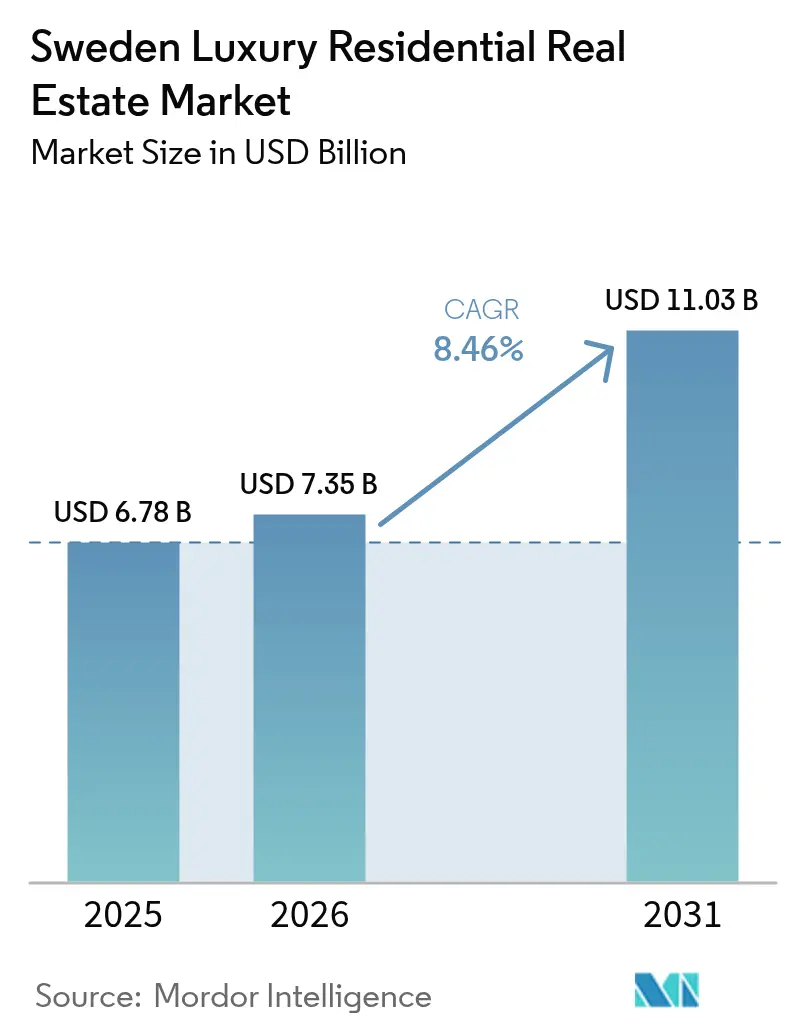
| Base Year Market Size (2025) | USD 6.78 Billion |
| Market Size (2026) | USD 7.35 Billion |
| Market Size (2031) | USD 11.03 Billion |
| Growth Rate (2026 - 2031) | 8.46 % |
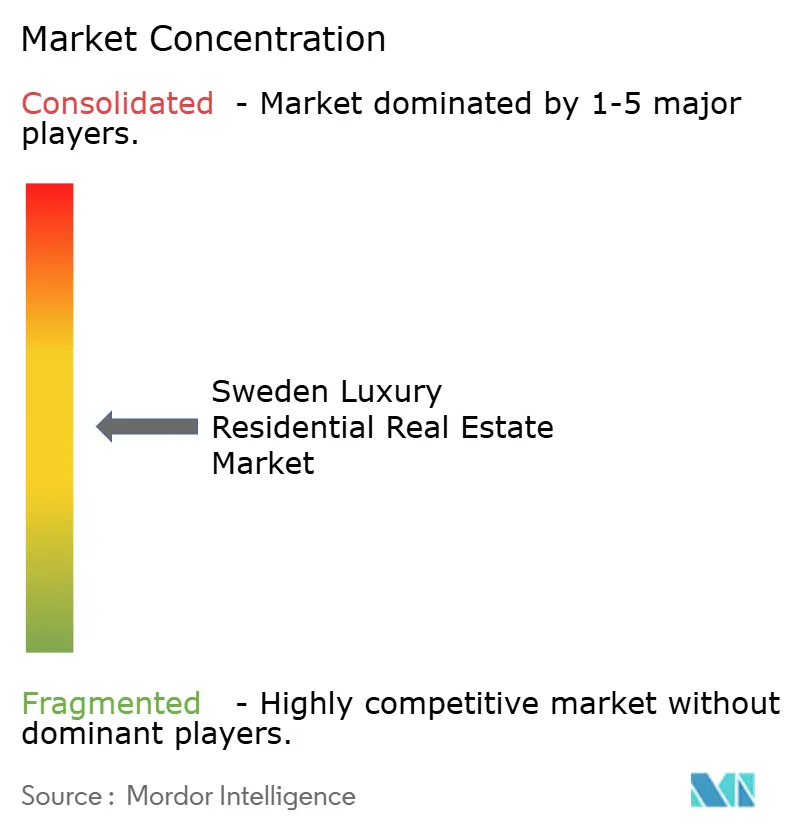
| Market Concentration | Medium |
Major Players *Disclaimer: Major Players sorted in no particular order Image © Mordor Intelligence. Reuse requires attribution under CC BY 4.0. | |
Sweden Luxury Residential Real Estate Market Analysis by Mordor Intelligence
The Sweden luxury residential real estate market size was valued at USD 6.78 billion in 2025 and estimated to grow from USD 7.35 billion in 2026 to reach USD 11.03 billion by 2031, at a CAGR of 8.46% during the forecast period (2026-2031). The upswing mirrors robust inflows from ultra-high-net-worth (UHNW) buyers who view prime Swedish homes as a safe-haven hedge and a krona-discounted store of value. Exchange-rate advantages, accommodative monetary policy, and a transparent legal framework have collectively pushed demand beyond the pace at which new stock can be delivered. Developers continue to face zoning bottlenecks, yet institutional investors deploy fresh capital into income-generating rental formats to capture predictable yields while domestic households preserve wealth through direct ownership. Tight supply, deepening digitalization, and rising wellness expectations provide fertile ground for price appreciation and product innovation in the Sweden luxury residential real estate market
Key Report Takeaways
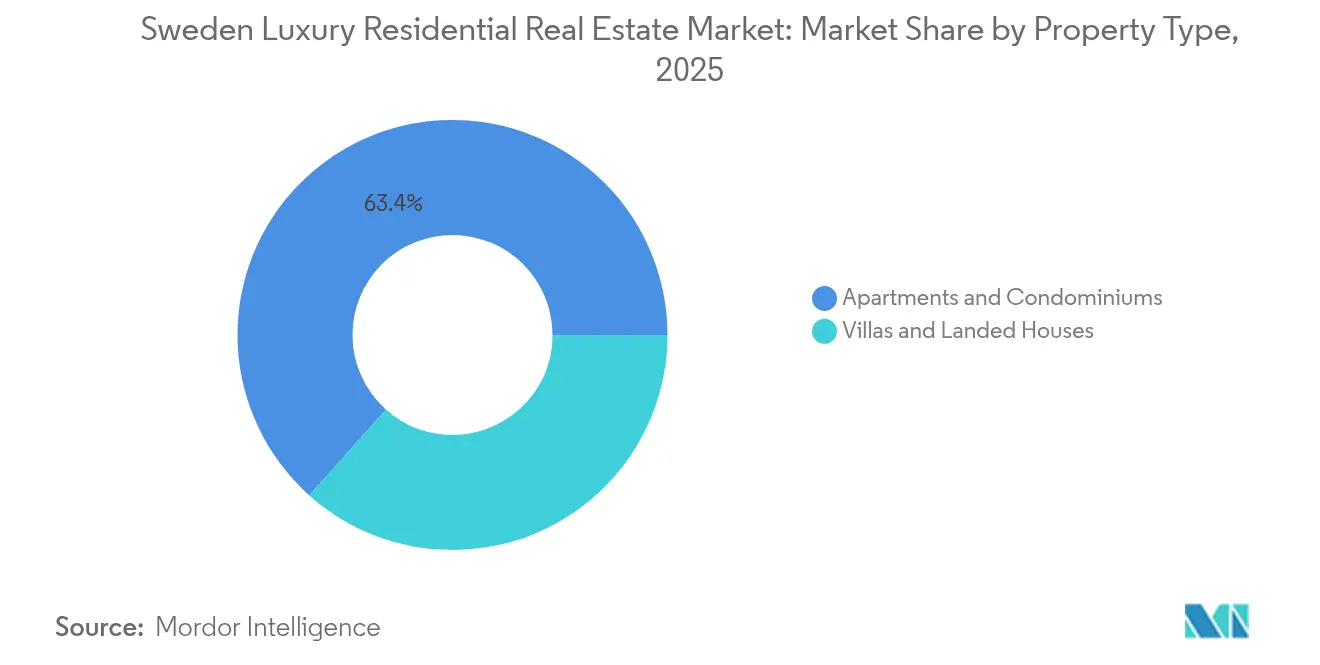
- By property type, apartments and condominiums led with 63.40% of the Sweden luxury residential real estate market revenue share in 2025. The Sweden luxury residential real estate market for villas and landed houses is projected to expand at an 8.72% CAGR between 2026-2031.
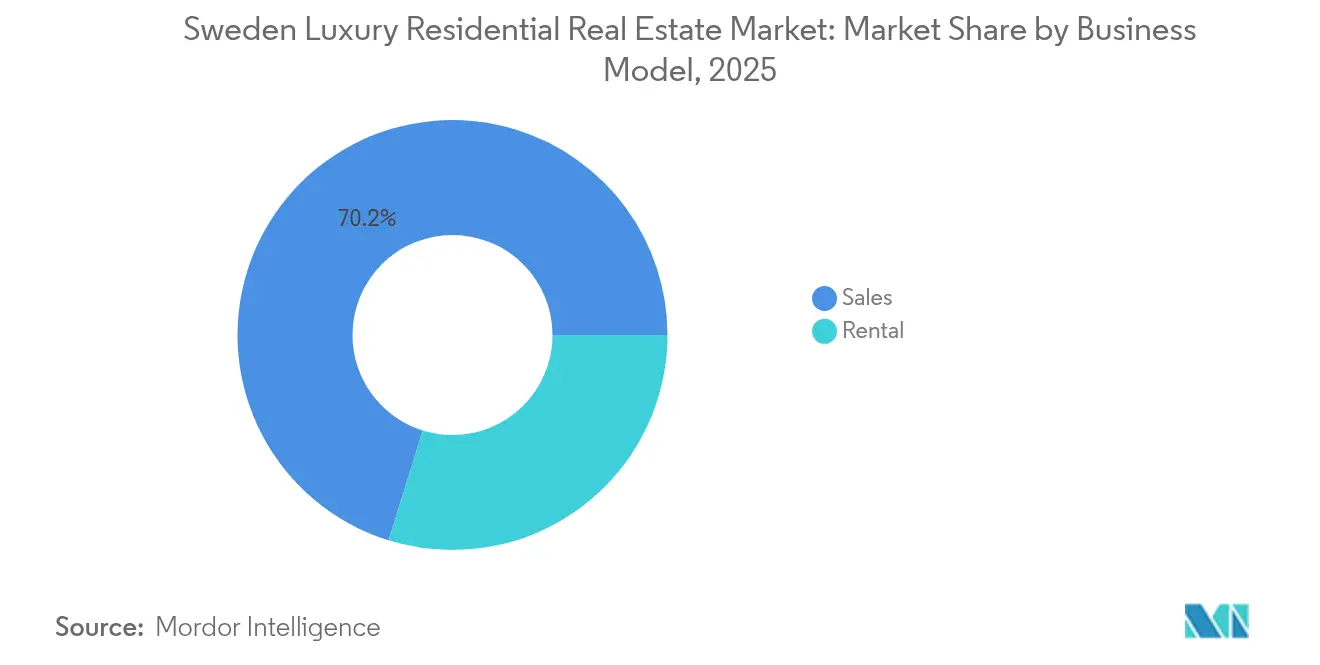
- By business model, sales transactions held 70.20% of the Sweden luxury residential real estate market share in 2025. The Sweden luxury residential real estate market for rentals is advancing at a 9.35% CAGR between 2026-2031.
- By mode of sale, secondary transactions accounted for 58.30% of the Sweden luxury residential real estate market size in 2025. The Sweden luxury residential real estate market for new-build activity is projected to grow at 8.93% CAGR between 2026-2031.
- By geography, Stockholm commanded 45.60% the Sweden luxury residential real estate market's national value in 2025. The Sweden luxury residential real estate market for Malmö is the fastest-growing city at 9.58% CAGR between 2026-2031.
Note: Market size and forecast figures in this report are generated using Mordor Intelligence’s proprietary estimation framework, updated with the latest available data and insights as of 2026.
Sweden Luxury Residential Real Estate Market Trends and Insights
Drivers Impact Analysis*
| Driver | (~) % Impact on CAGR Forecast | Geographic Relevance | Impact Timeline |
|---|---|---|---|
| Robust UHNW inflows & Sweden's safe-haven appeal | +2.1% | Stockholm, Gothenburg | Long term (≥ 4 years) |
| Negative / low real interest rates fueling hard-asset allocation | +1.8% | Nationwide, concentrated in metropolitan areas | Medium term (2-4 years) |
| Second-home demand from EU & UK buyers seeking krona discount | +1.2% | Coastal regions, archipelago, ski resorts | Short term (≤ 2 years) |
| Tokenized property platforms enabling crypto-wealth deployment | +0.9% | Stockholm and Gothenburg tech corridors | Medium term (2-4 years) |
| Wellness-centric “healthy homes” commanding premiums | +0.7% | Urban cores and high-end suburban projects | Long term (≥ 4 years) |
| Stockholm's tech-talent boom boosting prime residential demand | +0.6% | Greater Stockholm | Medium term (2-4 years) |
| Source: Mordor Intelligence | |||
Robust UHNW Inflows & Sweden's Safe-Haven Appeal
Sweden’s neutral foreign policy, rock-solid legal institutions, and AAA credit rating keep drawing UHNW families that want to shift capital away from volatile financial assets. Foreign ownership of second homes jumped 6.3% in 2024, and purchases concentrated on Stockholm’s archipelago islands and Gothenburg’s waterfront, where trophy assets trade almost entirely in cash. Low property taxes and no foreign-buyer restrictions make entry frictionless, turning the Sweden luxury residential real estate market into a preferred diversification play. This unlevered capital inflow cushions price cycles, lifts liquidity in the top quartile, and raises the bar for local bidders. The resulting depth of global demand underpins long-run appreciation prospects, even when domestic cycles soften.
Negative/Low Real Interest Rates Fueling Hard-Asset Allocation
The Riksbank trimmed its policy rate from 4.0% to 3.75% and signaled more cuts, keeping real rates negative once house-price inflation is factored in. Affluent Swedes hold financial assets worth SEK 16 trillion (USD 1.5 trillion), and roughly 79% of household borrowing already flows into housing. Cheap leverage allows domestic buyers to scale up, while foreign investors exploit both the rate spread and krona weakness to lock in superior yields. The stance strengthens asset valuations and absorbs supply faster than it can be replenished, thereby nurturing the Sweden luxury residential real estate market’s compound growth.
Second-Home Demand from EU & UK Buyers Seeking Krona Discount
The krona has fallen 13% against the euro since 2022, creating a window for European and British buyers to secure Scandinavian lifestyle assets at an implicit discount. Many cash-rich households dissatisfied with post-Brexit UK housing prospects switched sights to Sweden’s coast and ski territories, where sticker prices remain below historic peaks. Currency-arbitrage purchases also spill into the short-let segment, supplying high-yield inventory to Sweden’s expanding tourism pipeline. This cross-border appetite injects liquidity during periods of subdued domestic turnover and stabilizes high-end prices in the Sweden luxury residential real estate market.
Tokenized Property Platforms Enabling Crypto-Wealth Deployment
Stockholm’s fintech scene incubates blockchain venues that fractionalize luxury homes and settle in cryptocurrency. Early-stage platforms target prime districts where rental yields and liquidity justify tokenized structures, opening segments previously accessible only to institutions. Progressive regulators and cutting-edge digital infrastructure make Sweden one of Europe’s easiest venues for compliant tokenization. As crypto-wealth seeks regulated bricks-and-mortar exposure, token deals are expected to grow in share, add transparency, and accelerate closing times across the Sweden luxury residential real estate market.
Restraints Impact Analysis*
| Restraint | (~) % Impact on CAGR Forecast | Geographic Relevance | Impact Timeline |
|---|---|---|---|
| Scarce developable land & tight zoning in core cities | -1.4% | Stockholm, Gothenburg, Malmö urban cores | Long term (≥ 4 years) |
| Stricter energy-efficiency retrofit capex for heritage stock | -0.8% | Historic districts nationwide | Medium term (2-4 years) |
| Climate-risk-driven insurance spikes on coastal assets | -0.6% | Archipelago and other waterfront zones | Long term (≥ 4 years) |
| Supply-side squeeze from construction-sector bankruptcies | -0.5% | Nationwide, acute in major metros | Short term (≤ 2 years) |
| Source: Mordor Intelligence | |||
Scarce Developable Land & Tight Zoning in Core Cities
Geographic constraints and heritage-heavy districts cap the volume of fresh luxury housing that can realistically be built in Sweden’s top three cities. Planning approvals require lengthy consultation, and minimum lot sizes or building-height limits prevent density upgrades. Supply scarcity entrenches resale premiums, yet it also suppresses transaction velocity and sidelines buyers priced out of mature enclaves[1]Karin Wanngård, “Detaljplan Statistics 2025,” Stockholm Municipality, start.stockholm. The net effect is a structural drag on overall absorption and the long-run expansion of the Sweden luxury residential real estate market.
Stricter Energy-Efficiency Retrofit Costs for Heritage Stock
Sweden’s climate strategy obliges owners of pre-2000 buildings to deploy extensive insulation, ventilation, and renewable upgrades, especially in landmark areas. Retrofitting protected façades can add 15-25% to acquisition budgets, deterring some cross-border buyers who prefer turnkey efficiency. Compliance elevates capex and prolongs renovation cycles, leveling down the CAGR trajectory[2]Anders Sjelvgren, “Energy Efficiency Standards for Existing Buildings 2025,” Boverket, boverket.se. Yet assets that successfully combine heritage charm with low operating loads often achieve meaningful price premiums, offsetting part of the initial restraint in the Sweden luxury residential real estate market.
*Our forecasts treat driver/restraint impacts as directional, not additive. The impact forecasts reflect baseline growth, mix effects, and variable interactions.
Segment Analysis
By Property Type: Apartments, Anchor Urban Luxury Demand
Apartments and condominiums captured a 63.40% slice of 2025 turnover as global investors favor maintenance-light, centrally located assets with concierge services. Secondary apartments in Östermalm, Södermalm, and Vasastan trade quickly, supported by liquid resale channels and robust furnished-rental yields. Developers escalate amenity packages to differentiate new inventory, bundling fitness studios, shared rooftop gardens, and EV-ready parking into mid-rise designs. Foreign buyers like the instant usability and straightforward governance of Swedish condominium associations, translating into sustained demand even when credit conditions tighten.Villas and landed homes, while smaller in value terms, chart the fastest growth at 8.72% CAGR as privacy-seeking executives and cash-rich EU buyers pursue coastal and archipelago retreats. Large land plots around Lidingö, Djursholm, and Saltsjöbaden realize above-trend premiums owing to zoning limits that keep new supply muted. The Sweden luxury residential real estate market share for villas could edge toward 39.50% by 2031 if construction capacity recovers. Upsizing families target hybrid working layouts, biophilic design, and garden space, while high-net-worth foreigners treat waterfront estates as long-term capital stores and seasonal leisure bases.



By Business Model: Ownership Prevails but Rentals Accelerate
Sales still dominate with 70.20% of market activity as UHNW buyers lean into direct ownership for wealth preservation and lifestyle certainty. Cash continues to displace leverage at the top tier, aided by krona-linked discounts and thin transaction-cost friction. Brokers report a surge in off-market deals, signaling deeper liquidity and heightened privacy in the Sweden luxury residential real estate market for sales transactions. Developers focus on turnkey finishes to limit buyer-side renovation exposure and accelerate closes within a competitive pipeline.Rental formats, however, post a 9.35% CAGR thanks to institutional capital chasing predictable cash flows. Build-to-rent (BTR) campuses around emerging sub-markets such as Flemingsberg and Hagastaden absorb tech-sector talent and corporate expatriates, offering flex tenures with hotel-grade services. Tokenization and co-living hybrids further expand access for younger professionals who prize mobility over homeownership. Luxury landlords attain premium gross yields in a city with stringent rent control on conventional stock, supporting a solid risk-adjusted return stack in the Sweden luxury residential real estate market.
By Mode of Sale: Secondary Assets Hold the Lead
Resale homes represented 58.30% of 2025 deal flow as historically significant apartments and villas change hands within ultra-affluent circles. These addresses hold irreplicable waterfront or heritage footprints, and scarcity inflates price per square foot. The Sweden luxury residential real estate market share tied to secondary stock should soften marginally yet remain dominant, because zoning and environmental impact assessments limit the pipeline of new projects. High-resolution virtual tours and data-rich reporting have shortened the marketing cycle, enabling global bidders to commit without extensive site visits.Primary, or new-build, inventory is projected to grow at 8.93% CAGR through 2031, lifted by developers who embed wellness technology, ESG credentials, and smart-home platforms from inception. Miljöbyggnad Silver and higher certifications are becoming baseline, and buyers pay a premium for on-site solar, grey-water recycling, and passive-house envelopes. Bankruptcies in the construction sector are slowing the initiation of new projects, causing Sweden's luxury residential real estate market for newly built homes to remain constrained until labor and material constraints are resolved.
Geography Analysis
Stockholm anchors national luxury demand with 45.60% of 2025 value. The city fuses financial services scale with a thriving startup ecosystem that minted five unicorns in 2024 alone, enriching a new cadre of cash-opted buyers. Prime islands such as Djurgården, Skeppsholmen, and Fjäderholmarna fetch record prices as trophy mansions become increasingly rare. On the rental side, executive relocation packages underpin double-digit annual growth for high-spec flats, a trend that stabilizes income for landlords within the Sweden luxury residential real estate market.
Malmö logs the fastest growth at a 9.58% CAGR, propelled by cross-border mobility across the Öresund Bridge that draws Danish and continental European money. Thriving life-science clusters in Medicon Village and the Västra Hamnen eco-district embed ESG DNA into new luxury stock that aligns with EU Taxonomy rules. Waterfront penthouses with geothermal heating systems regularly clear above USD 1,200 per square foot, narrowing the historic price gap with Stockholm. Improved rail connectivity will further weave Malmö into pan-Nordic executive itineraries, extending the catchment for the Sweden luxury residential real estate market beyond domestic demand.
Gothenburg and Uppsala play complementary roles. In Gothenburg, C-suite executives from Volvo Group, Northvolt, and SKF find a unique blend of port-city commerce and archipelago leisure. Submarkets such as Änggården and Hovås enjoy stability, as buyers seek a harmonious balance between city access and nature. Uppsala’s luxury sector leans into cultural charm and academic gravitas anchored by a 500-year-old university. Renovated 19th-century townhouses within walking distance of biotech hubs trade briskly, appealing to professors and global R&D executives. Both cities broaden geographic participation and add diversification pathways within the Sweden luxury residential real estate market.
Regulatory Landscape
Sweden's luxury residential development and refurbishment operate under the Planning and Building Act (PBL, 2012:546), with municipalities controlling detailed plans and building permits and the National Board of Housing, Building and Planning (Boverket) setting national building rules and guidance. Boverket issued a new regulatory structure for building rules (a successor framework to prior BBR and EKS provisions) that entered into force on July 1, 2025. The transition period allowing older rules to be used ran until June 30, 2026, so 2026 functions as a key compliance reset point for project design, documentation, and approvals.
For existing and new luxury stock, the practical regulatory pressure concentrates on performance requirements for dwellings' suitability and technical properties (including BFS 2024:11). It is also tightening around energy and systems expectations aligned with broader EU policy direction. Boverket has flagged new energy management regulations scheduled to enter into force on October 1, 2026, increasing the need for upfront engineering choices in high-end new-builds and deeper retrofit scoping for heritage and prime secondary assets, where premium pricing depends on balancing protected character with modern performance.
Value Chain Analysis
The value chain for Sweden's luxury residential real estate starts with land sourcing and planning, including municipal detailed plans and building permits. It then moves into development and project management by listed and private developers, specialist design and engineering (architecture, MEP, and sustainability or energy consultants), and construction delivery through general contractors and subcontractors. Commercialization is handled through broker networks and branded luxury intermediaries, including global franchises and Swedish boutiques, while financing involves domestic banks, private wealth, and institutional capital, especially for premium rental and build-to-rent formats. Ongoing operations include property management and concierge services, as well as retrofit contractors supporting energy upgrades and wellness-led renovations.
Bottlenecks tend to show up in entitlement lead times upstream, and construction capacity and subcontractor working-capital availability downstream. This has raised the importance of alternative supply-chain finance tools and tighter procurement. Recent Greater Stockholm project activity illustrates how these constraints shape the pipeline: Wallin submitted the first building permit application in June 2026 for the Margo project (110 units) within Parkstaden Arstafaltet, and Sveafastigheter began construction in June 2026 on the Hedvig project in Spanga (127 units). Fabege's subsidiary Birger Bostad started production in July 2026 on 132 units in Haga Norra, with multiple completions clustered around 2028. Together, these moves point to permit processing, contractor availability, and phased district development as key drivers of new premium-adjacent supply in Stockholm's highest-demand submarkets.
Competitive Landscape
Fragmentation remains the hallmark of Sweden's luxury residential real estate market competitiveness. International franchises such as Sotheby’s International Realty, Christie’s International Real Estate, and Engel & Völkers devote resources to Stockholm and coastal trophy niches, but none surpass a double-digit national share. Swedish boutiques like Fantastic Frank, ESNY and Bjurfors Premium exploit hyper-local data, Scandinavian design aesthetics and curated digital storytelling to capture clientele that values discretion. Technology serves as the main battlefield: virtual-reality walk-throughs, blockchain escrow, AI-assisted valuation engines, and white-label tokenization solutions differentiate brokers in a crowded field.
Developers integrate vertical services, spinning up in-house brokerage and asset-management arms to retain end-to-end control over brand experience. Institutional investors break into the sales space via branded-residence concepts and long-lease strata, while prop-tech start-ups advertise instantaneous purchase offers or co-investment clubs to younger millionaires. Partnerships escalate; JLL’s cross-border advisory, EQT’s BTR roll-out, and Boverket’s permit streamlining each lower friction in capital deployment or approvals, thereby raising the sophistication ceiling in the Sweden luxury residential real estate market.
Barriers to scale persist. Zoning heterogeneity, linguistic nuance in contracts, and hyper-local buyer cultures impede the network benefits that usually crown a single national champion. Consequently, the top five intermediaries still control well under 35% of transaction value. The situation keeps fee margins healthy for specialized advisers while incentivizing continual innovation in client acquisition and retention. Ecosystem participants who blend Scandinavian authenticity with global reach stand to expand their share fastest in the Sweden luxury residential real estate market.
Sweden Luxury Residential Real Estate Industry Leaders
Sotheby’s International Realty Sweden
Skeppsholmen Sotheby’s
Eklund Stockholm New York (ESNY)
Bjurfors Premium
Svensk Fastighetsförmedling Luxury
- *Disclaimer: Major Players sorted in no particular order

Market Opportunities and Future Outlook
Regulatory and technology changes are creating a more defined execution pathway for premium new-build and renovation-led strategies. Boverket's post-transition building-rule framework, where the old rules were usable only until June 30, 2026, together with the scheduled October 1, 2026 energy management regulations, shifts competitive dynamics toward developers and owners that can document performance, deliver compliant technical solutions, and package ESG-grade specifications as part of the luxury proposition. On the permitting side, the government published Prop. 2025/26:180 in March 2026 to modernize and simplify rules around building alterations, and a June 2026 legislative referral proposed clarifications to building-permit requirements for specific residential extensions. This supports more predictable scoping for high-value refurbishments when heritage constraints and energy upgrades overlap.
Transaction digitization is also a near-term opportunity, since it reduces search and marketing friction and supports buyer confidence for remote and cross-border demand. In 2026, Hemnet introduced an integrated app in ChatGPT and launched an AI-based image tool that helps users visualize interior upgrades directly on listings. This reinforces a shift toward data-rich, digitally assisted buying journeys that can advantage premium brokers and sellers with high-quality presentation assets. Alongside the tokenization interest described in the market context, these platform and process changes create room for luxury-focused intermediaries and developers to differentiate through faster qualification, more persuasive digital storytelling, and improved documentation of building performance and renovation potential.
Recent Industry Developments
- July 2026: Fabege, via subsidiary Birger Bostad, started production of 132 residential units in Haga Norra, Stockholm, with completion planned for 2028. The project adds visible pipeline depth in a core premium catchment where entitlement and construction constraints limit new supply. It also reinforces the role of large, well-capitalized developers in securing contractor capacity and moving projects forward during uneven construction cycles.
- June 2026: Skeppsholmen Sotheby’s International Realty reported continued activity in Stockholm's premium segment, with multiple high-value listings moving through broker channels this quarter. The performance highlights liquidity in top-tier markets and strengthens the broker platform's reach for luxury transactions.
- May 2025: Stockholm Municipality rolled out a public-private framework that enabled 1,790 luxury property transactions in one month through fast-track approvals. The move highlighted how municipal process changes can accelerate throughput in tightly supplied submarkets where timing and certainty drive pricing power. Faster approvals also improve project feasibility for developers and investors targeting premium refurbishments and repositioning plays.


Research Methodology Framework and Report Scope
Market Definition and Coverage
This market is defined as the value of luxury residential properties in Sweden, where the homes are built for human occupation and are positioned as premium through location, build quality, and high-end amenities, as reflected in transaction pricing.
Scope exclusions: We exclude commercial real estate, pure land transactions without a residential unit, and non-luxury mass residential deals that do not meet the luxury price and specification thresholds used in the model.
Segmentation Overview
- By Property Type
- Apartments & Condominiums
- Villas & Landed Houses
- By Business Model
- Sales
- Rental
- By Mode of Sale
- Primary (New-build)
- Secondary (Resale)
- By City
- Stockholm
- Gothenburg
- Malmö
- Uppsala
- Other Cities
Data Sources, Market Sizing, and Validation
Desk Research
Desk research was used to set the market boundaries and to build the base time series for Sweden housing activity, pricing, and financing conditions. We reviewed public and official sources such as Statistics Sweden (SCB) housing and demographic tables, Sveriges Riksbank publications on policy rates and household borrowing, Eurostat housing price indicators, and the Swedish Mapping, Cadastral and Land Registration Authority (Lantmateriet) for property and conveyancing oriented references. We also used municipal planning portals and national building and housing oriented releases where available, since they help explain supply additions and constraints around prime locations.
To translate these signals into a market model, we added general secondary sources like annual reports and investor presentations from listed developers and property groups, reputable broker association commentary, and credible press coverage on transaction momentum in Stockholm and other key cities. Paid database subscriptions were used selectively for company financials and intelligence, plus news and financials screening that helps track major project launches, funding changes, and policy updates that can shift buyer sentiment. The sources listed above are illustrative only, and many other references were used for data collection, validation, and clarification during the research.
Primary Interviews and Surveys
Primary interviews and short surveys were completed with participants close to luxury residential transactions and development, including brokerage leaders, developers, property advisors, and select financing and legal professionals who see deal flows. We used these discussions to confirm how "luxury" is applied in Sweden by city and property type, and then to validate assumptions on discounting, time-on-market, buyer mix, and the practical effect of mortgage-rate shifts.
Distribution of primary research fieldwork respondents
| Company type | Respondent position |
|---|---|
| Top tier: 31% | CXOs: 15% |
| Mid tier: 52% | Functional/Unit leaders: 37% |
| Smaller Players: 17% | Managers: 48% |
Market-Sizing & Forecasting
Sizing was built using a combined top-down and bottom-up logic, so the totals are anchored to Sweden housing activity and then validated through price and volume checks that are visible to the market. In the top-down build, city-level transaction patterns and pricing indicators were used to reconstruct a luxury demand pool, which was then converted into value by applying a luxury share and a typical deal value for premium homes. Once that structure was set, we corroborated it using selective bottom-up approximations, such as sampled luxury listings and closes, channel checks on deal counts with brokers, and a sanity roll-up of premium project launches where details are public.
A few inputs had outsized impact and were refreshed often, including luxury price per square meter by key cities, transaction volumes and turnover, inventory tightness and time-on-market, mortgage-rate and credit availability shifts, and the mix between apartments and villas since ticket size differs. Where direct observations were thin for smaller cities, proxy ratios were applied from comparable urban markets and then adjusted using interview feedback, so gaps did not get filled with overly precise assumptions.
Forecasting was run with scenario analysis, where interest-rate paths, household income expectations, and supply delivery timing were varied within realistic bands, and then aligned with what primary respondents viewed as plausible for the next few years. The final trajectory reflects the most consistent scenario across these inputs, and it stays traceable so users can see what moved when a key variable changed.
Data Validation & Update Cycle
Validation was done in layers so a single data series did not drive the final number. Model outputs were checked against independent signals such as price index direction, broker commentary on transaction momentum, mortgage-rate movements, and observed shifts in listing supply, and then inconsistencies were investigated before sign-off.
When large variances appeared by city or property type, we rechecked assumptions and, if needed, re-contacted market participants to confirm whether the change was a real market move or a timing effect in the data. A second analyst review was completed for formulas, unit consistency, and year-to-year reasonableness checks. Reports are refreshed annually, with interim updates when material events occur, and a final pre-delivery scan is completed so clients receive the most current view available.
Mordor Intelligence's Sweden Luxury Residential Real Estate Market Sizing Compared With Other Published Estimates
It is normal to see different market sizes for luxury residential real estate, since publishers do not always align on what counts as "luxury," which cities are emphasized, and whether they size transactions, listings, or broader real estate activity linked to premium homes. Timing also matters because housing demand in Sweden can shift quickly when mortgage rates, credit terms, and buyer sentiment change.
By checking deal velocity and time-on-market by city, refreshing the SEK to USD conversion timing, and applying clear luxury price thresholds, Mordor Intelligence keeps the number tied to luxury home transactions in Sweden instead of blending in general real estate services or the entire high-value housing stock.
Benchmark comparison
| Source | Market Size | Gaps in Research Methodology |
|---|---|---|
| Mordor Intelligence | USD 6.78 B (2025) | |
| Industry Analyst Brief A | USD 13.40 B (2024) | This estimate appears to treat the market as a wider high-end residential segment value, which can combine luxury transactions with broader premium price bands, and it is anchored to a different base year that may reflect a stronger pricing period. |
| Real Estate Services Tracker B | USD 34.70 B (2025) | This number aligns more with a broad real estate activity definition that can include intermediated services and general real estate operations, so it is not limited to luxury residential property transaction value. |
Across the three values, the main drivers behind the spread are scope boundaries and what is being measured, which can be transactions only, wider high-end stock value, or real estate activity linked to the sector. We keep the final total repeatable by tying each year to observable pricing and demand indicators, and then confirming the highest-impact assumptions through local market feedback before locking the series.


Key Questions Answered in the Report
What is the current valuation of the Sweden luxury residential real estate market?
The market is valued at USD 7.35 billion in 2026 and is projected to grow to USD 11.03 billion by 2031 at an 8.46% CAGR.
Which Swedish city has the largest share of luxury residential value?
Stockholm leads with 45.60% of national turnover in 2025, reflecting its role as the country’s financial and tech center.
Are apartments or villas more popular among luxury buyers?
Apartments dominate with a 63.40% share due to urban convenience, while villas see the fastest growth at an 8.72% CAGR driven by lifestyle and privacy needs.
How are interest rates influencing luxury property demand?
Negative real interest rates and expected policy easing reduce financing costs and push both domestic and foreign investors toward hard assets like prime housing.
What role does tokenization play in Sweden’s luxury property scene?
Blockchain-based platforms are fractionalizing high-end homes, enabling cryptocurrency investors to access regulated real estate and adding liquidity to the segment.
Why is Malmö considered a high-growth luxury market?
Strong cross-border connectivity via the Öresund Bridge and sustainable waterfront development have positioned Malmö for a 9.58% CAGR through 2031.
Page last updated on:





