
Surety Insurance Market Size and Share
Market Overview
| Study Period | 2020 - 2031 |
|---|---|
| Market Size (2026) | USD 23.90 Billion |
| Market Size (2031) | USD 31.30 Billion |
| Growth Rate (2026 - 2031) | 5.60 % |
| Fastest Growing Market | Asia-Pacific |
| Largest Market | North America |
| Market Concentration | High |
Major Players *Disclaimer: Major Players sorted in no particular order Image © Mordor Intelligence. Reuse requires attribution under CC BY 4.0. | |
Surety Insurance Market Analysis by Mordor Intelligence
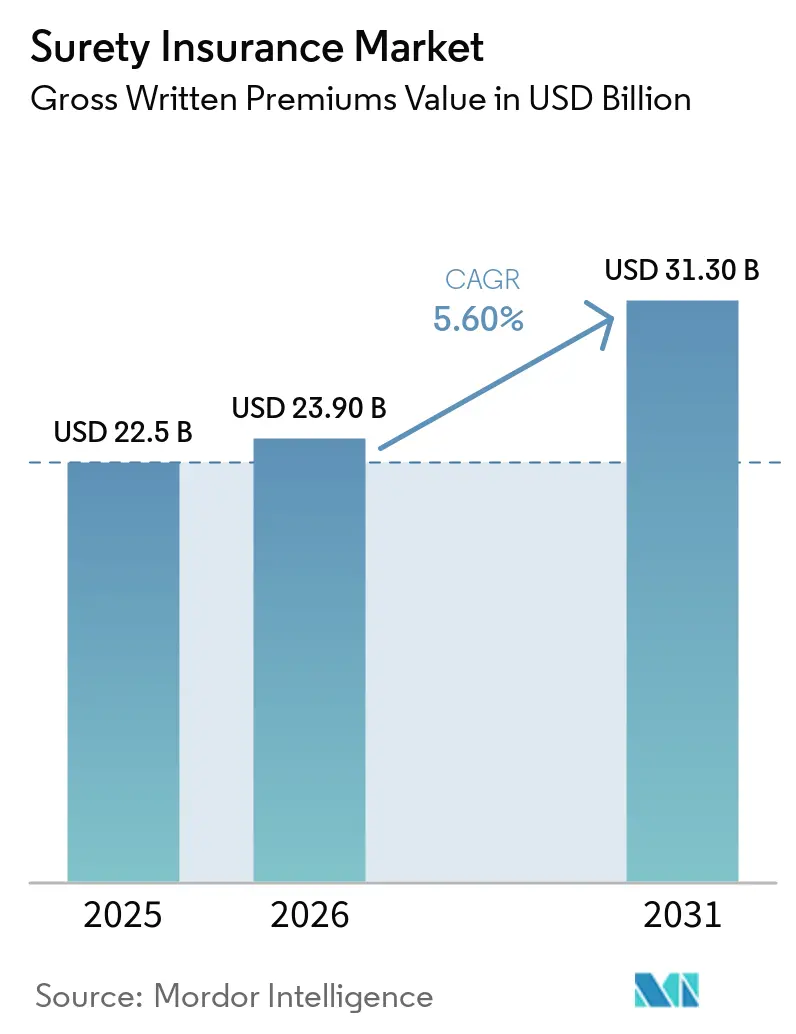
The Surety Insurance Market size in terms of gross written premiums value is expected to grow from USD 22.5 billion in 2025 to USD 23.90 billion in 2026 and is forecast to reach USD 31.30 billion by 2031 at 5.60% CAGR over 2026-2031.
The surety insurance market is supported by infrastructure, energy, and digital construction programs that require performance security throughout project delivery. Larger and more complex projects are increasing the value of individual obligations, placing greater emphasis on underwriting discipline and reinsurance support. With rate movement remaining limited, premium growth depends more on new project awards, regulatory requirements, and broader adoption of commercial bonds than on price increases. The market also faces greater exposure to concentrated project risks, as higher material costs, supply disruptions, and shortages of specialist labor can weaken contractor liquidity.
Key Report Takeaways
- By bond type, contract surety captured 63.2% of the surety insurance market share in 2025, while commercial surety is projected to grow at a 6.2% CAGR through 2031.
- By end user, construction and infrastructure contractors captured 57.1% of the surety insurance market share in 2025, while the others category is projected to grow at a 7.0% CAGR through 2031.
- By distribution channel, insurance brokers and agents captured 56.4% of the surety insurance market share in 2025, while digital and online platforms are projected to grow at a 10.6% CAGR through 2031.
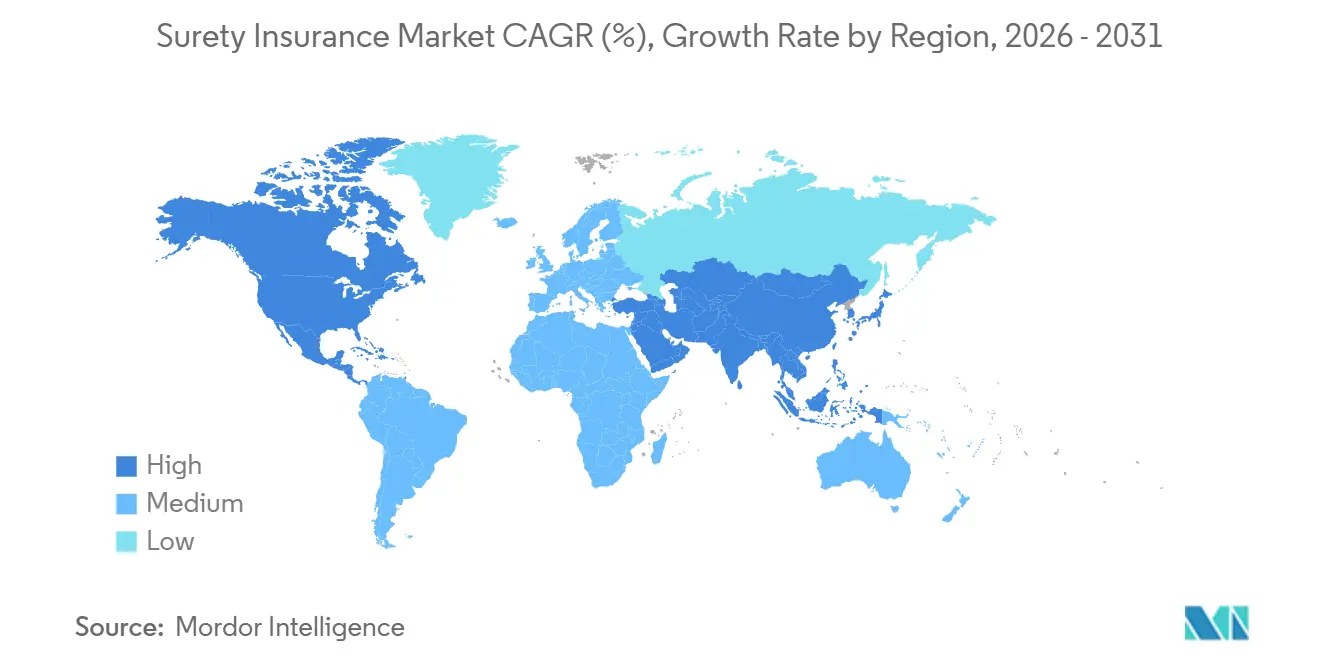
- By geography, North America captured 43.0% of the surety insurance market share in 2025, while Asia-Pacific is projected to grow at a 7.4% CAGR through 2031.
Note: Market size and forecast figures in this report are generated using Mordor Intelligence’s proprietary estimation framework, updated with the latest available data and insights as of January 2026.
Market Trends and Insights
Drivers Impact Analysis of Surety Insurance Market*
| Drivers | (~) % Impact on CAGR Forecast | Geographic Relevance | Impact Timeline |
|---|---|---|---|
| Infrastructure and EPC Contract Awards Expanding Demand for Bid and Performance Bonds | +1.8% | Global, concentrated in North America, Asia-Pacific, and Middle East | Medium term (2-4 years) |
| Stricter Public Procurement Requirements Increasing Mandatory Surety Bonding | +0.7% | North America & EU, expanding to MEA and Asia-Pacific | Short term (≤ 2 years) |
| Contractor Prequalification Increasing the Strategic Importance of Bonding Capacity | +0.4% | Global | Medium term (2-4 years) |
| Growing Acceptance of Surety Bonds as an Alternative to Bank Guarantees | +0.9% | Asia-Pacific core (India, Southeast Asia), spill-over to MEA | Medium term (2-4 years) |
| Digital Underwriting and E-Bond Platforms Accelerating Bond Issuance | +0.7% | North America, Europe, expanding to Asia-Pacific | Long term (≥ 4 years) |
| Expansion of Complex Energy and Industrial Projects Increasing Performance and Completion Bond Requirements | +0.6% | Global, concentrated in North America and MEA | Long term (≥ 4 years) |
| Source: Mordor Intelligence | |||
Infrastructure and EPC Contract Awards Expanding Demand for Bid and Performance Bonds
Infrastructure finance activity increased during the first half of 2026. The construction pipeline includes data centers, battery plants, semiconductor facilities, power assets, and transport projects that require substantial performance security. These projects tend to have larger contract values, longer delivery schedules, and more complex completion obligations than conventional work. The surety insurance market, therefore, depends on underwriters that can assess a contractor's operational capacity as well as its financial position. Mid-sized sureties can participate through co-surety arrangements when a single carrier does not want to retain the full exposure. Project owners can also view bonding as a financing support because a bonded contractor may be better placed to meet lender and procurement conditions.
Stricter Public Procurement Requirements Increasing Mandatory Surety Bonding
The Federal Acquisition Regulation update FAC 2026-01 took effect in March 2026 and retained mandatory performance and payment bonds for federal construction contracts above USD 150,000[1]U.S. General Services Administration, “Federal Acquisition Regulation 28.102-1 Performance and Payment Bonds,” Acquisition.gov, acquisition.gov. Each bond must generally equal 100% of the contract value, which gives federal project owners a defined level of security. This requirement gives the surety insurance market a durable base of demand that does not rely solely on private construction cycles. It also places a premium on Treasury-listed insurers that can meet federal eligibility requirements. Contractors seeking federal awards must maintain the financial records and bonding relationships needed to qualify before bidding. Similar procurement requirements in other jurisdictions can make a surety instrument part of contract eligibility rather than an optional financial product.
Growing Acceptance of Surety Bonds as an Alternative to Bank Guarantees
India's Coal Blocks Allocation Amendment Rules, 2026, permit insurers to issue performance security for coal block allottees in place of bank guarantees[2]Ministry of Coal, Government of India, “Coal Blocks Allocation Amendment Rules, 2026,” Ministry of Coal, coal.gov.in. The rules also allow existing allottees to replace submitted bank guarantees with insurance surety bonds under the stated framework. This change extends surety use beyond standard civil works and into an extractive sector with substantial performance obligations. The surety insurance market can benefit when contractors preserve bank credit lines for working capital rather than pledge them as project security. The change may be especially relevant for businesses that manage several contracts at the same time and need liquidity for materials, labor, and equipment. Broader acceptance still depends on insurer appetite, contractor qualifications, and clear conditions for obligees that receive the bond.
Digital Underwriting and E-Bond Platforms Accelerating Bond Issuance
Chubb, The Hartford, Liberty Mutual, and Travelers formed SuretyBind in December 2025 to develop shared digital infrastructure for the surety ecosystem[3]SuretyBind, “Leading Sureties Announce the Launch of SuretyBind,” SuretyBind, suretybind.com. Zurich joined the organization as an Associate Member in May 2026, extending participation among large international carriers. The initiative is designed to reduce duplicate data entry, support digital bond execution, and reduce fraud. The surety insurance market can gain from common data standards because brokers and carriers often exchange similar information through separate systems. Digital issuance is most suitable for smaller, standardized commercial bonds that do not require a complex underwriting review. Complex contract bonds are likely to continue using broker-led placement, although digital tools can improve information flow and underwriting speed.
Restraints Impact Analysis of Surety Insurance Market*
| Restraint | (~) % Impact on CAGR Forecast | Geographic Relevance | Impact Timeline |
|---|---|---|---|
| High Collateral and Financial Qualification Requirements Restricting Access for Smaller Contractors | -0.7% | Global, most acute in Asia-Pacific and South America | Medium term (2-4 years) |
| Large Contractor Defaults Creating High-Severity and Long-Tail Claims Exposure | -0.5% | Global, concentrated in North America and MEA | Short term (≤ 2 years) |
| Limited Underwriting Appetite for Non-Standard and Emerging Project Risks | -0.3% | Global | Long term (≥ 4 years) |
| Jurisdiction-Specific Bonding Regulations and Licensing Requirements Increasing Market Complexity | -0.3% | Global, most acute in Asia-Pacific and South America | Medium term (2-4 years) |
| Source: Mordor Intelligence | |||
High Collateral and Financial Qualification Requirements Restricting Access for Smaller Contractors
Surety underwriting commonly considers capital, capacity, and character when assessing a contractor. Bonds above USD 2 million can require CPA-prepared financial statements with independent verification. Specialty subcontractors may also be assessed against working capital requirements of 7% to 10% of the cost-to-complete backlog. These requirements can prevent smaller contractors from obtaining bonds before they establish a record of successful bonded work. The resulting cycle limits their ability to bid on larger projects and narrows the accessible customer base for the surety insurance market. Programs such as the United States Small Business Administration Surety Bond Guarantee Program provide some support, but they do not address all unmet demand
Large Contractor Defaults Creating High-Severity and Long-Tail Claims Exposure
The surety line reported a higher loss ratio in the first quarter of 2026 compared with the first quarter of 2025. Claim frequency remained stable, but claim severity increased as projects became larger and more technical. Mechanical, electrical, and plumbing packages can exceed a subcontractor's past delivery experience by 20% to 50%. Replacement contractor costs, longer negotiations, and litigation can increase completion expenses after a default. The surety insurance market must therefore evaluate contractor workload, labor management, quality controls, and supply-chain resilience alongside financial statements. Greater severity can also lead reinsurers to review portfolios more closely when a carrier has high exposure to a small group of contractors or projects.
*Our forecasts treat driver/restraint impacts as directional, not additive. The impact forecasts reflect baseline growth, mix effects, and variable interactions.
Surety Insurance Market Segment Analysis
By Bond Type:
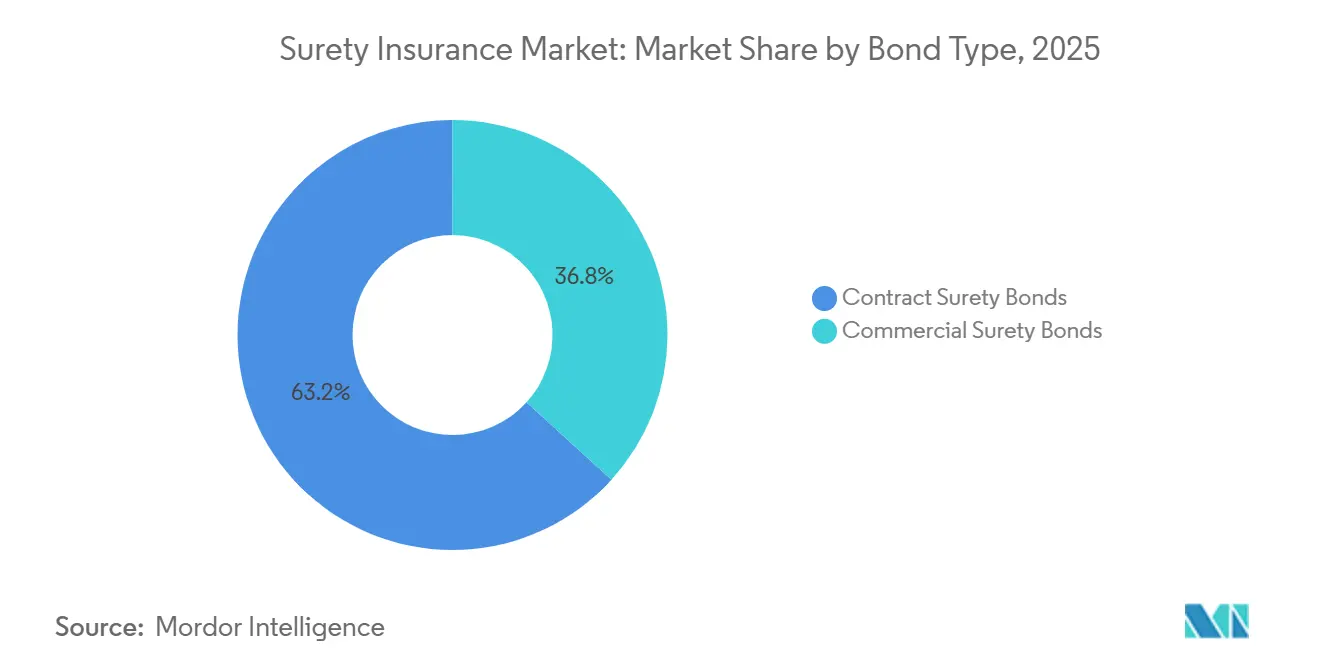
Contract Surety Holds the Leading Position While Commercial Surety Broadens DemandContract surety held 63.2% of the market in 2025, making it the largest bond type in the surety insurance market. Performance and payment bonds provide the core revenue base because they are closely linked to construction, engineering, procurement, and civil infrastructure contracts. Bid bonds are often issued early in the procurement process and reflect the underlying tender pipeline. Performance bonds receive greater underwriting attention because they can require the surety to respond if the principal does not complete its contractual scope. Payment bonds protect labor and material claimants, while maintenance and warranty bonds address obligations after construction completion. Construction starts rose 6.4% year over year through mid-2026, while commercial and data-center starts rose 74%, supporting contract bond demand.
Commercial surety is the fastest-growing bond type, and its surety insurance market size is projected to expand at a 6.2% CAGR between 2026 and 2031. License and permit bonds are the largest commercial sub-segment because public authorities use them to support compliance in regulated activities. Court and judicial bonds, fiduciary bonds, and public official bonds are also tied to legal processes and public administration. Customs and tax bonds can gain demand when trade and compliance obligations increase. This mix reduces reliance on construction procurement and gives carriers additional opportunities across commercial activities. The surety insurance industry benefits when carriers can assess regulatory exposures across several bond classes rather than concentrate on a single construction-related product.


By End User:
Construction and Infrastructure Contractors Lead While Other Users Grow FasterConstruction and infrastructure contractors held 57.1% of the market in 2025 and accounted for the largest end-user position in the surety insurance market. Their bond requirements are tied to performance and payment obligations on public and private projects. A contractor delivering a USD 500 million civil project may require bonds equal to the full contract value. This creates a high-premium account profile but also exposes insurers to concentration within large contractors. Contractors with data-center work had 11.6 months of backlog through mid-2026, compared with 8.6 months for contractors without such work. Manufacturing and industrial enterprises form another major user group through equipment supply contracts and industrial construction work.
The others category has the highest forecast growth, and its surety insurance market size is projected to grow at a 7.0% CAGR between 2026 and 2031. This category includes energy, transportation, and healthcare contractors that need security for specialized projects. Renewable energy engineering, procurement, and construction work can require performance and completion bonds with longer project periods. Solar farms, battery storage facilities, and offshore wind projects can require bond forms that cover commissioning, grid interconnection, and operating milestones. Financial institutions and professional services firms use fiduciary, court, and public official bonds, while retail and trade enterprises require license and permit bonds. The surety insurance industry must adapt legacy forms to the requirements of projects that differ from traditional building and civil engineering work.
By Distribution Channel:
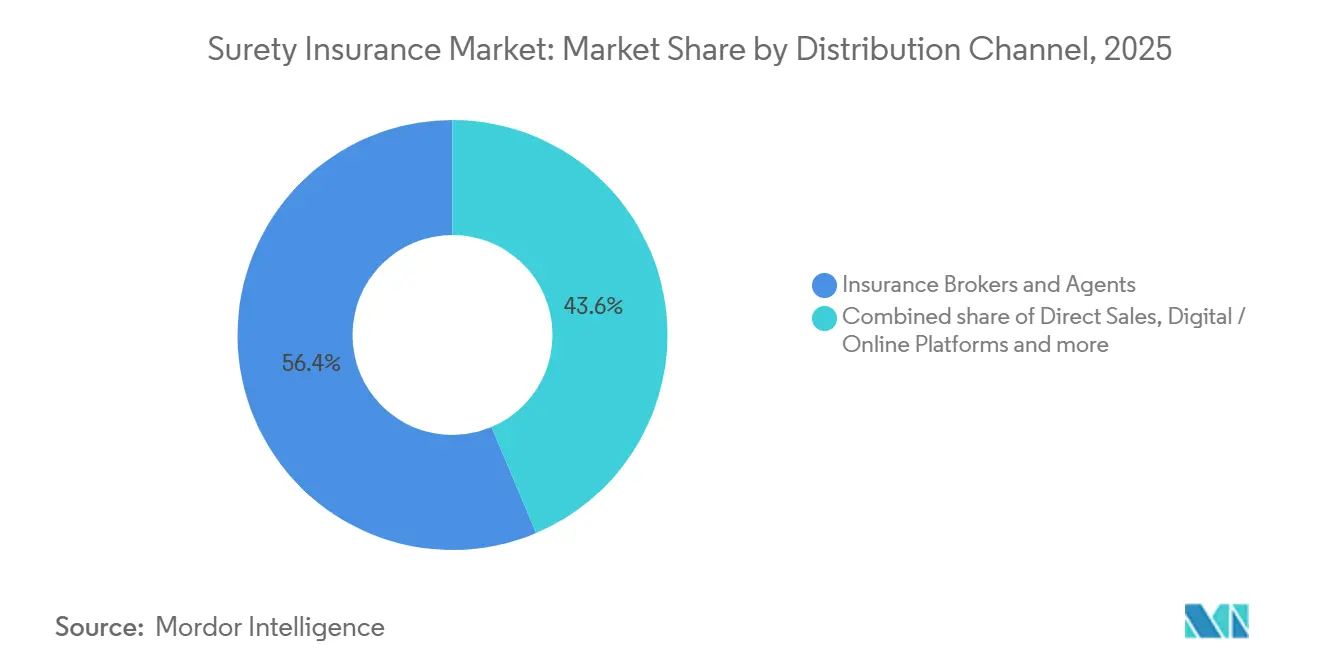
Brokers and Agents Lead While Digital Platforms Record the Highest GrowthInsurance brokers and agents held 56.4% of market distribution in 2025 and remain the leading channel in the surety insurance market. Their role is strongest in large contract programs where clients need assistance with single limits, aggregate limits, co-surety structures, and indemnity terms. Brokers also connect contractors with carrier underwriting teams and help present financial information during the qualification process. Bank-affiliated and bancassurance channels use existing lending relationships to offer bonding products to construction firms. Direct sales channels are important for large national accounts and public-sector programs where the principal works with the surety's underwriting team. These channel roles can continue because large and specialized bonds require review beyond a standard digital application.
Digital and online platforms are the fastest-growing channel and are projected to grow at a 10.6% CAGR between 2026 and 2031. Intact BondClick added auto-approved bonds, credit-scoring support, electronic indemnity execution, and credit card payment capability in January 2025. The platform supports a shorter issuance process for small commercial bonds, including license and permit products below USD 100,000. Digital systems can reduce data entry and offer a more consistent experience for brokers and buyers. Large carriers are also investing in shared infrastructure through SuretyBind to improve data transmission across the ecosystem. Routine bonds may shift toward automated channels, while complex contract bonds remain dependent on broker expertise and individual underwriting review.
Geography Analysis
North America and Europe Surety Insurance Market
North America held 43.0% of the market in 2025, representing the largest geographic share of the surety insurance market. The Miller Act framework and Federal Acquisition Regulation require performance and payment bonds for qualifying federal construction contracts. The requirement gives the region a stable base of construction-related bond demand. The United States Department of the Treasury Circular 570 maintains a list of approved sureties for federal projects, supporting carrier qualification and obligee confidence. North America also has demand for license and permit bonds in digital assets, cannabis, and specialty healthcare activities. Europe has a significant position but faces slower expansion because bank guarantees remain the preferred instrument in several jurisdictions.
APAC and South America Surety Insurance Market
Asia-Pacific is the fastest-growing region, and the surety insurance market size is projected to expand at a 7.4% CAGR between 2026 and 2031. The region's demand is linked to infrastructure programs, regulatory reform, and wider acceptance of bonds as an alternative to bank guarantees. India is an important contributor because its 2026 coal allocation rules permit insurance surety bonds for performance security. China and India have favorable capacity and competitive pricing, while Japan faces higher reinsurance costs and pricing pressure. Indonesia, Vietnam, and Thailand are developing public-private partnership frameworks that increasingly include surety requirements. South America, led by Brazil and Argentina, has faced currency volatility and financing complexity, although infrastructure concessions and energy reforms support demand for completion and performance bonds.
MEA Surety Insurance Market
The Middle East and Africa benefit from major construction and investment programs that require performance security across project supply chains. Saudi Arabia's active construction pipeline exceeded USD 1.3 trillion, which can support demand for bond instruments. The surety insurance market can grow where procurement rules provide clear acceptance standards for performance security. Saudi Arabia’s procurement reforms are strengthening security and cybersecurity requirements in government contracting, particularly for digital procurements. South Africa and Egypt are identified as regional growth points because public-private partnerships and energy investments are increasing project activity. Local insurance capacity, legal frameworks, and contractor financial quality will shape the pace at which new demand converts into issued bonds.

Competitive Landscape
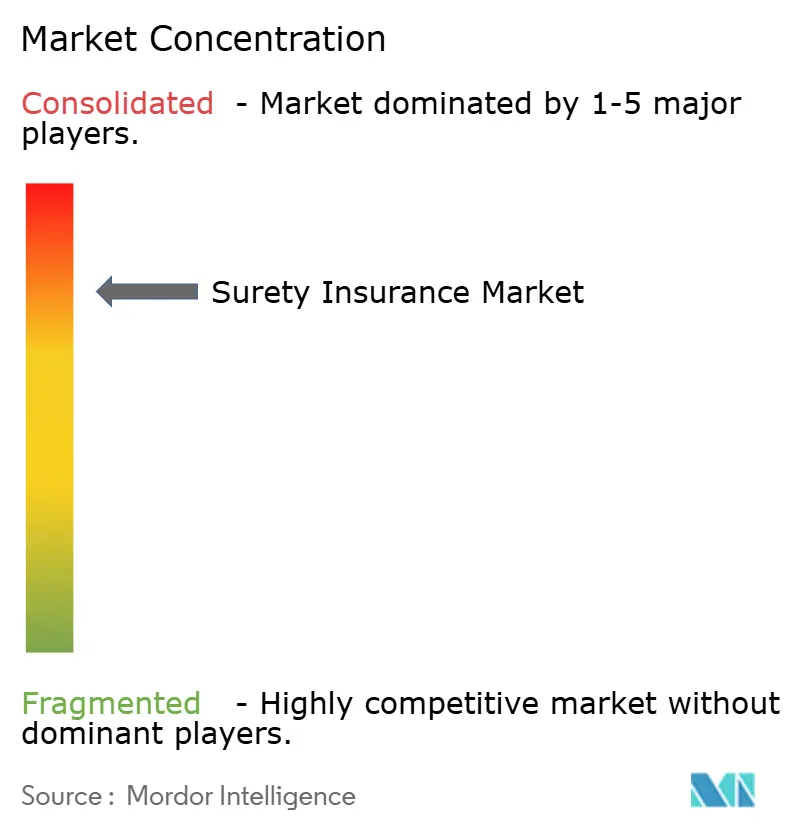
The surety insurance market is concentrated, with Travelers, Liberty Mutual, Zurich, and Tokio Marine in the leading tier. CNA Surety, Chubb, Allianz Trade, Arch Capital, Markel Surety, and W.R. Berkley form a second group that competes through specialization, geographic reach, and underwriting expertise. Travelers historically held 22% of United States contract surety bonds. CNA was reported to have an underwriting capacity of USD 10 billion in single-risk limits. The sector became highly profitable in 2024, achieving a net profit margin of over 45% (its best level in 10 years) even though prices remained almost unchanged for most of the period up to mid-2026. Carriers have relied on claims management, risk selection, and portfolio discipline rather than rate increases to support profitability.
Reinsurance remains available, but reinsurers differentiate between portfolios with strong historical performance and books with concentrated construction exposure. The surety insurance market is consequently more demanding for insurers with exposure to large projects or sectors facing higher contractor stress. Chubb, The Hartford, Liberty Mutual, and Travelers created SuretyBind in December 2025, and Zurich joined as an Associate Member in May 2026. The shared platform is intended to support digital bond execution, reduce duplicate information entry, and improve data exchange. The move could strengthen carrier positions in standardized commercial bonds where speed and ease of issuance matter. It also reflects recognition that technology standards can support competition without replacing underwriting judgment.
Specialty sureties can serve contractors that do not fit the financial requirements of the largest insurers. Merchants Bonding Company, Old Republic Surety, and Berkley Surety Group are examples of carriers operating in such niches. The surety insurance market has opportunities in mid-market contractors, renewable energy engineering projects, and cross-border programs where local capacity is limited. These areas require differentiated risk assessment because contract forms, completion risks, and legal remedies vary by project and jurisdiction. Carriers that combine local underwriting knowledge with sufficient capacity can serve obligations that are not well-suited to standardized programs. The competitive position of each carrier will depend on claims experience, reinsurance access, broker relationships, technology investment, and discipline in setting limits.
Surety Insurance Industry Leaders
The Travelers Companies, Inc.
Liberty Mutual Insurance Company
Zurich Insurance Group Ltd.
Tokio Marine Holdings, Inc. (Tokio Marine HCC)
Chubb Limited
- *Disclaimer: Major Players sorted in no particular order
Surety Insurance Market Companies Covered in this Report
- The Travelers Companies, Inc.
- Liberty Mutual Insurance Company
- Zurich Insurance Group Ltd.
- Chubb Limited
- CNA Financial Corporation (CNA Surety)
- Allianz SE (Allianz Trade)
- The Hartford Financial Services Group, Inc.
- Tokio Marine Holdings, Inc. (Tokio Marine HCC)
- Sompo Holdings, Inc. (Sompo International)
- American International Group, Inc. (AIG)
- Arch Capital Group Ltd.
- Markel Group Inc. (Markel Surety)
- Old Republic International Corporation (Old Republic Surety)
- Intact Financial Corporation
- QBE Insurance Group Limited
- W. R. Berkley Corporation (Berkley Surety Group)
- American Financial Group, Inc. (Great American Insurance Group)
- Merchants Bonding Company
- Atradius N.V.
- Credendo Group

Recent Industry Developments in Surety Insurance Market
- May 2026: Zurich Insurance Group joined SuretyBind as an Associate Member, extending the founding coalition of Chubb, Hartford, Liberty Mutual, and Travelers. Zurich's participation broadens the platform's reach into global infrastructure and cross-border contract surety programs, and signals industry-wide recognition that data standardization, not proprietary technology, is the critical first step toward full digital bond issuance.
- March 2026: The United States Federal Acquisition Regulation update FAC 2026-01 took effect, reaffirming under FAR 28.102-1 that performance and payment bonds, each at 100% of contract value, are mandatory on federal construction contracts exceeding USD 150,000. The update also maintained eligibility requirements for Treasury-listed sureties, reinforcing the regulatory compliance framework for United States contract surety underwriters.
- February 2026: India's Ministry of Coal issued the Coal Blocks Allocation Amendment Rules, 2026, formally permitting coal block allottees to substitute Insurance Surety Bonds for Performance Bank Guarantees across allocations under the Mines and Minerals Development and Regulation Act, 1957. Existing allottees were also permitted to replace already-submitted bank guarantees with Insurance Surety Bonds, extending the surety-as-bank-guarantee-alternative model from infrastructure into extractive industries.
- December 2025: Chubb Limited, The Hartford, Liberty Mutual, and Travelers announced the formation of SuretyBind, LLC, a shared digital infrastructure company designed to create a data-transmission platform connecting sureties, brokers, and market participants, and to provide technology enabling digital bond execution. Services are expected to commence in 2027 under strict antitrust supervision. The initiative represents the first coordinated industry response to the fragmentation of surety data infrastructure.


Global Surety Insurance Market Report Scope
| Contract Surety Bonds | Bid Bonds |
| Performance Bonds | |
| Payment (Labor & Material) Bonds | |
| Maintenance / Warranty Bonds | |
| Advance Payment & Other Contract Bonds | |
| Commercial Surety Bonds | License & Permit Bonds |
| Court & Judicial Bonds | |
| Fiduciary & Probate Bonds | |
| Public Official Bonds | |
| Customs, Tax & Miscellaneous Commercial Bonds |
| Construction & Infrastructure Contractors |
| Manufacturing & Industrial Enterprises |
| Financial Institutions & Professional Services Firms |
| Retail, Wholesale, Trade & Other Commercial Enterprises |
| Others (including energy, transportation, healthcare, etc.) |
| Direct Sales |
| Insurance Brokers and Agents |
| Bank-Affiliated / Bancassurance & Partnership Channels |
| Digital / Online Platforms |
| North America | United States |
| Canada | |
| Mexico | |
| South America | Brazil |
| Argentina | |
| Rest of South America | |
| Europe | United Kingdom |
| Germany | |
| France | |
| Italy | |
| Spain | |
| Rest of Europe | |
| Asia-Pacific | China |
| Japan | |
| India | |
| South Korea | |
| Australia | |
| Indonesia | |
| Thailand | |
| Malaysia | |
| Singapore | |
| Vietnam | |
| Rest of Asia-Pacific | |
| Middle East and Africa | Saudi Arabia |
| United Arab Emirates | |
| Turkey | |
| South Africa | |
| Egypt | |
| Rest of Middle East and Africa |
| By Bond Type | Contract Surety Bonds | Bid Bonds |
| Performance Bonds | ||
| Payment (Labor & Material) Bonds | ||
| Maintenance / Warranty Bonds | ||
| Advance Payment & Other Contract Bonds | ||
| Commercial Surety Bonds | License & Permit Bonds | |
| Court & Judicial Bonds | ||
| Fiduciary & Probate Bonds | ||
| Public Official Bonds | ||
| Customs, Tax & Miscellaneous Commercial Bonds | ||
| By End User | Construction & Infrastructure Contractors | |
| Manufacturing & Industrial Enterprises | ||
| Financial Institutions & Professional Services Firms | ||
| Retail, Wholesale, Trade & Other Commercial Enterprises | ||
| Others (including energy, transportation, healthcare, etc.) | ||
| By Distribution Channel | Direct Sales | |
| Insurance Brokers and Agents | ||
| Bank-Affiliated / Bancassurance & Partnership Channels | ||
| Digital / Online Platforms | ||
| By Geography | North America | United States |
| Canada | ||
| Mexico | ||
| South America | Brazil | |
| Argentina | ||
| Rest of South America | ||
| Europe | United Kingdom | |
| Germany | ||
| France | ||
| Italy | ||
| Spain | ||
| Rest of Europe | ||
| Asia-Pacific | China | |
| Japan | ||
| India | ||
| South Korea | ||
| Australia | ||
| Indonesia | ||
| Thailand | ||
| Malaysia | ||
| Singapore | ||
| Vietnam | ||
| Rest of Asia-Pacific | ||
| Middle East and Africa | Saudi Arabia | |
| United Arab Emirates | ||
| Turkey | ||
| South Africa | ||
| Egypt | ||
| Rest of Middle East and Africa | ||


Key Questions Answered in the Report
What is driving growth in surety insurance?
Infrastructure construction, formal procurement requirements, wider acceptance of surety bonds, and digital issuance tools support demand. The sector is forecast to grow at a 5.6% CAGR from 2026 to 2031.
Which bond type leads surety insurance?
Contract surety led with 63.2% of revenue in 2025. Performance, payment, and bid bonds remain closely tied to construction and infrastructure procurement.
Which customer group uses surety bonds most often?
Construction and infrastructure contractors held 57.1% of demand in 2025 because large projects commonly require performance and payment security.
Why are digital surety platforms gaining attention?
Digital platforms are forecast to grow at a 10.6% CAGR through 2031 because they can shorten issuance for smaller standardized commercial bonds.
Which region is growing fastest for surety products?
Asia-Pacific is forecast to grow at a 7.4% CAGR through 2031, supported by infrastructure programs and regulatory acceptance of bonds in place of some bank guarantees.
What is the main risk for surety providers?
Large contractor defaults can create high-severity and long-tail claims, particularly when technical projects exceed a contractor's financial and operating capacity.
Page last updated on:





