
Market Overview
| Study Period | 2021 - 2031 |
|---|---|
| Market Volume (2026) | 3.95 Million tons |
| Market Volume (2031) | 4.94 Million tons |
| Growth Rate (2026 - 2031) | 4.55 % |
| Fastest Growing Market | North America |
| Largest Market | Asia Pacific |
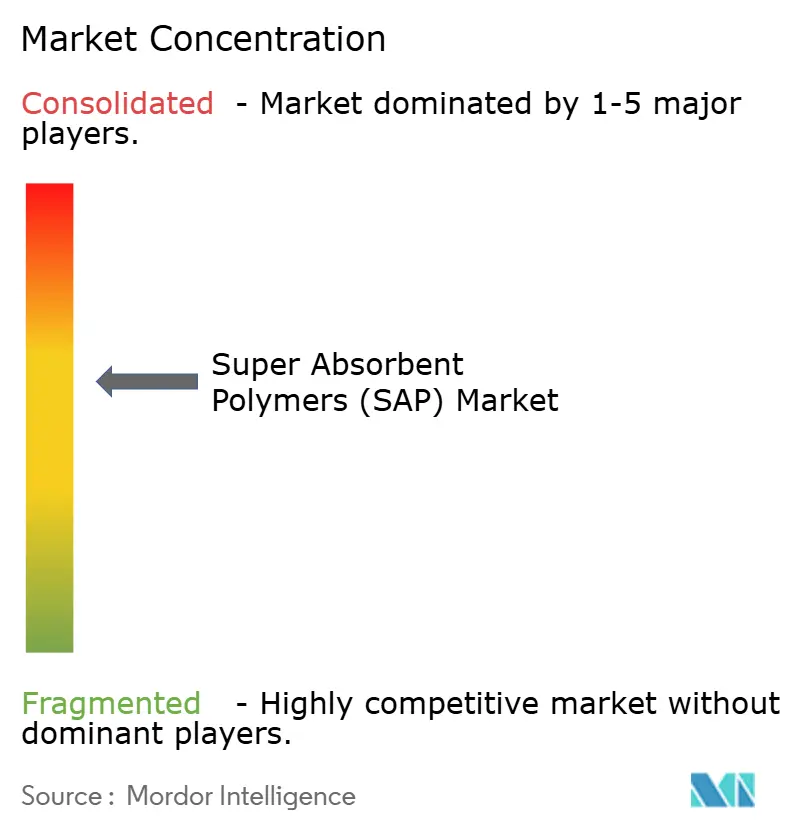
| Market Concentration | Medium |
Major Players *Disclaimer: Major Players sorted in no particular order Image © Mordor Intelligence. Reuse requires attribution under CC BY 4.0. | |
Super Absorbent Polymers (SAP) Market Analysis by Mordor Intelligence
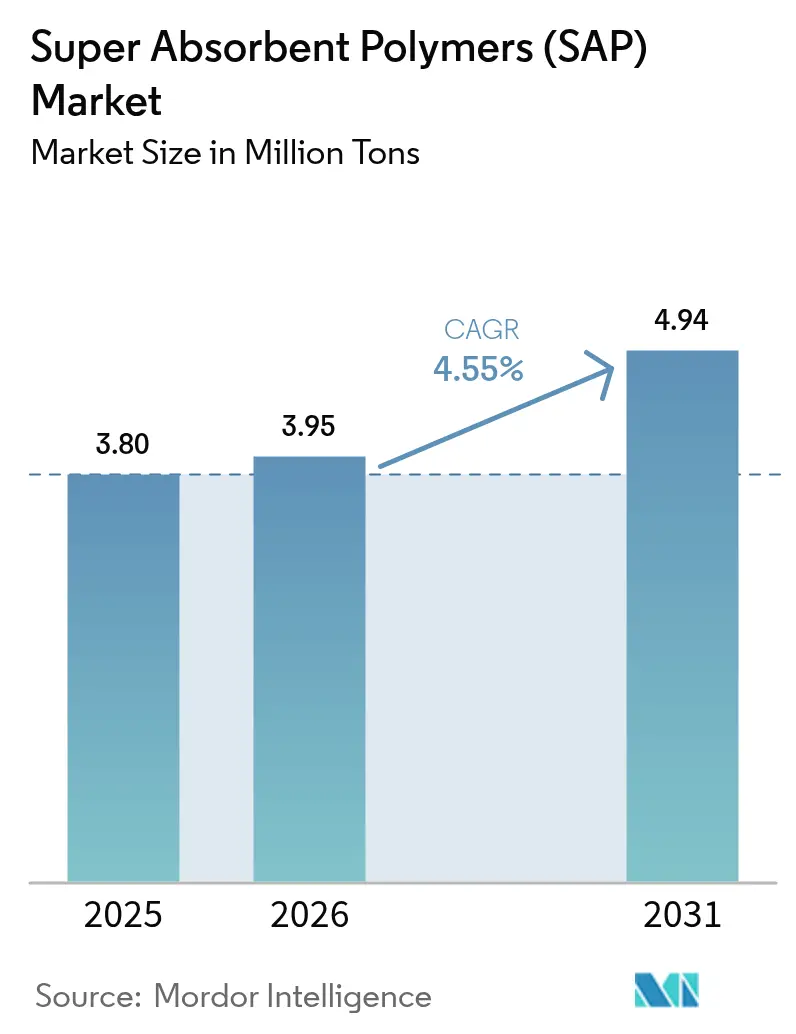
The Super Absorbent Polymers Market size is projected to grow from 3.80 million tons in 2025 to 3.95 million tons in 2026, and reach 4.94 million tons by 2031, growing at a CAGR of 4.55% from 2026 to 2031. Strong diaper demand in Asia, rapid take-up of high-SAP adult incontinence pads across Japan, South Korea, and Western Europe, and growing use of absorbent pads in e-commerce cold chains are reshaping global shipment flows. Producers are co-locating polymerization units next to diaper-converting lines to cut freight cost, while telecom cable makers are specifying SAP-based water-blocking yarns that swell on contact with moisture to protect expensive 5G fiber. Acrylic-acid feedstock volatility is compressing margins for non-integrated players, and landfill pressure in the European Union is accelerating pilot investment in bio-based grades that can satisfy future Extended Producer Responsibility mandates. As a result, the Super absorbent polymers market is moving toward backward-integrated and specialty-grade strategies that hedge feedstock swings and target premium applications.
Key Report Takeaways
- By product type, acrylic-acid SAP accounted for 72.54% of the super absorbent polymers market size in 2025; polyacrylamide variants are forecast to expand at a 6.67% CAGR between 2026-2031.
- By polymerization route, gel polymerization dominated with 60.64% revenue share in 2025; solution polymerization is projected to grow at 5.18% CAGR through 2031.
- By application, baby diapers held 60.12% of the super absorbent polymers market share in 2025, while adult incontinence pads are advancing at a 5.45% CAGR through 2031.
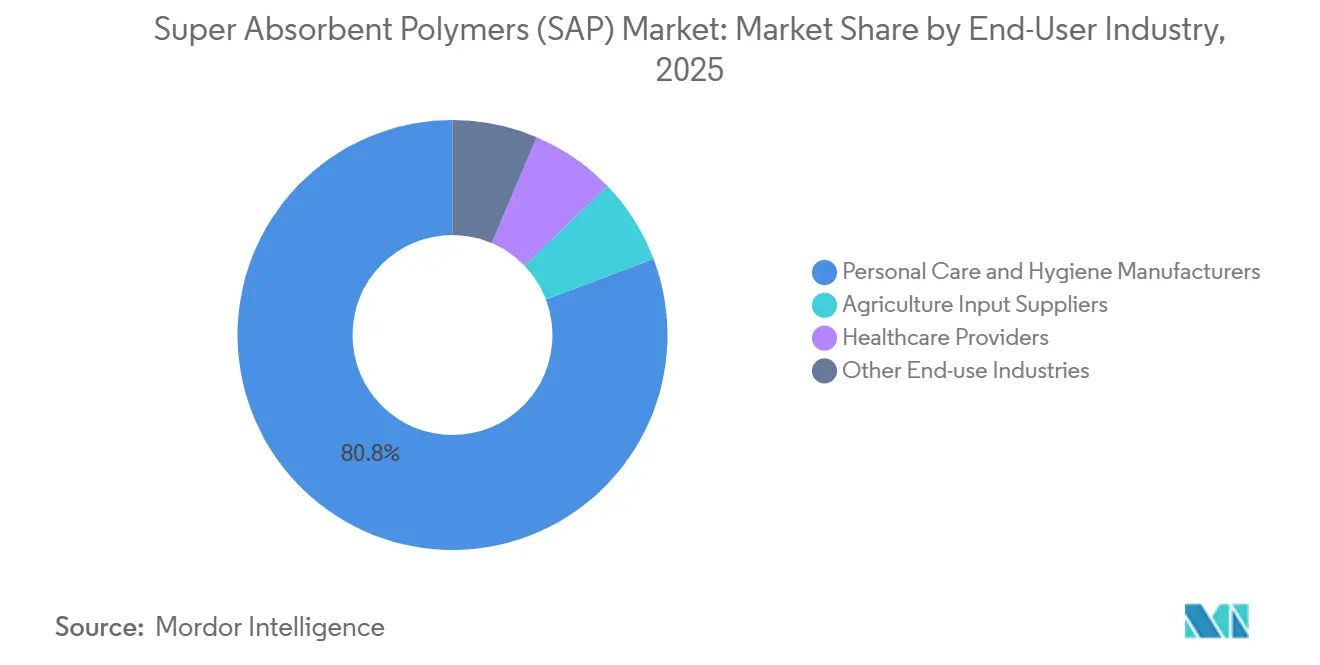
- By end-user industry, personal-care manufacturers absorbed 80.76% of 2025 volumes; agriculture input suppliers are pacing ahead at a 6.09% CAGR over 2026-2031.
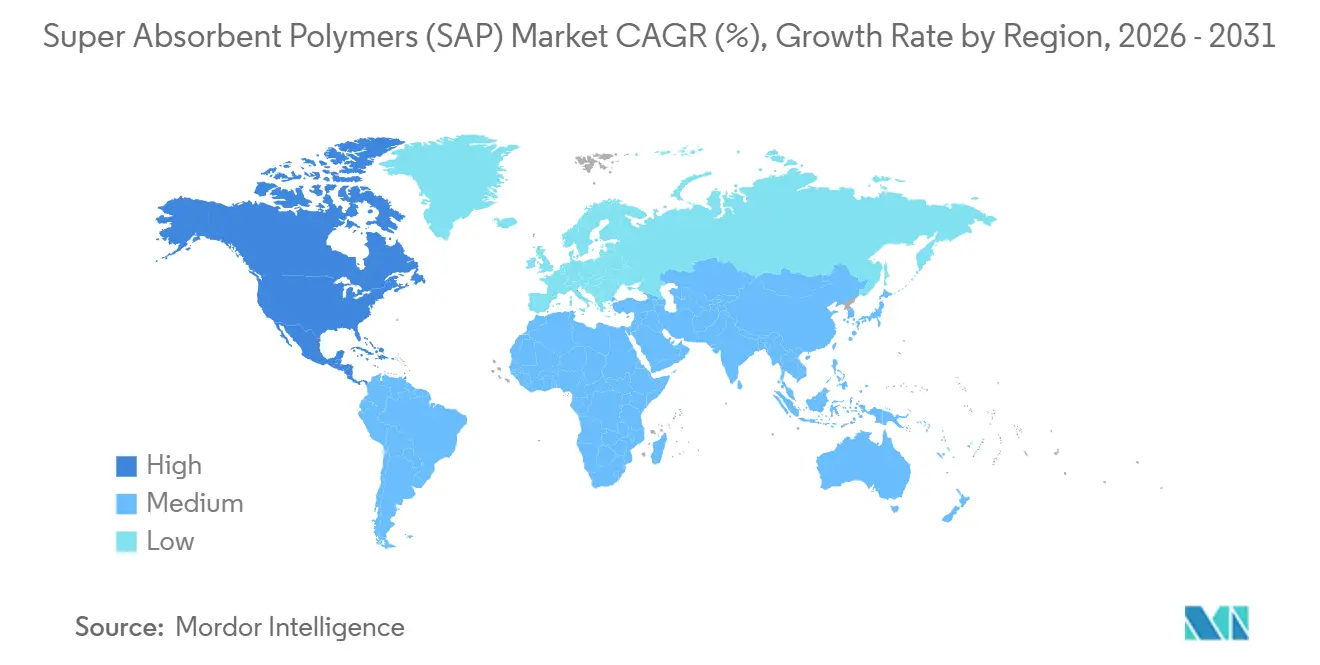
- By geography, Asia-Pacific captured 42.59% shipment share in 2025, whereas North America is set to deliver the fastest 5.59% CAGR to 2031.
Note: Market size and forecast figures in this report are generated using Mordor Intelligence’s proprietary estimation framework, updated with the latest available data and insights as of 2026.
Market Trends and Insights
Drivers Impact Analysis of Super Absorbent Polymers (SAP) Market*
| Drivers | (~) % Impact on CAGR Forecast | Geographic Relevance | Impact Timeline |
|---|---|---|---|
| Rising per-capita diaper spend in China and India | +1.2% | Asia-Pacific | Medium term (2-4 years) |
| Rapid adoption of high-SAP adult incontinence pads | +1.5% | Japan, South Korea, Germany, Italy | Long term (≥ 4 years) |
| E-commerce demand for absorbent cold-chain pads | +0.6% | North America, Europe, Asia-Pacific | Short term (≤ 2 years) |
| 5G cable roll-outs pulling SAP water-blocking yarn | +0.4% | Asia-Pacific core, spill-over to North America | Medium term (2-4 years) |
| Vertical-farming substrates using SAP hydrogels | +0.3% | North America, Europe, urban Asia-Pacific | Long term (≥ 4 years) |
| Source: Mordor Intelligence | |||
Rising Per-Capita Diaper Spend in China and India
India’s disposable diaper outlays reached USD 1.74 billion in 2025 after the Goods and Services Tax on baby-care items was cut to 18% in 2024, making branded diapers more affordable for tier-two and tier-three cities. China’s infant-diaper penetration rose to 70% in 2025 as leading e-commerce platforms bundled subscription deliveries with loyalty discounts that raised average SAP loading per diaper from 8 grams to 12 grams, a jump driven by the shift to ultra-thin cores. Domestic suppliers such as Satellite Chemical have been scaling specialty polyacrylamide lines to serve this premium segment, while multinationals co-locate new SAP reactors next to diaper plants in Guangdong and Jiangsu to shorten lead times and cut inventory. The combined effect keeps the Super absorbent polymers market on a secular expansion path as Asian consumers trade up to higher SAP weights per article.
Rapid Adoption of High-SAP Adult Incontinence Pads in Asia and Europe
Japan’s population aged 65 plus crossed 29.1% in 2024, and South Korea widened National Health Insurance reimbursement for incontinence supplies, trimming consumer out-of-pocket expense by roughly 40%[1]Statistics Bureau of Japan, “Population Estimates,” stat.go.jp. European nations face a parallel aging trend, with Germany and Italy crossing the 20% threshold of seniors. Manufacturers are rolling out “active-lifestyle” pads containing 15-20 grams of SAP and using surface-cross-linking to hold more than 800 milliliters without leakage, a design that supports overnight use and fewer changes. Lower residual monomer targets—below 300 ppm—add process complexity yet allow brands to command 10-15% price premiums. This demographic tide is therefore steering the super absorbent polymers market toward higher-value adult-care grades.
E-Commerce-Led Demand Spike for Absorbent Cold-Chain Pads
Global pharmaceutical cold-chain revenue moved beyond USD 20 billion in 2024 as biologics and mRNA vaccines scaled up distribution[2]U.S. Food & Drug Administration, “Food Safety Modernization Act Guidance,” fda.gov. SAP-based pads are displacing gel packs because they weigh less, cut freight costs, and trap condensation if the outer pouch is damaged. Grocery deliverers in North America and Europe insert 30-50 gram SAP pads into cartons of seafood, dairy, and produce, extending shelf life by up to two days, a benefit aligned with the Food Safety Modernization Act’s temperature-control provisions. As urban fulfillment hubs multiply, the super absorbent polymers market receives an incremental lift from every incremental chilled parcel shipped.
5G Cable Roll-Outs Driving SAP Water-Blocking Yarn Demand
Telecom carriers installed more than 3.5 million 5G base stations in China by the end of 2024 and launched national deployments in India the same year. The fiber cables feeding these sites require water-blocking yarns that swell rapidly to stop moisture ingress, a function that SAP particles perform better than petroleum jelly. North American cable specifiers reference Telcordia GR-20-CORE, while European engineers align with IEC 60794; in both cases, SAP yarns meet the swell-time benchmarks with lower overall cable weight. Though niche, the segment commands 30-50% price premiums, supporting profit pools for specialty suppliers within the Super absorbent polymers market.
Restraints Impact Analysis of Super Absorbent Polymers (SAP) Market*
| Restraint | (%) Impact on CAGR Forecast | Geographic Relevance | Impact Timeline |
|---|---|---|---|
| Volatile acrylic-acid feedstock prices | –1.0% | Asia-Pacific, Europe | Short term (≤ 2 years) |
| Residual-monomer safety concerns in infant diapers | –0.5% | North America, Europe | Medium term (2-4 years) |
| Limited biodegradability raising landfill pressure | –0.4% | Europe, emerging in North America | Long term (≥ 4 years) |
| Source: Mordor Intelligence | |||
Volatile Acrylic-Acid Feedstock Prices
Northeast Asian acrylic-acid spot quotes swung between USD 1,200 and USD 1,600 per ton in 2024 after unplanned cracker outages, and European contracts climbed 8% quarter-on-quarter in early 2025 as refiners throttled propylene co-product output. Non-integrated SAP converters lack bargaining power for multi-year monomer deals, so margin compression reaches 150-200 basis points in a single quarter. The resulting shake-out saw Evonik sell its SAP unit to ICIG and Sanyo Chemical exit the field in 2024, evidence that scale and backward integration are prerequisites for survival in the super absorbent polymers market.
Residual-Monomer Safety Concerns in Infant Diapers
Voluntary industry limits cap residual acrylic acid at 300 ppm for baby-diaper grades, below many jurisdictions’ regulatory ceilings. California’s Proposition 65 listing of acrylic acid raises the specter of warning labels, nudging U.S. brands to tighten internal specs. Achieving sub-200 ppm typically requires extra washing or surface neutralization, adding 5-10% to unit cost and penalizing smaller firms that cannot amortize new equipment. Heightened scrutiny, therefore, drives a bifurcation toward premium low-monomer grades and accelerates capacity rationalization within the super absorbent polymers market.
*Our forecasts treat driver/restraint impacts as directional, not additive. The impact forecasts reflect baseline growth, mix effects, and variable interactions.
Super Absorbent Polymers (SAP) Market Segment Analysis
By Product Type:
Acrylic-Acid Variants Dominate, Polyacrylamide Advances in AgricultureAcrylic-acid SAP captured 72.54% shipment share in 2025, owing to swelling capacity above 300 g/g and seamless fit with high-speed diaper lines. Polyacrylamide grades are pacing ahead at 6.67% CAGR to 2031 as agriculture suppliers seek cross-linked networks that hold water through extended droughts. Starch-graft and cellulose hydrogels remain niche because lower gel strength limits diaper use, and enzyme pretreatment inflates cost. Government subsidies in India and Australia encourage polyacrylamide soil conditioners, reinforcing a diversified demand base for the super absorbent polymers market.
Blended chemistries are emerging at the premium end: Japanese diaper brands specify surface-cross-linked acrylic SAP interspersed with natural polysaccharides to speed fluid uptake and lower residual monomer. With each functional tweak, suppliers secure higher margins and deepen customer lock-in, cushioning the Super absorbent polymers market from pure commodity pricing cycles.




By Polymerization Process:
Gel Routes Lead, Solution Methods Pursue Finer ParticlesGel polymerization held 60.64% of 2025 capacity because it produces high-swelling particles in a single pass and avoids costly grinding. Yet solution polymerization is on a 5.18% CAGR trajectory as feminine-pad and thin-diaper makers request sub-150 micron particles that deliver uniform cores without dusting. Solution reactors also hit residual monomer below 200 ppm in-process, saving an extra washing step and aligning with tighter safety targets for infant products.
Capital profiles diverge: horizontal belt gel plants require more than USD 50 million for a 30 kt/yr line, whereas solution retrofits can leverage existing batch reactors but consume more energy due to solvent recovery. This trade-off sets the competitive tempo as firms choose between scale economies and flexibility within the superabsorbent polymers market.
By Application:
Baby Diapers Anchor Demand, Adult Incontinence AcceleratesBaby diapers absorbed 60.12% of the 2025 volume, securing the highest super absorbent polymer market share among applications. Brands have lifted SAP loading per unit from 8 g in 2020 to 12 g in 2025 to create slimmer, more comfortable products, a shift that is adding around 3% a year to polymer intensity even as birth rates soften in developed economies. Ultra-thin menstrual pads occupy a mid-single-digit share and lean on surface-cross-linked grades that deliver sub-2 mm cores while holding more than 50 mL of fluid. Agriculture soil-conditioner and seed-coating uses are expanding, supported by precision-irrigation programs in the U.S. Corn Belt and Australia’s Murray–Darling Basin, where 2024 trials cut water use 35%.
Adult incontinence products are the fastest-growing outlet, forecast to rise at a 5.45% CAGR through 2031 as the 65-plus cohort passes 20% of the total population in Japan, Germany, and Italy. Premium “active-lifestyle” briefs now incorporate 15–20 g of polymer to ensure overnight protection, commanding 20–30% shelf-price premiums. Niche uses such as water-blocking yarn for 5G cables and absorbent pads for cold-chain logistics still contribute less than 5% of 2025 volume but are advancing at double-digit rates as fiber networks and grocery e-commerce expand. Together, these shifts reinforce the upward trajectory of the super absorbent polymer market size despite uneven demographic trends.
By End-User Industry:
Personal-Care Manufacturers Dominate, Agriculture Suppliers GainPersonal-care converters drew 80.76% of 2025 shipments, reinforcing their central position in the super absorbent polymer market size through diapers, adult briefs, and feminine-hygiene goods. Leading brand owners such as Procter & Gamble and Kimberly-Clark have penned multi-year supply and co-development pacts with BASF and Nippon Shokubai, speeding tailored grade launches and locking in favorable pricing. Healthcare providers, chiefly hospitals and nursing homes, evaluate incontinence pads on total cost of ownership, favoring high-SAP designs that reduce change frequency, laundry loads and skin-breakdown risk.
Agriculture input suppliers are set to expand at a 6.09% CAGR to 2031 by marketing SAP soil amendments that deliver 25–35% irrigation savings in dryland wheat and canola, findings backed by Australia’s Grains Research and Development Corporation field trials. Growth is also catalyzed by subsidy programs in water-stressed Indian states that reimburse up to 50% of SAP costs for smallholders. Unlike the consolidated personal-care channel, farm-supply chains remain fragmented, so vendors deploy digital agronomy tools, moisture sensors, and satellite imagery to prove return on investment at the plot level. Other users, from telecom-cable makers to vaccine cold-chain operators, represent a modest but rising slice of the super absorbent polymer market share as 5G rollouts and biologic drug distribution accelerate.
Geography Analysis
APAC Super Absorbent Polymers (SAP) Market
Asia-Pacific dominated with 42.59% of 2025 volume, led by China’s diaper uptick and Japan’s elderly-care boom. India’s disposable diaper retail climbed toward USD 1.74 billion as urban nuclear families adopted convenient baby-care products. Regional CAGR moderated versus the last decade, yet remains solid because SAP intensity per diaper rises even as birth rates flatten.
Europe Super Absorbent Polymers (SAP) Market
Europe held a mid-twenties share in 2025. Regulatory momentum—from the Waste Framework Directive to national EPR fees—pushes converters toward compostable cores and recycled packaging, adding research and development cost but positioning the super absorbent polymers market for a gradual pivot to bio-based grades. Nordic countries, with near-universal senior-care coverage, are testing premium adult pads that blend SAP with breathable back-sheets for skin health, reinforcing value over volume.
The Americas and MEA Super Absorbent Polymers (SAP) Market
North America, forecast at 5.59% CAGR through 2031, benefits from precision-ag training in the U.S. Corn Belt where SAP soil conditioners cut irrigation 30-50% in maize field trials. Biologics cold-chain expansion adds another tailwind as absorbent pads become standard in last-mile pharmaceutical parcels. South America and the Middle East and Africa represent single-digit shares yet are notable for pockets of high growth: Brazil’s rising middle class lifts diaper uptake, Saudi Arabia’s fiber-optic expansion needs water-blocking yarns, and South Africa trials SAPs to buffer drought-prone maize zones.

Value Chain Analysis
The SAP value chain starts with upstream hydrocarbon and bio-feedstock streams that shape monomer availability and cost. Acrylic-acid-derived chemistries dominate overall volumes (72.54% share in 2025), tying a large part of SAP economics to propylene and acrylic acid pricing cycles, which the report notes swung materially in 2024 and tightened again in early 2025. This has reinforced the strategic role of backward integration into acrylic acid and the need to qualify alternative feedstocks, such as starch or other biomass-derived inputs, for selected specialty grades as brands and converters seek lower fossil exposure and tighter residual-monomer specifications.
Midstream production includes polymerization (gel and solution routes), drying, milling and classification, and surface cross-linking to reach application-specific absorption and gel-strength targets. Downstream, SAP typically ships in bulk bags to hygiene converters (baby diapers, adult incontinence, and feminine hygiene), and to agriculture input suppliers and industrial users, including cold-chain pad manufacturers and telecom cable makers using water-blocking yarns aligned with Telcordia GR-20-CORE and IEC 60794. With freight cost and lead-time sensitivity, producers increasingly co-locate polymerization assets near diaper converting lines in high-volume regions, including Asia-Pacific, which held 42.59% of 2025 shipments, while specialty and premium-grade supply remains more concentrated and differentiated through technical service, quality assurance, and sustainability credentials.
Competitive Landscape
The super absorbent polymers market is moderately consolidated. Chinese competitors are aggressively expanding in the super absorbent polymers market, leveraging captive acrylic acid, economies of scale, and domestic logistical advantages. Differentiation is increasingly focused on specialty chemistries, sustainability credentials, and application-specific technical services. In response, Western producers are pursuing open-innovation initiatives with start-ups offering enzymatic or catalytic advancements for bio-monomer production to safeguard their margins in this dynamic market.
Super Absorbent Polymers (SAP) Industry Leaders
NIPPON SHOKUBAI CO., LTD.
BASF
SUMITOMO SEIKA CHEMICALS CO.,LTD.
LG Chem
SNF
- *Disclaimer: Major Players sorted in no particular order
Super Absorbent Polymers (SAP) Market Companies Covered in this Report
- ADM
- BASF
- Braskem
- Chase Corp.
- Chemtex Speciality Limited
- Formosa Plastics Group
- LG Chem
- NIPPON SHOKUBAI CO., LTD.
- SANYO CHEMICAL INDUSTRIES, LTD.
- SAP SE
- Satellite Chemical
- SNF
- SONGWON
- SUMITOMO SEIKA CHEMICALS CO.,LTD.
- TOYO BOEKI Co.,Ltd.
- Wanhua
- Yixing Danson Technology

Market Opportunities and Future Outlook
Specialty-grade whitespace is centered on performance and safety tightening in hygiene, where lower residual-monomer targets (below 300 ppm for baby-diaper grades in the report context) and higher SAP loadings in adult incontinence products (15-20 grams per pad or brief for premium designs) raise the value per ton of polymer supplied. The report points to opportunities for suppliers with advanced surface-cross-linking capability, tighter QA analytics, and co-development programs with large personal-care converters, particularly in Japan, South Korea, and Western Europe where adult-care adoption is structurally high. A second channel involves industrial niche expansion where SAP commands price premiums, including absorbent pads used in e-commerce cold chains under stricter temperature-control practices and SAP-based water-blocking yarns specified for fiber-optic cables.
Sustainability-led opportunities are also moving beyond pilots and certifications toward funded scale-up pathways. Trade bodies such as EDANA continue active engagement on EU REACH discussions tied to intentionally added microplastics, keeping product-design choices and material selection in focus for absorbent hygiene products. On the supply side, mass-balance and certified low-carbon offerings are gaining visibility, illustrated by Nippon Shokubai subsidiaries obtaining ISCC PLUS certification for acrylic acid and SAP (June 2025) to enable carbon-footprint-neutral product supply. Circularity and bio-based scale-up are likewise progressing through pilots and early commercialization signals, including Sumitomo Seika Chemicals completing a pilot plant for chemical recycling of SAP from used diapers at its Himeji Works (operational in 2026) and multiple bio-based SAP initiatives progressing via company announcements and EU-funded research programs, including algae-derived feedstock projects running through 2028.
Recent Industry Developments in Super Absorbent Polymers (SAP) Market
- June 2026: Sumitomo Seika Chemicals completed construction and began operating a pilot plant at its Himeji Works in Japan to chemically recycle super absorbent polymers recovered from used diapers. The move supports diaper-to-diaper resource-circulation pathways and establishes a new technical benchmark for suppliers seeking scalable end-of-life solutions aligned with waste and landfill pressure.
- June 2025: Nippon Shokubai reported that its American and U.S. subsidiaries acquired ISCC PLUS certification covering acrylic acid and SAP. This enables mass-balance and certified low-carbon product offerings, supporting premium positioning with hygiene customers that are tightening sustainability requirements across their supply chains.
- October 2024: BASF invested USD 19.2 million to install advanced surface-cross-linking reactors at its Freeport, Texas SAP line, reducing residual monomer below 200 ppm. The upgrade strengthens competitiveness in premium diaper and hygiene grades where low residuals and consistent core performance are used by brand owners to justify higher-value product tiers.


Super Absorbent Polymers (SAP) Market Report Scope and Research Methodology
Market Definition and Coverage
This market covers the global sales of super absorbent polymers that swell and retain liquids, mainly cross-linked polyacrylate and polyacrylamide based SAP supplied as powder, granules, or fibers for absorbent uses.
Scope exclusions: Finished hygiene products, fluff pulp, and non-SAP absorbents (such as silica gels and non-cross-linked hydro-gels) are not counted.
Segments Covered in This Report
- By Product Type
- Polyacrylamide
- Acrylic Acid Based
- Others
- By Polymerization Process
- Solution Polymerization
- Suspension/Inverse-Suspension Polymerization
- Gel Polymerization
- By Application
- Baby Diapers
- Adult Incontinence Products
- Feminine Hygiene
- Agriculture Support
- Other Application
- By End-User Industry
- Personal Care and Hygiene Manufacturers
- Agriculture Input Suppliers
- Healthcare Providers
- Other End-use Industries (Telecom and Power Cable Makers and Food and Pharmaceutical Cold-Chain Logistics)
- Geography
- Asia-Pacific
- China
- Japan
- India
- South Korea
- Rest of Asia-Pacific
- North America
- United States
- Canada
- Mexico
- Europe
- Germany
- United Kingdom
- France
- Italy
- Spain
- Nordics
- Rest of Europe
- South America
- Brazil
- Argentina
- Rest of South America
- Middle-East and Africa
- Saudi Arabia
- South Africa
- Egypt
- Nigeria
- Rest of Middle-East and Africa
- Asia-Pacific
Data Sources, Market Sizing, and Validation
Desk Research
Desk work starts with mapping demand signals tied to SAP consumption, then aligning them with the supply side so the totals do not drift. We rely on public datasets such as UN Comtrade trade statistics, US International Trade Commission trade data, national statistical offices, and environmental and chemical regulatory portals such as ECHA, which help validate where volumes are moving and how material classifications are treated.
To ground assumptions, we also review sources such as patent databases, peer reviewed polymer and hygiene materials journals, and public documents from trade associations linked to nonwovens and hygiene products. Company annual reports, investor presentations, and credible press are used to sense-check capacity additions, outages, and pricing direction. Where available, we use paid subscriptions for company financials and intelligence, patent lookups, and shipment-level import and export checks to reduce gaps. These examples are not exhaustive, and many other sources were also reviewed for data collection, validation, and clarification.
Primary Interviews and Surveys
Primary work is used to confirm what SAP is actually being sold into, how pricing is moving by grade, and how much volume is being absorbed by hygiene versus non-hygiene uses. We speak with a mix of producers, distributors, and downstream users, including hygiene and medical product participants, then test assumptions across APAC, EMEA, and the Americas so regional differences in diapers and adult incontinence demand are not averaged away.
Distribution of primary research fieldwork respondents
| Company type | Respondent position | Region |
|---|---|---|
| Top tier: 38% | CXOs: 21% | APAC: 43% |
| Mid tier: 40% | Functional/Unit leaders: 32% | EMEA: 34% |
| Smaller Players: 22% | Managers: 47% | Americas: 23% |
Market-Sizing & Forecasting
Our sizing model is built top-down by reconstructing the demand pool from hygiene and absorbent end uses, then cross-checking against production and trade signals to keep totals realistic by region. Results are corroborated with selective bottom-up approximations, such as sampled supplier volume splits by application and typical ASP by grade, and then adjusted when the two views disagree.
Key inputs include SAP consumption per diaper and per adult incontinence product, birth rates and aging population indicators that influence unit demand, diaper and incontinence penetration rates by country, SAP price trends for acrylic acid based grades, and regional net import or export movements for relevant polymer categories. Forecasts use scenario analysis supported by expert views on capacity additions, hygiene demand resilience, and the pace of down-gauging that changes SAP usage per product. When bottom-up details are missing for smaller countries, we use proxy adoption rates and trade intensity to fill gaps, then normalize back to the regional total.
Data Validation & Update Cycle
Figures are checked through multiple passes so outliers get caught early, and the assumptions behind them are written down in plain terms. We compare outputs with independent signals such as trade balances, regional hygiene unit growth, and known capacity changes, then re-check any variance that looks too large versus recent history.
Before sign-off, the model and narrative are reviewed by another analyst and updated when feedback flags inconsistencies. Reports are refreshed annually, with interim updates when there are material events such as major plant shutdowns, new capacity starts, or sharp feedstock price moves. Right before delivery, a final pass is completed so clients receive the latest updated view.
Mordor Intelligence's Super Absorbent Polymer Sap Market Size Versus Other Published Estimates
Published market sizes for super absorbent polymers often differ because not everyone counts the same thing or uses the same pricing and year assumptions. Differences usually come from what is included in the scope, whether figures are built on volume or value, and how quickly the model is updated when capacity or raw material costs change.
In SAP, the biggest gaps typically come from whether finished hygiene products are mixed into the total, whether non-cross-linked absorbents are counted, and how average selling prices are carried forward when acrylic acid moves. Currency conversion timing can also shift USD totals, especially when regional volumes are stable but local prices change. Some publishers also anchor their numbers on a single base year without re-checking trade and capacity updates, which can widen the spread.
Benchmark comparison
| Source | Market Size | Gaps in Research Methodology |
|---|---|---|
| Mordor Intelligence | USD 9.88 B (2025) | |
| Global Consultancy A | USD 10.39 B (2024) | Uses a different base year and may apply a single blended ASP across applications, which can overstate value when higher priced hygiene grades are assumed to dominate every region. |
| Industry Publisher B | USD 9.18 B (2024) | Likely reflects a narrower near-term pricing view and a longer forecast horizon, which can pull down the stated current value if ASP progression is held conservative. |
The table indicates a year and pricing effect more than a true demand disagreement, and in Mordor Intelligence's model the 2025 value is built from an explicit volume backbone with application-level ASP checks rather than a single blended price. When scope is kept to SAP material only and the year is aligned, the remaining spread is usually explained by how fast pricing and mix assumptions are refreshed.


Key Questions Answered in the Report
What is the projected demand volume for super absorbent polymers by 2031?
Global shipments are forecast to reach 4.94 million tons by 2031 on a 4.55% CAGR.
Which application segment is growing fastest?
Adult incontinence pads post the highest 5.45% CAGR through 2031 as aging populations expand in Japan, South Korea, and Europe.
Why are acrylic-acid SAP prices volatile?
Prices track propylene feedstock swings, refinery outages, and regional supply tightness, leading to quarterly acrylic-acid moves of several hundred USD per ton.
What role do SAPs play in 5G infrastructure?
SAP-infused yarns swell on water contact, blocking moisture in fiber-optic cables to protect signal integrity during 5G network roll-outs.
Are bio-based SAPs commercially significant yet?
Pilot lines exist, but bio-based grades account for less than 0.05% of output because current costs run 40-60% above petroleum-derived equivalents.
Page last updated on:


 Your data is secure and never sold or shared.


