
Market Overview
| Study Period | 2021 - 2031 |
|---|---|
| Forecast Data Period | 2026 - 2031 |
| Base Year Market Size (2025) | 4.38 gigawatt |
| Market Volume (2026) | 4.4 gigawatt |
| Market Volume (2031) | 4.51 gigawatt |
| Growth Rate (2026 - 2031) | 0.48 % |
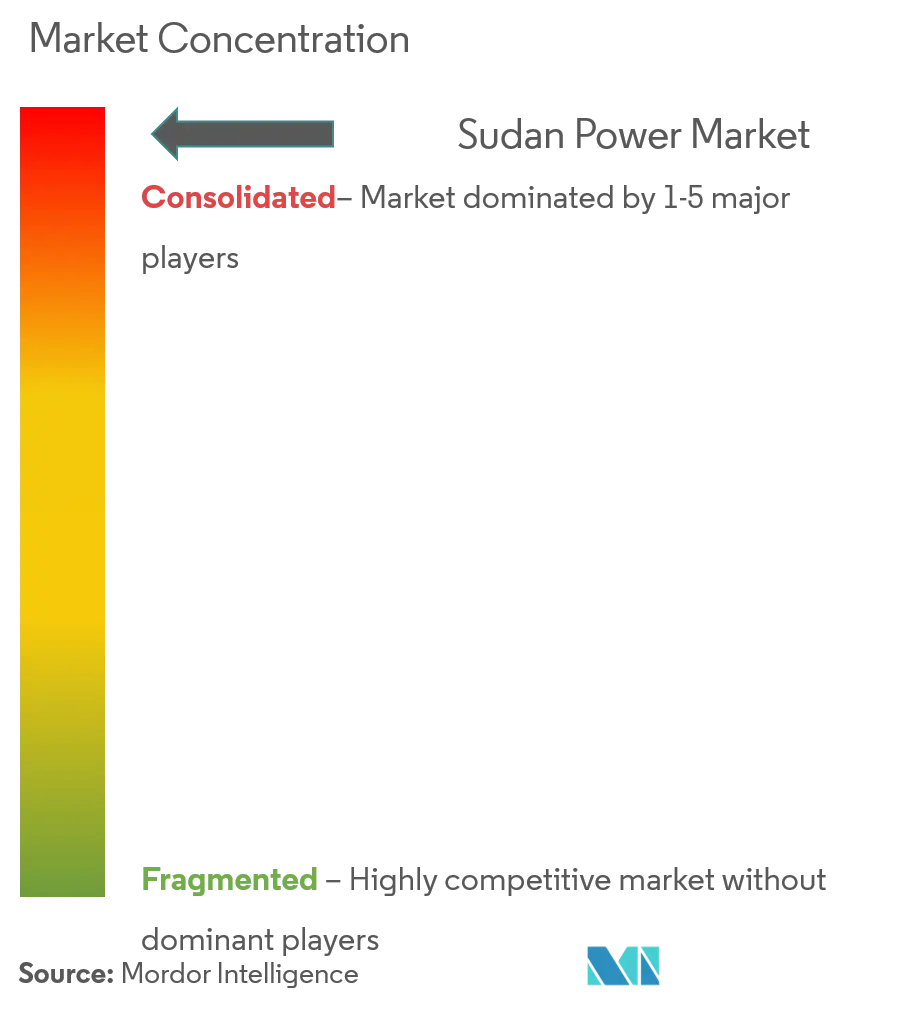
| Market Concentration | High |
Major Players *Disclaimer: Major Players sorted in no particular order Image © Mordor Intelligence. Reuse requires attribution under CC BY 4.0. | |
Sudan Power Market Analysis by Mordor Intelligence
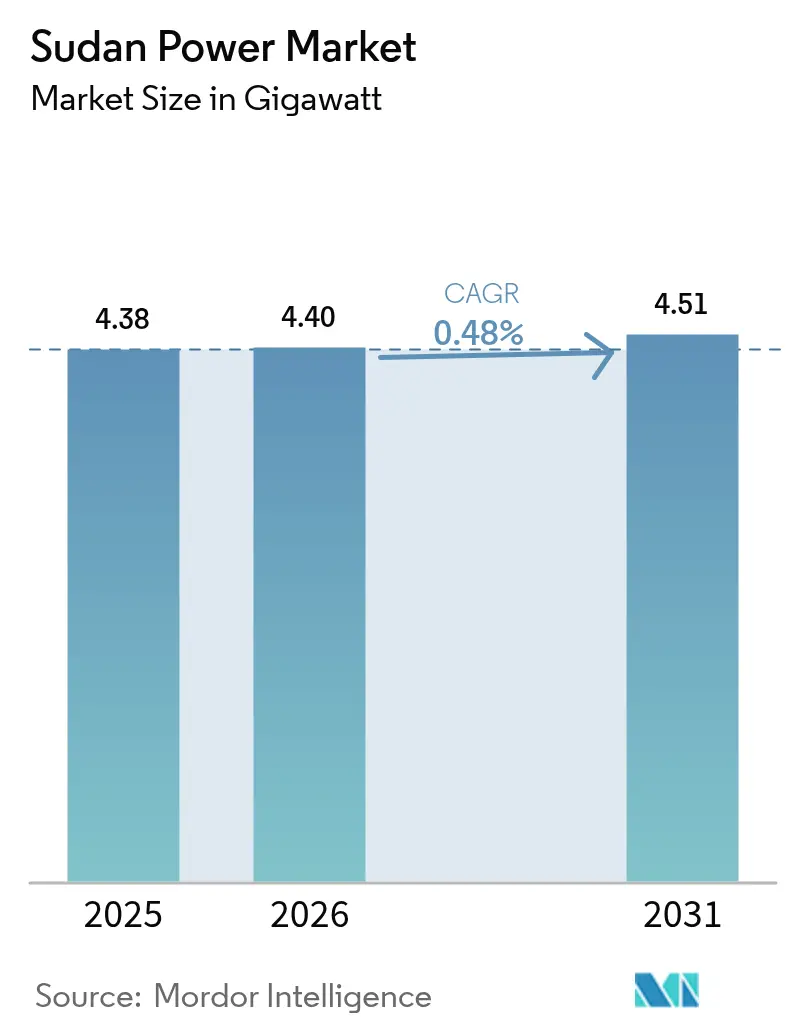
Sudan Power Market size in 2026 is estimated at 4.4 gigawatt, growing from 2025 value of 4.38 gigawatt with 2031 projections showing 4.51 gigawatt, growing at 0.48% CAGR over 2026-2031.
The market was negatively impacted by the outbreak of COVID-19. Currently, the market has reached pre-pandemic levels.
- The Sudan government is actively promoting the power sector by increasing electricity access in all parts of the country. Therefore, the demand for grid-connected electricity has been significantly increasingrecentlys and is expected to drive the market during the forecast period.
- However, the lack of power transmission infrastructure and unreliable electricity supply continued to limit private sector developers' investments, hindering the growth of the Sudan power market.
- Sudan announced to build four nuclear power plants by 2030 to fill its energy gap. This is likely to create several opportunities in the Sudan power market soon.
Note: Market size and forecast figures in this report are generated using Mordor Intelligence’s proprietary estimation framework, updated with the latest available data and insights as of 2026.
Sudan Power Market Trends and Insights
Hydropower Generating Source to Dominate the Market
- Sudan has significant water resources, primarily from the Nile River and its tributaries. This abundance of water provides a favorable condition for developing hydropower projects. The country has the potential to tap into its rivers and construct dams for power generation, making hydropower a viable and reliable source of electricity.
- Sudan has several sites with considerable hydropower potential, especially along the Nile River. The construction of large-scale hydropower dams, such as the Merowe Dam and the Grand Ethiopian Renaissance Dam (GERD), demonstrates the country's efforts to harness this potential. These projects have the capacity to generate significant amounts of electricity, making hydropower a prominent contributor to the power market.
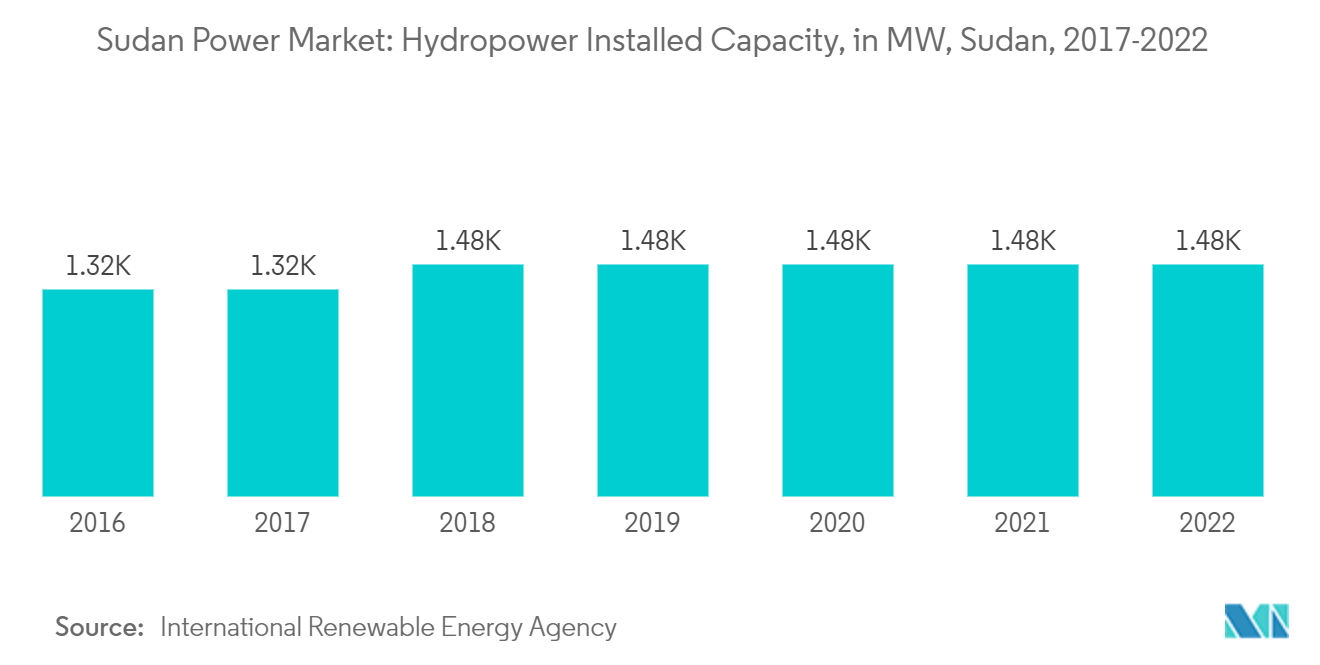
- According to the International Renewable Energy Agency, the total installed hydropower capacity in the country was 1,482 MW, an increase of almost 12% compared to 2017.
- However, the country reached this capacity in 2018. After its partition from South Sudan, Sudan faced severe electricity deficiency, and most of the installed hydropower capacity came under South Sudan after separation. The country is expected to harness the hydro potential during the forecast period.
- For instance, Shereik, a hydropower project with a capacity of 420MW, is being planned for development on the Nile River/Basin in Sudan. Currently, the project is in the permitting stage and is set to be developed in a single phase. Construction is projected to begin in 2023, with commercial operation anticipated to commence in 2026.
- Therefore, owing to these points, a hydropower-generating source is expected to dominate the Sudanese power market during the forecast period.
Increasing Renewable Energy Installations Driving Market Demand
- Over the past few years, Sudan has experienced a rise in the adoption of renewable energy installations, including the utilization of various renewable sources such as hydro energy, biofuels, and solar energy for electricity generation. As Sudan relies on power imports, the growing presence of renewable energy is expected to fulfill the country's energy demand while promoting clean and sustainable energy sources.
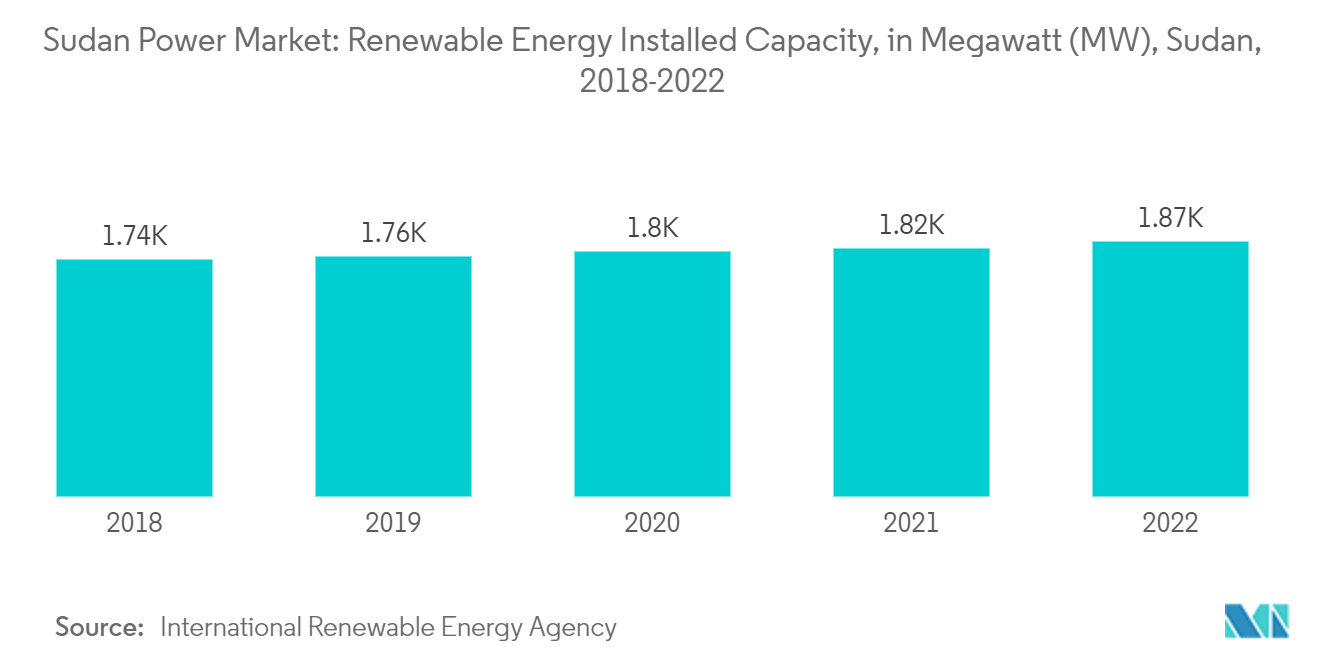
- According to the International Renewable Energy Agency, the installed capacity of renewable energy has increased in the country over the past few years. In 2022, the installed capacity of renewable energy in the country stood at 1,871 MW compared to 1,740 MW in 2018, registering a growth rate of more than 7.5%.
- The decreasing costs of renewable energy technologies, particularly solar and wind, make them increasingly competitive with conventional fossil fuel-based power generation.
- The Ministry of Water Resources, Irrigation, and Electricity, in collaboration with the UN Development Program (UNDP), initiated a Solar For Agriculture project. This project aligns with the Sudanese government's dedication to the widespread adoption of renewable energy across the country, and it receives support from the UNDP. Specifically focused on solar-powered water pumping, the project contributes to the shared goal of expanding renewable energy in Sudan.
- Hence, owing to these points, the increasing installation of renewable energy is expected to drive the Sudanese power market during the forecast period.
Regulatory Landscape
Sudan's electricity sector is governed primarily by the Electricity Act of 2001, while a draft 2019 Electricity Act has been referenced as a modernization step intended to better accommodate renewable energy and private participation, but it remains pending final approval. Sector policy and oversight sit with the Ministry of Energy and Petroleum, while the Sudan Electricity Regulatory Authority (ERA) is designated to handle licensing, technical regulations, and tariff methodology, including work on instruments such as a minigrid regulatory framework.
In 2026, official policy emphasis has focused on system recovery and operational enforcement rather than new market liberalization. In June 2026, the Ministry of Energy announced a policy framework prioritizing rehabilitation of war-damaged generation, transmission, and distribution assets, including restoration of Al-Hasahisa and Soba substations, alongside efforts referenced in official statements to curb unauthorized connections and strengthen metering and revenue collection.
Value Chain Analysis
Sudan's power value chain remains anchored in state-led system operations and reconstruction activities across generation (hydro and thermal units), high-voltage transmission, distribution, and end-user service delivery. Procurement of critical equipment and spares continues to be a binding constraint. War-related destruction has created acute bottlenecks in transformers and transmission assets, which has disconnected major load centers such as Khartoum and Gazira (previously a large share of demand). Shortages of spare parts, disrupted fuel logistics, and the loss of technical personnel have also constrained thermal plant availability and network maintenance.
Recovery actions increasingly define near-term value chain activity. In June 2026, the Ministry of Energy launched an urgent multi-track electricity recovery plan to stabilize supply. Earlier government coordination with Turkish firms (Simyokntr and Lamatak) targeted resumption of the second phase of the Kalanayeb Electricity Project in Port Sudan with African Export-Import Bank support. Downstream, the market has also shifted toward decentralized solutions where grid service is unreliable, with households and businesses scaling small solar systems and farmers adopting solar-powered pumping. This supports a larger role for importers, installers, and O&M providers for off-grid and hybrid setups alongside utility-led grid restoration.
Competitive Landscape
The Sudanese power market is consolidated. Some key players in this market (in no particular order) include Sudanese Thermal Power Generating Company, Sudanese Electricity Distribution Company, Siemens Energy AG, Ram Energy, and Dal Group.
Sudan Power Industry Leaders
-
Sudanese Electricity Distribution Company
-
Ram Energy
-
DAL Group
-
Sudanese Thermal Power Generation Company
-
Siemens Energy AG
- *Disclaimer: Major Players sorted in no particular order
Market Opportunities and Future Outlook
Grid rehabilitation and equipment replenishment remain the most immediate whitespace for capacity recovery and reliability improvements, supported by named government programs and actions. In March 2026, the Ministry of Energy set out a plan to rehabilitate major hydropower assets (Roseires, Sennar, Merowe, and Jebel Aulia dams). In June 2026, it announced a policy framework prioritizing restoration of generation, transmission, and distribution, including key substations such as Al-Hasahisa and Soba. The merger of five electricity-sector companies into the Sudan Electricity Company also concentrates counterparties for project execution and coordination across generation and T&D.
Cross-border interconnection and distributed renewables present two parallel opportunity lanes visible in current initiatives. In January 2026, Sudan held discussions with Egypt on the second phase of the Toshka 2 to Wadi Halfa interconnection to raise transfer capability to 300 MW, creating a concrete pathway for near-term supply reinforcement where domestic assets are constrained. In decentralized energy, policy measures such as removing customs duties on solar inputs, along with documented uptake of solar for agriculture and household backup, support addressable demand for solar equipment, inverters, storage, and service networks. This is especially relevant in relatively stable northern and eastern states where localized demand has risen and grid constraints persist.
Recent Industry Developments
- June 2026: Sudan relaunched a Turkish-Sudanese joint transformer factory south of Khartoum to ease equipment shortages after widespread destruction of grid assets. The effort targets faster availability of transformers and related components needed for transmission and distribution restoration, a limiting factor for reconnecting load centers.
- May 2026: The Ministry of Energy and Petroleum reconnected gas turbine unit G03 at the Qurei (1-2) power station to the national grid and completed major maintenance on Unit 3 at the Umm Dabakir power station, lifting its operational capacity to 122 MW. These actions support near-term supply stabilization by returning thermal capacity and improving plant availability.
- April 2026: Sudan's authorities announced funding to procure 5,500 electrical transformers for grid reconstruction, with 3,500 units reported delivered for restoration work in Khartoum State. The procurement program targets a core hardware bottleneck in distribution and substation rehabilitation and underpins the sequencing of power restoration in high-demand areas.
Research Methodology Framework and Report Scope
Market Definition and Coverage
For this methodology, the Sudan power market covers grid-connected electricity generation capacity in the country, tracked by source type using installed capacity in MW and then summarized in GW for easier reading.
Scope exclusions: off-grid captive generation, mini-grid capacity, and retail electricity billing revenues are not counted in the market size figures.
Segmentation Overview
- Power Generation from Sources
- Thermal Power
- Hydropower
- Non-hydro Renewables
- Nuclear
- Power Transmission and Distribution (T&D)
Data Sources, Market Sizing, and Validation
Desk Research
Desk research was used to map the sector structure, recent policy direction, and the physical constraints that shape capacity additions. We leaned on public energy statistics and planning documents, such as national utility and ministry releases where available, and cross-checked with International Energy Agency (IEA) and World Bank energy indicators.
To keep assumptions practical for Sudan, we also reviewed sources such as IRENA renewable statistics, UN Comtrade where equipment trade signals were helpful, and peer-reviewed papers that describe Sudan's generation mix and grid constraints. Company filings, project announcements, and reputable press were used to time major plants and to sense-check commissioning delays. When needed, paid subscriptions that cover company financials, news and financials, and patent databases were used to confirm ownership, timelines, and technology context. These desk sources are illustrative and not exhaustive, since many other public documents were also referred to for data collection, validation, and research clarification.
Primary Interviews and Surveys
We conduct expert interviews and surveys with utility, generation, transmission, distribution, engineering, regulatory, and project finance professionals in Sudan. Their input helps confirm plant status, commissioning delays, fuel and water constraints, outages, and network additions, while also clarifying secondary assumptions that are difficult to resolve from project records alone. Analysts then triangulate the model and document remaining gaps.
Distribution of primary research fieldwork respondents
| Company type | Respondent position |
|---|---|
| Top tier: 28% | CXOs: 15% |
| Mid tier: 47% | Functional/Unit leaders: 35% |
| Smaller Players: 25% | Managers: 50% |
Market-Sizing & Forecasting
Sizing is built with a top-down reconstruction of installed capacity, where published plant lists and sector statistics are used to form a year-by-year capacity base by source, and then adjusted for commissioning slippage that interviews highlighted. To keep the totals honest, we corroborated the results with selective bottom-up checks, such as sampling major plants and summing their nameplate MW, followed by sense checks using typical capacity addition patterns.
Inputs used in the model include announced and under-construction project MW, technology mix shifts between thermal and hydro, renewable pipeline visibility, grid readiness constraints that delay integration, and outage or rehabilitation expectations that affect effective capacity. Where project data was incomplete, gaps were handled by applying conservative timing rules based on similar project types and by validating the implied annual additions with expert feedback.
For forecasting, scenario analysis was used, because capacity growth in Sudan is strongly shaped by funding, grid constraints, and delivery risk rather than smooth demand curves. Assumptions were finalized after aligning expert views on likely commissioning windows, expected policy follow-through, and practical build rates.
Data Validation & Update Cycle
Model outputs are checked against independent signals, including implied annual capacity additions versus known project timelines and the overall mix shift that sector plans point to. When a variance shows up, the driver is traced back to a specific plant, timing assumption, or source allocation, then reviewed again before sign-off.
Reports refresh annually, and interim updates are made when material events occur, such as major project cancellations, large commissioning announcements, or policy moves that change build feasibility in the Sudan power sector. Before delivery, an analyst does a fresh pass on key inputs so clients receive an updated view that reflects the latest available information.
Mordor Intelligence's Sudan Power Market Estimate Compared With Other Published Estimates
Published estimates for the Sudan power market can look far apart because some sources mix capacity with value-based figures, and others treat planned projects as if they were already online. Differences also come from how transmission and distribution is handled, since it is sometimes quantified and sometimes left as context only.
The spread is often driven by update timing and conversion logic, where the same year can be reported using different currency months, different price assumptions, or different cutoffs for what counts as commissioned. A refresh-led review that rechecks project status close to publication, keeps the model tied to installed capacity rather than revenues, and validates timing through follow-up calls is what narrows these gaps, which is how Mordor Intelligence keeps the figure aligned to what is operational in the stated year.
Benchmark comparison
| Source | Market Size | Gaps in Research Methodology |
|---|---|---|
| Mordor Intelligence | USD 4.38 B (2025) | |
| Trade Publisher A | USD 4.38 B (2025) | Uses the same capacity headline but typically presents it without clarifying the operational cutoff used for late-stage projects, which can hide timing differences when readers compare across years. |
| Industry Site B | USD 1.90 M (2025) | Appears to value a narrow slice of the sector in monetary terms rather than installed capacity, which makes the number not comparable to a capacity-based definition and compresses the apparent market size. |
The table shows that alignment on units and timing matters more than the headline year itself. When scope is kept to installed capacity and project status is refreshed near release, the result is easier to reconcile with plant-level realities and to repeat year after year using the same steps.
Key Questions Answered in the Report
How big is the Sudan Power Market?
The Sudan Power Market size is expected to reach 4.4 gigawatt in 2026 and grow at a CAGR of 0.48% to reach 4.51 gigawatt by 2031.
What is the current Sudan Power Market size?
In 2026, the Sudan Power Market size is expected to reach 4.4 gigawatt.
Who are the key players in Sudan Power Market?
Sudanese Electricity Distribution Company, Ram Energy, DAL Group, Sudanese Thermal Power Generation Company and Siemens Energy AG are the major companies operating in the Sudan Power Market.
What years does this Sudan Power Market cover, and what was the market size in 2025?
In 2025, the Sudan Power Market size was estimated at 4.4 gigawatt. The report covers the Sudan Power Market historical market size for years: 2020, 2021, 2022, 2023 and 2024. The report also forecasts the Sudan Power Market size for years: 2026, 2027, 2028, 2029, 2030 and 2031.