
Student Loan Refinancing Market Size and Share
Market Overview
| Study Period | 2020 - 2031 |
|---|---|
| Market Size (2026) | USD 15.5 Billion |
| Market Size (2031) | USD 21.40 Billion |
| Growth Rate (2026 - 2031) | 6.70 % |
| Fastest Growing Market | Asia-Pacific |
| Largest Market | North America |
| Market Concentration | High |
Major Players *Disclaimer: Major Players sorted in no particular order Image © Mordor Intelligence. Reuse requires attribution under CC BY 4.0. | |
Student Loan Refinancing Market Analysis by Mordor Intelligence
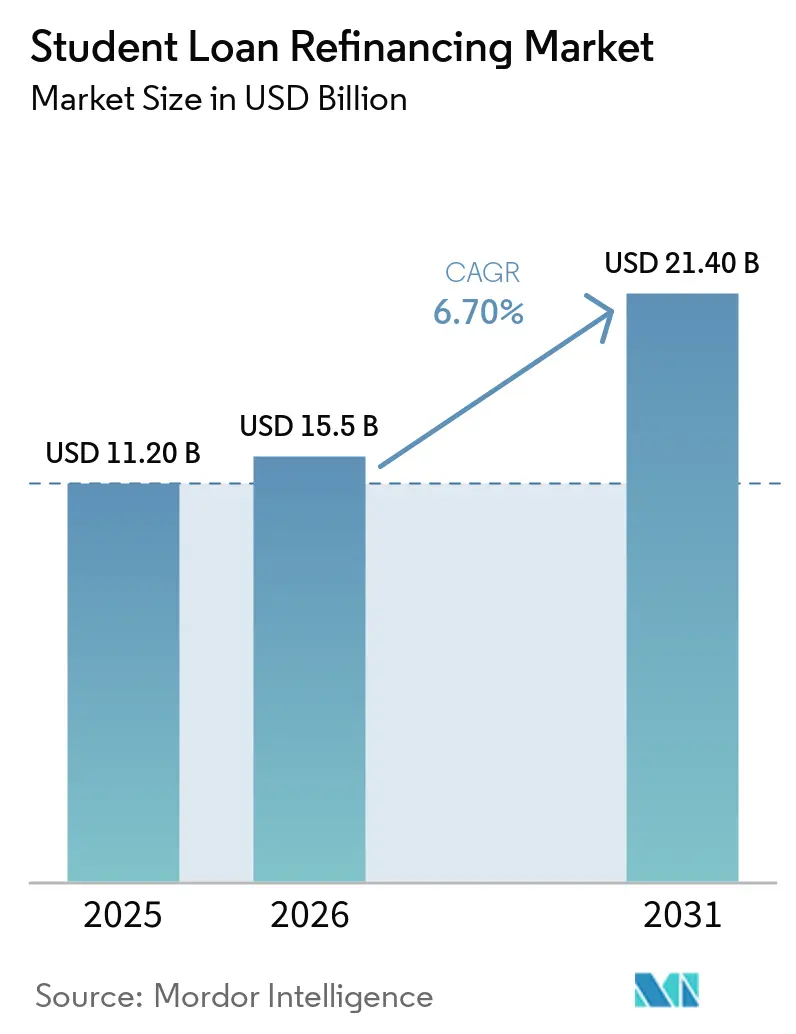
The student loan refinancing market size was valued at USD 11.2 billion in 2025 and is estimated to grow from USD 15.5 billion in 2026 to USD 21.4 billion by 2031, at a CAGR of 6.7% during the forecast period (2026-2031). Outstanding student loan debt in the United States reached USD 1.87 trillion in Q1 2026, including USD 181 billion in private loans, providing a large pool for lenders to evaluate. Federal Reserve rate cuts in late 2025 brought the benchmark range to 3.5% to 3.75%, improving the economics for borrowers considering private refinancing. Federal loan rates remain fixed after disbursement, so lower private refinancing rates can widen potential savings for borrowers who originated higher-rate loans during 2022 to 2024. Changes to federal repayment programs in 2026 are also reshaping borrower choices, while lenders are competing through rates, underwriting, servicing, and digital application processes.
Key Report Takeaways
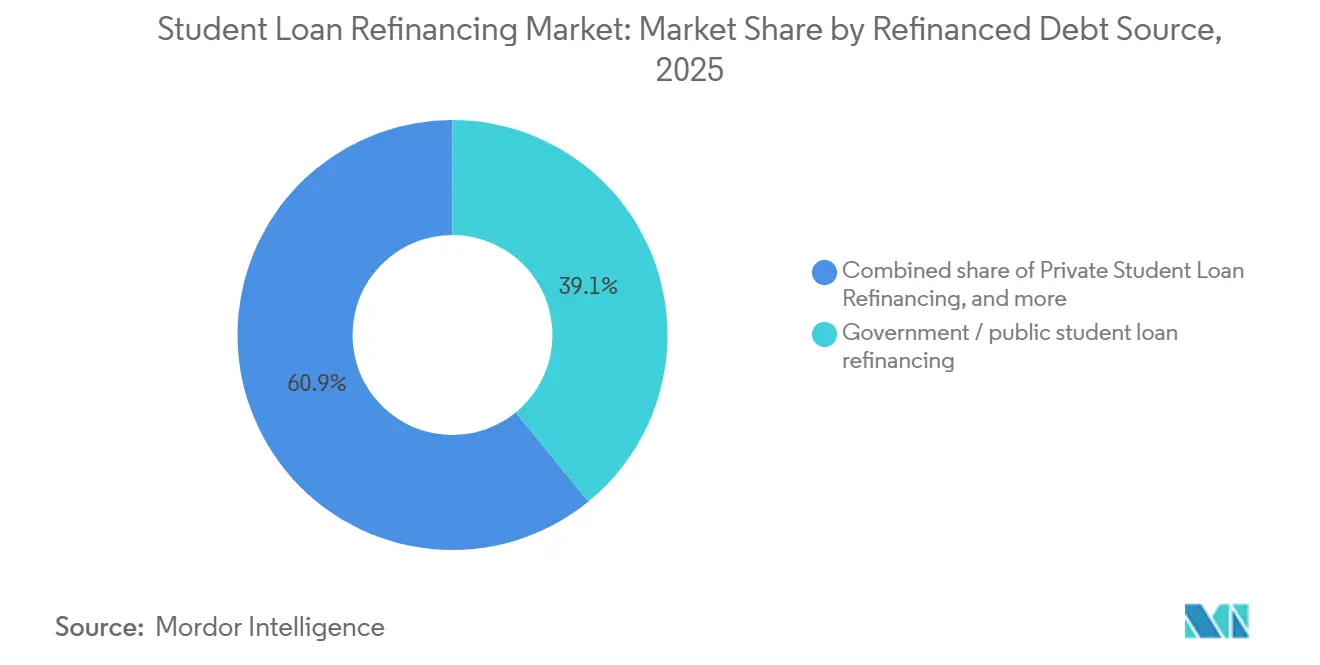
- By refinanced debt source, government and public loans captured 39.1% of the student loan refinancing market share in 2025, while private loan refinancing are forecast to expand at a 10.1% CAGR through 2031.
- By borrower education profile, graduate and professional-degree borrowers segment captured 57.6% of the student loan refinancing market share in 2025 and are forecast to expand at a 7.9% CAGR through 2031.
- By rate structure, fixed-rate refinancing captured 79.3% of the student loan refinancing market share in 2025, while variable-rate refinancing are forecast to expand at a 9.4% CAGR through 2031.
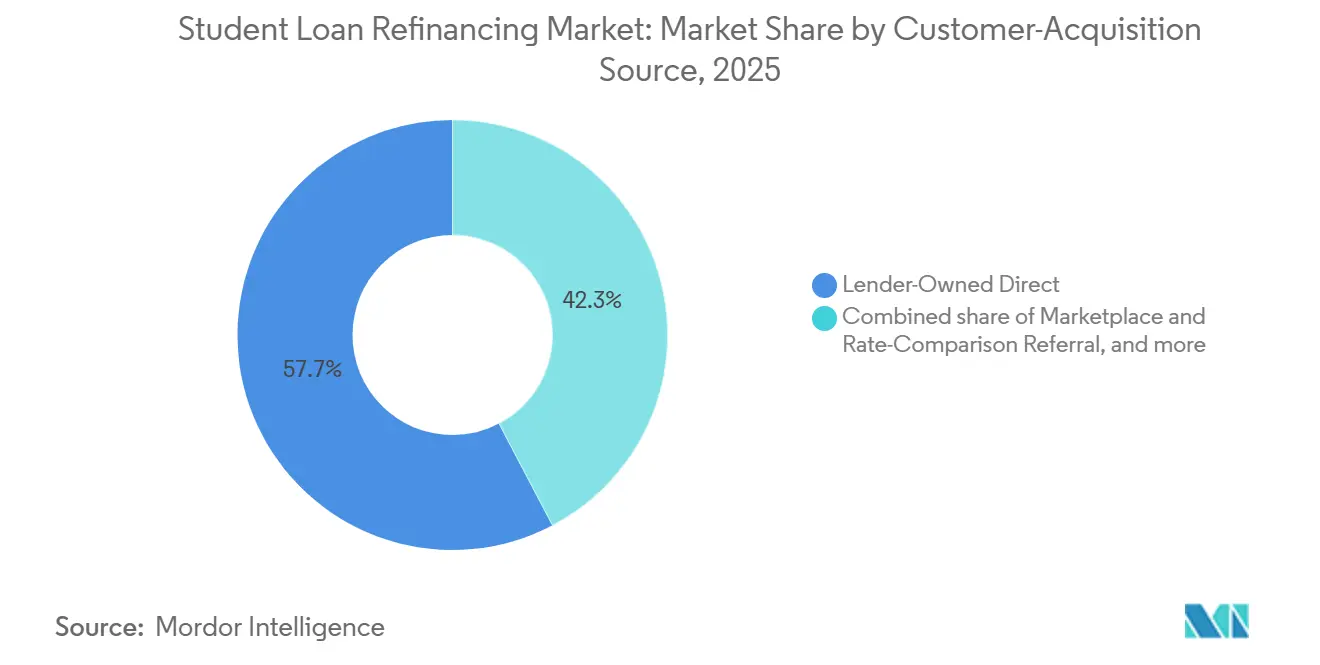
- By customer-acquisition source, lender-owned direct channels captured 57.7% of the student loan refinancing market share in 2025, while affinity, association, employer, and professional-society channels are forecast to expand at a 9.6% CAGR through 2031.
- By creditor type, deposit-taking commercial and digital banks captured 62.2% of the student loan refinancing market share in 2025, while nonbank finance companies and fintech originators segment are forecast to expand at a 8.6% CAGR through 2031.
- By geography, North America captured 93.5% of the student loan refinancing market share in 2025, while Asia-Pacific are forecast to expand at a 11.4% CAGR through 2031.
Note: Market size and forecast figures in this report are generated using Mordor Intelligence’s proprietary estimation framework, updated with the latest available data and insights as of January 2026.
Global Student Loan Refinancing Market Trends and Insights
Drivers Impact Analysis*
| Driver | (~) % Impact on CAGR Forecast | Geographic Relevance | Impact Timeline |
|---|---|---|---|
| High existing loan rates support savings-led refinancing demand | +1.8% | Global, concentrated in North America | Short term (≤ 2 years) |
| Better income and credit profiles expand borrower eligibility | +1.0% | North America and Europe | Medium term (2-4 years) |
| Cross-border education debt creates refinancing demand | +0.5% | Asia-Pacific, with spillover to the Middle East and Africa | Long term (≥ 4 years) |
| Alternative-data underwriting broadens access for thin-file borrowers | +0.7% | Global, with early gains in North America | Medium term (2-4 years) |
| Digital prequalification and automated underwriting reduce friction | +0.8% | North America and Europe | Short term (≤ 2 years) |
| Employer student-debt benefits create new refinancing opportunities | +0.6% | North America | Medium term (2-4 years) |
| Source: Mordor Intelligence | |||
Federal Rate Cuts and Elevated Legacy Loan Costs Open a Savings-Led Refinancing Window
The Federal Reserve cut its benchmark rate 3 times in late 2025 to a 3.5% to 3.75% target range and held it steady through the first 2 meetings of 2026[1]. Federal student loan rates for the 2025 to 2026 academic year were fixed at 6.39% for undergraduate loans, 7.94% for graduate loans, and 8.94% for Grad PLUS loans. Earnest stated in March 2026 that its refinancing rates had reached their lowest level in 3 years. Borrowers who originated loans between 2022 and 2024 may have stable private-sector income but no expected path to loan forgiveness. The student loan refinancing market benefits when lower private offers create a larger difference from those legacy federal rates. Federal rates do not move after a loan is disbursed, so each reduction in benchmark rates can improve the refinancing case for eligible borrowers.
Alternative-Data Underwriting Expands Refinancing Eligibility Beyond Credit History
Traditional credit models can exclude early-career and international borrowers with limited United States credit histories. Alternative underwriting can review rental payments, verified gig income, savings patterns, and education-linked income projections alongside standard credit information. MPOWER Financing uses Nova Credit cross-border bureau data with United States TransUnion reports to assess international graduates without a domestic credit file. This approach addresses a borrower group that many domestic refinancing providers cannot readily serve. Equal Credit Opportunity Act requirements and Consumer Financial Protection Bureau guidance on model governance require lenders to manage these systems carefully. The student loan refinancing market can widen access through these methods, provided lenders maintain fair-lending controls and clear adverse-action processes.
Automated Digital Origination Compresses Acquisition and Processing Costs
Open-banking application processes can allow lenders to verify employment, income, and existing loan terms without paper documentation. This reduces application time from days to minutes and can limit the abandonment that has historically affected refinancing applications. SoFi reported USD 2.6 billion in student loan originations during Q1 2026 and USD 2.7 billion during Q2 2026[2]. Its single member-authentication layer supports refinancing activity and the cross-selling of other financial products. LendKey uses a different model, with one digital application producing offers from community bank and credit union partners. Fair Credit Reporting Act notices and Regulation P privacy requirements apply to automated workflows, although scaled lenders can integrate them into established operating processes.
Section 127 Permanent Extension Makes Employer-Sponsored Refinancing a Structural Demand Channel
The One Big Beautiful Bill Act permanently removed the sunset provision for Internal Revenue Service Section 127 educational assistance plans. The provision allows employer student loan repayment assistance of up to USD 5,250 per employee each year, and the limit is indexed for inflation from 2026[3]. Only 14% of employers offered some form of student loan assistance in the cited 2026 source, leaving room for employer programs to expand. The affinity, association, employer, and professional-society channel is the fastest-growing acquisition source at a 9.6% CAGR through 2031. Employers can use white-label refinancing integrations to create referral channels for medical, legal, and technology professionals with high loan balances. This supports a more stable source of qualified applicants for providers operating in the student loan refinancing market.
Restraints Impact Analysis*
| Restraint | (~) % Impact on CAGR Forecast | Geographic Relevance | Impact Timeline |
|---|---|---|---|
| Loss of federal protections limits federal-to-private refinancing | -0.9% | North America, primarily the United States | Short term (≤ 2 years) |
| Interest-rate volatility reduces available refinancing savings | -0.6% | Global | Medium term (2-4 years) |
| Responsible-lending requirements limit alternative-data underwriting | -0.4% | North America and Europe | Medium term (2-4 years) |
| Limited credit histories and weak repayment performance raise risk | -0.3% | Asia-Pacific and Middle East, and Africa | Long term (≥ 4 years) |
| Source: Mordor Intelligence | |||
Federal Borrower Protection Trade-Offs Limit Federal-to-Private Conversion Rates
Refinancing a federal loan into a private obligation is permanent and removes access to income-driven repayment, Public Service Loan Forgiveness, federal forbearance, and disability discharge. The value of these protections differs according to a borrower’s employment and income outlook. The Repayment Assistance Plan and Tiered Standard Plan launched in July 2026, providing new federal options that may retain borrowers without a strong financial reason to refinance. Federal student loan complaints reached 18,400 during the year to June 2025, a 36% increase from the prior year. The reported rise in complaints indicates that borrower uncertainty can delay refinancing decisions. Disclosure rules for private student lending also require clear presentation of federal and private loan differences, which limits aggressive conversion marketing in the student loan refinancing market.
Rate Environment Uncertainty Compresses the Refinancing Savings Proposition for Rate-Sensitive Borrowers
Refinancing economics depend on the difference between the borrower’s existing rate and the offered private rate. That difference can narrow if the Federal Reserve pauses rate reductions or if private credit spreads widen because of greater delinquency risk. Student loan delinquencies rose from below 1% to nearly 8% in Q1 2025 after pandemic-era credit reporting pauses ended. Loans 90 or more days past due reached 10.2% in Q2 2025, which can make private underwriting more selective. Variable-rate products linked to the Secured Overnight Financing Rate can offer lower initial payments when rates fall. They also expose borrowers to higher payments after a rate reversal, which limits their suitability for borrowers with low risk tolerance.
*Our forecasts treat driver/restraint impacts as directional, not additive. The impact forecasts reflect baseline growth, mix effects, and variable interactions.
Segment Analysis
By Refinanced Debt Source: Policy Disruption Lifts Private Loan Origination
Government and public loans accounted for 39.1% of the student loan refinancing market share in 2025, making them the largest debt-source category within the student loan refinancing market. Many borrowers remain hesitant to surrender federal protections, even when a private offer has a lower rate. The elimination of the Saving on a Valuable Education plan in July 2026 changed repayment decisions for the 7.5 million borrowers previously enrolled in the plan. New federal repayment choices can retain some borrowers, especially those who rely on protections linked to public-sector or nonprofit employment. Other borrowers with stable private-sector careers may find that refinancing provides a clearer payment and savings case. The existing government loan base, therefore, remains important to loan originators, but conversion requires a transparent assessment of each borrower’s federal benefits.
Private student loan refinancing is forecast to expand at a 10.1% CAGR through 2031, the fastest rate within this debt-source grouping. Federal limits on graduate borrowing are expected to move more education financing demand toward private providers. The resulting change increases the importance of private credit options for borrowers who need funding beyond federal loan availability. The blended government-and-private category serves borrowers who want to combine multiple loan types into one payment. This is particularly relevant for graduate borrowers with multi-source debt above USD 100,000. The student loan refinancing market size for private debt is supported by policy changes that increase the role of private education financing.
By Borrower Education Profile: Graduate Debt Leads Both Volume and Growth
Graduate and professional-degree borrowers held 57.6% of the student loan refinancing market share in 2025 and are forecast to grow at a 7.9% CAGR through 2031. This group captured the largest student loan refinancing segment-level volume share because professional programs commonly generate high balances. Medical, dental, and law graduates can carry USD 200,000 to USD 300,000 in aggregate debt. A 50-basis-point rate reduction can therefore change total interest costs substantially over a 10 to 20-year repayment term. The end of Grad PLUS loans for new borrowers and federal aggregate borrowing limits create a different financing environment for current and future graduate students. These changes increase the importance of private options for borrowers who do not require federal repayment protections.
Earnest introduced early-graduation refinancing in 2026, allowing applicants to use signed job-offer letters within 6 months of graduation. This product approach seeks to reach borrowers before regular repayment begins. High expected income and large loan balances make this group valuable to lenders able to underwrite responsibly. Undergraduate and certificate borrowers usually have lower balances, which can reduce the potential interest savings from refinancing. They may also have less established credit and income records early in their careers. The student loan refinancing industry continues to focus on graduate borrowers because their loan amounts and repayment profiles can support more specialized products.
By Rate Structure: Fixed-Rate Incumbent Faces Variable-Rate Recovery on Rate-Cut Thesis
Fixed-rate refinancing represented 79.3% of the student loan refinancing market share in 2025, reflecting the preference for predictable payments on large balances and long repayment terms. This category held the largest student loan refinancing segment-level volume share in the rate-structure segmentation. Borrowers refinancing USD 100,000 or more across 10 to 20 years can face a meaningful increase in lifetime interest costs if variable rates rise. Payment certainty is therefore an important consideration for borrowers with long repayment horizons. Fixed pricing can also simplify household budgeting for borrowers who are evaluating a permanent move out of the federal loan system. The strong position of fixed-rate products reflects these needs, rather than a lack of interest in lower initial rates.
Variable-rate refinancing is expected to grow at a 9.4% CAGR through 2031, the highest rate in this segment. Borrowers with short payoff periods and aggressive prepayment plans may seek lower initial rates on products linked to the Secured Overnight Financing Rate. This structure can work for borrowers who have sufficient financial capacity to manage a later rise in rates. Earnest permits eligible borrowers to switch between fixed and variable structures every 30 days. The option turns rate selection into an ongoing choice, although it does not remove the risk of a higher benchmark rate. The student loan refinancing market size for variable-rate products depends on borrowers’ expectations for rates and their ability to absorb payment changes.
By Customer-Acquisition Source: Affinity Channels Challenge the Direct-Lender Incumbent
Lender-owned direct channels captured 57.7% of the student loan refinancing market share in 2025 and remained the largest customer-acquisition source. Established originators use brand recognition, member relationships, and cross-selling capabilities to reach borrowers. SoFi’s Financial Services Productivity Loop directs members from banking and investment products toward student loan refinancing. This approach can lower borrower acquisition costs and increase the value of each member relationship. Direct channels also allow lenders to control the application process, underwriting experience, and servicing communications. Their scale gives large originators a continuing advantage in the student loan refinancing market.
Affinity, association, employer, and professional-society channels are forecast to expand at a 9.6% CAGR through 2031. Section 127’s permanent extension supports the use of employer benefit programs as an entry point for refinancing offers. Professional associations in health care, law, and technology can also connect lenders with borrowers who have high balances and established earnings. Marketplace and rate-comparison platforms serve borrowers who have already decided to refinance and are comparing offers. Splash Financial works through a credit union network, while LendKey aggregates community bank offers. These channels provide digital distribution for lenders that do not have the same direct consumer reach as large national providers.
By Creditor Type: Banks Lead Volume, Fintechs Lead Growth
Deposit-taking commercial and digital banks held 62.2% of the student loan refinancing market share in 2025, giving them the leading position by creditor type. This category captured the largest student loan refinancing segment-level volume share through established brands and access to deposit funding. SoFi, now a chartered bank, reported USD 621.8 million in annualized interest-expense savings in Q1 2026 compared with warehouse-facility funding. Deposit funding can lower the cost of capital for lenders with eligible deposit bases. Banks can also use existing customer relationships to support cross-selling and repeat engagement. These advantages help explain their large share of the student loan refinancing market.
Nonbank finance companies and fintech originators are forecast to grow at an 8.6% CAGR through 2031. Their technology-led operating models can support faster product changes and broader approaches to assessing eligible borrowers. Credit unions and cooperative institutions align member-ownership principles with borrower savings and gain digital reach through Splash Financial and LendKey. Citizens Financial Group sold USD 1.9 billion in non-core education loans during 2025, showing that balance-sheet constraints can also lead creditor groups to exit. State-sponsored and mission lenders such as RISLA and MEFA serve credit profiles that commercial lenders may not prioritize. These organizations form a credit-extension layer across the broader student loan refinancing industry.
Geography Analysis
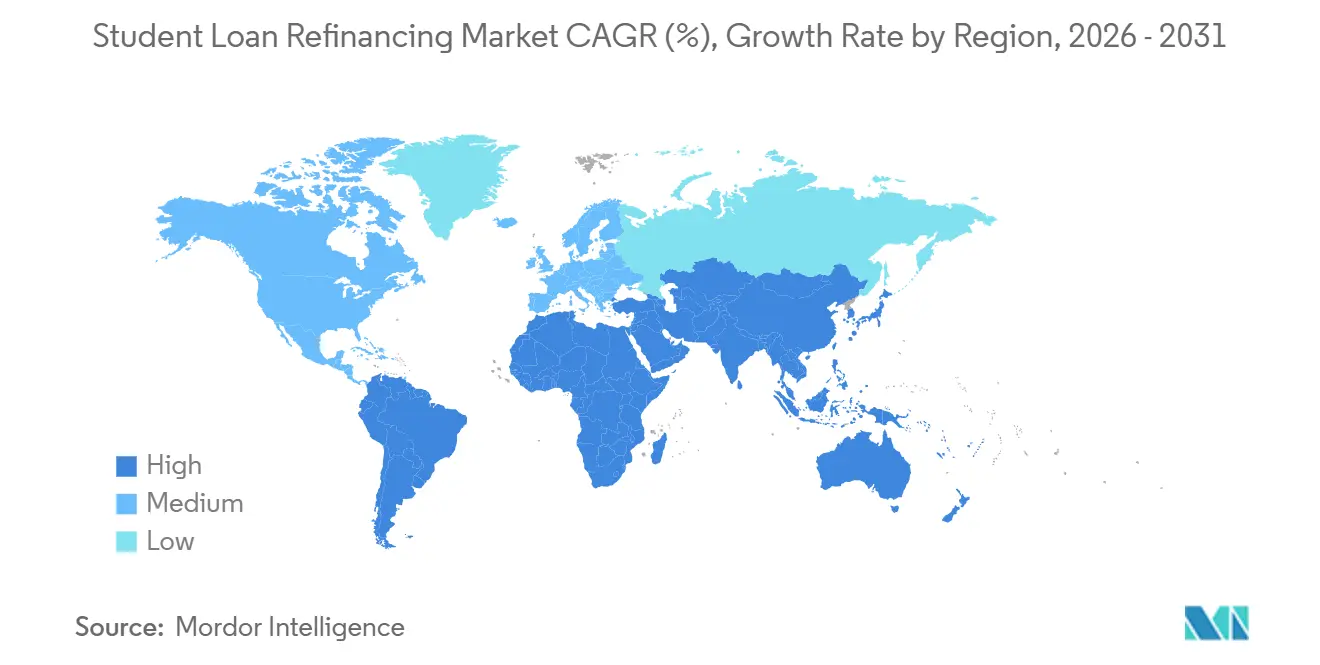
North America held 93.5% of the student loan refinancing market share in 2025, which made it the largest regional segment of the student loan refinancing market. The United States has the deepest private education lending ecosystem and the largest concentration of high-earning graduate-degree holders. United States student debt reached USD 1.87 trillion in Q1 2026, while mature securitization activity supports private loan funding. The 2026 changes to the Saving on a Valuable Education plan, Graduate PLUS lending, the Repayment Assistance Plan, and the Tiered Standard Plan are a North American catalyst for near-term refinancing demand. Canada has a smaller addressable private refinancing base because of provincial student loan structures. Mexico remains an early-stage market because formal credit infrastructure is less developed and postgraduate wage premiums are lower relative to transaction costs.
Asia-Pacific is projected to grow at an 11.4% CAGR through 2031 and is the fastest-growing regional segment. Indian students who borrowed from nonbank financial companies at 12% to 14% to finance overseas education can refinance into public-sector bank products at 8.5% to 10.5% once employed. Indian graduates working in the United States on H-1B or Optional Practical Training visas can also refinance across borders through MPOWER Financing without a domestic co-signer. MPOWER Financing offers fixed annual percentage rates starting at 9.99%. Australia, South Korea, and Singapore are developing post-graduation refinancing activity as education costs rise, although these countries do not yet have United States-scale secondary-market infrastructure.
Europe and South America are smaller but meaningful regional segments in the student loan refinancing market. France’s state-guaranteed student loans carried rates of 0.99% to 3.5% in 2026, with 70% state coverage through Bpifrance, which reduces the financial case for traditional private refinancing. Germany’s KfW Studienkredit had a 6.36% variable rate linked to EURIBOR, supporting interest in fixed-rate alternatives after borrowers enter employment. South America is limited by currency-denomination mismatches and macroeconomic volatility, particularly in Brazil and Argentina. The Middle East and Africa remain early-stage, with activity concentrated in the United Arab Emirates and South Africa.
Competitive Landscape
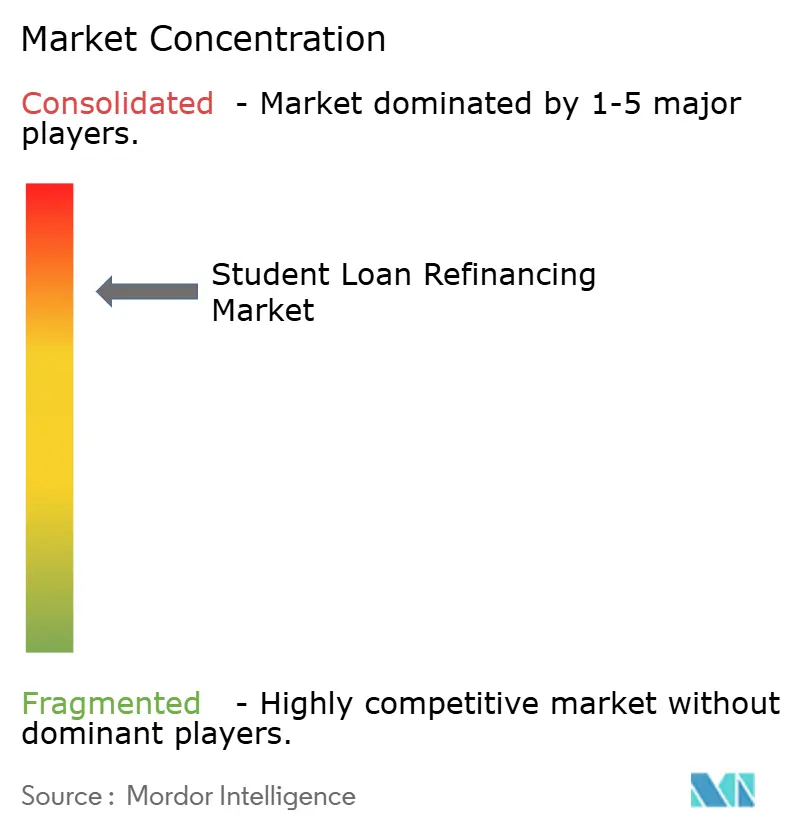
The student loan refinancing market is consolidated. SoFi Technologies, Earnest, and KeyBank, which incorporates Laurel Road, are among the leading direct originators. SoFi reported USD 2.7 billion in student loan originations in Q2 2026 and a net charge-off rate below 1%. Its strategy is to convert refinancing borrowers into members who use several banking products. That model can raise the lifetime value of a customer relationship while using deposit funding to support pricing. The competitive position of large lenders rests on underwriting quality, funding costs, servicing capacity, and a broad digital customer relationship.
Marketplace providers have a different position because they function as rate-discovery infrastructure rather than balance-sheet originators. Splash Financial raised more than USD 70 million in a Series C round in September 2025 and launched a home equity line of credit offering of up to USD 500,000. LendKey connects borrowers with community banks and credit union partners through a single digital application. Laurel Road completed its transition to the KeyBank brand in March 2026, moving refinancing accounts, digital services, and professional-society programs to the KeyBank platform. These moves show how providers are expanding distribution, product access, and operating scale. The student loan refinancing market remains competitive because lenders can differentiate through rate comparison, partner networks, and borrower service.
Mission lenders and state-linked providers add another layer of competition by serving borrower profiles that commercial providers may avoid. MPOWER Financing is positioned around cross-border lending for international graduates, while RISLA and MEFA serve borrowers through mission-oriented structures. Product designs that include hardship deferment or income-linked payment floors may address the protection trade-off that limits some private refinancing conversions. Providers must also meet Consumer Financial Protection Bureau disclosure expectations when explaining the loss of federal loan benefits. The most effective lenders can combine compliant underwriting processes with dependable funding and clear borrower communications.
Student Loan Refinancing Industry Leaders
-
SoFi Technologies, Inc.
-
Earnest LLC
-
Laurel Road
-
Citizens Financial Group, Inc.
-
ELFI
- *Disclaimer: Major Players sorted in no particular order
Recent Industry Developments
- July 2026: The United States Department of Education terminated the Saving on a Valuable Education income-driven repayment plan and launched the Repayment Assistance Plan and Tiered Standard Plan, affecting 7.5 million borrowers. The program changes created a different federal repayment environment for borrowers considering private refinancing.
- July 2026: The One Big Beautiful Bill Act provisions eliminated Graduate PLUS loans for new borrowers and capped federal graduate and professional loan limits. These provisions changed the funding options available to new graduate and professional borrowers.
- April 2026: Sallie Mae priced the SMB Private Education Loan Trust 2026-B, a private student loan securitization in 5 tranches with a March 2056 legal final maturity.
- March 2026: Laurel Road completed its transition to the KeyBank brand, migrating student loan refinancing accounts, digital services, and professional-society partnership programs to the KeyBank platform.
Global Student Loan Refinancing Market Report Scope
| Government/Public Student Loan Refinancing |
| Private Student Loan Refinancing |
| Government/Public and Private Student Loan Refinancing |
| Undergraduate-Degree Borrowers |
| Graduate and Professional-Degree Borrowers |
| Associate, Certificate, Non-Degree, Career-Training and Other Borrowers |
| Fixed-Rate Refinancing |
| Variable-Rate Refinancing |
| Hybrid/Other Rate Structures |
| Lender-Owned Direct |
| Marketplace and Rate-Comparison Referral |
| Affinity, Association, Employer, and Professional-Society Partner |
| Broker, Advisor, and Other Third-Party Originators |
| Deposit-Taking Commercial and Digital Banks |
| Credit Unions and Cooperative Financial Institutions |
| Nonbank Finance Companies and Fintech Originators |
| State-Sponsored, Nonprofit, and Mission Lenders Originating Private Refinance |
| North America | United States |
| Canada | |
| Mexico | |
| South America | Brazil |
| Argentina | |
| Rest of South America | |
| Europe | United Kingdom |
| Germany | |
| France | |
| Italy | |
| Spain | |
| Rest of Europe | |
| Asia-Pacific | China |
| Japan | |
| India | |
| South Korea | |
| Australia | |
| Indonesia | |
| Thailand | |
| Malaysia | |
| Singapore | |
| Vietnam | |
| Rest of Asia-Pacific | |
| Middle East and Africa | Saudi Arabia |
| United Arab Emirates | |
| Turkey | |
| South Africa | |
| Egypt | |
| Rest of Middle East and Africa |
| By Refinanced Debt Source | Government/Public Student Loan Refinancing | |
| Private Student Loan Refinancing | ||
| Government/Public and Private Student Loan Refinancing | ||
| By Borrower Education Profile | Undergraduate-Degree Borrowers | |
| Graduate and Professional-Degree Borrowers | ||
| Associate, Certificate, Non-Degree, Career-Training and Other Borrowers | ||
| By Rate Structure | Fixed-Rate Refinancing | |
| Variable-Rate Refinancing | ||
| Hybrid/Other Rate Structures | ||
| By Customer-Acquisition Source | Lender-Owned Direct | |
| Marketplace and Rate-Comparison Referral | ||
| Affinity, Association, Employer, and Professional-Society Partner | ||
| Broker, Advisor, and Other Third-Party Originators | ||
| By Creditor Type | Deposit-Taking Commercial and Digital Banks | |
| Credit Unions and Cooperative Financial Institutions | ||
| Nonbank Finance Companies and Fintech Originators | ||
| State-Sponsored, Nonprofit, and Mission Lenders Originating Private Refinance | ||
| By Geography | North America | United States |
| Canada | ||
| Mexico | ||
| South America | Brazil | |
| Argentina | ||
| Rest of South America | ||
| Europe | United Kingdom | |
| Germany | ||
| France | ||
| Italy | ||
| Spain | ||
| Rest of Europe | ||
| Asia-Pacific | China | |
| Japan | ||
| India | ||
| South Korea | ||
| Australia | ||
| Indonesia | ||
| Thailand | ||
| Malaysia | ||
| Singapore | ||
| Vietnam | ||
| Rest of Asia-Pacific | ||
| Middle East and Africa | Saudi Arabia | |
| United Arab Emirates | ||
| Turkey | ||
| South Africa | ||
| Egypt | ||
| Rest of Middle East and Africa | ||
Key Questions Answered in the Report
What is driving student loan refinancing demand in 2026?
Lower private refinancing rates, fixed legacy federal loan rates, and federal repayment changes are supporting demand among eligible borrowers in the student loan refinancing market. Borrowers with stable earnings and no expected forgiveness path may see a clearer savings case, while the permanent loss of federal protections remains a key decision factor.
How large is the student loan refinancing market?
The student loan refinancing market is estimated at USD 15.5 billion in 2026 and is forecast to reach USD 21.4 billion by 2031 at a 6.7% CAGR. The United States has the largest refinancing base because it combines a substantial student debt stock, established private lenders, and mature securitization funding.
Which borrower group has the strongest refinancing activity?
Graduate and professional-degree borrowers held 57.6% of 2025 volume and are projected to grow at a 7.9% CAGR through 2031. Medical, dental, and law graduates often have large balances, which can make the savings from a lower interest rate more meaningful within the student loan refinancing market.
Are fixed or variable refinancing loans more common?
Fixed-rate refinancing held 79.3% of 2025 volume, while variable-rate refinancing is forecast to grow faster at a 9.4% CAGR. Fixed payments provide more certainty, while variable rates may suit borrowers with short repayment horizons in the student loan refinancing market.
Which region is expanding fastest for student loan refinancing?
Asia-Pacific is forecast to grow at an 11.4% CAGR through 2031, led by cross-border and post-graduation refinancing needs. Indian borrowers who financed overseas education and later entered employment are one source of regional demand within the student loan refinancing market.
What should borrowers consider before refinancing federal loans?
Private refinancing permanently removes federal protections such as income-driven repayment, Public Service Loan Forgiveness, federal forbearance, and disability discharge. Borrowers should assess the value of these benefits, their employment outlook, existing interest rate, and ability to make payments before replacing a federal loan.