
Structural Steel Market Size and Share
Market Overview
| Study Period | 2021 - 2031 |
|---|---|
| Market Size (2026) | USD 137.39 Billion |
| Market Size (2031) | USD 184.98 Billion |
| Growth Rate (2026 - 2031) | 6.13 % |
| Fastest Growing Market | North America |
| Largest Market | Asia-Pacific |
| Market Concentration | Low |
Major Players *Disclaimer: Major Players sorted in no particular order Image © Mordor Intelligence. Reuse requires attribution under CC BY 4.0. | |
Structural Steel Market Analysis by Mordor Intelligence
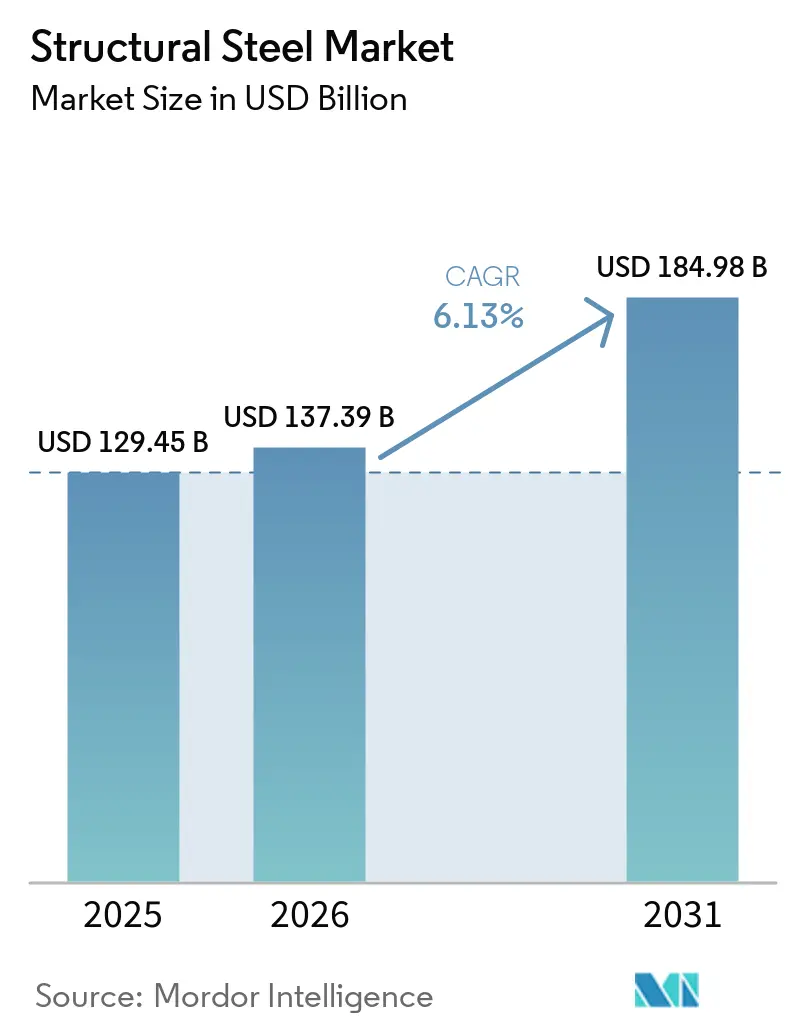
The Structural Steel Market size was valued at USD 129.45 billion in 2025 and is estimated to grow from USD 137.39 billion in 2026 to reach USD 184.98 billion by 2031, at a CAGR of 6.13% during the forecast period (2026-2031). Public infrastructure programs, industrial construction, and data center development support demand for load-bearing steel products. Buyers increasingly require traceable supply, recycled content, and documented emissions performance alongside cost and delivery reliability. Prefabrication and automated fabrication also favor products with consistent dimensions and predictable weld performance. Capacity growth in Asia, trade actions in North America and Europe, and volatile raw-material costs will continue to shape supplier strategies in the structural steel market. Producers that pair local supply with higher-value sections, plates, and low-carbon documentation are better positioned to serve complex projects in the structural steel market.
Key Report Takeaways
- By product, structural sections held 35.12% of the structural steel market share in 2025, while hollow structural sections are projected to advance at a 7.06% CAGR through 2031.
- By manufacturing process, hot-rolled structural steel held 70.41% of the structural steel market share in 2025, while cold-rolled structural steel is projected to advance at a 7.34% CAGR through 2031.
- By end-use, infrastructure held 42.87% of the structural steel market share in 2025 and is projected to advance at a 7.65% CAGR through 2031.
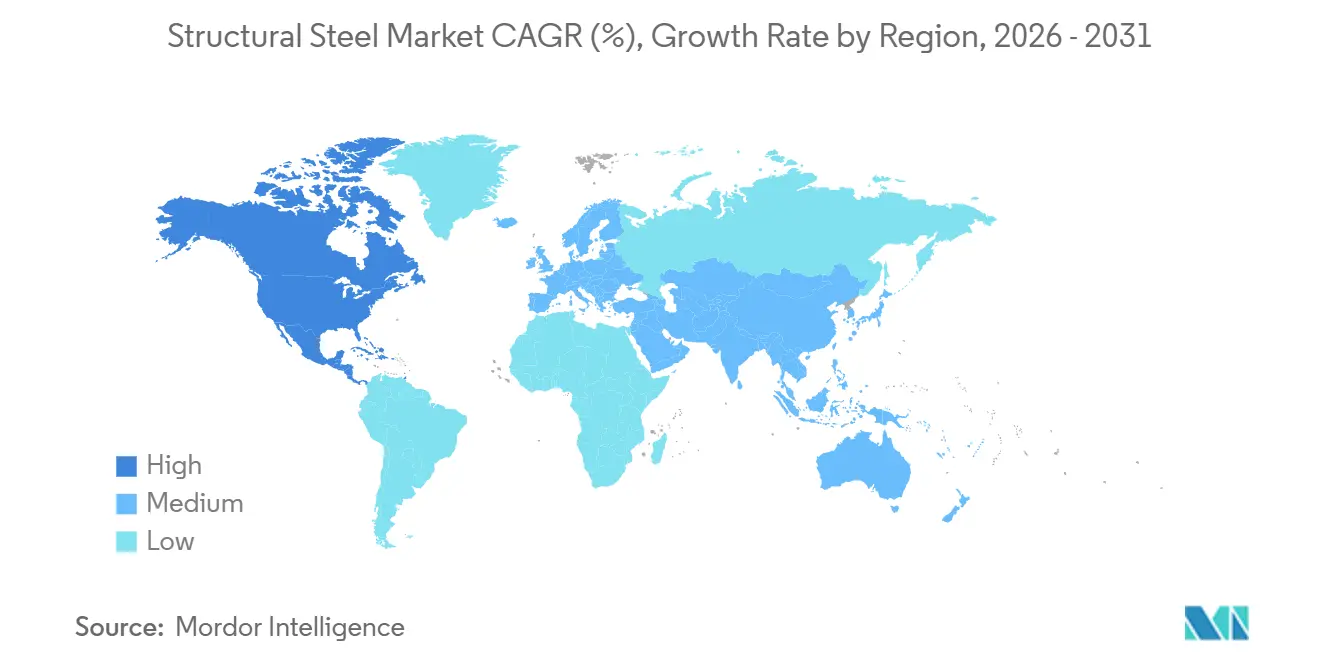
- By geography, Asia-Pacific held 55.34% of the structural steel market share in 2025, while North America is projected to advance at a 6.89% CAGR through 2031.
Note: Market size and forecast figures in this report are generated using Mordor Intelligence’s proprietary estimation framework, updated with the latest available data and insights as of January 2026.
Market Trends and Insights
Drivers Impact Analysis of Structural Steel Market*
| Driver | (~) % Impact on CAGR Forecast | Geographic Relevance | Impact Timeline |
|---|---|---|---|
| Infrastructure and Transport Investment | +2.0% | Global, with peak impact in South and Southeast Asia, North America | Long term (≥ 4 years) |
| Commercial, Industrial, and Logistics Construction | +1.5% | North America, Asia-Pacific, Europe | Medium term (2–4 years) |
| AI Data Center and Manufacturing Onshoring Build-Out | +1.2% | North America core, spillover to APAC and Europe | Medium term (2–4 years) |
| Modular and Prefabricated Construction Adoption | +0.8% | Global, with early concentration in China, India, and US states with prefab quotas | Long term (≥ 4 years) |
| Steel Design Optimization Through BIM, Robotics and AI | +0.5% | North America and Europe, incremental gains in APAC | Long term (≥ 4 years) |
| Source: Mordor Intelligence | |||
Infrastructure and Transport Investment
Infrastructure and transport investment remains the largest source of demand for the structural steel market. Bridges, rail corridors, ports, grids, and shipyards need substantial volumes of sections, plates, and reinforcing products. The Federal Highway Administration reported a USD 191.3 billion bridge rehabilitation backlog, while its fiscal 2026 budget request totaled USD 72.6 billion. Buy America requirements focus on steel melted and poured in the United States for covered projects[1]Federal Highway Administration, “Buy America Requirements for Iron, Steel, and Manufactured Products Q&A,” U.S. Department of Transportation, fhwa.dot.gov. India’s finished steel consumption reached 164 million metric tons in fiscal 2025-26, rising 7% as construction, infrastructure, railways, and manufacturing expanded. The United States maritime action plan also creates a potential source of plate and section demand through shipyard investment and procurement reform.
Commercial, Industrial, and Logistics Construction
Commercial, industrial, and logistics construction supports demand across the structural steel market. Warehouses, semiconductor plants, battery facilities, and large commercial properties often use wide-span steel frames and off-site fabrication. Manufacturing investment in North America has expanded the pipeline for fabrication plants, battery factories, and assembly facilities. These projects require structural frames, crane rails, utility structures, and specialized floor systems. Germany’s construction sector recorded 2.5% revenue growth in 2025, while order intake rose 6.8% because of rail, pipeline, and data center projects. Project execution often depends on regional fabricators, so distributors and fabricators can capture much of the margin improvement associated with this work.
AI Data Center and Manufacturing Onshoring Build-Out
AI data center and manufacturing onshoring build-out has added a concentrated source of demand to the structural steel market. A hyperscale facility can require up to 20,000 metric tons of structural steel, especially in frames, equipment supports, and heavy plate applications. The International Energy Agency expects global data center capacity to reach 171–219 gigawatts by 2030, which is close to twice the current installed capacity[2]International Energy Agency, “Energy and AI,” International Energy Agency, iea.org. This construction profile favors hollow structural sections and heavy plates rather than reinforcing steel. Domestic procurement requirements and reduced imports have also directed more project demand toward United States mills and fabricators. Nucor Corporation reported strong nonresidential demand from data centers, liquefied natural gas terminals, pipelines, bridges, and manufacturing projects in its first-quarter 2026 earnings materials.
Modular and Prefabricated Construction Adoption
Modular and prefabricated construction adoption gives the structural steel market a more standardized route to demand. The Modular Building Institute reported that the U.S. permanent modular construction sector reached USD 20.5 billion in 2025 and is projected to grow at a 6.5% CAGR through 2030. Public procurement requirements in China, India, and several U.S. states are supporting prefabricated delivery. Shorter construction schedules can concentrate purchasing into defined procurement periods. This pattern favors producers with reliable mill schedules and regional fabricators with automated welding capacity. Building Information Modeling, robotics, and AI improve detailing accuracy, reduce rework, and support greater standardization of steel modules.
Restraints Impact Analysis of Structural Steel Market*
| Restraint | (~) % Impact on CAGR Forecast | Geographic Relevance | Impact Timeline |
|---|---|---|---|
| Excess Capacity, Import Competition, and Trade Protection | -1.2% | Global, most acute in Europe and North America; originating in China and Southeast Asia | Short term (≤ 2 years) |
| Iron Ore, Scrap, and Coking Coal Price Volatility | -0.9% | Global, with highest exposure in Asia-Pacific (BOF route producers) and Europe | Short term (≤ 2 years) |
| Low-Carbon Compliance Cost and Scarcity of Qualified Fabrication Labor | -0.6% | Europe (CBAM compliance); North America (labor); emerging in APAC with capacity additions | Long term (≥ 4 years) |
| Source: Mordor Intelligence | |||
Iron Ore, Scrap, and Coking Coal Price Volatility
Iron ore, scrap, and coking coal price volatility limit pricing discipline in the structural steel market. Cost changes can occur while fabricators are working under fixed-price contracts, leaving limited room to recover higher input costs. The Organisation for Economic Co-operation and Development (OECD) reported that a steelmaking raw-material basket increased 10% in 2025, while weak construction demand in China kept pressure on product prices. Supply interruptions at mines can quickly lift metallurgical coal prices and disrupt planned margins. Low-carbon compliance and shortages of qualified fabrication labor add further cost pressure, particularly where projects need certified material and specialized welding skills. Producers must manage this volatility through purchasing discipline, contract design, and supply arrangements that protect delivery schedules.
Excess Capacity, Import Competition, and Trade Protection
Excess capacity, import competition, and trade protection restrain the structural steel market through uneven pricing and changing trade flows. The OECD expects global steel excess capacity to reach 745 million metric tons by 2028. Chinese producers exported 131 million metric tons in 2025, and China accounted for 40.8% of world steel exports in that year. Trade cases may protect domestic pricing, but circumvention through altered products or intermediate countries can weaken their effect. New import measures can also increase input costs for fabricators that compete for international projects. European carbon border requirements will further change sourcing decisions as buyers seek lower-emission and traceable material.
*Our forecasts treat driver/restraint impacts as directional, not additive. The impact forecasts reflect baseline growth, mix effects, and variable interactions.
Structural Steel Market Segment Analysis
By Product:
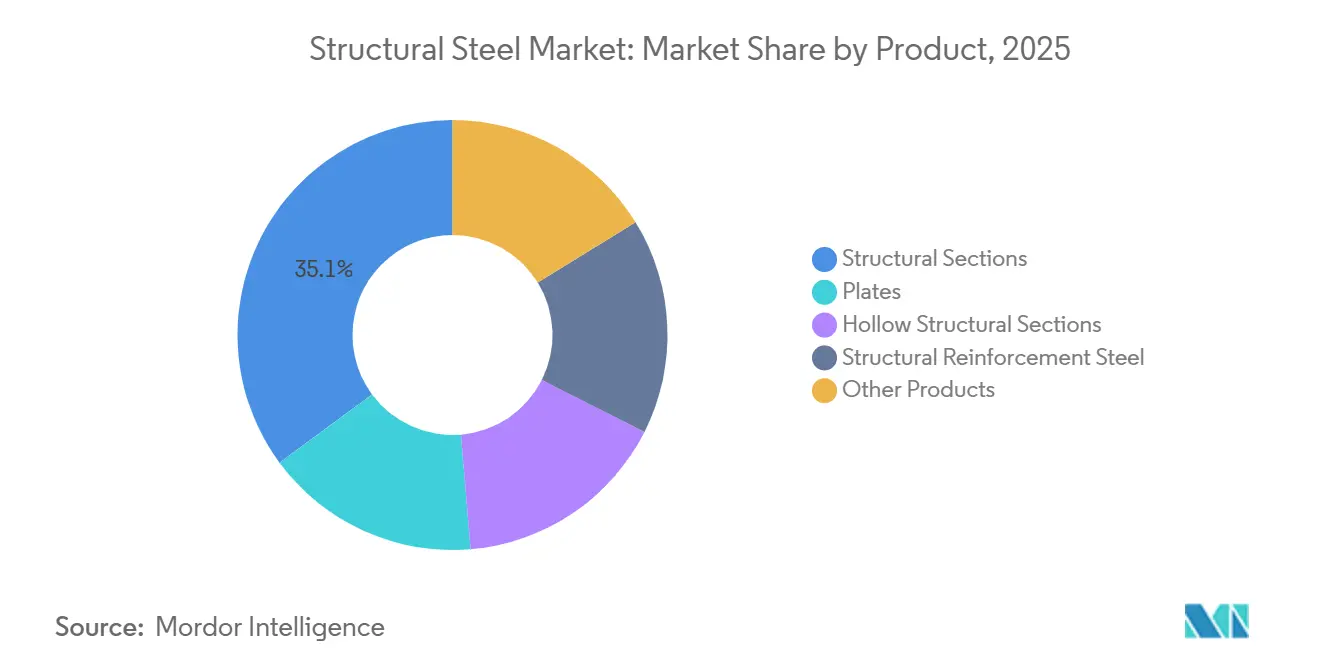
Structural Sections Lead Demand, Hollow Structural Sections ExpandStructural sections accounted for 35.12% of the structural steel market size in 2025. Wide-flange and H-section beams remain central to bridges, industrial buildings, stadiums, and high-rise cores. Their role in moment-resisting frames and long-span applications limits practical substitution. Plates are also important in bridge girders, dam gates, offshore structures, and pressure vessels. Reinforcing steel continues to support concrete-composite construction across residential and commercial projects. Angles, channels, merchant bars, and specialty profiles meet narrower industrial and architectural requirements.
Hollow structural sections are projected to advance at a 7.06% CAGR through 2031. Engineers use these products in data centers and semiconductor facilities because they offer a favorable strength-to-weight ratio and streamlined corrosion management. They are increasingly substituted for heavy wide-flange members in demanding frames. Atlas Tube identified strong demand for thick-walled hollow structural sections from data center projects. Digital detailing tools also improve fabrication accuracy for hollow profiles. These conditions make high-specification hollow sections an important opportunity within the structural steel market.



By Manufacturing Process:
Hot-Rolled Structural Steel Leads Revenue, Cold-Rolled Structural Steel Gains GroundHot-rolled structural steel held 70.41% of the structural steel market size in 2025. The process remains cost-effective for infrastructure, heavy industrial construction, and commercial frames. Hot-rolled profiles provide the toughness and weld-zone performance required by common structural codes. This makes substitution difficult even where alternative products carry a price advantage. The process also serves a broad set of beam, channel, plate, and section requirements. Its scale and established supply chain keep it central to the structural steel industry.
Cold-rolled structural steel is projected to advance at a 7.34% CAGR through 2031. Tighter dimensional tolerances suit robotic welding cells and computer numerical control cutting systems. Consistent geometry can reduce rejects and improve cycle times in automated fabrication. JSW Steel Limited and JFE Steel Corporation committed INR 58.45 billion (approximately USD 669 million) to expand cold-rolled grain-oriented electrical steel capacity in India, with phased commissioning planned from fiscal 2028. The investment concerns electrical steel, but it reflects broader investment in precision rolling capability. As automation reaches more fabrication shops, demand for consistently rolled inputs will increase.
By End-Use:
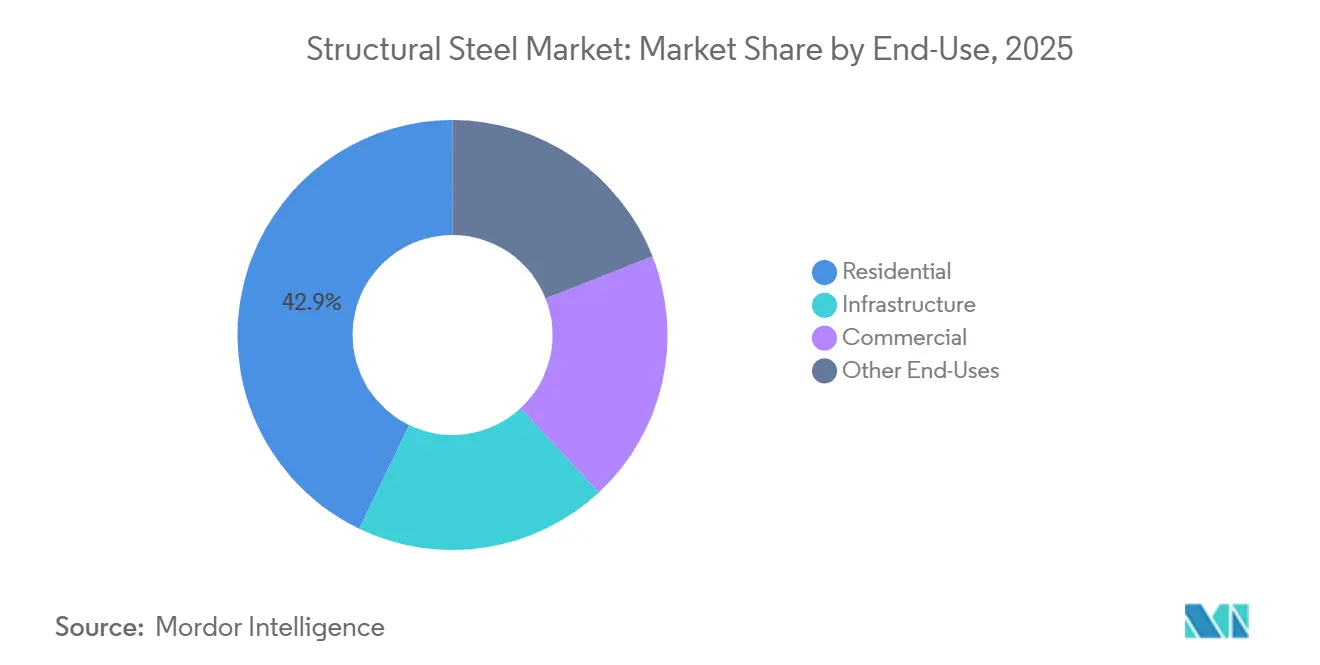
Infrastructure Remains the Core Demand BaseInfrastructure held 42.87% of the structural steel market share in 2025 and is projected to advance at a 7.65% CAGR through 2031. Transportation links, grid upgrades, renewable energy assets, ports, and public works create visible demand across long project cycles. This performance means that infrastructure is growing faster than the overall structural steel market. Fabricators serving transport and energy work benefit from multiyear project schedules. America’s Maritime Action Plan could add plate and section demand if planned shipyard investment proceeds. Public procurement rules also favor suppliers that can document domestic sourcing and material specifications.
Commercial construction benefits from logistics facilities and data centers, even as conventional office and retail development remains mixed. Steel joists, columns, and framing systems are integral to data center buildings. Residential construction faces weaker conditions in China after its sharp decline from earlier peaks. India and the Association of Southeast Asian Nations continue to support housing-related steel use as urbanization progresses. Wind towers, solar tracking systems, and substations also need steel-intensive support structures.
Geography Analysis
APAC and India Structural Steel Market
Asia-Pacific held 55.34% of the structural steel market share in 2025. India’s finished steel consumption rose 7% to 164 million metric tons in fiscal 2025-26, driven by infrastructure, construction, railways, and manufacturing. The OECD projects India’s steel demand to grow 6.7% in 2026 and 9.2% in 2027. India aims to expand steelmaking capacity from 220 million metric tons in 2025-26 to 300 million metric tons by 2030. JSW Steel Limited began work on its 13.2 million metric ton Paradeep integrated steel plant in Odisha.
China and APAC Structural Steel Market
China’s steel demand fell 6.9% in 2025 and is expected to decline 0.6% in 2026 as its property correction continues. Infrastructure demand could partly offset weaker residential construction during the 15th Five-Year Plan period. The Asia-Pacific region offers a source of construction and manufacturing demand. It also faces pricing pressure because it is a channel for rerouted Chinese exports. This combination requires local producers to balance growth opportunities against import competition.
The Americas, Europe and Middle East Structural Steel Market
North America is projected to advance at a 6.89% CAGR through 2031. United States steel production rose 6.8% year over year through May 2026 as imports fell under tariff measures. Infrastructure legislation, domestic-content rules, and manufacturing investment support demand for certified domestic supply. Canada increased trade enforcement in late 2025, while Mexico raised certain steel tariffs in December 2025. Europe is stabilizing after a weaker 2025, with rail, pipeline, and data center projects supporting German construction orders. Carbon Border Adjustment Mechanism requirements are increasing the value of traceable, lower-emission material, while South America and the Middle East provide selective demand through infrastructure investment and energy projects.

Competitive Landscape
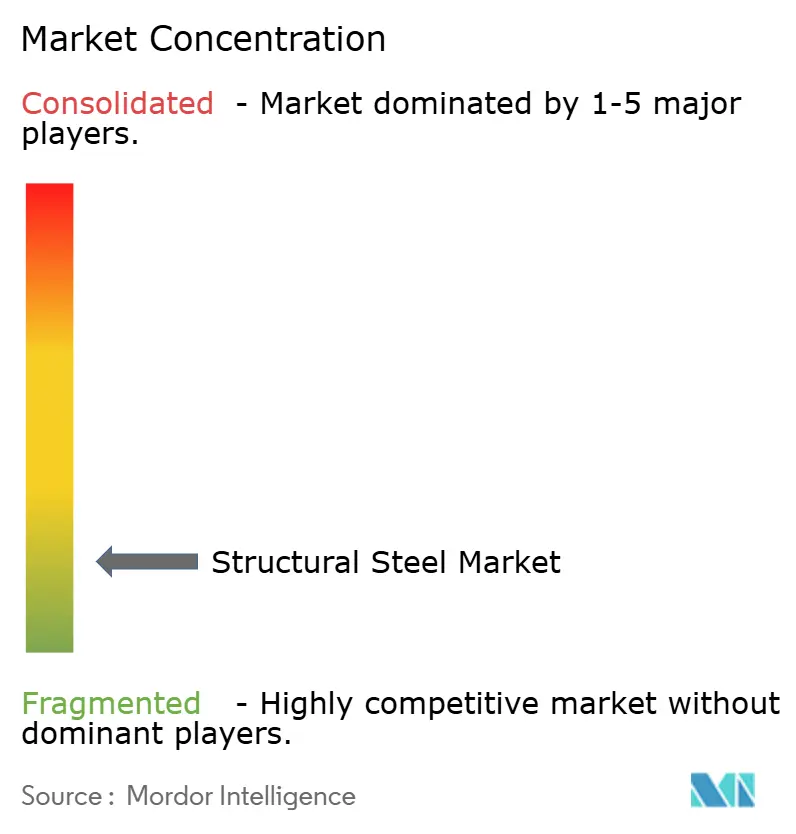
The structural steel market is highly fragmented, with the top five players including BAOWU Metal, ArcelorMittal, Ansteel Group Corporation Limited, NIPPON STEEL CORPORATION, and HBIS GROUP. Thousands of regional fabricators handle project design, detailing, fabrication, and erection. This split gives global mills scale in steelmaking while leaving local execution close to customers. NIPPON STEEL CORPORATION completed its USD 14.9 billion acquisition of United States Steel Corporation in June 2025 and committed USD 11 billion for domestic capital investment through 2028. The acquisition strengthens its United States production platform and extends its global capacity position.
ArcelorMittal has shifted investment toward higher-value and lower-emission products. In April 2026, ArcelorMittal signed a memorandum of understanding with Stockland to supply recycled and renewably produced XCarb steel for a logistics project in Sydney. In March 2026, it supplied 150 metric tons of recycled heavy plate for a bridge project in France. These moves show that verified emissions data and product traceability are becoming commercial requirements in major projects. Nucor Corporation is completing its West Virginia sheet mill in 2026 and has targeted USD 2.5 billion in capital expenditures for the year. Its electric arc furnace route supports its positioning in the domestic, recycled-content steel supply.
Asian producers continue to invest in scale and geographic reach. SSAB AB resumed its Oxelösund electric arc furnace project after the withdrawal of power-line appeals, and production is expected to start in the second quarter of 2027. The project is intended to reduce Sweden’s carbon dioxide emissions by 3%. AM/NS India launched STRUCTROMAX and WELDSTAR heavy plate brands in August 2026 for bridges, high-rise construction, wind energy, offshore, and heavy engineering. Competition in the structural steel market increasingly centers on certified low-carbon products, high-specification hollow sections, and digital supply records. These capabilities can help producers meet Buy America and Carbon Border Adjustment Mechanism requirements while serving technology and infrastructure projects.
Structural Steel Industry Leaders
BAOWU Metal
ArcelorMittal
Ansteel Group Corporation Limited
NIPPON STEEL CORPORATION
HBIS GROUP
- *Disclaimer: Major Players sorted in no particular order
Structural Steel Market Companies Covered in this Report
- Ansteel Group Corporation Limited
- ArcelorMittal
- BAOWU Metal
- Gerdau S/A
- HBIS GROUP
- JFE Steel Corporation
- JSW Steel Limited
- NIPPON STEEL CORPORATION
- Nucor Corporation
- POSCO HOLDINGS
- SSAB AB
- Tata Steel
- United States Steel Corporation

Recent Industry Developments in Structural Steel Market
- August 2026: AM/NS India launched STRUCTROMAX and WELDSTAR, expanding its heavy steel plate portfolio for infrastructure, high-rise construction, wind energy, and heavy engineering applications. The new products strengthened domestic availability of specialized steel plates used in structural and load-bearing construction
- June 2025: NIPPON STEEL CORPORATION completed the USD 14.9 billion acquisition of United States Steel Corporation, creating an integrated U.S. steelmaking platform and committing USD 11 billion in domestic investment by 2028. The investment is expected to expand and modernize steel production capacity, supporting the long-term supply of structural and high-performance steel production.


Global Structural Steel Market Report Scope
Structural steel is a category of steel products engineered to provide load-bearing capacity, strength, and dimensional stability in building and infrastructure structures. Its high strength-to-weight ratio, durability, and fabrication flexibility make it suitable for constructing frames, supports, bridges, industrial facilities, and other structural systems.
The Structural Steel Market is segmented by product, manufacturing process, end-use, and geography. By product, the market is segmented into structural sections, plates, hollow structural sections, structural reinforcement steel, and other products. By manufacturing process, the market is segmented into hot-rolled structural steel and cold-rolled structural steel. By end-use, the market is segmented into residential, commercial, infrastructure, and other end-uses. The report also covers the market size and forecasts for structural steel in 15 countries across major regions. For each segment, the market sizing and forecasts have been done on the basis of value (USD).
| Structural Sections |
| Plates |
| Hollow Structural Sections |
| Structural Reinforcement Steel |
| Other Products |
| Hot-Rolled Structural Steel |
| Cold-Rolled Structural Steel |
| Residential |
| Commercial |
| Infrastructure |
| Other End-Uses |
| Asia-Pacific | China |
| India | |
| Japan | |
| South Korea | |
| ASEAN Countries | |
| Rest of Asia-Pacific | |
| North America | United States |
| Canada | |
| Mexico | |
| Europe | Germany |
| United Kingdom | |
| France | |
| Italy | |
| NORDIC Countries | |
| Rest of Europe | |
| South America | Brazil |
| Argentina | |
| Rest of South America | |
| Middle East and Africa | Saudi Arabia |
| South Africa | |
| Rest of Middle East and Africa |
| By Product | Structural Sections | |
| Plates | ||
| Hollow Structural Sections | ||
| Structural Reinforcement Steel | ||
| Other Products | ||
| By Manufacturing Process | Hot-Rolled Structural Steel | |
| Cold-Rolled Structural Steel | ||
| By End-Use | Residential | |
| Commercial | ||
| Infrastructure | ||
| Other End-Uses | ||
| By Geography | Asia-Pacific | China |
| India | ||
| Japan | ||
| South Korea | ||
| ASEAN Countries | ||
| Rest of Asia-Pacific | ||
| North America | United States | |
| Canada | ||
| Mexico | ||
| Europe | Germany | |
| United Kingdom | ||
| France | ||
| Italy | ||
| NORDIC Countries | ||
| Rest of Europe | ||
| South America | Brazil | |
| Argentina | ||
| Rest of South America | ||
| Middle East and Africa | Saudi Arabia | |
| South Africa | ||
| Rest of Middle East and Africa | ||


Key Questions Answered in the Report
What is the size of the structural steel market?
The structural steel market stands at USD 137.39 billion in 2026 and is projected to reach USD 184.98 billion by 2031.
What is driving structural steel demand?
Infrastructure programs, industrial facilities, logistics buildings, and data centers are supporting demand for sections, plates, and fabricated systems.
Which product is expected to grow fastest through 2031?
Hollow structural sections are projected to advance at a 7.06% CAGR through 2031, supported by data center and semiconductor construction.
Which manufacturing process held the largest share in 2025?
Hot-rolled structural steel held 70.41% of the revenue in 2025 because it remains widely used in infrastructure and heavy construction.
Page last updated on:





