
Stablecoin Infrastructure Market Size and Share
Market Overview
| Study Period | 2020 - 2031 |
|---|---|
| Market Size (2026) | USD 9.57 Billion |
| Market Size (2031) | USD 15.02 Billion |
| Growth Rate (2026 - 2031) | 9.43 % |
| Fastest Growing Market | Europe |
| Largest Market | North America |
| Market Concentration | High |
Major Players *Disclaimer: Major Players sorted in no particular order Image © Mordor Intelligence. Reuse requires attribution under CC BY 4.0. | |
Stablecoin Infrastructure Market Analysis by Mordor Intelligence
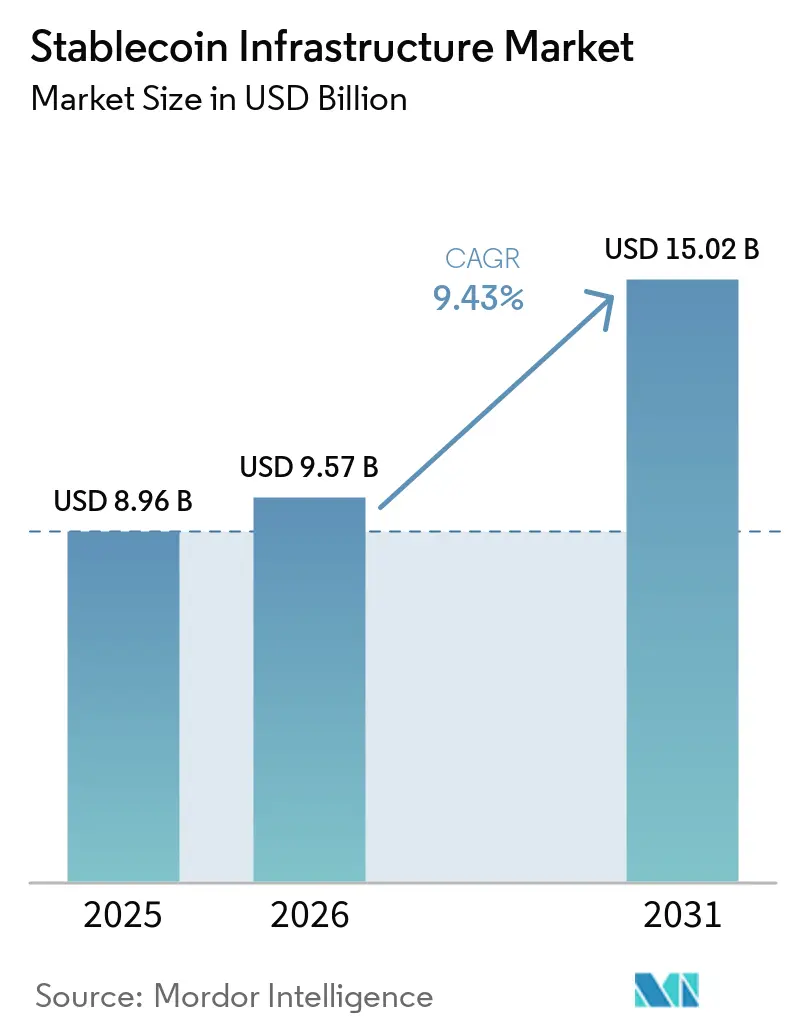
The Stablecoin Infrastructure Market size is expected to increase from USD 8.96 billion in 2025 to USD 9.57 billion in 2026 and reach USD 15.02 billion by 2031, growing at a CAGR of 9.43% over 2026-2031.
Regulatory rules are moving stablecoin activity toward licensed issuance, reserve controls, redemption systems, and verified reporting. Institutional users are also moving beyond pilots as banks, payment firms, and treasury teams connect stablecoin settlement to existing workflows. Cross-border payment activity remains central because programmable settlement can operate at all hours and reduce reliance on correspondent banking steps. The Stablecoin Infrastructure Market also faces pressure to build fee-based services as reserve-yield income changes with interest rates. Agent-led payments add a new source of demand, as automated systems need payment methods that can operate within digital workflows.
Key Report Takeaways
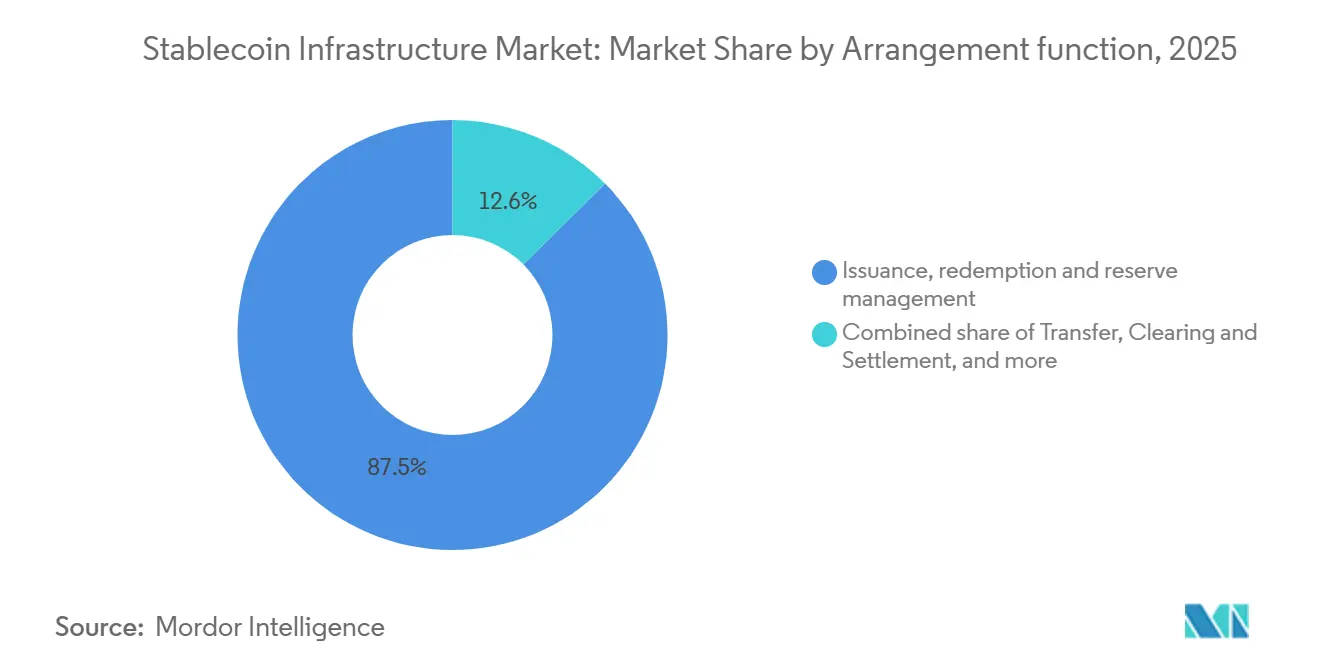
- By arrangement function, issuance, redemption, and reserve management captured 87.45% of the stablecoin infrastructure market share in 2025, while governance, attestation, and compliance services are projected to grow at a 16.22% CAGR through 2031.
- By denomination currency, the United States dollar captured 97.82% of the stablecoin infrastructure market share in 2025, while other fiat currencies are projected to grow at a 21.34% CAGR through 2031.
- By application, trading, exchange liquidity, and market-making captured 67.33% of the stablecoin infrastructure market share in 2025, while payments and settlement are projected to grow at a 15.26% CAGR through 2031.
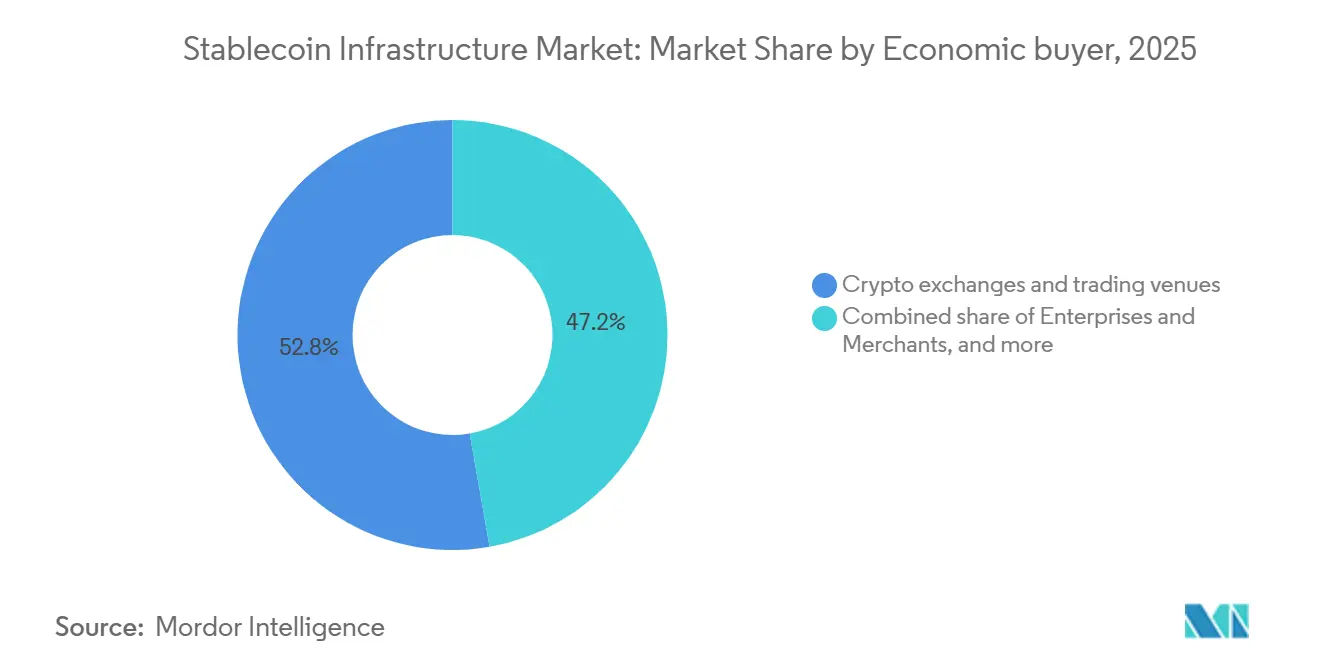
- By economic buyer, crypto exchanges and trading venues captured 52.76% of the stablecoin infrastructure market share in 2025, while banks, payment institutions, and money-transfer operators are projected to grow at a 14.33% CAGR through 2031.
- By access channel, exchange and broker channels captured 48.12% of the stablecoin infrastructure market share in 2025, while bank and payment-institution channels are projected to grow at a 16.88% CAGR through 2031.
- By geography, North America captured 36.63% of the stablecoin infrastructure market share in 2025, while Europe is projected to grow at a 12.74% CAGR through 2031.
Note: Market size and forecast figures in this report are generated using Mordor Intelligence’s proprietary estimation framework, updated with the latest available data and insights as of January 2026.
Global Stablecoin Infrastructure Market Trends and Insights
Drivers Impact Analysis*
| Driver | (~) % Impact on CAGR Forecast | Geographic Relevance | Impact Timeline |
|---|---|---|---|
| Regulatory Enablement of Compliant Stablecoin Infrastructure | +1.8% | Global; near-term gains concentrated in North America and EU | Short term (≤ 2 years) |
| Growing Demand for 24/7 Cross-Border Settlement Infrastructure | +1.5% | Global; strongest pull in Southeast Asia, Sub-Saharan Africa, Latin America | Short term (≤ 2 years) |
| Institutional Integration of Stablecoins into Treasury and Payments Workflows | +1.4% | North America and EU core, spill-over to Asia-Pacific and GCC | Medium term (2–4 years) |
| Expansion of Multi-Chain Stablecoin Liquidity and Settlement | +1.0% | Global; protocol-layer demand concentrated in Asia-Pacific and North America | Medium term (2–4 years) |
| Embedded Distribution Through Wallets, Payment Platforms and APIs | +0.9% | Global; highest adoption velocity in Southeast Asia and Latin America | Short to medium term |
| Emergence of Stablecoin-Native Machine and Agent Payments | +0.8% | North America and EU initially; global expansion as x402 and AP2 standards mature | Long term (≥ 4 years) |
| Source: Mordor Intelligence | |||
Regulatory Enablement of Compliant Stablecoin Infrastructure
The GENIUS Act was signed into law on July 18, 2025, establishing requirements for payment stablecoins, including 1:1 reserves in high-quality liquid assets and monthly reporting with third-party examination[1]https://www.whitehouse.gov/wp-content/uploads/2025/07/digital-Assets-Report-EO14178.pdf. MiCA’s transition period ended on July 1, 2026, strengthening requirements for authorization and e-money tokens. Circle began issuing MiCA-compliant USDC and EURC in the European Union on July 1, 2024, while Qivalis was formed by 10 European banks in December 2025 to develop a euro stablecoin. These developments increase demand for reserve management, custody, compliance, and reporting infrastructure.
Growing Demand for 24/7 Cross-Border Settlement Infrastructure
Stablecoins can reduce settlement times and intermediary steps in correspondent banking by enabling programmable, 24/7 transfers. The Federal Reserve highlighted its potential to reduce cross-border payment frictions and intermediation costs. In March 2026, Thunes enabled 11,500 financial institutions on the SWIFT network to reach more than 500 million stablecoin wallets across 140+ countries without additional integration[2]https://www.thunes.com/news/thunes-brings-stablecoin-payouts-to-11500-banks-via-swift-connectivity-bridging-traditional-finance-and-digital-assets/. This creates demand for settlement, liquidity, custody, compliance, and fiat-to-stablecoin conversion infrastructure.
Institutional Integration of Stablecoins into Treasury and Payments Workflows
Institutional adoption is increasingly moving into real payment and treasury workflows that require speed, governance, custody, and auditability. UBS completed business-to-business stablecoin cross-border payments with Merge in under two minutes, compared with multiple banking days through traditional settlement. In August 2026, HSBC and Standard Chartered also completed a live interbank transaction on SWIFT’s blockchain-based 24/7 ledger, involving 17 banks across 6 continents[3]https://www.sc.com/en/press-release/standard-chartered-and-hsbc-execute-first-live-tokenised-deposit-transaction-on-swifts-blockchain-based-ledger. These developments support demand for infrastructure embedded directly into institutional payment, treasury, and compliance systems.
Emergence of Stablecoin-Native Machine and Agent Payments
AI agents and autonomous software are creating demand for programmable payment infrastructure that can operate with automated authorization and settlement. The x402 Foundation launched under the Linux Foundation in July 2026, supporting an open payment standard for machine-to-machine transactions[4]https://www.linuxfoundation.org/blog/linux-foundation-newsletter-april-2026. Google’s Agent Payments Protocol also supports authorization and mandate records for agent-driven payments. This emerging use case increases demand for stablecoin infrastructure that combines automated settlement with identity, sanctions screening, transaction monitoring, and auditable compliance controls.
Restraints Impact Analysis*
| Restraint | (~) % Impact on CAGR Forecast | Geographic Relevance | Impact Timeline |
|---|---|---|---|
| Fragmented Regulation, Licensing, and Compliance | -0.8% | Global, most acute for operators across the United States, European Union, United Kingdom, Japan, Singapore, and United Arab Emirates | Medium term (2-4 years) |
| Reserve, Redemption, and Counterparty Risks | -0.6% | Global, with systemic exposure concentrated in North American issuance and custody layers | Medium term (2-4 years) |
| Liquidity and Fiat Access Fragmentation | -0.5% | Asia-Pacific, with effects across the Middle East, Africa, and Latin America | Medium term (2-4 years) |
| Pressure on Infrastructure Economics | -0.4% | Global, with higher margin exposure among mid-tier issuers in North America and the European Union | Long term (≥ 4 years) |
| Source: Mordor Intelligence | |||
Fragmented Regulatory, Licensing and Compliance Requirements
Stablecoin infrastructure providers face different licensing, reserve, reporting, AML, KYC, sanctions, and Travel Rule requirements across major markets, increasing compliance costs and limiting the use of a single global operating model. The Basel Committee’s prudential framework for banks’ cryptoasset exposures became effective on January 1, 2026, adding capital, liquidity, risk-management, and disclosure considerations for bank exposures to cryptoassets, including stablecoins. The European Commission also launched a MiCA review consultation on May 20, 2026, examining whether the framework remains fit for purpose as the market evolves. Smaller providers can face greater compliance burdens because they must adapt infrastructure and controls to multiple regulatory regimes, potentially slowing cross-border interoperability.
Reserve, Redemption and Counterparty Risks
Reserve quality, liquidity, and redemption arrangements remain key risks for stablecoin infrastructure. The Federal Reserve reported that USDT maintained approximately 1.04x reserves per coin, with about 0.74x in higher-quality reserves such as Treasuries, Treasury-backed repurchase agreements, and bank deposits, while USDC maintained 1.0x backing with higher-quality reserves. These differences matter because redemption stability depends on the liquidity and quality of reserve assets. The Federal Reserve also highlights risks from complex chains of third-party infrastructure and concentration among service providers. Separately, the European Systemic Risk Board has identified risks from EU and non-EU multi-issuer stablecoin structures, including potential reserve-transfer restrictions across jurisdictions during periods of stress. These risks increase the need for robust reserve management, custody, liquidity, redemption, and contingency infrastructure.
*Our forecasts treat driver/restraint impacts as directional, not additive. The impact forecasts reflect baseline growth, mix effects, and variable interactions.
Segment Analysis
By Arrangement Function: Compliance Infrastructure Expanding Beyond the Issuance Core
Issuance, redemption, and reserve management held 87.45% of the Stablecoin Infrastructure Market share in 2025. This reflects the capital-intensive role of reserve infrastructure supporting more than USD 307 billion in circulating supply. MiCA’s 100% high-quality liquid asset requirement and the GENIUS Act’s custody requirements concentrate activity among the largest issuers. Transfer, clearing, settlement, storage, exchange, and fiat access functions support the middle layer of the value chain. On-ramp and off-ramp services are becoming a distinct area of competition as institutions seek easier links to fiat systems.
Governance, attestation, and compliance services are projected to grow at a 16.22% CAGR through 2031. Monthly reserve attestations, executive certifications, and on-chain reserve dashboards are moving from optional features to operating requirements. Deloitte provides reserve attestation services to Circle. Tether’s move toward full audit coverage in 2025 also showed how regulatory standing can influence issuer competition. FinCEN and Financial Action Task Force guidance, along with the European Union anti-money-laundering package that applies from July 2027, add to the demand for compliance infrastructure. The Stablecoin Infrastructure Market size for this function can therefore benefit from rules that require verified data and controlled operating processes.


By Denomination Currency: Dollar Dominance Under Structural Pressure from Regional Currency Issuers
The United States dollar held 97.82% of the Stablecoin Infrastructure Market share in 2025. Tether’s USDT held 59% of the total stablecoin supply at USD 184 billion in mid-2026, while Circle’s USDC held 24%. Together, they represented more than 83% of the USD 307 billion supply base. This concentration reflects the role of the United States dollar in global digital-asset trading and cross-border settlement. It also means that the market’s current liquidity and infrastructure are heavily tied to dollar-based rails.
Other fiat currencies are projected to grow at a 21.34% CAGR through 2031. Japan’s amended Payment Services Act took effect on June 1, 2026, and enabled SBI’s JPYSC as a trust-type yen stablecoin under Financial Services Agency approval. Qivalis, a joint venture of 10 European banks, targets a MiCA-compliant euro stablecoin launch in the second half of 2026. The United Arab Emirates Central Bank-licensed DDSC dirham stablecoin also connects regional fiat infrastructure with M-Pesa users in Africa. These developments require foreign-exchange liquidity and settlement capabilities that have not yet reached scale for non-dollar denominations. The Stablecoin Infrastructure Market industry will need multi-currency liquidity management if regional stablecoins gain broader use.
By Application: Payments and Settlement Gaining Structural Momentum as Institutional Use Cases Mature
Trading, exchange liquidity, and market-making accounted for 67.33% of application revenue in 2025. USDT held 74% of on-chain trading volume while representing 59% of the supply. This shows its role in exchange liquidity and market-making activity. Corporate treasury, cash management, capital-markets collateral, and settlement remain smaller but strategically important uses. Tokenized money market fund integration and real-world asset collateral are supporting their development.
Payments and settlement are projected to grow at a 15.26% CAGR through 2031. Visa integrated stablecoin capabilities across Visa Direct in August 2026. Circle launched CPN Managed Payments in April 2026 to provide managed USDC settlement across more than 20 blockchains without direct digital-asset custody. These services reduce operational barriers for regulated institutions. The Stablecoin Infrastructure Market industry is therefore moving toward payment tools that hide technical complexity from treasury users.
By Economic Buyer: Banks and Payment Institutions Building the Deepest Infrastructure Integration
Crypto exchanges and trading venues accounted for 52.76% of the Stablecoin Infrastructure Market share among economic buyers in 2025. They remain primary venues for USDT and USDC trading pairs. They also serve as the main access point for many institutional users seeking stablecoin liquidity. This position gives exchanges a continuing role in issuance, redemption, custody, and liquidity routing. Their established user base supports strong network effects in the current infrastructure model.
Banks, payment institutions, and money-transfer operators are projected to grow at a 14.33% CAGR through 2031. Shinhan Financial Group agreed with Visa in August 2026 to build a Korea-specific issuance, remittance, and redemption stack. JPMorgan, Citi, and UBS participated in the Bank for International Settlements Project Agorá pilot in July 2026, settling USD 1 million across 6 currencies on a shared blockchain ledger. Asset managers and institutional investors are using related infrastructure for capital markets settlement. Enterprises and merchants remain underpenetrated, though Lawson tested JPYC payments in Japan through its Tokyo Takanawa Gateway City store. These cases show that buyer demand is spreading from exchange activity into regulated financial services and merchant use.
By Access Channel: Bank and Institution Channels Capturing the Next Infrastructure Build-Out
Exchange and broker channels held 48.12% of the Stablecoin Infrastructure Market share in 2025. Centralized exchanges remain mature distribution points for issuance and redemption. Tether and Circle’s combined 97% trading-volume concentration reinforces the scale advantages of established channels. Direct issuer, application programming interface, white-label, and self-custody wallet access serve developers and enterprises. Bridge, owned by Stripe, and Zero Hash provide embedded access without requiring users to develop proprietary blockchain connections.
Bank and payment-institution channels are projected to grow at a 16.88% CAGR through 2031. Mastercard completed its USD 1.8 billion acquisition of BVNK on August 3, 2026. The acquisition brought on-chain payment infrastructure into Mastercard’s distribution stack. Thunes also uses SWIFT connectivity to extend stablecoin wallet access across existing bank networks. This approach lets financial institutions use established correspondent connections rather than build separate distribution systems. The Stablecoin Infrastructure Market size for bank channels can grow as institutions seek regulated access to settlement and wallet connectivity.
Geography Analysis
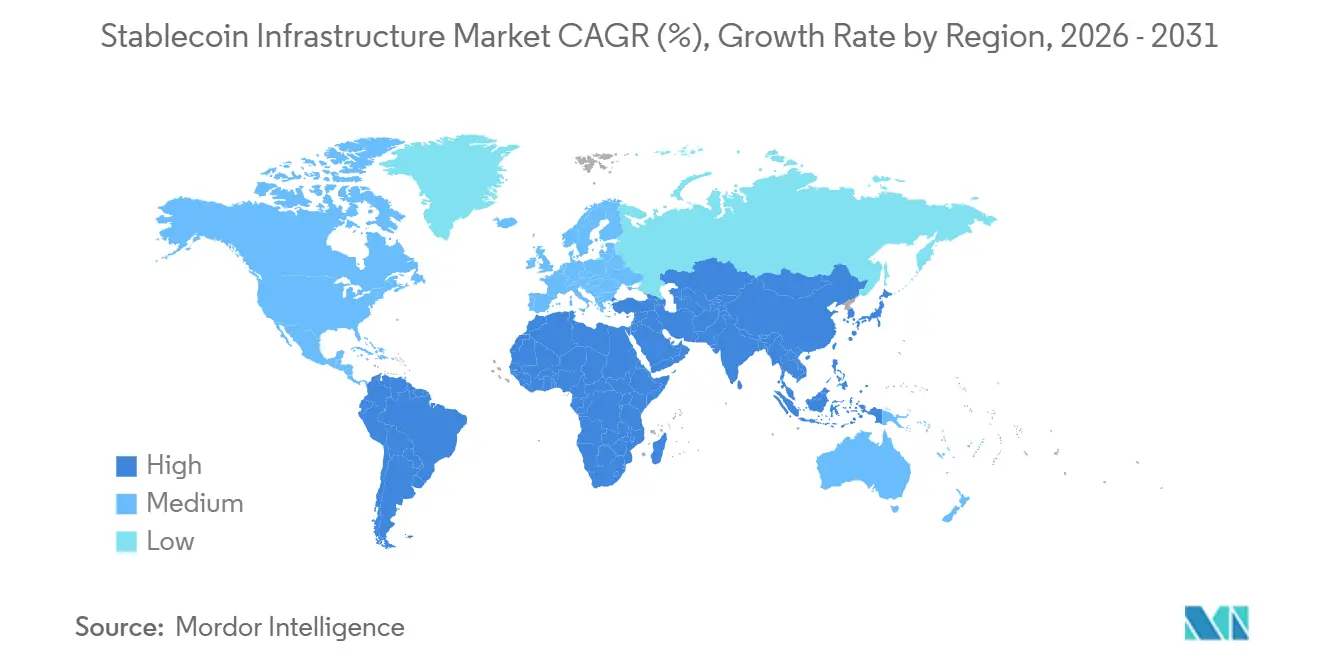
North America held 36.63% of the Stablecoin Infrastructure Market share in 2025. The region includes major issuers such as Tether, Circle, and Paxos, as well as deep custody, compliance, and settlement capacity. The GENIUS Act, enacted on July 18, 2025, created a federal licensing framework for permitted payment stablecoin issuers. It requires 1:1 reserve backing, monthly accounting-firm examinations, and qualified reserve custody. Implementing rules are being finalized in 2026 and can clarify the federal and state split for larger issuers. Canada’s Office of the Superintendent of Financial Institutions and Mexico’s digital payment policy work also create potential expansion paths as regional coordination develops.
Europe is projected to grow at a 12.74% CAGR through 2031. MiCA allows an authorized issuer to serve all 27 European Union member states without obtaining separate authorization in every country. Circle’s authorization for USDC and EURC gives it an early position in the regional market. The European Commission consultation examines multi-issuer stablecoin models, non-European Union issuer equivalence, and asset-referenced token authorization. The European Central Bank’s Pontes project is scheduled to offer distributed ledger technology-linked wholesale settlement through TARGET from September 2026. Private initiatives, including Qivalis and DekaBank’s consortium, are developing alongside this public infrastructure.
Asia-Pacific, the Middle East and Africa, and South America offer growth opportunities where stablecoin systems address weak correspondent banking links. Japan’s Payment Services Act amendment created a legal path for foreign trust-type stablecoins, while the Cabinet included on-chain finance promotion in its July 2026 fiscal policy document. Singapore’s Monetary Authority of Singapore BLOOM framework supported Visa’s stablecoin settlement pilot with Nium in August 2026. In South America, Brazil and Argentina use dollar-denominated stablecoins as currency hedges. The United Arab Emirates Central Bank-licensed DDSC stablecoin launched on ADI Chain with M-Pesa connectivity across 8 African countries. Circle also partnered with Cassava Technologies to extend USDC settlement across 30 African countries

Competitive Landscape
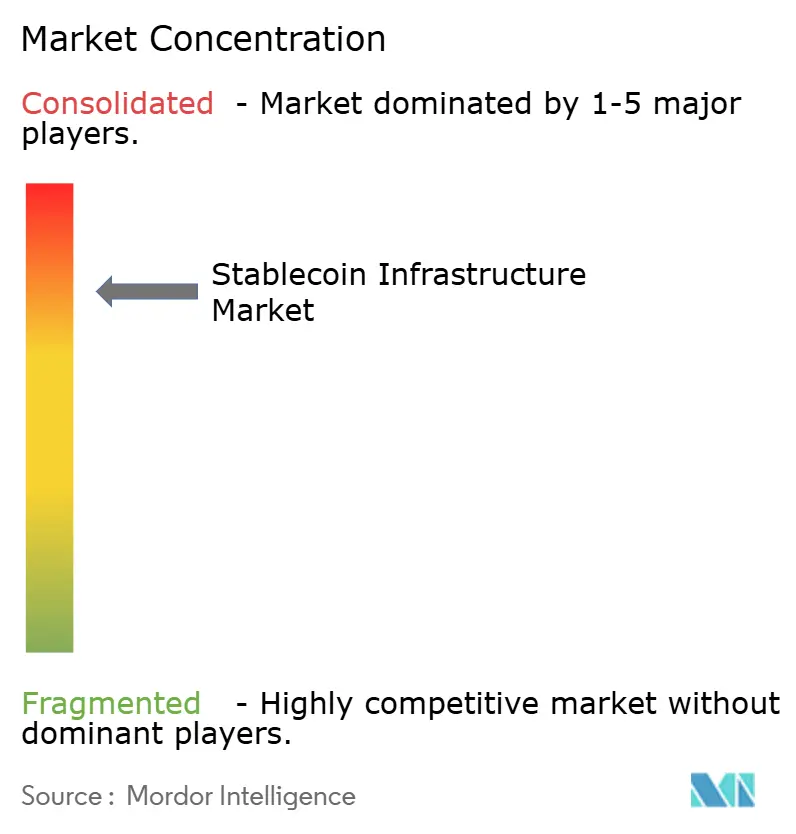
The Stablecoin Infrastructure Market remains concentrated at the issuance level, with Tether and Circle together accounting for approximately 83% of global stablecoin supply in early 2026. Tether’s USDT remained the largest stablecoin, while Circle’s USDC reached approximately USD 73.3 billion in circulation in Q2 2026. Custody, settlement orchestration, compliance, and distribution are more fragmented. Dozens of providers compete on regulatory approval, integration depth, geographic coverage, and service reliability. Fireblocks has become an important institutional custody provider across Mastercard’s USDG and Visa’s USDC settlement activity. This makes its operational reliability important across several payment routes.
Large payment companies are using different strategies to secure stablecoin capabilities. Mastercard completed the USD 1.8 billion BVNK acquisition in August 2026, adopting an ownership-based approach to on-chain payment infrastructure. Stripe acquired Bridge for USD 1.1 billion in 2025, also using an acquisition to build payment connectivity. Visa has instead worked with Zero Hash, Nium, and Shinhan Financial through a multi-operator partnership model. These moves show that established networks see stablecoin settlement as a capability that can strengthen cross-border payments, treasury services, and fiat connectivity. The Stablecoin Infrastructure Market remains competitive because no single provider leads every layer of the value chain.
Paxos uses Office of the Comptroller of the Currency charter, New York Department of Financial Services, and Monetary Authority of Singapore licensing to support PayPal, SoFi, and the Global Dollar Network. Circle’s Cross-Chain Transfer Protocol had processed more than USD 110 billion across 5.3 million transfers by November 2025. Brale launched ION Protocol on July 29, 2026, to support custom stablecoins through a burn-and-mint approach that avoids pre-funded liquidity pools. The x402 protocol also points to a payment layer for machine-to-machine activity that established providers have not fully productized. MiCA authorization, GENIUS Act compliance, and Financial Action Task Force travel rule compliance are baseline requirements for institutional use. The market concentration score is 8 out of 10 because Tether and Circle together held over 83% of global stablecoin supply, although the other infrastructure layers remain fragmented.
Stablecoin Infrastructure Industry Leaders
Tether Limited
Circle Internet Group, Inc.
Coinbase Global, Inc.
Fireblocks Ltd.
PayPal Holdings, Inc.
- *Disclaimer: Major Players sorted in no particular order

Recent Industry Developments
- August 2026: Mastercard completed its acquisition of BVNK for USD 1.8 billion on August 3, becoming the first major listed card network to directly own on-chain stablecoin infrastructure, targeting cross-border B2B payments, treasury flows, and fiat/on-chain interoperability for institutional clients globally.
- August 2026: HSBC and Standard Chartered completed the first live interbank transaction on SWIFT's blockchain-based 24/7 settlement ledger using tokenized deposits, with 17 participating banks across 6 continents, establishing that bank-grade, always-on settlement is technically viable at institutional scale.
- August 2026: Fasset raised USD 68 million in Series C funding at a USD 1 billion valuation, led by SBI Group, to expand its stablecoin settlement network and agentic AI-enabled payment infrastructure across GCC, Asia, and Europe
- June 2026: Paga Group and Crossmint announced a partnership to deploy multi-chain stablecoin wallets and bi-directional fiat/stablecoin payment infrastructure across Africa, connecting local fiat on/off-ramps to Crossmint's enterprise wallet platform trusted by Fortune 500 institutions.


Global Stablecoin Infrastructure Market Report Scope
| Issuance, Redemption and Reserve Management |
| Transfer, Clearing and Settlement |
| Store, Exchange and Fiat Access |
| Governance, Attestation and Compliance Services |
| United States Dollar |
| Euro |
| Other Fiat Currencies |
| Trading, Exchange Liquidity and Market-Making |
| Payments and Settlement |
| Corporate Treasury and Cash Management |
| Capital-Markets Collateral and Settlement |
| Other On-Chain use |
| Banks, Payment Institutions and Money-Transfer Operators |
| Crypto Exchanges and Trading Venues |
| Enterprises and Merchants |
| Asset Managers and Institutional Investors |
| Fintechs and Platform Developers |
| Exchange and Broker Channels |
| Bank and Payment-Institution Channels |
| Direct Issuer, API and White-Label Channels |
| Self-Custody Wallet Access |
| North America | United States |
| Canada | |
| Mexico | |
| South America | Brazil |
| Argentina | |
| Rest of South America | |
| Europe | United Kingdom |
| Germany | |
| France | |
| Italy | |
| Spain | |
| Rest of Europe | |
| Asia-Pacific | China |
| Japan | |
| India | |
| South Korea | |
| Australia | |
| Indonesia | |
| Thailand | |
| Malaysia | |
| Singapore | |
| Vietnam | |
| Rest of Asia-Pacific | |
| Middle East and Africa | Saudi Arabia |
| United Arab Emirates | |
| Turkey | |
| South Africa | |
| Egypt | |
| Rest of Middle East and Africa |
| By Arrangement Function | Issuance, Redemption and Reserve Management | |
| Transfer, Clearing and Settlement | ||
| Store, Exchange and Fiat Access | ||
| Governance, Attestation and Compliance Services | ||
| By Denomination Currency | United States Dollar | |
| Euro | ||
| Other Fiat Currencies | ||
| By Application | Trading, Exchange Liquidity and Market-Making | |
| Payments and Settlement | ||
| Corporate Treasury and Cash Management | ||
| Capital-Markets Collateral and Settlement | ||
| Other On-Chain use | ||
| By Economic Buyer | Banks, Payment Institutions and Money-Transfer Operators | |
| Crypto Exchanges and Trading Venues | ||
| Enterprises and Merchants | ||
| Asset Managers and Institutional Investors | ||
| Fintechs and Platform Developers | ||
| By Access Channel | Exchange and Broker Channels | |
| Bank and Payment-Institution Channels | ||
| Direct Issuer, API and White-Label Channels | ||
| Self-Custody Wallet Access | ||
| By Geography | North America | United States |
| Canada | ||
| Mexico | ||
| South America | Brazil | |
| Argentina | ||
| Rest of South America | ||
| Europe | United Kingdom | |
| Germany | ||
| France | ||
| Italy | ||
| Spain | ||
| Rest of Europe | ||
| Asia-Pacific | China | |
| Japan | ||
| India | ||
| South Korea | ||
| Australia | ||
| Indonesia | ||
| Thailand | ||
| Malaysia | ||
| Singapore | ||
| Vietnam | ||
| Rest of Asia-Pacific | ||
| Middle East and Africa | Saudi Arabia | |
| United Arab Emirates | ||
| Turkey | ||
| South Africa | ||
| Egypt | ||
| Rest of Middle East and Africa | ||


Key Questions Answered in the Report
What is driving stablecoin infrastructure growth?
Licensed issuance, compliance services, cross-border settlement, and institutional payment integration support the forecast 9.4% CAGR from 2026 to 2031.
Which arrangement function leads stablecoin infrastructure?
Issuance, redemption, and reserve management led with 87.45% of revenue in 2025.
Which stablecoin use case is growing fastest?
Payments and settlement are forecast to grow at a 15.26% CAGR through 2031 as regulated institutions adopt managed settlement tools.
Which region has the strongest growth outlook?
Europe is projected to expand at a 12.74% CAGR through 2031, supported by MiCA passporting across 27 European Union member states.
Why are banks adopting stablecoin settlement systems?
Banks are seeking faster cross-border settlement, controlled compliance processes, and integration with existing treasury and payment workflows.
How concentrated is stablecoin issuance?
Tether and Circle together accounted for over 83% of global stablecoin supply in mid-2026, while other infrastructure layers remain more fragmented.
Page last updated on:





