
Market Overview
| Study Period | 2021 - 2031 |
|---|---|
| Market Size (2026) | USD 79.06 Billion |
| Market Size (2031) | USD 107.01 Billion |
| Growth Rate (2026 - 2031) | 6.24 % |
| Fastest Growing Market | Middle East and Africa |
| Largest Market | Asia Pacific |
| Market Concentration | Medium |
Major Players *Disclaimer: Major Players sorted in no particular order Image © Mordor Intelligence. Reuse requires attribution under CC BY 4.0. | |
Spray Dried Food Market Analysis by Mordor Intelligence
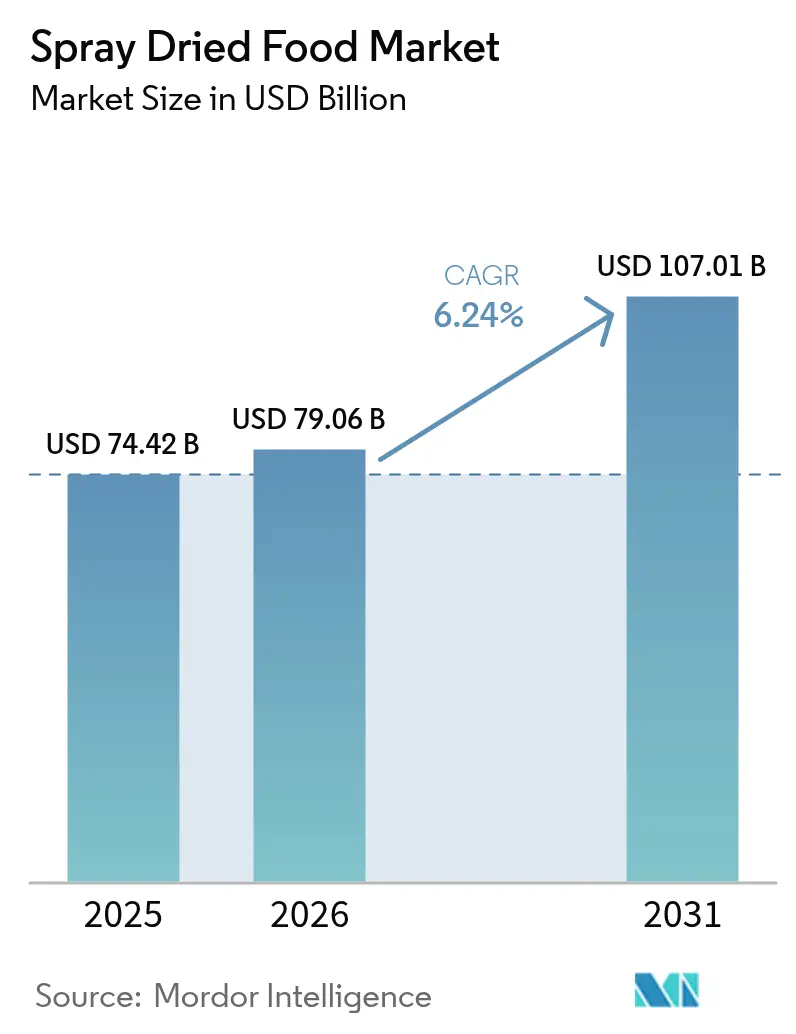
The spray dried food market size is expected to grow from USD 74.42 billion in 2025 to USD 79.06 billion in 2026 and is forecast to reach USD 107.01 billion by 2031 at 6.24% CAGR over 2026-2031. This growth trajectory reflects accelerating demand for convenient, shelf-stable food ingredients across multiple application sectors, driven by urbanization patterns that prioritize preparation speed without compromising nutritional integrity. The market's resilience stems from spray drying's unique ability to preserve bioactive compounds while extending product shelf life, positioning it as the preferred processing method for functional food manufacturers seeking clean-label compliance.
Key Report Takeaways
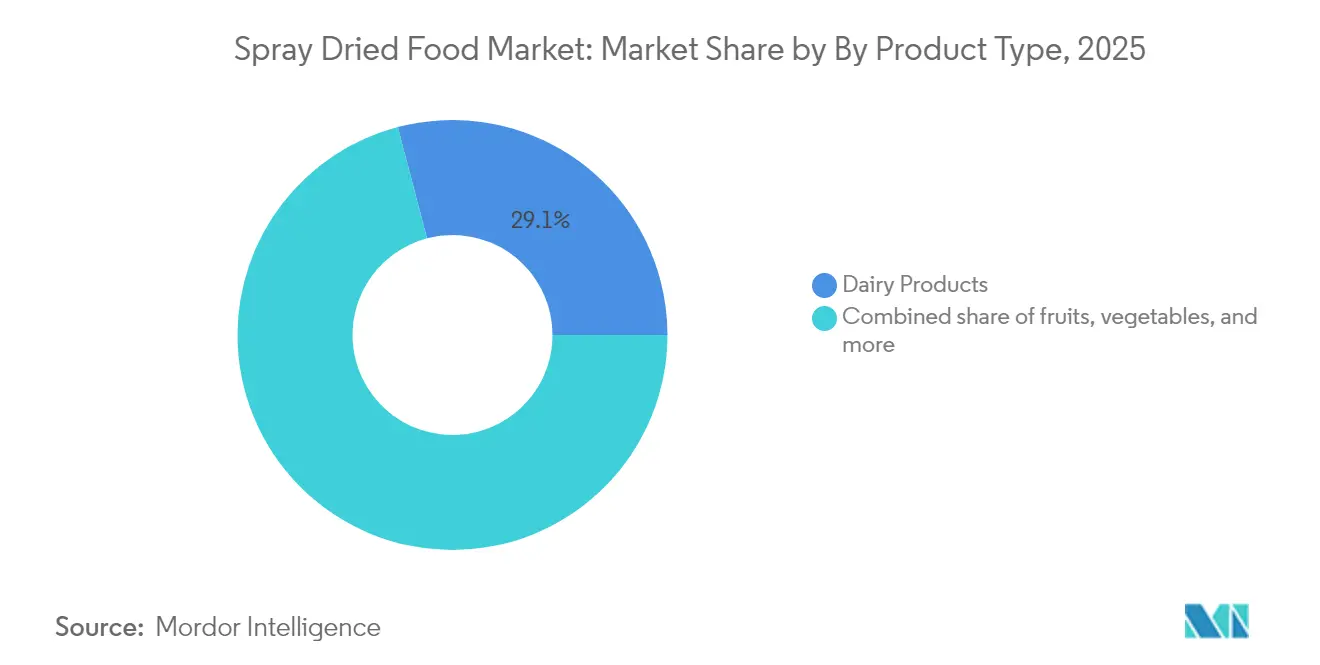
- By product type, dairy products dominated the spray dried food market with a 29.10% share in 2025 and are expected to grow at a CAGR of 7.18% through 2031.
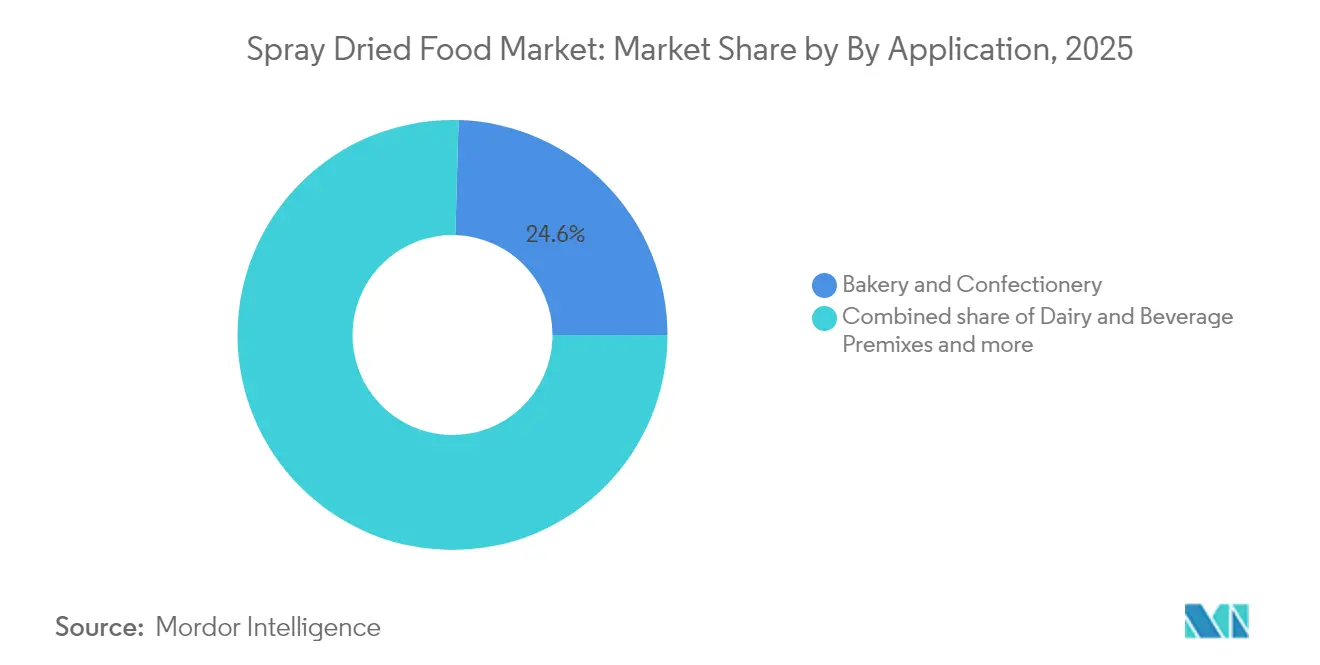
- By application, bakery and confectionery accounted for 24.55% share of the spray dried food market size in 2025, while nutraceuticals and supplements are projected to advance at a 7.74% CAGR during 2026-2031.
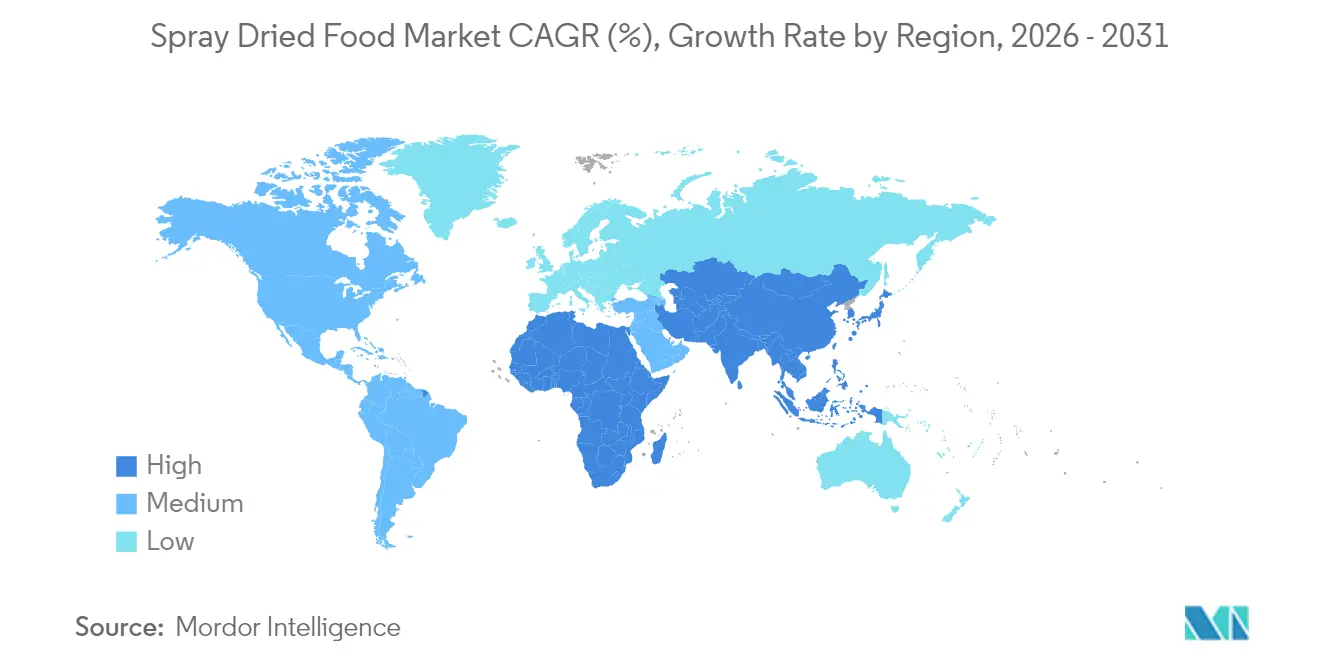
- By geography, Asia-Pacific commanded 37.80% of the spray dried food market in 2025, whereas the Middle East and Africa is anticipated to record the fastest 7.39% CAGR to 2031.
Note: Market size and forecast figures in this report are generated using Mordor Intelligence’s proprietary estimation framework, updated with the latest available data and insights as of 2026.
Market Trends and Insights
Drivers Impact Analysis of Spray Dried Food Market*
| Driver | (~) % Impact on CAGR Forecast | Geographic Relevance | Impact Timeline |
|---|---|---|---|
| Increased demand for convenient foods with extended shelf life | +1.2% | Global, with strongest impact in Asia-Pacific urban centers | Medium term (2-4 years) |
| Rising demand for clean-label and natural ingredients | +0.8% | North America and EU primary, expanding to Asia-Pacific | Long term (≥ 4 years) |
| Enhanced safety and stability | +0.7% | Global, with regulatory emphasis in developed markets | Short term (≤ 2 years) |
| Expanding use of spray-drying for encapsulating active compounds in functional and fortified food | +0.6% | North America, EU, and premium Asia-Pacific segments | Medium term (2-4 years) |
| Advanced spray drying technology | +0.5% | Global, with early adoption in developed markets | Long term (≥ 4 years) |
| Rise of ready-to-eat and instant mixes | +0.4% | Asia-Pacific core, spill-over to Middle East and Africa and South America | Short term (≤ 2 years) |
| Source: Mordor Intelligence | |||
Increased Demand for Convenient Foods with Extended Shelf Life
Consumer behavior shifts toward grab-and-go consumption patterns, accelerated by post-pandemic lifestyle changes, drive substantial demand for shelf-stable food products that maintain nutritional integrity without refrigeration requirements. Spray drying's ability to reduce water activity below 0.6 while preserving heat-sensitive vitamins and bioactive compounds positions it as the optimal processing method for manufacturers seeking to extend product shelf life from weeks to years. This trend particularly benefits protein powder manufacturers and instant beverage producers, who leverage spray drying to create stable, reconstitutable products that meet consumer expectations for both convenience and nutritional density. The technology's scalability from laboratory to industrial production enables rapid market response to emerging consumer preferences, creating competitive advantages for early adopters in convenience food segments.
Rising Demand for Clean-Label and Natural Ingredients
Regulatory pressure and consumer expectations for transparency are reshaping ingredient selection criteria, with clean-label products commanding premium pricing across developed markets while expanding into emerging economies through multinational brand strategies. The EU's Regulation (EC) 1334/2008 establishes stricter natural flavor definitions requiring appropriate physical, enzymatic, or microbiological processes, creating compliance challenges that favor spray drying over chemical extraction methods[1]. Clean-label alternatives for food preservation are gaining traction as manufacturers seek natural antimicrobials and antioxidants that maintain efficacy after spray drying. Plant extracts and essential oils, in particular, require optimized process parameters to retain their bioactivity [2]. This regulatory landscape creates opportunities for spray drying equipment manufacturers to develop specialized systems that preserve natural ingredient integrity while meeting industrial throughput requirements. The trend accelerates the adoption of alternative carrier materials like organic maltodextrin and modified starches that align with clean-label positioning, driving innovation in encapsulation matrices and processing conditions.
Enhanced Safety and Stability
Microbiological safety requirements and extended distribution networks necessitate processing technologies that eliminate pathogens while maintaining product quality, positioning spray drying as a critical food safety intervention that reduces water activity below pathogen growth thresholds. HACCP implementation across global food supply chains mandates validated thermal treatments, with spray drying's high-temperature, short-time exposure profile providing effective pathogen reduction while minimizing thermal damage to sensitive nutrients and bioactive compounds. The technology's ability to produce stable powders with consistent moisture content below 5% eliminates conditions conducive to mold, yeast, and bacterial growth, extending product shelf life without chemical preservatives that conflict with clean-label positioning. Advanced spray drying systems incorporate process analytical technology (PAT) for real-time monitoring of critical control points, ensuring consistent safety parameters while optimizing energy efficiency and product quality. This safety enhancement becomes particularly crucial for infant nutrition and nutraceutical applications, where regulatory oversight demands validated pathogen elimination and nutritional stability throughout extended storage periods.
Expanding Use of Spray-Drying for Encapsulating Active Compounds in Functional and Fortified Food
The rapid growth of the microencapsulation market reflects increasing demand for protected delivery of bioactive compounds, with spray drying emerging as the preferred method for encapsulating vitamins, probiotics, and nutraceuticals that require stability during processing and storage. Functional food manufacturers leverage spray drying to create stable powders containing omega-3 fatty acids, plant sterols, and antioxidants that maintain bioactivity through typical food processing conditions, enabling fortification of conventional products without sensory impact. The technology's versatility in processing both hydrophilic and lipophilic compounds through emulsion spray drying expands application possibilities across beverage, bakery, and dairy sectors seeking functional ingredient integration. Pharmaceutical-grade spray drying systems adapted for food applications enable precise particle size control and improved bioavailability of encapsulated compounds, creating competitive advantages for manufacturers targeting premium functional food segments. This encapsulation capability becomes increasingly valuable as regulatory frameworks for novel foods require demonstrated stability and bioavailability data, with spray drying providing validated processing methods that support regulatory submissions.
Restraints Impact Analysis of Spray Dried Food Market*
| Restraint | (~) % Impact on CAGR Forecast | Geographic Relevance | Impact Timeline |
|---|---|---|---|
| High energy consumption | -0.9% | Global, with acute impact in regions with high energy costs | Short term (≤ 2 years) |
| Expensive equipment and high capital investment | -0.6% | Emerging markets primarily, developed market SMEs | Medium term (2-4 years) |
| Competition from alternative drying technologies | -0.4% | Developed markets with established freeze-drying infrastructure | Long term (≥ 4 years) |
| Stringent food safety, labeling, and additive regulations | -0.3% | EU and North America primarily, expanding globally | Medium term (2-4 years) |
| Source: Mordor Intelligence | |||
High Energy Consumption
Energy costs represent 15-25% of total operating expenses in spray drying operations, with thermal efficiency challenges intensifying as carbon pricing mechanisms expand across developed markets and energy security concerns drive utility cost inflation. Industrial spray dryers typically consume 1.5-2.0 kg of steam per kg water evaporated, compared to 0.8-1.2 kg for freeze drying, creating operational cost disadvantages that pressure profit margins, particularly for high-volume, low-margin applications. Heat pump integration and waste heat recovery systems offer energy reduction potential of 20-30%, but retrofit costs and technical complexity limit adoption among existing facilities, creating competitive advantages for new installations that incorporate energy-efficient designs. This energy intensity constraint particularly affects emerging market expansion, where energy infrastructure limitations and cost volatility create barriers to spray drying adoption despite growing demand for processed food products.
Expensive Equipment and High Capital Investment
Spray drying systems involve significant capital investment, which creates barriers to entry for small and medium enterprises. This financial hurdle tends to favor established companies that have access to substantial project financing, making it challenging for newer or smaller players to compete in the market. Equipment complexity requiring specialized materials for corrosion resistance, precise temperature control, and particle size optimization drives manufacturing costs higher than alternative drying technologies, with maintenance requirements demanding skilled technicians and specialized spare parts that increase the total cost of ownership. Contract manufacturing emerges as a viable alternative for smaller food companies; however, capacity constraints and quality control challenges in toll processing create supply chain risks that favor vertical integration among larger manufacturers. This capital intensity particularly constrains expansion in emerging markets, where local financing availability and technical expertise limitations create dependencies on foreign equipment suppliers and technology transfer agreements.
*Our forecasts treat driver/restraint impacts as directional, not additive. The impact forecasts reflect baseline growth, mix effects, and variable interactions.
Spray Dried Food Market Segment Analysis
By Product Type:
Dairy Dominance Drives InnovationDairy Products hold a 29.10% market share in 2025 and are projected to grow at a 7.18% CAGR (2026-2031). This dominance results from established infrastructure and expanding applications in plant-based alternatives that utilize dairy processing capabilities. The segment's success derives from dairy's compatibility with spray drying, as milk proteins and lactose form natural encapsulation matrices that protect bioactive compounds and produce free-flowing, easily reconstitutable powders. The Fruits and Vegetables segment grows due to increased demand for natural colorants and flavors, particularly in bakery and confectionery products.
Meat, Poultry, and Seafood applications concentrate on protein hydrolysates and flavor enhancers, while Spices and Seasonings utilize spray drying for essential oil encapsulation and flavor standardization. The market's expansion reflects improvements in controlling protein denaturation and preventing fat oxidation during spray drying, resulting in dairy powders with longer shelf life and preserved nutritional properties. The plant-based dairy alternatives market increasingly employs spray drying for protein concentration and flavor enhancement, with oat-based products requiring specific processing conditions to maintain texture and nutritional content.

By Application:
Nutraceuticals Surge Past Traditional SegmentsBakery and confectionery applications hold a 24.55% market share in 2025, utilizing spray-dried ingredients for flavor standardization, shelf-life extension, and clean-label positioning. The nutraceuticals and supplements segment exhibits the highest growth rate at 7.74% CAGR (2026-2031), driven by personalized nutrition trends and functional ingredient developments. This shift indicates consumers moving from passive nutrition to active wellness management, as nutraceutical producers require specific encapsulation of bioactive compounds to maintain effectiveness during processing and storage. Dairy and beverage premixes grow due to convenience trends and industrial efficiency requirements, while infant nutrition shows consistent growth through regulatory compliance and safety standards that align with spray drying's pathogen reduction properties.
The nutraceuticals and supplements segment growth is attributed to improvements in microencapsulation technology, enabling the conversion of unstable compounds like probiotics, omega-3 fatty acids, and plant extracts into powder forms for capsules and beverage fortification. Savory and ready meals applications grow through urbanization and lifestyle changes, with spray-dried ingredients providing flavor enhancement and nutritional fortification in convenient formats. Moreover, EFSA regulatory requirements mandate proven stability and bioavailability for new functional ingredients, creating advantages for companies with validated spray drying processes.
Geography Analysis
APAC and Oceania Spray Dried Food Market
Asia-Pacific holds 37.80% market share in 2025, driven by robust dairy processing infrastructure in China and India. Government support for food processing modernization and export development strengthens the region's position. The market growth is supported by readily available agricultural materials, cost-effective manufacturing, and increasing middle-class food consumption patterns. Indonesia and Thailand are expanding their processing capabilities through international investments and technology adoption. Japan and South Korea concentrate on advanced spray drying applications for high-value functional foods. Australia's dairy export focus fuels spray drying investments, with manufacturers utilizing their geographic proximity to Asian markets.
EMEA Spray Dried Food Market
The Middle East and Africa region projects a 7.39% CAGR from 2026-2031, supported by food security programs, economic diversification, and infrastructure development. The United Arab Emirates is developing as a key food processing center, using its location and logistics capabilities to serve Middle East and Africa markets. South Africa provides technical expertise and manufacturing support for regional growth, while Nigeria and Egypt leverage their large domestic markets and agricultural resources. Morocco and Turkey function as connection points between African, European, and Middle Eastern markets, investing in spray drying capabilities for both domestic and export markets.
North America and Europe Spray Dried Food Market
North America and Europe maintain stable growth through developments in functional foods, clean-label products, and sustainable processing methods. European market regulations and environmental requirements increase demand for efficient spray drying systems that reduce energy use while maintaining product standards. The growing organic and natural products market drives investments in specialized equipment for processing temperature-sensitive bioactive ingredients that align with clean-label requirements.
Regulatory Landscape
The regulatory environment for spray-dried foods is shaped by food safety, additive approvals, and compositional standards that vary by region, but converge on validated hygienic processing for low-moisture powders. In China, the National Health Commission (NHC) and the State Administration for Market Regulation (SAMR) updated the National Food Safety Standard for Milk Powder and Modified Milk Powder (GB19644-2024), effective February 8, 2025, tightening compliance requirements for dairy powders used across infant nutrition and functional applications.
In the European Union, food additive use is assessed by the European Food Safety Authority (EFSA) under Regulation (EC) No 1333/2008, while national implementing measures continue to update milk-powder related rules. For example, Ireland brought S.I. No. 622/2025 into operation on June 14, 2026 to align with Directive (EU) 2024/1438 for dehydrated preserved milk. Globally, the Codex Alimentarius Code of Hygienic Practice for Low-Moisture Foods (CAC/RCP 75-2015) is a common reference point for pathogen control (notably Salmonella) in powders. In the United States, FDA oversight covers additive permissions and conditions of use in 21 CFR Parts 172 and 173, reinforcing the need for documented safety, purity, and process control across spray-dried ingredient systems.
Value Chain Analysis
The spray-dried food value chain starts with agricultural and fermentation-derived raw materials (milk, whey, fruit and vegetable streams, botanicals, flavors, and bioactives), followed by pre-processing such as standardization, concentration, emulsification, and formulation with carriers to support stable drying and reconstitution. Conversion is carried out by integrated ingredient producers (especially in dairy), specialized spray drying contractors and toll manufacturers, and broad-line ingredient solution providers. Upstream, the process relies on atomization, heat-generation, and filtration components, while downstream packaging is optimized for low water activity powders.
The main constraints sit at the manufacturing step: capital intensity for new industrial towers, long build and qualification cycles, and operational complexity for microencapsulation and sensitive actives. Equipment suppliers address scale-up and SKU flexibility needs through modular platforms, including ANDRITZ introducing modular, small-scale spray dryers (ANDRITZ Dedert range) with water evaporation capacities of 5 to 250 kg/hr to bridge pilot trials and industrial production. Technology differentiation increasingly depends on closed-cycle and inert gas systems for oxidation-sensitive ingredients and on digitalization (PAT, real-time monitoring, and AI-enabled control) that reduces off-spec product, improves yield predictability, and supports customer qualification in nutraceuticals, infant nutrition, and clean-label formulations.
Competitive Landscape
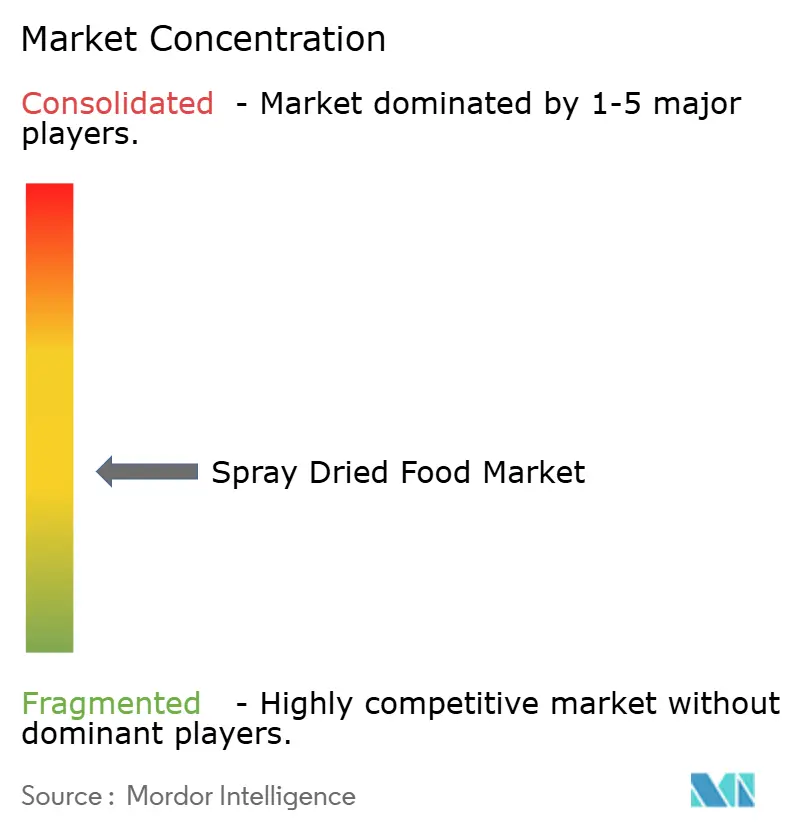
The spray dried food market exhibits moderate fragmentation with a concentration score of 4 out of 10, creating opportunities for both established multinational corporations and specialized technology providers to capture market share through differentiated value propositions and application-specific solutions. Market leaders like Sensient Technologies, Kerry Group, and Fonterra leverage vertical integration strategies and global distribution networks, while emerging players focus on niche applications and technological innovation to establish competitive positions.
Technology adoption patterns reveal competitive advantages for companies investing in advanced spray drying systems with integrated process control, energy recovery, and quality monitoring capabilities that reduce operational costs while improving product consistency. White-space opportunities emerge in specialized applications requiring customized spray drying solutions, including microencapsulation of probiotics, plant-based protein processing, and functional ingredient development for emerging markets.
Smaller companies increasingly adopt contract manufacturing strategies to access spray drying capabilities without capital investment, creating opportunities for toll processors with specialized equipment and technical expertise. The competitive landscape favors companies with strong R&D capabilities, regulatory compliance expertise, and ability to scale production from laboratory to industrial levels while maintaining product quality and cost competitiveness.
Spray Dried Food Industry Leaders
-
Sensient Technologies
-
Fonterra Co-operative Group Ltd.
-
Kerry Group plc
-
Döhler GmbH
-
DSM-Firmenich
- *Disclaimer: Major Players sorted in no particular order
Spray Dried Food Market Companies Covered in this Report
- Bluegrass Ingredients, Inc.
- Kerry Group plc
- Fonterra Co-operative
- DSM-Firmenich
- Döhler GmbH
- Sensient Technologies
- McCormick & Co.
- Chr. Hansen Holding
- Kanegrade Ltd.
- Mevive International
- Ingredion Inc.
- Tate & Lyle PLC
- Archer Daniels Midland
- AmTech Ingredients
- FrieslandCampina
- Agropur Dairy
- Symrise AG
- Alland & Robert
- Aarkay Food Products
- Express Contract Drying Ltd
Market Opportunities and Future Outlook
Opportunities are concentrated where spray drying adds value beyond dehydration, particularly in functional ingredients, advanced proteins, and encapsulated actives used in nutraceuticals and supplements, infant nutrition, and premium beverage premixes. Evidence of continued capital allocation toward higher-value powder formats includes Fonterra's Studholme investment program in New Zealand to expand advanced protein capability for sports and medical nutrition applications, and Food Empire Holdings announcing a US$37 million investment to expand its spray-dried soluble coffee capacity in Andhra Pradesh, India (targeting a 60% capacity increase). Together, these moves point to whitespace for suppliers that can provide application-specific powders (protein, coffee, botanicals) with tight specifications on flowability, solubility, and stability.
A second opportunity area is manufacturing modernization and quality-by-design adoption in spray drying operations. New modular installations and upgrades help reduce scale-up friction for brands moving from lab validation to commercial powders. Industry uptake of Process Analytical Technology (PAT) and machine learning for residual moisture control and yield prediction supports tighter quality windows in regulated end uses. Regulatory and safety compliance also steers investment toward auditable operations and engineered safety controls, including dust hazard analysis and explosion protection practices referenced in US standards frameworks (NFPA 61, NFPA 68, NFPA 69, and NFPA 652) used in dairy and nutritional powder environments. This creates demand for solutions that combine hygienic design, validated microbial control, and digital traceability across spray-dried ingredient production.
Recent Industry Developments in Spray Dried Food Market
- July 2026: Fonterra reported that its Studholme site expansion is on track for the first advanced protein products to come off the line in 2026. The project supports higher-value dairy ingredient formats used in sports and medical nutrition, strengthening supply availability of functional powders produced with tight performance specifications.
- May 2025: PARIC, LLC completed a multi-phase facility upgrade for Sensient Colors that included installation of industrial spray drying equipment for converting liquid to powder. The added drying capability expands Sensient's ability to supply shelf-stable color systems and support customers shifting formulations toward powder formats for handling and stability advantages.
- August 2024: Fonterra announced an NZD 75 million investment to expand its Studholme site in South Canterbury, New Zealand, positioning it as a hub for high-value advanced proteins. The investment signals continued prioritization of specialized, higher-margin spray-dried dairy ingredients over commodity output in parts of the global dairy powder network.
Spray Dried Food Market Report Scope and Research Methodology
Market Definition and Coverage
For this report, the market covers packaged and bulk food ingredients and finished food powders made using spray drying, which are sold for use in processed foods, beverage premixes, infant nutrition, and related food applications across regions.
Scope exclusions: Freeze-dried, drum-dried, and air-dried products are excluded unless they are sold as clearly spray-dried items.
Segments Covered in This Report
- By Product Type
- Fruits
- Vegetables
- Dairy Products
- Meat, Poultry, and Seafood
- Spices and Seasonings
- Others
- By Application
- Bakery and Confectionery
- Dairy and Beverage Premixes
- Infant Nutrition
- Nutraceuticals and Supplements
- Savory and Ready Meals
- Pet Foods
- Others
- By Geography
- North America
- United States
- Canada
- Mexico
- Rest of North America
- Europe
- Germany
- United Kingdom
- Italy
- France
- Spain
- Netherlands
- Poland
- Belgium
- Sweden
- Rest of Europe
- Asia-Pacific
- China
- India
- Japan
- Australia
- Indonesia
- South Korea
- Thailand
- Singapore
- Rest of Asia-Pacific
- South America
- Brazil
- Argentina
- Colombia
- Chile
- Peru
- Rest of South America
- Middle East and Africa
- South Africa
- Saudi Arabia
- United Arab Emirates
- Nigeria
- Egypt
- Morocco
- Turkey
- Rest of Middle East and Africa
- North America
Data Sources, Market Sizing, and Validation
Desk Research
Desk research was used to build the fact base around spray drying usage in food manufacturing and to set realistic boundaries for what is counted as spray-dried food. Public sources helped us align the market model to real-world production and demand signals, rather than relying on a single narrative.
We referred to sources such as FAOSTAT for agricultural supply context, UN Comtrade for trade patterns in relevant food powder categories, and national statistics agencies (such as the US Census Bureau and Eurostat) for packaged food output and consumption series. We also used publications from food science journals and association websites tied to dairy, ingredients, and nutrition categories, along with company annual reports, investor presentations, and reputable press coverage. In addition, paid subscriptions were used selectively for company financials and intelligence, news and financials tracking, patent databases, and shipment-level import and export checks where classification was clear. This list is not exhaustive, and many other public and paid sources were used to collect data, validate assumptions, and clarify open questions.
Primary Interviews and Surveys
Primary work focused on validating what gets sold as spray-dried food versus adjacent dried formats, and on confirming price and mix shifts across key use cases like bakery, premixes, and infant nutrition. We spoke with a spread of industry participants across APAC, EMEA, and the Americas so regional consumption patterns and supply footprints could be sanity-checked before the model was finalized.
Distribution of primary research fieldwork respondents
| Company type | Respondent position | Region |
|---|---|---|
| Top tier: 29% | CXOs: 14% | APAC: 38% |
| Mid tier: 56% | Functional/Unit leaders: 28% | EMEA: 36% |
| Smaller Players: 15% | Managers: 58% | Americas: 26% |
Market-Sizing & Forecasting
The sizing started with a top-down build where production and trade indicators were used to reconstruct the addressable pool for spray-dried food powders by region, and then it was allocated across the main food use areas. Once the first cut totals were formed, we checked them with selective bottom-up approximations, such as sampled supplier revenue disclosures where spray-dried food was a clear line item, plus ASP x volume checks for common powder categories.
Key inputs used in the model included mix by product type (such as dairy powders and fruit or vegetable powders), end-use split across premixes and processed food applications, regional food processing output trends, import and export movement for relevant powder groups, and observed ASP movement tied to raw material costs and packaging. Where bottom-up signals were incomplete, gaps were handled through conservative share ranges and cross-checked against trade flows and regional demand trends so the total did not drift away from the observable market.
For forecasting, scenario analysis was used so the outlook could flex with changes in processed food demand, ingredient reformulation activity, and cost-driven substitution between powder formats. The scenario weights were refined through expert inputs, and the final forecast path was kept consistent with the most repeatable leading indicators.
Data Validation & Update Cycle
Validation was done through repeated cross-checks between the model output and independent signals, including regional trade trends, packaged food production movement, and the expected share of spray-dried formats within key ingredient groups. Outliers were investigated, and when a variance could not be explained by scope or timing, the assumptions were revisited and interview follow-ups were triggered.
A multi-step internal review was used before sign-off, which included logic checks, unit consistency, and year-on-year reasonableness tests. Reports are refreshed annually, and interim updates are made when material events affect demand, pricing, or the supply footprint. Before delivery, a final analyst pass is completed so clients receive the most current version available.
Mordor Intelligence's Spray Dried Food Market Size Compared With Other Published Estimates
Published market sizes for spray-dried food often differ because the counted product boundary is not the same, and because some models treat ingredients and finished powders as one pool without clear checks. Timing also matters, since base year choice and inflation or commodity swings can shift USD values quickly.
By tracking category-level scope rules and refresh timing, Mordor Intelligence keeps the spray-dried food total tied to food applications like bakery, premixes, and infant nutrition, instead of blending in broader dried food formats that use different processing methods.
Benchmark comparison
| Source | Market Size | Gaps in Research Methodology |
|---|---|---|
| Mordor Intelligence | USD 79.06 B (2026) | |
| Industry Publisher A | USD 67.60 B (2025) | Uses a different base year and a longer forecast frame, and the scope leans on broader product groupings, which can undercount fast-growing premix and nutrition demand in the near term. |
| Global Publisher B | USD 4.77 B (2025) | Applies a much narrower counted set that looks closer to a selected subset of spray-dried powders, and it also mixes in non-food end uses in the narrative, which makes the food-only total hard to reconcile. |
The spread in the table is mainly explained by scope boundary and year alignment, followed by how pricing and mix are treated across powder categories. When the counted pool is kept consistent with food applications and cross-checked against observable trade and demand signals, the resulting market size becomes easier to follow and to update in a repeatable way.
Key Questions Answered in the Report
What is the projected value of the spray dried food market by 2031?
The sector is forecast to reach USD 107.01 billion by 2031, reflecting a 6.24% CAGR from 2026.
Which product type holds the largest share?
Dairy Products account for 29.10% of 2025 revenue and also post the fastest 7.18% CAGR.
Which application is growing the fastest?
Nutraceuticals and supplements are projected to rise at 7.74% CAGR through 2031 owing to the increased personalized nutrition demand.
Which region registers the highest growth rate?
The Middle East and Africa leads with a 7.39% CAGR owing to food-security and processing-capacity investments.