
Special Education Teacher Training Market Size and Share
Market Overview
| Study Period | 2021 - 2031 |
|---|---|
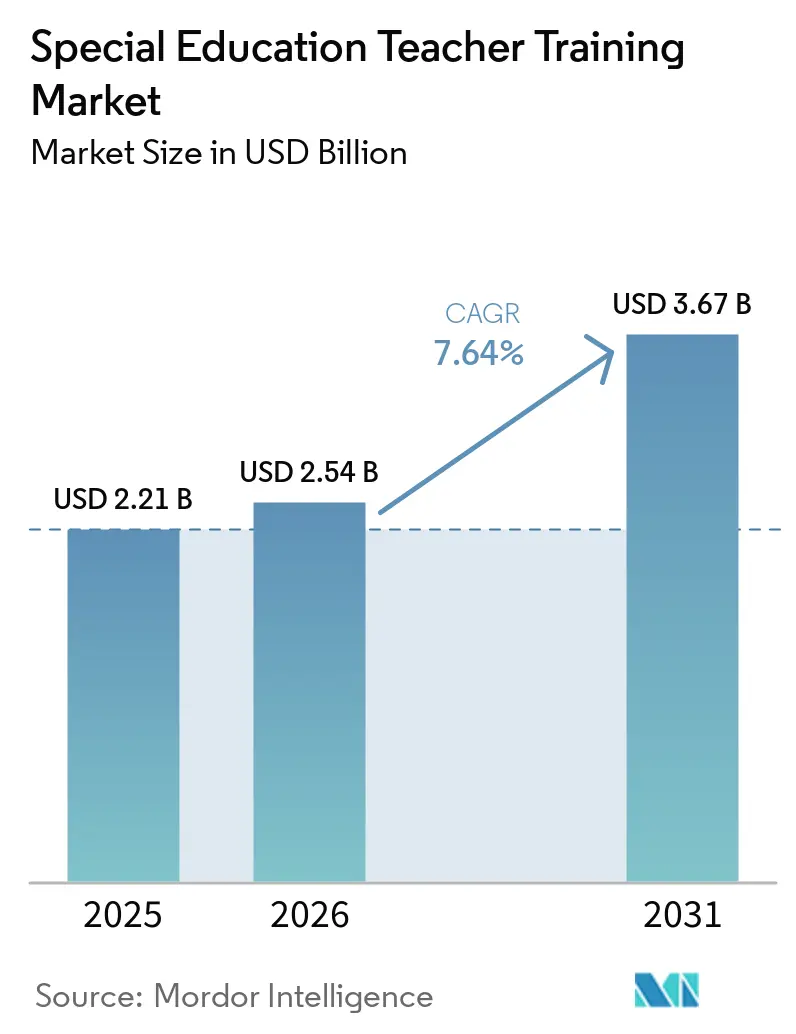
| Market Size (2026) | USD 2.54 Billion |
| Market Size (2031) | USD 3.67 Billion |
| Growth Rate (2026 - 2031) | 7.64 % |
| Fastest Growing Market | South America |
| Largest Market | North America |
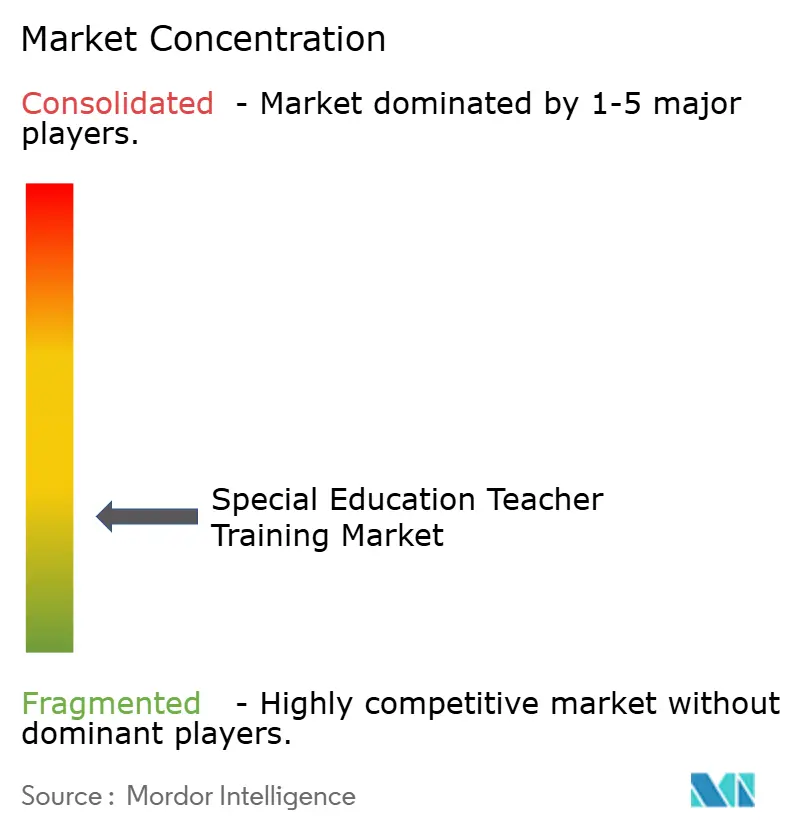
| Market Concentration | Low |
Major Players *Disclaimer: Major Players sorted in no particular order Image © Mordor Intelligence. Reuse requires attribution under CC BY 4.0. | |
Special Education Teacher Training Market Analysis by Mordor Intelligence
The special education teacher training market was valued at USD 2.21 billion in 2025 and is estimated to grow from USD 2.54 billion in 2026 to reach USD 3.67 billion by 2031, at a CAGR of 7.6% during the forecast period (2026-2031). Growth is driven by the integration of inclusive education into daily classroom practices, increasing the need for training among special educators and general teachers. Services under IDEA Part B supported 7.9 million children aged 3 to 21 during the 2023-24 school year, highlighting the demand for teacher preparation in identification, instruction, and classroom support[1]U.S. Department of Education, “Building and Sustaining Inclusive Educational Practices Aligned with the Elementary and Secondary Education Act of 1965 (ESEA) and Part B of the Individuals with Disabilities Education Act (IDEA),” U.S. Department of Education, ed.gov. Persistent staffing shortages have led districts to adopt certificate programs, professional development courses, and online platforms to address capability gaps faster than degree pathways. AI-enabled documentation tools are also influencing spending priorities, with 86% of AI early-adopter districts offering professional development on general AI tools, while individual special educators increasingly use generative AI to streamline paperwork and reduce IEP drafting times. Fragmented standards across states and countries maintain a diverse provider landscape, creating opportunities for publishers, e-tech firms, universities, nonprofits, and district-led training models.
Key Report Takeaways
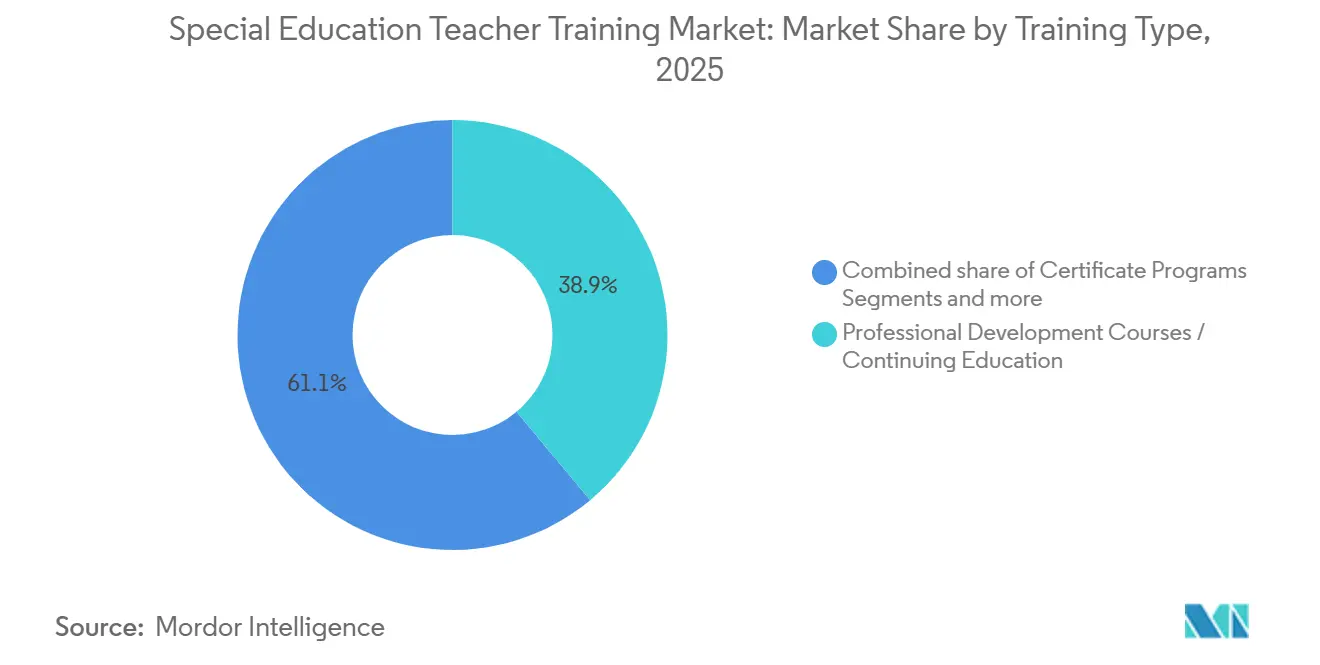
- By training type, Professional Development Courses / Continuing Education held a 38.94% share of the Special Education Teacher Training Market in 2025, while Certificate Programs are projected to grow at the highest CAGR of 7.98% by 2031.
- By delivery mode, Online accounted for a 41.83% share of the Special Education Teacher Training Market in 2025, while Blended Learning is projected to expand at the highest CAGR of 8.12% by 2031.
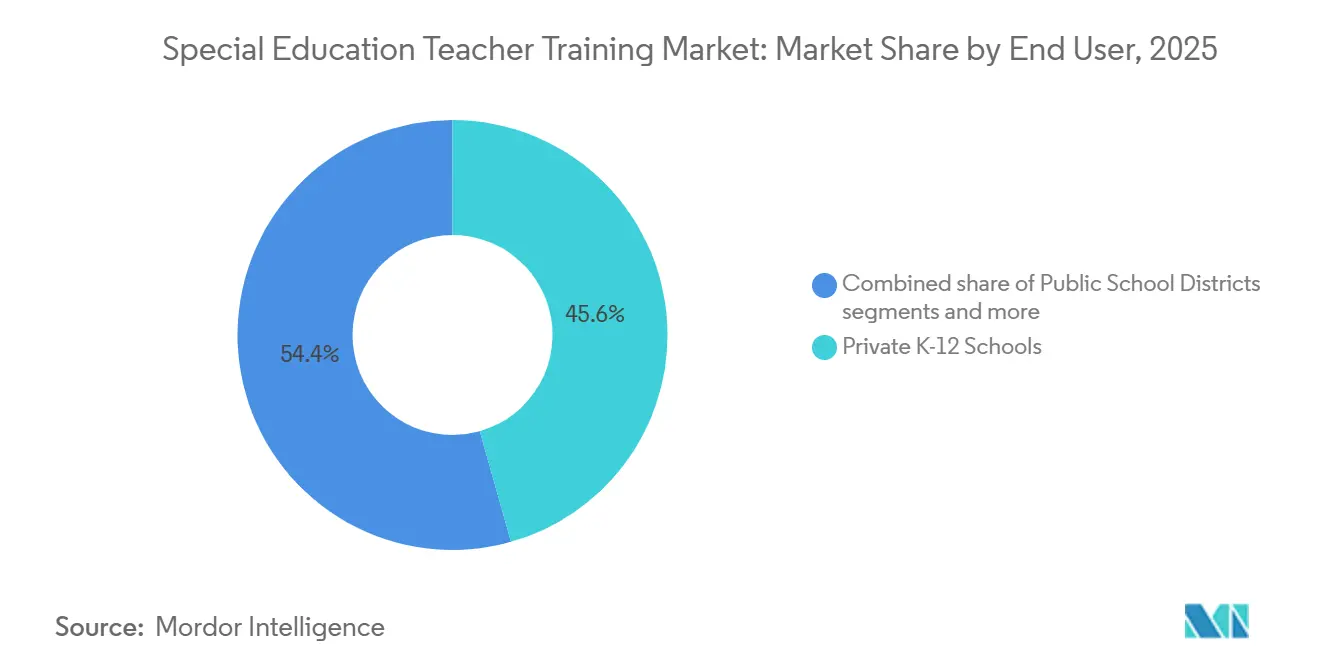
- By end user, Private K-12 Schools commanded a 45.61% share of the Special Education Teacher Training Market in 2025, while Special Education Centers are projected to grow at the highest CAGR of 8.57% by 2031.
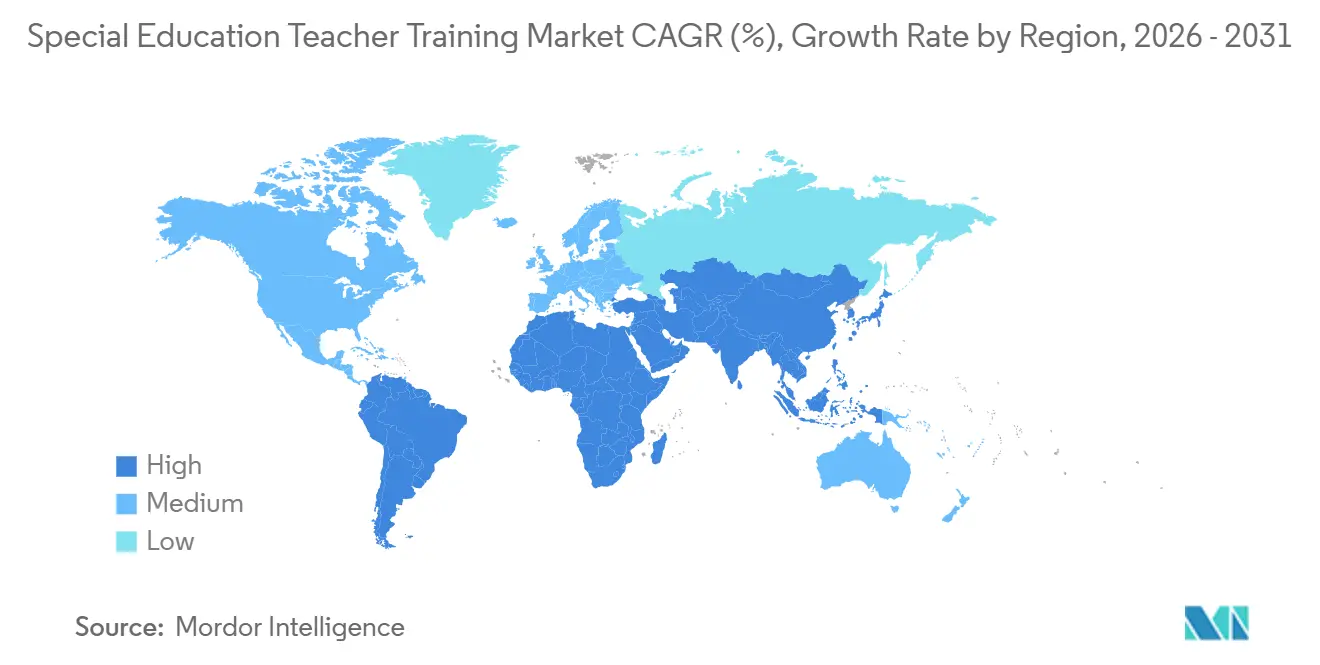
- By geography, North America captured a 34.23% share of the Special Education Teacher Training Market in 2025, while South America is projected to expand at the highest CAGR of 9.60% by 2031.
Note: Market size and forecast figures in this report are generated using Mordor Intelligence’s proprietary estimation framework, updated with the latest available data and insights as of January 2026.
Global Special Education Teacher Training Market Trends and Insights
Drivers Impact Analysis*
| Driver | (~) % Impact on CAGR Forecast | Geographic Relevance | Impact Timeline |
|---|---|---|---|
| Increased Mainstreaming of Students With Disabilities | +1.6% | Global | Medium term (2-4 years) |
| Expansion of Inclusive Education Mandates in Public School Systems | +1.5% | North America & Europe, spill-over to Asia-Pacific | Long term (≥ 4 years) |
| Shortage of Special Education Qualified Teachers | +1.2% | Global, concentrated in North America | Short term (≤ 2 years) |
| Growth of Digital Teacher Upskilling Platforms | +1.0% | Global | Short term (≤ 2 years) |
| Rising Demand for Evidence-Based Classroom Intervention Training | +0.8% | North America, Asia-Pacific | Medium term (2-4 years) |
| Employer Preference for Micro-Credentials and Stackable Certifications | +0.6% | North America, Europe | Medium term (2-4 years) |
| Source: Mordor Intelligence | |||
Increased Mainstreaming of Students With Disabilities
The special education teacher training market is growing due to the increasing integration of students with disabilities into mainstream classrooms. A significant portion of students served under IDEA Part B now spend most of their school day in general education settings, driving demand for training in co-teaching, differentiated instruction, classroom accommodations, and behavior support. General educators require enhanced preparation to manage mixed-ability classrooms effectively. Federal data shows that state educational agencies are allocating substantial funds from IDEA Part B for professional development, indicating that training demand is becoming a formal budget priority. As mainstreaming continues, school district contracts are expanding from single-role programs to comprehensive training packages for both general and special educators. This trend supports providers offering integrated training solutions, contributing to market growth through increased trainee numbers and broader training scopes within institutional contracts.
Expansion of Inclusive Education Mandates in Public School Systems
The special education teacher training market is driven by the implementation of inclusive education mandates in public systems. Article 24 of the Convention on the Rights of Persons with Disabilities requires signatories to establish inclusive education systems, aligning teacher preparation with policy directives[2]United Nations Division for Inclusive Social Development, “Article 24, Education | Convention on the Rights of Persons with Disabilities,” United Nations, social.desa.un.org. Official Data notes that inclusive education has become a central policy focus in global education planning, ensuring stable demand. The Philippines recently introduced rules under Republic Act No. 11650, formalizing teacher preparation for inclusion and reflecting Southeast Asia's commitment to training standards. These mandates create long-term demand as systems adjust hiring practices, qualifications, and classroom methods to comply with new laws. Providers that secure early recognition from ministries or boards benefit by building recurring demand through policy-linked credentials and approved content frameworks.
Shortage of Special Education Qualified Teachers
The special education teacher training market is driven by a persistent shortage of qualified teachers, particularly in systems requiring expedited workforce entry pathways. A review by the Learning Policy Institute identified widespread unfilled teaching positions, with special education highlighted as the most critical shortage area by many states during the 2024-25 school year[3]Learning Policy Institute, “An Overview of Teacher Shortages: 2025,” Learning Policy Institute, learningpolicyinstitute.org. Similarly, Frontline Education reported that a significant percentage of districts continued to cite special education as their most pressing shortage area, despite some improvement in overall vacancy rates. This demand sustains interest in certificate programs, continuing education, and licensure-aligned modules designed to upskill staff more quickly than traditional academic programs. Federal support also plays a role, with funding allocated under IDEA for personnel preparation and professional development. The special education teacher training market benefits stakeholders prioritize practical training solutions to address immediate classroom needs rather than waiting for long-term pipeline improvements.
Growth of Digital Teacher Upskilling Platforms
The special education teacher training market is advancing with the adoption of digital platforms, driven by the need for scalability, flexibility, and measurable outcomes across dispersed teacher populations. Lexia reported increased state department adoptions and renewals of its Aspire Professional Learning and LETRS programs, reflecting deeper integration of digital delivery into state procurement processes. Coursera’s merger with Udemy expanded its enterprise and learner base, enabling broader distribution of online teacher training content through consolidated procurement agreements. Digital models align with school operations by reducing travel, easing scheduling challenges, and supporting modular course completion for teachers unable to leave classrooms for extended periods. Buyer expectations are shifting beyond basic course completion, with institutions seeking platforms that connect training activities to classroom application, compliance documentation, and supervisor evaluations. The market is transitioning toward integrated platforms that combine content delivery, progress tracking, and competency verification, moving away from standalone course libraries.
Restraints Impact Analysis*
| Restraint | (~) % Impact on CAGR Forecast | Geographic Relevance | Impact Timeline |
|---|---|---|---|
| High Training Cost for Districts and Private Institutions | -1.3% | Global | Short term (≤ 2 years) |
| Limited Availability of Qualified Special Education Trainers | -0.9% | Asia-Pacific, Middle East and Africa | Medium term (2-4 years) |
| Teacher Workforce Bandwidth Limitations for Continuous Professional Development | -0.7% | North America, Europe | Short term (≤ 2 years) |
| Uneven Curriculum Standardization Across Regions | -0.6% | Global, concentrated in Middle East and Africa | Long term (≥ 4 years) |
| Source: Mordor Intelligence | |||
High Training Cost for Districts and Private Institutions
The special education teacher training market faces cost pressures, particularly in public systems managing increasing special education service demands. Funding and service challenges influence district spending decisions, including the balance between direct services and training[4]Washington State Joint Legislative Audit and Review Committee, “Performance Audit of Special Education,” Washington State JLARC, leg.wa.gov. Procurement often relies on grants or annual budget reviews, delaying contracts and limiting training deployments. Private institutions encounter similar issues, as specialized training in areas like applied behavior analysis and high-needs classroom management is more expensive than general professional development. Smaller schools and centers frequently choose modular or online solutions over comprehensive programs. Consequently, the market grows slowly in budget-constrained settings, despite regulatory and staff pressures driving demand for improved training.
Limited Availability of Qualified Special Education Trainers
The special education teacher training market is constrained by a limited supply of qualified trainers capable of delivering specialized instruction on a scale. UNESCO Bangkok and the SEAMEO Regional Centre for Special Educational Needs are developing a training package for teachers of learners with physical, visual, and hearing disabilities, indicating ongoing capacity-building efforts. UNESCO’s Gulf States office, in collaboration with the Arab Educational Training Centre for the Gulf States, launched inclusive education and AI in education training toolkits, reflecting the need to strengthen the trainer base in the region. A shortage of trainers makes it difficult to maintain consistent program quality across locations, languages, and disability categories. It also complicates classroom transfer validation, as many models rely on coached observation and practice review rather than course completion. The special education teacher training market in Asia-Pacific and Middle East and Africa faces scalability challenges until local trainer capacity is further developed and institutionalized.
*Our forecasts treat driver/restraint impacts as directional, not additive. The impact forecasts reflect baseline growth, mix effects, and variable interactions.
Segment Analysis
By Training Type: Certificate Programs Gain Ground on Professional Development Dominance
Professional Development Courses and Continuing Education held 38.94% of the special education teacher training market share in 2025. Certificate Programs are expected to grow at a compound annual growth rate (CAGR) of 7.98% through 2031. The preference for professional development courses reflects the need for modular upskilling that accommodates staffing shortages, teacher schedules, and compliance requirements. This format is effective for training both special educators and general classroom teachers without requiring long-term academic commitments. Degree-based programs remain relevant for supporting the credential pipeline and formal preparation systems. Diploma programs, positioned between professional development and degree programs, attract practitioners seeking structured study without the time commitment of full degrees. The market continues to favor shorter, adaptable formats, while academic routes retain importance for credibility and licensure.
Certificate Programs are gaining traction as employers prioritize skills that are verifiable, renewable, and tied to classroom functions. North Carolina’s quality assurance standards for micro-credentials have reinforced the value of shorter credentials within formal quality frameworks. The focus on the science of reading has also increased demand for targeted, research-based training pathways. Lexia reported that over 30 state departments acquired or renewed Aspire Professional Learning and LETRS between 2025 and early 2026. Accreditation-linked products are influencing district purchasing decisions, as recognized approvals impact eligibility for procurement and renewal. Blended credential pathways, combining digital modules with coaching or supervised practice, are also gaining support. The market increasingly values certificate formats that offer portability, recognized quality standards, and classroom relevance.



By Delivery Mode: Blended Learning Challenges the Scale Advantage of Online Platforms
Online delivery represented 41.83% of the special education teacher training market size in 2025, while blended learning is expected to grow at a CAGR of 8.12% through 2031. Online delivery remains prominent due to its scalability, scheduling flexibility, and cost efficiency, particularly for schools with dispersed staff. It is effective for quick rollouts of compliance topics, foundational inclusion methods, or refresher courses that do not require extensive observation. Improved digital platforms with enhanced analytics, assignment tracking, and reporting have further increased its appeal. However, complex skill areas in special education often require live feedback, coached practice, and applied observation. The market is evolving toward a model where online delivery provides broad access, while blended learning supports deeper skill development.
Blended learning is expanding as institutions recognize the need for hands-on practice in areas like behavior support, assistive technology, and classroom intervention methods. A Pearson survey found 34% of teachers sought specialized training for supporting students with special needs, while 53% wanted professional development on AI integration. This demand supports combining digital content with guided practice. Initiatives like Frontline Education’s partnership with AI for Education and RethinkEd’s expansion with NavigatED and LifeEd reflect a shift toward multi-format delivery models. While online delivery remains foundational, schools are increasingly investing in hybrid models that incorporate interaction, coaching, and implementation depth. Blended learning is becoming a core growth area in the special education teacher training market.
By End User: Special Education Centers Signal the Market's Fastest Expansion Node
Private K-12 schools held 45.61% of the market share in 2025 due to their flexibility in vendor selection, fund allocation, and adoption of specialized content, avoiding the approval processes common in public systems. This flexibility is crucial in addressing varying needs based on disability categories, staffing, and compliance rules. Public School Districts remain significant in value terms but rely on grants, public approvals, and compliance frameworks. Higher Education Institutions contribute as buyers for faculty development and providers of teacher preparation programs. The market reflects a contrast between private schools’ spending flexibility and public systems’ institutional scale, with both playing essential roles in demand.
Special Education Centers are projected to be the fastest-growing segment during 2026-2031, registering a CAGR of 8.57%, driven by their focus on learners with complex support needs requiring specialized and continuously updated staff training. These centers value integrated training programs combining instruction, behavior management, data capture, family support, and therapeutic coordination. Products like RethinkFirst’s Behavior Suite and launches such as NavigatED and LifeEd demonstrate vendors’ efforts to meet these needs in center-based environments. Nonprofit and government training organizations, though holding smaller market shares, influence standards, grant criteria, and evidence expectations shaping private buyers’ decisions. In regions like India and Asia-Pacific, specialized support centers are expanding faster than mainstream classrooms, increasing demand for intensive staff training and additional facilities.
Geography Analysis
North America held 34.23% of the special education teacher training market share in 2025, driven by federal legislation, established funding mechanisms, and a mature provider base. The United States Department of Education allocated USD 273.6 million for Special Education National Activities in the FY2025 budget, emphasizing capacity building. Persistent staffing challenges, highlighted by a teacher shortage review across 48 states and the District of Columbia, kept special education central to workforce development. Canada supports the market through provincial accessibility frameworks, while Mexico offers opportunities in private-school modular and localized training. Policy, funding, and workforce shortages sustain demand across compliance and instructional needs.
The Asia-Pacific region is projected to grow at a CAGR of 8.98% through 2031. Australia committed AUD 222.1 million (USD 148.84 million) to its “More teachers, better education” initiative, focusing on inclusive capability building. UNESCO Bangkok and SEAMEO SEN are developing a regional disability-focused teacher training package for Southeast Asia. In India, inclusive schooling requirements are increasing demand for state-level teacher training, though implementation quality varies. South America, with a 9.6% CAGR through 2031, sees growth driven by bilingual delivery and government alignment. Both regions are expanding from policy adoption to institutional purchasing.
Europe is forecast to grow at a 7.1% CAGR through 2031, supported by the European Disability Strategy 2021-2030 and stricter qualification requirements. In the Middle East, UNESCO and the Arab Educational Training Centre launched toolkits in 2025 for inclusive education and AI. Africa, with capacity-building efforts across eight West African countries, is moving toward structured institutional demand. Policy-driven inclusion is creating broader teacher preparation needs across these regions.

Competitive Landscape
The special education teacher training market remains fragmented, with key players holding a significant but not dominant share. This fragmentation is due to the presence of diverse provider types, including education publishers, edtech firms, universities, nonprofit organizations, and district-led programs. No single provider controls curriculum standards, procurement, or accreditation across regions, keeping market concentration low. Regional compliance differences further complicate scaling, as products often require adaptation for different systems. Providers that combine content depth, local adaptability, reporting capabilities, and recognized quality standards are better positioned to succeed.
Recent strategic initiatives show companies are focusing on integrating broader workflow relevance rather than standalone training. Presence expanded its reach by acquiring Education Modified, moving from service delivery to including administrator and educator support tools. Frontline Education introduced an AI K-12 Advisory Council and partnered with AI for Education, embedding AI literacy and IEP support into its professional growth platform. Coursera’s merger with Udemy increased its scale and distribution potential for online professional learning, targeting both enterprise and individual customers. These developments reflect a shift toward platforms that integrate content, workflow support, data visibility, and procurement convenience.
Smaller and specialized providers continue to find opportunities as buyers prioritize evidence-based solutions, accreditation, and applied relevance over content volume. Lexia’s state-level adoption growth demonstrated that a focused, research-driven approach can scale when aligned with instructional priorities. RethinkEd’s product launches illustrated how specialist vendors are expanding their roles by creating comprehensive ecosystems for student support and teacher use. The market is expected to remain fragmented due to broad demand, uneven standards, and buyer preferences for tailored solutions over universal platforms.
Special Education Teacher Training Industry Leaders
Frontline Education
Pearson plc
McGraw Hill Education
Savvas Learning Company
Teachstone, Inc.
- *Disclaimer: Major Players sorted in no particular order

Recent Industry Developments
- May 2026: Presence acquired Education Modified, a special education workflow platform, to create a unified operating environment for administrators and educators. Presence's network had delivered over 8 million remote evaluations and teletherapy sessions via 2,000+ clinicians, and its Kanga platform received the Tech&Learning Best of 2025 Awards in primary and secondary categories.
- May 2026: Coursera merged with Udemy, creating a skills platform with 197 million Coursera learners, 80 million Udemy learners, and 17,000 enterprise customers. This merger expands the reach of online teacher training content, addressing both enterprise and individual educator needs.
- April 2026: Frontline Education has introduced an AI K-12 Advisory Council and established a strategic partnership with AI for Education. This initiative integrates evidence-based GenAI literacy content and an AI-powered IEP Goal Writer into its Professional Growth platform, which supports over 10,000 K-12 organizations across the country. The advisory council comprises special education leaders who provide guidance on the responsible adoption of AI for district compliance functions.
- September 2025: RethinkEd launched NavigatED and LifeEd, expanding its whole-child support framework for special educators alongside the Behavior Suite. This portfolio provides districts with a tiered, data-driven approach to student behavior, emotional wellness, and transition readiness, strengthening RethinkEd's role in behavioral and social-emotional learning for K-12 special education.


Global Special Education Teacher Training Market Report Scope
| Certificate Programs |
| Diploma Programs |
| Professional Development Courses / Continuing Education |
| Degree-Based Training Programs |
| Online |
| Blended |
| In-Person |
| Public School Districts |
| Private K-12 Schools |
| Special Education Centers |
| Higher Education Institutions |
| Nonprofit and Government Training Bodies |
| North America | United States |
| Canada | |
| Mexico | |
| South America | Brazil |
| Peru | |
| Chile | |
| Argentina | |
| Rest of South America | |
| Europe | United Kingdom |
| Germany | |
| France | |
| Spain | |
| Italy | |
| BENELUX (Belgium, Netherlands, and Luxembourg) | |
| NORDICS (Denmark, Finland, Iceland, Norway, and Sweden) | |
| Rest of Europe | |
| Asia-Pacific | India |
| China | |
| Japan | |
| Australia | |
| South Korea | |
| South East Asia (Singapore, Malaysia, Thailand, Indonesia, Vietnam, and Philippines) | |
| Rest of Asia-Pacific | |
| Middle East and Africa | United Arab Emirates |
| Saudi Arabia | |
| South Africa | |
| Nigeria | |
| Rest of Middle East and Africa |
| By Training Type | Certificate Programs | |
| Diploma Programs | ||
| Professional Development Courses / Continuing Education | ||
| Degree-Based Training Programs | ||
| By Delivery Mode | Online | |
| Blended | ||
| In-Person | ||
| By End User | Public School Districts | |
| Private K-12 Schools | ||
| Special Education Centers | ||
| Higher Education Institutions | ||
| Nonprofit and Government Training Bodies | ||
| By Geography | North America | United States |
| Canada | ||
| Mexico | ||
| South America | Brazil | |
| Peru | ||
| Chile | ||
| Argentina | ||
| Rest of South America | ||
| Europe | United Kingdom | |
| Germany | ||
| France | ||
| Spain | ||
| Italy | ||
| BENELUX (Belgium, Netherlands, and Luxembourg) | ||
| NORDICS (Denmark, Finland, Iceland, Norway, and Sweden) | ||
| Rest of Europe | ||
| Asia-Pacific | India | |
| China | ||
| Japan | ||
| Australia | ||
| South Korea | ||
| South East Asia (Singapore, Malaysia, Thailand, Indonesia, Vietnam, and Philippines) | ||
| Rest of Asia-Pacific | ||
| Middle East and Africa | United Arab Emirates | |
| Saudi Arabia | ||
| South Africa | ||
| Nigeria | ||
| Rest of Middle East and Africa | ||


Key Questions Answered in the Report
What is the expected value of the special education teacher training market by 2031?
The special education teacher training market is forecast to reach USD 3.67 billion by 2031 from USD 2.54 billion in 2026, reflecting a 7.64% CAGR over 2026-2031.
Which training type currently leads revenue generation?
Professional Development Courses / Continuing Education led in 2025 with a 38.94% share because districts prefer modular upskilling that fits staffing and scheduling limits.
Which delivery mode is growing the fastest for teacher training in this field?
Blended Learning is projected to grow at 8.12% CAGR through 2031 because buyers increasingly want online scale along with supervised practice and coaching.
Which end-user group is expanding the fastest?
Special Education Centers are forecast to grow at 8.57% CAGR through 2031 as they need more intensive and specialized staff capability across complex learner needs.
Why are AI tools becoming relevant in teacher training for special education?
AI tools matter because they can reduce administrative burden in tasks such as IEP development, allowing districts to redirect more time and budget toward instructional training and skill development.
Page last updated on:


 Your data is secure and never sold or shared.


