
Dyslexia Treatment Market Size and Share
Market Overview
| Study Period | 2020 - 2031 |
|---|---|
| Market Size (2026) | USD 23.69 Billion |
| Market Size (2031) | USD 32.27 Billion |
| Growth Rate (2026 - 2031) | 6.38 % |
| Fastest Growing Market | Asia-Pacific |
| Largest Market | North America |
| Market Concentration | Medium |
Major Players *Disclaimer: Major Players sorted in no particular order Image © Mordor Intelligence. Reuse requires attribution under CC BY 4.0. | |
Dyslexia Treatment Market Analysis by Mordor Intelligence
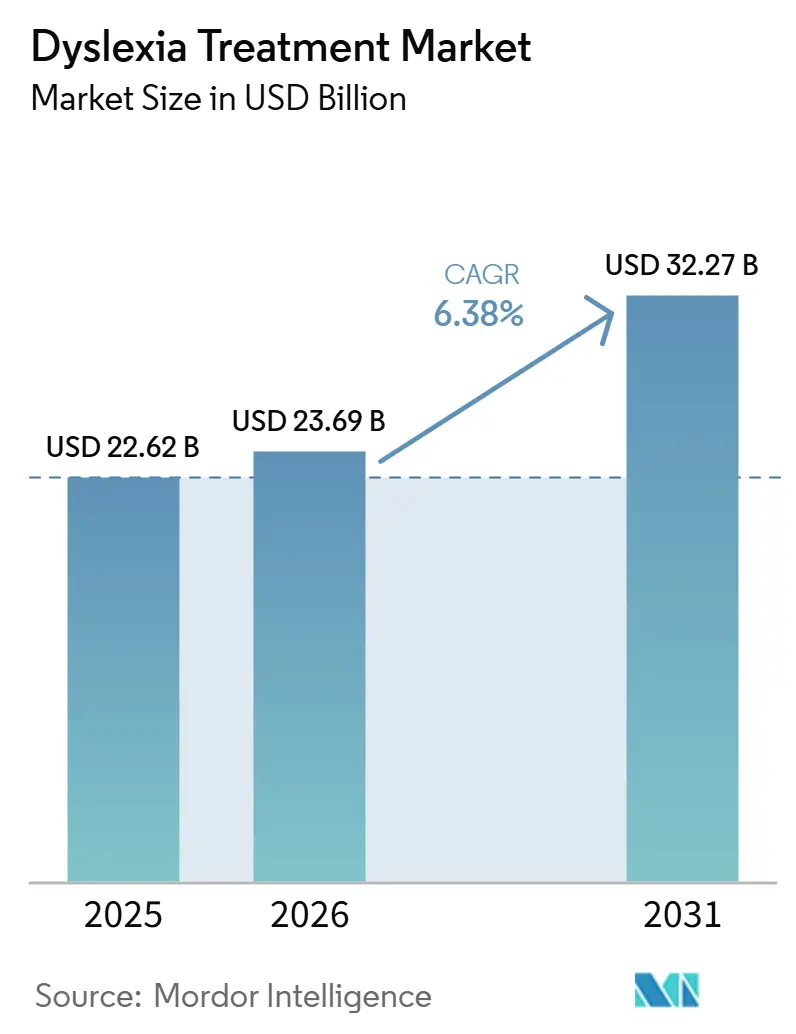
The Dyslexia Treatment Market size is expected to grow from USD 22.62 billion in 2025 to USD 23.69 billion in 2026 and is forecast to reach USD 32.27 billion by 2031 at 6.38% CAGR over 2026-2031.
Rising diagnosed learning disability prevalence and earlier identification requirements are widening the need for assessment and intervention. Many countries still lack digital support within national care pathways, leaving providers room to expand access through schools, clinics, and homes. Policy, evidence standards, and the ability to deliver services without long waits will shape procurement decisions. Competition remains spread across literacy publishers, assistive technology developers, clinical providers, and digital therapy companies.
Key Report Takeaways
- By treatment modality, Structured Literacy and Explicit Phonics held 24.23% of the Dyslexia treatment market share in 2025, while Digital Therapy Solutions are expected to record the highest CAGR at 8.92% through 2031.
- By age group, Children and Adolescents held 72.36% of the Dyslexia treatment market share in 2025, and are also projected to have the highest CAGR at 6.73% through 2031.
- By end user, Schools and Special Education Programs held 34.32% of revenue in 2025, while Home Care Settings are expected to have a CAGR at 7.42% through 2031.
- By distribution channel, Retail Pharmacies held 35.12% of revenue in 2025, while Online Pharmacies are expected to record the highest forecast CAGR at 8.56% through 2031.
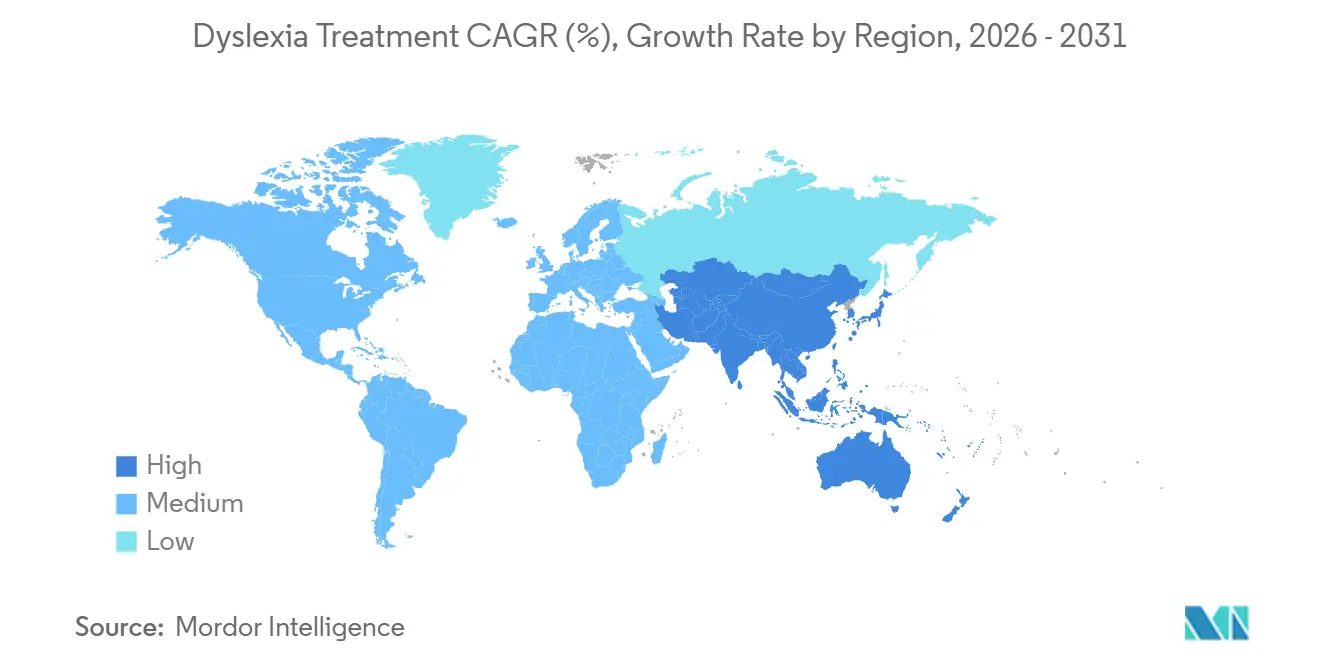
- By geography, North America held 38.87% of revenue in 2025, while Asia-Pacific is expected to have the fastest CAGR at 8.16% through 2031.
Note: Market size and forecast figures in this report are generated using Mordor Intelligence’s proprietary estimation framework, updated with the latest available data and insights as of January 2026.
Global Dyslexia Treatment Market Trends and Insights
Drivers Impact Analysis*
| Driver | (~) % Impact on CAGR Forecast | Geographic Relevance | Impact Timeline |
|---|---|---|---|
| Earlier Identification and Intervention Mandates | +1.2% | North America and Europe | Short term (≤ 2 years) |
| Expansion of Structured Literacy and Science of Reading Adoption | +1% | North America, with spillover to Asia-Pacific and Europe | Medium term (2-4 years) |
| AI-Enabled Screening and Phoneme-Level Personalization | +0.9% | Global, with early gains in North America, Europe, and Asia-Pacific | Medium term (2-4 years) |
| Growth of School-Based and Teletherapy Delivery | +0.7% | Global, concentrated in North America and Europe | Short term (≤ 2 years) |
| Mainstreaming of Assistive Reading and Writing Technology | +0.8% | Global | Medium term (2-4 years) |
| Parent-Led Home Intervention and Subscription Adoption | +0.5% | North America and Europe, growing in Asia-Pacific | Medium term (2-4 years) |
| Source: Mordor Intelligence | |||
Earlier Identification and Intervention Mandates Embed Structural Screening Demand
Legislative action is moving dyslexia identification from a reactive process toward routine screening in schools. The National Conference of State Legislatures reported at least 35 literacy bills across 25 U.S. states in 2024[1]National Conference of State Legislatures, “Legislatures Lead the Way with Science of Reading Approach,” National Conference of State Legislatures, ncsl.org., with substantial attention on evidence-based assessments and dyslexia screeners. Pennsylvania’s Act 135[2]Pennsylvania Department of Education, “Act 135 of 2024, Structured Literacy,” Pennsylvania Department of Education, pa.gov. expanded access to structured literacy and required universal reading screeners. Georgia’s HB 307 requires science-of-reading-aligned teacher training that covers students with dyslexia. Screening at kindergarten entry can bring children into support earlier than past referral patterns allowed. This can extend the period in which schools and families use assessment, intervention, and progress-monitoring services.
Expansion of Structured Literacy and Science of Reading Adoption Creates a B2G Revenue Channel
Structured literacy adoption is closely tied to public education policy and district purchasing. When a state requires science-of-reading curricula, districts need new programs, staff training, and implementation support. Lexia reported increased state-level acquisition or renewal activity for its Aspire and LETRS professional learning programs, reflecting continued investment in educator learning[3]Lexia Learning, “Lexia Science of Reading Classroom Expands with New Back-to-School 2026 Capabilities,” Lexia Learning, lexialearning.com.. Washington’s HB 1295[4]Washington State Legislature, “2025–2026 HB 1295, Comprehensive Literacy Program Requirements,” Washington State Legislature, leg.wa.gov. requires districts to phase in comprehensive literacy programs during the 2025–2026 school year and complete implementation by 2027–2028. These requirements create longer procurement cycles than individual family purchases. They also raise the importance of teacher training, reporting tools, and evidence that programs meet state standards.
AI-Enabled Screening and Phoneme-Level Personalization Reduces the Diagnostic Bottleneck
AI-based screening is being used to address delays between a parent’s concern and specialist assessment. A 2026 review in Frontiers in Medicine described eye-movement-based computational screening as a noninvasive option for scalable dyslexia detection. The review reported that multimodal models in peer-reviewed studies achieved accuracy levels within a broad range, showing both potential and the need for validation across settings. China’s DysDiTect model was tested on more than 2,000 students and reached 83.2% accuracy, showing that these tools can operate at larger screening volumes. LUCA uses phoneme-level reading analysis and has a U.S. patent covering its approach. Better early screening can create demand for follow-up intervention, but institutional adoption still depends on privacy safeguards, clinical validation, and clear reporting.
Growth of School-Based and Teletherapy Delivery Broadens Service Reach
School-based delivery remains central because public funding and literacy mandates direct purchasing through districts. Teletherapy gives providers a way to reach families outside specialist centers and may reduce travel barriers. A Dutch study found that online dyslexia treatment was as effective as face-to-face treatment when session count was controlled. This supports hybrid care models that combine home practice with professional oversight. Schools can use these models to extend specialist capacity across a larger number of students. Providers that fit into existing education workflows are likely to have an advantage in district purchasing.
Restraints Impact Analysis*
| Restraint | (~) % Impact on CAGR Forecast | Geographic Relevance | Impact Timeline |
|---|---|---|---|
| Shortage of Qualified Literacy Intervention Professionals | -1% | Global, most acute in Europe and Asia-Pacific | Long term (≥ 4 years) |
| High Out-of-Pocket Cost and Uneven Reimbursement | -0.8% | North America and Europe | Medium term (2-4 years) |
| Limited Evidence Transfer Across Languages and Writing Systems | -0.4% | Asia-Pacific, Middle East and Africa, and South America | Long term (≥ 4 years) |
| Privacy, Bias, and Validation Risk in AI-Enabled Tools | -0.3% | Global, most acute in Europe under GDPR | Medium term (2-4 years) |
| Source: Mordor Intelligence | |||
Therapist Shortage Caps Fundable Intervention Volume Regardless of Technology
A shortage of certified literacy specialists limits the volume of supervised treatment that can be delivered. France has 1.3 million children with dyslexia and 25,000 speech therapists, contributing to assessment waits of 12–24 months. This limits access even when digital screening or teletherapy tools are available. Indiana’s 2024 literacy training requirement added 80 hours of training for pre-K through sixth-grade teachers before license renewal, and some educators raised concerns about workforce pressure. AI tools can help with screening and practice, but reimbursement and clinical protocols often still require qualified professional involvement. The shortage can therefore shift demand toward self-service tools while restricting growth in clinical services.
High Out-of-Pocket Costs and Coverage Gaps Stratify Access by Income
Traditional dyslexia programs can exceed USD 20,000 annually per child in high-cost U.S. settings. Many U.S. payers do not treat structured literacy programs as reimbursable medical services unless they are included in a broader treatment plan. This produces uneven access across households and locations. Research in the Journal of Benefit-Cost Analysis found that dyslexic individuals earned USD 8,000 less annually than non-dyslexic peers, which can compound barriers to treatment. Digital subscriptions can lower the upfront cost, but they still require dependable internet access and active family support. These limits are particularly important in low-income and rural communities.
*Our forecasts treat driver/restraint impacts as directional, not additive. The impact forecasts reflect baseline growth, mix effects, and variable interactions.
Segment Analysis
By Treatment Modality: Structured Literacy Leads While Digital Therapy Grows Fastest
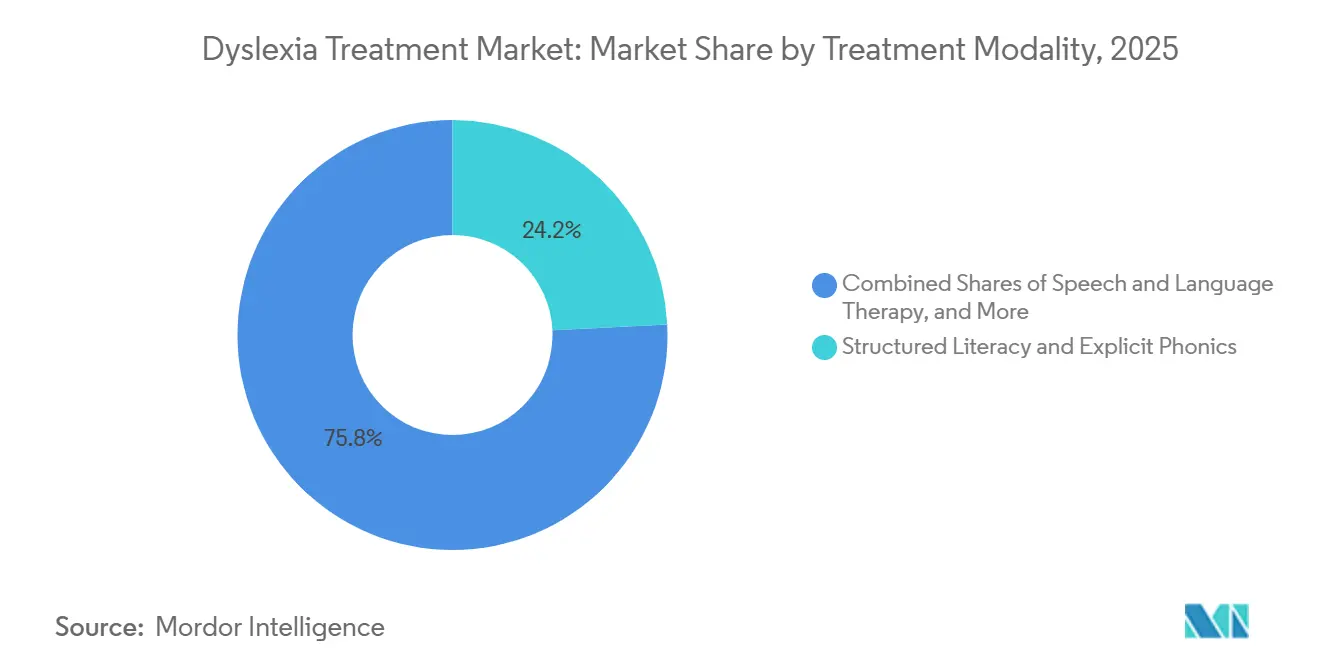
Structured Literacy and Explicit Phonics held 24.23% of the Dyslexia treatment market share in 2025, while Digital Therapy Solutions are forecast to grow at an 8.92% CAGR from 2026 to 2031. Structured literacy benefits from state mandates, school procurement, and a well-established evidence base, the Hedges’ g of 0.65 for systematic phonics interventions in school-age children. Speech and Language Therapy remains important for younger children and people with phonological disorders.
Digital Therapy Solutions are gaining adoption through adaptive practice, virtual reality, and gamified learning. The pooled effects were 0.54 for reading accuracy and 0.58 for fluency in digital meta-analyses. Occupational Therapy supports children with graphomotor and fine motor difficulties, while Cognitive and Behavioral Support addresses anxiety and lower academic self-esteem.



By Age Group: Children and Adolescents Lead and Grow Fastest
Children and Adolescents held 72.36% of the Dyslexia treatment market size in 2025 and are forecast to grow at a 6.73% CAGR from 2026 to 2031. School funding, parental advocacy, and structured literacy evidence support their leading position. Earlier screening at ages 5–6 can bring children into care before reading difficulties become more established. Digital programs can also add regular phonological-awareness practice between professional sessions.
By End User: Schools Lead While Home Care Grows Fastest
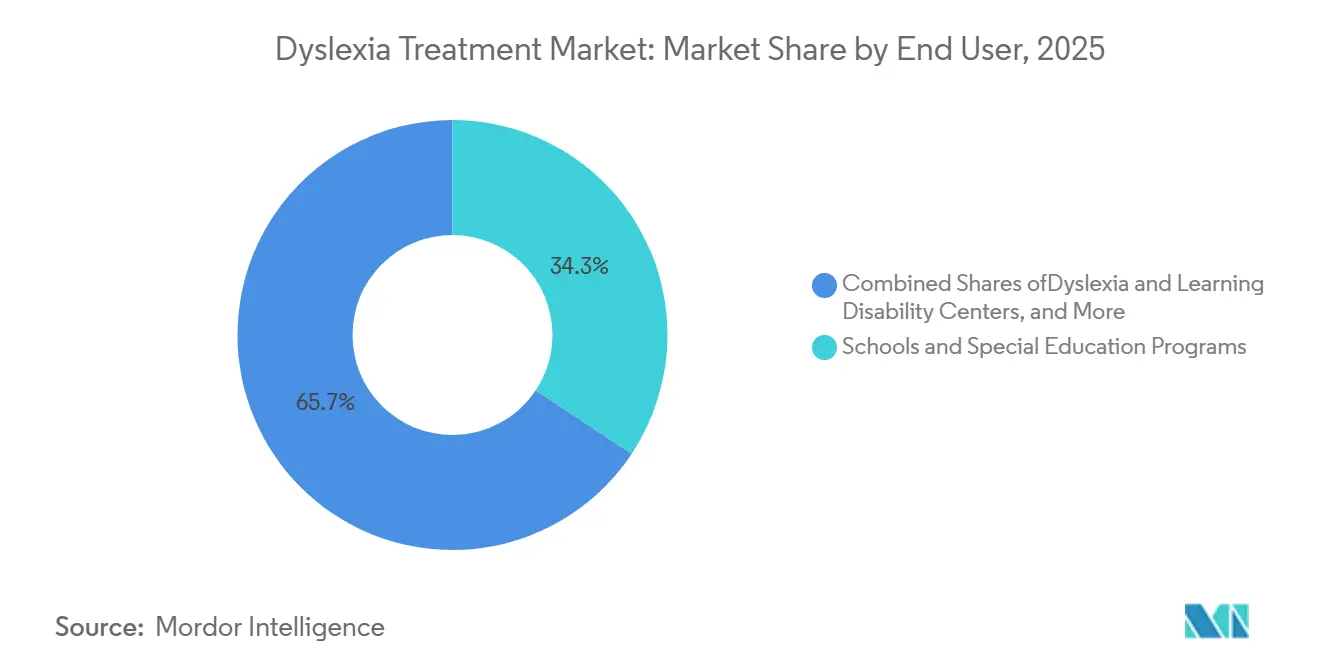
Schools and Special Education Programs held 34.32% of revenue in 2025, while Home Care Settings are forecast to grow at a 7.42% CAGR from 2026 to 2031. Schools benefit from IDEA requirements and state literacy mandates that support spending on screening, curriculum, and teacher training. Districts also need progress monitoring and documentation for special education services. Scottish Rite for Children launched its Texas Education Agency-approved Bridges curriculum in 2025 and reduced certified teacher training from two years to 10 days.
By Distribution Channel: Retail Pharmacies Lead While Online Channels Grow Fastest
Retail Pharmacies held 35.12% of revenue in 2025, while Online Pharmacies are forecast to grow at an 8.56% CAGR from 2026 to 2031. Retail Pharmacies distribute medication for related conditions and offer consumer-facing products. Hospital Pharmacies remain important for institutional prescription needs and formal medical supervision. Their role is shaped by hospital purchasing cycles and clinical treatment patterns. Online Pharmacies and direct-to-consumer channels help users find assessment tools and assistive software without relying on pharmacy supply chains. App stores and school platform licensing also create direct routes to families and districts.
Geography Analysis
North America held 38.87% of the Dyslexia treatment market share in 2025. The United States drives regional demand through IDEA, state literacy laws, and a mature supplier base. The National Conference of State Legislatures documented 35 literacy bills enacted across 25 states in 2024. Lexia Learning, Wilson Language Training, Learning Ally, and Lexercise participate in the region’s school and intervention ecosystem. National Assessment of Educational Progress data showed that fewer than one-third of U.S. students read proficiently at grade level, supporting continued district interest in structured literacy services.
Asia-Pacific is expected to grow with 8.16% CAGR through the forecast period, which is supported by large undiagnosed populations, rising education technology investment, and improving digital infrastructure. India is using screening camps and the PRASHAST 2 tool through Samagra Shiksha and the Rights of Persons with Disabilities Act, as described in a 2025 NIH-hosted review. Europe has varied levels of policy maturity and service availability. The United Kingdom launched its National Year of Reading in January 2026 with GBP 27.7 million (USD 35.2 million).

Competitive Landscape
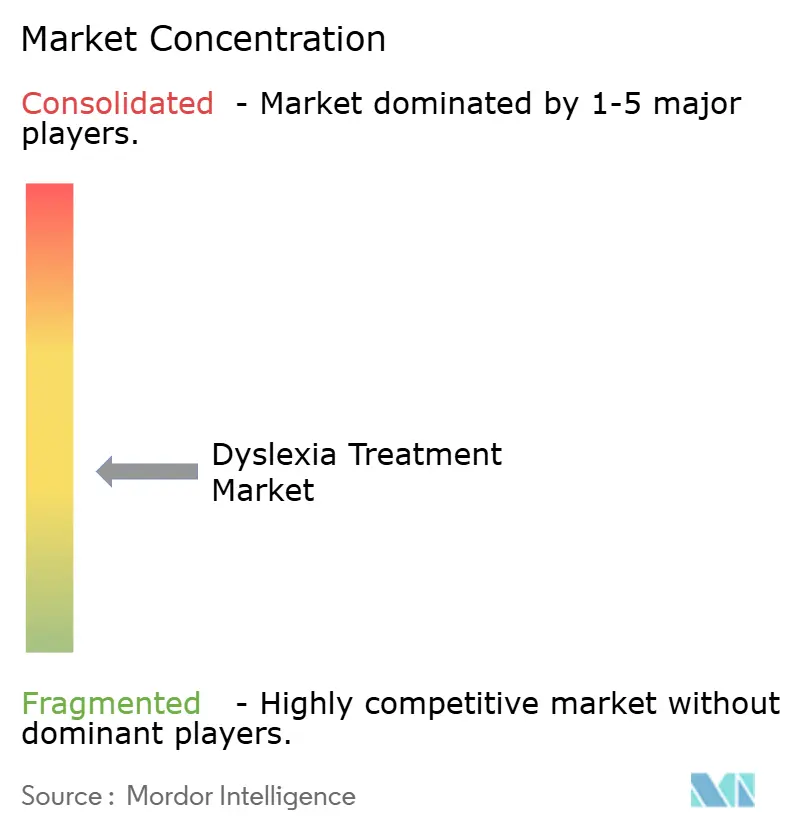
The Dyslexia treatment market is moderately fragmented because providers compete in distinct parts of the care pathway. Lexia Learning, Texthelp, Learning Ally, and Nessy Learning focus on school-based literacy and assistive technology. Wilson Language Training, Lindamood-Bell, and Lexercise compete through credentialed intervention and practitioner training. Dysolve, Poppins, and Dybuster offer digital approaches that can reduce reliance on clinic-based models. No provider operates a fully integrated system spanning screening, intervention, occupational therapy referral, and outcome monitoring. This leaves room for partnerships or acquisitions that connect these functions.
Texthelp’s Read&Write is used in more than 14,000 schools globally and operates on Windows, Mac, iOS, Android, and Chrome. Broad device coverage can make an assistive tool harder for institutions to replace. LUCA holds U.S. Patent No. 12,394,332 B2 for phoneme-level AI reading analysis. Lexia released Science of Reading Classroom in June 2026, bringing LETRS Insights and Skill Check reporting into district data workflows.
Dyslexia Treatment Industry Leaders
Pearson PLC
Lexia Learning Systems LLC
Learning Ally
Kurzweil Education
Everway Ltd.
- *Disclaimer: Major Players sorted in no particular order

Recent Industry Developments
- July 2026: Lexia (Cambium Learning Group) expanded its Science of Reading Classroom with Summer 2026 Back-to-School capabilities, including LETRS Insights, Lexia Assignments, and Skill Check reporting enhancements, connecting professional learning, assessment, and student performance data in a unified K–12 literacy ecosystem that increases district switching costs.
- April 2025: Scottish Rite for Children launched Bridges, a Texas Education Agency-approved web-based dyslexia intervention curriculum, reducing certified teacher training time from two years to 10 days and lowering price for the 2025–2026 school year to broaden district access.


Global Dyslexia Treatment Market Report Scope
As per the scope of the market, dyslexia treatment comprises a range of therapeutic, educational, technological, and supportive interventions designed to improve reading, writing, language processing, and learning outcomes among individuals with dyslexia. The market includes structured literacy programs, speech and language therapy, occupational therapy, cognitive and behavioral support, digital therapy solutions, assistive reading and writing technologies, and pharmacological management of coexisting conditions, delivered through educational, clinical, and home-based settings.
The dyslexia treatment market is segmented by treatment modality, including structured literacy and explicit phonics, speech and language therapy, occupational therapy, cognitive and behavioral support, digital therapy solutions, assistive reading and writing technology, pharmacological and comorbidity-management support, and other interventions such as screening, assessment, progress monitoring, and multisensory instruction. The market is further categorized by age group, covering children and adolescents, adults, and older adults. Based on end user, the market is segmented into schools and special education programs, dyslexia and learning disability centers, hospitals and clinics, rehabilitation centers, home care settings, and others. By distribution channel, the market is segmented into hospital pharmacies, retail pharmacies, online pharmacies, and other channels including educational institutions, learning centers, and direct-to-consumer platforms. Geographically, the market is segmented into North America, Europe, Asia-Pacific, the Middle East & Africa, and South America. The market report also covers the estimated market sizes and trends for 17 countries across major regions globally. For each segment, the market size and forecast are provided in terms of value (USD).
| Structured Literacy and Explicit Phonics |
| Speech and Language Therapy |
| Occupational Therapy |
| Cognitive and Behavioral Support |
| Digital Therapy Solutions |
| Assistive Reading and Writing Technology |
| Pharmacological and Comorbidity-Management Support |
| Others (Screening, Assessment, and Progress Monitoring, Multisensory Instruction) |
| Children and Adolescents |
| Adults |
| Older Adults |
| Schools and Special Education Programs |
| Dyslexia and Learning Disability Centers |
| Hospitals and Clinics |
| Rehabilitation Centers |
| Home Care Settings |
| Others |
| Hospital Pharmacies |
| Retail Pharmacies |
| Online Pharmacies |
| Others (Educational Institutions and Learning Centers, Direct-to-Consumer Channels) |
| North America | United States |
| Canada | |
| Mexico | |
| Europe | Germany |
| United Kingdom | |
| France | |
| Italy | |
| Spain | |
| Rest of Europe | |
| Asia-Pacific | China |
| India | |
| Japan | |
| Australia | |
| South Korea | |
| Rest of Asia-Pacific | |
| Middle East and Africa | GCC |
| South Africa | |
| Rest of Middle East and Africa | |
| South America | Brazil |
| Argentina | |
| Rest of South America |
| By Treatment Modality | Structured Literacy and Explicit Phonics | |
| Speech and Language Therapy | ||
| Occupational Therapy | ||
| Cognitive and Behavioral Support | ||
| Digital Therapy Solutions | ||
| Assistive Reading and Writing Technology | ||
| Pharmacological and Comorbidity-Management Support | ||
| Others (Screening, Assessment, and Progress Monitoring, Multisensory Instruction) | ||
| By Age Group | Children and Adolescents | |
| Adults | ||
| Older Adults | ||
| By End User | Schools and Special Education Programs | |
| Dyslexia and Learning Disability Centers | ||
| Hospitals and Clinics | ||
| Rehabilitation Centers | ||
| Home Care Settings | ||
| Others | ||
| By Distribution Channel | Hospital Pharmacies | |
| Retail Pharmacies | ||
| Online Pharmacies | ||
| Others (Educational Institutions and Learning Centers, Direct-to-Consumer Channels) | ||
| By Geography | North America | United States |
| Canada | ||
| Mexico | ||
| Europe | Germany | |
| United Kingdom | ||
| France | ||
| Italy | ||
| Spain | ||
| Rest of Europe | ||
| Asia-Pacific | China | |
| India | ||
| Japan | ||
| Australia | ||
| South Korea | ||
| Rest of Asia-Pacific | ||
| Middle East and Africa | GCC | |
| South Africa | ||
| Rest of Middle East and Africa | ||
| South America | Brazil | |
| Argentina | ||
| Rest of South America | ||


Key Questions Answered in the Report
What is driving demand for dyslexia treatment market?
Earlier school screening, literacy mandates, and a rise in diagnosed learning disabilities are expanding demand for assessment and intervention.
Which dyslexia treatment modality had the largest share in 2025?
Structured Literacy and Explicit Phonics held 24.23% of revenue in 2025.
Which age group generates the most demand for dyslexia treatment?
Children and Adolescents accounted for 72.36% of revenue in 2025, supported by school funding and early identification programs.
Why are schools important buyers of dyslexia solutions?
Schools and Special Education Programs held 34.32% of revenue in 2025 because public mandates support screening, curriculum, and teacher training purchases.
What limits access to dyslexia care?
Specialist shortages, waits for assessment, high out-of-pocket costs, uneven reimbursement, and unequal internet access can limit access.
How are digital tools changing dyslexia support?
Digital tools can support screening, home practice, teletherapy, and assistive reading and writing across school and workplace settings.
Page last updated on:





