
South Korea Solid Waste Management Market Size and Share
Market Overview
| Study Period | 2020 - 2031 |
|---|---|
| Forecast Data Period | 2026 - 2031 |
| Base Year Market Size (2025) | USD 23.08 Billion |
| Market Size (2026) | USD 24.06 Billion |
| Market Size (2031) | USD 31.65 Billion |
| Growth Rate (2026 - 2031) | 5.64 % |
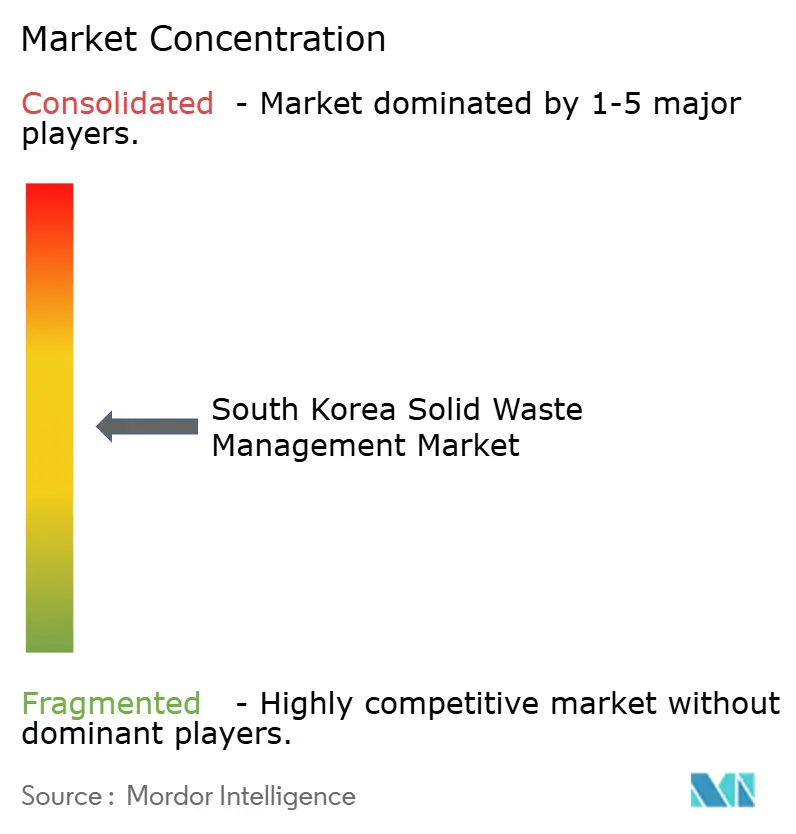
| Market Concentration | Medium |
Major Players *Disclaimer: Major Players sorted in no particular order Image © Mordor Intelligence. Reuse requires attribution under CC BY 4.0. | |
South Korea Solid Waste Management Market Analysis by Mordor Intelligence
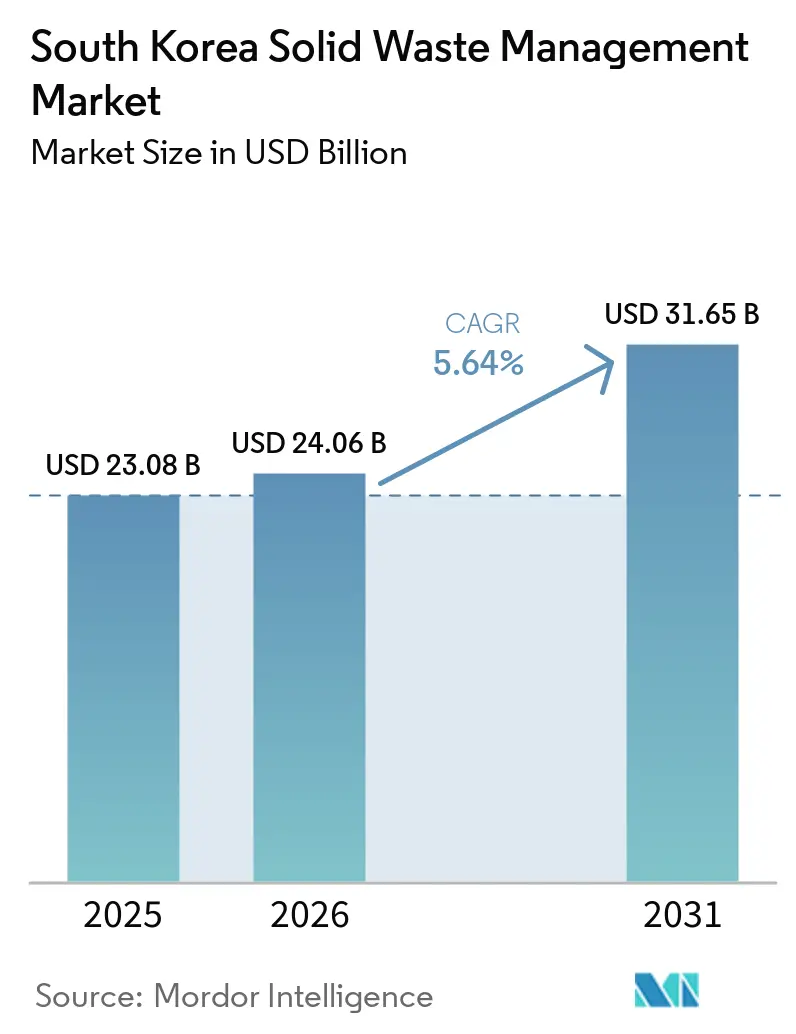
The South Korea Solid Waste Management Market size is projected to be USD 23.08 billion in 2025, USD 24.06 billion in 2026, and reach USD 31.65 billion by 2031, growing at a CAGR of 5.64% from 2026 to 2031.
The Volume-Based Waste Fee (VBWF) system continues to support the South Korea solid waste management market by encouraging households and businesses to reduce waste generation and improve source segregation. This framework is reinforced by extended producer responsibility (EPR) requirements, which place collection and recycling obligations on manufacturers and importers of designated products and packaging, as well as by the direct ban on landfilling combustible municipal waste. The 5th Waste Management Master Plan calls for a 70% municipal solid waste recycling rate and the elimination of direct landfill disposal for most waste categories by 2027, driving sustained investment in recycling facilities, waste-to-energy plants, and advanced material recovery infrastructure. The government's circular economy initiatives also promote higher resource recovery from plastics, food waste, construction debris, and electronic waste through stricter recycling targets and digital waste-tracking systems. These regulations sustain demand for collection, sorting, treatment, recycling, and energy-recovery infrastructure even as overall waste-generation patterns evolve. In addition, the rapid expansion of the semiconductor, electric vehicle battery, and advanced manufacturing industries is increasing the volume of hazardous and high-value industrial waste requiring licensed collection, treatment, recycling, and final disposal.
Key Report Takeaways
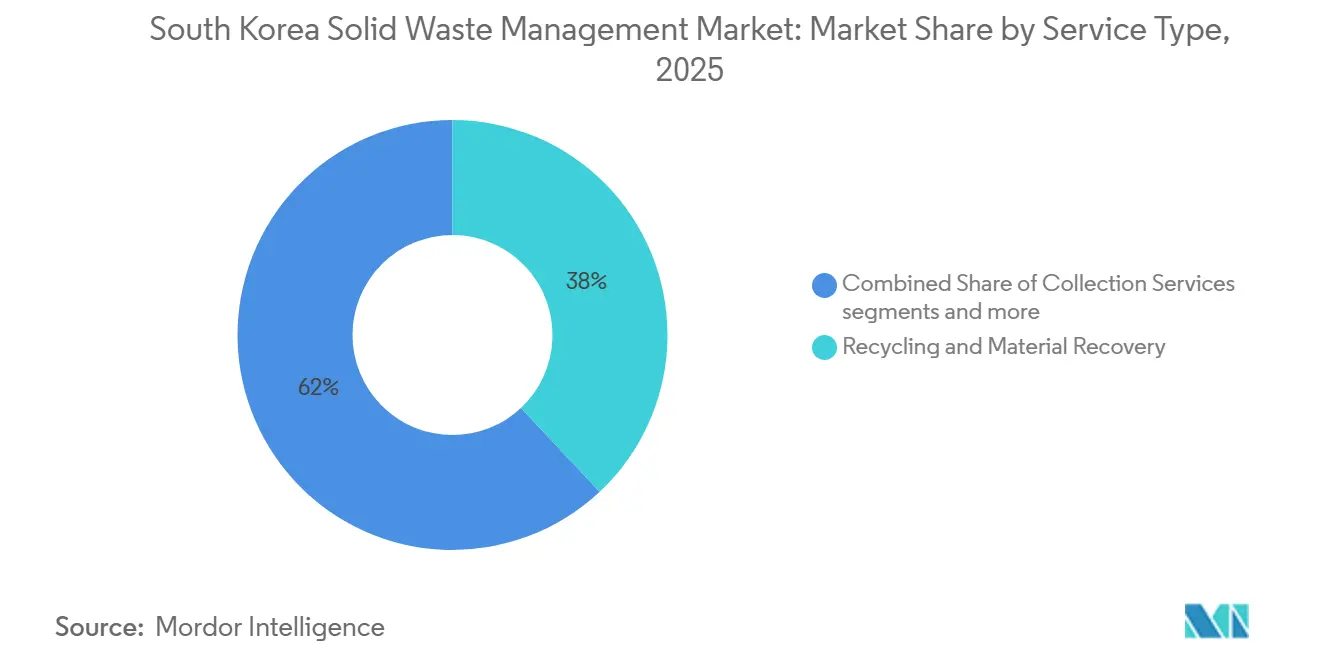
- By service type, recycling and material recovery held 38% of the South Korea solid waste management market share in 2025, while waste-to-energy is forecast to grow at an 8.3% CAGR from 2026 to 2031.
- By waste type, industrial waste accounted for 42% of the South Korea solid waste management market size in 2025, while hazardous waste is forecast to expand at an 8.8% CAGR from 2026 to 2031.
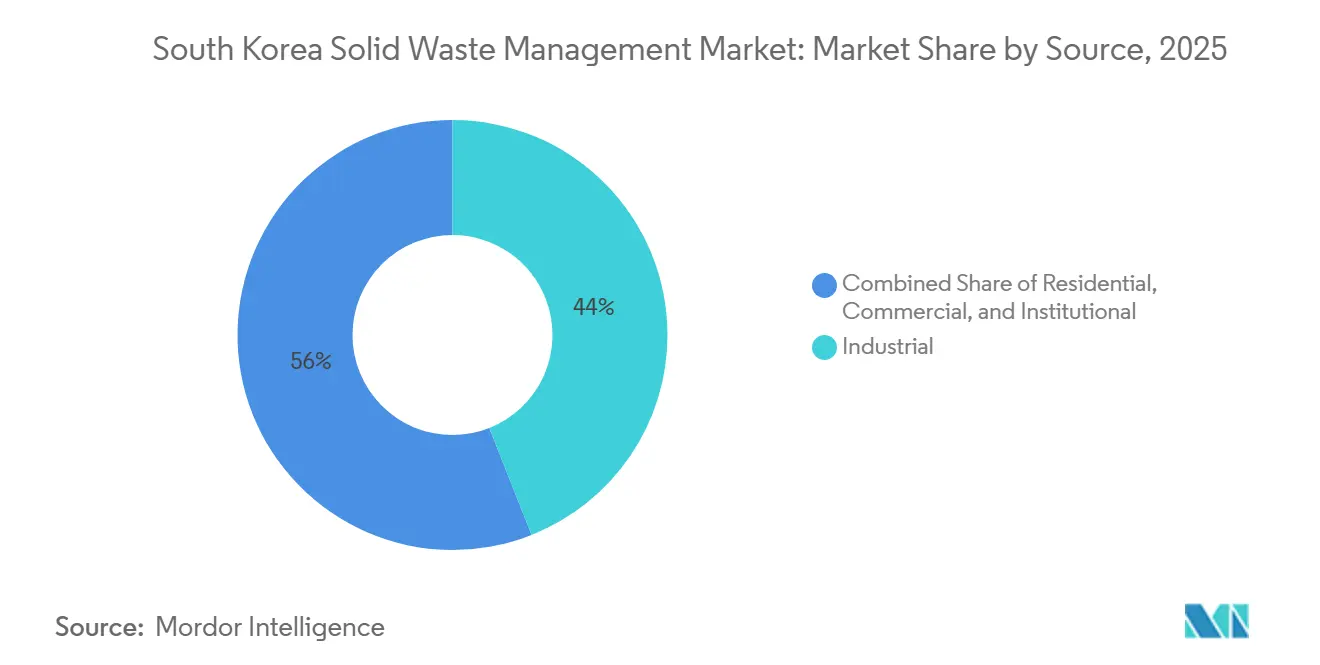
- By source, industrial accounted for 44% of the market share in 2025 and is forecast to grow at a 6.8% CAGR from 2026 to 2031.
Note: Market size and forecast figures in this report are generated using Mordor Intelligence’s proprietary estimation framework, updated with the latest available data and insights as of January 2026.
South Korea Solid Waste Management Market Trends and Insights
Drivers Impact Analysis*
| Driver | (~) % Impact on CAGR Forecast | Geographic Relevance | Impact Timeline |
|---|---|---|---|
| Volume-Based Waste Fee (VBWF) System Enhancing Waste Segregation Efficiency | +1.2% | National, with high compliance in Seoul and Gyeonggi | Short term (≤ 2 years) |
| Expansion of Smart Waste Collection Using IoT and AI Technologies | +1.1% | National, with early deployment in Seoul, Gyeonggi, and Busan | Medium term (2-4 years) |
| Rapid Growth in Food Waste Recycling and Bioenergy Production | +0.9% | National, with facilities in Seoul, Daejeon, and Incheon | Short term (≤ 2 years) |
| Government Investment in Resource Circulation and Zero-Waste Cities | +0.8% | National, with near-term activity in Gyeonggi and the Seoul Capital Area | Medium term (2-4 years) |
| Rising E-commerce Packaging Waste Driving Advanced Recycling Infrastructure | +0.6% | National, especially logistics corridors, and the Seoul Capital Area | Medium term (2-4 years) |
| Increasing Semiconductor and Battery Manufacturing Waste Requiring Specialized Treatment | +0.5% | Gyeonggi and Chungcheong | Long term (≥ 4 years) |
| Source: Mordor Intelligence | |||
Volume-Based Waste Fee System Enhancing Waste Segregation Efficiency
South Korea marked 30 years of nationwide implementation of the Volume-Based Waste Fee in 2025. The Ministry of Environment stated that the system had eliminated 160 million tons of household waste and produced KRW 45 trillion (USD 31.7 billion) in economic benefits from waste reduction and recycling. The landfill ban in the greater capital region took effect in 2026 and placed greater emphasis on source separation. The South Korea solid waste management market, therefore, has a stronger need for sorting capacity, reverse logistics, and organic waste processing. Higher private treatment costs can encourage municipalities and operators to improve the quality of the material they collect. The system also supports investment in biogas facilities and sorting equipment that can process separated organic and dry recyclable waste.
Expansion of Smart Waste Collection Using IoT and AI Technologies
Digital collection systems are moving from pilot projects to broader operational deployment across the South Korea solid waste management market. In 2026, Seoul expanded the use of approximately 6,000 RFID-equipped food-waste bins across apartment complexes and commercial districts, enabling pay-as-you-throw charging, automated weighing, and real-time collection monitoring. Hyundai Motor Company launched a six-month pilot in Seongbuk-gu in April 2026 using two ST1-platform smart collection vehicles equipped with digital fleet management capabilities to optimize municipal waste collection. At the same time, RECO and Ecube Labs are developing an edge AIoT sensor integrating RADAR technology with vision AI cameras for deployment at more than 300 factory waste loading bays, enabling automated waste identification and fill-level monitoring. Municipalities and private waste operators are also increasingly adopting IoT-enabled smart bins, cloud-based route optimization software, GPS-enabled fleet management, and digital waste-tracking platforms to improve operational efficiency and regulatory compliance.
Rapid Growth in Food Waste Recycling and Bioenergy Production
Food waste recycling provides a stable and expanding feedstock base for the South Korea solid waste management market. South Korea recycles approximately 97%–98% of its daily food waste annually through a nationwide network of around 300 biogas, animal feed, and composting facilities, making it one of the world's highest-performing food waste recycling systems. The Daejeon Bioenergy Center alone processes more than 400 tons of food waste per day and generates sufficient electricity to supply approximately 20,000 households, demonstrating the commercial viability of waste-to-energy projects. Government-operated treatment facilities are required to achieve at least a 50% biogasification rate, while designated private waste generators must meet a 10% biogasification requirement beginning in 2026, with the target gradually increasing to 80% by 2045. In addition, the 2025 designation of used cooking oil, coffee grounds, and rice bran as circular resources expands the range of organic feedstocks available for recycling and bioenergy production. These policy measures encourage investment in anaerobic digestion, composting, and resource recovery infrastructure while supporting the production of renewable biogas, organic fertilizers, and other value-added products.
Government Investment in Resource Circulation and Zero-Waste Cities
Public programs are expanding the project pipeline for South Korea's solid waste management market. Gyeonggi Province is allocating KRW 1.5 trillion (USD 1.1 billion) over 5 years starting in 2026. The program targets a 30-gram per-person reduction in daily household waste, 750 household waste hubs by 2030, and a public incineration capacity of 6,359 tons per day. February 2026 Resource Circulation Roadmap introduced Circular Economy Regulatory Special Zones for the reuse of manufacturing by-products. The KRW 254 billion (USD 178.6 million) K-Circular Economy Re-born Project passed pre-feasibility review in March 2026 and is planned to start in 2027. The measures support procurement demand for material recovery, sorting, biogas, and treatment services.
Restraints Impact Analysis*
| Restraint | (~) % Impact on CAGR Forecast | Geographic Relevance | Impact Timeline |
|---|---|---|---|
| Limited Land Availability for New Waste Treatment and Disposal Facilities | -0.8% | National, most acute in Seoul, Incheon, and the Capital Area | Long term (≥ 4 years) |
| High Processing Costs for Composite Plastic and Multi-Layer Packaging Waste | -0.6% | National, concentrated in logistics hubs and manufacturing zones | Medium term (2-4 years) |
| Dependence on Export Markets for Certain Recyclable Materials | -0.5% | National exposure to Chinese and Southeast Asian demand | Short term (≤ 2 years) |
| Aging Incineration Infrastructure Requiring Large Capital Upgrades | -0.4% | National, especially metropolitan and provincial cities | Medium term (2-4 years) |
| Source: Mordor Intelligence | |||
Limited Land Availability for New Waste Treatment and Disposal Facilities
Limited sites for new facilities constrain the South Korea solid waste management market. The Sudokwon Landfill Site stopped accepting non-incinerated waste in 2026, having served the Seoul Capital Area since 1992. Municipalities must manage a treatment gap while projects remain in the design, permitting, and site-selection stages. Private treatment arrangements can raise costs for municipalities and industrial users that need additional capacity. The 5th Waste Management Master Plan seeks to end direct landfill disposal for most waste categories by 2027. Without suitable sites, new capacity can take longer to reach operation even as demand for treatment grows. This constraint gives existing permitted facilities a stronger role in local treatment networks.
High Processing Costs for Composite Plastic and Multi-Layer Packaging Waste
Composite plastic packaging remains a cost challenge for the South Korea solid waste management market. Food, consumer electronics, and pharmaceutical products commonly use multi-layer flexible packaging. The Korea Environmental Corporation applies recyclability-based EPR contribution modulation, with a surcharge of up to 30% for difficult-to-recycle materials. Chemical and solvent-based recycling is required to return many composite materials to circular-feedstock quality. These processes are not yet deployed at a commercial scale across the country. A significant portion of these materials, therefore, continues to enter energy recovery rather than material recycling. This raises the cost of genuine material recovery and creates pressure to redesign packaging and improve sorting systems.
*Our forecasts treat driver/restraint impacts as directional, not additive. The impact forecasts reflect baseline growth, mix effects, and variable interactions.
Segment Analysis
By Service Type: Energy Recovery Gains Ground on a Recycling-Led Base
Recycling and material recovery held 38% of the South Korea solid waste management market share by service type in 2025. The segment benefits from mandatory EPR obligations for key packaging materials and a broad base of food-waste processing. The South Korea solid waste management market size for recycling-related services is supported by decades of public investment and EPR-funded private participation. This installed base provides recurring work in collection, sorting, composting, feed conversion, and material recovery.
Waste-to-Energy is forecast to grow at an 8.3% CAGR from 2026 to 2031 as landfill restrictions redirect investment to incineration and biogas generation. Incheon plans to rebuild the Songdo Resource Circulation Center for KRW 264.8 billion (USD 186.2 million) by 2030. Gyeonggi Province also plans to have a public incineration capacity of 6,359 tons per day. Across the remaining service types, digital route planning is improving efficiency in collection and logistics, while treatment and disposal face rising costs as private capacity fills the public gap. The others category includes hazardous specialist services and laboratory waste. Biogasification is becoming a larger part of treatment activity as organic waste generators comply with 2026 obligations.



By Waste Type: Semiconductor and Battery Sectors Propel Hazardous Streams
Industrial waste held 42% of waste-type revenue in 2025. Semiconductor, battery, and petrochemical operations generate etching chemicals, process sludge, fluoride-containing wastewater, and spent cathode materials. These streams require licensed specialist treatment rather than general industrial processing. The Ministry of Trade, Industry, and Energy selected 16 inter-company resource circulation projects in August 2025. The projects included the recovery of gold and silver from semiconductor and electronic industrial waste and received KRW 4.2 billion (USD 3.1 million) for facility construction and commercialization.
Hazardous waste is forecast to grow at an 8.8% CAGR from 2026 to 2031, the highest rate among waste types. End-of-life electric vehicle batteries will require performance assessments from 2027 to determine whether they are remanufactured, reused for energy storage, or sent for material recovery. Municipal solid waste remains a large category, although household waste generation is falling under source separation rules. Construction and demolition waste depends on urban redevelopment and on-site sorting. Agricultural and medical waste remain smaller regulated categories that rely mainly on biogas conversion and high-temperature incineration. The 2024 classification of undamaged electric-vehicle batteries as recyclable resources supports commercial recycling.
By Source: Industrial Dominance Reinforced by Manufacturing Cluster Expansion
The industrial source category held 44% of revenue in 2025 and is forecast to grow at a 6.8% CAGR from 2026 to 2031. It is concentrated in the Seoul-Gyeonggi semiconductor belt, the Chungcheong battery and display corridor, the Ulsan petrochemical zone, and the Busan-Gyeongnam advanced-parts hub. NewBotec was selected in 2025 to collect and recycle spent chemical containers at SK Hynix sites in Icheon and Cheongju, as well as at the planned Yongin cluster. These contracts set treatment standards in advance and create demand for specialist services.
Residential sources remain important because apartment living produces concentrated household waste flows. RFID bins and digital reward programs can improve household sorting in urban complexes. Commercial sources are expanding across food service, retail, logistics, and e-commerce. Fulfillment centers in the Seoul-Gyeonggi corridor produce cardboard, cushioning material, and multi-layer film that can be difficult to sort. Institutional sources include hospitals, schools, and government facilities with defined handling requirements. Reusable-container programs in public venues indicate an effort to reduce waste at the source.
Geography Analysis
The Seoul Capital Area held a central position in South Korea solid waste management market in 2025. Seoul generated more than 2,400 tons of food waste each day, while Gyeonggi Province generated 5,497 tons of municipal solid waste per day. The landfill ban in effect during 2026 has increased the need for incineration, biogasification, and household waste hubs. Gyeonggi Province is funding these additions through its five-year program. This concentration of waste volumes and public spending makes the capital region the main location for treatment and technology deployment.
Busan is developing as a secondary location for AI-enabled resource recovery. The city and Busan Techno Park are implementing an AI-based recycling design platform with KRW 1.5 billion (USD 1.1 million) in funding over two years. Ulsan invested KRW 160.6 billion (USD 113 million) in the reconstruction of Seongam Incinerator Units 1 and 2, with startup targeted in 2026. Daegu expanded the Seongseo Resource Recovery Facility Unit 1 from 160 to 360 tons per day in 2024. These projects show a wider regional need to replace aging facilities and modernize treatment capacity.
South Korea combines high recycling participation with mature source-separation rules. The Volume-Based Waste Fee and EPR frameworks have been documented as relevant policy models for other urbanizing economies. This policy experience supports the international standing of Korean environmental technology suppliers. It may also support overseas technical services opportunities for domestic operators. The domestic South Korea solid waste management market remains centered on local infrastructure needs. International activity is more relevant to the longer-term positioning of established operators.
Competitive Landscape
The South Korea solid waste management market exhibits a medium level of market concentration. An IMM Private Equity and IMM Investment consortium acquired ECORBIT in December 2024 for KRW 2.1 trillion (USD 1.48 billion). ECORBIT operates landfill, waste-to-energy, water treatment, and recycling businesses. SK Ecoplant entered exclusive negotiations in 2025 to sell Renewus and Renewon to KKR for USD 1.2 billion. These transactions show demand for assets with permits, operating capacity, and integrated service coverage.
Mid-tier operators such as KC Green Holdings, and IS Dongseo are expanding across collection, treatment, and energy recovery. The South Korea solid waste management market benefits firms that can offer integrated municipal and industrial contracts. Compliance requirements under the Waste Management Act and EPR reporting favor operators with capital and specialist teams. The 2026 Circular Economy Regulatory Special Zones provide a route for industrial users to reuse eligible by-products without standard collection and transfer requirements. This could reduce third-party treatment demand for selected manufacturing streams while creating opportunities in technical compliance and material recovery.
Technology is an important competitive factor in AI-supported sorting, battery recycling, and semiconductor waste processing. PKC and Adeka Korea formed a 2025 consortium to develop closed-loop hafnium recovery from semiconductor process waste. NewBotec's contract with SK Hynix illustrates how long-term specialist service agreements can strengthen operator positions.
South Korea Solid Waste Management Industry Leaders
ECORBIT Co., Ltd.
SK ecoplant Co., Ltd.
IS Dongseo Co., Ltd.
KC Green Holdings Co., Ltd.
Hansol Paper Co., Ltd.
- *Disclaimer: Major Players sorted in no particular order

Recent Industry Developments
- July 2026: Gyeonggi Province announced support for establishing 19 Local Circulation Hubs as neighborhood-level resource-circulation bases, in response to the provincial direct landfill ban taking effect in 2026. The initiative targets a resident-driven resource circulation ecosystem and is integrated into the province's five-year waste management investment program.
- April 2025: Gyeonggi Province launched the 30 Grams a Day, Resident-Driven Household Waste Reduction Project, backed by a KRW 1.5 trillion investment (USD 1.1 billion) in combined national, provincial, and municipal funds over five years. The program targets the installation of 750 household waste hub facilities by 2030 and the expansion of public incineration capacity to 6,359 tons per day.
- April 2025: Hyundai Motor Company launched a six-month pilot for eco-friendly smart waste collection vehicles in Seongbuk-gu, Seoul, deploying two ST1-platform vehicles with dumping and moving-floor systems.


South Korea Solid Waste Management Market Report Scope
The South Korea Solid Waste Management Market is Segmented by Service Type (Collection Services, Transportation & Logistics, Recycling & Material Recovery, Treatment & Disposal, and More), by Waste Type (Municipal Solid Waste, Industrial Waste, Hazardous Waste, Agricultural Waste, and More), and by Source (Residential, Commercial, Industrial, and Institutional). The Market Forecasts are Provided in Terms of Value (USD).
| Collection Services |
| Transportation & Logistics |
| Recycling & Material Recovery |
| Treatment & Disposal |
| Waste-to-Energy |
| Others |
| Municipal Solid Waste |
| Industrial Waste |
| Hazardous Waste |
| Construction & Demolition Waste |
| Agricultural Waste |
| Medical Waste |
| Others |
| Residential |
| Commercial |
| Industrial |
| Institutional |
| By Service Type | Collection Services |
| Transportation & Logistics | |
| Recycling & Material Recovery | |
| Treatment & Disposal | |
| Waste-to-Energy | |
| Others | |
| By Waste Type | Municipal Solid Waste |
| Industrial Waste | |
| Hazardous Waste | |
| Construction & Demolition Waste | |
| Agricultural Waste | |
| Medical Waste | |
| Others | |
| By Source | Residential |
| Commercial | |
| Industrial | |
| Institutional |


Key Questions Answered in the Report
What is the forecast for solid waste management in South Korea?
The South Korea solid waste management market is forecast to rise from USD 24.1 billion in 2026 to USD 31.7 billion by 2031, at a 5.6% CAGR.
Which service is growing fastest in South Korea waste sector?
Waste-to-Energy is the fastest-growing service type, registering an 8.30% CAGR through 2026-2031, supported by landfill restrictions and investment in incineration and biogas facilities.
Why is industrial waste important in South Korea?
Industrial Waste leads by waste type, accounting for 44% of the market share in 2025 because semiconductor, battery, and petrochemical operations need specialist treatment for regulated process waste.
How does the landfill ban affect waste operators?
The 2026 capital-region ban increases demand for incineration, sorting, biogasification, and permitted treatment capacity.
What technologies are used in waste collection?
RFID food-waste bins, smart collection vehicles, and AI-enabled sensors are being deployed to improve collection routes and sorting quality.
Which region has the greatest level of activity?
The Seoul Capital Area has the highest concentration of waste volumes, public investment, and new treatment infrastructure activity.
Page last updated on:


 Your data is secure and never sold or shared.


