
South Korea Die Casting Market Size and Share
Market Overview
| Study Period | 2019 - 2031 |
|---|---|
| Forecast Data Period | 2026 - 2031 |
| Base Year Market Size (2025) | USD 2.56 Billion |
| Market Size (2026) | USD 2.67 Billion |
| Market Size (2031) | USD 3.31 Billion |
| Growth Rate (2026 - 2031) | 4.42 % |
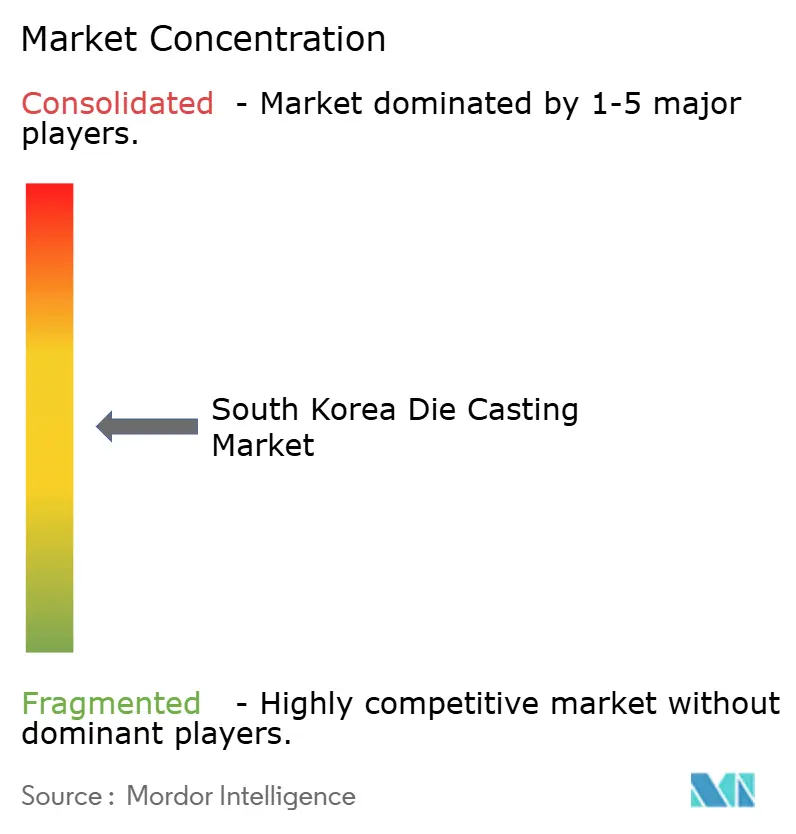
| Market Concentration | Medium |
Major Players *Disclaimer: Major Players sorted in no particular order Image © Mordor Intelligence. Reuse requires attribution under CC BY 4.0. | |
South Korea Die Casting Market Analysis by Mordor Intelligence
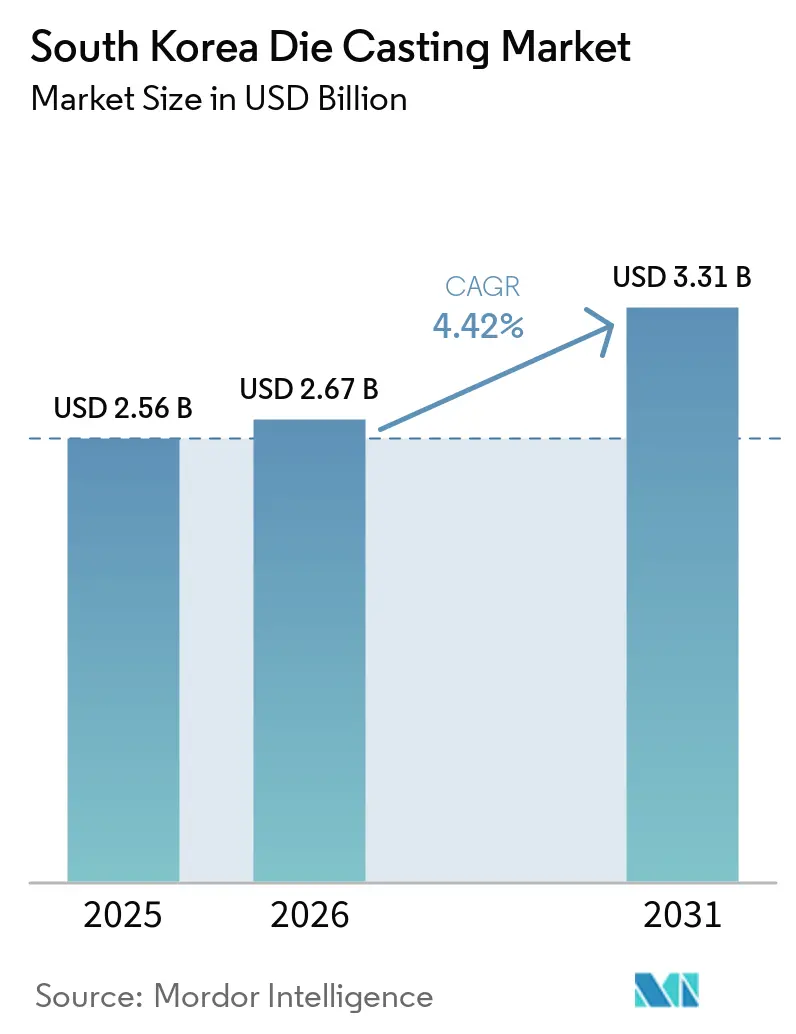
The South Korea Die Casting Market size was valued at USD 2.56 billion in 2025 and is estimated to grow from USD 2.67 billion in 2026 to reach USD 3.31 billion by 2031, at a CAGR of 4.42% during the forecast period (2026-2031). This measured trajectory masks a structural pivot underway: the sector is transitioning from high-volume commodity castings toward ultra-large structural components and precision electronic housings, both driven by electrification mandates and sovereign semiconductor ambitions. Hyundai Motor Company's KRW 1 trillion (USD 730 million) investment in a hypercasting plant in Ulsan—featuring a 9,000-ton press capable of producing 200,000 EV structural parts annually by 2026—signals that Korean OEMs are adopting Tesla-style gigacasting to collapse dozens of stamped and welded parts into a single aluminum extrusion.
Key Report Takeaways
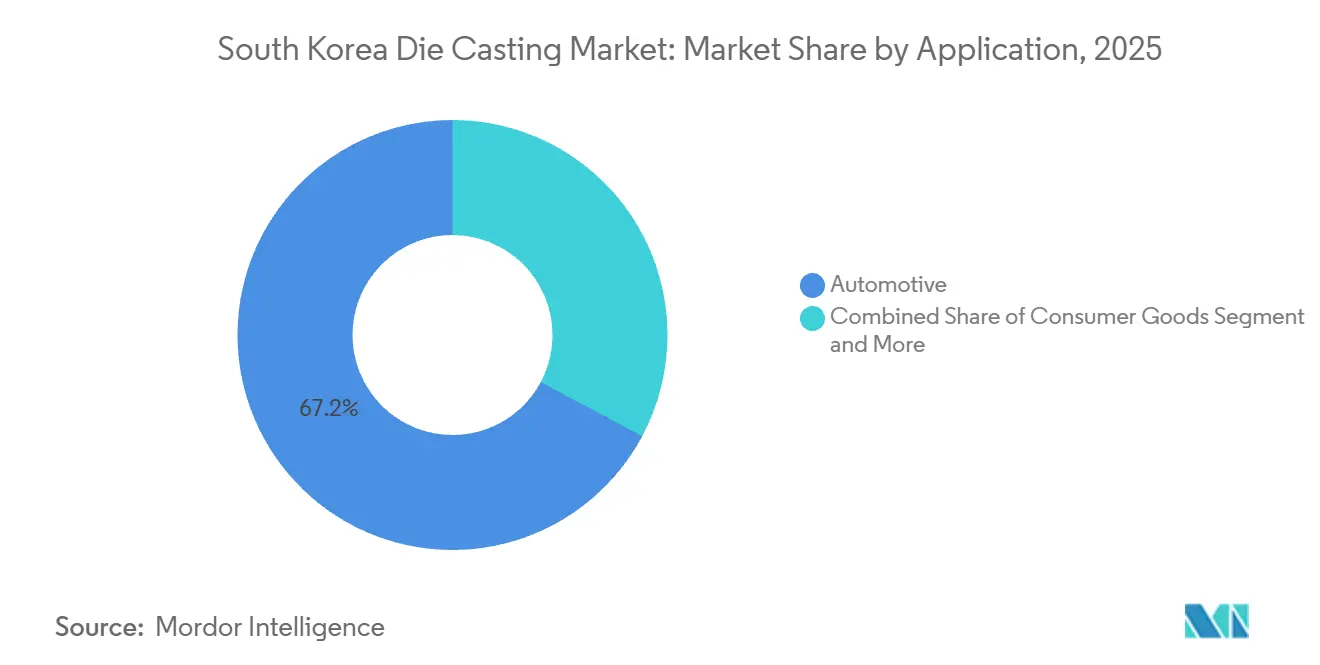
- By application, the automotive segment captured 67.17% of the South Korean die casting market share in 2025, and the electronics and communications segment is projected to expand at the fastest CAGR of 4.61% between 2026 and 2031.
- By process, high-pressure die casting held 52.28% revenue share in 2025, while vacuum die casting is set to record a 4.56% CAGR through 2031.
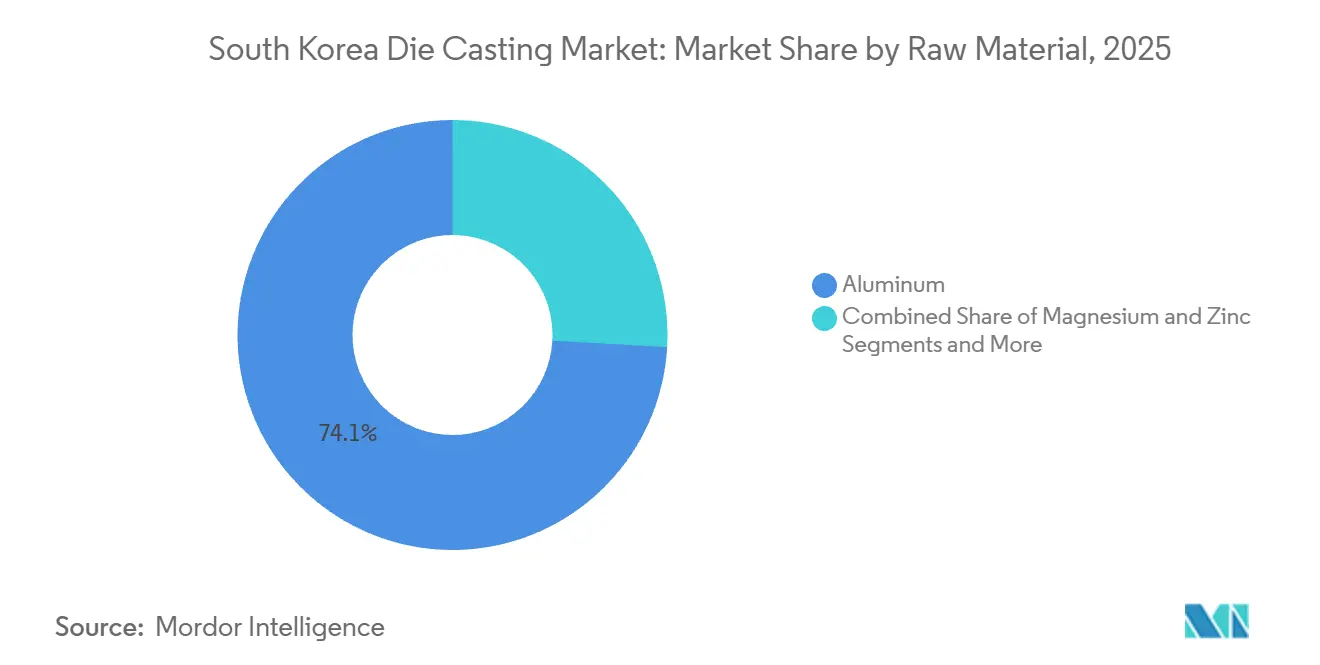
- By raw material, aluminum accounted for 74.14% of the South Korean die casting market size in 2025; magnesium is on track for the quickest 4.53% CAGR.
- By tonnage class, the 401-800-ton machinery class led with a 35.13% share in 2025, whereas presses above 2,000 tons are forecast to post a 4.47% CAGR.
- By province, Gyeonggi-do province commanded 36.57% of 2025 revenues, and the Gyeongsang Region is projected to rise at a 4.51% CAGR to 2031.
Note: Market size and forecast figures in this report are generated using Mordor Intelligence’s proprietary estimation framework, updated with the latest available data and insights as of January 2026.
Worldwide, activity is shaped by contributions from multiple countries and regions, with South korea representing one among them. The global report on die casting market by Mordor Intelligence reflects how these countries and regional layers combine into a single system.
Market Trends and Insights
Drivers Impact Analysis of South Korea Die Casting Market*
| Driver | (~) % Impact on CAGR Forecast | Geographic Relevance | Impact Timeline |
|---|---|---|---|
| EV-Led Lightweighting | +1.1% | National, with concentration in Gyeonggi-do and Ulsan automotive hubs | Medium term (2-4 years) |
| Surge in Complex Electronic Housings | +0.8% | Gyeonggi-do semiconductor cluster, Seoul metropolitan area | Short term (≤ 2 years) |
| Design-Flexibility Demands | +0.7% | National automotive manufacturing regions | Medium term (2-4 years) |
| Government Smart-Foundry Subsidies | +0.5% | National, with priority zones in industrial complexes | Short term (≤ 2 years) |
| Hydrogen-Vehicle Component Build-out | +0.4% | Ulsan hydrogen industrial complex, Gyeonggi-do | Long term (≥ 4 years) |
| Circular-Economy Scrap-Utilisation Mandate | +0.4% | National, with focus on metal recycling hubs | Long term (≥ 4 years) |
| Source: Mordor Intelligence | |||
EV-led Lightweighting Boom
In April 2024, Hyundai Motor Company announced plans for a KRW 1 trillion hypercasting plant in Ulsan. The facility, with a 9,000-ton press, aims to produce 200,000 EV structural parts annually by 2026. This marks a significant shift in South Korea's supplier dynamics and the first major adoption of gigacasting outside Tesla. Gigacasting consolidates up to 70 components into a single aluminum extrusion, reducing assembly time by 40%, vehicle weight by 10%, and extending EV range by 6 to 8%. Kia is also investing KRW 2.2 trillion in the Hwaseong EVO Plant, sourcing die-cast subframes and battery trays from suppliers in Gyeonggi-do to create a localized gigacasting hub. Demand for ultra-large-tonnage machines over 2,000 tons is projected to grow at a 4.47% CAGR through 2031, alongside increased adoption of vacuum die casting processes that achieve porosity levels below 0.1%. Suppliers unable to invest in 6,000-ton presses or master vacuum-assisted solidification risk being confined to legacy powertrain components as OEMs shift to skateboard platforms.
Surge in Complex Electronic Housings
The USD 471 billion semiconductor mega-cluster in Gyeonggi-do will house 16 fabs producing 7.7 million wafers per month by 2030. Fab equipment requires hermetic chambers, fluid manifolds, and heat spreaders machined to single-digit-micron tolerances, a task now migrating to vacuum die-casting lines outfitted with melt-quality sensors. Samsung and SK Hynix demand 50% local sourcing of mechanical parts to derisk their supply chains, translating into multi-year blanket contracts for domestic foundries. AI accelerator chips use dense packaging that generates heat flux exceeding 1,000 W/cm², compelling adopters to specify thin-walled aluminum housings with integrated vapor chambers. These technical stipulations elevate average selling prices and lengthen tooling lifecycles, adding profitable backlog for specialists in the South Korean die casting market.[1]
Design-Flexibility Demands in Auto Body Panels
As electric SUVs and crossovers adopt unibody construction, demand for die-cast structural nodes such as A-pillars, cross-car beams, and shock towers is growing. These components absorb crash energy while reducing weight, driving a shift to squeeze die casting over traditional methods. Squeeze die casting applies 50-150 MPa of pressure during solidification, producing near-net-shape components with ±0.1 mm accuracy and 15-20% higher tensile strength, ideal for safety-critical chassis parts. In March 2025, Ryobi Limited installed a 6,500-ton gigacasting machine at its Kikugawa Plant in Japan, the first of its kind by a Japanese die-casting specialist. The machine supports prototype manufacturing of large chassis components and positions Ryobi to aid Hyundai Motor Group's North American EV expansion. Korean suppliers are upgrading from 800-ton to over 2,000-ton machines. Seojin System partnered with Shibaura Machine to develop a 12,000-ton press, driven by OEMs' aim to mold entire rear floors in one shot. These advancements favor well-capitalized players, pressuring smaller foundries reliant on 400-ton equipment.
Government Smart-Foundry Subsidies
In 2026, South Korea's Ministry of Trade, Industry, and Energy allocated KRW 436.56 billion (USD 315 million) to digitize 12,000 manufacturing facilities by 2030, addressing labor shortages and energy efficiency. Subsidies cover up to 50% of costs for real-time quality monitoring, AI defect detection, and robotic finishing cells, helping small and medium die casters automate and reduce scrap rates. Compliance with IATF 16949 standards is required, pushing foundries to improve traceability and process control for automotive OEMs. The program also supports energy-efficient melting furnaces and heat-recovery systems, cutting electricity use by 15-20%. Early adopters use subsidies for vacuum-assisted high-pressure die casting equipment, essential for EV battery housing contracts with porosity thresholds below 0.1%.
Restraints Impact Analysis of South Korea Die Casting Market*
| Restraint | (~) % Impact on CAGR Forecast | Geographic Relevance | Impact Timeline |
|---|---|---|---|
| Raw-Material Price Volatility | -0.7% | National, with supply chain dependencies on China and global markets | Short term (≤ 2 years) |
| Advanced-Skilled Labour Shortage | -0.5% | National, particularly acute in traditional manufacturing regions | Medium term (2-4 years) |
| Stringent Foundry-Emission Regulations | -0.4% | National, with stricter enforcement in metropolitan areas | Medium term (2-4 years) |
| Grid-Power Instability | -0.3% | National, affecting energy-intensive die casting operations | Short term (≤ 2 years) |
| Source: Mordor Intelligence | |||
Raw-Material Price Volatility
As of Q1 2026, aluminum prices are around USD 2,850 per ton and zinc near USD 3,100 per ton. Quarterly price swings of 15-20%, driven by Chinese production cuts and LME inventory changes, are squeezing die caster margins, especially for smaller foundries without hedging tools or long-term contracts. South Korea imports 95% of its aluminum and 80% of its zinc, exposing domestic foundries to freight rate volatility and geopolitical disruptions. The 2025 Red Sea shipping crisis added USD 200-300 per ton in logistics costs for Middle Eastern aluminum, further eroding the already tight 4.7% operating profit margins. OEMs are demanding fixed-price contracts with quarterly adjustments, shifting commodity risk to Tier-1 die casters, who must absorb losses or pass costs to sub-tier suppliers. This is driving vertical integration, with larger players acquiring scrap-remelting capacities to stabilize input costs. Capital-rich incumbents like Samkee (KRW 570.5 billion in turnover in FY25) are investing in closed-loop recycling to reduce reliance on virgin aluminum, while smaller foundries consolidate or exit.
Advanced-Skilled Labour Shortage
South Korea's foundry sector loses 500 to 700 small and medium enterprises annually due to retiring skilled workers and younger generations avoiding demanding roles. This has left 22,662 positions unfilled, with foreign nationals now comprising 32.4% of technical staff. Critical shortages in mold design and process engineering, requiring 5-7 years of training, delay new product launches as OEMs accelerate EV platform rollouts. In March 2026, Ajinkaintech invested KRW 23.2 billion (USD 17 million) in an AI, big data, and blockchain research institute in Daegu, with factories using over 80% robot automation to address expertise gaps. However, the automation costs of KRW 5-10 billion per facility challenge 60% of die casters with fewer than 50 employees, forcing price-based competition and market-share losses to larger players. Government smart factory subsidies help, but 18-24 month payback periods strain cash flow for foundries with sub-5% margins.
*Our forecasts treat driver/restraint impacts as directional, not additive. The impact forecasts reflect baseline growth, mix effects, and variable interactions.
South Korea Die Casting Market Segment Analysis
By Application:
Automotive Dominance Drives MarketAutomotive applications accounted for 67.17% of the market in 2025, anchored by Hyundai Motor Group and Kia's combined domestic production of approximately 3.5 million vehicles annually. Yet, the electronics and communication segment is forecast to grow at 4.61% CAGR through 2031, outpacing the market average as Samsung and LG localize semiconductor packaging and 5G infrastructure production. The automotive segment's maturity is evident in slowing volume growth—South Korea's passenger vehicle output has plateaued near 3.8 million units since 2019—but a compositional shift toward EVs is driving higher die casting intensity per vehicle; a battery-electric platform requires 40-50 kg of die-cast aluminum for motor housings, battery trays, and thermal management systems versus 25-30 kg for internal combustion powertrains.
Hyundai Mobis’s KRW 90 billion EV module complex in Ulsan will consume up to 20,000 tons of aluminum annually once fully operational in 2026, translating into steady batch orders for local die casters.[2] Electronics assemblers specify tighter porosity ceilings to protect high-frequency signal integrity, a shift that is driving upgrades to vacuum casting equipment. Across consumer goods, demand for decorative finishes drives investment in duplex nickel-chrome plating lines integrated with die-casting cells, demonstrating how downstream integration enhances margins. These diverse end-uses cushion cyclical swings within the portfolio, supporting sustained expansion of the South Korea die casting market.

By Process:
High-Pressure Leadership with Vacuum InnovationIn 2025, high-pressure die casting accounted for 52.28% of the market, serving automotive powertrain housings, transmission cases, and structural nodes. Vacuum die casting is projected to grow at a 4.56% CAGR through 2031, driven by EV battery enclosures requiring porosity below 0.1% for IP67-rated sealing. Vacuum-assisted high-pressure die casting reduces gas porosity and enables T6 heat treatment, boosting tensile strength by 15-20%, critical for safety-critical chassis components. Low-pressure die casting, with 0.3-1.0 bar pressure, holds an 8-10% share and is favored for large, thin-walled components such as automotive wheels and aerospace housings. Squeeze die casting, applying 50-150 MPa during solidification, achieves ±0.1 mm accuracy and is used for steering knuckles and suspension arms. Gravity casting and other methods, such as permanent mold casting and sand casting, serve low-volume prototypes and legacy applications.
In March 2025, Ryobi Limited installed a 6,500-ton gigacasting machine at its Kikugawa Plant in Japan, marking a shift to hybrid vacuum-squeeze processes that minimize porosity and shrinkage. Seojin System and Shibaura Machine are developing a 12,000-ton press that enables OEMs to mold entire rear floors and front subframes, reducing welding and improving rigidity. Vacuum and squeeze processes increase capital intensity, with vacuum-assisted machines costing 20-30% more than traditional equipment. This shift favors suppliers with expertise in die thermal management and process monitoring. Smaller foundries using 400-800 ton machines face obsolescence as OEMs consolidate sourcing with Tier-1 suppliers capable of delivering heat-treatable castings at scale.
By Raw Material:
Aluminum Prevalence with Magnesium MomentumIn 2025, aluminum held a 74.14% market share due to its recyclability, thermal conductivity, and established supply chains for ADC12 and A380 alloys. Magnesium is projected to grow at a 4.53% CAGR through 2031 as OEMs prioritize lightweighting in battery-electric platforms, where a 10% curb weight reduction extends range by 6-8%. Magnesium, 75% lighter than steel and 30% lighter than aluminum, is used in non-structural components like seat frames and steering-column housings. However, its higher cost (USD 3,500-4,000 per tonne vs. USD 2,850 for aluminum) and corrosion issues limit adoption. Zinc, with a 12-14% share in 2025, is used in high-precision applications like door handles and electronic enclosures due to its superior surface finish and dimensional stability (±0.01 mm tolerances). Its density (7.1 g/cm³ vs. aluminum's 2.7 g/cm³) restricts use in weight-sensitive structures. Other materials, such as copper alloys and specialty aluminum-silicon grades, serve niche applications in electrical connectors and heat sinks.
In January 2024, South Korea classified scrap aluminum as a "circular resource," removing recycling barriers and boosting closed-loop alloy production, which uses 3% of the energy required for virgin bauxite and offers a 10-15% cost advantage. Ryobi Limited, which sources aluminum from recycled car parts and construction materials, achieved a 99.6% waste recycling rate in fiscal 2024, demonstrating that closed-loop systems reduce costs and meet OEM sustainability goals. APS Materials developed ECO-Almag, a magnesium-aluminum hybrid that offers 30% weight savings over aluminum and improved EMI shielding. Aluminum is expected to dominate through 2031 due to recycling economics and supply-chain maturity, while magnesium gains share in ultra-lightweight EV applications where range benefits justify the cost.
By Tonnage Class:
Mid-Range Strength with Heavy-Duty ExpansionIn 2025, machines in the 401-800 ton class held a 35.13% market share, serving automotive powertrain housings, transmission cases, and mid-size structural nodes. The above-2,000-ton segment is projected to grow at a 4.47% CAGR through 2031 as OEMs adopt gigacasting to consolidate parts into single aluminum extrusions for EV platforms. Hyundai invested KRW 1 trillion in a 9,000-ton press at Ulsan, while Seojin System and Shibaura are developing a 12,000-ton machine. Ultra-large presses cost USD 15-25 million, compared to USD 2-5 million for 800-ton equipment, favoring Tier-1 suppliers with strong financial capacity. The up-to-400-ton class (18-20% share) remains relevant for small electronic housings and legacy automotive parts, with a priority on tooling simplicity and short cycle times. The 801-2,000-ton segment (25-27% share) serves mid-size structural components but faces substitution risks as OEMs shift to gigacastings or high-pressure injection molding.
In March 2025, Ryobi installed a 6,500-ton gigacasting machine at its Kikugawa Plant in Japan, aligning with Hyundai's North American EV expansion. Gigacasting reduces assembly time by 40%, cuts welding fixtures by 60-70%, and improves torsional rigidity by 15-20%, benefiting OEMs producing over 100,000 units annually. However, adoption remains limited to Tesla, Hyundai, and some Chinese EV startups, with uncertainty for legacy platforms and cost-sensitive segments. Smaller die casters with 400-800 ton machines must either focus on niche precision applications or consolidate with larger players to compete in gigacasting.
Geography Analysis
In 2025, Gyeonggi-do held a 36.57% market share, driven by Kia's KRW 2.2 trillion (USD 1.6 billion) investment in the Hwaseong EVO Plant, the first purpose-built vehicle factory. The plant sources components locally to reduce logistics costs and ensure timely assembly. Gyeonggi's role as South Korea's automotive and electronics hub, with Samsung and LG facilities in Suwon and Pyeongtaek, boosts demand for die-cast housings across sectors. Governor Kim Dong-yeon's goal of KRW 100 trillion in investments by 2030, supported by streamlined approvals and tariff protections, has spurred reshoring. Dongyang Diecasting and Daehan Autotech are expanding to serve domestic and export markets. Proximity to Incheon Port and integrated logistics networks cuts freight costs by 8-12% and enables 24-hour delivery to Hyundai and Kia plants.
Gyeongsang Region is charting a 4.51% CAGR to 2031. Shipyards diversify into offshore wind and hydrogen carriers, each requiring large aluminum tank brackets produced on presses above 2,000 tons. Ulsan’s hydrogen corridor secures early purchase agreements for fuel-cell truck fleets, translating into forecastable order books for lightweight stack casings.[3] The regional government pairs smart-factory grants with rent reductions in industrial parks to attract component suppliers, further bolstering local die-casting capacity.
The Chungcheong region (12-14% share) is growing as an electronics die-casting hub, driven by Samsung's semiconductor packaging in Cheonan and LG's display production in Paju. Gwangdeok A&T's KRW 43.6 billion (USD 32 million) relocation to Wonju Enterprise City in 2026 positions it to support the "Future Car Core Parts Cluster" at Halla University, set to include an innovation center by 2027. Jeolla and other provinces (8-10% share) focus on legacy automotive and export goods but face consolidation due to regulations and labor shortages.
Competitive Landscape
The South Korean die casting market is moderately fragmented, with domestic specialists and multinational entrants splitting large OEM programs. The top five suppliers account for roughly half of revenue, leaving room for niche players that excel in proprietary alloys, custom surface finishing, or rapid prototype delivery. Established firms deepen vertical integration, adding powder-bed fusion printers for mould inserts and in-house anodizing lines to capture more value per kilogram.
Seojin System deployed two Bühler Carat 920 megacasting cells in Vietnam in February 2025, each producing 200,000 EV structural parts annually. This reflects Tier-1 suppliers adopting OEM nearshoring strategies to reduce tariffs and lead times for Hyundai Motor Group's USD 21 billion U.S. expansion. Samkee's FY25 turnover of KRW 570.5 billion (USD 412 million) and its 2023 IPO of Samkee EV highlight vertical integration to secure higher-margin EV powertrain and thermal management contracts while maintaining traditional automotive volumes. Magnesium die casting offers 30% weight savings for EVs despite higher costs, with APS Materials' ECO-Almag alloy balancing cost, corrosion resistance, and EMI shielding.
Technology drives competitiveness, with AI defect detection and digital-twin optimization reducing scrap rates below 5% and shortening product cycles by 20-30%. Ryobi Limited achieved a 99.6% waste recycling rate in fiscal 2024 and invested in renewable energy to meet OEM Scope 3 emissions targets. Hyundai and Kia require suppliers to disclose carbon intensity per kilogram of casting by 2027. MKTRON Group leverages a "China + 2" strategy for tariff-optimized sourcing and supply-chain resilience. The market is splitting: large players invest in gigacasting and EV battery housing, while smaller ones focus on niche sectors or consolidate to manage costs. IATF 16949 certification remains critical, with certified suppliers commanding 15-20% price premiums.
South Korea Die Casting Industry Leaders
-
Seojin System Co., Ltd.
-
Samkee Corp.
-
Castec Korea Co., Ltd.
-
Dynacast International (Korea)
-
Ryobi Ltd. (Korea)
- *Disclaimer: Major Players sorted in no particular order
South Korea Die Casting Market Companies Covered in this Report
- Seojin System Co., Ltd.
- Samkee Corp.
- Castec Korea Co., Ltd.
- Dynacast International (Korea)
- Ryobi Ltd. (Korea)
- Castman Co., Ltd.
- WonTae Die-Casting Co., Ltd.
- Gibbs Die Casting Korea
- Daeyong Industry
- MKTRON Group
- Samkwang Precision Co., Ltd.
- Dongyang Die Casting Co., Ltd.
- KODACO Co., Ltd.
- Hanjoometal Co., Ltd.
- Hyunjin Cast Co., Ltd.
- Korea Casting Co., Ltd.
- Hyundai Sungwoo Die-Casting
- Worldcast Co., Ltd.
- WooSu AMS Co., Ltd.
Recent Industry Developments in South Korea Die Casting Market
- February 2026: South Korea’s Hyundai Motor Group has announced a major investment of approximately 9 trillion won (USD 6.3 billion) to develop advanced manufacturing and technology infrastructure in the country’s western coastal region. In addition, the automaker will invest 400 billion won in a dedicated robot manufacturing facility, which is expected to produce a range of robotic systems, including wearable robots for industrial applications.
- March 2026: General Motors announced a USD 600 million investment in its South Korean unit to upgrade manufacturing facilities and enhance production capabilities. The company is adding this to a previously announced USD 300 million, bringing the total committed investment to USD 600 million.
South Korea Die Casting Market Report Scope
The South Korea Die Casting Market Report is Segmented by Application (Automotive, Electronics and Communication, Consumer Goods, Packaging and Others), Process (High-Pressure, Low-Pressure, Vacuum, Squeeze, Gravity and Others), Raw Material (Aluminum and Others), Tonnage Class (Up To 400 Ton, 401-800 Ton, 801-2, 000 Ton, and More), and Province.
Segmentation Overview
| Automotive |
| Electronics and Communication |
| Consumer Goods |
| Packaging and Others |
| High-Pressure Die Casting |
| Low-Pressure Die Casting |
| Vacuum Die Casting |
| Squeeze Die Casting |
| Gravity and Others |
| Aluminum |
| Magnesium |
| Zinc |
| Others |
| Up to 400 Ton |
| 401-800 Ton |
| 801-2,000 Ton |
| Above 2,000 Ton |
| Gyeonggi-do |
| Chungcheong Region |
| Gyeongsang Region |
| Jeolla and Others |
| By Application | Automotive |
| Electronics and Communication | |
| Consumer Goods | |
| Packaging and Others | |
| By Process | High-Pressure Die Casting |
| Low-Pressure Die Casting | |
| Vacuum Die Casting | |
| Squeeze Die Casting | |
| Gravity and Others | |
| By Raw Material | Aluminum |
| Magnesium | |
| Zinc | |
| Others | |
| By Tonnage Class | Up to 400 Ton |
| 401-800 Ton | |
| 801-2,000 Ton | |
| Above 2,000 Ton | |
| By Province | Gyeonggi-do |
| Chungcheong Region | |
| Gyeongsang Region | |
| Jeolla and Others |
Key Questions Answered in the Report
How large is the South Korean die casting market in 2026?
The South Korean die casting market size is USD 2.67 billion in 2026 and is projected to reach USD 3.31 billion by 2031.
What is the expected growth rate for die casting in South Korea?
The market is forecast to expand at a 4.42% CAGR from 2026 to 2031.
Which application segment contributes the most revenue?
Automotive accounts for 67.17% of 2025 revenue due to strong domestic vehicle production and rising EV gigacasting orders.
Which province is growing the fastest in die casting activity?
Gyeongsang Region leads provincial growth with a 4.51% CAGR through 2031, supported by hydrogen-vehicle and shipbuilding diversification.
What material is gaining share most rapidly?
Magnesium is the fastest-growing raw material, advancing at a 4.53% CAGR as EV lightweighting intensifies.
How fragmented is the competitive landscape?
The top five vendors command roughly around half of sales, signalling moderate fragmentation and leaving room for niche specialists.