
Market Overview
| Study Period | 2019 - 2031 |
|---|---|
| Forecast Data Period | 2026 - 2031 |
| Base Year Market Size (2025) | USD 12.68 Billion |
| Market Size (2026) | USD 13.37 Billion |
| Market Size (2031) | USD 17.90 Billion |
| Growth Rate (2026 - 2031) | 6.01 % |
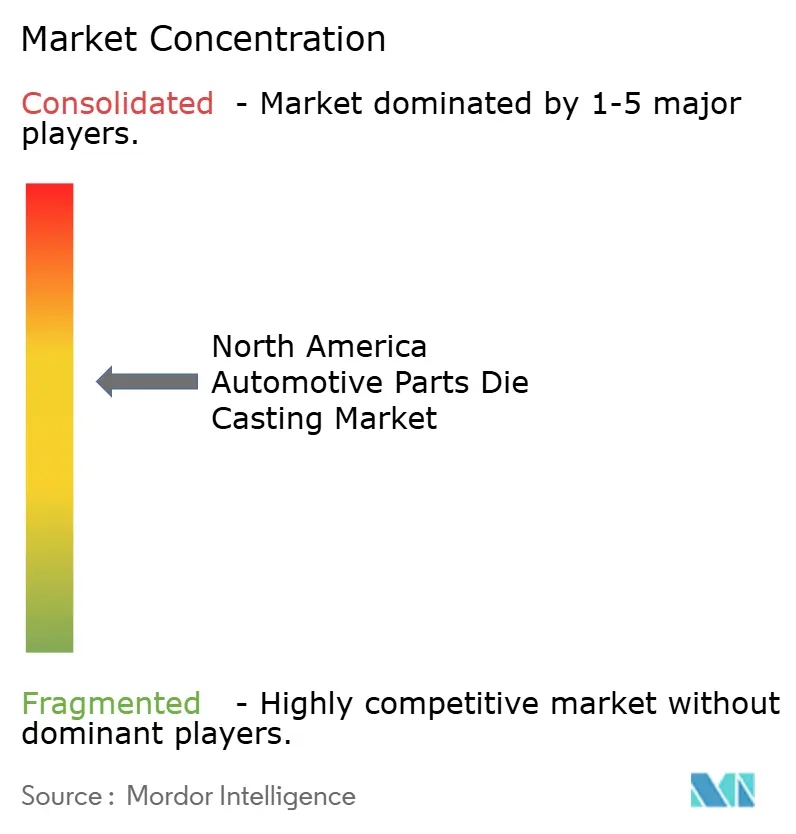
| Market Concentration | Medium |
Major Players *Disclaimer: Major Players sorted in no particular order Image © Mordor Intelligence. Reuse requires attribution under CC BY 4.0. | |
North America Automotive Parts Die Casting Market Analysis by Mordor Intelligence
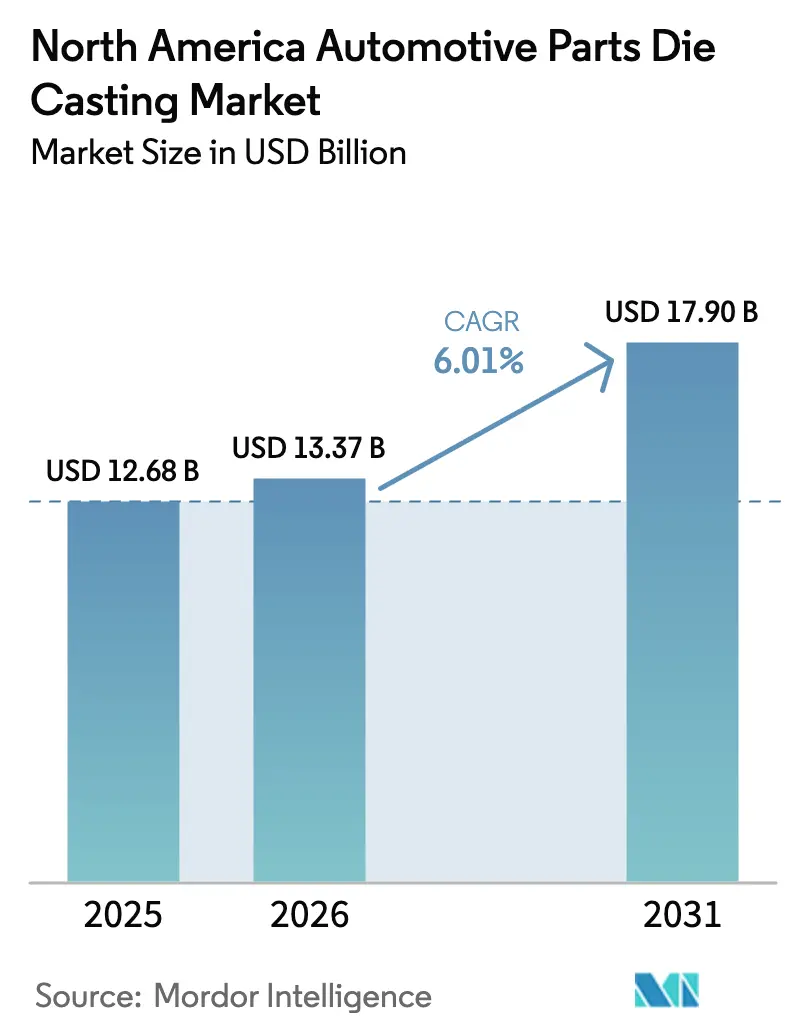
The North American automotive parts die casting market size was valued at USD 12.68 billion in 2025 and estimated to grow from USD 13.37 billion in 2026 to reach USD 17.90 billion by 2031, at a CAGR of 6.01% during the forecast period (2026-2031). The growth path reflects tightening Corporate Average Fuel Economy (CAFE) targets, rapid electrification, and accelerated alloy substitution that favor aluminum and magnesium die-cast structural components. Foundries are scaling 4,000- to 6,100-ton press lines so that single-piece gigacastings can replace hundreds of welded stampings, cutting assembly time and removing up to 18 kg from a body-in-white. As the share of electric vehicles (EVs) in light-vehicle sales grows, North America experiences a significant increase in battery-housing demand. While rising capital intensity and tighter emission limits from the Environmental Protection Agency (EPA) push for industry consolidation, numerous member firms of the North American Die Casting Association (NADCA) continue to fiercely compete. These firms focus on automation, porosity control, and near-net-shape machining, all in a bid to secure lucrative long-term contracts with original equipment manufacturers (OEMs).
Key Report Takeaways
- By raw material, aluminum led with 57.12% of North America's automotive parts die casting market share in 2025, while magnesium is projected to expand at an 8.25% CAGR through 2031.
- By process, pressure die casting held 79.25% of the North America automotive parts die casting market size in 2025; vacuum die casting records the fastest forecast CAGR at 7.86% through 2031.
- By application, body parts commanded 51.33% revenue share in 2025, and electric-vehicle components are advancing at a 9.65% CAGR to 2031.
- By vehicle type, passenger cars captured 71.45% share of the North America automotive parts die casting market in 2025, while light commercial vehicles are set to grow at a 9.14% CAGR through 2031.
- By end-use industry, original equipment manufacturers (OEMs) absorbed 83.26% of demand in 2025, and the aftermarket is poised for a 7.21% CAGR on the back of an aging fleet.
- By country, the United States accounted for 74.18% of the North America automotive parts die casting market size in 2025; Canada represents the fastest-growing area with a 6.82% CAGR over 2026-2031.
Note: Market size and forecast figures in this report are generated using Mordor Intelligence’s proprietary estimation framework, updated with the latest available data and insights as of January 2026.
Market Trends and Insights
Drivers Impact Analysis of North America Automotive Parts Die Casting Market*
| Driver | (~) % Impact on CAGR Forecast | Geographic Relevance | Impact Timeline |
|---|---|---|---|
| Rising EV Housing Demand | +1.8% | United States, Canada, Mexico | Short term (≤ 2 years) |
| HPDC Adoption by OEMs | +1.4% | United States, Canada | Medium term (2-4 years) |
| Strict Weight CAFE Rules | +1.2% | United States, Canada | Medium term (2-4 years) |
| USMCA Rule Near-Shoring | +0.9% | Mexico, United States, Canada | Short term (≤ 2 years) |
| Foundry Automation and Retrofits | +0.7% | United States, Canada | Long term (≥ 4 years) |
| High Recycled Feedstock Alloys | +0.5% | United States, Canada | Long term (≥ 4 years) |
| Source: Mordor Intelligence | |||
Exploding EV Battery-Housing Demand
As electric vehicles (EVs) continue to gain traction in the automotive market, battery trays have become a key driver in the growth of the die-casting segment. Tesla's innovative gigacasting for its rear underbody streamlines production by consolidating numerous parts and eliminating welds, resulting in cost savings and improved manufacturing efficiency. General Motors is advancing its electric vehicle (EV) production capabilities by installing high-capacity presses to support the manufacturing of components for its electric pickups. Meanwhile, Linamar's advanced press technology is contributing to Tesla's production efforts, highlighting Canada's growing prominence as a hub for gigacasting. These one-piece castings not only optimize production processes but also enhance battery safety by significantly reducing water-leak risks for vehicles operating within high-voltage ranges.
HPDC Gigacasting Adoption by NA OEMs
In 2025, General Motors, Ford, and Tesla secured significant multi-year contracts for structural gigacastings. Ford’s Ontario facility, operational since late 2025, is set to deliver aluminum front and rear subframes for multiple electric vehicle (EV) platforms, streamlining production by significantly reducing the number of components and welds per vehicle. Linamar’s Welland line highlights the substantial investments required in gigacasting technology [2]. Gigacast front modules have transformed body-shop efficiency, drastically reducing production time while also improving crash absorption performance.
Light-Weighting Regulations and CAFE Tightening
Stricter Corporate Average Fuel Economy (CAFE) rules for model years 2027-2031 mandate significantly higher fleet averages, compelling automakers to reduce vehicle weight substantially. By transitioning shock towers, hinge pillars, and seat frames from stamped steel to aluminum high-pressure die castings, automakers achieve notable weight reductions and avoid substantial costs associated with fuel-economy credit purchases. Ford’s F-150 Lightning and Mustang Mach-E benefited from a front subframe conversion, contributing meaningfully to each model’s overall weight-saving goal. The Environmental Protection Agency's (EPA) greenhouse-gas limits align with Corporate Average Fuel Economy (CAFE), further intensifying compliance challenges [3]. Tier-1 suppliers highlight that increasing cast-aluminum content improves combined fuel economy, positioning die casting as a highly cost-effective compliance strategy.
OEM Near-Shoring Under USMCA Rules Boosts Regional Die-Casting Volumes
By 2027, the United States-Mexico-Canada Agreement (USMCA) mandates higher regional-value content, pushing automakers to prioritize domestic sourcing for castings. Ryobi's Irapuato expansion introduced additional large-tonnage presses and created new jobs, catering to Ford and GM's electric vehicle (EV) contracts. Pace Industries moved its headquarters to Detroit, significantly reducing prototype lead times. In a strategic move, Martinrea acquired a recycling facility in Mexico, ensuring a substantial portion of North American feedstock for its Saltillo plant, providing a buffer against tariffs. Near-shoring not only reduces logistics costs but also shortens lead times significantly.
Restraints Impact Analysis of North America Automotive Parts Die Casting Market*
| Restraint | (~) % Impact on CAGR Forecast | Geographic Relevance | Impact Timeline |
|---|---|---|---|
| Aluminum/Magnesium Price Volatility | -0.8% | North America | Short term (≤ 2 years) |
| Capex of 4,000-ton Press | -0.6% | United States, Canada | Long term (≥ 4 years) |
| Mg Supply Chain Risk | -0.5% | North America | Short term (≤ 2 years) |
| EPA and OSHA Emission Limits | -0.4% | United States, Canada | Medium term (2-4 years) |
| Source: Mordor Intelligence | |||
Aluminum/Magnesium Price Volatility
In 2025, aluminum prices experienced significant fluctuations, leading to margin compression due to delays in cost pass-through. Chinese export restrictions caused a sharp increase in magnesium prices, necessitating expensive alloy redesigns. This shift negatively impacted Linamar's casting margins. While rising aluminum prices can substantially increase the cost of producing a mid-size sedan, only a small proportion of die casters take the precaution of hedging prices.
Capex Intensity of 4,000-ton Press Lines
A high-pressure line represents a significant investment, while larger gigacasters demand considerably higher costs due to their advanced capabilities and scale. The tooling process for gigacasting dies is highly complex and time-intensive, which extends the timeline for achieving a return on investment compared to smaller and more conventional presses. This longer timeline highlights the challenges associated with adopting larger-scale technologies in the industry. Recognizing these challenges, private equity firms are increasingly stepping in to support modernization efforts. These investments aim to enhance the efficiency, productivity, and competitiveness of die casting operations, ensuring they remain viable and aligned with evolving industry demands.
*Our forecasts treat driver/restraint impacts as directional, not additive. The impact forecasts reflect baseline growth, mix effects, and variable interactions.
North America Automotive Parts Die Casting Market Segment Analysis
By Raw Material:
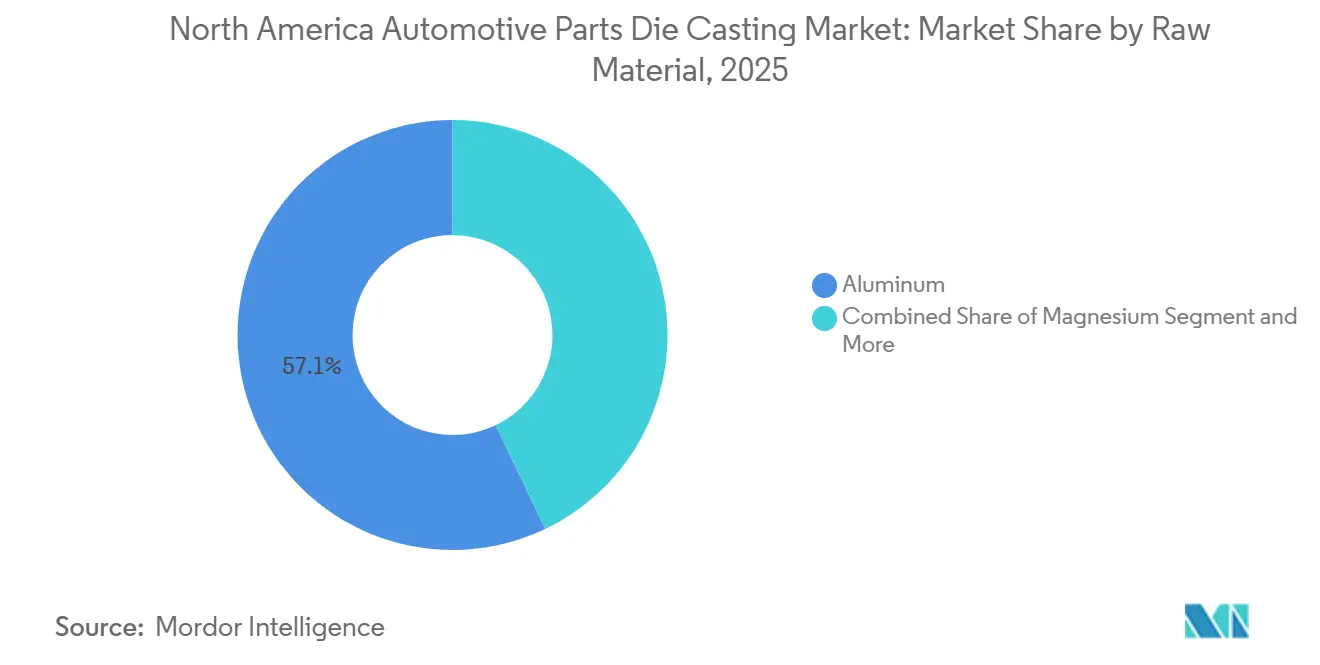
Aluminum Dominance Meets Magnesium MomentumAluminum alloys held 57.12% of the North American automotive parts die casting market share in 2025, riding on their balance of strength, thermal conductivity, and corrosion resistance. Magnesium is projected to outpace all materials at an 8.25% CAGR through 2031 thanks to its density advantage, despite a notable cost premium. Zinc claims a significant portion of output for door handles, buckles, and electronics, benefiting from die life that runs 10 times longer than aluminum. At Honda's Anna plant, aluminum boasts a high recycled content. This not only reduces lifecycle CO₂ emissions but also bolsters compliance with United States-Mexico-Canada Agreement (USMCA) sourcing regulations. Meanwhile, at Meridian's Strathroy site, magnesium recycling has made significant progress, marking a stride in overcoming oxidation challenges.
Demand trends are influenced by both thermal and electromagnetic requirements. Aluminum, with its superior conductivity, is essential for battery trays that manage heat effectively. On the other hand, magnesium's properties make it ideal for shielding inverters in advanced systems. Research funded by the Department of Energy (DOE) is pushing towards a future where scrap-fed alloys dominate, aiming for recycled aluminum that matches the properties of primary alloys. These developments not only solidify aluminum's leading position but also carve out a substantial niche for magnesium in ultra-light EV modules.

By Process:
Pressure Casting Leads, Vacuum Technology GainsHigh-pressure die casting accounted for 79.25% of volume in 2025, driven by 60-90 second cycles and thin-wall repeatability for housings and brackets. Vacuum die casting is projected to log a 7.86% CAGR through 2031, fueled by suspension knuckles and control arms that demand porosity below 0.5% for T6 heat treatment. Gravity die casting holds a significant position for low-volume prototype blocks, while squeeze casting is increasingly being used for steering knuckles, replacing heavier iron components.
Choosing a process involves balancing cost, volume, and mechanical objectives. Ryobi’s innovative vacuum-valve system significantly reduces porosity, enabling welded A-pillars with impressive yield strength. Squeeze-cast engine mounts have demonstrated exceptional performance under heavy loads, proving their suitability for heavy-duty trucks. While High-Pressure Die Casting (HPDC) remains the preferred choice for thin-wall parts, both vacuum and squeeze methods are increasingly taking on structural roles, previously dominated by stampings, highlighting a diverse technological evolution in North America's automotive parts die casting landscape.
By Application:
Body Parts Lead, EV Components SurgeBody structures commanded 51.33% of 2025 demand, led by shock towers, hinge pillars, and instrument-panel beams that yield significant weight savings over steel and help meet CAFE targets. EV components are set to post a 9.65% CAGR, the fastest among applications, as single-piece battery trays and motor housings will ramp up by 2031. Engine blocks and heads make up a notable share of value, but decline as ICE output will drop by 2031. Transmission housings split: multi-speed ICE cases fade while single-speed EV gearboxes climb.
Tesla's Gigacast rear underbodies streamline production by significantly reducing the number of parts, lowering costs, and improving manufacturing efficiency. Similarly, Ford and GM are transitioning from multiple welded parts to single aluminum castings, optimizing factory operations and enhancing space utilization. While the decline in ICE engines impacts certain components, the adoption of EV technologies, such as larger battery structures and advanced reducer housings, is driving an increase in casting content. These developments are fostering greater application diversification within North America's automotive parts die casting market.
By Vehicle Type:
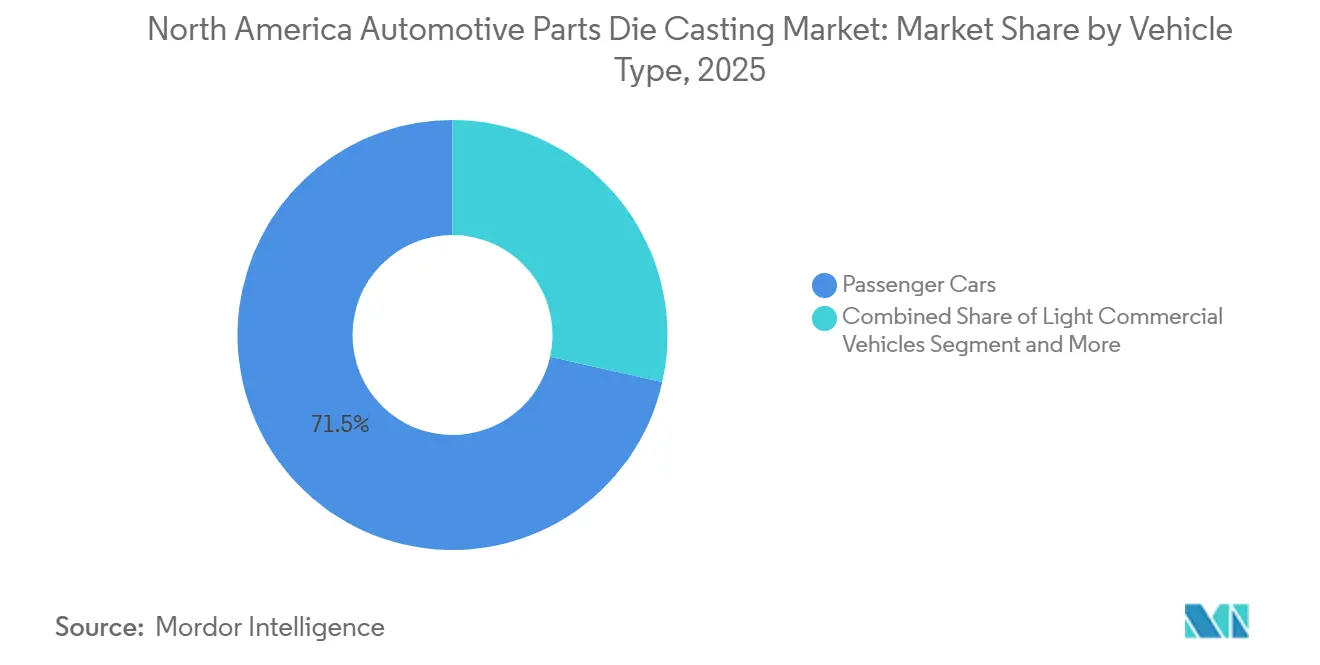
Passenger Cars Dominate, Light Commercials AcceleratePassenger cars absorbed 71.45% of 2025 tonnage, averaging 85-120 kg of die castings per vehicle. Light commercial vehicles (LCVs) are forecast to log a 9.14% CAGR, topping all vehicle types, as e-commerce fleets electrify and specify 120-180 kg of aluminum castings per van to offset battery mass. Class 6-8 trucks hold a nominal share, mostly engine and transmission housings, but remain ICE-heavy through 2031.
Ford's E-Transit has replaced its previous welded steel battery tray with a lighter single-piece version, enhancing its payload capacity. BrightDrop's electric vans have adopted aluminum die-cast subframes, leading to a significant reduction in body-in-white mass. As the mix of passenger cars increasingly shifts toward SUVs, these vehicles require more cast content. Simultaneously, the electrification of light commercial vehicles (LCVs) is driving new growth opportunities in the North American automotive parts die casting market, independent of passenger car trends.
By End-Use Industry:
OEMs Command, Aftermarket ExpandsOEMs controlled 83.26% of 2025 shipments, reflecting five- to seven-year contracts for engine blocks, transmission housings, and gigacast body structures. The aftermarket is expected to grow at a 7.21% CAGR, driven by the demand for replacement housings and steering knuckles in aging vehicles. Remanufacturing plays a significant role in the aftermarket, offering rebuilt parts at more affordable prices compared to new ones.
United States-Mexico-Canada Agreement (USMCA) rules encourage dealership channels to source North American castings for replacement parts, shielding domestic foundries from Asian imports. EVs complicate forecasts by removing engine blocks yet adding high-value battery-tray replacements for the housing alone. Thus, even as electrification reduces part counts, aftermarket revenue may evolve rather than vanish.
Geography Analysis
Michigan and Midwestern United States Automotive Parts Die Casting Market
The United States captured 74.18% of regional value in 2025 on the back of several Michigan High-Pressure Die Casting (HPDC) foundries located within 150 miles of Detroit engineering centers. At GM’s Flint Metal Center, large-tonnage presses play a crucial role in producing significant volumes of Ultium trays annually, highlighting strong domestic demand for such projects. Larger plants in the United States, which are better equipped to meet stringent environmental compliance requirements, maintain a competitive edge due to their ability to invest in advanced filtration systems. The limited availability of domestic primary aluminum further emphasizes the importance of utilizing scrap-based alloys to meet production needs. Secondary production clusters in regions like Indiana, Ohio, and Tennessee are strategically positioned to support the operations of Japanese automotive manufacturers in North America.
Quebec and Canada Automotive Parts Die Casting Market
Canada is projected to grow at a 6.82% CAGR, the fastest geography, buoyed by Linamar’s 6,100-ton Welland line that feeds Tesla Texas and represents a notable share of North American casting capacity. Technological upgrades in Canadian foundries have significantly improved operational efficiency, with government support playing a pivotal role in reducing the costs associated with automation. Quebec’s focus on magnesium production adds a layer of strategic flexibility to the region’s capabilities, although it remains exposed to potential supply chain disruptions from international markets.
Mexico Automotive Parts Die Casting Market
Mexico, as a leader in near-shoring initiatives under the United States-Mexico-Canada Agreement (USMCA) framework, continues to benefit from its strategic position in North America. Recent expansions by key manufacturers have enhanced production capacity and created new employment opportunities. Additionally, the cost advantages offered by the Mexican labor market provide a competitive edge, enabling manufacturers to optimize production costs. Many remanufacturers leverage these advantages by routing components to Mexican facilities for processing before returning the finished products to distribution hubs in the United States, creating an efficient and cost-effective supply chain.
Regulatory Landscape
In North America, die-cast automotive parts demand and sourcing decisions are closely shaped by USMCA rules of origin, including the 75% regional value content threshold for vehicles and the requirement that key core parts originate in North America for duty-free treatment. In July 2026, the Office of the U.S. Trade Representative initiated the official joint review of the USMCA, and the same review cycle has intensified discussion around tighter regional content. This includes a May 2026 U.S. negotiating proposal to raise regional content requirements for North American-built vehicles to 82% with a 50% U.S.-specific value component, which strengthens incentives for near-shored melt, pour, and machining footprints across the United States, Canada, and Mexico.
Emissions and compliance requirements also influence foundry operations and OEM lightweighting choices. In February 2026, the U.S. Environmental Protection Agency finalized a rule rescinding the 2009 Greenhouse Gas Endangerment Finding and repealing associated GHG standards for highway vehicles. In July 2026, the EPA issued a separate proposal covering Model Year 2027 and later heavy-duty highway engines (including nonconformance penalties and revised SCR-related provisions). Alongside ongoing OSHA-related workplace exposure and environmental controls referenced by industry participants, these actions keep permitting and compliance investments central to plant siting and modernization decisions, particularly for high-capital, large-tonnage HPDC lines.
Value Chain Analysis
The value chain starts with primary and secondary aluminum and magnesium supply, alloying, and recycled feedstock management, then moves through die design and hardened steel tooling, melting and dosing, high-pressure and vacuum die casting, trimming and heat treatment (where applicable), and downstream CNC machining and assembly before delivery to OEMs and Tier-1 integrators. Tooling capacity and lead times remain a bottleneck for large structural programs, given the specialized die-making requirements and concentrated capability in established manufacturing corridors.
Downstream integration and regionalization are also reshaping how value is captured. Tier suppliers are adding captive finishing and machining to reduce program risk and compress lead times, including Form Technologies (Dynacast) acquiring Platinadora Baja in Mexico in March 2026 to expand aluminum die casting capacity and integrated manufacturing. Upstream recycling and low-carbon metal supply are becoming more central for automotive-grade inputs as well. Hydro's USD 85 million investment in recycling and casting technology at its Henderson, Kentucky plant (HyForge) is aimed at supplying the U.S. automotive market, aligning scrap-to-casting flows with OEM sourcing and footprint requirements.
Competitive Landscape
The top five suppliers - Nemak, Linamar, Martinrea, Pace Industries, and Ryobi - held a notable combined share in 2025, indicating moderate concentration within the North American automotive parts die casting market. Linamar’s gigacasting capability and Welland outlay illustrate the capital threshold for Tier-1 scale. Pace Industries moved its headquarters to Detroit in 2021 to shorten prototype loops to eight weeks and align with Ford and GM engineering. Whitespace openings lie in vacuum die casting for safety-critical structures, where fewer than 15 regional plants can hit porosity below 0.5%.
In the race of technology adoption, some companies sprint ahead while others lag. Ryobi's proactive inline inspection of cast-in inserts has effectively addressed issues related to product quality, ensuring greater reliability and customer satisfaction. Meanwhile, Martinrea has leveraged IoT-driven edge analytics to achieve notable improvements in operational efficiency and equipment performance over time, showcasing the transformative potential of advanced technologies in manufacturing processes.
Private equity firms are increasingly driving consolidation within the industry, with significant investments being directed toward modernizing operations and enhancing production capabilities. Architect Equity, for instance, has focused on revitalizing Gibbs Die Casting, aiming to capitalize on the benefits of advanced manufacturing upgrades. At the same time, rising compliance costs are creating challenges for smaller plants with limited capacities, prompting many to consider exiting the market. This ongoing trend is strengthening the mergers and acquisitions pipeline, enabling well-capitalized groups to expand their presence and secure a competitive edge in the market.
North America Automotive Parts Die Casting Industry Leaders
-
Nemak, S.A.B. de C.V.
-
Pace Industries, Inc.
-
Form Technologies (Dynacast)
-
Ryobi Die Casting
-
Linamar Corporation
- *Disclaimer: Major Players sorted in no particular order
North America Automotive Parts Die Casting Market Companies Covered in this Report
- Nemak, S.A.B. de C.V.
- Pace Industries, Inc.
- Form Technologies (Dynacast)
- Ryobi Die Casting
- Linamar Corporation
- Martinrea International Inc.
- Dura | Shiloh
- Meridian Lightweight Technologies
- Gibbs Die Casting Corporation
- Alcast Technologies Ltd.
- Empire Casting Co
- KSM Castings Group
- Rheinmetall AG
- Cosma International
- Chicago White Metal Casting, Inc.
Read Analysis of North America Automotive Parts Die Casting Companies
Market Opportunities and Future Outlook
Large structural castings for body and EV architectures create whitespace for North American suppliers that can combine large-tonnage HPDC capability with porosity control for safety-critical parts and post-casting operations. Equipment localization is an enabling step: Buhler Group completed construction of the first Carat 610 megacasting machine at its Holland, Michigan plant (61,000 kN locking force) for a North American OEM, expanding the region's ability to industrialize megacast structural parts. In parallel, semi-solid and high-integrity process development is moving into commercial capability builds, including PSW Group opening its High Integrity Diecasting Center in Bellevue, Ohio in January 2026 to support light-metal R&D for semi-solid and HPDC applications.
USMCA-driven sourcing programs and consolidation moves are widening opportunities for suppliers with Mexico, U.S., and Canada footprints and integrated machining. Linamar's October 2025 agreement to acquire select Aludyne North American casting and machining assets (USD 300 million) and Nemak's October 2025 acquisition of GF Casting Solutions' automotive business point to active repositioning toward North America-aligned capacity and broader lightweight portfolios. On the supply side, Hydro's Henderson recycling and casting upgrade provides a concrete pathway for higher recycled-content aluminum inputs, which fits OEM procurement requirements tied to lower-carbon materials and supports closed-loop scrap-to-casting arrangements within North America.
Recent Industry Developments in North America Automotive Parts Die Casting Market
- June 2026: Gordon Brothers announced it is facilitating the sale of surplus and operational die-cast assets from multiple Pace Industries facilities across the United States. The action signals footprint rationalization and capacity rebalancing, with used-equipment availability potentially reshaping the cost and timing of capacity additions for other regional die casters.
- March 2026: Form Technologies announced the acquisition of Platinadora Baja to expand Dynacast's integrated manufacturing capabilities in Mexico. The deal adds aluminum cold-chamber die casting capacity and downstream manufacturing steps, supporting shorter lead times and more USMCA-aligned supply for U.S.-tied programs.
- October 2024: Hydro announced a USD 85 million investment in new recycling and casting technology at its Henderson, Kentucky plant to supply high-quality recycled aluminum products for the U.S. automotive industry. By strengthening regional recycled-metal inputs, the project supports higher recycled-content alloy strategies and improves supply resilience for aluminum-intensive automotive castings.
North America Automotive Parts Die Casting Market Report Scope and Research Methodology
Market Definition and Coverage
This market covers the value of automotive parts made using die casting processes across North America, counted at the point of part production and mapped to demand from OEM and aftermarket channels.
Scope exclusions: We exclude non-automotive die castings and non-die-cast metal forming processes, such as sand casting, forging, stamping, and machining-only parts.
Segments Covered in This Report
- By Raw Material
- Aluminum
- Magnesium
- Zinc
- Others
- By Process
- Pressure Die Casting
- High-Pressure
- Low-Pressure
- Gravity Die Casting
- Vacuum Die Casting
- Squeeze Die Casting
- Pressure Die Casting
- By Application
- Engine Components
- Blocks
- Cylinder Heads
- Transmission Components
- Housings
- Gear Cases
- Body Parts
- Structural Frames
- Brackets
- Electric Vehicle (EV) Components
- Battery Housings
- Motor Casings
- Others
- Engine Components
- By Vehicle Type
- Passenger Cars
- Light Commercial Vehicles
- Medium and Heavy Commercial Vehicles
- By End-Use Industry
- OEMs
- Aftermarket
- By Country
- United States
- Canada
- Rest of North America
Data Sources, Market Sizing, and Validation
Desk Research
For desk research, we first built the boundaries around automotive die cast parts, and then pulled the best available public time series to anchor demand direction. Sources used included, for example, vehicle production and sales releases from government statistics bodies, trade and customs datasets for aluminum and related alloy flows, and energy and commodity price updates for key inputs.
To tighten the story, we also reviewed materials and manufacturing publications, peer-reviewed papers on die casting and alloy trends, and association websites that cover foundry and light metal casting activity. On top of this, we used company filings, investor presentations, and reputable press coverage to cross-check capacity additions, plant utilization talk tracks, and changes in part mix. A paid subscription for company financials and a patent database were also used selectively to confirm product focus and investment direction. This list is illustrative only, and many other sources were also referred to for data collection, validation, and clarification.
Primary Interviews and Surveys
Primary work was used to sanity check what the desk data cannot show clearly, especially the split of demand across aluminum, zinc, and magnesium parts and the shift toward larger structural castings for newer vehicle platforms. We spoke with a mix of die casters, raw material distributors, and downstream automotive stakeholders across the United States, Canada, and the rest of North America so our assumptions on utilization, pricing moves, and sourcing patterns could be corrected where needed.
Distribution of primary research fieldwork respondents
| Company type | Respondent position |
|---|---|
| Top tier: 38% | CXOs: 16% |
| Mid tier: 46% | Functional/Unit leaders: 27% |
| Smaller Players: 16% | Managers: 57% |
Market-Sizing & Forecasting
Sizing was built using a top-down approach where vehicle production, platform mix, and casting intensity were used to reconstruct a realistic demand pool for die cast automotive parts in North America. The model was then checked using selective bottom-up approximations, such as sampled part family volumes multiplied by typical selling prices, along with supplier and channel checks, and totals were adjusted only when the evidence stayed consistent.
Key inputs used in the model included light vehicle production and sales by country, the share of vehicles using higher aluminum content, the mix shift across ICE and electrified platforms, average die cast part weight and design changes by application, and the movement of alloy and energy costs that influence pricing. Since not every dataset breaks out automotive-only die cast parts cleanly, gaps were handled through controlled assumptions that were pressure-tested in expert calls and kept consistent across years.
For the forecast, scenario analysis was used so the outlook could reflect different build-rate paths and different speeds of lightweighting adoption. Assumptions on utilization and pricing were refreshed using interview feedback, and then carried through with year-by-year logic that can be traced back to the same demand indicators.
Data Validation & Update Cycle
Results were triangulated across multiple angles, including implied spend per produced vehicle, changes in casting intensity by vehicle type, and consistency with raw material and manufacturing signals. If a segment value moved outside what these checks suggested, it was flagged and reviewed again, and follow-up outreach was triggered when the driver behind the change could not be explained clearly.
Before sign-off, a second analyst review was completed to test calculations, confirm currency treatment, and verify that assumptions were applied consistently across the time series. Reports are refreshed annually, with interim updates when material events occur, such as major capacity expansions, sharp commodity swings, or major shifts in vehicle output. Right before delivery, a final pass is done so clients receive the latest updated view.
Mordor Intelligence's North America Automotive Parts Die Casting Market Estimate Compared With Other Published Estimates
Published market sizes for North America automotive parts die casting do not always match, even when the titles look similar, because the underlying counting rules can change quietly. Differences in base year, whether the value is counted at the part level or at the material level, and how countries inside the region are treated are common reasons the numbers spread.
Key gap drivers here usually come from what gets included as an automotive die cast part and how pricing is moved through the forecast period. Some estimates blend general die casting or broader aluminum die casting with automotive-only parts, and others keep a wider range of metal forming output in-scope through loose definitions. In addition, conservative versus aggressive vehicle build assumptions, different currency timing, and less frequent refresh cycles can push the stated market size up or down.
Benchmark comparison
| Source | Market Size | Gaps in Research Methodology |
|---|---|---|
| Mordor Intelligence | USD 12.68 B (2025) | |
| Global Consultancy A | USD 11.20 B (2024) | Uses an earlier base year and appears to apply a broader revenue-to-volume conversion without clearly separating OEM and aftermarket pricing shifts across the period. |
| Industry Publisher B | USD 8.99 B (2025) | The published series looks driven by a narrower part basket and lighter casting intensity assumptions, which can undercount larger structural castings that are growing in newer vehicle platforms. |
Vehicle production by country and the implied die cast spend per vehicle are the checks that keep Mordor Intelligence's estimate tied to an automotive-only part demand pool, and then validated with practical pricing and utilization inputs from interviews. Overall, the spread in published values is mostly explained by base-year choice and scope tightness, so using repeatable demand signals and consistent counting rules helps keep the estimate stable year to year.
Key Questions Answered in the Report
What is the current value of the North American automotive parts die casting market?
The market is valued at USD 13.37 billion in 2026.
Which raw material is gaining share the quickest?
Magnesium castings will register an 8.25% CAGR through 2031, the fastest among all materials.
How will EPA rules affect small die-casting plants?
New MACT and dust-exposure standards add USD 3-5 million in compliance costs, pushing small foundries toward consolidation.
Which geography will be the fastest-growing market?
Canada is projected to grow at 6.82% CAGR through 2031, outpacing the United States and Mexico.