
Market Overview
| Study Period | 2020 - 2032 |
|---|---|
| Forecast Data Period | 2027 - 2032 |
| Base Year Market Size (2026) | USD 3.68 Billion |
| Market Size (2027) | USD 3.91 Billion |
| Market Size (2032) | USD 5.25 Billion |
| Growth Rate (2027 - 2032) | 6.13 % |
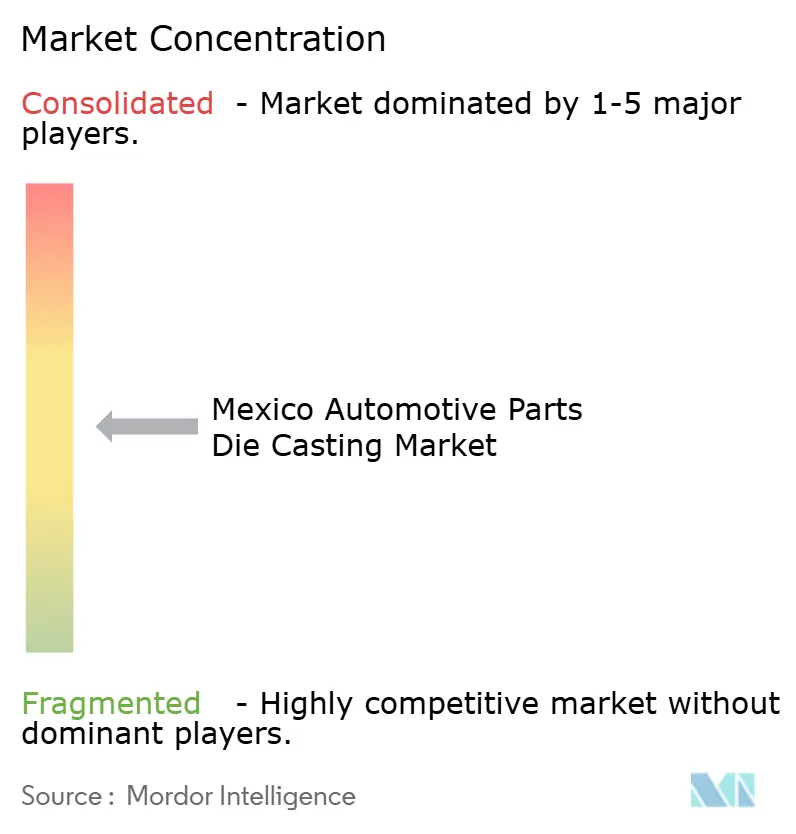
| Market Concentration | Medium |
Major Players *Disclaimer: Major Players sorted in no particular order Image © Mordor Intelligence. Reuse requires attribution under CC BY 4.0. | |
Mexico Automotive Parts Die Casting Market Analysis by Mordor Intelligence
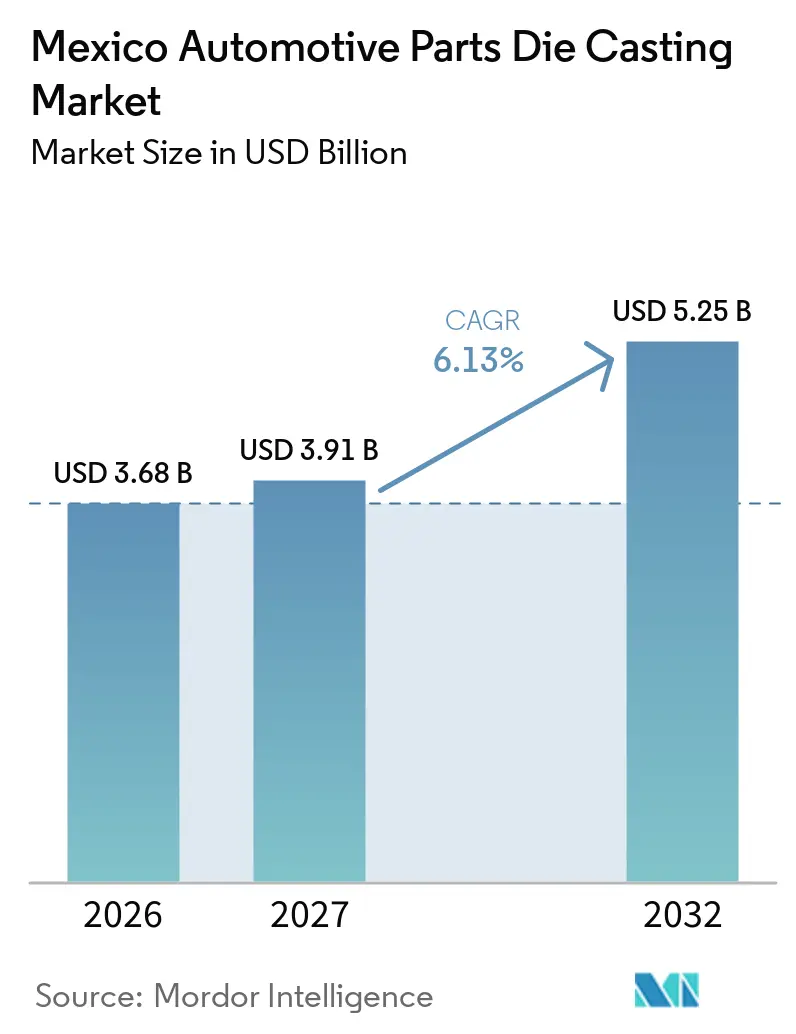
The Mexico automotive parts die casting market size is valued at USD 3.68 billion in 2026 and USD 3.91 billion in 2027, and is projected to reach USD 5.25 billion by 2032, growing at a CAGR of 6.13% from 2027 to 2032. The market is supported by Mexico’s established vehicle assembly base and the recurring need for cast powertrain, body, and structural components. Regional sourcing rules favor suppliers that can meet OEM quality requirements and manage material traceability. Local remelting, machining, and quality control can strengthen a supplier’s position when customers seek shorter supply chains. EV programs are widening demand for larger and more complex aluminum parts, although ICE vehicle programs remain important to current volumes. The Mexican automotive die casting market, therefore, rewards investment in process capability, reliable alloy supply, and long-term customer qualification.
Key Report Takeaways
- By production process, pressure die casting held 68.29% of the Mexican automotive parts die casting market share in 2026, while semi-solid die casting is forecast to grow at an 8.18% CAGR through 2032.
- By raw material, aluminum accounted for 83.17% of the Mexican automotive parts die-casting market share in 2026, while magnesium is forecast to grow at a 7.63% CAGR through 2032.
- By application, engine parts accounted for 24.18% of the Mexican automotive parts die-casting market in 2026, while EV battery, motor, and power-electronics housings are forecast to grow at a 14.26% CAGR through 2032.
- By vehicle type, passenger cars accounted for 47.26% of the Mexican automotive parts die-casting market share in 2026, while light commercial vehicles are forecast to grow at a 6.32% CAGR through 2032.
- By propulsion, internal combustion engine vehicles held 81.37% of the Mexican automotive parts die casting market share in 2026, while battery electric vehicles are forecast to grow at a 15.83% CAGR through 2032.
- By sales channel, OEM direct supply accounted for 88.26% of the Mexican automotive parts die casting market share in 2026 and is forecast to grow at a 7.12% CAGR through 2032.
- By geography, the Bajío States held 41.83% of the Mexican automotive parts die casting market share in 2026 and are forecast to grow at a 6.37% CAGR through 2032.
Note: Market numbers in this report are based on Mordor Intelligence's proprietary estimation framework, which combines nine months of actuals with Q4 projections for base year 2026.
Mexico Automotive Parts Die Casting Market Trends and Insights
Drivers Impact Analysis*
| Driver | (~)% Impact on CAGR Forecast | Geographic Relevance | Impact Timeline |
|---|---|---|---|
| Nearshoring and USMCA-Driven OEM and Tier-1 Investment | +1.86% | Bajío and Northern Border States | Medium term (2–4 years) |
| North American Export Orientation of Mexican Automotive Production | +1.45% | Northern Border States and Bajío | Medium term (2–4 years) |
| Vehicle Lightweighting and Emissions-Efficiency Requirements | +1.17% | Mexico nationwide | Long term (≥ 4 years) |
| EV Platforms, Battery Housings, and Giga-Casting Programs | +0.83% | Bajío, Nuevo León and Coahuila | Short term (≤ 2 years) |
| Closed-Loop Secondary Aluminum and Local Scrap Utilization | +0.62% | Bajío and Northern Border States | Long term (≥ 4 years) |
| Supplier Clustering and Faster Local Qualification Cycles | +0.48% | Bajío and Northern Border States | Medium term (2–4 years) |
| Source: Mordor Intelligence | |||
Nearshoring, Regional Content, and Supplier Clustering
The Mexican automotive parts die-casting market benefits when OEMs and Tier-1 suppliers bring production closer to North American assembly plants. This setting favors suppliers that combine casting, machining, testing, and program management within Mexico. Regional content requirements raise the value of documented material flows and qualified local production. Local suppliers can also shorten the time required for engineering changes and reduce cross-border logistics exposure for customers. Guanajuato and San Luis Potosí remain important because automotive production and supplier networks are already established there. The opportunity is strongest for companies that can support a vehicle program through launch and stable serial production.
Export Demand and Local Supplier Qualification
Mexican die casters remain closely linked to North American vehicle production because a large share of foundry output serves export programs. This connection makes OEM schedules, model launches, and supplier nominations central to order visibility. Direct supply to assembly programs creates recurring demand, but it also requires strict quality performance and predictable delivery. The Mexican automotive die casting market can still gain local content when OEMs shift work from distant suppliers into the region. Supplier clustering also helps toolmakers, alloy suppliers, and machining partners respond faster to new program needs. A shortage of local mold and die capacity leaves room for investment in precision tooling and repair services.
Lightweight Materials and Closed-Loop Aluminum
Aluminum remains the primary material in the Mexican automotive parts die-casting market because it enables high-volume production and lower vehicle mass. OEMs use cast aluminum across powertrain, structural, and electric-vehicle applications. Nemak’s melting center near Monterrey achieved ASI Chain of Custody certification in 2025 and remelts recycled aluminum into liquid aluminum for internal transfer, with an annual output of nearly 300,000 tonnes. Closed-loop systems can improve traceability and reduce dependence on primary metal. Honda Trading Group has also described a die-cast aluminum recycling process that employs impurity removal and composition control to reuse ADC12-equivalent scrap without adding high-purity aluminum [1]. Magnesium has a smaller starting base, but its lower density supports interest in applications where weight reduction matters.
EV Platforms, Battery Housings, and Giga-Casting
EV housings are the fastest-growing application in the Mexican automotive parts die casting market, with a supply forecast CAGR of 14.26% through 2032. These parts require controlled porosity, tight dimensions, and stable mechanical performance. BMW is expanding its San Luis Potosí site with an EUR 800 million investment, including a high-voltage battery assembly area of more than 80,000 square meters, for Neue Klasse production planned from 2027. BMW GROUP Bühler reported that Honda is using Carat 610 machines for electric-vehicle Intelligent Power Unit cases in North America. These cases are large structural parts that hold battery modules and form part of the vehicle floor structure. Large-format casting raises the importance of equipment access, die design, and casting-cell expertise.
Restraints Impact Analysis*
| Restraint | (~)% Impact on CAGR Forecast | Geographic Relevance | Impact Timeline |
|---|---|---|---|
| US Tariff and Trade-Policy Uncertainty for Vehicles, Parts, Steel, and Aluminum | -0.78% | Mexico nationwide; export-oriented clusters | Short term (≤ 2 years) |
| Energy and Water Constraints in Industrial Automotive States | -0.60% | Northern Border States and Bajío | Medium term (2–4 years) |
| Shortage of High-Pressure Die-Casting Technicians and Tooling Engineers | -0.48% | Bajío and Northern Border States | Long term (≥ 4 years) |
| Peso Volatility and Imported Equipment and Alloy Cost Exposure | -0.36% | Mexico nationwide | Short term (≤ 2 years) |
| Source: Mordor Intelligence | |||
Trade Policy, Tariffs, and Peso Exposure
Trade-policy uncertainty can affect pricing, sourcing decisions, and investment timing in the Mexico automotive parts die casting market. Suppliers that import alloy inputs or capital equipment can face changing costs when tariffs or exchange rates move. Annual customer price expectations can make it difficult to pass those increases through quickly. A foundry with local remelt capacity and stable supplier agreements is better positioned to manage input risk. Program delays may also occur when customers wait for clarity on regional content and tariff treatment. The result is a greater value for suppliers that can provide transparent sourcing records and dependable delivered costs.
Energy, Water, and Technical Talent Constraints
Die casting requires skilled operators, engineers, and toolmakers, as well as reliable power and water for process cooling. Capacity additions are harder to execute when industrial sites face utility constraints or a limited supply of experienced personnel. Large high-pressure die-casting cells require specialized setup, maintenance, and quality skills. The Mexican automotive parts die-casting market may therefore grow unevenly across locations with different labor pools and infrastructure conditions. Training programs and automation can improve consistency, but they require time and sustained investment. These constraints favor established sites that already have technical teams and supporting service providers.
*Our forecasts treat driver/restraint impacts as directional, not additive. The impact forecasts reflect baseline growth, mix effects, and variable interactions.
Segment Analysis
By Production Process Type: Pressure Die Casting Supports High-Volume Programs
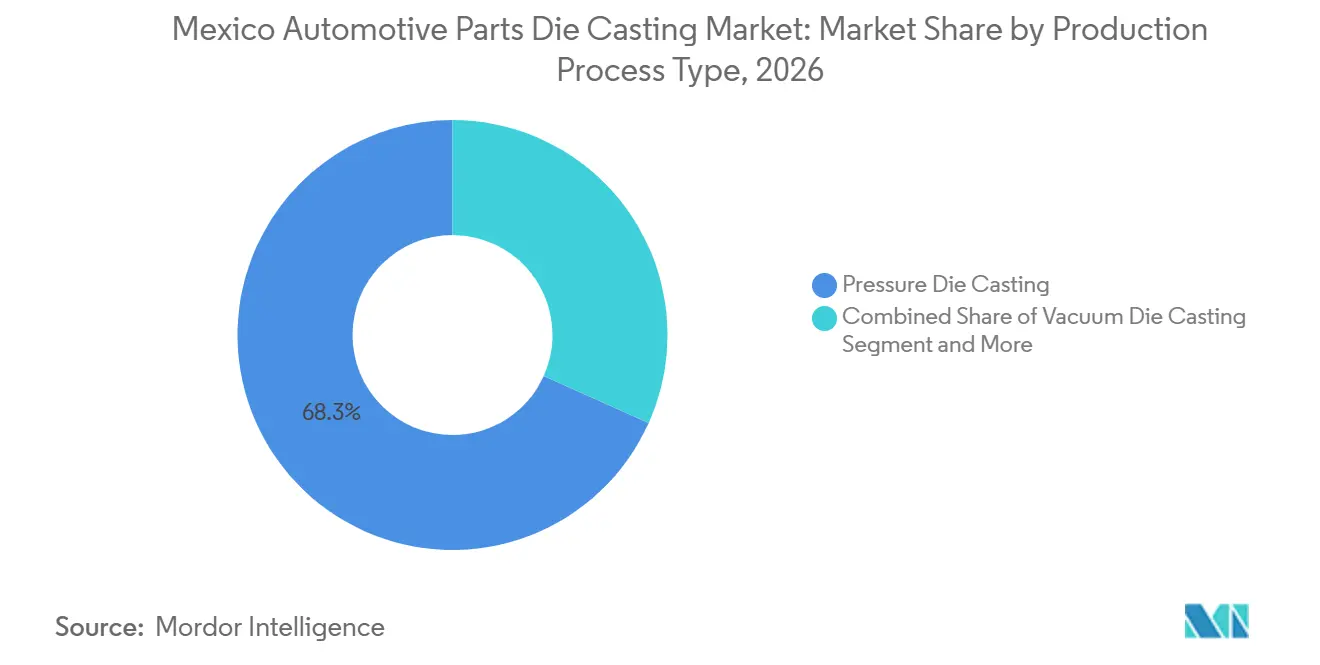
Pressure die casting held 68.29% of the Mexican automotive parts die-casting market share in 2026. Its large share reflects the need for repeatable, high-volume production of engine, transmission, and structural components. The process suits programs that need short cycle times and controlled part dimensions. Existing high-pressure die-casting capacity gives established suppliers an advantage during new platform awards. Vacuum and squeeze processes are used in applications that require improved integrity or lower porosity. Customers use those methods when mechanical performance is more important than the lowest possible unit cost.
Semi-solid die casting is forecast to grow at an 8.18% CAGR through 2032. Its growth reflects demand for parts with thin walls, controlled porosity, and close dimensional tolerances. EV battery enclosures and structural nodes can require these attributes. The Mexican automotive parts die-casting industry is also watching large-format cells because they can combine several smaller parts into fewer castings.

By Raw Material: Aluminum Leads While Magnesium Serves Lighter Structures
Aluminum accounted for 83.17% of the Mexican automotive parts die-casting market share in 2026. It remains widely used because it meets production, weight, and durability requirements for many component types. Established aluminum supply and remelting systems also support its leading position. Aluminum is relevant to engine, transmission, body, chassis, and electric-vehicle housings. Nemak’s certified melting center shows the local importance of recycled aluminum and traceable internal material transfer.
Magnesium is forecast to expand at a 7.63% CAGR through 2032, the fastest rate among the listed materials. Its lower density can support weight reduction in applications such as crossbeams, seat structures, and e-drive housings. The material requires careful process control and supply planning. Zinc continues to serve smaller parts where thin-wall casting and detail reproduction are important. Material selection in the Mexican automotive parts die-casting market depends on function, target weight, cost, and the capabilities of the selected production process. Closed-loop aluminum developments remain important because they may improve material utilization without changing a component’s application requirements.
By Application Type: Engine Parts Lead Current Demand While EV Housings Grow Fastest
Engine parts accounted for 24.18% of the Mexican automotive parts die-casting market share in 2026. The share reflects the continuing production life of established internal-combustion vehicle programs. Engine blocks, covers, housings, and related components remain core products for many Mexican foundries. Transmission and driveline components provide another stable source of casting volume. Body, structural, and chassis parts extend demand across passenger and commercial vehicle programs. Replacement demand adds smaller volumes through the vehicle aftermarket.
EV battery, motor, and power-electronics housings are forecast to grow at a 14.26% CAGR through 2032. These applications may require larger parts and tighter tolerances than conventional engine castings. BMW’s planned 2027 Neue Klasse production in San Luis Potosí underscores the importance of battery manufacturing in the Bajío region. The Mexican automotive die casting market is likely to favor suppliers that combine vacuum-assisted casting, machining, inspection, and production traceability. The growth of EV housing does not eliminate the need for engine parts, as ICE components still make up a large share of the current production base. Application demand will depend on the pace of vehicle-program launches and customer sourcing decisions.
By Vehicle Type: Passenger Cars Retain the Largest Base
Passenger cars accounted for 47.26% of the Mexican automotive parts die-casting market share in 2026. Their leading position is linked to Mexico’s established compact and mid-size vehicle assembly programs. These vehicles use cast components in powertrain, body, and structural systems. Rising aluminum content per vehicle can support casting value even when unit output is stable. Long-running passenger vehicle platforms also support predictable tooling and production schedules. The large installed base creates a secondary opportunity for replacement components.
Light commercial vehicles are forecast to grow at a 6.32% CAGR through 2032. Pickup trucks and small vans support demand from North American business, distribution, and service fleets. Electrified commercial vehicles can increase demand for battery housings and e-axle structures. Medium and heavy commercial vehicles remain a smaller but steady outlet for engine, transmission, and axle castings. The Mexican automotive parts die casting market benefits when suppliers serve more than one vehicle category and customer program. Vehicle-type demand will remain linked to fleet replacement patterns, commercial activity, and OEM product cycles.
By Propulsion: ICE Holds Scale While BEVs Post the Highest Growth Rate
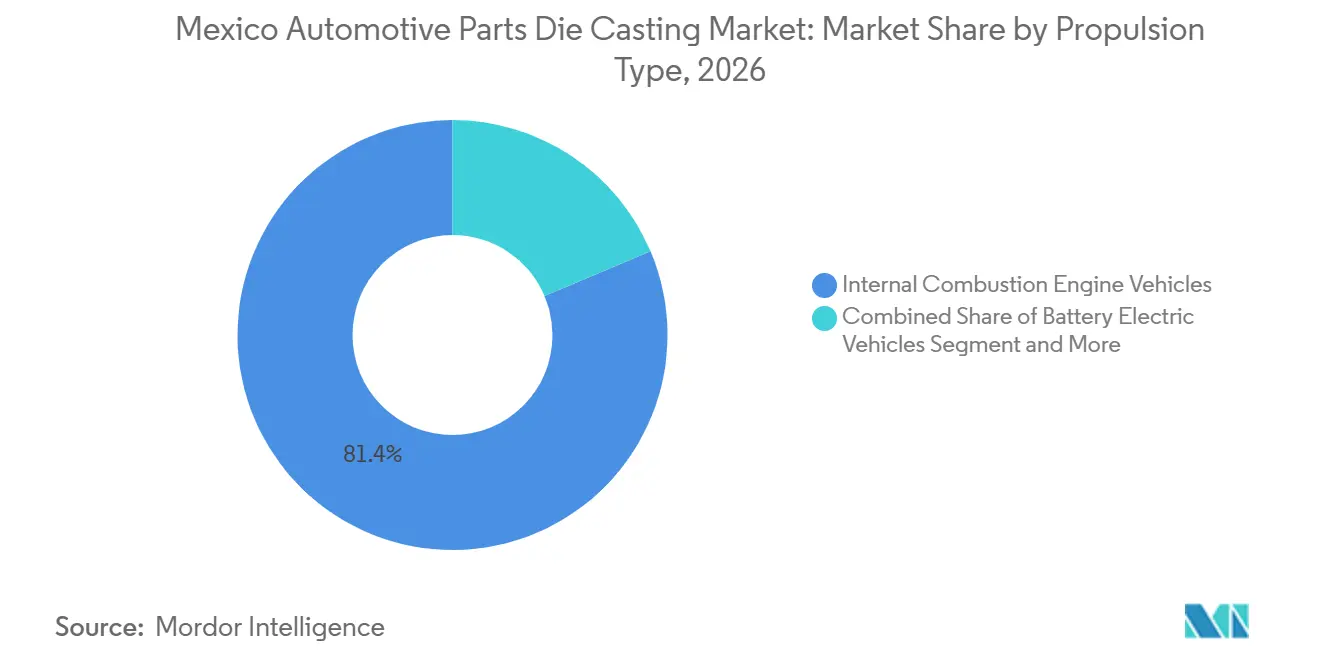
Internal-combustion-engine vehicles accounted for 81.37% of the Mexican automotive parts die-casting market share in 2026. This share reflects the current production mix and the multi-year duration of existing casting contracts. ICE platforms continue to require engine, transmission, and related cast housings. Hybrid vehicles also use internal-combustion components while adding electric-drive systems. This mix provides continuity for suppliers with current powertrain programs. It also gives foundries time to build capability for new electrified applications.
Battery electric vehicles are forecast to grow at a 15.83% CAGR through 2032. This is the highest supplied CAGR among the listed segmentation types in the Mexico automotive parts die casting market. BEVs use battery, motor, inverter, and structural parts that can increase the role of aluminum castings. Honda’s North American Intelligent Power Unit case program illustrates the direction of electric-vehicle structural casting requirements. Hybrid and other propulsion types create an intermediate demand pattern rather than directly replacing ICE casting needs. The speed of this change will depend on specific model launches and supplier awards.
By Sales Channel: OEM Direct Supply Defines the Commercial Model
OEM direct supply accounted for 88.26% of the Mexican automotive parts die-casting market share in 2026 and is forecast to grow at a 7.12% CAGR through 2032. This share reflects multi-year contracts tied to named vehicle platforms and assembly schedules. Tier-1 die casters generally work with OEMs on specifications, tooling, launch timing, and quality documentation. The channel provides order visibility when production plans remain stable. It also exposes suppliers to changes in customer schedules and annual cost-reduction expectations. Quality certification and proven delivery performance remain important barriers to entry.
The aftermarket is smaller, but it provides demand for replacement engines, drivelines, and structural parts. Aging vehicles can increase the need for remanufactured and replacement components over time. Suppliers with established tooling and alloy programs can use these capabilities for selected aftermarket work. The Mexican automotive parts die casting market can benefit when manufacturers balance OEM programs with aftermarket opportunities without disrupting contracted production. Direct OEM supply will remain the central route to volume because assembly programs determine the largest casting requirements. Channel strategy, therefore, depends on customer diversification, program duration, and available manufacturing capacity.
Geography Analysis
The Bajío States held 41.83% of the Mexican automotive parts die-casting market share in 2026 and are forecast to grow at a 6.37% CAGR through 2032. Guanajuato, San Luis Potosí, Querétaro, Aguascalientes, and nearby manufacturing areas form a major vehicle and supplier cluster. BMW’s San Luis Potosí expansion includes a new battery assembly and supports planned Neue Klasse production starting in 2027. The cluster gives suppliers access to OEM sites, machining partners, toolmakers, and logistics routes. Its growth also increases the need for skilled workers, utilities, and industrial space.
The Northern Border States are the second major production area because of their links to United States customers. Nuevo León and Coahuila are particularly relevant for foundry operations and cross-border logistics. Nemak’s operations are headquartered in García, Nuevo León, while its certified melting center is near Monterrey. Bocar’s facilities in Chihuahua, Saltillo, and Lerma received ASI provisional certification in 2026 for aluminum automotive component manufacturing. These locations can offer shorter delivery routes into the United States vehicle production networks.
Central Mexico, outside the Bajío, and the rest of the country contribute a smaller share of activity. These areas can provide alternative sites for suppliers seeking to diversify location risk. Jalisco has a broader industrial customer base, including automotive and non-automotive work. Border states in the northwest also offer access to Pacific-facing and United States supply routes. The Mexican automotive die-casting market will develop differently across regions because sites vary in supplier depth, labor availability, infrastructure, and proximity to customers. Geographic selection will remain important for suppliers planning new casting, machining, or recycling capacity.
Competitive Landscape
The Mexican automotive parts die-casting market is moderately concentrated, with Nemak and Bocar among the established suppliers serving automotive programs. Their scale, multiple facilities, and customer relationships support production continuity. In February 2026, Nemak completed its acquisition of GF Casting Solutions' automotive business for an enterprise value of USD 336 million. The acquired business operates multiple facilities, generates significant revenue, and derives a substantial share of its portfolio from e-mobility and structure-and-chassis applications. The transaction expands Nemak's technology capabilities and customer base beyond its traditional powertrain focus [2].
Sustainability and quality certifications are increasingly relevant in customer sourcing decisions. Bocar's Mexican facilities received ASI provisional certification covering aluminum engine, powertrain, structural, and electric-mobility components. Aluminum Mexico achieved ASI Performance Standard certification for aluminum high-pressure die casting at its Guanajuato production units. These developments demonstrate how certification, documented processes, and traceability can support supplier qualification. New entrants require comparable process knowledge, customer approvals, and stable local operations to compete for major programs.
Competitive strategies center on large-format casting, local material management, machining integration, and reliable launch support. Honda's work with Bühler on large battery-module cases illustrates the casting requirements that are becoming more prominent in electric-vehicle programs. BMW's planned battery assembly in San Luis Potosí represents a relevant future manufacturing program in Mexico. Suppliers that combine casting with machining, inspection, and assembly can address a broader range of component needs. The Mexican automotive die casting market remains open to capable local and international suppliers, but platform awards favor companies with proven technical and operational credentials.
Mexico Automotive Parts Die Casting Industry Leaders
-
Nemak, S.A.B. de C.V.
-
Bocar Group
-
Ryobi Limited
-
Linamar Corporation
-
Martinrea International Inc.
- *Disclaimer: Major Players sorted in no particular order
Recent Industry Developments
- September 2026: Bocar Group achieved ASI Performance Standard V3.1 certification with Provisional status for three HPDC facilities in Chihuahua, Saltillo, and Lerma, covering engine, powertrain, structural, and electric-mobility aluminum components.
- February 2026: Anhui Zhongding Sealing Parts began constructing a 60,000-square-meter plant in Guanajuato, Mexico. The company is expected to commence production in the first quarter of 2027. The plant will complement Tristone’s existing Mexican operations and support metalworking, foundry operations, sealing technology, and automotive component manufacturing.
Mexico Automotive Parts Die Casting Market Report Scope
The Mexico Automotive Parts Die Casting Report is Segmented by Production Process Type (Pressure Die Casting, Vacuum Die Casting, Squeeze Die Casting, Semi-Solid Die Casting, and Other Production Process Types), Raw Material (Aluminum, Zinc, Magnesium, and Other Raw Materials), Application Type (Engine Parts, Transmission and Driveline Parts, Body Assemblies, Structural and Chassis Parts, EV Battery/Motor/Power-Electronics Housings, and Other Applications), Vehicle Type (Passenger Cars, Light Commercial Vehicles, Medium and Heavy Commercial Vehicles, and Other Vehicle Types), Propulsion (Internal Combustion Engine Vehicles, Hybrid Electric Vehicles, Battery Electric Vehicles, and Other Propulsion Types), Sales Channel (Original Equipment Manufacturers and Aftermarket), and Geography (Bajío States, Northern Border States, Central Mexico Excluding Bajío, and Rest of Mexico). The Market Forecasts are Provided in Terms of Value (USD) and Volume (Units).
By Production Process Type
| Pressure Die Casting |
| Vacuum Die Casting |
| Squeeze Die Casting |
| Semi-Solid Die Casting |
| Other Production Process Types |
By Raw Material
| Aluminum |
| Zinc |
| Magnesium |
| Other Raw Materials |
By Application Type
| Engine Parts |
| Transmission and Driveline Parts |
| Body Assemblies |
| Structural and Chassis Parts |
| EV Battery, Motor, and Power-Electronics Housings |
| Other Applications |
By Vehicle Type
| Passenger Cars |
| Light Commercial Vehicles |
| Medium and Heavy Commercial Vehicles |
| Other Vehicle Types |
By Propulsion
| Internal Combustion Engine Vehicles |
| Hybrid Electric Vehicles |
| Battery Electric Vehicles |
| Other Propulsion Types |
By Sales Channel
| Original Equipment Manufacturers |
| Aftermarket |
By Geography
| Bajío States |
| Northern Border States |
| Central Mexico Excluding Bajío |
| Rest of Mexico |
| By Production Process Type | Pressure Die Casting |
| Vacuum Die Casting | |
| Squeeze Die Casting | |
| Semi-Solid Die Casting | |
| Other Production Process Types | |
| By Raw Material | Aluminum |
| Zinc | |
| Magnesium | |
| Other Raw Materials | |
| By Application Type | Engine Parts |
| Transmission and Driveline Parts | |
| Body Assemblies | |
| Structural and Chassis Parts | |
| EV Battery, Motor, and Power-Electronics Housings | |
| Other Applications | |
| By Vehicle Type | Passenger Cars |
| Light Commercial Vehicles | |
| Medium and Heavy Commercial Vehicles | |
| Other Vehicle Types | |
| By Propulsion | Internal Combustion Engine Vehicles |
| Hybrid Electric Vehicles | |
| Battery Electric Vehicles | |
| Other Propulsion Types | |
| By Sales Channel | Original Equipment Manufacturers |
| Aftermarket | |
| By Geography | Bajío States |
| Northern Border States | |
| Central Mexico Excluding Bajío | |
| Rest of Mexico |
Key Questions Answered in the Report
What is the current market size and growth rate of the automotive parts die-casting market in Mexico?
The Mexico automotive parts die casting market size is valued at USD 3.68 billion in 2026 and USD 3.91 billion in 2027, and is projected to reach USD 5.25 billion by 2032, growing at a CAGR of 6.13% from 2027 to 2032.
Which production process holds the largest share in Mexico?
Pressure die casting accounts for 68.29% of the market value in 2026.
Why Is Aluminum Important to Mexico's Vehicle Casting Suppliers?
Aluminum accounts for 83.17% of the value in 2026, supporting lightweighting, structural, and powertrain applications. Local recycled-metal systems also enhance traceability.
Which region leads automotive die-casting activity in Mexico?
The Bajío States lead with 41.83% of value in 2026 and a supplied CAGR of 6.37% through 2032.