
Market Overview
| Study Period | 2020 - 2031 |
|---|---|
| Forecast Data Period | 2026 - 2031 |
| Base Year Market Size (2025) | USD 10.13 Billion |
| Market Size (2026) | USD 10.40 Billion |
| Market Size (2031) | USD 11.85 Billion |
| Growth Rate (2026 - 2031) | 2.65 % |
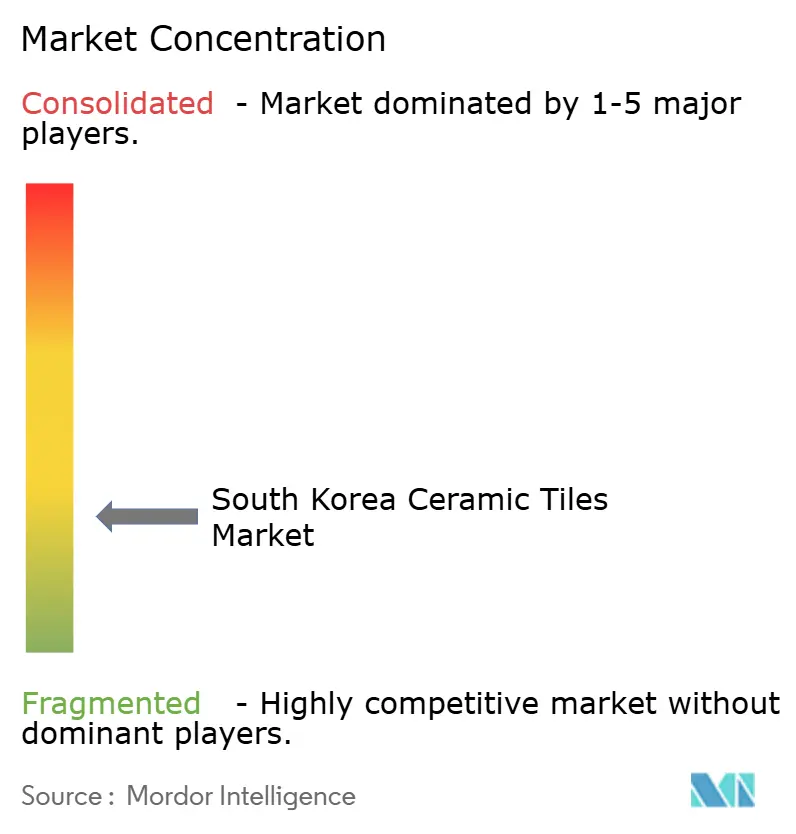
| Market Concentration | Low |
Major Players *Disclaimer: Major Players sorted in no particular order Image © Mordor Intelligence. Reuse requires attribution under CC BY 4.0. | |
South Korea Ceramic Tiles Market Analysis by Mordor Intelligence
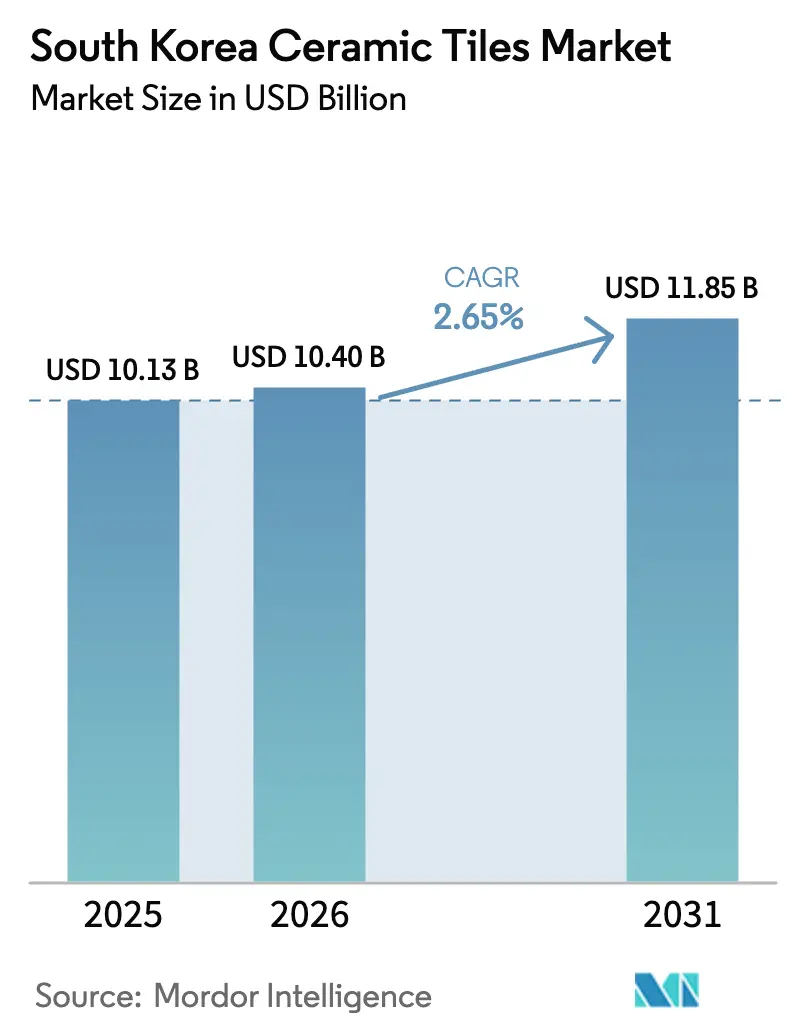
The South Korea Ceramic Tiles Market size is expected to grow from USD 10.13 billion in 2025 to USD 10.40 billion in 2026 and is forecast to reach USD 11.85 billion by 2031 at 2.65% CAGR over 2026-2031.
The growth trajectory is steady because renovation and redevelopment demand balances a softer new-build cycle. Awarded urban-renewal contracts worth USD 19.5 billion (KRW 27 trillion) in the first half of 2025 point to strong procurement cycles for floor, wall, and façade tile systems in multi-phase complexes[1]. New-apartment supply planned for 2025 stands at 146,130 units, the lowest since 2000, which channels household spending into upgrades of existing homes where porcelain formats often see premium specification[2]. Policy-driven building-efficiency requirements are lifting specification intensity in roofing through cool-roof ceramic tiles that improved modelled cooling loads for Seoul buildings in controlled studies, reinforcing an emerging application niche. Trade frictions and tighter anti-dumping enforcement in nearby markets have reduced the most aggressive price undercutting from Chinese exporters, easing price pressure on domestic plants in the market. Modular bathroom pods are compressing site labour, while elevated LNG feedstock and tighter emissions thresholds raise the premium on energy-efficient kilns and stable supply plans in the South Korea ceramic tiles market.
Key Report Takeaways
- By product type, porcelain led with a 46.23% revenue share of the South Korea ceramic tiles market in 2025, while Decorative / Patterned Tiles are projected to expand at a 2.98% CAGR through 2031.
- By application, floor accounted for a 58.15% share of the South Korea ceramic tiles market in 2025, while roofing is projected to expand at a 2.86% CAGR through 2031.
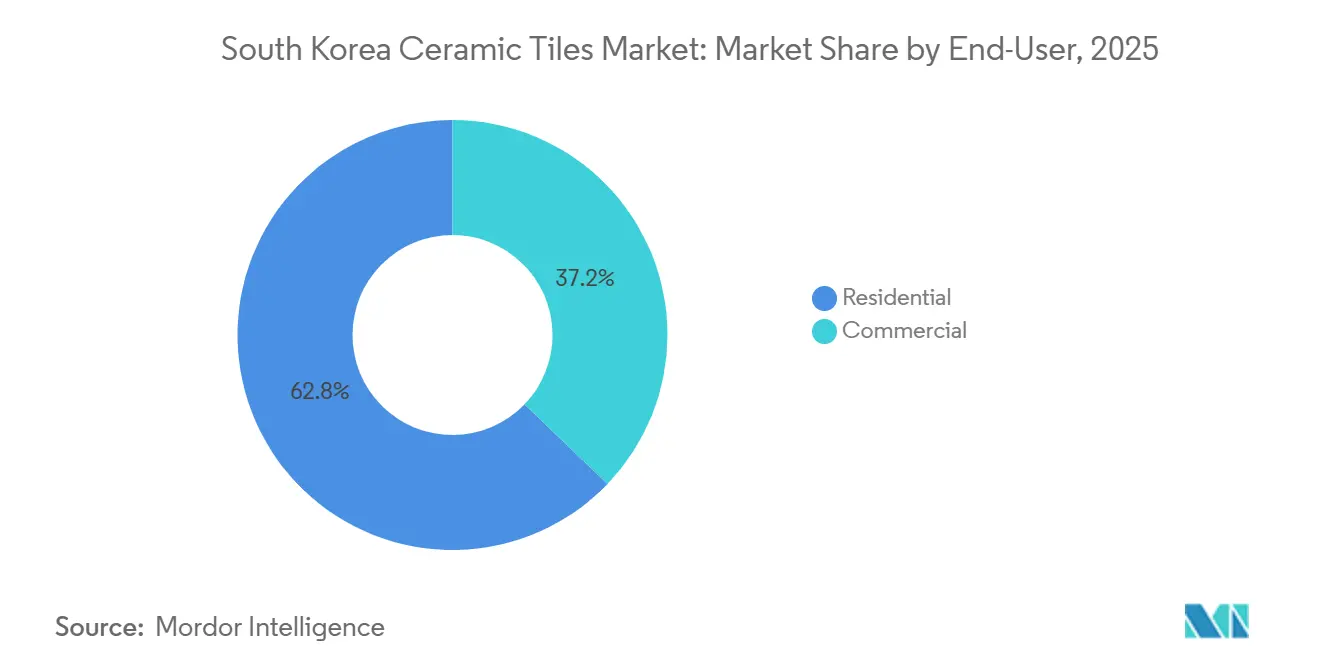
- By end-user, residential represented 62.81% of the South Korea ceramic tiles market share in 2025 and holds the highest projected growth at a 3.19% CAGR through 2031.
- By construction type, renovation held 61.42% of the South Korea ceramic tiles market in 2025, and new construction records the fastest 2.92% CAGR to 2031.
- By distribution channel, specialty stores captured 41.73% of the South Korea ceramic tiles market in 2025, while online retail posts the fastest 3.64% CAGR through 2031.
- By geography, the Seoul Capital Region accounted for 39.21% of the South Korea ceramic tiles market in 2025, and Busan-Ulsan-Gyeongsang is the fastest at 3.15% CAGR.
Note: Market size and forecast figures in this report are generated using Mordor Intelligence’s proprietary estimation framework, updated with the latest available data and insights as of January 2026.
South Korea Ceramic Tiles Market Trends and Insights
Drivers Impact Analysis*
| Driver | (~) % Impact on CAGR Forecast | Geographic Relevance | Impact Timeline |
|---|---|---|---|
| Housing-redevelopment pipeline boosts tile demand | + 0.8% | National, with early gains in Seoul, Gyeonggi, and Busan metro areas | Medium term (2-4 years) |
| Large-format porcelain adoption in renovation | + 0.6% | Seoul Capital Region, Busan-Ulsan-Gyeongsang | Short term (≤ 2 years) |
| Commercial construction revival | + 0.5% | Seoul, Incheon GTX-B corridor, Busan Gadeok Airport zone | Long term (≥ 4 years) |
| Anti-dumping duties stabilize prices | + 0.3% | Global, spill-over to domestic pricing in South Korea | Medium term (2-4 years) |
| ZEB rules lift cool-roof tiles | + 0.3% | National, priority enforcement in Seoul, Sejong, Daejeon | Long term (≥ 4 years) |
| Modular pods adopt thin-tile systems | + 0.2% | National, concentrated in Gyeonggi prefab hubs, expanding to Jeonnam | Medium term (2-4 years) |
| Source: Mordor Intelligence | |||
Government Housing-Redevelopment Pipeline Boosts Tile Demand
Fast-track approvals for demolition and reconstruction of apartment complexes older than 30 years open a large pipeline that spans 950,000 households through 2027, with direct implications for tile consumption across kitchens, baths, and shared corridors in the market. The policy shift addresses permit bottlenecks from the previous credit squeeze, when issuance in 2023 fell short of planned levels and delayed procurement for finishing materials like porcelain. Contract wins for urban renewal exceeded USD 19.5 billion (KRW 27 trillion) in the first half of 2025, signalling a sustained sequence of bidding rounds and material awards for high-spec installations. Landmark redevelopments now underway include large sites such as Hannam District 4 and Guri Sutaek-dong, each with multi-hundred-thousand-square-meter finish scopes where tile selection sets durability and maintenance baselines. The current emissions-allocation design under the Korea Emissions Trading Scheme offsets part of the carbon cost burden for energy-intensive materials producers, which helps keep redevelopment economics viable for kiln-fired products. This combination of permit acceleration, backlogged projects, and partial emissions-cost relief underpins stable multi-year orders for the South Korea ceramic tiles market.
Preference for Large-Format Porcelain Tiles in Home-Renovation Boom
Renovation now anchors a majority of installations as households prioritize upgrades to existing properties while new-build supply sits at a multi-decade low, which steers budgets toward high-visual-impact surfaces that elevate valuations. Large-format porcelain with fewer grout lines provides a clean look, faster placement, and lower maintenance, attributes that align with premium apartment remodelling in the capital region. The market benefits from digital printing advances that deliver natural-stone and wood visuals with consistent quality suited for repeat-fit-out programs. Factory-finished rectified edges and calibrated thickness improve installation productivity in occupied units, which reduces disruption and labour time for contractors. Renovation’s installed-base advantage sustains demand for floor, wall, and bath tile sets even as developers schedule staggered completions for major rebuilds.
Revival of Commercial Construction (Offices, Transit Hubs)
Public works spending in 2025 provides a base layer of tiling demand in transit hubs, municipal buildings, and institutional projects, which anchors commercial volumes during residential volatility in the South Korea ceramic tiles market. Long-horizon mega projects such as the GTX-B express rail and the Gadeok Airport program carry large concourse and terminal finish scopes where slip resistance and antimicrobial performance favour high-grade glazed and porcelain formats. Korean-specific standards for flexural strength and flame spread shape sourcing choices in these projects and often lead to domestic supply because compliance and documentation are streamlined with local certifications[3]. The 2026 enforcement of advanced energy-performance thresholds increases the value of reflective roofing and high-thermal-mass interior materials that contribute to building-level efficiency targets. As retrofit cycles continue in offices and public venues, the South Korea ceramic tiles market gains from a steady cadence of capital projects with defined finish packages.
Anti-Dumping Duties on Low-Priced Chinese Imports Stabilize Prices
Regional trade actions have reduced the sharpest price undercutting from Chinese tiles, which narrows the imported price gap and helps local producers defend list prices. Broader tariff pressure on Chinese ceramics in large end markets also tightens price dispersion and reduces arbitrage risk in South Korea. Liquefied-natural-gas prices are expected to hold in a moderate range through 2026, which helps stabilize kiln-fuel inputs while producers focus on steady throughput and mix optimization. Australia’s seasonal biosecurity rule that mandates heat treatment for certain ceramic consignments adds friction to re-export routes, which further reduces indirect import-price pressure at home. This environment creates a more predictable price floor for domestic porcelain and glazed lines in the South Korea ceramic tiles market.
Restraints Impact Analysis*
| Restraint | (~) % Impact on CAGR Forecast | Geographic Relevance | Impact Timeline |
|---|---|---|---|
| Natural-gas price volatility inflates kiln costs | - 0.7% | National, acute in Gyeonggi and South Chungcheong kiln clusters | Short term (≤ 2 years) |
| Competition from engineered stone and luxury vinyl tiles | - 0.5% | Seoul Capital Region, Busan metro, upscale segments | Medium term (2-4 years) |
| An aging installer workforce raises placement costs | - 0.4% | National, more severe outside the capital with outmigration | Long term (≥ 4 years) |
| Tighter PM-emission limits raise capex for SME kilns | - 0.3% | National, disproportionate impact outside the Seoul-Gyeonggi corridor | Medium term (2-4 years) |
| Source: Mordor Intelligence | |||
Competition from Engineered Stone and Luxury-Vinyl Tiles
Engineered stone and resilient vinyl alternatives continue to gain placement in kitchens, baths, and corridors because they address speed, weight, and maintenance concerns for select projects. The product portfolios of large local suppliers reflect this shift, with new engineered-stone and vinyl introductions showcased in 2025 to broaden options for designers and builders. Elevated energy inputs for ceramics tilt some specifications toward less energy-intensive materials, especially in cost-sensitive renovations where lifecycle criteria are secondary. Workforce constraints further support click-lock vinyl formats for tight schedules and limited skilled labour availability. Sustainability remains a counterweight because porcelain’s inert composition and long service life align with procurement policies in public and healthcare projects, but price and speed pressures still shape outcomes in mixed-use developments. The result is healthy competition that requires ceramic producers to position themselves on performance, ESG, and design rather than cost alone in the South Korea ceramic tiles market.
Aging Installer Workforce Drives Up Placement Costs
The average age of construction engineers in early 2025 reached 52.2 years, and skilled tilers are in shorter supply as older crews retire faster than new entrants train up. Adjustments in foreign-worker quotas for 2026 reduce the pool available for site work, which can raise labour costs and lead times for projects dependent on traditional wet-set tile installation. Installers with experience are gravitating toward factory assembly roles in modular programs that use thin tiles with mechanical locking systems, a shift that shrinks availability for conventional on-site work. Construction firms report that talent gaps are more acute outside the capital, compounding timelines for redevelopment in secondary cities. Persistent shortages push design teams to specify larger formats and pre-mounted mosaics to reduce unit counts per square meter, although such choices can add to material premiums. The cumulative effect is higher installed cost pressure, which projects must manage through scheduling and channel planning in the South Korea ceramic tiles market.
*Our forecasts treat driver/restraint impacts as directional, not additive. The impact forecasts reflect baseline growth, mix effects, and variable interactions.
Segment Analysis
By Product Type: Porcelain Commands, Decorative Innovates
Porcelain tiles held 46.23% of 2025 revenue in the South Korea ceramic tiles market, supported by low water absorption and durability credentials that suit high-traffic zones and exterior use. The segment sustains a premium position in large urban remodels where pattern consistency and stain resistance inform long-term maintenance plans. Glazed ceramic products serve high-volume kitchen and bath applications in residential towers and small retail, while unglazed formats find use in projects that prioritize abrasion performance. Mosaic formats align with pools, spas, and accent zones because mesh-mounted assemblies reduce site complexity and speed installation in tight spaces. Thin-format and special-shape tiles in the “others” category build on emerging façade-retrofit and feature-wall demand, especially where weight and anchoring considerations are material to design approval. Decorative and patterned tiles are projected to grow fastest at 2.98% CAGR to 2031, supported by maturing digital print capabilities and stable price points in mainstream channels. The segment composition benefits from predictable procurement in urban renewal, where premium wet-area surfaces in bathrooms and kitchens often default to porcelain systems that deliver stain resistance and longevity.
Across product types, digital printing delivers wood, marble, and terrazzo visuals with batch stability, which expands design choice without sacrificing mechanical properties. Tile makers adjust press tonnage and firing curves to balance strength, flatness, and visual definition, which is essential for rectified edges and narrow grout joints. Local standards for flexural strength and flame spread guide specification and factor into procurement preferences for public tenders in the South Korea ceramic tiles market. Energy and emissions rules encourage upgrades in kiln insulation and heat recovery regardless of format, so producers optimize the mix to keep throughput high and fuel per square meter low. As modular pods scale and dry-stack methods mature, demand for thin porcelain panels is positioned to rise across several product categories in the South Korea ceramic tiles market.


By Application: Floor Dominates, Roofing Surges on ZEB Tailwind
Floor applications accounted for a 58.15% share of the South Korea ceramic tiles market size in 2025 and remain the anchor for both residential remodelling and commercial retrofits. Surface finish, slip resistance, and cleaning cycles drive specification in transit, healthcare, and education settings where lifecycle performance outweighs upfront savings. Walls remain a large companion category for bathrooms, kitchens, and lobbies, with large formats used to reduce grout lines and improve maintenance routines. Attention to acoustic and impact criteria grows in multi-family and office environments, which makes heavier porcelain and underlayment details attractive in project specs. As building codes emphasize energy and indoor-environment quality, better-performing tile assemblies are selected to support compliance in the South Korea ceramic tiles market.
Roofing is the fastest-growing application at a 2.86% CAGR to 2031 as building-efficiency mandates shift attention to envelope reflectivity and thermal performance. High-albedo ceramic tiles have demonstrated lower cooling loads in modelled cases, a finding that enables owners to capture operating savings while meeting design targets. Retrofit constraints on aging structures reward lighter panels that reduce dead load while maintaining durability that asphalt shingles cannot match. The South Korea ceramic tiles market benefits from roofing specifications that become more standardized as rules tighten and as local certification programs recognize verifiable performance data.
By End-User: Residential Leads Growth, Commercial Chases Infrastructure Pulse
Residential end-users represented 62.81% of total volume in 2025 and hold the highest growth outlook at 3.19%, driven by approvals for demolition and reconstruction of older apartment stock. Renovation of bathrooms and kitchens in mid- to high-rise apartments concentrates spend on porcelain floors and walls where homeowners want premium visuals and longer service life. Floor replacements that fix acoustic and levelling issues in older buildings are also common, supporting steady floor-tile throughput. As lenders and policy settings shift, owners continue to direct budgets toward visible upgrades that support valuations and comfort. The South Korea ceramic tiles market reflects this pivot, translating household balance-sheet stability into material orders for repeatable residential fit-outs.
Commercial demand tracks public infrastructure and service-sector upgrades, which provide a durable baseline for tiles used in concourses, lobbies, restrooms, and food-service areas. Antimicrobial glazes and slip-resistant surfaces are frequently specified in heavy footfall spaces, and local standards support consistent quality across procurement cycles. Office retrofits and institutional refreshes often combine floor and wall packages that favour larger formats to reduce grout maintenance and deliver a seamless look. Transit projects funded under the public works umbrella maintain a rolling schedule of tiling work that helps smooth cycles for commercial installers. As these schemes progress, the South Korea ceramic tiles market keeps a balanced footprint across private and public end-use programs.
By Construction Type: Renovation Reigns, New-Build Waits for Policy Clarity
Renovation and replacement projects accounted for 61.42% of 2025 installations, reflecting near-term strength in upgrades amid softer new starts in the South Korea ceramic tiles market. Urban renewal wins by large contractors, stacking up to a multi-year wave of bathroom, kitchen, and corridor tile orders. Streamlined approvals for older complexes shorten timelines and reduce uncertainty in scheduling for finishing trades. Renovation remains the volume anchor because it addresses more units quickly, with standardized fit-out kits across buildings in programmatic rollouts.
New construction carries a smaller base but a faster projected 2.92% CAGR through 2031, as supply constraints and policy responses set up a gradual recovery in starts. Recent lows in planned apartment supply have induced more focus on redevelopment but also highlight the need for new product, which will eventually lift base volumes for floors and walls. Project economics face pressure from labour, energy, and compliance costs, so tile specifications may skew toward formats and finishes that reduce total installed cost over time. Modular integration can add to predictability for new-build schedules when deployed in high-rise settings.
By Distribution Channel: Specialty Stores Defend, Online Scales with AR Tools
Specialty stores accounted for 41.73% of the 2025 channel mix and continue to play a key role for homeowners and contractors who value tactile sampling and expert consultancy. These stores provide essential services such as guidance on layout design, trim coordination, and installer selection, which helps maintain their relevance in densely populated urban areas. Their ability to offer personalized advice and hands-on support makes them a preferred choice for many customers. DIY outlets and home-improvement chains also hold a significant share of the market. These formats attract weekend renovation budgets by offering a wide range of products, including adhesives, grouts, trims, and tools.
Online sales represent the fastest-growing channel, with a compound annual growth rate of 3.64%. This growth is supported by the availability of visualizer tools and improved logistics, which reduce the need for multiple showroom visits. The convenience of online platforms is driving more consumers to explore and purchase products digitally. In the market, direct sales to contractors remain a critical channel. These sales are particularly important for large redevelopment projects, where factory gate pricing and volume agreements align orders with project timelines.
Geography Analysis
The Seoul Capital Region accounted for 39.21% of demand in 2025, reflecting a concentration of remodelling and redevelopment spend and a deep base of multi-family housing. Forecast growth in the region trails the national average because of saturation and tighter loan-to-value policies in regulated zones that cool speculative turnover while favouring planned redevelopment. Major redevelopment programs, such as Hannam District 4 and other multi-phase sites, sustain tile orders across floors, walls, and amenities in the South Korea ceramic tiles market. Infrastructure work in and around the capital, including the GTX-B program, keeps commercial and transport concourses on a steady improvement path where ceramic performance requirements are stringent. As energy rules tighten, cool-roof adoption and high-thermal-mass interiors complement upgrades in HVAC to meet compliance, pulling ceramic specifications into roofing and interior envelopes more often.
The Busan-Ulsan-Gyeongsang corridor holds a large share of provincial demand and leads growth at a 3.15% CAGR to 2031, anchored by the Gadeok Airport program and port expansions that commit large finish packages. Industrial and logistics upgrades in the region reinforce commercial tile placements where abrasion resistance and slip ratings are decisive. Residential projects in coastal cities add to volumes as developers target buyers who prefer new mid-market stock outside the capital, which supports flows of floor and wall sets. Expanded public spaces and tourism assets foster organized refresh cycles for corridors and restrooms that favour antimicrobial glazes. As environmental performance becomes a stronger procurement factor, the region’s specifications lean toward high-reflectance roofing and compliant interior surfaces in the South Korea ceramic tiles market.
Jeolla and Jeju together contribute a significant share of provincial demand with steady growth as tourism infrastructure and public facilities continue to modernize. Hotel and airport improvements, along with upgrades in public buildings, generate predictable tile packages that prioritize easy-clean surfaces and lifecycle value. The “Rest of South Korea” bucket, including Gangwon and the Chungcheong provinces, maintains a stable base with tiling activity tied to municipal refreshes and selected housing programs. Some secondary cities saw planned-unit delivery shortfalls in 2024, which delayed floor and wall programs and shifted timing into later phases. Export-focused producers face seasonal heat-treatment requirements for shipments to Australia, which introduces friction to outward logistics but does not materially affect local distribution in the South Korea ceramic tiles market.
Regulatory Landscape
Ceramic tile performance and test compliance in South Korea is anchored by the Korean Standard KS L 1001, administered through the Korean Agency for Technology and Standards (KATS) via the national standards system, with an update or confirmation reflected in September 2025. This standard framework shapes project specifications for flexural strength, water absorption, and related quality documentation, which can simplify qualification for public and large commercial tenders.
On trade and industrial policy, ceramic tiles fall under HS Chapter 6907, where applied import tariffs are commonly in the high single digits (typically around 8.5% to 10%), with outcomes varying by product subcategory and Free Trade Agreement provisions. In December 2025, the Ministry of Trade, Industry and Energy announced a KRW 100 billion R&D roadmap through 2030 for core ceramic technologies and supply-chain stabilization, and KICET programs in 2025 targeted modernization support for traditional ceramic enterprises, influencing the compliance and capability investments domestic producers prioritize.
Value Chain Analysis
The value chain begins with raw material sourcing (clays, feldspar, kaolin, and additives), with import dependence for inputs such as refined kaolin and clay from Southeast Asia alongside domestic limestone. Tile manufacturers then move through body preparation, pressing, glazing or digital printing, firing in gas-fired kilns, sorting, and packaging, where energy-management and emissions controls increasingly influence cost and throughput stability for both SMEs and scaled producers.
Route-to-market splits across project-driven channels and consumer retail. Large redevelopment and commercial projects typically operate through contractor and distributor networks, with cooperative-style buying behavior concentrated around Gyeonggi-do supply hubs serving Seoul-area reconstruction, while specialty tile retailers remain key for sampling, specification support, and installer coordination. Industry bodies such as the Korea Ceramic Federation help connect producers, material suppliers, and downstream construction stakeholders, and the growing use of modular or off-site bathroom pods shifts some tile demand toward factory-program procurement where thin-tile systems and repeatable quality gates are prioritized.
Competitive Landscape
The South Korea ceramic tiles market exhibits moderate concentration because large groups deploy scale in sourcing, production, and distribution, while dozens of smaller kilns compete in regional niches. Design leadership, digital printing, and ESG credentials differentiate portfolios in premium segments where owners and architects expect long-wear surfaces and consistent visual quality. Companies with strong sustainability disclosure and certifications influence procurement outcomes in public programs where environmental scoring carries weight. Local standards and certification regimes favour suppliers with proven compliance records and deepen ties to public tenders, while international suppliers face higher entry costs for documentation and testing. Energy and emissions trends push producers toward kiln upgrades and heat-recovery investments that absorb fuel-price volatility and carbon constraints, which reinforces the advantage of scale.
Modular construction is a rising channel that changes procurement timing and routes more volume through factory programs that pre-assemble bathrooms and service cores. This shift rewards producers capable of delivering thin porcelain panels and lock-in trims that match off-site takt times and quality gates. Public and institutional projects that adopt modular methods will increase direct factory-to-project flows and reduce reliance on traditional distributors in select segments of the South Korea ceramic tiles market. Compliance costs around particulate capture and monitoring are accelerating exits among smaller kilns, and acquisitions of distressed assets can expand capacity for well-capitalized players. Seasonal biosecurity measures in key destination markets create timing challenges for exports but also limit arbitrage back into South Korea, stabilizing domestic pricing for broader portfolios.
Product roadmaps now emphasize cool-roof formulations, antimicrobial glazes, and high-definition natural looks to meet project needs across residential towers and public infrastructure. Suppliers expand design libraries quickly to capture trending aesthetics while relying on standards-based performance to secure repeat specifications. Partnerships with builders and modular integrators tighten forecasting and lower logistics risk, which is essential when kiln scheduling is sensitive to energy costs. The mix of scale economics, design capability, and compliance execution defines competitive outcomes through the forecast in the South Korea ceramic tiles market.
South Korea Ceramic Tiles Industry Leaders
-
KCC Corporation
-
IS Dongseo Co. Ltd.
-
Kukdong Ceramics Co. Ltd.
-
Woongjin Ceramics
-
Korea Fine Ceramics Co. Ltd.
- *Disclaimer: Major Players sorted in no particular order
Market Opportunities and Future Outlook
Renovation-led demand (61.42% of installations in 2025) and the multi-year housing redevelopment pipeline create whitespace for products and services that reduce installed labor and disruption, including large-format rectified porcelain, pre-mounted systems, and thin-tile solutions that fit modular bathroom production. The LH push toward off-site construction was demonstrated in April 2025 when Korea Land and Housing Corporation and NRB showcased a high-rise precast modular apartment approach integrating fully prefabricated bathroom units using thin porcelain tiles and click-lock systems, reinforcing demand for suppliers that can meet factory takt-time requirements and deliver consistent quality.
A second opportunity area is capability upgrading and eco-performance alignment. In December 2025, the Ministry of Trade, Industry and Energy announced a KRW 100 billion ceramics R&D roadmap through 2030 focused on core ceramic technologies and supply-chain stabilization, creating openings for tile producers to translate process improvements like energy-efficient firing and durability upgrades into products that better align with tightening emissions thresholds and building-efficiency requirements. Capacity and channel integration also shows up in planned capex, for example Boseong Stone and Ceramics announced in July 2026 a KRW 33 billion investment for a new ceramic kitchen processing center, production facility, and showroom to build an integrated production-to-distribution system, signaling appetite for vertically controlled delivery models that can tighten lead times for redevelopment and remodeling packages.
Recent Industry Developments
- July 2026: Boseong Stone and Ceramics invested KRW 33 billion to build a ceramic kitchen processing center and production facility, alongside a showroom, to set up an integrated production-to-distribution system. The move strengthens domestic supply capabilities for finished ceramic products and tightens control over lead times and service levels for renovation and redevelopment customers.
- June 2025: KCC Glass launched the Seren ceramic tile collection under its HomCC brand, using natural stone-inspired visuals offered across multiple colorways and size specifications. The release expands premium interior options at a time when renovation dominates installations, supporting higher-value mix strategies through differentiated design libraries.
- April 2024: The Korea Land and Housing Corporation advanced its OSC Housing Roadmap implementation through factory-based modular housing demonstrations that highlighted prefabricated wet-area solutions. For ceramic tile suppliers, the shift accelerates demand for thin-tile and systemized installation formats that fit off-site production workflows and reduce on-site labor intensity.
Research Methodology Framework and Report Scope
Market Definition and Coverage
For this methodology, the market covers the value of ceramic tiles sold for use in South Korea across new build and renovation demand, where ceramic tiles are used as a surface material in buildings.
Scope exclusions: We exclude related materials like natural stone, wood, vinyl, carpets, and concrete finishes, and we also exclude installation labor and tools.
Segmentation Overview
- Segmentation by Product Type
- Porcelain Tiles
- Glazed Ceramic Tiles
- Unglazed Ceramic Tiles
- Mosaic Tiles
- Others (Decorative, Patterned, Hand-made)
- Segmentation by Application
- Floor
- Wall
- Roofing
- Segmentation by End-User
- Residential
- Commercial
- Hospitality (Hotels, Resorts)
- Retail Spaces
- Offices & Institutions
- Healthcare
- Educational Facilities
- Transport Hubs (Airport/Metro/Bus)
- Others
- Segmentation by Construction Type
- New Construction
- Renovation & Replacement
- Segmentation by Distribution Channel
- Specialty Tile & Stone Stores
- Home Improvement & DIY Stores
- Online Retail
- Direct Sales to Contractors
- Segmentation by Geography
- Seoul Capital Region (Seoul + Gyeonggi)
- Busan-Ulsan-Gyeongsang Region
- Jeolla & Jeju
- Rest of South Korea
Data Sources, Market Sizing, and Validation
Desk Research
We mapped the market using public construction and housing signals, and then connected them to tile demand. Key references included Statistics Korea and the Ministry of Land, Infrastructure and Transport building indicators, along with Korea Customs Service customs trade series and UN Comtrade.
To keep pricing and product mix assumptions realistic, we also reviewed technical and demand-side material such as ISO and TC 189 ceramics standards context, building code and energy-efficiency guidance, and construction journals that discuss ceramic tile performance and replacement cycles. These desk sources were supported by company annual reports, investor presentations, and reputable press coverage, plus selective checks using paid subscriptions for company financial intelligence and shipment-level import and export databases. The desk sources listed here are illustrative only, and many other public documents were also used for validation and clarification.
Primary Interviews and Surveys
We validated the desk findings through expert interviews and short surveys with manufacturers, importers, distributors, retailers, and contractors that regularly specify or procure tiles. Because demand patterns can vary by project type and region, we also tested assumptions with stakeholders focused on major urban areas and refurbishment-heavy pockets, then reconciled differences before finalizing the model.
Distribution of primary research fieldwork respondents
| Company type | Respondent position |
|---|---|
| Top tier: 26% | CXOs: 13% |
| Mid tier: 57% | Functional/Unit leaders: 38% |
| Smaller Players: 17% | Managers: 49% |
Market-Sizing & Forecasting
The sizing starts with a top-down build that reconstructs demand from South Korea construction activity and renovation intensity, and then translates that into tile consumption using typical tiling area per project and replacement timing. Once that demand pool was formed, we applied price and mix assumptions to convert volumes into value, and then checked the result with selective bottom-up approximations such as supplier roll-ups, channel checks, and sampled average selling price times estimated shipment volumes.
Inputs that most influenced the model included housing starts and completions, renovation and replacement frequency, non-residential floor space additions, import dependence and trade value trends, and the mix shift between porcelain, glazed ceramic, and other tile types. For forecasting, we used scenario analysis anchored to construction outlook and renovation momentum, and then tuned the slope using expert views on pricing progression, competitive discounting, and product mix changes. Where visibility is limited for small, fragmented channels, gaps were handled by using conservative share bands informed by distributor feedback and trade-data consistency checks.
Data Validation & Update Cycle
Model outputs are cross-checked against independent signals such as import value movements, construction pipeline indicators, and observed pricing ranges from channel feedback. When a variance looks unusual, the underlying driver is reviewed, assumptions are reworked, and a targeted re-contact is triggered with interviewees to confirm what changed.
Before sign-off, the work goes through multiple analyst reviews, including logic checks on units, currency timing, and year-over-year growth behavior. Reports refresh annually, and interim updates are made when material events occur, such as a sharp demand shift in renovation or a trade disruption. Right before delivery, an analyst performs a final pass so clients receive the most current view available.
Mordor Intelligence's South Korea Ceramic Tiles Market Sizing Compared With Other Published Estimates
Published estimates for South Korea ceramic tiles do not always match because the market boundary is not applied the same way, and the demand series used to build the estimate can differ by source. In practice, differences often come from whether the number is built from construction consumption logic versus being inferred from trade flows or partial channel coverage.
By tracking demand indicators and price progression checks, Mordor Intelligence keeps the estimate tied to in-country tile consumption, which reduces the risk of treating import value as a full market proxy or mixing in adjacent surface materials.
Benchmark comparison
| Source | Market Size | Gaps in Research Methodology |
|---|---|---|
| Mordor Intelligence | USD 10.13 B (2025) | |
| Trade Analytics Publisher A | USD 0.48 B (2022) | Uses import value as the main indicator, so it undercounts domestic production and can miss locally sold volumes that do not cross customs. |
| Industry Report Publisher B | USD 1.70 B (2024) | Typically reflects a narrower product and channel scope and may rely on simplified average price assumptions that do not fully adjust for porcelain mix and premium formats. |
The spread in the table is mainly explained by what is being measured, since import-only and narrow-channel views will naturally land below a full consumption-based market value. Our approach stays repeatable because the drivers are observable, and the checks are done across construction activity, trade signals, and channel pricing before totals are finalized.
Key Questions Answered in the Report
What is the size and growth outlook for the South Korea ceramic tiles market by 2031?
The South Korea ceramic tiles market size is USD 10.40 billion in 2026 and is projected to reach USD 11.85 billion by 2031 at a 2.65% CAGR.
Which applications lead demand in South Korea’s ceramic tiles space?
Floor installations lead with a 58.15% share in 2025, and roofing has the fastest projected growth at 2.86% due to energy-performance mandates.
Which end-user group is expanding fastest in South Korea's ceramic tiles?
Residential holds the largest share at 62.81% and the highest projected growth at 3.19%, supported by accelerated redevelopment approvals.
What policies are shaping tile specifications in commercial projects?
Zero-Energy-Building requirements and related performance standards favour high-albedo roofing and high-thermal-mass finishes, lifting specifications for cool-roof ceramic tiles.
How is modular construction changing tile procurement in South Korea?
Factory-built bathroom pods using thin porcelain and click-lock systems shift orders to off-site schedules and reduce site labour, expanding new channels for tile suppliers.
How do energy prices affect tile producers in South Korea?
Reliance on imported LNG keeps kiln costs sensitive to global prices, making hedging and kiln-efficiency upgrades critical for margins.