
South America Video Surveillance Market Size and Share
Market Overview
| Study Period | 2020 - 2031 |
|---|---|
| Forecast Data Period | 2026 - 2031 |
| Base Year Market Size (2025) | USD 4.08 Billion |
| Market Size (2026) | USD 4.42 Billion |
| Market Size (2031) | USD 6.56 Billion |
| Growth Rate (2026 - 2031) | 8.22 % |
| Market Concentration | Medium |
Major Players *Disclaimer: Major Players sorted in no particular order Image © Mordor Intelligence. Reuse requires attribution under CC BY 4.0. | |
South America Video Surveillance Market Analysis by Mordor Intelligence
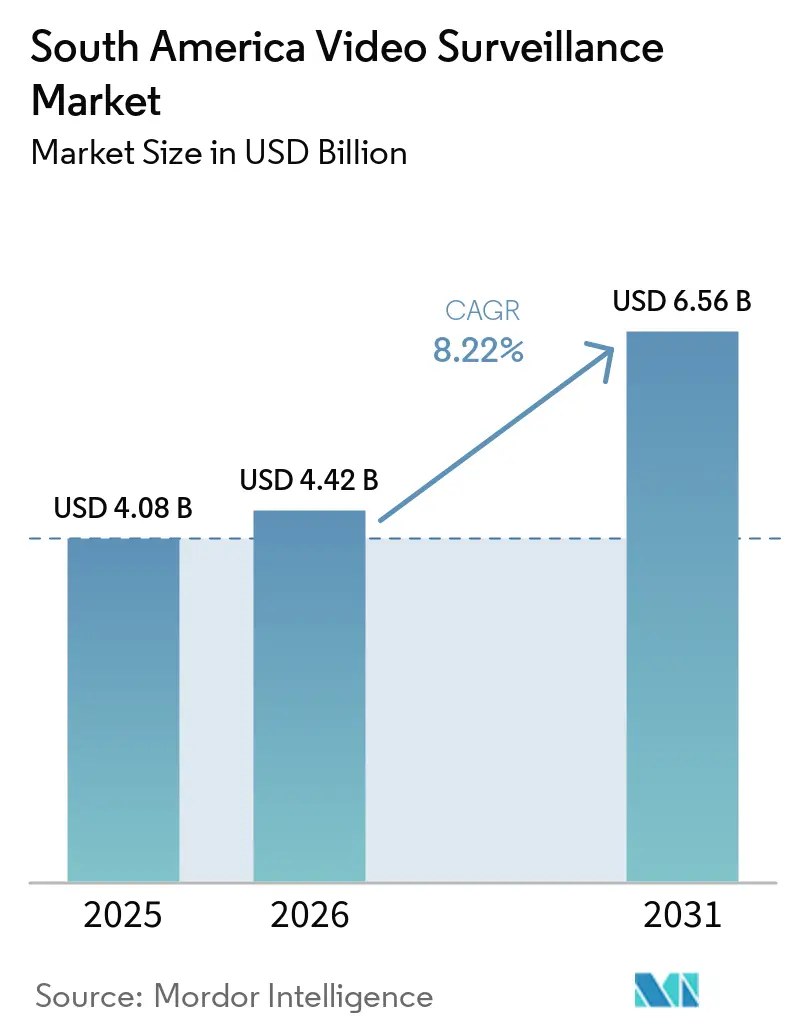
The South America video surveillance market size was valued at USD 4.08 billion in 2025 and estimated to expand from USD 4.42 billion in 2026 to reach USD 6.56 billion by 2031, at a CAGR of 8.22% during the forecast period (2026-2031). Public safety spending, high urban crime levels, and safe-city programs are increasing procurement across the region. The transition from analog systems to IP cameras is also expanding demand in secondary cities where legacy coverage remained limited. Lower prices for megapixel IP cameras are bringing smaller commercial operators and residential buyers into the customer base. Cloud subscriptions are reducing upfront costs for small and medium-sized enterprises, while telecom providers are becoming important distribution partners. Import duties, currency volatility, and shortages of specialized edge-AI chipsets may delay large installations despite available public funding.
Key Report Takeaways
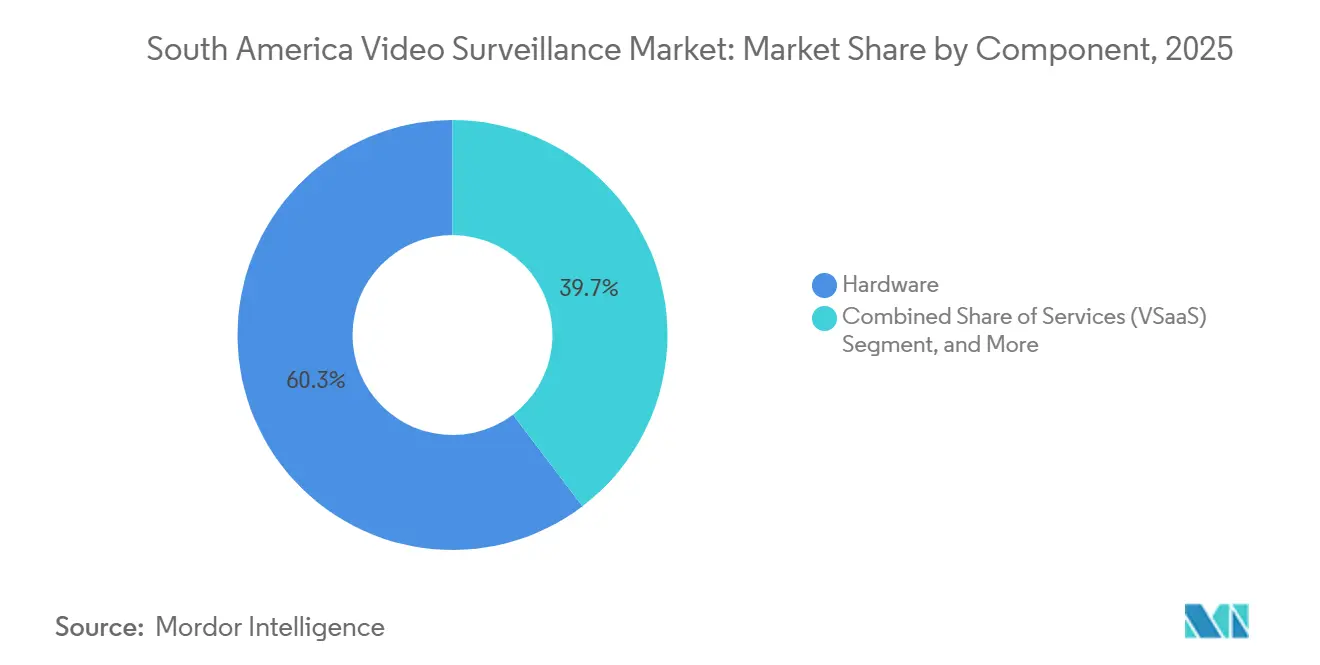
- By component, hardware held 60.33% of South America video surveillance market share in 2025, while services are projected to expand at an 8.57% CAGR through 2031.
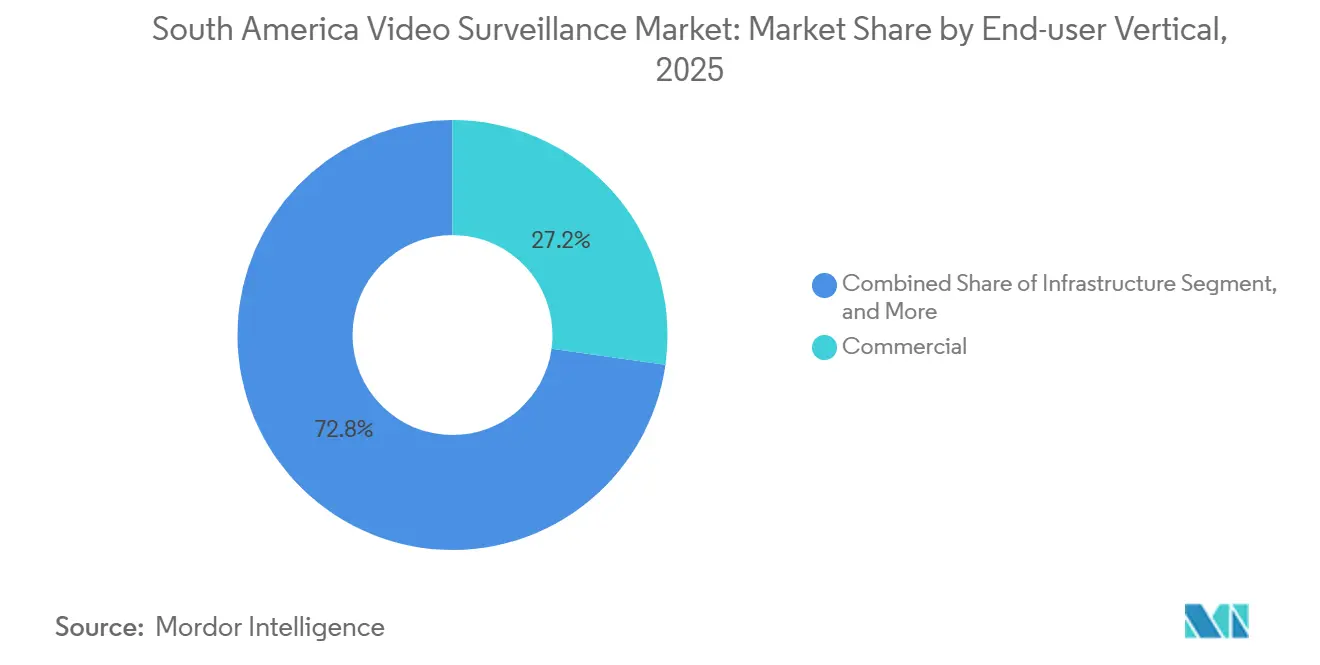
- By end-user vertical, commercial held 27.21% of South America video surveillance market share in 2025, while infrastructure is projected to expand at an 8.89% CAGR through 2031.
- By geography, Brazil held 34.68% of revenue in 2025, while Colombia is projected to expand at an 8.94% CAGR through 2031.
Note: Market size and forecast figures in this report are generated using Mordor Intelligence’s proprietary estimation framework, updated with the latest available data and insights as of January 2026.
South America Video Surveillance Market Trends and Insights
Drivers Impact Analysis*
| Driver | (~) % Impact on CAGR Forecast | Geographic Relevance | Impact Timeline |
|---|---|---|---|
| Rising Public-Safety and Security Spending | +2.3% | South America, strongest in Brazil, Colombia, and Chile | Short term (≤ 2 years) |
| Smart-City and Urban Video Infrastructure Programs | +1.8% | Brazil, Colombia, Chile, and Peru | Medium term (2-4 years) |
| Migration From Analog to IP and High-Definition Systems | +1.5% | South America, concentrated in secondary cities | Medium term (2-4 years) |
| AI Analytics for Facial Recognition, LPR, and Incident Detection | +1.2% | Brazil, Argentina, and Colombia | Long term (≥ 4 years) |
| Falling IP Camera and Storage Costs | +0.8% | South America | Short term (≤ 2 years) |
| Expansion of Cloud Video Surveillance as a Service for SMEs | +0.7% | Brazil, Colombia, and Peru | Medium term (2-4 years) |
| Source: Mordor Intelligence | |||
Rising Public-Safety and Security Spending
High urban violence levels have kept public security near the top of government spending priorities across South America. These budgets translate into procurement for cameras, software, storage, integration, and managed services within the South America video surveillance market. Rio de Janeiro significantly increased the Civitas monitoring center budget to support real-time analysis across an extensive network of integrated cameras. Major citywide deployments can encourage nearby commercial operators to upgrade systems for footage-sharing arrangements with public authorities. This extends camera coverage without equivalent public spending and supports private-sector demand. Security preparations for the upcoming FIFA World Cup also supported procurement in Brazilian host cities, leaving network capacity that can remain in operation after the event.
Smart-City and Urban Video Infrastructure Programs
The South America video surveillance market is increasingly shaped by municipal and state agencies that position camera networks within smart-city platforms instead of treating them as separate security expenses. This approach increases demand for analytics software, systems integration, sensors, and control-room capabilities. São Paulo's Muralha Paulista integrated a large network of public and private cameras, while Smart Sampa expanded its AI-enhanced camera network significantly. Seguritech signed a contract for Medellín's first integrated command center, which combines cameras, license-plate readers, and IoT sensors through the SAIMON Tech platform. Integrated procurement places greater importance on open application programming interfaces and data exchange with adjacent city systems. Peru and Chile are also advancing tenders that favor multisensor integration and cloud connectivity, which may concentrate demand among suppliers with regional delivery capacity.
Migration From Analog to IP and High-Definition Systems
The South America video surveillance market is experiencing an analog-to-IP transition across a wide group of cities with limited earlier camera deployment. Many secondary cities are making their first substantial installation instead of simply replacing an older analog estate. This supports demand in mid-sized cities where municipal security budgets can support meaningful projects. Way Brasil, TIM Brasil, and Hikvision deployed LTE-connected cameras along highways in Mato Grosso do Sul, with further expansion planned. The project shows how connectivity upgrades and camera modernization can be combined to shorten installation timelines and reduce wiring needs. As the IP installed base expands, video management and analytics platforms should benefit because hardware deployment creates a later need for software and services.
AI Analytics for Facial Recognition, LPR, and Incident Detection
AI-enabled video analytics is moving from a premium option toward a standard capability in larger South America video surveillance market procurement programs. Government mandates, public safety targets, and lower inference hardware costs support this shift. Brazil has implemented numerous facial-recognition projects, including deployments by Rio de Janeiro military police using NTechLab software on street cameras and Dahua systems on police vehicles. Rio's system contributed to a significant number of military-police arrests after its rollout, providing other agencies with a performance reference for AI-assisted screening. Brazil's proposed AI legislation remains unresolved in Congress, creating uncertainty around data retention and sharing requirements. Suppliers that include independent accuracy audits and bias assessments can be better positioned if public buyers later adopt more detailed compliance conditions.
Restraints Impact Analysis*
| Restraint | (~) % Impact on CAGR Forecast | Geographic Relevance | Impact Timeline |
|---|---|---|---|
| High Upfront and Lifecycle Costs for Advanced Systems | -1.5% | South America, most acute for SMEs and smaller national markets | Short term (≤ 2 years) |
| Privacy, Data Protection, and Facial Recognition Compliance Risk | -1.0% | Brazil, Argentina, and Chile | Medium term (2-4 years) |
| Shortage of Skilled Video Security Integrators | -0.5% | South America | Medium term (2-4 years) |
| Interoperability and Connectivity Friction Across Legacy and Cloud Systems | -0.4% | South America | Long term (≥ 4 years) |
| Source: Mordor Intelligence | |||
High Upfront and Lifecycle Costs for Advanced Systems
Advanced IP cameras, edge AI processing units, software licenses, and cloud storage can create substantial capital and operating costs within the South America video surveillance market. The burden is greatest for small and medium-sized enterprises and residential users who cannot fund large installations. Video surveillance as a service subscriptions are easing this barrier, but they have not replaced conventional capital purchases in markets with limited leasing finance. Brazilian import duties can significantly raise landed hardware costs compared with comparable North American markets, limiting purchases in price-sensitive segments. Large infrastructure agencies can use staged tenders and structured financing to manage initial costs, but smaller buyers have less negotiating power. Ongoing charges for AI model updates may also raise the lifetime cost of AI cameras and reduce the appeal of hardware-only procurement.
Privacy, Data Protection, and Facial Recognition Compliance Risk
Privacy concerns and evolving data protection requirements can delay procurements involving identifiable personal data. Brazil's National Data Protection Authority identified high risks in mass biometric surveillance in a recent Technology Radar report. Argentina proposed legislation on biometric data protection and facial-recognition rules, while rights groups also called for restrictions on remote biometric recognition. Chile's data protection law sets proportionality and transparency requirements for processing and retaining identifiable footage. Legal reviews can extend the procurement cycle for high-value public safety networks that use AI analytics. Vendors with clear data governance and storage options can reduce buyer concerns, particularly for government projects.
*Our forecasts treat driver/restraint impacts as directional, not additive. The impact forecasts reflect baseline growth, mix effects, and variable interactions.
Segment Analysis
By Component: Hardware Leads Revenue While Services Support Faster Adoption
Hardware accounted for 60.33% of the South America video surveillance market size in 2025. Public safety procurements and analog-to-IP replacement programs supported demand for cameras, storage systems, and related equipment. IP cameras are the fastest-growing camera type because agencies and large commercial operators need high-definition networked devices that can support edge analytics. Analog cameras continue to serve smaller cities that need lower-cost, gradual upgrades. Hybrid equipment also helps industrial and infrastructure operators manage mixed legacy and modern networks without replacing every system at once. Axis Communications launched the AXIS S1228 AI-Optimized Server in June 2025 with 28 simultaneous-stream processing licenses and 12 TB of local storage, supporting local AI processing for multi-camera installations.
Services are projected to expand at an 8.57% CAGR from 2026 to 2031, the highest rate in the component classification. Software is becoming more important as camera prices decline and suppliers pursue recurring licensing revenue through video analytics and video management platforms. Facial recognition and license-plate recognition deployments are supporting demand for analytical software. Telecom companies in Brazil and Peru are bundling cloud surveillance subscriptions with broadband services, which opens access for small and medium-sized enterprises.[1]Aipix, “Aipix VSaaS Solution Sounds at Expo ISP Perú 2026,” Aipix, aipix.ai. This channel can reduce reliance on traditional security integrators for smaller accounts. Eagle Eye Networks and Brivo completed their merger in December 2025, combining cloud video surveillance and access control on a managed service platform.



By End-User Vertical: Commercial Deployments Lead While Infrastructure Accelerates
Commercial users accounted for 27.21% of South America video surveillance market revenue in 2025. Retail chains, logistics warehouses, financial institutions, and hospitality operators deploy large camera networks for theft prevention and operational monitoring. Retailers in Brazil and Colombia have adopted AI analytics for people counting, queue monitoring, and behavioral anomaly detection. These functions allow video systems to serve operational purposes beyond conventional security monitoring. Institutional and residential buyers are increasing their installed base as IP cameras become more accessible. Defense remains a smaller revenue contributor but supports demand for premium equipment, specialized optics, local certifications, and government supply agreements.
Infrastructure is projected to expand at an 8.89% CAGR through 2031, making it the fastest-growing end-user vertical. Transport authorities, utilities, water-treatment operators, and port managers are integrating cameras with supervisory control systems. The use case increasingly includes traffic optimization, equipment anomaly detection, and monitoring of critical sites. Hanwha Vision supplied 2,000 AI CCTV cameras to Lima's Santiago de Surco district in August 2025, including license-plate recognition and multisensor monitoring. The purchase shows that advanced analytics are being specified at the tender stage for infrastructure-related deployments. Industrial sites in manufacturing, mining, and oil and gas can support higher-value demand for rugged, explosion-proof, and thermal imaging products that face less mass-market price pressure.
Geography Analysis
Brazil led the South America video surveillance market with a 34.68% revenue share in 2025. Federal public safety spending, state smart-city programs, and private commercial deployments support its position. Smart Sampa deployed a large network of AI-enhanced cameras, while Muralha Paulista integrated an extensive network of public and private cameras within a single command structure. The National Data Protection Authority's earlier warning on biometric surveillance is encouraging agencies to consider on-premise and hybrid storage options. Import duties materially raise landed equipment costs, supporting locally assembled products and increasing the importance of local delivery, assembly, compliance, and integration capabilities.
Colombia is projected to expand at an 8.94% CAGR from 2026 to 2031, the fastest pace among the regional countries. Municipal command and control investment supports demand in Bogotá, Medellín, and Cali. Seguritech's May 2026 contract for Medellín's C5i center combined camera feeds, sensor data, and AI analytics in one operating interface. The program provides a model for integrated security projects in other Colombian cities. Argentina remains the third-largest country market, where economic volatility coexists with demand for AI-enabled surveillance and an expanded policy basis for federal police use.[2]JURIST, “Amnesty International Decries Argentina's Expanding AI Surveillance as Tool of Social Control,” JURIST, jurist.org.
Chile is updating municipal specifications before Law 21.719 takes effect in December 2026, favoring suppliers with compliance-ready architectures. Peru and the Rest of South America are smaller but expanding parts of the South America video surveillance market. Peruvian internet service providers are bundling fiber broadband with cloud camera services for small businesses and residential customers.[3]Aipix, “Aipix VSaaS Solution Sounds at Expo ISP Perú 2026,” Aipix, aipix.ai. Ecuador, Uruguay, and Paraguay remain early-stage opportunities where rising crime concerns are beginning to translate into capital-city procurement budgets for IP cameras and video management systems.
Competitive Landscape
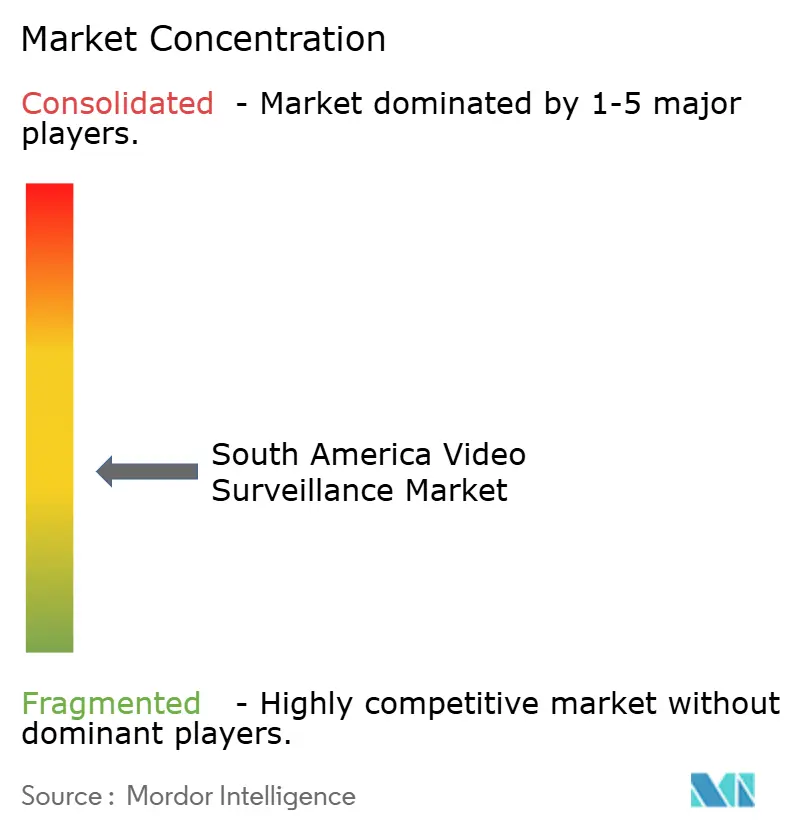
The South America video surveillance market is moderately fragmented, with Chinese volume suppliers holding strong positions through established distributors and channel networks. European and North American suppliers compete through AI capabilities, software ecosystems, cybersecurity certifications, and local technical support. Hikvision reported strong overseas business revenue and continued revenue growth in the recent reporting period. The company described its performance in emerging markets, including South America, as sustained and robust. Intelbras maintains a strong domestic position in Brazil because import duties increase the relative cost of foreign hardware and because the company has long-standing relationships with security integrators.
White-space opportunities in the South America video surveillance market include cloud surveillance for small and medium-sized enterprises, edge computing for remote industrial and mining sites, and managed services for logistics and e-commerce warehouses. Verkada and Eagle Eye Networks are among the cloud-native entrants offering systems that reduce reliance on on-premise recording equipment. These systems can suit small and mid-sized customers that lack dedicated on-site IT teams. Genetec is gaining relevance among enterprise and infrastructure buyers that prefer open-architecture video management systems over proprietary ecosystems. Government specifications that require interoperability have reinforced interest in that model.
The Eagle Eye Networks and Brivo merger in December 2025 created an integrated cloud security platform spanning video surveillance, access control, and AI analytics. In the South America video surveillance market, competition also depends on localized product features, including national license-plate formats and Spanish and Portuguese interfaces. Local distributors matter because inventory availability, field support, and installation capability can influence tender outcomes. Suppliers that combine hardware, software, compliance support, local service, and flexible deployment models are better aligned with the region's procurement requirements.
South America Video Surveillance Industry Leaders
Hangzhou Hikvision Digital Technology Co., Ltd.
Zhejiang Dahua Technology Co., Ltd.
Intelbras S.A. Indústria de Telecomunicação Eletrônica Brasileira
Axis Communications AB
Motorola Solutions, Inc.
- *Disclaimer: Major Players sorted in no particular order

Recent Industry Developments
- August 2026: Hanwha Vision opened its Hanwha Innovation and Technology Experience Center in São Paulo, its second such facility in South America, providing enterprise and government customers a dedicated venue to evaluate the Wisenet 9 AI camera portfolio, including multisensor panoramic and license-plate recognition models. The opening reflects the company's intent to deepen local channel relationships and win specification-stage inclusion in large infrastructure tenders across Brazil.
- August 2026: Dahua Technology and Grupo NSO jointly presented AI-enabled onboard monitoring solutions for São Paulo's public-transit fleet, integrating real-time video analytics into bus surveillance to support operator safety and incident management. The collaboration positions Dahua's urban-transport analytics proposition ahead of expected public-transit security tenders across other South American capitals.
- July 2026: São Paulo's Smart Sampa surveillance network reached a milestone of 50,000 AI-enhanced cameras, cementing its status as one of the largest municipal surveillance deployments in South America. The program integrates facial recognition and real-time incident detection and is being tracked by peer cities across the continent as a replicable public-safety model.
- May 2026: Seguritech signed a contract to construct and operate Medellín's first C5i integrated command center in Colombia, incorporating thousands of cameras, license-plate readers, and IoT sensors through its SAIMON Tech platform. The contract establishes Seguritech as a reference operator for large-scale integrated security management in Colombia and creates a proof-of-concept for replication in other major cities.


South America Video Surveillance Market Report Scope
South America Video Surveillance Market refers to the ecosystem of hardware, software, and services used to capture, transmit, store, and analyze video footage for security, safety, and operational monitoring across the region. It includes analog, IP, and hybrid cameras; DVRs, NVRs, and storage; video management software; video analytics; monitors; and related infrastructure and services.
The South America Video Surveillance Market Report is Segmented by Component (Hardware, Software, and Services (VSaaS)), End-user Vertical (Commercial, Infrastructure, Institutional, Industrial, Defense, and Residential), and Geography (Brazil, Argentina, Chile, Colombia, and Peru). The Market Forecasts are Provided in Terms of Value (USD).
| Hardware | Cameras | Analog Cameras |
| IP Cameras | ||
| Hybrid Cameras | ||
| Storage | ||
| Software | Video Analytics | |
| Video Management Software | ||
| Services (VSaaS) |
| Commercial |
| Infrastructure |
| Institutional |
| Industrial |
| Defense |
| Residential |
| Brazil |
| Argentina |
| Chile |
| Colombia |
| Peru |
| Rest of South America |
| By Component | Hardware | Cameras | Analog Cameras |
| IP Cameras | |||
| Hybrid Cameras | |||
| Storage | |||
| Software | Video Analytics | ||
| Video Management Software | |||
| Services (VSaaS) | |||
| By End-user Vertical | Commercial | ||
| Infrastructure | |||
| Institutional | |||
| Industrial | |||
| Defense | |||
| Residential | |||
| By Geography | Brazil | ||
| Argentina | |||
| Chile | |||
| Colombia | |||
| Peru | |||
| Rest of South America | |||


Key Questions Answered in the Report
What is the South America video surveillance market size?
The South America video surveillance market size is estimated at USD 4.42 billion in 2026 and is forecast to reach USD 6.56 billion by 2031 at an 8.22% CAGR. The forecast covers 2026 to 2031 and reflects hardware, software, and cloud-delivered services.
What is driving demand for video surveillance in South America?
Public safety budgets, smart-city projects, analog-to-IP migration, and lower camera prices are supporting adoption. Broadband-linked subscriptions are widening access for smaller users that previously had limited capacity for large capital purchases.
Which component leads revenue in South America?
Hardware led with 60.33% of revenue in 2025, supported by public safety demand for cameras, storage, and related equipment. Services are the fastest-expanding component because cloud subscriptions can lower adoption barriers for small and medium-sized enterprises.
Which end-user vertical is expanding fastest?
Infrastructure is projected to expand at an 8.89% CAGR through 2031 as transport, utility, water-treatment, and port operators deploy integrated systems. These systems support security monitoring, traffic management, equipment checks, and perimeter protection at critical sites.
Which country leads regional video surveillance revenue?
Brazil led with a 34.68% revenue share in 2025, supported by public safety programs, smart-city activity, and commercial deployments. Colombia is forecast to record the fastest country-level CAGR as municipal command centers and private-sector upgrades continue.
What limits adoption of advanced surveillance systems?
High upfront and lifetime costs, privacy rules, limited integrator capacity, and connectivity challenges can slow installations. These factors matter most for smaller buyers and projects that need advanced analytics, wide-area connectivity, or integration with older systems.
Page last updated on:





