
South America Urban Design Market Size and Share
Market Overview
| Study Period | 2020 - 2031 |
|---|---|
| Forecast Data Period | 2026 - 2031 |
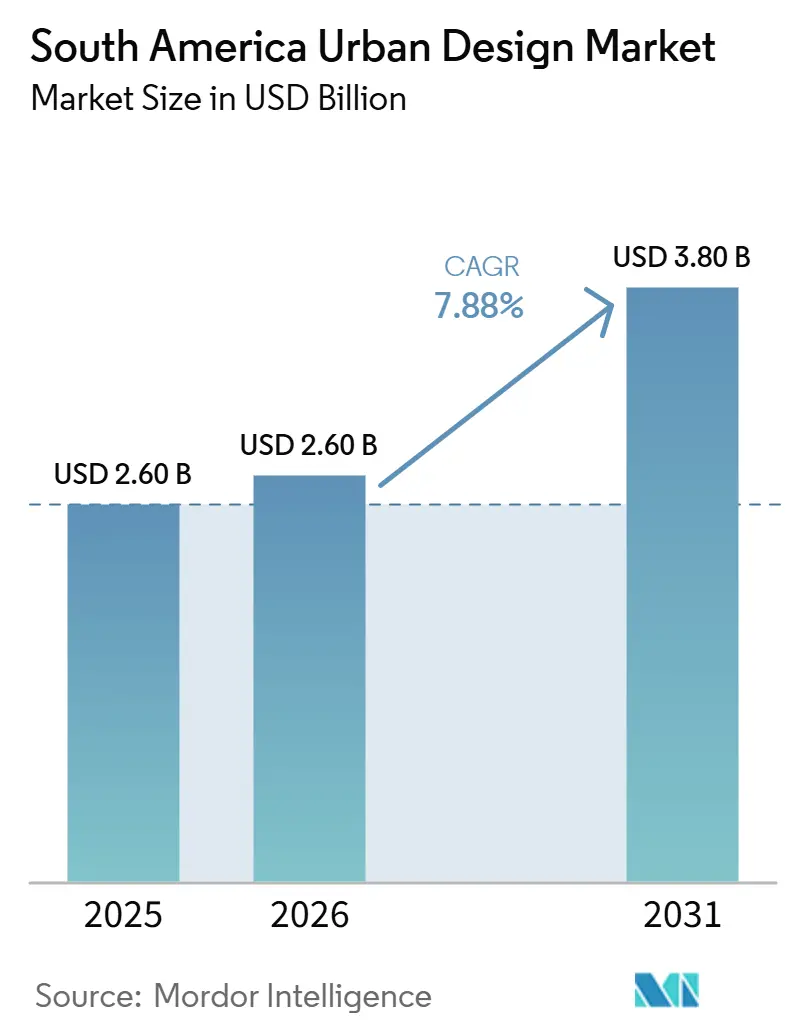
| Base Year Market Size (2025) | USD 2.60 Billion |
| Market Size (2026) | USD 2.60 Billion |
| Market Size (2031) | USD 3.80 Billion |
| Growth Rate (2026 - 2031) | 7.88 % |
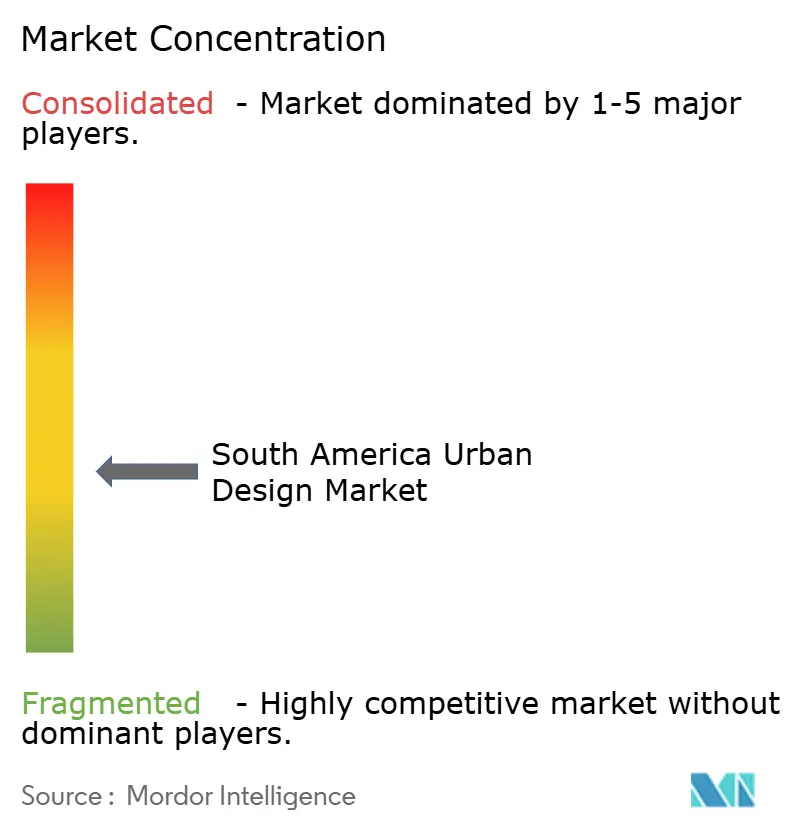
| Market Concentration | Medium |
Major Players *Disclaimer: Major Players sorted in no particular order Image © Mordor Intelligence. Reuse requires attribution under CC BY 4.0. | |
South America Urban Design Market Analysis by Mordor Intelligence
The South America Urban Design Market size is expected to increase from USD 2.60 billion in 2025 to USD 2.60 billion in 2026 and reach USD 3.80 billion by 2031, growing at a CAGR of 7.88% over 2026-2031. The South America urban design market is supported by a shift from outward city expansion toward denser, better connected urban areas. Public agencies remain central buyers because transit programs, neighborhood renewal, and climate planning require coordinated land-use and public-realm work. Private developers are also bringing planning teams into projects earlier, especially for mixed-use districts where zoning, mobility, and infrastructure decisions affect project feasibility. The South America urban design market therefore favors firms that can handle design delivery and local approval requirements in the same engagement. Regulatory uncertainty remains a material constraint because permit disputes can stop construction activity and defer advisory assignments.
Key Report Takeaways
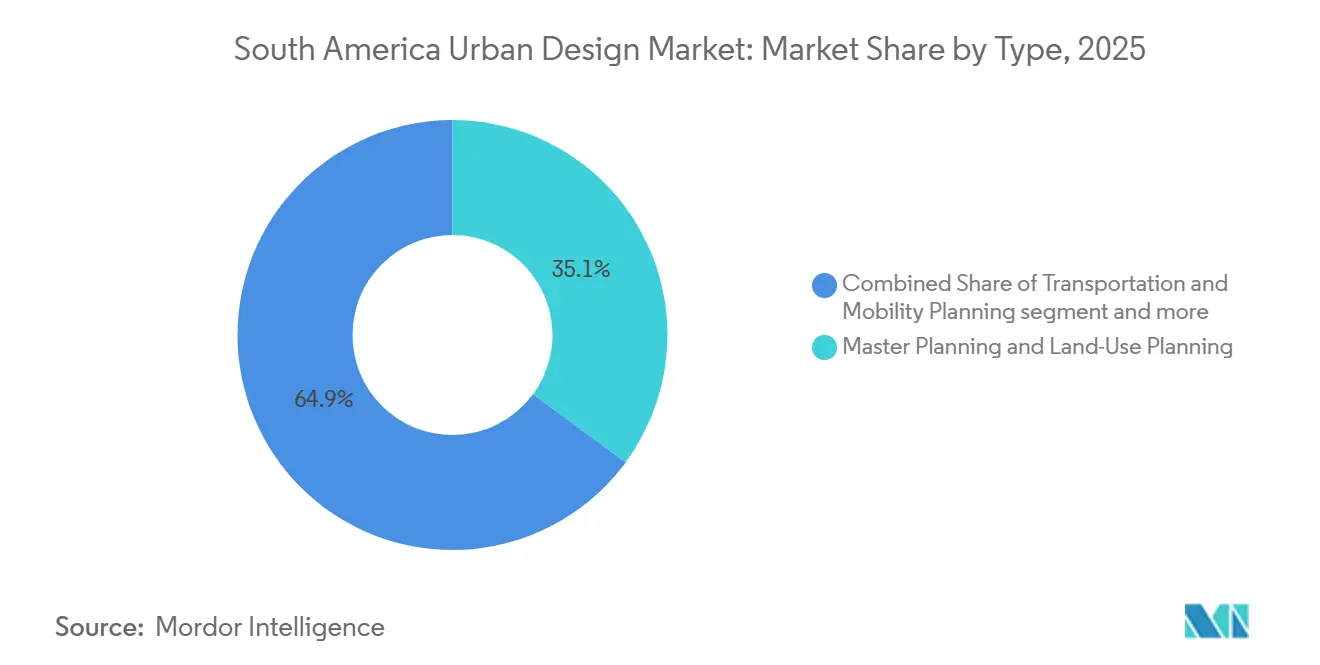
- By type, master planning and land-use planning held 35.1% of the South America urban design market share in 2025, while Transportation and Mobility Planning recorded the highest projected CAGR at 8.7% through 2031.
- By sector, mixed-use and township developments accounted for 41.3% of the South America urban design market share in 2025, while Transportation and Infrastructure recorded the highest projected CAGR at 9.1% through 2031.
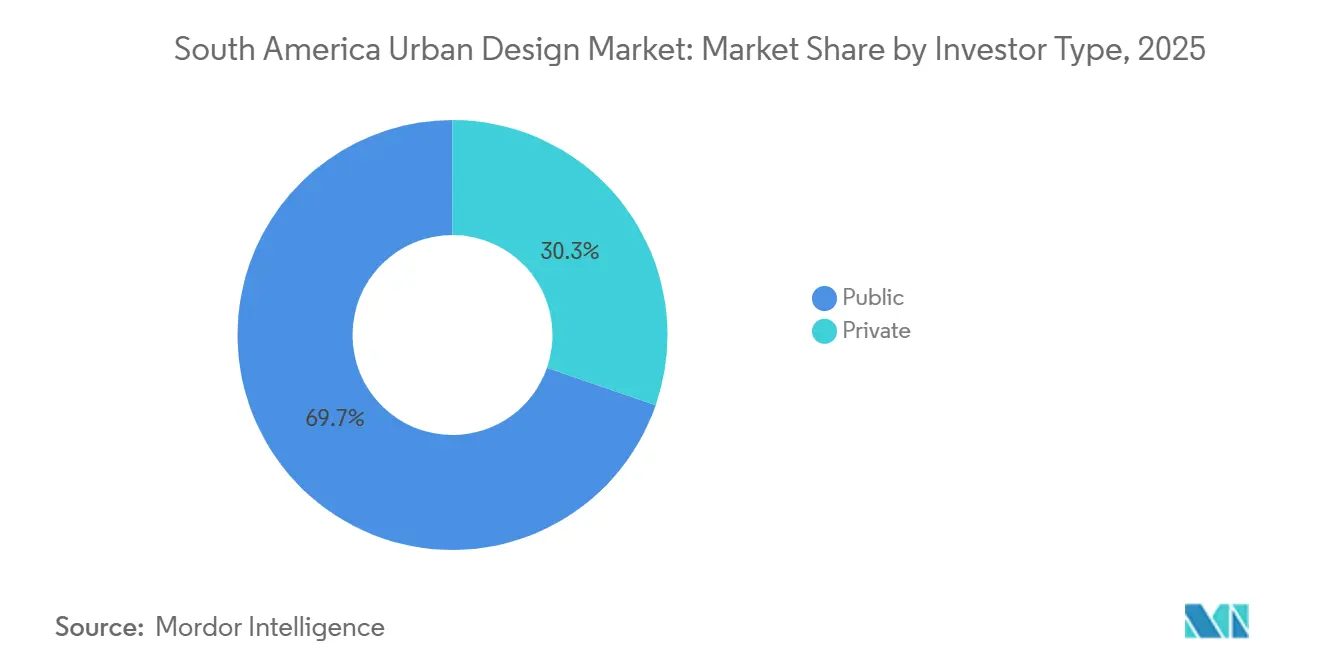
- By investor type, public clients held 69.7% of the South America urban design market share in 2025, while private clients recorded the highest projected CAGR at 9.5% through 2031.
- By geography, Brazil held 55.2% of the South America urban design market share in 2025, while the Rest of South America recorded the highest projected CAGR at 10.2% through 2031.
Note: Market size and forecast figures in this report are generated using Mordor Intelligence’s proprietary estimation framework, updated with the latest available data and insights as of January 2026.
South America Urban Design Market Trends and Insights
Drivers Impact Analysis*
| Drivers | (~) % Impact on CAGR Forecast | Geographic Relevance | Impact Timeline |
|---|---|---|---|
| Urban Population Growth | +2.2% | Brazil, Colombia, Peru | Short term (≤ 2 years) |
| Infrastructure and Transit Investment | +1.9% | Brazil, Colombia, Chile, Rest of South America | Medium term (2-4 years) |
| Urban Regeneration and Redevelopment | +1.6% | Brazil, Argentina, Chile | Medium term (2-4 years) |
| Climate-Resilient Urban Development | +1.1% | Brazil and Andean cities | Long term (≥ 4 years) |
| Demand for Mixed-Use Development | +0.9% | Brazil, Chile, Colombia, Argentina | Medium term (2-4 years) |
| Demand for Walkable Communities | +0.9% | Brazil, Chile, Colombia, Argentina | Medium term (2-4 years) |
| Source: Mordor Intelligence | |||
Urban Population Growth
South America had an urbanization rate of 88.7% in 2026, which shifts planning demand toward the quality and capacity of established cities rather than basic urban expansion. The South America urban design market is therefore increasingly shaped by inner-city rezoning, transit-corridor density, and mixed-use infill. Planning briefs now need to address how existing districts absorb more residents, workers, and daily trips without weakening access to public space. This changes the role of master planning from a peripheral growth tool to a framework for redevelopment and coordinated infrastructure. It also extends demand beyond major capitals when secondary metropolitan areas need land-use and mobility plans that respond to their own growth pressures.
Infrastructure and Transit Investment
Transit investment is a direct source of demand for station-area plans, transit-oriented districts, and public-realm redesign. Brazil's National Urban Mobility Study mapped 187 projects across 21 metropolitan areas and identified investment needs of up to BRL 500 billion (USD 87.7 billion) through 2054. The study includes an objective to double the metro network and quadruple the capacity of BRT and VLTs, which supports a sustained pipeline for mobility planning. BNDES committed USD 1.1 billion to urban-mobility projects in São Paulo in March 2026. In Bogotá, Decree 229 established 13 Multimodal Integration Areas and 13 Sustainable Mobility Urban Renewal Projects along the first metro line. The South American urban design market benefits when these projects shift from transport engineering to land-use planning, station access, and community-scale design.
Urban Regeneration and Redevelopment
Urban renewal is creating longer planning assignments because redevelopment programs combine land-use, transportation, housing, and public-space decisions. In July 2026, Rio de Janeiro enacted Complementary Law No. 301 for the Praça Onze Maravilha Special Urban Interest Area. The program commits BRL 1.7 billion (USD 298 million) over 20 years to transform 458,000 m² of the historic city center and create 37,000 residential units. It also provides for a Metro Line 2 extension, connecting the redevelopment area to an upstream mobility improvement. Such arrangements bring planning and infrastructure work together, thereby reducing the uncertainty faced by private co-investors and widening the scope of urban design appointments.
Climate-Resilient Urban Development
Climate planning is adding recurring work to municipal planning assignments because cities must translate risk information into plans, drainage priorities, and development rules. Brazil launched the Green Resilient Model Cities Programme in 2024 and selected 50 municipalities for its first phase of climate-adaptive planning support. The AdaptAÇÃO Project, presented at COP30 in November 2025, supports the use of climate-risk indicators in municipal master plans for 50 selected municipalities. São Paulo State adopted its PEARC climate adaptation and resilience plan in June 2025, following the incorporation of more than 600 public contributions. The South American urban design market can attract recurring assignments in plan reviews and implementation work, where consultants combine environmental engineering with municipal planning.
Restraints Impact Analysis*
| Restraints | (~) % Impact on CAGR Forecast | Geographic Relevance | Impact Timeline |
|---|---|---|---|
| Lengthy Approval and Zoning Processes | -1.4% | Brazil, Colombia, Peru | Short term (≤ 2 years) |
| High Land and Infrastructure Costs | -1.0% | Brazil, Argentina, Chile | Medium term (2-4 years) |
| Community Opposition and Stakeholder Conflicts | -0.7% | Peru, Colombia, Brazil | Medium term (2-4 years) |
| Shortage of Qualified Urban Planning Professionals | -0.6% | Region-wide, most acute in secondary cities | Long term (≥ 4 years) |
| Source: Mordor Intelligence | |||
Lengthy Approval and Zoning Processes
Approval complexity can delay design commissions before work reaches the design stage. In March 2026, an injunction suspended building-permit issuance in São Paulo after a legal challenge to the January 2024 zoning-map update. The episode showed how a procedural dispute can interrupt new construction authorizations across a large municipality. The South America urban design market is exposed to this risk because clients frequently defer planning appointments when site entitlements or infrastructure approvals remain uncertain. Local firms with established knowledge of municipal procedures may be better able to manage the added coordination work. The same condition can raise pre-investment risk for developers and reduce the annual volume of projects that enter the design pipeline.
High Land and Infrastructure Costs
High land and infrastructure costs can limit the feasibility of mid-scale projects while pushing investment toward dense mixed-use schemes. A 2025 study of Santiago found that pericentral areas near metro stations saw strong land-value uplift as transit proximity became reflected in purchase prices. This condition can restrict access for lower-income households in districts intended to support walkable development. Public authorities may need concession structures or certificate-based finance when they cannot fund improvements directly. Those arrangements add legal, financial, and planning work before design activity can begin. They can sustain demand for complex advisory services, but they can also lengthen project preparation and raise delivery risk.
*Our forecasts treat driver/restraint impacts as directional, not additive. The impact forecasts reflect baseline growth, mix effects, and variable interactions.
Segment Analysis
By Type: Master Planning Leads While Mobility Planning Expands
Master Planning and Land-Use Planning held 35.1% of the South America urban design market size in 2025. This position reflects the need for comprehensive planning in public procurement and private developer due diligence. Major plans increasingly bring land-use decisions together with mobility requirements and public infrastructure. The scope of work is moving beyond conventional architectural concepts because transit access, density, and public space must be addressed within one plan. This can direct a greater share of fees toward multidisciplinary engineering and planning teams. Allos launched the 450,000 m² Masterplan Parque Dom Pedro in Campinas in June 2026, and the Ramblas del Plata plan in Buenos Aires covered 895,000 m². These examples show that major plans can create multiyear engagement pipelines for the planning firms retained on them. It also makes master planning an early stage service that can remain active throughout project delivery.
Transportation and Mobility Planning is projected to grow at a CAGR of 8.7% through 2031. The South America urban design market is supported by metro extensions, BRT corridors, and intermodal hubs across Brazil, Colombia, and Chile. Public-realm and landscape work increasingly complements transit-led master plans, rather than operating as a separate design package. Arcadis contributed to Parque da Cidade in Belém, where wetlands-based sewage treatment was incorporated into a park setting completed for COP30. Zoning, development control, and implementation advisory also become more important when municipalities revise legacy codes for transit-oriented density. This expands the billable work beyond preparation of the initial plan.



By Sector: Mixed-Use Development Provides Scale While Infrastructure Grows Faster
Mixed-Use and Township Developments accounted for 41.3% of the South America urban design market size in 2025. The segment reflects the convergence of residential, retail, workplace, and public-space requirements within larger urban districts. Developers are moving away from single-use projects and toward more integrated development formats. This makes planning work broader because teams need to coordinate access, density, community facilities, and site phasing. Such commissions often extend across multiple years from concept through delivery. The South America urban design industry benefits when planning is retained throughout that period instead of being limited to a single design stage.
Transportation and Infrastructure is expected to record a CAGR of 9.1% through 2031. The expansion is linked to Brazil's planned metro, BRT, and VLT capacity growth, which requires sustained mobility and land-use coordination. Transit projects generate demand for station districts, pedestrian access, public-realm design, and implementation advice. Public, civic, and institutional developments remain an important and relatively stable source of work. They include municipal buildings, schools, hospitals, and cultural facilities. However, this segment is more exposed to fiscal constraints, particularly where public budgets are under pressure. The South America urban design market has a stronger opportunity where infrastructure programs are paired with formal urban renewal or station-area planning frameworks.
By Investor Type: Public Funding Anchors Demand While Private Clients Accelerate
Public clients held 69.7% of the South America urban design market size in 2025. National governments, development banks, and municipal authorities continue to initiate a large share of major planning assignments. This position is reinforced by urban mobility programs and public procurement requirements. Public commissions can also include compliance work tied to lender and environmental standards. Brazil allocated BRL 37 billion, equivalent to USD 6.5 billion, to the Urban Mobility PAC for electric buses and LRT systems. These requirements can raise the value of advisory work because technical, environmental, and implementation issues must be coordinated. At the same time, public demand remains sensitive to budget timing, regulatory approval, and the pace of concession awards.
Private clients are forecast to expand at a CAGR of 9.5% through 2031. Developers, private equity funds, and real estate investment vehicles are bringing urban design advisers into project origination rather than treating planning as a late cost. IRSA appointed a masterplan team for its 70-hectare Ramblas del Plata development in Buenos Aires, while Allos engaged planning consultants at the concept stage for Parque Dom Pedro. Large mixed-use plans illustrate this shift because land-use rights and mobility access can affect the value of a site before construction begins. Private commissions increasingly include early zoning and land-use advice, which adds a new source of advisory revenue. Firms with public-law knowledge and municipal planning capability can be well positioned for this work. The South America urban design market gains when early planning helps investors assess entitlement risk and site potential.
Geography Analysis
Brazil accounted for 55.2% of the South America urban design market share in 2025. Its position reflects the combination of public procurement, private real estate capital, and infrastructure concession activity. São Paulo's transport investments can generate work around station areas, transit-oriented districts, and public-realm improvements. In 2026, individual metro lines received BRL 1.06 billion and BRL 996 million in state-budget allocations. Rio de Janeiro's Praça Onze Maravilha program adds a significant renewal mandate with a planned Metro Line 2 extension. Brazil's Green Resilient Model Cities Programme also requires selected municipalities to address climate-related planning needs.
Argentina and Chile remain important markets with different demand conditions. Argentina's private capital supports large urban-regeneration and mixed-use planning work despite macroeconomic uncertainty. Ramblas del Plata combines 10,000 residential units, more than 200 retail outlets, and a 32-hectare public park. Secondary cities such as Córdoba and Rosario are also relevant for transit-oriented and mixed-use assignments. Chile's demand is shaped by a mature institutional framework and greater focus on urban quality rather than basic expansion. In Santiago, higher values around metro stations illustrate the challenge of combining accessibility objectives with affordability. These conditions require planning teams to balance density, transport access, and public-space outcomes.
The Rest of South America is projected to grow at a CAGR of 10.2% through 2031. Colombia and Peru contribute through infrastructure, urban-renewal, and metropolitan planning activity. The Regiotram del Norte bidding process was confirmed for launch before the end of July 2026, with a project value of COP 17.4 trillion, equivalent to USD 4.2 billion. Bogotá's formal designation of 13 Multimodal Integration Areas and 13 Sustainable Mobility Urban Renewal Projects creates a defined planning framework along the first metro line. Peru shows activity in secondary cities through metropolitan planning and transit-oriented mixed-use development. Paraguay, Bolivia, Ecuador, and Uruguay add opportunities through downtown regeneration, compact-city development, and urban expansion. The cluster's growth outlook reflects the broader geographic spread of planning needs beyond the region's largest national markets.
Competitive Landscape
The South America urban design market has moderate consolidation at the upper tier. AECOM, WSP Global, Arcadis, Jacobs Solutions, and AtkinsRéalis compete for mandates that require engineering depth and cross-border delivery capability. Their scale is most relevant for government and multilateral-backed projects with complex infrastructure needs. The specialist and mid-market tiers remain more fragmented. ENR placed WSP Global, AECOM, and Arcadis among the top 4 global building-sector firms by international revenue in its 2025 ranking. Architecture-led firms such as Gensler, HOK, Perkins&Will, and Sasaki Associates compete for private mixed-use and campus master plans. This division allows local specialists to retain opportunities in zoning, landscape, and community-scale commissions that larger engineering firms may not pursue.
Local regulatory knowledge, sustainability capability, and data-led design methods increasingly separate competitors. Arcadis applied laser scanning and chromatic differentiation to distinguish original and replicated structural elements at Porto Futuro II in Belém. The project shows how technical heritage capability can extend a firm's role beyond standard renovation work. Arcadis also supported Parque da Cidade in Belém through an approach that combined public space with environmental infrastructure. Gensler has used equity-focused urban-design research for Latin America to position its work for public-sector and nonprofit clients that require participatory planning approaches. Perkins&Will has expanded its South American portfolio through work in Chile's international-school sector and a healthcare-campus conversion in Rio de Janeiro. These strategies reflect a shift toward specialized capabilities that can be applied across public and private commissions.
ISO 37101 and IFC Performance Standards are becoming more relevant to procurement requirements, which can favor firms with established compliance experience. This may create barriers for smaller entrants that lack documented certification records or multidisciplinary delivery teams. At the same time, secondary-city master planning remains an opening for firms with local presence and strong coordination capability. The Rest of South America cluster has planning needs that can exceed local capacity in more complex, co-financed projects. Global firms may have limited local coverage in some of these locations. Competition therefore varies by project scale, funding structure, and the degree of local regulatory knowledge needed.
South America Urban Design Industry Leaders
AECOM
Jacobs Solutions Inc.
WSP Global Inc.
Arcadis N.V.
Stantec Inc.
- *Disclaimer: Major Players sorted in no particular order

Recent Industry Developments
- July 2026: Rio de Janeiro's city government enacted Complementary Law No. 301 establishing the Praça Onze Maravilha Special Urban Interest Area, committing BRL 1.7 billion (approximately USD 298 million) over 20 years to transform 458,000 m² of the historic city centre, create 37,000 residential units, and enable a Metro Line 2 extension, one of the largest urban regeneration frameworks enacted by a South American municipality in recent years.
- July 2026: Brazil's government disclosed BRL 150 billion, equivalent to USD 26.3 billion, under discussion in amendments to existing São Paulo highway and metro concessions. The proposals included potential new metro stations on Lines 5 and 6 and would require changes to station-adjacent public-realm and urban-connectivity frameworks.
- July 2026: Bogotá's Alcaldía Mayor issued Decree 229, which demarcated 13 Multimodal Integration Areas and 13 Urban Renewal Projects for Sustainable Mobility along the first metro line. The decree established a planning framework for zoning and urban-design advisory along the transit corridor.
- June 2026: Allos launched the Masterplan Parque Dom Pedro in Campinas, a 450,000 m² mixed-use development with up to 17 planned towers. The company had secured the first construction permits for 4 towers, pointing to more complex master-planning activity in São Paulo State's secondary cities.


South America Urban Design Market Report Scope
| Master Planning and Land-Use Planning |
| Urban Design, Public Realm and Landscape Design |
| Transportation and Mobility Planning |
| Zoning, Development Control and Implementation Advisory |
| Others |
| Mixed-Use and Township Developments |
| Transportation and Infrastructure |
| Public, Civic and Institutional Developments |
| Others |
| Public |
| Private |
| Brazil |
| Argentina |
| Chile |
| Colombia |
| Peru |
| Rest of South America |
| By Type | Master Planning and Land-Use Planning |
| Urban Design, Public Realm and Landscape Design | |
| Transportation and Mobility Planning | |
| Zoning, Development Control and Implementation Advisory | |
| Others | |
| By Sector | Mixed-Use and Township Developments |
| Transportation and Infrastructure | |
| Public, Civic and Institutional Developments | |
| Others | |
| By Investor Type | Public |
| Private | |
| By Country | Brazil |
| Argentina | |
| Chile | |
| Colombia | |
| Peru | |
| Rest of South America |


Key Questions Answered in the Report
What is the projected value of South America urban design in 2031?
The South America urban design market is forecast to reach USD 3.8 billion by 2031, growing at a CAGR of 7.9% from 2026 to 2031. The outlook reflects continued demand for regeneration, mobility, and climate-related planning work.
Which service type is the largest in South America urban design?
Master Planning and Land-Use Planning was the largest type, with 35.1% share in 2025. It remains important because public authorities and developers need integrated land-use, infrastructure, and public-space frameworks before projects move forward.
Which service is growing fastest in the region?
Transportation and Mobility Planning is forecast to grow at 8.7% CAGR through 2031. Metro, BRT, and intermodal programs create work on station areas, access routes, transit-oriented development, and supporting public-realm design.
Why do public clients remain important for urban design providers?
Public clients held 69.7% share in 2025 because governments and municipal authorities initiate major mobility, renewal, and climate-planning assignments. Their projects also often require implementation, environmental, and lender compliance coordination.
Page last updated on:





