
South America Single Use Packaging Market Size and Share
Market Overview
| Study Period | 2020 - 2031 |
|---|---|
| Forecast Data Period | 2026 - 2031 |
| Base Year Market Size (2025) | USD 1.82 Billion |
| Market Size (2026) | USD 1.89 Billion |
| Market Size (2031) | USD 2.29 Billion |
| Growth Rate (2026 - 2031) | 3.91 % |
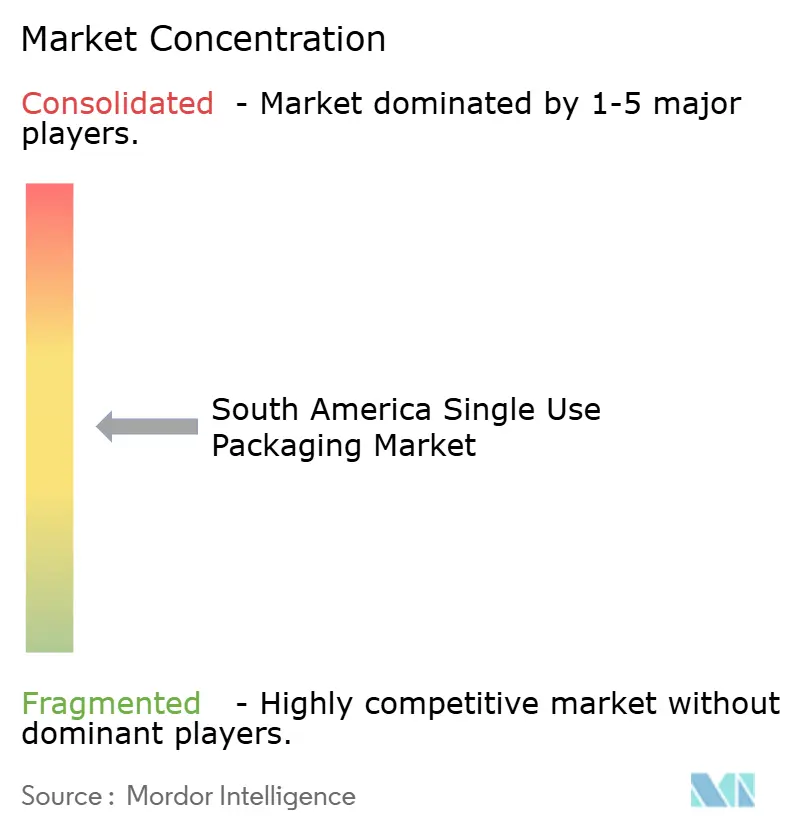
| Market Concentration | Medium |
Major Players *Disclaimer: Major Players sorted in no particular order Image © Mordor Intelligence. Reuse requires attribution under CC BY 4.0. | |
South America Single Use Packaging Market Analysis by Mordor Intelligence
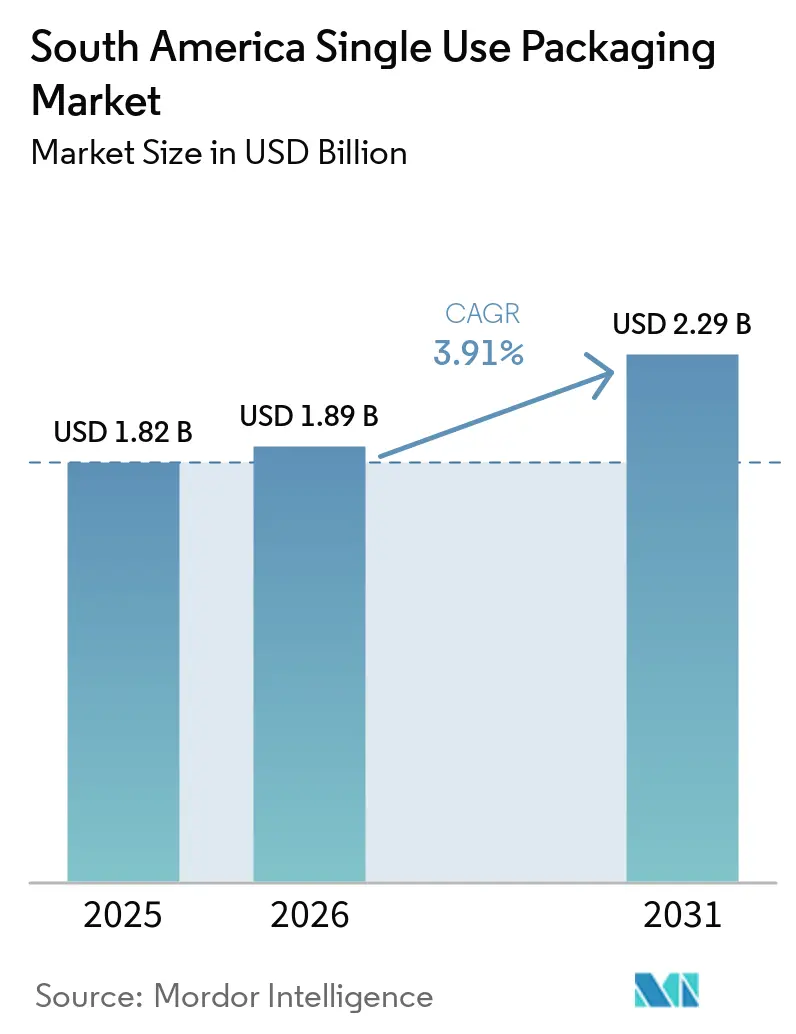
The South America single use packaging market size was valued at USD 1.82 billion in 2025 and is estimated to expand from USD 1.89 billion in 2026 to USD 2.29 billion by 2031, at a CAGR of 3.91% during the forecast period 2026-2031. Urbanization and the wider reach of organized foodservice are increasing the need for packaging that protects food during transport and service. Delivery platforms, quick-service restaurants, and digital fulfillment networks are raising demand for sealed containers, pouches, wraps, and tamper-evident formats. Regulatory requirements are also shifting procurement toward recyclable mono-material formats and verified recycled content. This favors suppliers that can provide dependable materials, technical support, and documented compliance across South America single use packaging market operations.
Key Report Takeaways
- By material, polyethylene held 35.05% of South America single use packaging market share in 2025, while other materials are projected to expand at a 4.47% CAGR through 2031.
- By product type, bottles held 36.14% of South America single use packaging market share in 2025, while pouches and sachets are projected to expand at a 4.67% CAGR through 2031.
- By end-use industry, food and beverages held 28.82% of the South America single use packaging market size in 2025, while quick-service restaurants are projected to expand at a 4.64% CAGR through 2031.
- By distribution channel, direct sales held 73.41% of the South America single use packaging market share in 2025 and are projected to expand at a 4.81% CAGR through 2031.
- By geography, Brazil held 44.13% of the South America single use packaging market share in 2025, while Colombia is projected to expand at a 4.63% CAGR through 2031.
Note: Market size and forecast figures in this report are generated using Mordor Intelligence’s proprietary estimation framework, updated with the latest available data and insights as of January 2026.
Market Trends and Insights
Drivers Impact Analysis of South America Single Use Packaging Market*
| Driver | (~) % Impact on CAGR Forecast | Geographic Relevance | Impact Timeline |
|---|---|---|---|
| Food Delivery and Quick-Service Restaurant Expansion | +1.1% | Brazil, Colombia, Argentina | Short term (≤ 2 years) |
| Packaged Food and Beverage Processing Growth | +0.8% | Brazil, Argentina | Medium term (2-4 years) |
| E-Commerce and Quick-Commerce Fulfillment Demand | +0.7% | Brazil, Colombia | Short term (≤ 2 years) |
| Recyclable Mono-Material Conversion | +0.5% | Brazil, Chile, Colombia | Medium term (2-4 years) |
| Cold-Chain and Fresh-Produce Export Expansion | +0.3% | Brazil, Argentina | Long term (≥ 4 years) |
| Regional Nearshoring and Packaging Capacity Localization | +0.3% | Colombia, Argentina | Long term (≥ 4 years) |
| Source: Mordor Intelligence | |||
Food Delivery and Quick-Service Restaurant Expansion
Brazil’s food delivery sector was the world’s fourth largest by revenue in 2025 and is expected to reach USD 29.5 billion by 2030. The number of users is projected to reach 90.5 million by 2028. Meituan’s Keeta entered Brazil in 2025, while 99Food returned with BRL 2 billion (USD 0.4 billion). iFood committed BRL 17 billion (USD 2.98 billion) through March 2026, increasing competition among delivery platforms. These platforms increase demand for tamper-evident containers, thermal liners, and resealable pouches that protect food during delivery and preserve presentation quality across multi-leg urban routes. Firehouse Subs also announced plans in January 2025 to open more than 500 Brazilian restaurants over 10 years, which supports standardized packaging demand across its franchise network.
Packaged Food and Beverage Processing Growth
Brazil’s flexible plastic packaging sector generated BRL 40.1 billion (USD 7.04 billion) in gross revenue in 2025, rising 6.2% from the preceding year. Agricultural flexible packaging consumption rose 9.7% in 2025, while the agro-industrial segment increased 10.1%. Production reached 2.321 million tons against installed capacity of 3.297 million tons, leaving capacity available for further conversion to shelf-ready packaged goods. This available capacity can serve branded food producers moving from unpackaged formats to packaged stock-keeping units without a material near-term need for greenfield plants. Formal retail expansion in secondary cities is raising packaging intensity in protein, dairy, and ambient grocery categories, where branded product presentation and transport requirements are increasing. Beverage producers are also using more portion-controlled bottles, cans, and aseptic pouches across different price points and distribution channels.
E-Commerce and Quick-Commerce Fulfillment Demand
Mercado Libre committed USD 13.2 billion across South America in 2025 to expand distribution infrastructure, an increase of 36% from the preceding year. Its 2025 annual report identified kitting and specialized co-packing as logistics activities expanding at a 12.46% CAGR. These services increase demand for scan-ready labels, retail-ready cartons, and protective single-use mailers that move through standardized fulfillment processes. Dark-store networks in São Paulo, Buenos Aires, and Santiago need packaging that withstands rapid pick-and-sort handling without secondary consolidation. Marketplace requirements for drop performance, dimensional efficiency, and barcode readability make packaging part of platform compliance rather than a basic procurement item. The South America single use packaging market therefore benefits from demand for flexible pouches, polybags, and lightweight rigid containers that meet these operating requirements.
Recyclable Mono-Material Conversion
Brazil’s Federal Decree No. 12,688, issued in October 2025, requires large companies to use at least 22% post-consumer recycled content in plastic packaging from January 2026.[1] The minimum requirement rises to 30% by 2030 and 40% by 2040. The decree also requires participation in a national reverse-logistics system with a 32% recovery target for 2026. Braskem made its first commercial sale of chemically recycled circular polyethylene in South America to Copobras Group in July 2025. ANVISA recognizes chemically recycled resin as equivalent to virgin-origin material for food-contact uses, supporting compliant packaging for chilled food and pharmaceutical applications. Mono-material designs simplify sorting and can improve collection economics, which reinforces converter interest in structures designed around a single recoverable material.
Restraints Impact Analysis of South America Single Use Packaging Market*
| Restraint | (~) % Impact on CAGR Forecast | Geographic Relevance | Impact Timeline |
|---|---|---|---|
| Extended Producer Responsibility and Single-Use Plastic Restrictions | -0.6% | Brazil, Argentina, Colombia | Short term (≤ 2 years) |
| Food-Grade Post-Consumer Resin Scarcity | -0.4% | Brazil, Colombia | Medium term (2-4 years) |
| Polymer Price and Currency Volatility | -0.4% | Brazil, Argentina | Short term (≤ 2 years) |
| Fragmented Collection and Recycling Infrastructure | -0.3% | Regional, with severity in Argentina, Peru | Long term (≥ 4 years) |
| Source: Mordor Intelligence | |||
Extended Producer Responsibility and Single-Use Plastic Restrictions
Federal Decree No. 12,688 requires manufacturers, importers, distributors, and retailers to participate in a national reverse-logistics system for plastic packaging. The system has a 32% recovery target for 2026 and a 50% target for 2040. Buenos Aires and Córdoba introduced local limits on plastic clamshells and lidded cups in foodservice. These rules shift some demand to fiber-based products and add compliance requirements for national brands. Mid-sized converters may need 2 to 3 years for investment, certification, and customer reapproval. The South America single use packaging market is consequently placing greater value on scale, certification capability, and compliant material supply.
Food-Grade Post-Consumer Resin Scarcity
South America had an estimated 4,000-7,000 metric tons of food-grade post-consumer recycled resin capacity in 2026, covering 20-30% of regional demand. Brazil’s plastic recycling rate stood at 25-30%, but less than 5% of recycled material met food-contact purity requirements. Mixed collection, limited solid-state polymerization capacity, and uneven near-infrared sorting constrain supply and prevent larger volumes from meeting demanding primary-contact specifications. The shortage is greatest in pharmaceutical and chilled-food packaging because ANVISA requires barrier performance and decontamination traceability for primary-contact materials. Braskem’s Wenew platform and Cazoolo design lab support recyclable package design and compliant resin sourcing. Braskem stated in July 2026 that production-scale availability of post-consumer recycled resin would remain constrained in the medium term.
*Our forecasts treat driver/restraint impacts as directional, not additive. The impact forecasts reflect baseline growth, mix effects, and variable interactions.
South America Single Use Packaging Market Segment Analysis
By Material:
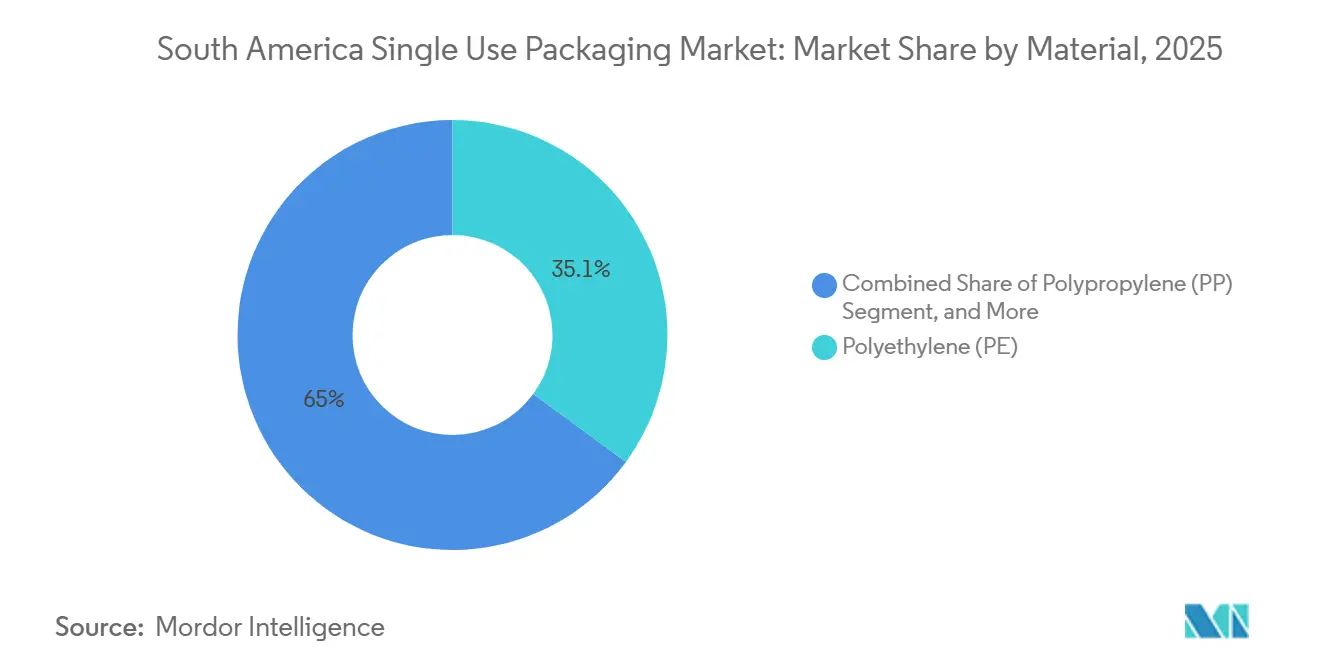
PE Anchors Volume as Bio-Based Grades Gain GroundPolyethylene held 35.05% of the South America single use packaging market share in 2025. Its position reflects broad use in flexible food films, shrink wrap, and stand-up pouch substrates. These applications serve food and beverages, quick-service restaurants, and personal care producers. LDPE and LLDPE together accounted for 73% of Brazilian flexible packaging production volume in 2025. Polypropylene accounted for 15% of Brazilian flexible packaging production and remains relevant for rigid cups, trays, and lids.
Polystyrene remained in foam trays, cups, and clamshells, although municipal restrictions in Buenos Aires and Bogotá limited its addressable demand. PET production reached 807 thousand tons in Brazil in 2025 and supported natural juice, dairy protein, and home-care formats. Other materials, including polylactic acid and bio-based formats, are projected to expand at a 4.47% CAGR through 2031. Braskem's 275,000 tons per year bio-based polyethylene capacity gives buyers an industrial-scale alternative for mono-material packaging. Bio-based PE sales volumes rose 49% in the second quarter of 2026 compared with the first quarter of 2026, reflecting improved commercial opportunities and seasonal effects.

By Product Type:
Bottles Dominate as Pouches and Sachets Drive Next-Cycle GrowthBottles held 36.14% of the South America single use packaging market size in 2025. Beverage producers depend on PET bottles for carbonated soft drinks, water, edible oil, and juices. The region's population and export activity support recurring demand across these categories. Brazil maintained 807 thousand tons of virgin PET resin production in 2025. Clamshells remain common for fresh-produce retail in Colombia and Argentina.
Trays, cups, and lids gain from quick-service restaurant expansion into secondary cities. Films and wraps serve fresh protein and produce exports that need barrier performance and reliable sealing. Pouches and sachets are projected to expand at a 4.67% CAGR through 2031. Their demand is supported by condiment packaging, e-commerce grocery fulfillment, and personal care refill formats. Amcor installed a Moda Vac rotary vacuum chamber sealing system in Brazil during June 2026 with Barra Mansa Alimentos, illustrating the role of equipment programs in promoting high-barrier protein packaging.
By End-Use Industry:
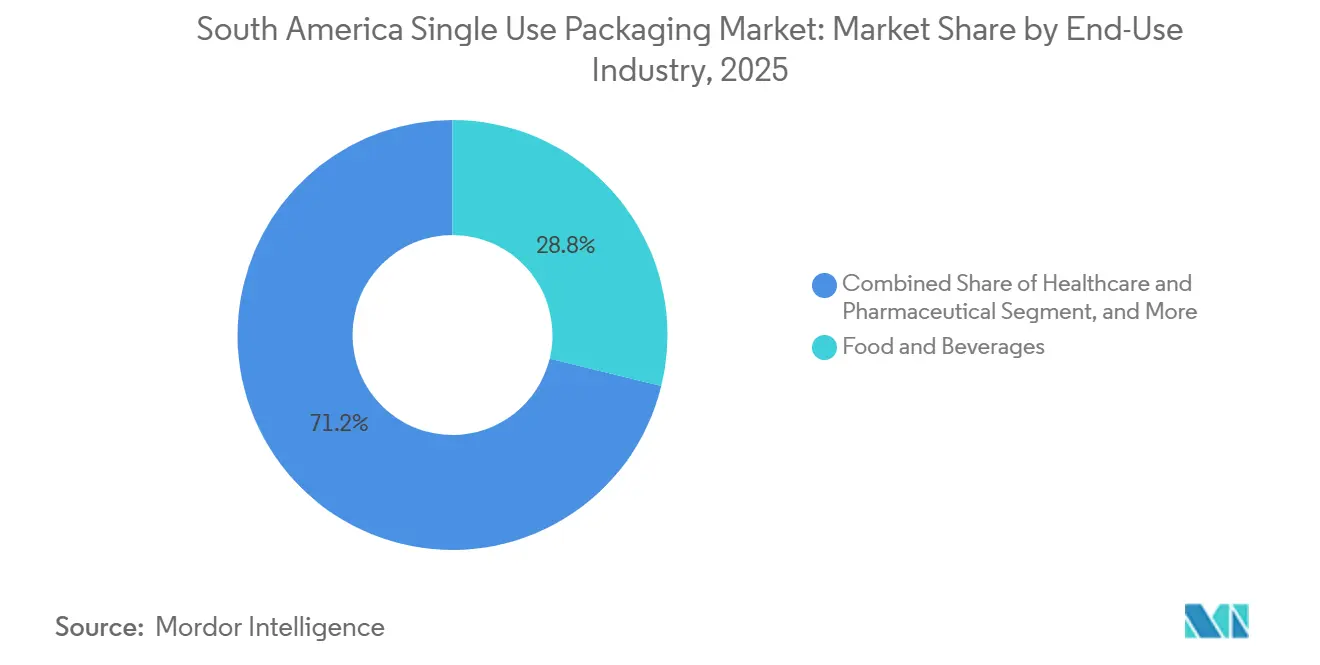
Food and Beverages Lead as QSR Expands FastestFood and beverages held 28.82% of the South America single use packaging market share in 2025. Brazil's role as a large agricultural processor supports demand for packaging used in proteins, grains, and fresh produce. Brazilian flexible packaging generated BRL 40.1 billion (USD 6.9 billion) in gross revenue in 2025. Healthcare and pharmaceutical packaging gains from cold-chain medicine distribution and vaccine logistics in second-tier cities. Personal care and cosmetics producers are moving from multi-layer sachets toward mono-material refillable formats.[2]
Full-service restaurants provide stable demand for multi-portion trays and film-sealed catering platters. Quick-service restaurants are projected to expand at a 4.64% CAGR through 2031. These businesses use individual sauces, cutlery kits, condiment pouches, and sealed protein servings for each customer visit. Food and beverage franchise revenue reached BRL 79.86 billion (USD 13.7 billion) in 2025 after 15.6% expansion. Other end-use settings, including industrial and institutional foodservice, add volume where bulk catering expands in Peru, Ecuador, and Bolivia.
By Distribution Channel:
Direct Sales Command Sustained Volume and GrowthDirect sales held 73.41% of the South America single use packaging market share in 2025. Food processors, quick-service restaurant franchise networks, and FMCG manufacturers purchase directly from converters or integrated resin producers. The model supports volume commitments, custom tooling amortization, and consistent quality standards. Marketplace operators are also formalizing long-term packaging supply agreements as fulfillment networks expand. Direct sales are projected to expand at a 4.81% CAGR through 2031.
Indirect sales serve smaller foodservice businesses, independent restaurants, and regional personal care brands. These customers often cannot meet direct converter minimum order quantities. Distributors provide credit, inventory buffering, and fractional order quantities. Digital catalogs are widening access to packaging materials for smaller buyers in Medellín, Fortaleza, and Belém. This can move some channel activity from traditional distributors to digital intermediaries without changing direct sales leadership for large customers.
Geography Analysis
Brazil Single Use Packaging Market
Brazil held 44.13% of the South America single use packaging market share in 2025, supported by its large food-processing base, e-commerce activity, and comparatively established packaging compliance environment. Federal Decree No. 12,688 requires market operators to participate in reverse logistics from January 2026, embedding compliance spending into procurement and investment decisions. Amcor installed its Moda rotary vacuum sealing technology in Brazil with Barra Mansa Alimentos in June 2026.[3] The first deployment in the country serves the protein-packaging channel and reflects demand for advanced vacuum packaging systems. Brazil’s delivery sector, pharmaceutical traceability requirements, and generic-drug pipeline support demand for tamper-evident, thermally stable, serialized, and compliant primary packaging.
Colombia Single Use Packaging Market
Colombia is projected to record the fastest regional CAGR of 4.63% through 2031. CANPACK announced a USD 140 million greenfield aluminum can plant near Barranquilla in September 2025, under a long-term agreement with Bavaria. The facility is expected to begin production in Q1 2027 and has capacity for 1 billion can bodies each year. ProColombia projected domestic packaging production to reach 10.5 billion units, supported by petrochemical inputs, pulp supply, and glass manufacturing. These conditions can reduce import dependence and support the country’s transition from a packaging import destination to a regional manufacturing base for circular packaging products.
Argentina and Broader South America Single Use Packaging Market
Argentina’s recovery supports packaged-goods consumption and demand from organized retail and foodservice. The OECD projected gross domestic product expansion of 2.8% in 2026 and 3.5% in 2027, driven by agricultural exports, energy development, and critical-minerals investment. Provincial restrictions in Buenos Aires and Córdoba have shifted foodservice demand toward fiber-based products, creating an opportunity for paper and molded-pulp converters. The rest of South America includes Chile, Peru, Ecuador, Uruguay, Bolivia, and Paraguay, where pharmaceutical cold chains, produce exports, and beef-shipment corridors support demand for high-barrier and export-specification packaging.
Competitive Landscape
The South America single use packaging market is moderately fragmented. Amcor, Sealed Air, Sonoco Products Company, Huhtamäki, and ALPLA compete with regional specialists including Valgroup, ZARAPLAST, Klabin, Coveris, and Constantia Flexibles. Regional suppliers compete through price, local customer relationships, and short lead times. Amcor completed its acquisition of Berry Global in April 2025. The combined consumer packaging company had annualized revenue above USD 23 billion.
Amcor reported USD 285 million in synergies in fiscal 2026, which was 10% ahead of its initial projection. CD&R completed its acquisition of Sealed Air in April 2026 at an enterprise value of USD 10.3 billion. Sealed Air stockholders received USD 42.15 per share in cash. The change in ownership supports investment in protective and flexible packaging innovation and geographic expansion. Braskem is developing recyclable mono-material and bio-based resin options for the packaging value chain.
Food-grade recycled-resin supply, pharmaceutical packaging in Colombia and Argentina, and cold-chain flexible formats are important areas of competition. Kurma Descartáveis Sustentáveis and OEKO Bioplásticos focus on bioplastic and compostable single-use products. Mid-sized Brazilian converters face pressure from compliance costs, recycled-content requirements, and consolidation. DataMatrix printing and digital traceability are becoming important capabilities for suppliers serving regulated pharmaceutical applications.
South America Single Use Packaging Industry Leaders
-
Amcor plc
-
Sealed Air Corporation
-
Sonoco Products Company
-
Huhtamäki Oyj
-
Mondi plc
- *Disclaimer: Major Players sorted in no particular order
South America Single Use Packaging Market Companies Covered in this Report
- Amcor plc
- Sealed Air Corporation
- Mondi plc
- Sonoco Products Company
- Huhtamäki Oyj
- Coveris Management GmbH
- Constantia Flexibles Group GmbH
- ALPLA Werke Alwin Lehner GmbH & Co KG
- Plastipak Holdings, Inc.
- Braskem S.A.
- ZARAPLAST Packaging Industry and Commerce Ltda.
- Petropack S.A.
- Videplast Indústria de Plásticos Ltda.
- Valgroup
- Lord Brasil Indústria e Comércio de Embalagens Ltda.
- Globalpack Indústria e Comércio de Embalagens Ltda.
- Soluplex Indústria e Comércio de Embalagens Ltda.
- Kurma Descartáveis Sustentáveis Ltda.
- OEKO Bioplásticos Ltda.
- C-Pack Creative Packaging Ltda.
- Revpack Indústria de Plásticos Ltda.
- Real Plastic Indústria e Comércio de Embalagens Ltda.
- Klabin S.A.
- Suzano S.A.
- Smurfit Westrock plc
Recent Industry Developments in South America Single Use Packaging Market
- August 2026: Klabin reported the completion of a decade-long investment cycle totaling BRL 30 billion (USD 5.26 billion) in forest and industrial expansion, shifting the company toward a cash-generation phase with no significant capital expenditure planned before 2030. Q2 2026 packaging revenue reached BRL 1.59 billion (USD 279 million), a 5% increase year on year, supported by a 3% rise in corrugated cardboard prices and a 4% volume increase in paperboard and kraftliner.
- July 2026: Suzano established Arbex, a global tissue paper joint venture with Kimberly-Clark, after paying USD 1.3 billion for a 51% stake. Arbex launched operations on July 1, 2026, with annual revenue of USD 3.5 billion (BRL 18.1 billion) and includes Kimberly-Clark’s tissue production and sales outside the United States across 22 facilities in 14 countries, including South American sites.
- June 2026: Amcor installed its Moda high-speed rotary vacuum chamber sealing system in Brazil through a partnership with Barra Mansa Alimentos. This was the first deployment of the technology in the country, and all 3 Moda Vac lines are expected to operate by the end of 2026. The lines can replace up to 9 conventional belt chamber machines and support protein-packaging efficiency.
- April 2026: Braskem showcased I’m Green bio-based polyethylene grades for food-contact applications and Medcol V7040 for healthcare and hygiene at interpack 2026 in Düsseldorf. The company offered sugarcane-derived plastics for these applications commercially for the first time.
South America Single Use Packaging Market Report Scope
The South America Single Use Packaging Market refers to the industry involved in the production, distribution, and use of disposable packaging solutions for one-time use across food and beverage, healthcare, personal care, e-commerce, retail, and industrial applications throughout the region.
The South America Single Use Packaging Market Report is Segmented by Material (Polyethylene Terephthalate (PET), Polyethylene (PE), Polypropylene (PP), Polystyrene (PS), and Other Materials), Product Type (Bottles, Pouches and Sachets, Clamshells, Trays, Cups and Lids, Films and Wraps, and Other Product Types), End-Use Industry (Quick-Service Restaurants (QSR), Full-Service Restaurants (FSR), Food and Beverages, Healthcare and Pharmaceutical, Personal Care and Cosmetics, and Other End-Use Industries), Distribution Channel (Direct Sales, and Indirect Sales), and Geography (Brazil, Argentina, Colombia, and Rest of South America). The Market Forecasts are Provided in Terms of Value (USD).
Segmentation Overview
| Polyethylene Terephthalate (PET) |
| Polyethylene (PE) |
| Polypropylene (PP) |
| Polystyrene (PS) |
| Other Materials |
| Bottles |
| Pouches and Sachets |
| Clamshells |
| Trays, Cups, and Lids |
| Films and Wraps |
| Other Product Types |
| Quick-Service Restaurants (QSR) |
| Full-Service Restaurants (FSR) |
| Food and Beverages |
| Healthcare and Pharmaceutical |
| Personal Care and Cosmetics |
| Other End-Use Industries |
| Direct Sales |
| Indirect Sales |
| Brazil |
| Argentina |
| Colombia |
| Rest of South America |
| By Material | Polyethylene Terephthalate (PET) |
| Polyethylene (PE) | |
| Polypropylene (PP) | |
| Polystyrene (PS) | |
| Other Materials | |
| By Product Type | Bottles |
| Pouches and Sachets | |
| Clamshells | |
| Trays, Cups, and Lids | |
| Films and Wraps | |
| Other Product Types | |
| By End-Use Industry | Quick-Service Restaurants (QSR) |
| Full-Service Restaurants (FSR) | |
| Food and Beverages | |
| Healthcare and Pharmaceutical | |
| Personal Care and Cosmetics | |
| Other End-Use Industries | |
| By Distribution Channel | Direct Sales |
| Indirect Sales | |
| By Geography | Brazil |
| Argentina | |
| Colombia | |
| Rest of South America |
Key Questions Answered in the Report
What is the South America single use packaging market size?
The South America single use packaging market size is estimated at USD 1.89 billion in 2026 and is forecast to reach USD 2.29 billion by 2031, registering a CAGR of 3.91% during the forecast period.
Which material leads demand in South America?
Polyethylene led the material category with a 35.05% market share in 2025, driven by its extensive use in flexible films, shrink wraps, and pouch substrates.
Which product format is expanding fastest?
Pouches and sachets are projected to be the fastest-growing product format, expanding at a CAGR of 4.67% through 2031, supported by demand from condiment packaging, grocery fulfillment, and refill applications.
Why are quick-service restaurants important to packaging suppliers?
Quick-service restaurants (QSRs) are expected to grow at a CAGR of 4.64% through 2031 and require high volumes of sealed servings, condiment pouches, and cutlery kits, driving packaging demand.
Which country has the largest demand base?
Brazil accounted for the largest demand base, holding a 44.13% market share in 2025, supported by its large consumer economy, food processing industry, and agricultural export sector.
What is the main challenge for packaging converters?
Limited availability of food-grade post-consumer resin (PCR), along with increasing recycled-content requirements and polymer price volatility, continues to create procurement and regulatory compliance challenges for packaging converters.