
Market Overview
| Study Period | 2020 - 2031 |
|---|---|
| Forecast Data Period | 2026 - 2031 |
| Base Year Market Size (2025) | USD 541.45 Million |
| Market Size (2026) | USD 565.60 Million |
| Market Size (2031) | USD 703.49 Million |
| Growth Rate (2026 - 2031) | 4.46 % |
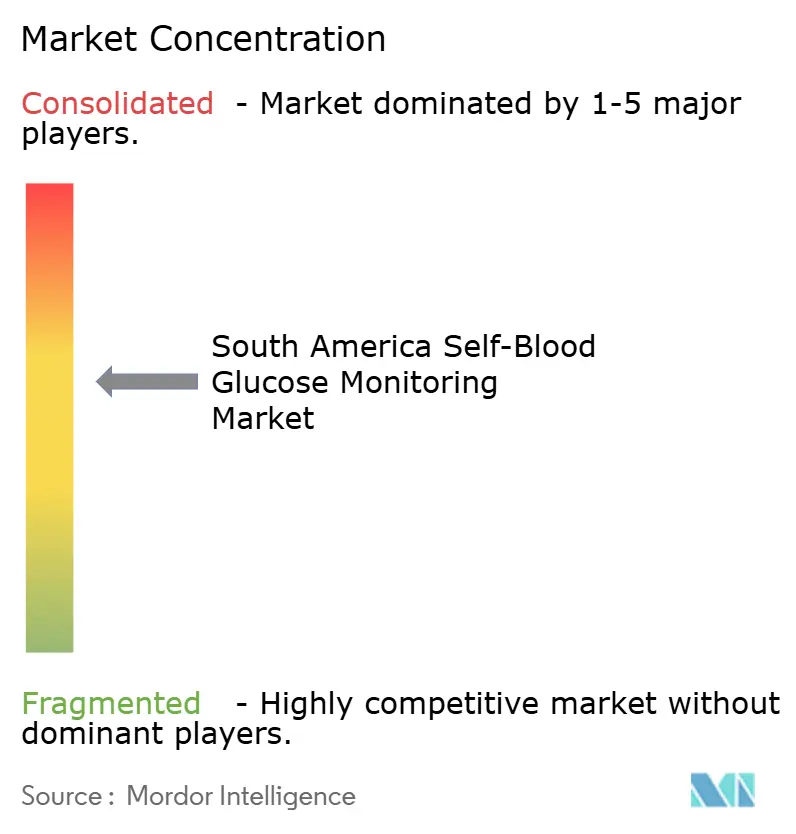
| Market Concentration | Medium |
Major Players *Disclaimer: Major Players sorted in no particular order Image © Mordor Intelligence. Reuse requires attribution under CC BY 4.0. | |
South America Self-Blood Glucose Monitoring Market Analysis by Mordor Intelligence
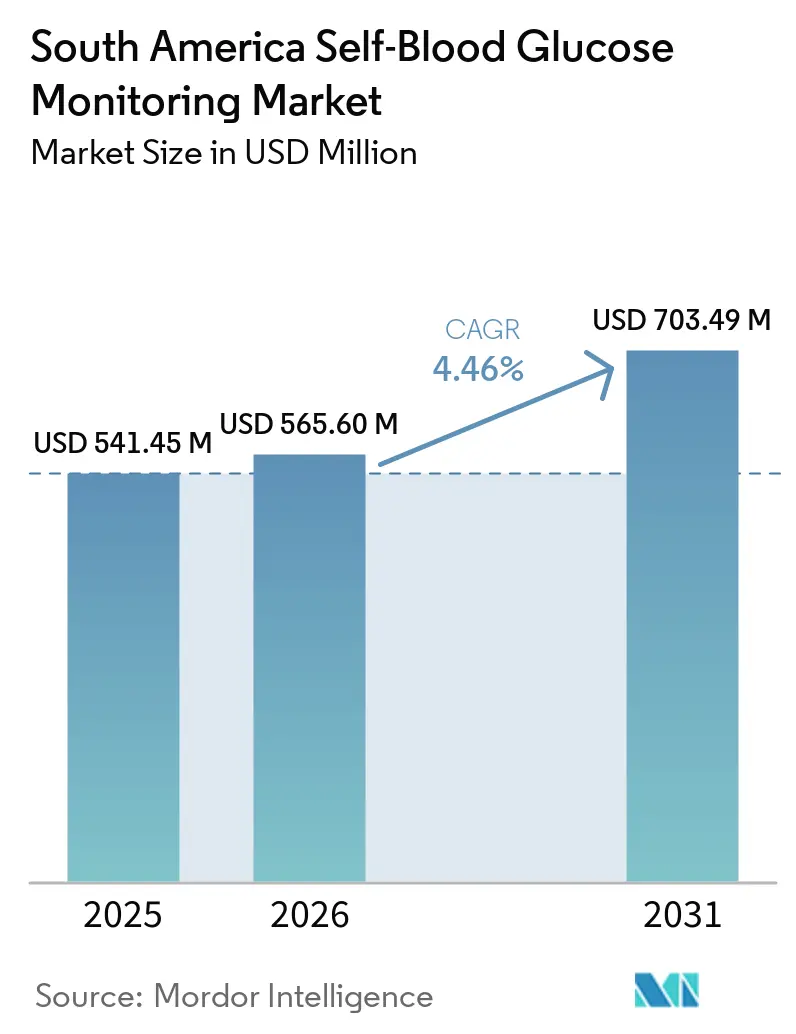
The South America Self-Blood Glucose Monitoring Market size is expected to increase from USD 541.45 million in 2025 to USD 565.60 million in 2026 and reach USD 703.49 million by 2031, growing at a CAGR of 4.46% over 2026-2031.
Diabetes care needs remain the central source of demand because many adults require routine glucose checks outside a clinic. The region had 35.4 million adults with diabetes in 2024, and 30.4%, or 10.7 million people, were undiagnosed, which leaves a large group that may need monitoring after diagnosis. Diabetes-related expenditure in South and Central America totaled USD 81 billion in 2024, equal to 8% of global diabetes spending. Public reimbursement gives suppliers steady tender demand, while retail and online channels extend access for people who pay directly. The South America self-blood glucose monitoring market, therefore, continues to rely on affordable supplies, reliable distribution, and products that fit home-based care.
Key Report Takeaways
- By component, test strips held 82.31% revenue share in 2025 and are expected to have the highest CAGR of 5.58% through 2031.
- By diabetes type, Type 2 diabetes held 89.24% revenue share in 2025, while gestational diabetes is expected to have the highest CAGR of 7.22% through 2031.
- By distribution channel, retail pharmacies held 46.14% revenue share in 2025, while online pharmacies are projected to have a CAGR of 7.82% through 2031.
- By end user, homecare held 58.65% revenue share in 2025 and is expected to have the highest CAGR of 5.65% through 2031.
- By country, Brazil held 52.61% revenue share in 2025 and is projected to have a CAGR of 6.25% through 2031.
Note: Market size and forecast figures in this report are generated using Mordor Intelligence’s proprietary estimation framework, updated with the latest available data and insights as of January 2026.
Market Trends and Insights
Drivers Impact Analysis of South America Self-Blood Glucose Monitoring Market*
| Driver | (~) % Impact on CAGR Forecast | Geographic Relevance | Impact Timeline |
|---|---|---|---|
| Rising Diabetes Prevalence and Undiagnosed Burden | +0.8% | Pan-regional, strongest in Brazil and Argentina | Long term (≥ 4 years) |
| Public Provision and Reimbursement of SMBG Supplies | +0.7% | Brazil, Argentina, and Chile | Medium term (2-4 years) |
| Home-Based Self-Management and Digital Enablement | +0.6% | Brazil and Argentina urban centers, with spillover to Colombia and Chile | Medium term (2-4 years) |
| Retail and E-Pharmacy Fulfillment Expansion | +0.5% | Brazil, Colombia, Chile, and secondary cities | Short term (≤ 2 years) |
| Meter-Strip Ecosystem Lock-In | +0.5% | Private and public channels across the region | Long term (≥ 4 years) |
| Omnichannel Pharmacy Programs Improving Adherence | +0.3% | Brazil and Chile, with spillover to major Argentine cities | Short term (≤ 2 years) |
| Source: Mordor Intelligence | |||
Rising Diabetes Prevalence and Undiagnosed Burden
The South America self-blood glucose monitoring market is supported by the large number of adults who live with diabetes without a diagnosis. The IDF recorded 35.4 million adults with diabetes in South and Central America in 2024. It also reported that 10.7 million adults were undiagnosed, representing 30.4% of adults with diabetes. These individuals may require entry-level meters and supplies when screening identifies their condition. Brazil had 17 million people with diabetes in 2024, which made it the region’s largest source of patient demand. Screening activity converts a previously unmonitored population into people who need regular testing, although out-of-pocket costs can limit testing frequency.
Public Provision and Reimbursement of SMBG Supplies
Public reimbursement gives the South America self-blood glucose monitoring market a predictable institutional sales channel. Brazil’s public health system has provided glucometers and test strips without charge to insulin-dependent patients under Portaria nº 2.583 since 2007[1]. Product specifications in these tenders influence which suppliers can compete for public contracts. Argentine obras sociales and PAMI also support access to self-monitoring supplies, although currency depreciation raises procurement costs. Brazil’s national health technology assessment process did not add flash CGM to the public system in its January 2025 recommendation, leaving conventional monitoring supplies relevant for covered patients. Tender access can give suppliers multiyear volume visibility that is not available through retail sales alone.
Shift to Home-Based Diabetes Self-Management and Digital Enablement
Home-based management remains important to the South America self-blood glucose monitoring market because many patients test outside formal care settings. A Brazilian real-world study found that 86.5% of tracked users used blood glucose meters rather than flash CGM. The same study found lower mean 24-hour glucose among flash CGM users than blood glucose meter users, although the difference was not statistically significant. This supports the continued clinical role of blood glucose meters for patients who cannot afford a CGM. Bluetooth-enabled meters and companion applications can turn individual tests into stored records. These records may help patients follow their testing routines and allow clinicians to review without a routine office visit.
Expansion of Retail and E-Pharmacy Fulfillment
Retail and online distribution extend the South America self-blood glucose monitoring market beyond public procurement routes. Pharmacies can reach people in secondary cities where public supply is less consistent. Retail outlets provide immediate access to meters, lancets, and replacement strips. Online pharmacies support recurring delivery of supplies for people who already use a compatible meter. Subscription delivery can reduce the effort of replacing strips and help patients maintain their testing routine. The growth of online purchasing, therefore, complements, rather than replaces, the retail pharmacy base.
Restraints Impact Analysis of South America Self-Blood Glucose Monitoring Market*
| Restraint | (~) % Impact on CAGR Forecast | Geographic Relevance | Impact Timeline |
|---|---|---|---|
| CGM Adoption Reducing Fingerstick Frequency | -1.1% | Brazil, Argentina, and Chile premium healthcare segments | Medium term (2-4 years) |
| Import Dependence, Foreign-Exchange Volatility, and Price Caps | -0.8% | Argentina, Colombia, and Peru | Long term (≥ 4 years) |
| Regulatory Suspensions and Quality Interdictions | -0.5% | Brazil and Argentina, with regional spillover | Medium term (2-4 years) |
| Counterfeit and Substandard Strips in Informal Channels | -0.3% | Argentina, Chile, and cross-border informal channels | Short term (≤ 2 years) |
| Source: Mordor Intelligence | |||
Accelerating CGM Adoption Among Insulin Users: Reducing Fingerstick Frequency
CGM adoption can reduce demand for frequent fingerstick testing among insulin-dependent patients in the South America self-blood glucose monitoring market. These patients often consume the highest volumes of test strips because they test more often. Chile expanded CGM coverage in December 2025 for people under 18 and pregnant women with Type 1 diabetes. Brazil is evaluating real-time CGM coverage for Type 1 diabetes through Consulta Pública 63/2026. The Brazilian real-world study found that 87.6% of flash CGM users had Type 1 diabetes. Brazil’s January 2025 decision on flash CGM indicates that the transition in the public system remains gradual.
Import Dependence, Foreign-Exchange Volatility, and Price Caps
Imported devices and supplies expose the South America self-blood glucose monitoring market to currency movements and procurement limits. Argentina faces the most serious exposure because peso depreciation raises the local cost of imported meters and strips. Public purchasing rules can limit the prices that buyers pay, which can narrow supplier margins. Ascensia Diabetes Care discontinued the Contour Plus product range in Brazil from August 2024. Customs duties can add 10% to 25% to landed costs, depending on trade agreement status. Local manufacturing capacity and currency hedging can therefore be important for suppliers that need stable pricing.
*Our forecasts treat driver/restraint impacts as directional, not additive. The impact forecasts reflect baseline growth, mix effects, and variable interactions.
South America Self-Blood Glucose Monitoring Market Segment Analysis
By Component:
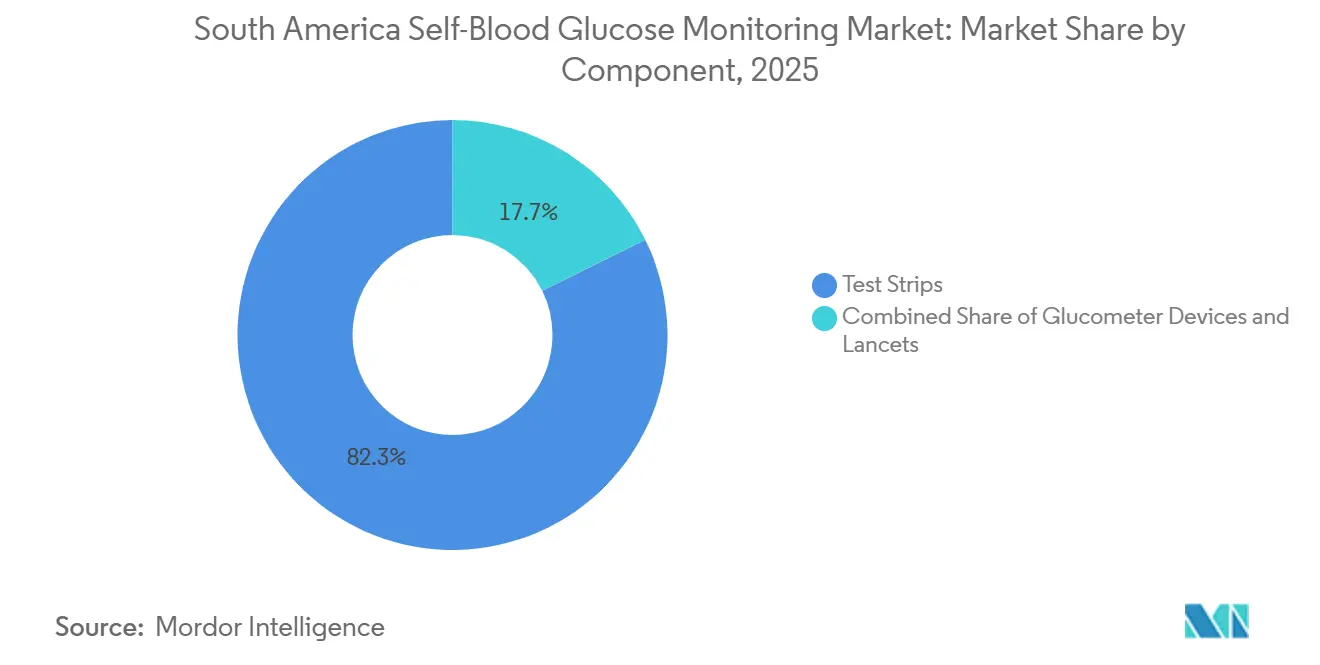
Test Strip Dominance Reinforces Recurring Revenue DynamicsTest strips held 82.31% of the South America self-blood glucose monitoring market share in 2025 and recorded a 5.58% CAGR through 2031. Their leading position reflects the repeated use of strips after a meter is placed. Each test requires a compatible consumable, which creates a continuing purchase cycle. Meters can be subsidized or included in reimbursement programs to encourage access. That approach can increase the installed base for a supplier’s proprietary strip format. The recurring nature of strips makes a stable supply a priority for pharmacies, public buyers, and patients.
Lancets are usually bundled with other products at the point of sale. They are less likely to make a purchase decision on their own. Their quality can still affect testing regularity, especially for pediatric users, where lower pain can support use. The IDF recorded 967,187 live births affected by hyperglycemia in pregnancy in South and Central America during 2024. These pregnancies create a defined period when intensive monitoring may be needed. This demand supports the use of strips among patients managing gestational diabetes.

By Diabetes Type:
Type 2 Anchors Volume, Gestational Sets the Growth PaceType 2 diabetes held 89.24% revenue share in 2025. Its large share aligns with the broad prevalence of Type 2 diabetes across income groups in the region. Many people with Type 2 diabetes require periodic glucose checks rather than continuous monitoring. This care pattern supports sales through retail pharmacies and hospital procurement. The high patient base gives suppliers a broad volume foundation. It also leaves affordability and refill access central to regular testing.
Gestational diabetes is forecast to grow at a 7.22% CAGR through 2031. A 2024 Buenos Aires hospital study recorded gestational diabetes in 9% of pregnancies[2]. A provincial maternity center reported an incidence rising from 16.8% in 2021 to 37.1% in 2023 after it adopted more sensitive diagnostic protocols. Wider screening in Brazil and Colombia is expected to identify more patients during pregnancy. These patients need intensive monitoring for a limited care period.
By Distribution Channel:
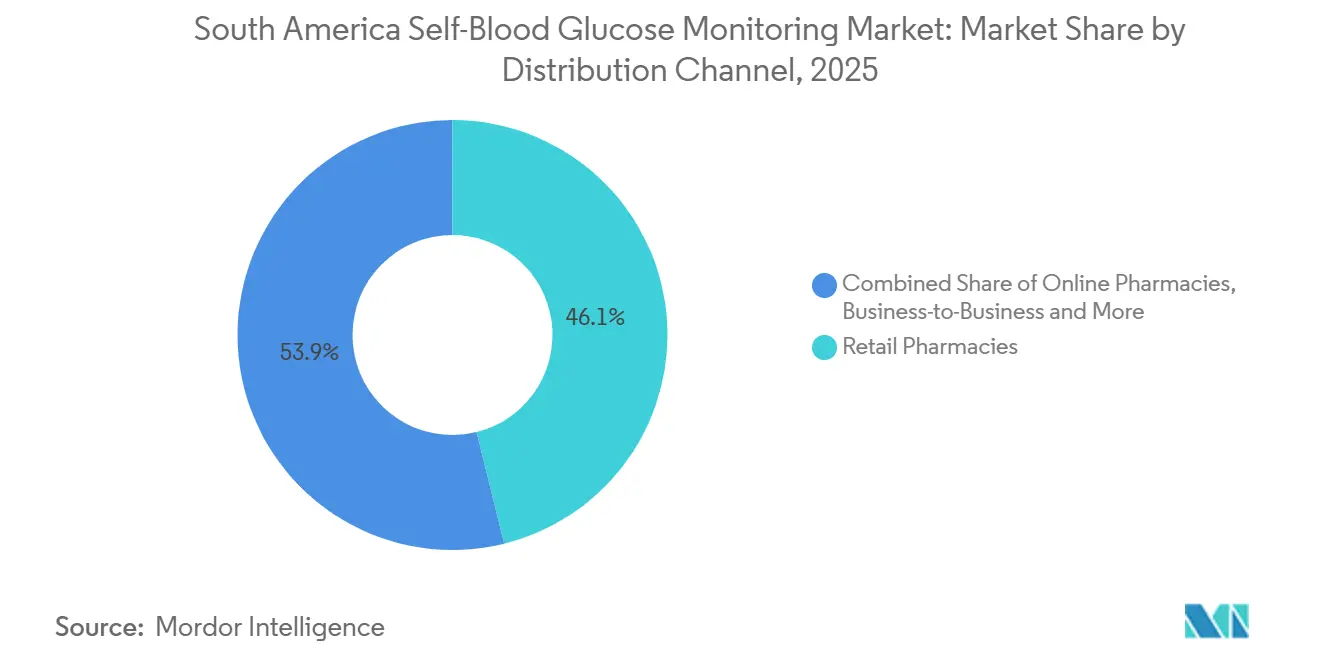
Online Pharmacies Disrupting a Retail-Dominant BaseRetail pharmacies accounted for 46.14% revenue share in 2025. They remain the most established distribution route for people purchasing meters and strips directly. Pharmacies offer product access, refill convenience, and local advice. They also provide a familiar option for people who do not use online purchasing. This channel remains important even as digital ordering becomes more common. Its broad physical presence supports access in cities and smaller population centers.
Online pharmacies are projected to expand at a 7.82% CAGR through 2031. Their growth is linked to e-pharmacy use, chronic-disease subscriptions, and digital health purchasing behavior. Online ordering can simplify repeat purchases of compatible strips. B2B sales through hospitals, institutional tenders, and distributors remain an important volume tier. These contracts often run for multiple years and use fixed specifications. Brazil’s online pharmacy revenue was reported as significant in 2025, although no specific value was provided in the source material.
By End User:
Homecare at the Core of Regional SMBG GrowthHomecare held 58.65% revenue share in 2025 and is forecast to grow at a 5.65% CAGR through 2031. The segment reflects the large number of people who manage diabetes outside hospitals and clinics. Brazil’s SUS policy provides meters and strips to eligible insulin-dependent patients for home monitoring. Home testing can reduce the need for a clinical visit for routine measurement. It also aligns with connected meters that allow data to be stored and reviewed remotely.
Hospitals and clinics retain demand for point-of-care testing in inpatient wards and emergency settings. These settings need timely results and calibrated accuracy. Diagnostic centers serve a smaller group of patients undergoing structured diabetes assessments. They are less focused on routine self-monitoring than homecare settings. Their role can become smaller as home-use monitoring is included more fully in care pathways. The South America self-blood glucose monitoring industry, therefore, depends on both home use and institution-based testing needs.
Geography Analysis
Brazil Self-Blood Glucose Monitoring Market
Brazil held 52.61% revenue share in 2025 and is forecast to grow at a 6.25% CAGR through 2031. SUS procurement creates an institutional demand base for eligible insulin-dependent patients. Suppliers need ANVISA registration and tender-compliant products to compete for government supply contracts. These contracts can provide volume visibility over multiple years. Brazil also has private demand through pharmacies and digital channels.
Southeast Brazil Self-Blood Glucose Monitoring Market
ANVISA’s RDC 830/2023 entered into force on June 1, 2024. The resolution modernized risk-based registration for in vitro diagnostic devices and aligned requirements with EU and IMDRF standards. The rules raise compliance requirements for importers. The Brazilian Glic platform reported that Southeast Brazil represented 57% of its user base. This concentration reflects activity in São Paulo and Rio de Janeiro, where private health coverage and digital health use are stronger.
South America Self-Blood Glucose Monitoring Market
Argentina held the second-largest country share in 2025. PAMI provides self-monitoring supplies as a formal benefit, creating demand among pensioners. Currency instability affects the cost of imported products and public purchasing. Colombia, Chile, and Peru represent a middle group with different demand conditions. Chile’s GES program covers diabetes monitoring supplies and expanded CGM access in December 2025 for minors and pregnant people with Type 1 diabetes. A Lima screening study estimated gestational diabetes prevalence at 16%, which points to demand not fully served through existing channels. Bolivia, Ecuador, Paraguay, and Uruguay rely more on retail and informal channels, with demand growing as screening reaches lower-income urban populations.
Competitive Landscape
The South America self-blood glucose monitoring market is moderately consolidated. A limited group of multinational suppliers holds established registrations and public tender positions. Abbott Laboratories, F. Hoffmann-La Roche AG, and Ascensia Diabetes Care have historically held important tender positions through their meter-strip systems. This position is supported by established supply relationships and compatible consumables. Asian manufacturers compete more actively on strip pricing in private retail and e-commerce channels.
Ascensia Diabetes Care discontinued its Contour Plus range in Brazil from August 2024. The withdrawal created an opening in a mid-tier institutional category. Sinocare is expanding its South American presence through distributor partnerships and lower strip prices. In December 2024, Sinocare and A. Menarini Diagnostics signed an exclusive agreement for a third-generation CGM system in more than 20 reimbursed markets[3]. The agreement shows that suppliers can participate in both SMBG and CGM categories.
ANVISA’s strengthened registration framework creates a barrier for lower-specification imports. Market leaders therefore compete through regulatory status, tender access, and strip availability rather than product features alone. Affordable connected meters remain a potential opening for mid-tier suppliers. Devices below USD 30 are largely described as lacking app connectivity, while connected meters remain premium priced. A Bluetooth-enabled meter priced near generic devices could challenge retail positions without public tender access. The South America self-blood glucose monitoring industry remains shaped by the balance between established platforms and price-led competitors.
South America Self-Blood Glucose Monitoring Industry Leaders
-
Abbott Laboratories
-
F. Hoffmann-La Roche AG
-
LifeScan IP Holdings, LLC
-
Ascensia Diabetes Care Holdings AG
-
i-SENS, Inc.
- *Disclaimer: Major Players sorted in no particular order
South America Self-Blood Glucose Monitoring Market Companies Covered in this Report
- Abbott Laboratories
- Acon Laboratories
- AgaMatrix, Inc.
- Arkray
- Ascensia Diabetes Care Holdings AG
- Beurer
- Bionime
- Embecta Corp.
- Roche
- I-Sens
- LifeScan IP Holdings, LLC
- Nipro
- Nova Biomedical
- Rossmax
- Sinocare
- Terumo
- Trividia Health, Inc.
Recent Industry Developments in South America Self-Blood Glucose Monitoring Market
- August 2026: Chilean lawmakers raised a formal alert about a possible illegal market for stolen glucose monitors sourced from the Ministry of Health inventory and requested an investigation from the Ministerio de Salud, highlighting the diversion risk in publicly procured SMBG supplies and its dual impact on patient safety and legitimate channel demand.
- August 2025: Embecta Corp. completed its full transition to an independent South America distribution infrastructure, with dedicated distribution centers operational in Bogotá, Colombia, and Itapoá, Brazil, ending reliance on legacy transition service agreements and establishing a proprietary supply network for pen needles and related diabetes delivery products.
South America Self-Blood Glucose Monitoring Market Report Scope
As per the scope of the report, self-blood glucose monitoring (SBGM) devices are portable medical devices that allow individuals with diabetes to measure their blood glucose (blood sugar) levels independently and conveniently at home or on the go. These devices typically consist of a lancet for pricking the finger to obtain a blood sample, a test strip to collect the blood, and a meter that analyzes the sample to provide a digital readout of the current blood glucose level.
The South America self-blood glucose monitoring market is segmented by component into glucometer devices, test strips, and lancets; by diabetes type into type 1 diabetes, type 2 diabetes, and gestational diabetes; by distribution channel into business-to-business (B2B), retail pharmacies, online pharmacies, and other distribution channels; by end user into home care settings, hospitals and clinics, diagnostic centers, and other end users; and by country into Brazil, Argentina, Colombia, Chile, Peru, and the rest of South America. For each segment, the market size and forecast are provided in terms of value (USD).
Segmentation Overview
By Component
| Glucometer Devices |
| Test Strips |
| Lancets |
By Diabetes Type
| Type 1 Diabetes |
| Type 2 Diabetes |
| Gestational Diabetes |
By Distribution Channel
| Business-to-Business |
| Retail Pharmacies |
| Online Pharmacies |
| Other Distribution Channels |
By End-User
| Homecare Settings |
| Hospitals and Clinics |
| Diagnostic Centers |
| Other End Users |
By Country
| Brazil |
| Argentina |
| Colombia |
| Chile |
| Peru |
| Rest of South America |
| By Component | Glucometer Devices |
| Test Strips | |
| Lancets | |
| By Diabetes Type | Type 1 Diabetes |
| Type 2 Diabetes | |
| Gestational Diabetes | |
| By Distribution Channel | Business-to-Business |
| Retail Pharmacies | |
| Online Pharmacies | |
| Other Distribution Channels | |
| By End-User | Homecare Settings |
| Hospitals and Clinics | |
| Diagnostic Centers | |
| Other End Users | |
| By Country | Brazil |
| Argentina | |
| Colombia | |
| Chile | |
| Peru | |
| Rest of South America |
Key Questions Answered in the Report
What is the forecast for South America self-blood glucose monitoring?
The sector is forecast to increase from USD 565.60 million in 2026 to USD 703.49 million by 2031 at a 4.46% CAGR.
Which component leads self-blood glucose monitoring demand in South America?
Test strips led with 82.31% share in 2025 and are projected to grow at a 5.58% CAGR through 2031.
Why is homecare important for glucose monitoring in South America?
Homecare held 58.65% share in 2025 and is projected to grow at a 5.65% CAGR, supported by routine self-management and public access to supplies.
Which country is the largest destination for these devices?
Brazil held 52.61% share in 2025 and is projected to grow at a 6.25% CAGR through 2031.
How does CGM affect blood glucose meter and strip demand?
CGM can reduce fingerstick testing among insulin-dependent patients, although Brazil's January 2025 public decision indicated a gradual transition.
Which sales channel is growing fastest for glucose monitoring supplies?
Online pharmacies are projected to grow at a 7.82% CAGR through 2031, while retail pharmacies remained the largest channel in 2025.