
Market Overview
| Study Period | 2020 - 2031 |
|---|---|
| Forecast Data Period | 2026 - 2031 |
| Base Year Market Size (2025) | USD 299.28 Billion |
| Market Size (2026) | USD 323.82 Billion |
| Market Size (2031) | USD 482.20 Billion |
| Growth Rate (2026 - 2031) | 8.29 % |
| Market Concentration | Low |
Major Players *Disclaimer: Major Players sorted in no particular order Image © Mordor Intelligence. Reuse requires attribution under CC BY 4.0. | |
South America Residential Construction Market Analysis by Mordor Intelligence
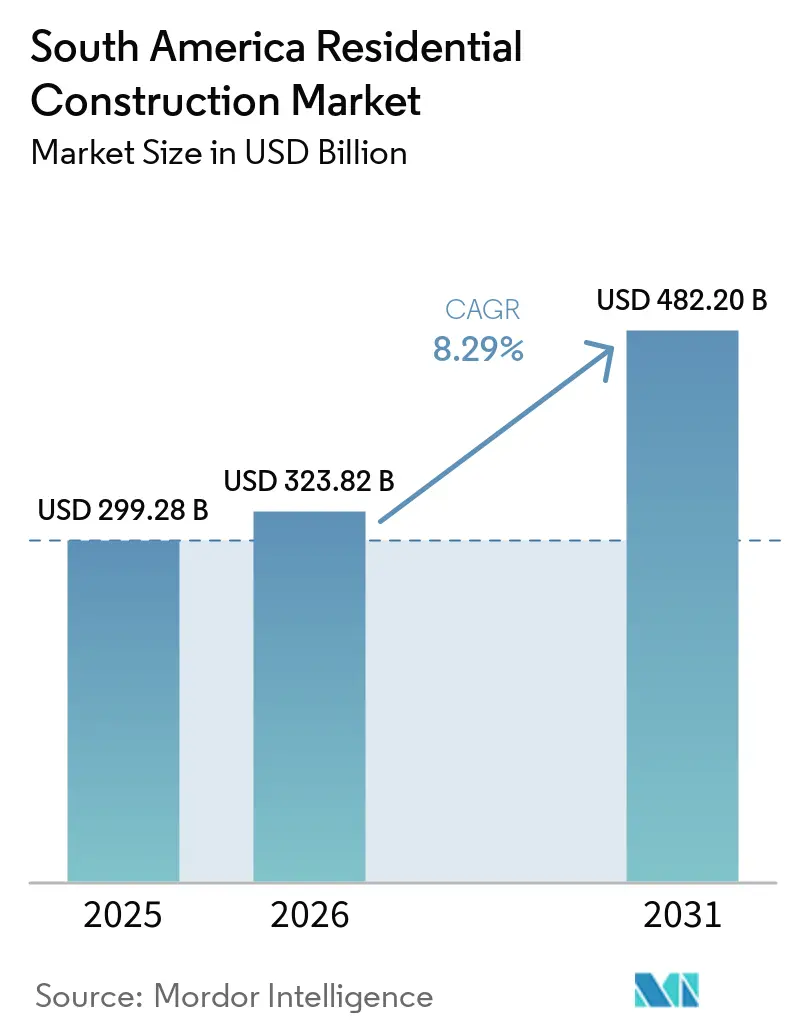
The South America Residential Construction Market size is projected to be USD 299.28 billion in 2025, USD 323.82 billion in 2026, and reach USD 482.20 billion by 2031, growing at a CAGR of 8.29% from 2026 to 2031.
Persistent housing shortages in Brazil, Colombia, and Chile support demand for the South America residential construction market. Brazil’s federal housing program gives developers a source of demand that is less dependent on conventional mortgage lending. Higher interest rates and construction costs still limit private buyer affordability and put pressure on project margins. Developers are responding through subsidized housing, rental formats, factory-built components, and digital design systems. This leaves opportunities for companies that can secure land, program-linked finance, and reliable materials supply.
Key Report Takeaways
- By type, apartments/condominiums held 55.00% of the South America residential construction market share in 2025, while villas/landed houses are forecast to expand at an 8.70% CAGR through 2031.
- By construction type, new construction accounted for 78.00% of the South America residential construction market size in 2025, while renovation is projected to record a 9.40% CAGR through 2031.
- By construction method, conventional on-site construction held 88.00% of the South America residential construction market share in 2025, while modern methods of construction are expected to grow at a 10.50% CAGR through 2031.
- By investment source, private investment held 82.00% of the South America residential construction market share in 2025, while public investment is forecast to grow at a 9.20% CAGR through 2031.
- By geography, Brazil represented 40.85% of the South America residential construction market share in 2025, while Colombia is forecast to grow at a 9.92% CAGR through 2031.
Note: Market size and forecast figures in this report are generated using Mordor Intelligence’s proprietary estimation framework, updated with the latest available data and insights as of January 2026.
Market Trends and Insights
Drivers Impact Analysis of South America Residential Construction Market*
| Drivers | (~) % Impact on CAGR Forecast | Geographic Relevance | Impact Timeline |
|---|---|---|---|
| Affordable Housing Program Funding Supports Residential Construction | +2.5% | Brazil, Colombia, Chile, Peru, and Paraguay | Short term (≤ 2 years) |
| Urban Housing Deficits Drive New Residential Development | +2.1% | Regional, with the highest pressure in Brazil, Colombia, and Chile metropolitan areas | Long term (≥ 4 years) |
| Social Rental and Subsidized Mortgage Programs Expand Housing Demand | +1.3% | Brazil and Colombia primarily, with secondary effects in Chile and Argentina | Medium term (2-4 years) |
| Urban Density Increases Demand for Vertical Housing | +1.0% | São Paulo, Rio de Janeiro, Bogotá, and Santiago metropolitan cores | Medium term (2-4 years) |
| Industrialized Housing Accelerates Residential Project Delivery | +0.7% | Brazil, Argentina, and Colombia coastal cities | Long term (≥ 4 years) |
| BIM-Enabled Design Improves Construction and Procurement Efficiency | +0.4% | Brazil, Chile, and Colombia tier-1 cities | Long term (≥ 4 years) |
| Source: Mordor Intelligence | |||
Affordable Housing Program Funding Supports Residential Construction
Public funding gives developers a more stable base of housing demand when private credit is limited. Brazil’s Minha Casa, Minha Vida program, known as MCMV, has contracted 2.4 million homes since 2023 and targets 3 million homes by the end of 2026[1]. Its annual allocation reached USD 27.3 billion, compared with USD 22.7 billion in 2025. Brazil also allocated USD 1.9 billion to 85,000 MCMV homes through the New PAC program in June 2026[2]. These commitments support new project pipelines across income groups and regions.
Urban Housing Deficits Drive New Residential Development
Housing shortages keep demand for formal homebuilding in place across the region. Brazil’s quantitative housing deficit stood at 5.77 million units in 2024, while Colombia reported a deficit of 4.81 million homes in 2025. Chile’s Ministry of Housing and Urban Development estimated a shortage of 491,804 homes using the 2024 census[3]. These deficits support long-term demand even when high interest rates delay private purchases. Builders with approved land and access to public programs can address demand as financing conditions improve.
Social Rental and Subsidized Mortgage Programs Expand Housing Demand
Rental and mortgage support programs widen access to housing beyond direct subsidized purchase. Brazil’s Faixa 4 financing tier covers households earning up to USD 2,321 a month and homes priced up to USD 107,143. MRV’s Luggo unit signed a July 2026 memorandum to transfer 3 rental properties to a real estate investment fund. SalfaCorp S.A. also entered Chile’s multifamily rental segment through a fund and a joint venture in La Florida. These models help developers recycle capital and add professionally managed rental supply.
Urban Density Increases Demand for Vertical Housing
Limited urban land and long approval periods encourage more intensive residential development. Apartments/condominiums were the largest type in 2025 because they make greater use of scarce land in major cities. Permitting delays added 12.2% to housing prices in Santiago’s metropolitan area. Permit disruption in São Paulo during 2026 also reduced certainty around new project timing. Developers with approved sites can benefit as dense cities direct demand toward multi-family housing.
Restraints Impact Analysis of South America Residential Construction Market*
| Restraints | (~) % Impact on CAGR Forecast | Geographic Relevance | Impact Timeline |
|---|---|---|---|
| High Mortgage Rates and Credit Selectivity Limit Buyer Demand | -1.5% | Brazil, Colombia, and Argentina | Short term (≤ 2 years) |
| Construction Cost and Skilled Labor Volatility Pressures Project Viability | -1.2% | Regional, with the highest exposure in Brazil and Argentina | Short term (≤ 2 years) |
| Land, Permitting, and Utility Bottlenecks Delay Project Delivery | -0.8% | Chile, Brazil, and Argentina | Medium term (2-4 years) |
| Fragmented Industrialized Housing Standards Increase Compliance Complexity | -0.3% | Brazil, Chile, and Colombia | Long term (≥ 4 years) |
| Source: Mordor Intelligence | |||
High Mortgage Rates and Credit Selectivity Limit Buyer Demand
High interest rates reduce the number of buyers who can qualify for conventional mortgages. Brazil’s Selic policy rate reached 15% in 2026, increasing pressure on regulated mortgage products. Colombia also saw a gap between new-home sales and construction starts in 2025. Argentina’s mortgage-backed purchases fell by more than 37% in the first 5 months of 2026 from the same period in 2025. Program-linked developers are therefore better placed than builders who rely on market-rate mortgage demand.
Construction Cost and Skilled Labor Volatility Pressure Project Viability
Rising material and labor costs reduce the flexibility available to developers after sale prices are agreed. Brazil’s civil construction index rose 5.6% in 2025, with labor costs rising faster than material costs. Argentina’s construction cost index increased 17% in the first 7 months of 2026. Smaller contractors face greater risk because they have less purchasing power and fewer long-term supply agreements. These pressures increase interest in prefabricated components that reduce on-site rework and weather-related delays.
*Our forecasts treat driver/restraint impacts as directional, not additive. The impact forecasts reflect baseline growth, mix effects, and variable interactions.
South America Residential Construction Market Segment Analysis
By Type:
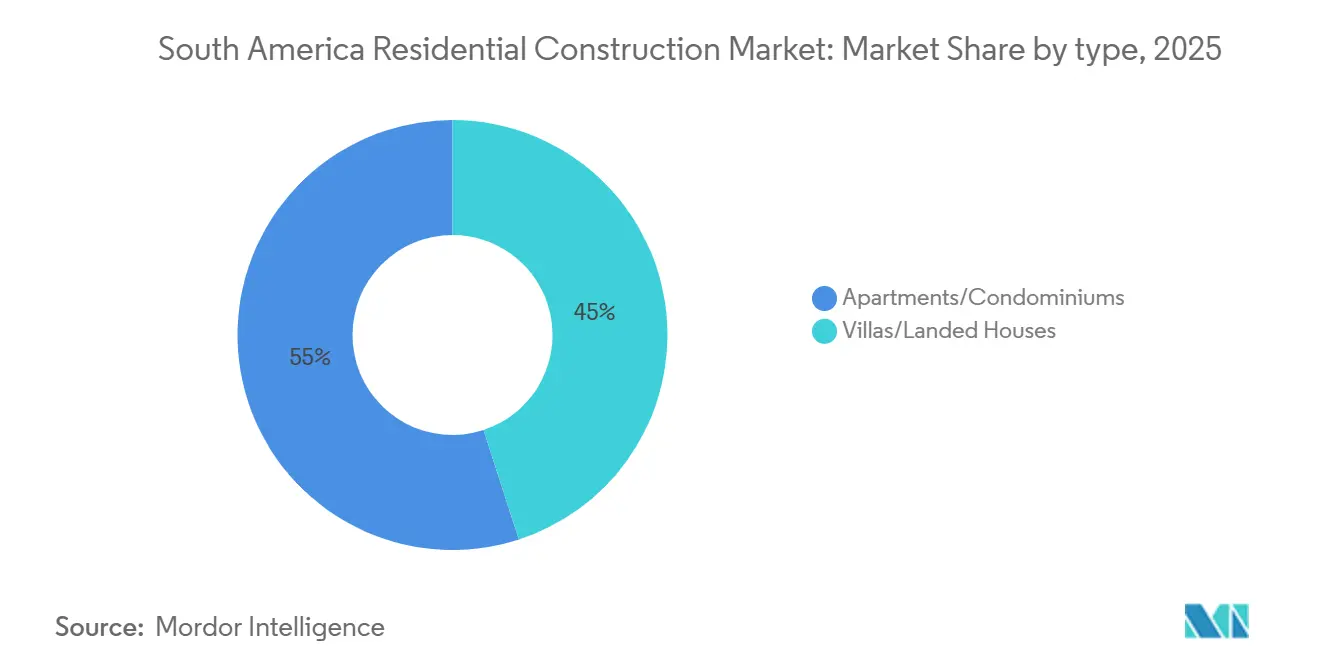
Apartments/Condominiums Lead Value, While Villas/Landed Houses Grow FasterApartments/condominiums held 55.00% of the South America residential construction market size in 2025. Their position reflects long-standing urban concentration in Brazil, Colombia, and Chile, where infrastructure and employment are concentrated in major cities. Multi-family projects make more intensive use of costly urban land and can serve both affordable and middle-income buyers. In São Paulo, vertical projects linked to Minha Casa, Minha Vida represented a substantial share of residential launches and sales in 2025. Developers also use apartment projects in premium segments, which broadens the format beyond social housing. Cyrela launched Heritage Riviera in Porto Feliz in 2026, a multi-phase development with potential sales of USD 536 million to USD 714 million. This shows that denser project formats can also be used in higher-value residential communities.
Villas/landed houses are forecast to expand at an 8.70% CAGR through 2031. The format benefits from demand outside expensive urban cores, especially in secondary Colombian cities. Amarilo S.A.S. expanded its geographic presence into Pereira and Cúcuta and planned a 3,385-unit social housing project near Armenia. These moves indicate that land availability and affordability can support horizontal development where major-city prices rise. Chile’s DS 1 subsidy also supports construction on owned sites for middle-income households. This creates a distributed source of single-family development that is not limited to large developer-led projects. The South America residential construction market includes both urban towers and outward residential growth, with each responding to a different housing need.

By Construction Type:
New Construction Holds the Largest Position, While Renovation Addresses Existing Housing NeedsNew construction accounted for 78.00% of the South America residential construction market size in 2025. Government programs continue to emphasize fresh-unit delivery, and household formation remains an important source of demand in Brazil and other countries. New projects also absorb migration into growing cities and provide the physical supply needed to reduce quantitative housing shortages. Program funding can support new construction even when conventional credit conditions are restrictive. Large housing allocations in Brazil, Peru, and Paraguay, therefore, have a direct effect on development pipelines. New Construction remains important to listed developers because it supports repeatable project models and access to formal housing finance. Its scale also supports demand for building materials, contractors, and utility connections.
Renovation is forecast to grow at a 9.40% CAGR through 2031, the fastest pace within the construction type. This growth follows the large number of existing homes that require repairs or improvements to meet habitability needs. Brazil’s Housing Improvement stream and Colombia’s Decree 413 of 2025 direct public support toward this part of the housing shortage. Renovation projects generally have lower ticket values and avoid the land costs that affect new developments. Their shorter project cycles can help contractors deploy capital more frequently during periods of high financing costs. Colombia’s seismic construction rules apply to structural interventions, including renovations, which increases the importance of qualified contractors. The South America residential construction industry can therefore gain from repair work as well as from large new residential developments.
By Construction Method:
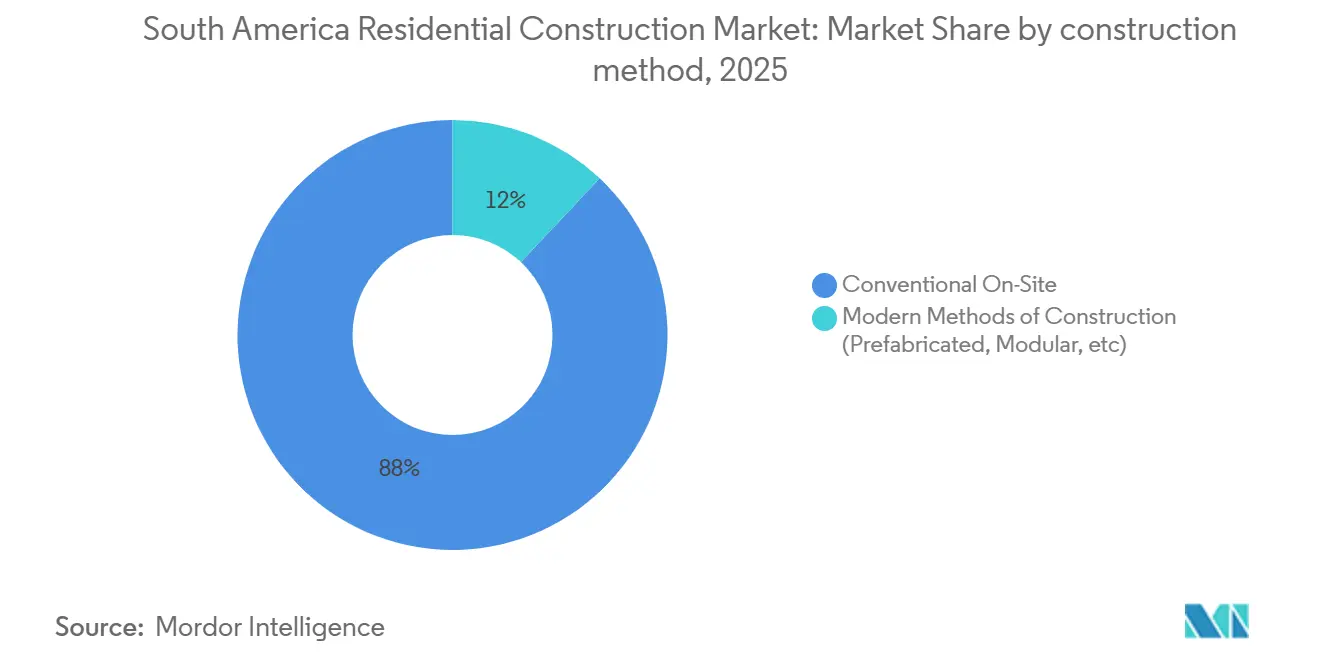
Conventional On-Site Construction Retains Scale While Modern Methods Improve Delivery SpeedConventional on-site construction held 88.00% of the value in 2025. Cast-in-place concrete and masonry remain common because contractors, suppliers, and regulatory practices are built around these methods. This approach is familiar across the region and supports a wide range of project sizes. However, conventional work increasingly uses drywall, precast concrete, and steel elements. The result is a gradual change in how buildings are delivered, even before category-level shares change materially. Established contractors can adopt more industrial components without fully changing their construction model. This makes the transition more practical for developers with active projects and established supply chains.
Modern methods of construction are projected to grow at a 10.50% CAGR through 2031. The South America residential construction market size for this method benefits from program acceptance of industrialized systems and the need to shorten delivery schedules. Modular builders can make better use of factory settings, where work is less exposed to weather and unplanned site disruption. SteelCorp’s Cajamar facility and Brasil ao Cubo’s 8-story modular project in Tubarão illustrate commercial use of these systems in Brazilian housing. Argentina’s industrialized housing agreement with Spain adds another route for technology transfer. The method still faces differing standards across countries, so compliance requirements remain a practical constraint. Its growth depends on builders proving reliable delivery, cost control, and code compliance at larger volumes.
By Investment Source:
Private Investment Leads While Public Investment Expands Its RolePrivate investment held 82.00% of the South America residential construction market size in 2025. Brazil’s listed developer base and Chile’s established residential sector underpin this position. Private developers remain responsible for land acquisition, project execution, sales, and much of the delivery risk. Yet a substantial part of private activity depends on public-backed financing for eligible buyers. Cury Construtora and Direcional Engenharia have significant exposure to Minha Casa, Minha Vida-eligible units. This structure allows private developers to continue building where conventional lending is difficult. It also means business performance is closely linked to public housing policy and funding availability.
Public investment is forecast to increase at a 9.20% CAGR through 2031. The expansion reflects Brazil’s housing budget, Chile’s Housing Emergency Plan, and Colombia’s public-private structures for social rental. Public money can provide stability when market-rate mortgage finance does not support sufficient housing demand. The distinction between public and private funding is increasingly less clear in subsidized projects. For example, a listed developer may build a project, while public sources support buyer finance and program eligibility. This blended structure can sustain delivery volume but requires developers to manage policy, compliance, and funding timelines. It also creates an advantage for firms with experience in government-linked housing programs.
Geography Analysis
Brazil Residential Construction Market
Brazil held 40.85% of the South America residential construction market share in 2025. Its scale gives the country a major influence on regional construction activity, materials demand, and developer strategy. Minha Casa, Minha Vida aims to contract 3 million homes by the end of 2026 after contracting 2.4 million homes since 2023. Brazil recorded 453,005 residential launches in 2025, a 10.6% increase from 2024, with USD 51.3 billion in launch value. New PAC funding for rural and entities' housing extends activity beyond the Southeast. Environmental licensing and local approvals still affect the timing of greenfield projects, particularly in peri-urban areas.
Colombia Residential Construction Market
Colombia is forecast to grow at a 9.92% CAGR through 2031, making it the fastest-growing country in the regional forecast. New-home sales increased to 173,632 units in 2025, while starts fell to 115,687 units. This gap could support construction recovery as inventory is absorbed, but subsidies remain important for lower-income projects. Constructora Bolívar targets USD 762 million in 2026 sales, and Amarilo S.A.S. plans 21 launches. These plans reflect confidence in demand, although lower disbursement under Mi Casa Ya could limit activity in very low-income housing. Companies that operate across several cities may be less exposed to conditions in a single local market.
Southern Cone and Peru Residential Construction Market
Chile and Argentina add demand from housing shortages but face distinct financing and regulatory conditions. Chile’s Ministry of Housing and Urban Development reported a quantitative deficit of 491,804 homes, while the Chilean Chamber of Construction identified demand near 980,000 units. Argentina’s construction activity improved during 2025, but mortgage availability continued to limit transactions. Peru and Paraguay also contribute to the South America residential construction market through targeted housing finance programs. Peru’s Techo Propio funding supports lower-income homebuilding, while Paraguay’s Che Róga Porã financing broadens program capacity. These smaller markets add volume and create opportunities for contractors, lenders, and building-product suppliers.
Competitive Landscape
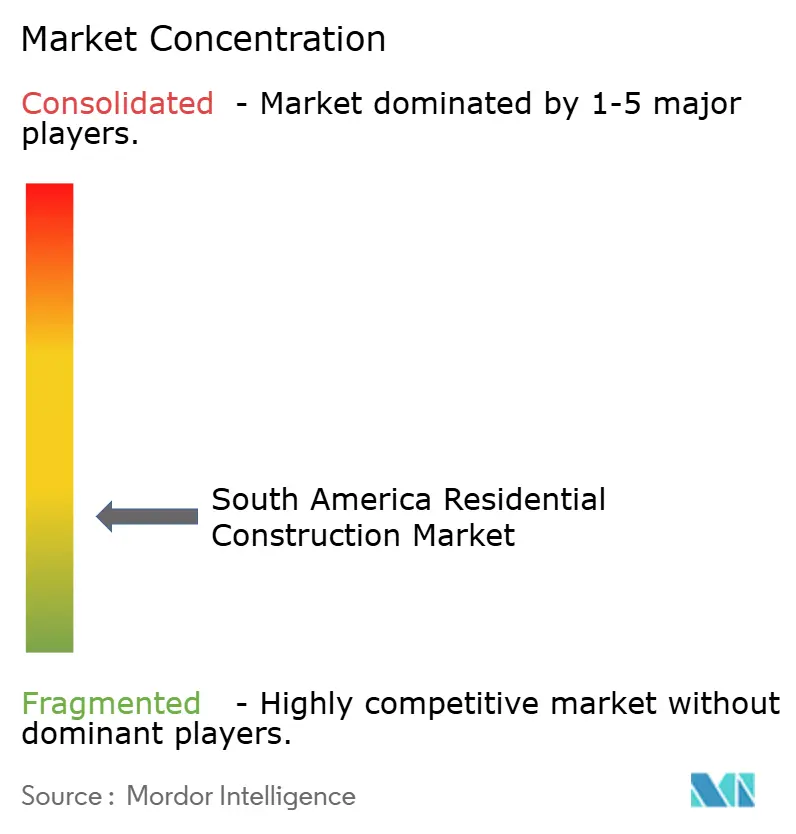
The South America residential construction market is fragmented across national developers, local contractors, and program-focused builders, with no single company holding a dominant regional position. Competition varies substantially by country, reflecting differences in housing demand, government programs, financing conditions, and construction capacity. Brazilian companies such as MRV Engenharia e Participações S.A., Cyrela Brazil Realty S.A., Cury Construtora e Incorporadora S.A., and Direcional Engenharia are important participants in the country's large residential pipeline. At the same time, numerous smaller and regional builders compete for projects at the local level. Their participation in Minha Casa, Minha Vida programs supports demand in the affordable segment, but access to land, financing, program eligibility, and execution capabilities continues to differentiate competitors.
Leading developers are pursuing different strategies rather than following a single competitive model. MRV has concentrated capital on Brazilian affordable housing while reducing exposure to its Resia business in the United States. The company received recognition from BIM Fórum Brasil in 2026 for applying a fully BIM-based method across more than 50 projects in Rio Grande do Sul. Cyrela partnered with Helbor on a USD 268 million project under Minha Casa, Minha Vida, and also launched Heritage Riviera, expanding its exposure to higher-priced housing. These moves demonstrate how individual developers are targeting different price segments and project opportunities rather than competing through a consolidated regional structure.
Chilean and Colombian developers further reinforce the fragmented nature of the market through country-specific strategies focused on rental formats, land banks, structured financing, and project partnerships. SalfaCorp S.A. entered multifamily rental through a fund and a joint venture with Mallplaza, while Amarilo S.A.S. secured a USD 127 million syndicated credit facility led by Bancolombia to support expansion. Amarilo S.A.S. also partnered with Rocasol to install 58,500 solar panels across 318 projects. Such initiatives highlight how developers differentiate through financing access, sustainability, project specialization, and local market expertise. The fragmented competitive structure leaves opportunities for regional and local builders that can secure land, access project financing, meet government housing requirements, and deliver efficiently within their respective markets.
South America Residential Construction Industry Leaders
-
MRV Engenharia e Participações S.A.
-
Cyrela Brazil Realty S.A.
-
Direcional Engenharia S.A.
-
Cury Construtora e Incorporadora S.A.
-
Construtora Tenda S.A.
- *Disclaimer: Major Players sorted in no particular order
South America Residential Construction Market Companies Covered in this Report
- MRV Engenharia e Participações S.A.
- Cyrela Brazil Realty S.A.
- Direcional Engenharia S.A.
- Cury Construtora e Incorporadora S.A.
- Construtora Tenda S.A.
- EZTEC Empreendimentos e Participações S.A.
- Even Construtora e Incorporadora S.A.
- Gafisa S.A.
- Plano&Plano Desenvolvimento Imobiliário S.A.
- Trisul S.A.
- Tecnisa S.A.
- Moura Dubeux Engenharia S.A.
- Melnick Desenvolvimento Imobiliário S.A.
- Pacaembu Construtora S.A.
- Socovesa S.A.
- Besalco S.A.
- SalfaCorp S.A.
- Constructora Bolívar S.A.
- Amarilo S.A.S.
- Constructora Conconcreto S.A.
Recent Industry Developments in South America Residential Construction Market
- August 2026: Cyrela Brazil Realty S.A. signed a non-binding MoU with TRXF11 and TRX for the potential sale of a ~USD 382 million real estate portfolio, including commercial floors in the Cyrela Oscar Freire Corporate building in São Paulo, equity stakes, and logistics assets.
- August 2026: Cyrela launched Heritage Riviera in Porto Feliz, São Paulo, with ~USD 179 million in first-phase potential sales. Total investment of at least ~USD 268 million across four phases is expected to generate ~USD 536-714 million in potential sales value.
- August 2026: MRV Engenharia launched Porto Colônia in São Leopoldo, Rio Grande do Sul, comprising 480 apartments across 24 blocks for MCMV Faixa 2 buyers. Average unit price is ~USD 42,143, with ~USD 10.7 million in project investment and ~USD 19.6 million in gross development value.
South America Residential Construction Market Report Scope
Segmentation Overview
By Type
| Apartments/Condominiums |
| Villas/Landed Houses |
By Construction Type
| New Construction |
| Renovation |
By Construction Method
| Conventional On-Site |
| Modern Methods of Construction (Prefabricated, Modular, etc) |
By Investment Source
| Public |
| Private |
By Country
| Brazil |
| Argentina |
| Colombia |
| Chile |
| Rest of South America |
| By Type | Apartments/Condominiums |
| Villas/Landed Houses | |
| By Construction Type | New Construction |
| Renovation | |
| By Construction Method | Conventional On-Site |
| Modern Methods of Construction (Prefabricated, Modular, etc) | |
| By Investment Source | Public |
| Private | |
| By Country | Brazil |
| Argentina | |
| Colombia | |
| Chile | |
| Rest of South America |
Key Questions Answered in the Report
What is the projected value of residential construction in South America by 2031?
The sector is projected to reach USD 482.2 billion by 2031, growing at an 8.29% CAGR from 2026.
Which residential property type holds the largest share in South America?
Apartments/condominiums held 55.00% of the value in 2025, supported by demand in large urban areas.
Which construction method is growing fastest in South America?
Modern methods of construction are forecast to grow at a 10.50% CAGR through 2031.
Why does public housing funding matter to builders in South America?
Public programs support buyer finance and project pipelines when high interest rates restrict conventional mortgages.
Which country is growing fastest in the regional forecast?
Colombia is forecast to grow at a 9.92% CAGR through 2031, supported by sales recovery and expected project launches.
What is limiting residential project delivery in South America?
High mortgage rates, rising construction costs, labor pressure, permitting delays, and utility bottlenecks continue to slow delivery.