
South America Postal Services Market Size and Share
Market Overview
| Study Period | 2020 - 2031 |
|---|---|
| Forecast Data Period | 2026 - 2031 |
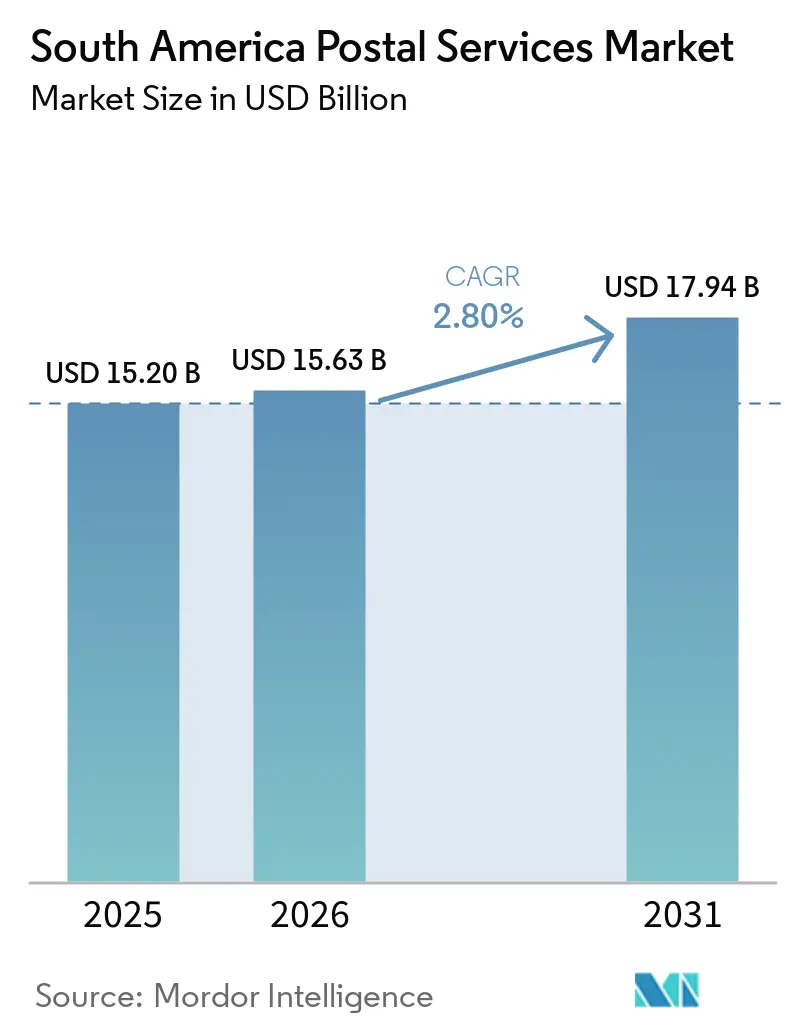
| Base Year Market Size (2025) | USD 15.20 Billion |
| Market Size (2026) | USD 15.63 Billion |
| Market Size (2031) | USD 17.94 Billion |
| Growth Rate (2026 - 2031) | 2.80 % |
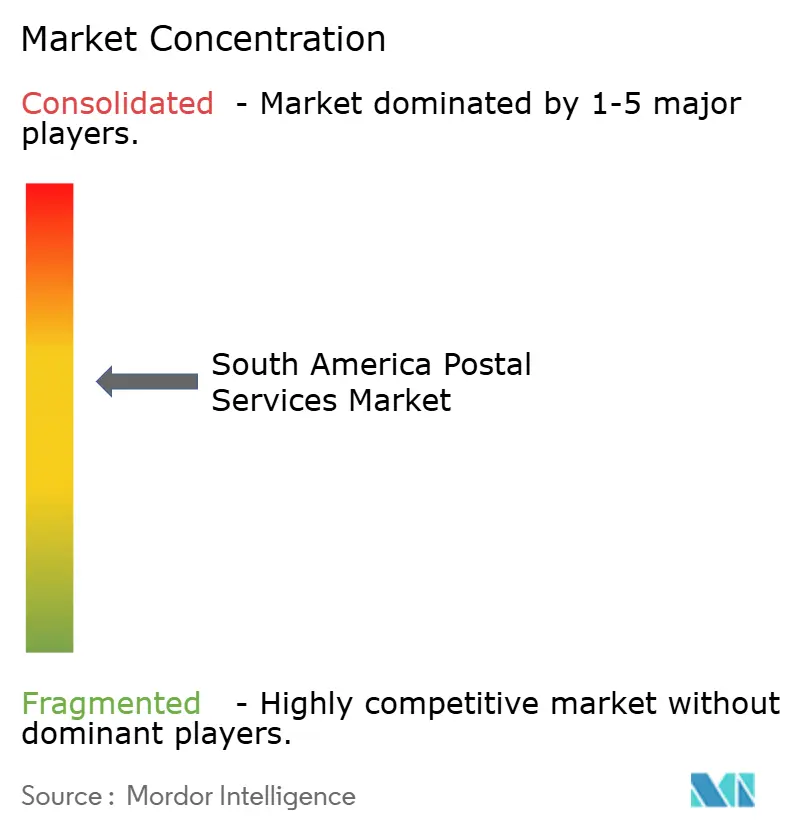
| Market Concentration | Medium |
Major Players *Disclaimer: Major Players sorted in no particular order Image © Mordor Intelligence. Reuse requires attribution under CC BY 4.0. | |
South America Postal Services Market Analysis by Mordor Intelligence
The South America postal service market size was valued at USD 15.20 billion in 2025 and estimated to grow from USD 15.63 billion in 2026 to reach USD 17.94 billion by 2031, at a CAGR of 2.80% during the forecast period (2026-2031).
The market is changing as declining letter-mail revenue gives way to more parcel and express activity generated by digital commerce. Cross-border purchases are becoming more important because customs reforms and new port links are changing the cost and speed of delivery. State postal operators still have broad delivery obligations and established coverage, but private providers are expanding faster in urban and premium delivery services. Investment is therefore moving toward sorting capacity, shipment data, collection points, and temperature-controlled handling. Financial pressure at national operators may limit modernization spending and create room for private logistics networks.
Key Report Takeaways
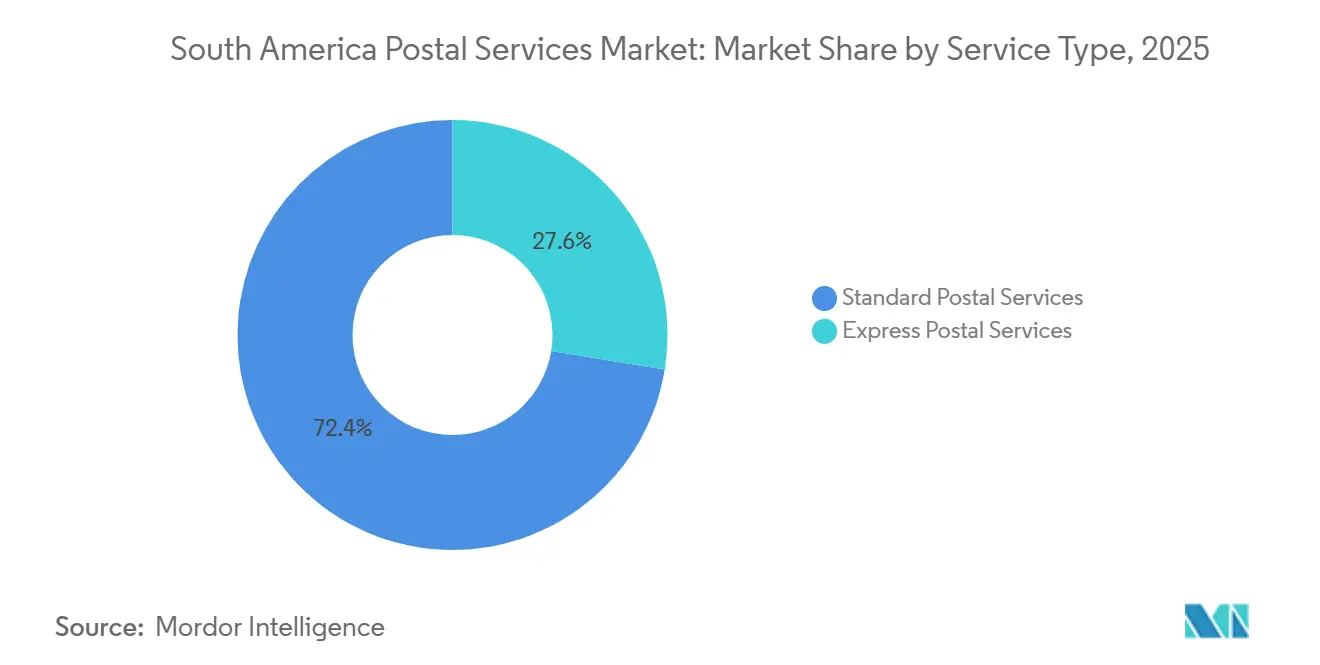
- By service type, standard postal Services held 72.44% of the South America postal service market share in 2025, while express postal Services recorded the highest projected CAGR at 4.97% through 2031.
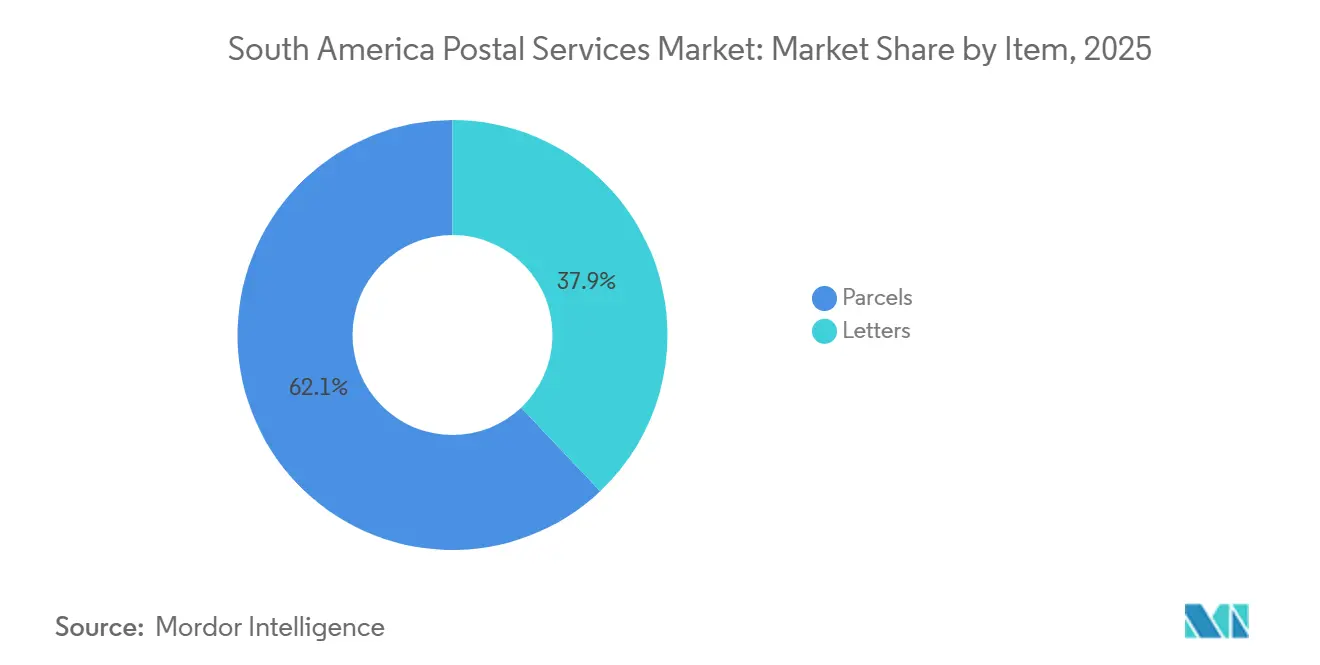
- By item, parcels accounted for 62.06% of the South America postal service market size in 2025 and recorded the highest projected CAGR at 5.13% through 2031.
- By destination, domestic held 79.29%of the South America postal service market share in 2025, while international recorded the highest projected CAGR at 4.00% through 2031.
- By delivery mode, road accounted for 78.20% of the South America postal service market share in 2025, while air recorded the highest projected CAGR at 4.32% through 2031.
- By country, Brazil held 51.34% of the South America postal service market share in 2025, while Peru recorded the highest projected CAGR at 3.79% through 2031.
Note: Market size and forecast figures in this report are generated using Mordor Intelligence’s proprietary estimation framework, updated with the latest available data and insights as of January 2026.
South America Postal Services Market Trends and Insights
Drivers Impact Analysis*
| Driver | (~) % Impact on CAGR Forecast | Geographic Relevance | Impact Timeline |
|---|---|---|---|
| E-Commerce and Cross-Border Parcel Expansion | +0.8% | Brazil, Argentina, Colombia, Peru, Chile | Short term (≤ 2 years) |
| Digital Customs and Pre-Arrival Data Requirements | +0.5% | Brazil, Argentina, Peru, Colombia | Medium term (2-4 years) |
| Healthcare and Temperature-Controlled Parcel Demand | +0.4% | Brazil, Argentina, Colombia | Long term (≥ 4 years) |
| Automated Sorting and Last-Mile Modernization | +0.4% | Brazil, Colombia, Chile | Medium term (2-4 years) |
| Postal Network Monetization Through Government and Financial Services | +0.3% | Brazil, Peru, Argentina | Medium term (2-4 years) |
| Same-Day and Next-Day Delivery Expectations in Major Metropolises | +0.3% | Sao Paulo, Buenos Aires, Bogota, Santiago | Short term (≤ 2 years) |
| Source: Mordor Intelligence | |||
E-Commerce and Cross-Border Parcel Expansion
E-commerce parcel demand was a central force in the South America postal service market. Argentina’s Decree 604/2026 changed the international postal shipment regime and raised the duty-free threshold to USD 400 per shipment, subject to the stated annual purchase limit. Courier imports reached USD 643 million in the first half of 2026, which was 104.2% higher than the same period in 2025. COSCO SHIPPING Lines launched a Shanghai-to-Chancay sea-postal route in February 2026, bringing Chinese e-commerce parcels into Peru through a maritime channel. International services were projected to grow at a 4.00% CAGR through 2031, faster than domestic flows, although processing capacity and bonded warehousing remained uneven. Operators with capacity near maritime and air gateways could gain parcel revenue as cross-border volumes increase.
Digital Customs and Pre-Arrival Data Requirements
Electronic advance data requirements changed the processing of cross-border postal shipments. Argentina’s General Resolution 5884/2026 required Correo Argentino to submit sender, recipient, merchandise, and value information before shipments arrived. The Universal Postal Union required Harmonized System codes for commercial postal flows from September 2025 onward. The UPU launched ORE Plus on August 30, 2026, to support e-commerce readiness, customs alignment, and digital interoperability through 2029.[1] “UPU Launches ORE Plus to Advance Postal E-Commerce Readiness,” UPU Official News, upu.int. Better shipment data can shorten clearance time and reduce manual handling costs for operators. Compliance also became a basic operating requirement for designated operators serving cross-border commerce.
Healthcare and Temperature-Controlled Parcel Demand
Healthcare logistics created demand for parcel networks with validated temperature control and reliable custody records. Colombia’s 2025 health-system review identified cold-chain failures affecting temperature-sensitive biologics, which supported demand for stronger distribution systems. Peli BioThermal formed a partnership with Polar Group in March 2026 to expand reusable and single-use temperature-controlled pharmaceutical packaging in Brazil. Brazil sold 6.07 billion pharmaceutical packs in 2024, and varied product requirements raised the need for traceable delivery. Healthcare parcels can generate more revenue per shipment than ordinary mail when carriers have suitable handling capacity. The Inter-American Development Bank invested USD 180 million in 2025 to improve vaccine cold-chain logistics in Peru, Colombia, and Bolivia, including equipment and monitoring systems that could also support parcel delivery.[2]“One Year In: How South Connection Is Rewiring South America,” Inter-American Development Bank, iadb.org.
Automated Sorting and Last-Mile Modernization
Automation raised service expectations across the South America postal service market. Jadlog opened a BRL 200 million (USD 36.13 million) logistics hub in Sao Paulo in May 2026, with a 310-meter sorting system capable of processing 16,000 to 18,000 packages per hour. The facility was designed to complete sorting and loading in less than 5 minutes after arrival and reduce delivery time by 1 day to several major Brazilian cities. PUDO shipments grew 53% in the first half of 2026 from the same period in 2025, showing greater use of collection points to manage last-mile cost. DHL Express announced a BRL 118 million (USD 21.31 million) investment plan through 2030 for a modular hub in the Sao Paulo metropolitan area. Operators without automated central sorting faced a cost disadvantage as parcel volumes increased.
Restraints Impact Analysis*
| Restraint | (~) % Impact on CAGR Forecast | Geographic Relevance | Impact Timeline |
|---|---|---|---|
| Macroeconomic and Foreign-Exchange Volatility | -0.5% | Argentina, Colombia, Rest of South America | Short term (≤ 2 years) |
| Road Congestion and Weak Secondary-City Infrastructure | -0.3% | Brazil, Colombia, Peru secondary cities | Long term (≥ 4 years) |
| Cargo Theft, Parcel Security and Insurance Costs | -0.2% | Brazil Southeast, Colombia | Medium term (2-4 years) |
| Legacy Information-Technology Integration and Capital Constraints | -0.2% | Brazil, Peru, Argentina | Long term (≥ 4 years) |
| Source: Mordor Intelligence | |||
Macroeconomic and Foreign-Exchange Volatility
Currency instability and changing import rules created uncertainty for cross-border postal volumes. Correios reported a BRL 8.5 billion (USD 1.53 billion) loss in 2025 and a BRL 5.5 billion (USD 993.59 million) loss in the first half of 2026, which placed the operator under a government-backed restructuring process.[3]“Roubo de Cargas Muda Logística e Pressiona Frete no País,” Estadão, estadao.com.br. The Argentine government revised the courier taxation framework twice between 2024 and mid-2026, which made long-term carrier planning more difficult. Servientrega reported a 3.9% revenue decline in 2025, reflecting pressure on carrier performance during softer economic conditions. Multi-country operators needed to account for currency-adjusted revenue and changing import costs when planning network investment. These conditions could delay spending by both state-owned and private operators.
Cargo Theft, Parcel Security and Insurance Costs
Cargo theft increased the direct cost and insurance burden of parcel networks. NTC&Logística recorded 8,570 cargo theft incidents in 2025, with BRL 900 million (USD 162.58 million) in direct losses, and 86.8% of incidents were concentrated in Brazil’s Southeast. Pharmaceutical cargo represented 22.3% of national theft losses in the first quarter of 2026, compared with 1.7% in the first quarter of 2025. The International Union of Marine Insurance identified links between physical cargo theft and cyber-enabled identity fraud in its March 2026 cargo-risk review. Brazil’s road transport regulator began automated insurance-policy verification in March 2026.[4]“Cargo Theft Risk: Reducing Loss Frequency,” IUMI Newsletter, iumi.com. Coverage and enforcement remained incomplete in secondary transport corridors, leaving carriers exposed to continued losses.
*Our forecasts treat driver/restraint impacts as directional, not additive. The impact forecasts reflect baseline growth, mix effects, and variable interactions.
Segment Analysis
By Service Type: Express Volumes Gain Ground Against a Standard-Service Majority
Standard Postal Services held 72.44% of the South America postal service market share in 2025. Universal service mandates kept designated operators responsible for letters and government communications, including deliveries to remote municipalities. Correios, 4-72, and Serpost relied on public-service mandates and government contracts to support their standard networks. These obligations preserved a revenue base that private couriers did not always seek in lower-density areas. The standard segment nevertheless faced pressure to provide tracking and shorter delivery windows. Customer expectations increasingly connect delivery speed with the checkout experience on e-commerce platforms.
Express Postal Services were projected to expand at a 4.97% CAGR through 2031. DHL, FedEx, Jadlog, Servientrega, and Inter Rapidísimo competed in this service category through tracked and time-defined delivery. Private providers focused their network investment on the cities and routes where faster transit could command a premium. Colombia’s postal sector generated USD 2.7 billion in revenue in 2024, while express messaging represented 80% of shipment traffic. This shipment mix showed the service pressure facing standard postal operators. The South America postal service market, therefore, depended on whether designated operators could modernize service without losing their universal coverage role.


By Item: Parcel Dominance Deepens as Letter Mail Continues Its Structural Decline
Parcels accounted for 62.06% of the South America postal service market size in 2025. They also recorded the highest projected CAGR at 5.13% through 2031. This position reflected a shift from document delivery toward the movement of physical goods ordered through digital platforms. Marketplace activity from Mercado Libre, Amazon, Shein, and Temu increased the regular flow of consumer parcels. Operators needed handling systems suited to larger and more varied package formats. Parcel volumes also made route density more valuable in city delivery networks.
Argentina’s physical postal shipment volume fell from 692 million units in 2023 to 628 million units in 2025, even as sector billing rose by more than 400% in nominal terms. This pattern placed more value on parcel handling than on ordinary letter volumes. Serpost projected 6.7 million postal shipments in 2026, including 5.6 million from international origins. Larger package dimensions increased handling costs for networks that had not upgraded their equipment. Maritime parcel channels also shifted a greater share of bulky e-commerce products into postal systems. The postal service sector needed capacity that could process parcels without slowing high-volume sorting operations.
By Destination: Domestic Networks Dominate, but International Flows Accelerate
Domestic services held 79.29% of the South America postal service market share in 2025. Brazil, Colombia, and Argentina generated large domestic parcel volumes because urban areas had established e-commerce demand and dense delivery routes. Domestic networks benefited from lower transport costs and familiar address systems. Jadlog’s network included more than 4,000 partner collection points by mid-2026, supporting lower-cost delivery options in Brazil. Collection points allowed carriers to consolidate deliveries and reduce unsuccessful home-delivery attempts. Road transport remained the main operating base for domestic distribution.
International services were projected to grow at a 4.00% CAGR through 2031. Argentina processed USD 751 million in cross-border postal and courier imports during the first 7 months of 2026, compared with USD 894 million during all of 2025. Shipment data quality, pre-clearance processes, and customs coordination became important to this segment. The UPU’s ORE 3 cycle showed that better data processes could reduce end-to-end transit by 6 to 12 days and customs clearance from multiple days to minutes. International growth created a reason to place capacity near ports, airports, and customs facilities. It also required consistent documentation across the postal and courier network.
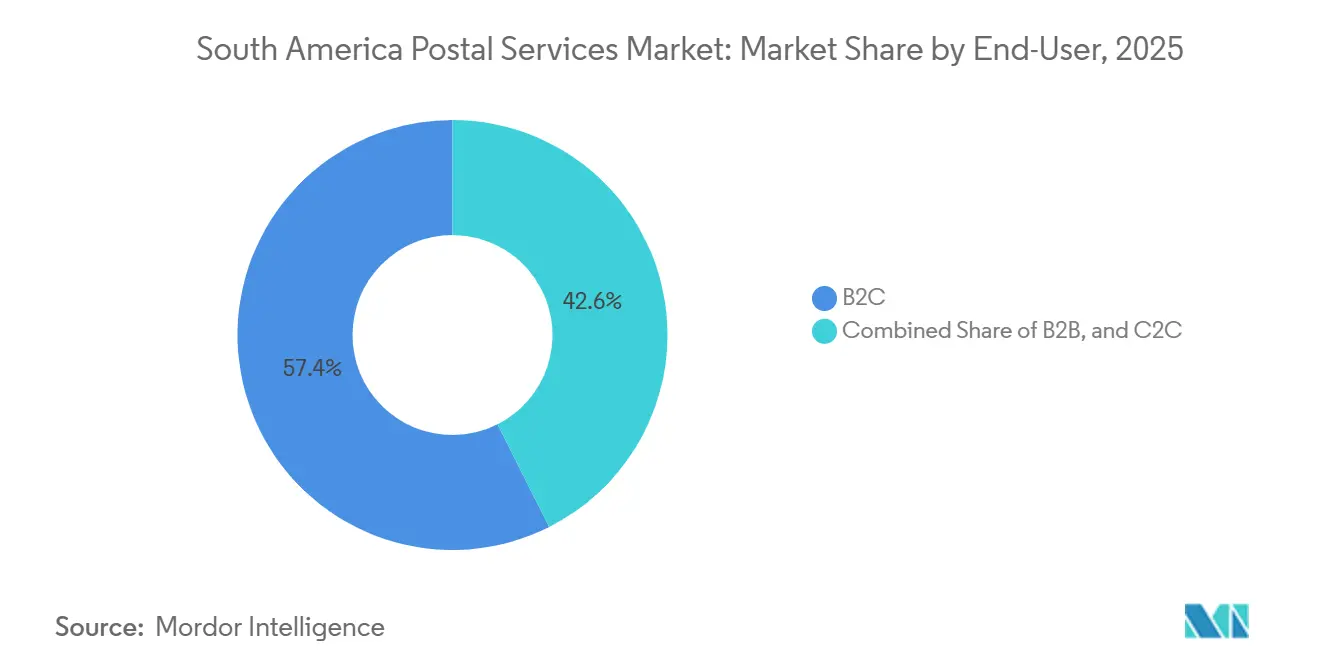
By End User: B2C Commands the Revenue Base, With Private Carriers Set to Capture Incremental Share
Business-to-Consumer accounted for 57.43% of the South America postal service market size in 2025. The segment was also projected to grow at a 4.24% CAGR through 2031. Consumer marketplace orders created regular parcel demand across major cities and secondary locations. Amazon invested BRL 19 billion (USD 3.43 billion) in Brazilian logistics infrastructure in 2025 and continued investment activity in 2026. This parallel logistics buildout increased competition for traditional delivery networks. B2C providers had to improve reliability, visibility, and delivery choice to retain volume.
Business-to-Business demand continued through pharmaceutical, legal, and financial document contracts. Consumer-to-Consumer services also changed as resale platforms introduced more standardized packaging and carrier options. Servientrega allied with Cobre in 2026 to offer QR-based cash-on-delivery payments through its Colombian courier network. The service responded to a national volume of 51 to 61 million cash-on-delivery orders each year. Payment integration could improve delivery completion by making collection easier for customers and drivers. These changes extended the role of postal and courier operators beyond transport alone.

By Delivery Mode: Road Holds the Volume Base, Air Accelerates on Express Demand
Road delivery accounted for 78.20% of the South America postal service market size in 2025. The mode remained the default for domestic parcel delivery because it offered a lower cost per shipment than air transport. Highway-based networks also supported regular deliveries between large urban centers and surrounding municipalities. Brazil’s road freight pricing framework provided carriers with more predictable cost terms for longer contracts. However, road congestion and weaker infrastructure in secondary cities still add time and operating risk. Collection points and route optimization became important ways to manage these limits.
Air delivery was projected to grow at a 4.32% CAGR through 2031. Express commitments, cross-border orders, and pharmaceutical shipments supported demand for faster transport. DHL Group announced a EUR 2 billion (USD 2.35 billion) life sciences and healthcare investment plan from 2025 onward, with 10% directed to South America. Serpost expected sea transport to represent 40% of postal imports by the end of 2026, compared with 0.5% during the prior 3 decades. This emerging maritime option could carry less time-sensitive e-commerce parcels at a lower cost. Rail remained a limited delivery option across the region.
Geography Analysis
Brazil held 51.34% of the South America postal service market share in 2025 and remained the region’s largest national base. Private operators expanded infrastructure while Correios managed financial restructuring. Amazon continued to assess proprietary last-mile vehicles in Brazil after investing BRL 19 billion (USD 3.43 billion) in logistics infrastructure during 2025. The Sao Paulo-Guarulhos and Viracopos corridor served as a redistribution route for imports from Asia and Europe. DHL Global Forwarding targeted 30% growth in consolidated shipment volume by the end of 2026. ANTT introduced automated carrier-insurance verification in March 2026, while ANVISA maintained temperature-control requirements for pharmaceutical delivery.
Peru was projected to grow at a 3.79% CAGR through 2031. Chancay enabled a maritime route that Serpost expected to raise to 40% of postal imports by the end of 2026. PromPerú and Serpost reviewed a collaboration agreement in August 2026 to support small and medium enterprise exports through the postal channel. Lima absorbed 60% of Serpost’s domestic distribution, while provincial cities offered additional delivery demand. Bolivia, Ecuador, Uruguay, Paraguay, and Venezuela represented a smaller combined base. The Capricorn Bioceanic Corridor was expected to begin freight operations in the second half of 2026 and could provide new parcel routing options.
Argentina and Colombia showed different operating conditions. Argentina’s 2025 courier imports were USD 894 million, compared with USD 239 million in 2024, after postal and import rule changes. Correo Argentino registered as a courier operator in March 2026 and projected 19% growth in e-commerce shipments during 2026. Colombia’s postal revenue grew 10.8% in 2024, supported by its regulatory framework. Chile’s 96% internet penetration supported a more mature same-day and next-day delivery environment. Chilexpress and Blue Express competed for B2C express demand.
Competitive Landscape
The South America postal service market had moderate concentration because global integrators held premium cross-border and B2B positions, while national operators retained broad last-mile coverage. DHL Group, FedEx, and UPS served international and contract-led business demand. Correios and Serpost retained delivery density through their designated postal roles. Mercado Libre moved 94% of its parcels through a proprietary network and invested USD 180 million in 5 Argentine cross-dock facilities in January 2026. The investment reduced the Buenos Aires-to-Cordoba transit from 4 days to 2 days. Secondary-city delivery, healthcare parcels, and maritime-postal integration remained areas where provider coverage was less established.
Jadlog’s 2026 Sao Paulo hub processed up to 18,000 packages per hour and represented a clear automation move by La Poste Group. DHL Express announced its modular São Paulo hub with a BRL 118 million (USD 21.31 million) investment plan through 2030. Servientrega’s 2026 QR-based cash-on-delivery service with Cobre added a payment function to its courier network. These actions reflected competition through faster sorting, flexible delivery, and payment support. Inter Rapidísimo operated 1,600 trucks and 3,500 offices across more than 1,100 municipalities in 2025. Its network scale gave it a strong position in Colombian delivery activity.
DHL Group planned specialized cold-chain capacity in Uruguay to support life sciences logistics across Brazil, Argentina, Chile, and Colombia. Pharmaceutical handling and compliant shipment data became important forms of differentiation for higher-value parcel flows. ISO 22000 handling capacity and UPU-standard data processes could help carriers meet these service requirements. State operators faced a different challenge because they had to modernize while sustaining wide service coverage. The South America postal service market remained open to regional challengers where city-level last-mile capacity was fragmented.
South America Postal Services Industry Leaders
DHL Group
United Parcel Service of America, Inc. (UPS)
FedEx
Correo Argentino
Empresa Brasileira de Correios e Telégrafos (Correios)
- *Disclaimer: Major Players sorted in no particular order

Recent Industry Developments
- August 2026: The Universal Postal Union officially launched ORE Plus, a 2026-2029 postal e-commerce readiness program targeting more than 150 designated operators with cross-border digital interoperability, customs alignment, and MSME trade integration support.
- August 2026: Peru’s PromPeru and Serpost reviewed their inter-institutional collaboration agreement to expand training programs for Peruvian SMEs seeking to export through the postal channel.
- May 2026: La Poste Group announced that Jadlog opened a BRL 200 million (USD 36.13 million) logistics hub in Sao Paulo, with a 310-meter sorting system, capacity for 16,000 to 18,000 packages per hour, 87 loading bays, and 4,000 partner PUDO collection points.
- March 2026: Peli BioThermal announced a partnership with Polar Group to expand temperature-controlled pharmaceutical packaging solutions across Brazil.


South America Postal Services Market Report Scope
| Standard Postal Services |
| Express Postal Services |
| Letters |
| Parcels |
| Domestic |
| International |
| Business-to-Business |
| Business-to-Consumer |
| Consumer-to-Consumer |
| Road |
| Air |
| Sea |
| Rail |
| Argentina |
| Brazil |
| Chile |
| Colombia |
| Peru |
| Rest of South America |
| By Service Type | Standard Postal Services |
| Express Postal Services | |
| By Item | Letters |
| Parcels | |
| By Destination | Domestic |
| International | |
| By End User | Business-to-Business |
| Business-to-Consumer | |
| Consumer-to-Consumer | |
| By Delivery Mode | Road |
| Air | |
| Sea | |
| Rail | |
| By Country | Argentina |
| Brazil | |
| Chile | |
| Colombia | |
| Peru | |
| Rest of South America |


Key Questions Answered in the Report
What is the value of South America postal services in 2026?
The value is estimated at USD 15.63 billion in 2026 and is projected to reach USD 17.94 billion by 2031.
What was the forecast growth rate through 2031?
The forecast CAGR is 2.80% from 2026 to 2031.
Which service type held the largest revenue share?
Standard Postal Services held 72.44% revenue share in 2025.
Which item category was growing the fastest?
Parcels had the highest projected CAGR at 5.13% through 2031.
Which country had the largest postal service base?
Brazil held 51.34% revenue share in 2025.
Which country was expected to grow the fastest?
Peru was projected to grow at a 3.79% CAGR through 2031.
Page last updated on:





