
South America Pharmaceutical Plastic Bottles Market Size and Share
Market Overview
| Study Period | 2020 - 2031 |
|---|---|
| Forecast Data Period | 2026 - 2031 |
| Base Year Market Size (2025) | USD 2.88 Billion |
| Market Size (2026) | USD 2.99 Billion |
| Market Size (2031) | USD 3.64 Billion |
| Growth Rate (2026 - 2031) | 4.01 % |
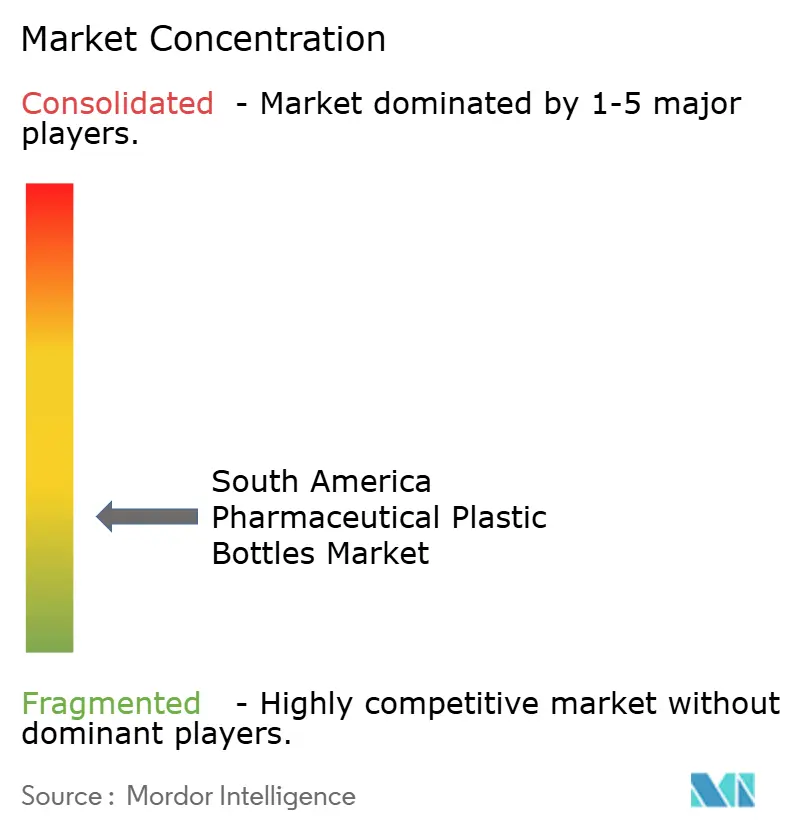
| Market Concentration | Low |
Major Players *Disclaimer: Major Players sorted in no particular order Image © Mordor Intelligence. Reuse requires attribution under CC BY 4.0. | |
South America Pharmaceutical Plastic Bottles Market Analysis by Mordor Intelligence
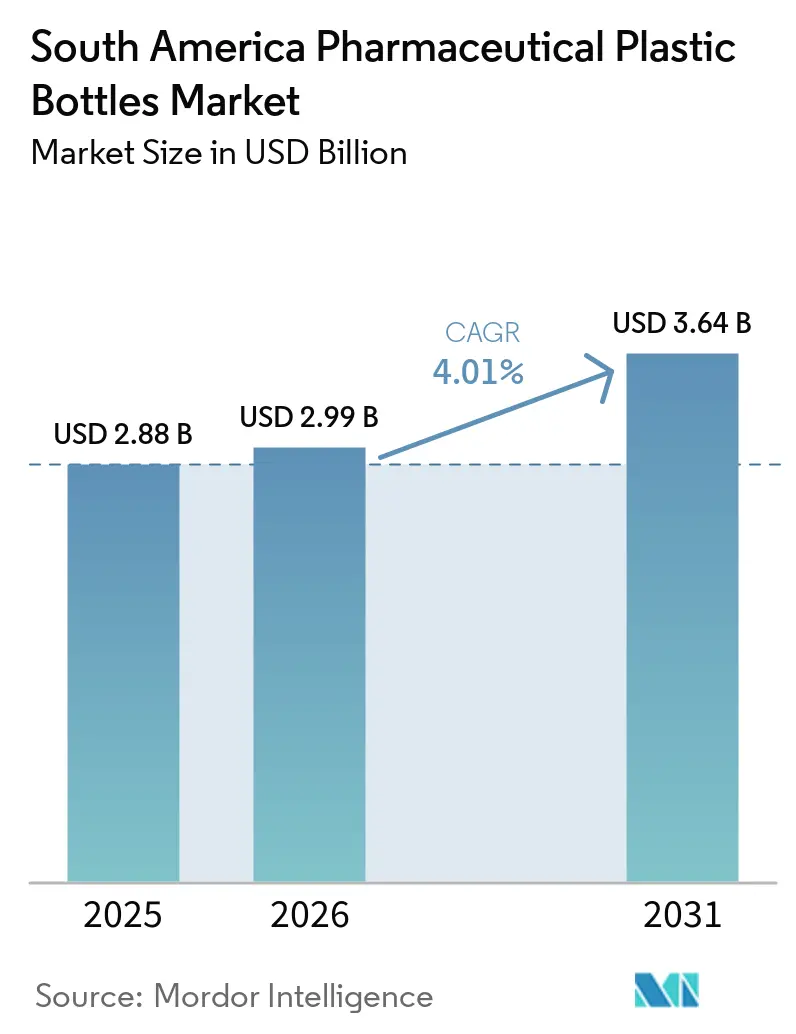
The South America Pharmaceutical Plastic Bottles Market size was valued at USD 2.88 billion in 2025 and estimated to grow from USD 2.99 billion in 2026 to reach USD 3.64 billion by 2031, at a CAGR of 4.01% during the forecast period (2026-2031). Generic medicine output, local drug production, and contract development and manufacturing organization capacity are increasing the demand for validated primary packaging. Brazil’s March 2026 semaglutide patent expiry supports a pipeline of generic GLP-1 products and related demand for bottles. Suppliers are competing on pharmaceutical validation, traceability readiness, barrier performance, and recycled-content capability. Resin-cost exposure and complex approval requirements remain material limits for converters. The South America Pharmaceutical Plastic Bottles Market also benefits from pharmaceutical manufacturers seeking shorter supply chains, more dependable local qualification processes, and suppliers that can support a product from initial validation through routine commercial production, manage controlled specification changes, offer reliable bottle and closure supply, and provide documented performance for formulations that require moisture protection, precision dispensing, or traceability-compatible packaging.
Key Report Takeaways
- By raw material, PET held 42.14% of the South America Pharmaceutical Plastic Bottles Market value in 2025, while polypropylene is forecast to grow at a 4.67% CAGR through 2031.
- By bottle type, solid oral containers held 38.71% of the total value in 2025, while nasal spray bottles are forecast to grow at a 4.98% CAGR through 2031.
- By capacity, the 101-250 ml tier accounted for 35.92% of the total South America Pharmaceutical Plastic Bottles Market value in 2025, while the ≤30 ml tier is forecast to grow at a 5.52% CAGR through 2031.
- By end user, branded pharmaceutical manufacturers held 46.23% of the total value in 2025, while CDMOs are forecast to grow at a 6.01% CAGR through 2031.
- By geography, Brazil accounted for 52.86% of the total South America Pharmaceutical Plastic Bottles Market value in 2025, while Colombia is forecast to grow at a 5.97% CAGR through 2031.
Note: Market size and forecast figures in this report are generated using Mordor Intelligence’s proprietary estimation framework, updated with the latest available data and insights as of January 2026.
South America Pharmaceutical Plastic Bottles Market Trends and Insights
Drivers Impact Analysis*
| Driver | (~) % Impact on CAGR Forecast | Geographic Relevance | Impact Timeline |
|---|---|---|---|
| Expansion of Generic Drug Manufacturing | +1.3% | Brazil, Argentina, Colombia | Short term (≤ 2 years) |
| Growth in Domestic Pharmaceutical Packaging Demand | +1.0% | Brazil, Colombia, Chile | Short term (≤ 2 years) |
| Brazil Serialization and Traceability Upgrades | +0.8% | Brazil primary, spillover to Argentina | Medium term (2-4 years) |
| Demand for Recyclable and Lightweight Bottles | +0.6% | Brazil and Chile, spillover to Colombia | Medium term (2-4 years) |
| Regionalized Supply for Critical Medicines | +0.5% | South America-wide, gains in the Andean corridor | Long term (≥ 4 years) |
| Rising Demand for Barrier Bottles in Moisture-Sensitive Formulations | +0.4% | Brazil, Colombia | Medium term (2-4 years) |
| Source: Mordor Intelligence | |||
Expansion of Generic Drug Manufacturing
Generic drug manufacturing is a central demand source for the South America Pharmaceutical Plastic Bottles Market, as patent expiries, public procurement, and production-line investment support higher volumes of tablets, capsules, and liquid medicines within the South America Pharmaceutical Plastic Bottles Market. Brazilian domestic drugmakers continued to expand retail sales in 2026, while companies committed to new lines and product launches under revised federal pricing rules.[1]Associação Brasileira da Indústria de Artigos e Equipamentos Médicos, “Sistema de Logística Reversa de Embalagens Plásticas e Seus Impactos no Setor de Dispositivos Médicos,” ABIMED, abimed.org.br. Greater generic output requires more primary packaging at each stage, including bottles, closures, labels, and systems that preserve batch traceability. These products commonly use PET and HDPE formats because they fit automated filling operations, existing closure systems, established stability requirements, and repeatable production scheduling. Generic producers also prefer formats that can be used across multiple product presentations without repeated line adjustments, which supports recurring demand for standard bottles rather than only short runs. This favors converters that can maintain consistent specifications, reliable lead times, and controlled documentation across large generic portfolios.
Growth in Domestic Pharmaceutical Packaging Demand
Domestic pharmaceutical investment is raising local procurement of primary packaging in the South America Pharmaceutical Plastic Bottles Market and expanding the addressable manufacturing base for the South America Pharmaceutical Plastic Bottles Market. Novo Nordisk announced a BRL 6.4 billion (USD 1.09 billion) investment to expand its Montes Claros facility in Brazil in 2025.[2]Novo Nordisk, “Novo Nordisk Announces 8 Billion DKK Investment in Montes Claros, Brazil,” Novo Nordisk, novonordisk.com. The project includes aseptic production lines and a quality-control laboratory for GLP-1 injectable medicines. Large plants need predictable, validated packaging supplies during commissioning, process qualification, and ongoing commercial operations, including the ability to accommodate changes to specifications and regulatory documents. Bottle suppliers must complete material qualification and maintain supply continuity while coordinating with pharmaceutical production teams. Several production investments occurring simultaneously can create a denser base of demand for qualified local suppliers, reducing transport time and exposure to shipping disruptions within the South America Pharmaceutical Plastic Bottles Market.
Brazil Serialization and Traceability Upgrades
Brazil’s National Medicine Control System requires unit-level serialization and aggregation throughout the pharmaceutical supply chain.[3]Repsol, “Pharmapack 2026, We Present the Repsol Healthcare HPP03G Grade, Our Sustainable Alternative to PVC,” Repsol, repsol.com. This requirement increases the value of bottles and labels that work with validated coding and traceability processes. Bottle dimensions, material behavior, and production consistency can affect coding and inspection, so suppliers must align controls with customer quality systems and data-submission requirements. A manufacturer changing a qualified converter may need to repeat validation work across its packaging workflow and confirm that the replacement supports the same operational controls. This makes technical integration an important driver of customer retention in the South America Pharmaceutical Plastic Bottles Market, especially when a supplier supports multiple packaging formats under the same pharmaceutical quality system. Compliance with ANVISA requirements and ISO 15378 narrows the practical supplier pool and rewards converters that can document their controls clearly for customers and auditors.
Demand for Recyclable and Lightweight Bottles
Brazil’s Federal Decree No. 12.688/2025 set a 32% plastic-packaging recovery rate and 22% recycled-content requirement for large companies from January 2026, creating a clear compliance consideration for the South America Pharmaceutical Plastic Bottles Market.[4]Agência Nacional de Vigilância Sanitária, “Plano de Serialização, SNCM,” ANVISA, gov.br. The requirement encourages bottle designs that use materials that are more easily collected and recycled, while highlighting the importance of suppliers that can demonstrate material provenance and reliable recyclate quality. Mono-material PET and polypropylene formats are receiving greater attention because they avoid some recycling barriers associated with multilayer structures. Repsol introduced HPP03G at Pharmapack 2026, a recyclable polypropylene grade that complies with USP and European Pharmacopeia requirements. The material was reported to have a 40%-50% lower carbon footprint than traditional materials. These developments support the use of polypropylene where optical clarity is not the primary requirement and increase the focus on supply verification and pharmaceutical compatibility.
Restraints Impact Analysis*
| Restraint | (~) % Impact on CAGR Forecast | Geographic Relevance | Impact Timeline |
|---|---|---|---|
| Stringent Pharmaceutical Packaging Compliance | -0.2% | Brazil primary, Colombia, Argentina | Short term (≤ 2 years) |
| Volatility in Polymer and Additive Costs | -0.1% | South America-wide, most acute in Argentina and Venezuela | Medium term (2-4 years) |
| Limited Pharmaceutical-Grade Recyclate Availability | -0.1% | Brazil and Chile | Long term (≥ 4 years) |
| Fragmented Reverse Logistics and Waste Collection | -0.1% | South America-wide | Long term (≥ 4 years) |
| Source: Mordor Intelligence | |||
Stringent Pharmaceutical Packaging Compliance
Pharmaceutical packaging compliance can slow material and supplier changes in the South America Pharmaceutical Plastic Bottles Market. ANVISA requires controlled traceability and supports a regulated serialization framework for medicines. A resin change or the addition of recycled content may require compatibility and stability assessments before release, coordinated among the drug manufacturer, converter, material supplier, and quality teams. Smaller converters may find it difficult to fund the testing, documentation, audit systems, and specialist staff needed for regulated supply. Pharmaceutical buyers also face a lengthy requalification process when adding a new primary packaging supplier. These demands favor established converters, but they can limit competition, delay the adoption of materials, and make it difficult to introduce suitable packaging within procurement schedules.
Volatility in Polymer and Additive Costs
Polypropylene, PET, HDPE, and LDPE costs follow petrochemical feedstock cycles and can change after a 4-8 week lag. Fixed-price supply contracts can compress converter margins when input prices rise after a pricing agreement has been set. Currency depreciation in Argentina and Venezuela increases the local cost of resins purchased in USD, particularly for firms that import pharmaceutical-grade material and sell packaging on locally negotiated terms. Limited hedging options can leave smaller converters more exposed to changes in imported material costs. This exposure may postpone investment in precision blow molding, barrier technology, qualification testing, and traceability-compatible production systems. The South America Pharmaceutical Plastic Bottles Market, therefore, remains sensitive to resin purchasing, inventory levels, and contract terms, with stronger purchasing discipline supporting sustained quality investment during volatile periods.
*Our forecasts treat driver/restraint impacts as directional, not additive. The impact forecasts reflect baseline growth, mix effects, and variable interactions.
Segment Analysis
By Raw Material: Polypropylene Gains as PET Retains the Largest Base
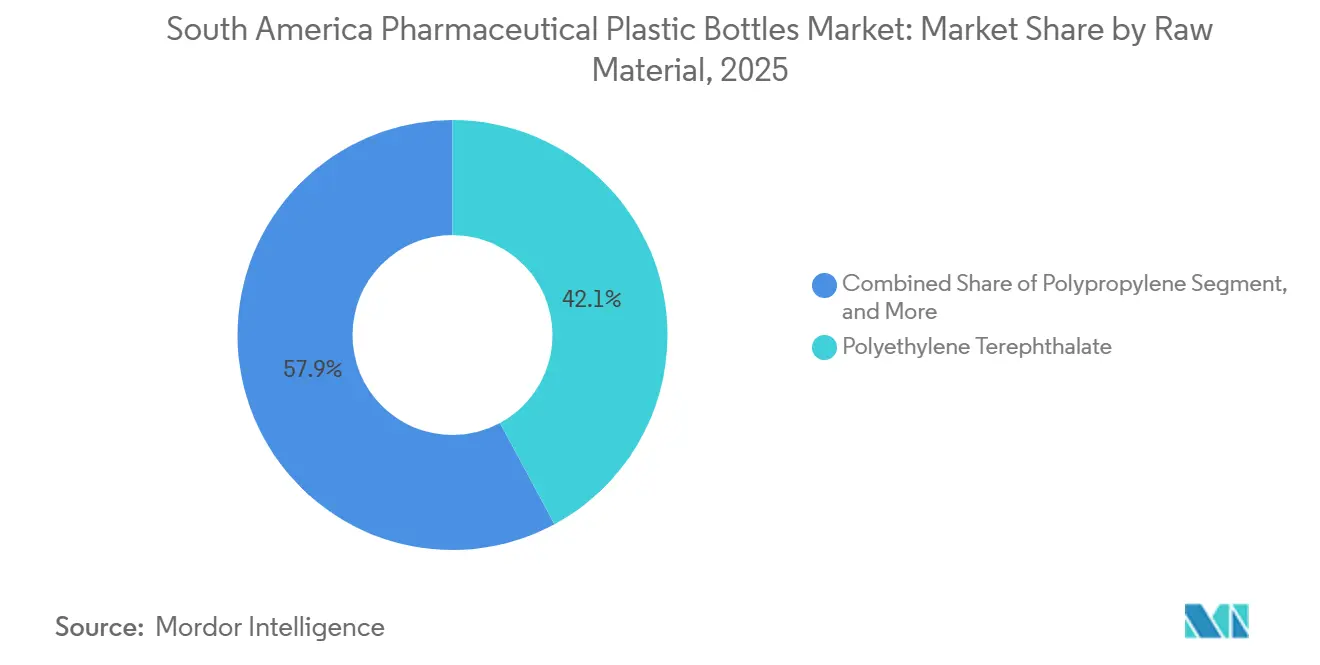
PET accounted for 42.14% of the South America Pharmaceutical Plastic Bottles Market size in 2025. Its transparency, barrier performance, and established acceptance under major pharmacopoeial standards support use in products requiring clear packaging and cross-border registrations. Pharmaceutical manufacturers value PET because a familiar format can simplify product dossiers and reduce operational variation across registered product lines, and its compatibility with standard blow-molding processes supports high-volume production for conventional tablet, capsule, and liquid medicine bottles. HDPE is used for desiccant-integrated solid oral containers and moisture-sensitive products, where opacity and moisture resistance are more important than visibility. LDPE remains suited to squeeze bottles for ophthalmic and topical medicines because flexible dispensing is required.
Polypropylene is projected to record a 4.67% CAGR from 2026 to 2031. Its heat resistance, moisture-barrier properties, and fit with mono-material designs support adoption where clarity is less important, while meeting pharmaceutical performance needs in applications that require a robust container and support circularity targets. Repsol’s HPP03G is a 100% recyclable polypropylene grade that complies with USP and European Pharmacopeia requirements. Brazil’s recycled-content requirements strengthen the case for materials with credible recycling pathways. PET is likely to retain its established role in clarity-dependent applications during the forecast period, particularly where product presentation, visual inspection, and existing filling-line qualification favor a familiar clear bottle, while its installed base means material substitution will depend on the formulation, validation requirements, available recyclate quality, and alternative-bottle performance.



By Bottle Type: Solid Oral Containers Lead as Nasal Spray Formats Accelerate
Solid oral containers held 38.71% of the South America Pharmaceutical Plastic Bottles Market share in 2025. Tablets and capsules used to treat chronic conditions create a stable demand for HDPE and PET bottles with child-resistant closures. High-volume cardiovascular, anti-diabetic, and anti-hypertensive medicines commonly use standardized formats that suit automated filling and routine pharmacy dispensing, with established dimensions that help manufacturers plan closures, labels, and secondary packaging around repeatable specifications. Dropper bottles remain important for ophthalmic products and concentrated liquid extracts where precise delivery is needed. Syrup bottles also serve as containers for pediatric medicines and cough-and-cold preparations.
Nasal spray bottles are forecast to expand at a 4.98% CAGR between 2026 and 2031. Intranasal delivery is extending beyond allergy and rhinitis products to migraine rescue, systemic delivery, and emergency epinephrine applications. These formats require precise dosing, metal-free pumps, and controlled dimensions to protect performance through filling, transport, and patient use. Their technical requirements can lift unit values above those of standard oral-bottle formats, while oral-care rinse bottles retain a separate role in over-the-counter portfolios sold through pharmaceutical channels. This mix leaves both standardized and specialized bottle demand relevant to suppliers, requiring manufacturers in the South America Pharmaceutical Plastic Bottles Market to balance high-volume, repeatable solid-oral production with lower-volume formats that demand closer control of pumps, closures, and bottle dimensions, while tailoring the bottle configuration to the dosage form.
By Capacity: Mid-Range Formats Hold Volume While ≤30 ml Bottles Grow Faster
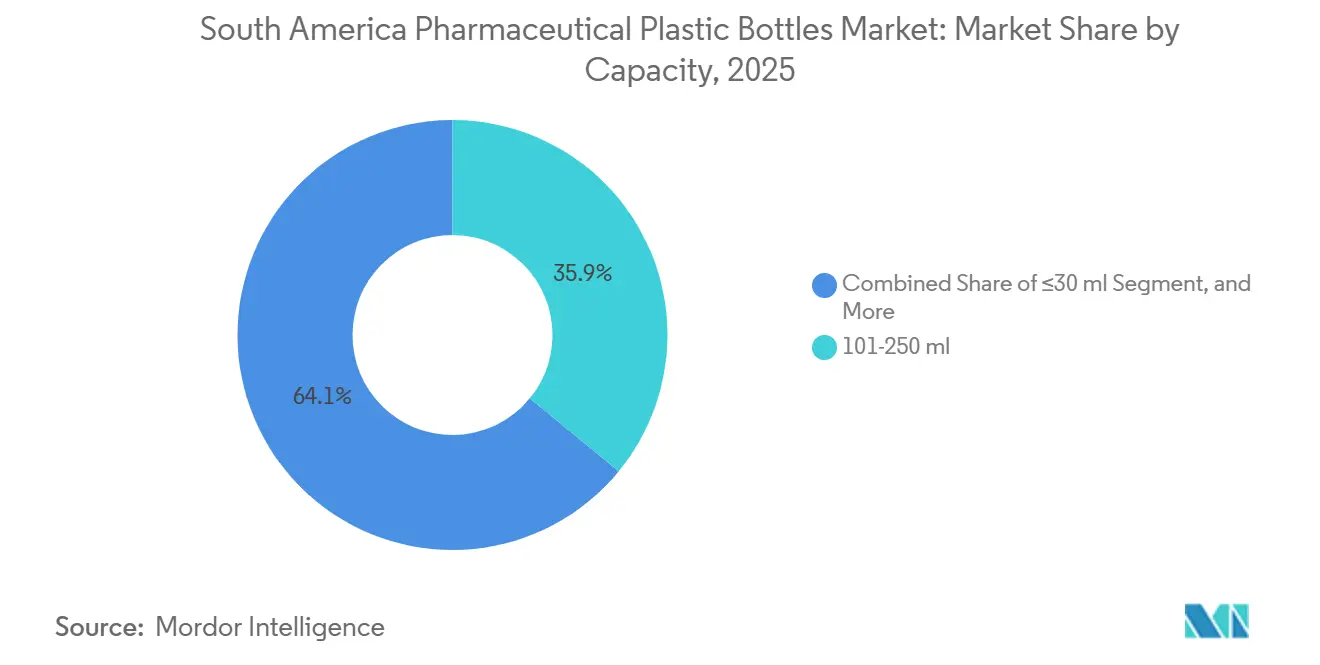
The 101-250 ml tier accounted for 35.92% of the South America Pharmaceutical Plastic Bottles Market in 2025. These bottles are widely used for tablet and capsule products produced on automated filling lines. Standard dispensing formats support consistent procurement for pharmacies and drug manufacturers, maintain familiar pack sizes for patients, and fit chronic-disease products requiring regular replenishment through retail and institutional channels. The 31-100 ml tier serves dropper bottles and mid-volume liquid formulations. The 251-500 ml and >500 ml tiers support institutional pharmacy and hospital dispensing.
The ≤30 ml segment is expected to grow at a 5.52% CAGR from 2026 to 2031. Nasal sprays, ophthalmic drops, and concentrated liquid formulations drive demand for these compact formats, while CDMO expansion for complex liquid products adds demand from prescription and export-oriented production. The small format requires careful control of bottle geometry, closures, pumps, and barrier properties because the contents are often high-value. LOG Pharma presented a high-performance HDPE barrier bottle that was 30% lighter and provided twice the moisture-vapor barrier protection of standard containers. This type of bottle addresses the material-efficiency needs of small, high-value formulations in the South America Pharmaceutical Plastic Bottles Market, combining lower resin use with adequate moisture protection, reliable dispensing, and closure or pump compatibility for a validated package.
By End User: Branded Manufacturers Lead While CDMOs Expand Faster
Branded pharmaceutical manufacturers accounted for 46.23% of the total value in 2025. Their portfolios require reliable bottle specifications, established validation records, and supply continuity across products with different volumes and dosage forms, leading buyers to prioritize a converter’s ability to manage change controls and preserve specifications during recurring production. Generic manufacturers are the next major source of demand as their product pipelines expand, while over-the-counter companies need pharmaceutical-grade bottles that remain cost-competitive in retail pharmacy channels. Each buyer group uses a mix of standard bottles and specialized formats based on formulation requirements.
CDMOs are forecast to grow at a 6.01% CAGR through 2031. Their procurement can be concentrated among fewer bottle suppliers that meet several technical requirements across product formats and client programs. This favors converters with broad validation packages, flexible production capability, and the ability to support product transfer work. Brazilian, Argentine, and Colombian facilities are building capabilities in biologics and complex solid dosage forms. The resulting demand supports suppliers who can provide consistent packaging across development, scale-up, and commercial supply, including pilot quantities, technical transfer, and larger runs, which places value on documented change controls, format flexibility, and a consistent bottle specification as volumes change.
Geography Analysis
Brazil held 52.86% of the South America Pharmaceutical Plastic Bottles Market share in 2025. Its position reflects the scale of pharmaceutical manufacturing and the reach of ANVISA’s regulatory framework. Novo Nordisk announced its BRL 6.4 billion (USD 1.09 billion) Montes Claros expansion in 2025, with operations expected to begin in 2028. The March 2026 semaglutide patent expiry supports generic GLP-1 activity and related packaging requirements. Serialization and recycled-content rules strengthen demand for validated converters and compliant materials, making production capability, documentation, material selection, and recycling claims part of the purchasing decision, with Brazil’s scale extending the relevance of these capabilities to neighboring South American manufacturing locations.
Colombia is forecast to grow at a 5.97% CAGR from 2026 to 2031. Its pharmaceutical manufacturing base can support packaging demand for domestic use and the South American supply. Colombia pursued pharmaceutical self-sufficiency and secured approval for domestically produced chloroquine in 2025. The country’s regulatory capabilities support broader packaging validation activities. Argentina maintains a capable base for small-molecule APIs and biosimilars, but its exchange-rate structure and persistent inflation constrain packaging investment capacity.
Recycled-content requirements and an expanding retail pharmacy network shape Chile’s packaging demand. Venezuela’s pharmaceutical sector faces infrastructure constraints and relies heavily on essential medicine supply channels. Peru and Ecuador are building pharmaceutical manufacturing capabilities from smaller bases, supported by supply-chain diversification. Across South America, the South America Pharmaceutical Plastic Bottles Market depends on local manufacturing scale, regulatory capacity, and access to qualified resin supply, which vary by country and require converters to align product ranges and qualification resources with each manufacturing base and regulatory environment.
Competitive Landscape
The South America Pharmaceutical Plastic Bottles Market is fragmented, although pharmaceutical customers limit active supplier lists to validated converters. ANVISA compliance, ISO 15378 certification, and serialization compatibility are central barriers to entry. These requirements make product quality, traceability, and documented change control more important than price alone for regulated accounts. Suppliers that have completed customer-specific validation can retain business because switching requires further qualification work. This structure supports established global and regional converters with pharmaceutical capabilities.
In July 2026, Gerresheimer agreed to sell its global Primary Packaging Plastics business and Centor US Holding to an Apax Partners affiliate for a combined enterprise value of EUR 1.5 billion (USD 1.7 billion). The businesses generated EUR 570 million (USD 655.79 million) in combined 2025 revenue and operated across 16 production sites in 9 countries. The transaction changes ownership of a significant primary-plastics platform in the pharmaceutical industry. Gerresheimer and Milliken also announced a partnership in April 2026 to introduce LeneX UltraGuard additive technology for pharmaceutical plastic packaging. These moves reflect a focus on polymer performance, protection, and technical differentiation.
ALPLA entered recycling operations in South America and committed EUR 15 million (USD 17.51 million) annually to recycling infrastructure from 2026. This investment can support packaging suppliers seeking a validated recycled-content supply before Brazil’s compliance deadlines. LOG Pharma’s barrier eco line also demonstrated how suppliers can enhance moisture protection while reducing bottle weight. Smaller regional converters have an opening in validated nasal-spray and dropper-bottle formats, particularly in Brazil’s industrial centers, where specialized tooling, quality controls, documented material performance, local service, and customer-specific validation support can differentiate suppliers from standard tablet-bottle producers.
South America Pharmaceutical Plastic Bottles Industry Leaders
Gerresheimer AG
AptarGroup, Inc.
Amcor plc
Alpha Packaging, Inc.
Sanner GmbH
- *Disclaimer: Major Players sorted in no particular order

Recent Industry Developments
- July 2026: Gerresheimer AG signed definitive agreements to sell its global Primary Packaging Plastics business and Centor US Holding to an affiliate of Apax Partners at a combined enterprise value of EUR 1.5 billion (USD 1.7 billion). The 2 businesses generated combined revenue of EUR 570 million (USD 655.79 million) in 2025, spanning 16 production sites across 9 countries. Centor's sale is expected to close by end of financial year 2026, and the PPP sale in the first half of financial year 2027. Gerresheimer will use proceeds to reduce debt and focus on high-value injectable drug delivery and device packaging.
- July 2026: ANVISA published Normative Instruction nº 456/2026, effective July 10, 2026, updating labeling requirements for injectable medications and sterile parenteral products. The instruction mandates Pantone color coding by therapeutic class, a minimum 3 mm color band, and specific rules for ampoules and vials up to 5 ml. Pharmaceutical manufacturers and packaging suppliers must evaluate primary packaging compliance against the updated standard for injectable products distributed in Brazil.
- April 2026: Gerresheimer and Milliken and Company announced a strategic partnership to advance pharmaceutical plastic packaging performance through Milliken's LeneX UltraGuard additive technology. The partnership targets high-value pharmaceutical applications requiring enhanced polymer durability, processing efficiency, and consistency.
- April 2025: Novo Nordisk announced a BRL 6.4 billion (USD 1.09 billion) expansion at its Montes Claros, Minas Gerais, Brazil, facility. The project adds aseptic production lines and a quality-control laboratory for GLP-1 injectable drugs. Construction began in April 2025, and operations are expected to begin in 2028, creating 600 permanent jobs.


South America Pharmaceutical Plastic Bottles Market Report Scope
The South America Pharmaceutical Plastic Bottles Market refers to the production and supply of plastic packaging containers specifically designed for storing and dispensing pharmaceutical products. This includes various bottle types, such as dropper bottles, syrup bottles, and nasal sprays, manufactured from materials like PET, HDPE, and polypropylene in a range of capacities. These bottles are primarily utilized by branded and generic drug manufacturers, as well as CDMOs, to ensure safe, compliant, and convenient drug delivery across the region.
The South America Pharmaceutical Plastic Bottles Market Report is Segmented by Raw Material (Polyethylene Terephthalate, High-Density Polyethylene, Low-Density Polyethylene, Polypropylene, and Other Raw Materials), Bottle Type (Solid Oral Containers, Dropper Bottles, Nasal Spray Bottles, Liquid Syrup Bottles, Oral-Care Rinse Bottles, and Other Bottle Types), Capacity (≤30 ml, 31-100 ml, 101-250 ml, 251-500 ml, and Above 500 ml), End User (Branded Pharmaceutical Manufacturers, Generic Drug Manufacturers, Contract Development and Manufacturing Organizations, and Over-the-Counter Product Companies), and Geography (Brazil, Argentina, Colombia, Chile, and Rest of South America). The Market Forecasts are Provided in Terms of Value (USD).
| Polyethylene Terephthalate |
| High-Density Polyethylene |
| Low-Density Polyethylene |
| Polypropylene |
| Other Raw Materials |
| Solid Oral Containers |
| Dropper Bottles |
| Nasal Spray Bottles |
| Liquid Syrup Bottles |
| Oral-Care Rinse Bottles |
| Other Bottle Types |
| ≤30 ml |
| 31-100 ml |
| 101-250 ml |
| 251-500 ml |
| Above 500 ml |
| Branded Pharmaceutical Manufacturers |
| Generic Drug Manufacturers |
| Contract Development and Manufacturing Organizations |
| Over-the-Counter Product Companies |
| Brazil |
| Argentina |
| Colombia |
| Chile |
| Rest of South America |
| By Raw Material | Polyethylene Terephthalate |
| High-Density Polyethylene | |
| Low-Density Polyethylene | |
| Polypropylene | |
| Other Raw Materials | |
| By Bottle Type | Solid Oral Containers |
| Dropper Bottles | |
| Nasal Spray Bottles | |
| Liquid Syrup Bottles | |
| Oral-Care Rinse Bottles | |
| Other Bottle Types | |
| By Capacity | ≤30 ml |
| 31-100 ml | |
| 101-250 ml | |
| 251-500 ml | |
| Above 500 ml | |
| By End User | Branded Pharmaceutical Manufacturers |
| Generic Drug Manufacturers | |
| Contract Development and Manufacturing Organizations | |
| Over-the-Counter Product Companies | |
| By Geography | Brazil |
| Argentina | |
| Colombia | |
| Chile | |
| Rest of South America |


Key Questions Answered in the Report
What is the size of the South America Pharmaceutical Plastic Bottles Market?
The South America Pharmaceutical Plastic Bottles Market was valued at USD 2.88 billion in 2025, is estimated at USD 2.99 billion in 2026, and is forecast to reach USD 3.64 billion by 2031. The forecast reflects higher demand from generic medicine production, local pharmaceutical investment, and validated primary-packaging supply, while compliance requirements make established technical capability important for suppliers.
What CAGR is forecast for the South America Pharmaceutical Plastic Bottles Market through 2031?
The South America Pharmaceutical Plastic Bottles Market is forecast to grow at a 4.01% CAGR from 2026 to 2031. Demand is supported by local pharmaceutical output, greater CDMO activity, and bottle formats used for solid oral and specialized liquid medicines, with compact nasal and ophthalmic products contributing to specialized-format demand.
Which raw material held the largest share in 2025?
PET led with a 42.14% share in 2025, supported by its transparency and established pharmaceutical acceptance. It remains useful where clear packaging, conventional filling processes, and accepted material documentation are central to product specifications, while HDPE and LDPE meet different moisture-resistance and flexible-dispensing needs.
Which bottle type is growing the fastest?
Nasal spray bottles are forecast to record a 4.98% CAGR through 2031 as intranasal drug delivery applications broaden. These applications need controlled dimensions, precise dosing systems, and packaging that can meet demanding technical requirements, which differentiates them from standardized solid-oral containers.
Which country held the largest share in 2025?
Brazil held a 52.86% share in 2025, supported by its pharmaceutical production base and regulatory infrastructure. Its serialization and recycled-content requirements increase the importance of validated converters and compliant materials for local supply, while major manufacturing investment reinforces the long-term local demand base.
What factors are influencing demand for pharmaceutical plastic bottles?
Generic-drug production, domestic manufacturing investment, serialization requirements, recyclable designs, and specialized small-volume formats are shaping demand. Resin-cost volatility and the time required to qualify new materials or suppliers remain important constraints for converters and pharmaceutical buyers, particularly where imported pharmaceutical-grade resins are exposed to currency movements, contracts use fixed prices, and the converter has limited ability to pass a sudden material-cost increase through to pharmaceutical customers.
Page last updated on:





