
Market Overview
| Study Period | 2021 - 2031 |
|---|---|
| Forecast Data Period | 2026 - 2031 |
| Base Year Market Size (2025) | USD 6.15 Billion |
| Market Size (2026) | USD 6.56 Billion |
| Market Size (2031) | USD 9.10 Billion |
| Growth Rate (2026 - 2031) | 6.79 % |
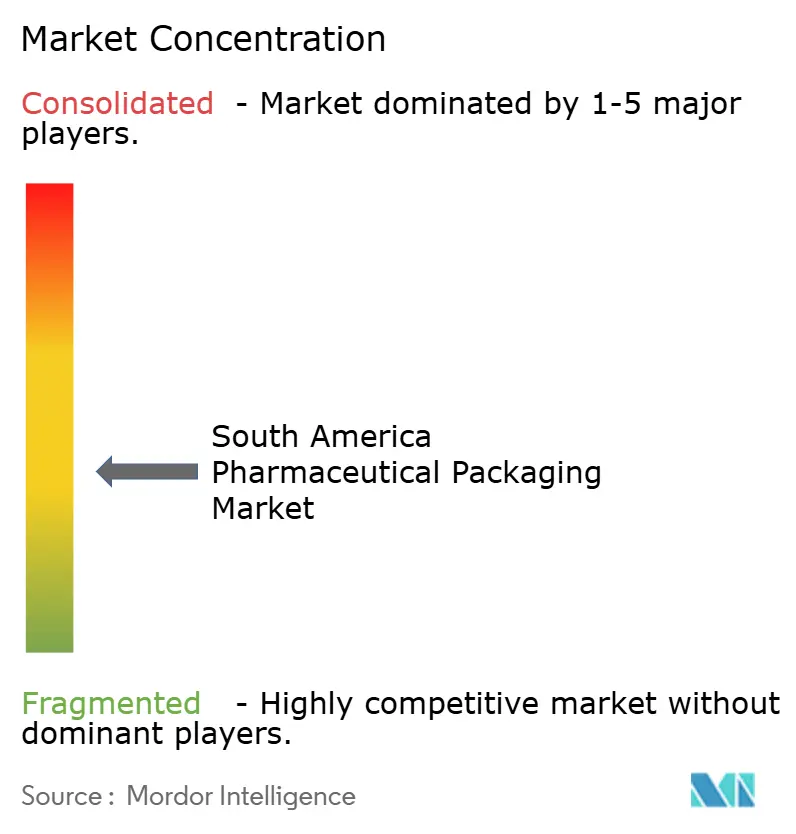
| Market Concentration | Medium |
Major Players *Disclaimer: Major Players sorted in no particular order Image © Mordor Intelligence. Reuse requires attribution under CC BY 4.0. | |
South America Pharmaceutical Packaging Market Analysis by Mordor Intelligence
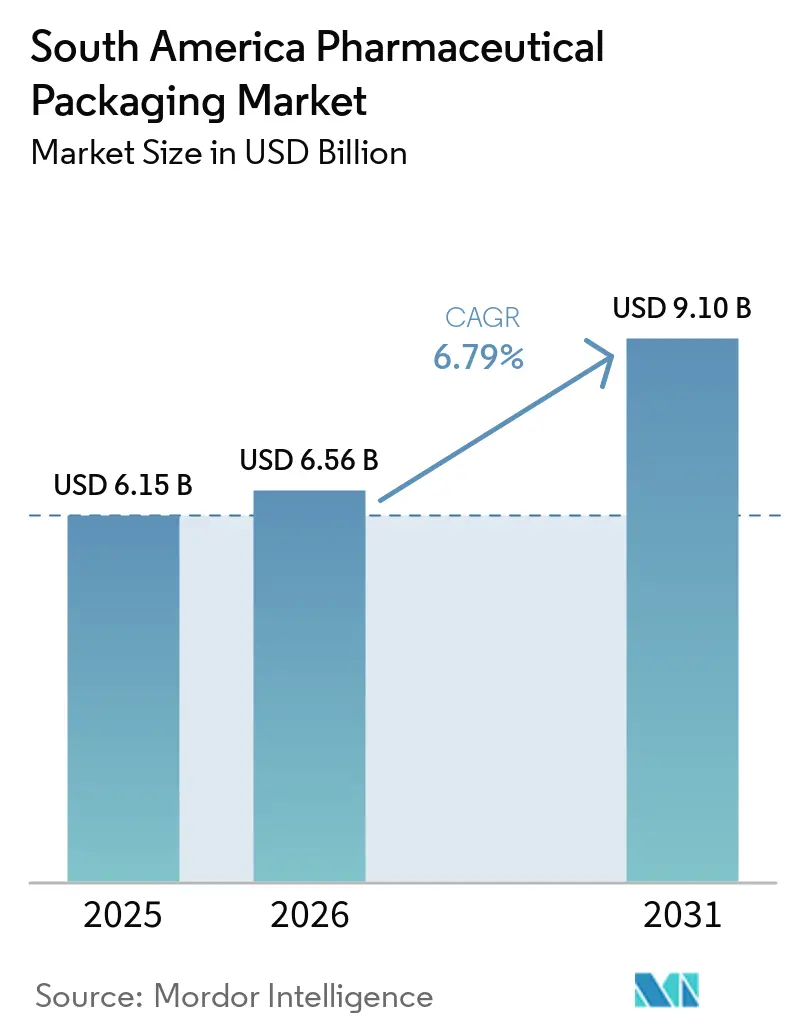
The South America pharmaceutical packaging market size was valued at USD 6.15 billion in 2025 and is projected to reach USD 9.1 billion by 2031, at a CAGR of 6.79% during 2026-2031. Pharmaceutical manufacturing investment in Brazil and Argentina is raising demand for primary and secondary formats across drug categories. Chronic disease treatment supports recurring demand for generic medicines and their unit-dose packaging. Injectable biologics, vaccines, and biosimilars are increasing the need for high-barrier containers and validated closure systems. Sustainability rules in Chile are changing material choices, especially for cartons and recyclable formats. Suppliers with traceability, inspection, and ready-to-use injectable packaging capabilities are positioned to address more demanding customer requirements.
Key Report Takeaways
- By material, plastics held 48.62% of the South America pharmaceutical packaging market share in 2025, while paper and paperboard is projected to expand at a 7.45% CAGR through 2031.
- By packaging level, primary packaging accounted for 74.62% of the South America pharmaceutical packaging market size in 2025 and is expected to expand at a 7.78% CAGR through 2031.
- By product type, bottles accounted for 28.63% of the South America pharmaceutical packaging market share in 2025, while prefilled syringes are projected to expand at an 8.03% CAGR through 2031.
- By end user, pharmaceutical companies held 64.72% of the South America pharmaceutical packaging market share in 2025, while pharma manufacturing companies are expected to expand at a 7.89% CAGR through 2031.
- By country, Brazil held 52.84% of the South America pharmaceutical packaging market share in 2025, while Chile is projected to expand at an 8.12% CAGR through 2031.
Note: Market size and forecast figures in this report are generated using Mordor Intelligence’s proprietary estimation framework, updated with the latest available data and insights as of January 2026.
Market Trends and Insights
Drivers Impact Analysis of South America Pharmaceutical Packaging Market*
| Driver | (~) % Impact on CAGR Forecast | Geographic Relevance | Impact Timeline |
|---|---|---|---|
| Pharmaceutical Manufacturing Expansion in Brazil and Argentina | +1.8% | Brazil, Argentina, with spillover to Colombia and Peru | Medium term (2-4 years) |
| Chronic Disease and Generic Drug Volumes | +1.5% | South America, concentrated in Brazil, Argentina, and Colombia | Short term (≤ 2 years) |
| Biologics, Vaccines, and Parenteral Therapies | +1.2% | Brazil, with expansion into Argentina and Colombia | Medium term (2-4 years) |
| Shift Toward Recyclable Packaging | +0.7% | Chile, Argentina, and Brazil, with wider regional adoption | Long term (≥ 4 years) |
| Serialization and Traceability in Unit-Dose Packaging | +0.6% | Brazil, with expansion into Argentina and Colombia | Short term (≤ 2 years) |
| Regional Fill-Finish and Contract Packaging Capacity | +0.5% | Brazil and Argentina, with emerging activity in Colombia and Chile | Medium term (2-4 years) |
| Source: Mordor Intelligence | |||
Expansion of Pharmaceutical Manufacturing in Brazil and Argentina
Brazil and Argentina are expanding pharmaceutical production capacity, thereby supporting demand for primary and secondary packaging across multiple drug categories. Brazilian generic drug manufacturers sold billions of units in 2025, a significant increase over 2024, with domestic laboratories accounting for most of the generic unit volume. Public procurement under Brazil’s Unified Health System favors individually blister-packed doses for hypertension and diabetes treatments rather than bulk bottles. This requirement supports demand for blister packaging, even for established generic molecules. BNDES approved BRL 650 million (USD 111 million) in financing for Bionovis in 2025, supporting domestic biologics production and future demand for high-complexity injectable packaging.[1]
Rising Chronic Disease and Generic Drug Volumes
Chronic disease treatment creates a stable volume base for oral-solid generic packaging across South America. Losartan, enalapril, atenolol, and amlodipine were among the leading generic products in Brazil during 2025. Losartan recorded 56.4 million boxes sold through April 2025. Retail pharmacies in the region commonly use strip packs and unit-dose blisters for these medicines. This preference increases demand for aluminum foil laminates and printed packaging rather than bulk-bottle formats. It also supports recurring production runs for high-volume medicines that are dispensed over long treatment periods. Generic volume does not necessarily reduce packaging requirements. Unit-dose specifications and traceability rules can increase packaging content per medicine even as active ingredient costs decline.
Growth of Biologics, Vaccines, and Parenteral Therapies
Parenteral drug pipelines are changing primary packaging specifications toward high-integrity containment systems. ANVISA authorized Ranivisio, Brazil’s first biosimilar ranibizumab, in June 2025.[2] Blau Farmacêutica received ANVISA Good Manufacturing Practice approval for a locally developed pembrolizumab biosimilar in January 2026. These products require packaging that can maintain sterility and protect sensitive formulations. Type I borosilicate glass vials and prefilled syringe systems are used where extractables and leachables performance must be evaluated. Each additional biologic program increases the need for validated glass and rubber closures and controlled-filling components. SCHOTT Pharma, Gerresheimer, and Stevanato Group formed the Alliance for RTU in 2024 to standardize ready-to-use vials and cartridges.[3] The initiative is intended to reduce qualification effort and enable faster access to ready-to-use containment systems. This approach is relevant for contract development and manufacturing organizations that need to establish new fill-finish programs on compressed schedules.
Sustainability-Led Shift Toward Recyclable Packaging
Chile’s Extended Producer Responsibility Law No. 20.920 has made the country a leading regional market for sustainable pharmaceutical packaging requirements. Mandatory collection and recovery targets under Supreme Decree DS 12/2020 have been in effect since 2023. The SISREP reporting system, which will be operational from 2025, requires producers and importers to record packaging recovery performance. Pharmaceutical companies selling in Chile must therefore consider end-of-life evidence alongside print quality and drug-contact compliance. This places greater emphasis on the selection of recyclable materials, recovered-content credentials, and clear documentation. The policy can favor secondary packaging suppliers that can meet both pharmaceutical and recovery-related requirements. Suzano offers Pharma Plus paperboard for pharmaceutical outer cartons and blister cards. Global converters are also developing mono-material blister laminates that aim to retain moisture and oxygen-barrier properties while supporting circularity targets.
Restraints Impact Analysis of South America Pharmaceutical Packaging Market*
| Restraint | (~) % Impact on CAGR Forecast | Geographic Relevance | Impact Timeline |
|---|---|---|---|
| Imported Resin, Aluminum, and Pharmaceutical Glass Cost Volatility | -0.9% | South America, most acute in Brazil and Argentina | Short term (≤ 2 years) |
| Currency, Import, and Working-Capital Pressure | -0.7% | South America, most severe in Argentina and elevated in Brazil | Short term (≤ 2 years) |
| Sterile and Barrier Packaging Validation Costs | -0.6% | South America, concentrated in Brazil’s sterile manufacturing hubs | Medium term (2-4 years) |
| Fragmented Waste Collection and Recycling Infrastructure | -0.4% | South America excluding Chile, most acute in Bolivia and Venezuela | Long term (≥ 4 years) |
| Source: Mordor Intelligence | |||
Volatility in Imported Resin, Aluminum, and Pharmaceutical Glass Costs
Raw material cost volatility is a major operational challenge for pharmaceutical packaging converters in South America. More than 70% of high-purity borosilicate glass tubing used in Brazil is imported. Import tariffs on pharmaceutical glass containers under NCM code 7010 range from 12% to 18%. A 10% depreciation of the Brazilian real can raise landed glass container costs by 5% to 8% in the absence of an offsetting mechanism. Aluminum prices on the London Metal Exchange moved by ±30% between 2023 and 2025. These movements required blister-foil converters to renegotiate contracts with pharmaceutical buyers that may use multiyear fixed supply agreements. Capacity constraints add to this cost exposure. Borosilicate tubing forming lines require 18 to 24 months of lead time from European and Japanese capital equipment suppliers. Producers cannot quickly adjust supply when price changes alter demand.
High Validation Costs for Sterile and Barrier Packaging
Changes to a sterile injectable package can trigger extensive validation work. A new glass type, elastomeric stopper formulation, or barrier-film supplier may require extractables and leachables studies and a variation filing with ANVISA or ANMAT. These validation cycles cost USD 0.5 million to USD 2 million per primary component and take 12 to 24 months to complete. The expense can keep pharmaceutical manufacturers with incumbent suppliers even when other suppliers offer lower prices. This creates a durable barrier for new regional converters trying to enter sterile packaging tenders. It also limits the speed at which buyers can respond to changes in input costs. ISO 15747 requirements for plastic containers used in intravenous injections and ANVISA good manufacturing practice expectations reinforce this barrier. Suppliers must maintain technical documentation and quality systems that support the drug manufacturer’s filing and validation process. Smaller converters often lack the documented testing history needed to compete for validated sterile applications.
*Our forecasts treat driver/restraint impacts as directional, not additive. The impact forecasts reflect baseline growth, mix effects, and variable interactions.
South America Pharmaceutical Packaging Market Segment Analysis
By Material:
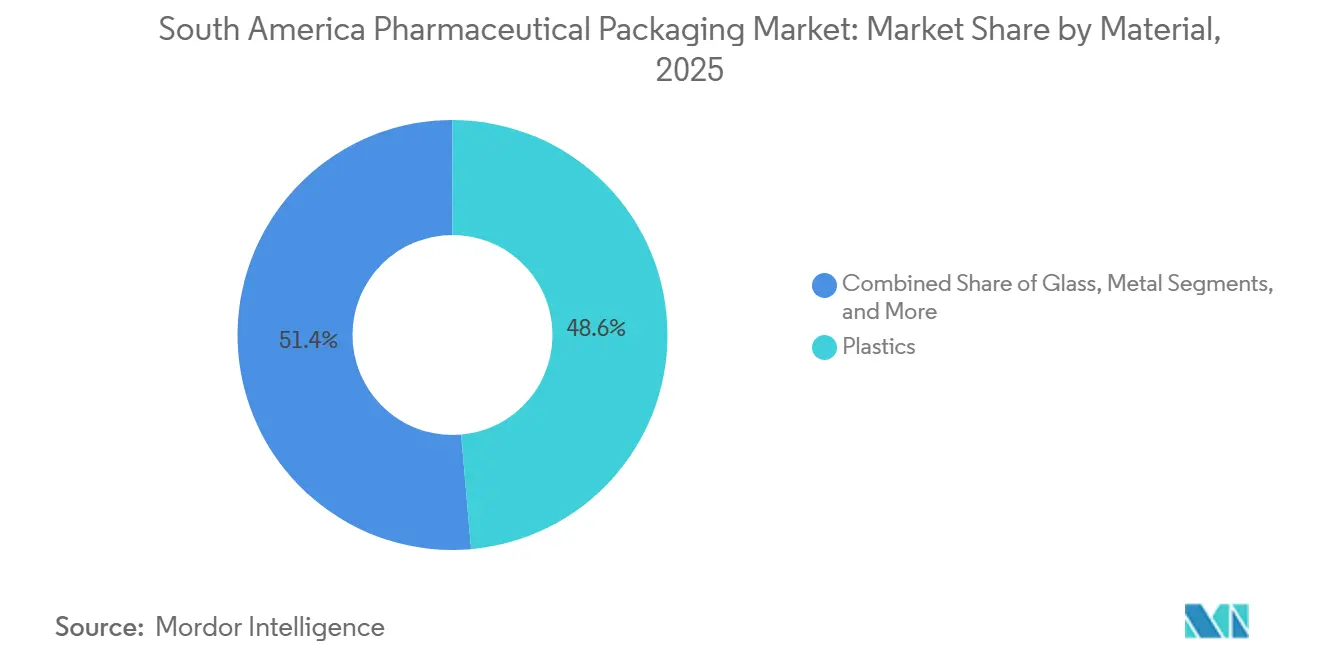
Plastics Lead Volume While Paperboard Accelerates Through Sustainability RequirementsPlastics held 48.62% of the South America pharmaceutical packaging market in 2025. HDPE bottles and PET containers support oral-solid generic medicines, while LDPE and LLDPE pouches and tubes serve liquid and semi-solid formulations. Glass carries greater revenue weight than its volume share because Type I borosilicate formats for biologics and vaccines carry a premium. Metal, biopolymers, and other materials address specialized needs, including aluminum foil for blister lidding. The use of biopolymers remains limited by the availability of validated pharmaceutical-grade alternatives.
Paper and paperboard is projected to expand at a 7.45% CAGR from 2026 to 2031, making it the fastest-growing material category. Chilean recovery rules and sustainability programs in Brazil are influencing demand for recyclable cartons and blister cards. Suzano’s Pharma Plus paperboard was designed for pharmaceutical outer cartons and blister-card uses. Klöckner Pentaplast and Constantia Flexibles are developing mono-material blister laminates that retain moisture- and oxygen-barrier performance while supporting recyclable packaging goals. The South America pharmaceutical packaging industry must balance sustainability requirements with drug protection and regulatory documentation.

By Packaging Level:
Primary Packaging Holds the Largest Value Position and the Highest Forecast RatePrimary packaging accounted for 74.62% of the South America pharmaceutical packaging market size in 2025. It is projected to expand at a 7.78% CAGR through 2031, the highest rate among packaging levels. The segment includes containers and closure systems that directly protect medicines, with its value position reflecting the needs of injectables, biologics, and vaccines. Prefilled syringes are the fastest-growing primary format as manufacturers shift from vial-and-syringe systems to ready-to-use configurations. Vials and ampoules still handle the largest volumes for parenteral antibiotics and vaccines.
SCHOTT Pharma’s Itupeva facility in Brazil marked its 25th anniversary in 2026 and employs 500 people. The site produces ampoules, vials, and cartridges for the local market. Secondary packaging includes cartons, sleeves, labels, and inserts, while tertiary formats include corrugated shippers and pallets. ANVISA’s RDC 885/2024 digital leaflet pilot requires changes to secondary cartons so they can carry compliant 2D DataMatrix codes for the regulatory information electronic repository. Cold-chain distribution for biosimilars and vaccines increases the need for coordinated primary, secondary, and tertiary solutions.
By Product Type:
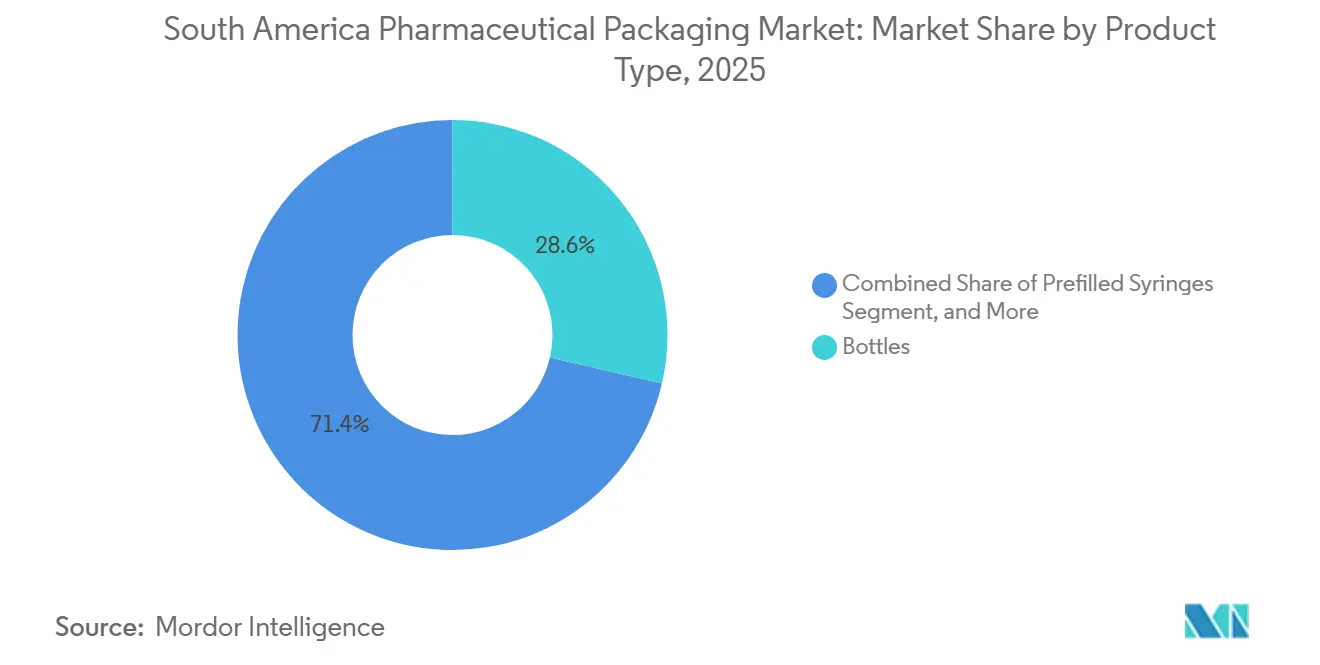
Bottles Remain the Largest Format While Prefilled Syringes Gain ValueBottles were the largest product type in 2025, holding 28.63% of the market value. HDPE and PET bottles are widely used for oral-solid generic medicines and are expected to remain the largest format, although faster blister-pack and syringe demand may reduce their share. Prefilled syringes are projected to expand at an 8.03% CAGR from 2026 to 2031, supported by GLP-1 receptor agonist volumes and local fill-finish investment. Novo Nordisk is upgrading its Montes Claros facility in Brazil with a BRL 6.4 billion investment (USD 1.09 billion) to produce aseptic GLP-1 receptor agonists. Operations are expected to begin in 2028.
The Alliance for RTU standardizes ready-to-use syringe platforms that regional contract development and manufacturing organizations can procure to expand their lines. Vials and ampoules are used for parenteral antibiotics, vaccines, and lyophilized biologics that require the integrity of Type I borosilicate glass. Blister packs remain the principal unit-dose oral dispensing format, while caps and closures provide child-resistant and tamper-evident features for prescription medicines. AptarGroup acquired Sommaplast in December 2025, a São Paulo provider of oral-dosing closures, droppers, dispensers, and dosing cups with more than 400 employees. The transaction reflects the importance of dispensing precision and device-adjacent packaging in the South America pharmaceutical packaging market.
By End User:
Pharmaceutical Companies Lead Demand While Integrated Manufacturers Expand QuicklyPharmaceutical companies accounted for 64.72% of the South America pharmaceutical packaging market in 2025. Brazilian domestic laboratories sold significant billions of generic units and accounted for most of the country’s total generic volume in 2025. They purchase packaging for high-volume oral treatments and prescription products with stricter containment requirements. This demand supports bottles, blisters, cartons, labels, closures, and consistent regulatory compliance in supplier selection.
Pharma manufacturing companies with integrated fill-finish operations are projected to expand at a 7.89% CAGR from 2026 to 2031. They are internalizing packaging procurement as they commission aseptic production lines and retain more value previously held by contract development and manufacturing organizations. These organizations are closely linked to biosimilar and small-molecule generic filings, and their serialization-capable secondary lines depend on higher filling volumes. Research institutes create a smaller demand for clinical-trial vials, syringes, and specialized closures. ANVISA’s regulatory modernization supports Brazil’s clinical trial infrastructure and the need for controlled primary packaging components.
Geography Analysis
Brazil Pharmaceutical Packaging Market
Brazil held 52.84% of the South America pharmaceutical packaging market in 2025. Its leading position reflects the scale of its pharmaceutical sector, the largest on the continent and the 7th globally, and the depth of ANVISA requirements. ANVISA’s SNCM framework requires pharmaceutical traceability through serialized DataMatrix barcodes. Consulta Dirigida No. 5/2026 implements the RDC 885/2024 digital leaflet pilot and is prompting secondary-carton redesigns with compliant QR codes. Brazil remains the principal regional demand center for generic medicine packaging and higher-specification injectable formats.
Pacific South America Pharmaceutical Packaging Market
Chile is projected to expand at an 8.12% CAGR from 2026 to 2031, the highest rate among countries in the region. The Chilean segment of the South America pharmaceutical packaging market is supported by Extended Producer Responsibility compliance and greater access to biologics. Companies selling pharmaceutical products in Chile must demonstrate packaging recovery results or finance collective management systems under DS 12/2020. This increases the cost of nonrecyclable secondary packaging and favors paperboard and mono-material formats. Colombia and Peru are mid-tier markets where public health coverage and biosimilar procurement support demand for injectable vials, ampoules, and chronic-disease blister packs.
Broader South America Pharmaceutical Packaging Market
The Rest of South America category includes Ecuador, Uruguay, Bolivia, Paraguay, and Venezuela. It represents the smallest demand pool, but Ecuador and Uruguay offer accessible opportunities through stable regulatory settings and expanding private pharmaceutical activity. Bolivia and Venezuela remain constrained by infrastructure gaps and cold-chain limitations beyond major cities. The South America pharmaceutical packaging market combines a large Brazilian demand base with a faster-moving Chilean market and diverse smaller-country opportunities.
Competitive Landscape
The South America pharmaceutical packaging market has a two-tier competitive structure. A concentrated upper tier comprises global suppliers with validated capabilities in primary injectable packaging, while a fragmented lower tier includes regional converters for secondary and tertiary formats. Gerresheimer, SCHOTT Pharma, Stevanato Group, Nipro, SGD Pharma, West Pharmaceutical Services, and Becton, Dickinson and Company supply vials, ampoules, prefilled syringes, cartridges, and related components. Their pricing position is supported by good manufacturing practice-certified glass compositions and ANVISA-registered documentation. Drug manufacturers face high switching costs because a change in supplier may require additional validation and a regulatory filing.
The 2024 Alliance for RTU brought SCHOTT Pharma, Gerresheimer, and Stevanato Group together to standardize ready-to-use vials and cartridges. The collaboration can reduce procurement timelines for contract development and manufacturing organizations entering the region’s biologics segment. It can also reduce the inventory-buffer requirement associated with single-supplier dependence. SCHOTT Pharma’s Itupeva facility produces ampoules, vials, and cartridges for the local market. The competitive balance is strongest in primary injectable packaging, where technical barriers are highest.
Amcor, Constantia Flexibles, Klöckner Pentaplast, Huhtamäki, and Berry Global compete in flexible and semi-rigid formats alongside Evertis S.A., Grupo HZ, Farmografica, Celomat S.A., and Neopackaging S.A. Constantia Flexibles completed its acquisition of Aluflexpack in March 2025, increasing its foil-based blister packaging capacity and specialized converting assets for Brazil and Colombia. AptarGroup’s acquisition of Sommaplast in December 2025 expanded its oral-dosing packaging offer in Brazil. Opportunities remain in serialization-integrated secondary packaging, recyclable packaging that meets ANVISA and Chilean material requirements, and ready-to-fill syringe supply for regional fill-finish operations.
South America Pharmaceutical Packaging Industry Leaders
-
Amcor plc
-
Gerresheimer AG
-
West Pharmaceutical Services, Inc.
-
Berry Global Group, Inc.
-
AptarGroup, Inc.
- *Disclaimer: Major Players sorted in no particular order
South America Pharmaceutical Packaging Market Companies Covered in this Report
- Amcor plc
- Gerresheimer AG
- West Pharmaceutical Services, Inc.
- Berry Global Group, Inc.
- AptarGroup, Inc.
- Smurfit WestRock plc
- Becton, Dickinson and Company
- Stevanato Group S.p.A.
- SCHOTT Pharma AG and Co. KGaA
- Nipro Corporation
- SGD Pharma
- Klockner Pentaplast Group
- Constantia Flexibles Group GmbH
- Huhtamaki Oyj
- Tekni-Plex, Inc.
- Evertis S.A.
- Grupo HZ
- Condensa S.A.
- TGI Pack S.R.L.
- SG+PACK
Recent Industry Developments in South America Pharmaceutical Packaging Market
- August 2026: Laboratório Cristália acquired the Takeda pharmaceutical manufacturing plant in Jaguariúna, São Paulo, expanding its network to 11 production units in Brazil. The ANVISA-GMP-certified facility focuses on solid-dosage forms and is projected to increase Cristália's oral pharmaceutical packaging volumes by 50-70%.
- August 2026: Eurofarma received environmental approval from CODEMA for a new production line at its Montes Claros complex, the largest pharmaceutical industrial complex in the southern hemisphere at 515,000 m² total area. The expansion adds new oral-form packaging volume requirements for converters supplying the site.
- March 2026: Novo Nordisk commenced construction at its Montes Claros, Brazil facility as part of a BRL 6.4 billion, USD 1.09 billion, upgrade to add aseptic GLP-1RA production capacity, a warehouse, and quality control infrastructure. New injectable packaging demand is expected from 2028 onward.
- February 2026: Gerresheimer AG's Querétaro facility, which expanded RTF glass prefilled syringe capacity for the North and South American pharmaceutical markets, reached full operational capacity in the first half of 2026 following a ground-breaking ceremony in November 2023.
South America Pharmaceutical Packaging Market Report Scope
The South America Pharmaceutical Packaging Market Report is Segmented by Material (Plastics, Glass, Metal, Paper and Paperboard, and Biopolymers and Other Materials), Packaging Level (Primary Packaging, Secondary Packaging, and Tertiary Packaging), Product Type (Bottles, Prefilled Syringes, Vials and Ampoules, Blister Packs, Caps and Closures, Tubes and Pouches, and Other Product Types), End User (Pharmaceutical Companies, Contract Development and Manufacturing Organizations, Research Institutes, and Other End Users), and Country (Brazil, Argentina, Chile, Colombia, Peru, and Rest of South America). The Market Forecasts are Provided in Terms of Value (USD).
Segmentation Overview
By Material
| Plastics | HDPE |
| LDPE and LLDPE | |
| PET | |
| Other Plastics | |
| Glass | Type I Borosilicate |
| Type II Treated Soda-Lime | |
| Type III Soda-Lime | |
| Metal | |
| Paper and Paperboard | |
| Biopolymers and Other Materials |
By Packaging Level
| Primary Packaging | Bottles |
| Prefilled Syringes | |
| Vials and Ampoules | |
| Blister Packs | |
| Secondary Packaging | Cartons and Sleeves |
| Labels and Inserts | |
| Tertiary Packaging | Corrugated Shippers |
| Pallets and Protective Systems |
By Product Type
| Bottles |
| Prefilled Syringes |
| Vials and Ampoules |
| Blister Packs |
| Caps and Closures |
| Tubes and Pouches |
| Other Product Types |
By End User
| Pharmaceutical Companies |
| Contract Development and Manufacturing Organizations |
| Research Institutes |
| Other End Users |
By Country
| Brazil |
| Argentina |
| Chile |
| Colombia |
| Peru |
| Rest of South America |
| By Material | Plastics | HDPE |
| LDPE and LLDPE | ||
| PET | ||
| Other Plastics | ||
| Glass | Type I Borosilicate | |
| Type II Treated Soda-Lime | ||
| Type III Soda-Lime | ||
| Metal | ||
| Paper and Paperboard | ||
| Biopolymers and Other Materials | ||
| By Packaging Level | Primary Packaging | Bottles |
| Prefilled Syringes | ||
| Vials and Ampoules | ||
| Blister Packs | ||
| Secondary Packaging | Cartons and Sleeves | |
| Labels and Inserts | ||
| Tertiary Packaging | Corrugated Shippers | |
| Pallets and Protective Systems | ||
| By Product Type | Bottles | |
| Prefilled Syringes | ||
| Vials and Ampoules | ||
| Blister Packs | ||
| Caps and Closures | ||
| Tubes and Pouches | ||
| Other Product Types | ||
| By End User | Pharmaceutical Companies | |
| Contract Development and Manufacturing Organizations | ||
| Research Institutes | ||
| Other End Users | ||
| By Country | Brazil | |
| Argentina | ||
| Chile | ||
| Colombia | ||
| Peru | ||
| Rest of South America | ||
Key Questions Answered in the Report
What is the size of the South America pharmaceutical packaging market?
The South America pharmaceutical packaging market was valued at USD 6.15 billion in 2025 and is projected to reach USD 9.1 billion by 2031 at a 6.79% CAGR.
What is driving pharmaceutical packaging demand in South America?
Manufacturing investment, high generic medicine volumes, and greater use of biologics, vaccines, and parenteral therapies are supporting demand.
Which material leads pharmaceutical packaging demand in South America?
Plastics led with 48.62% of regional value in 2025, supported by HDPE and PET use for oral-solid generic medicines.
Which packaging level is expected to expand fastest?
Primary packaging is projected to expand at a 7.78% CAGR through 2031, supported by demand for high-integrity injectable containment.
Why are prefilled syringes gaining importance in the region?
Prefilled syringes are projected to expand at an 8.03% CAGR through 2031 as GLP-1 therapies and local aseptic fill-finish capacity increase.