
South America OTT Market Size and Share
Market Overview
| Study Period | 2020 - 2031 |
|---|---|
| Forecast Data Period | 2026 - 2031 |
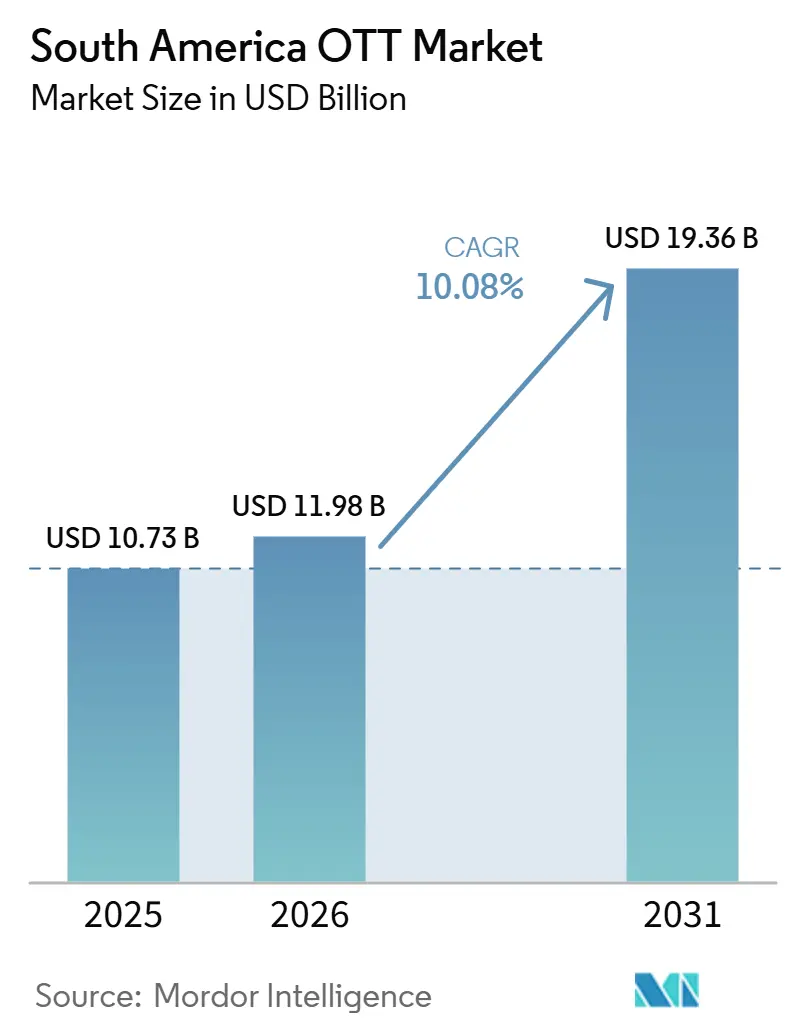
| Base Year Market Size (2025) | USD 10.73 Billion |
| Market Size (2026) | USD 11.98 Billion |
| Market Size (2031) | USD 19.36 Billion |
| Growth Rate (2026 - 2031) | 10.08 % |
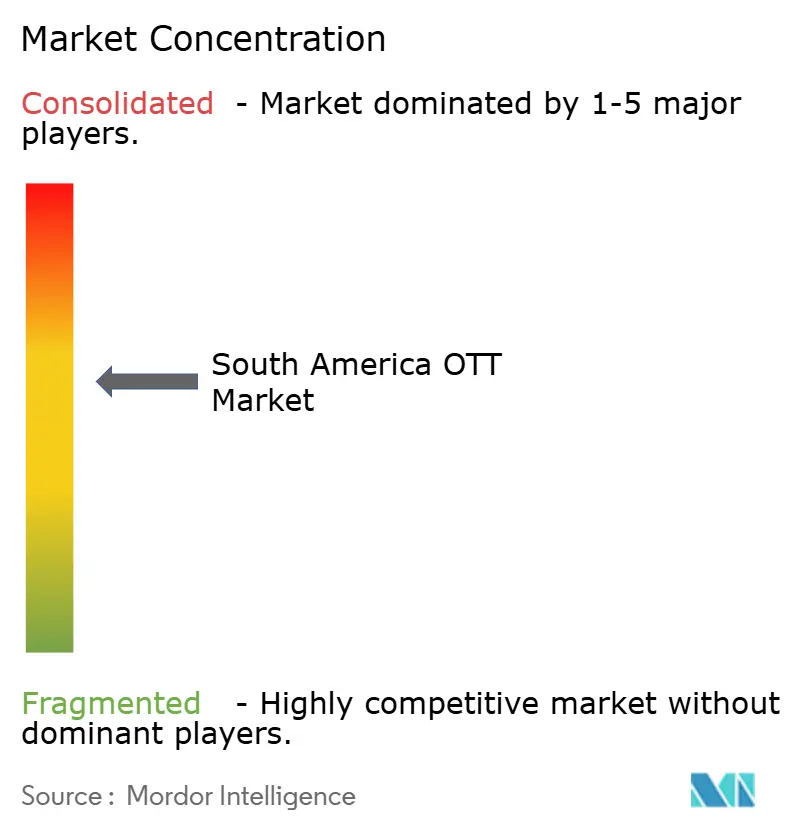
| Market Concentration | Medium |
Major Players *Disclaimer: Major Players sorted in no particular order Image © Mordor Intelligence. Reuse requires attribution under CC BY 4.0. | |
South America OTT Market Analysis by Mordor Intelligence
The South America OTT market size was valued at USD 10.73 billion in 2025 and estimated to grow from USD 11.98 billion in 2026 to reach USD 19.36 billion by 2031, at a CAGR of 10.08% during the forecast period (2026-2031). The South America OTT market is moving beyond early subscriber adoption toward households using several services for different viewing needs. Advertising-supported plans, broadband expansion, and connected television screens are expanding access for consumers sensitive to subscription prices. Live sports and local programming remain important tools for attracting viewers and reducing cancellations. Brazil combines the region's largest audience, production base, and advertising potential, while Colombia offers the fastest national growth outlook. Piracy, subscription rotation, fragmented rights, and uneven spending power outside major cities continue to limit revenue conversion across the South America OTT market.
Key Report Takeaways
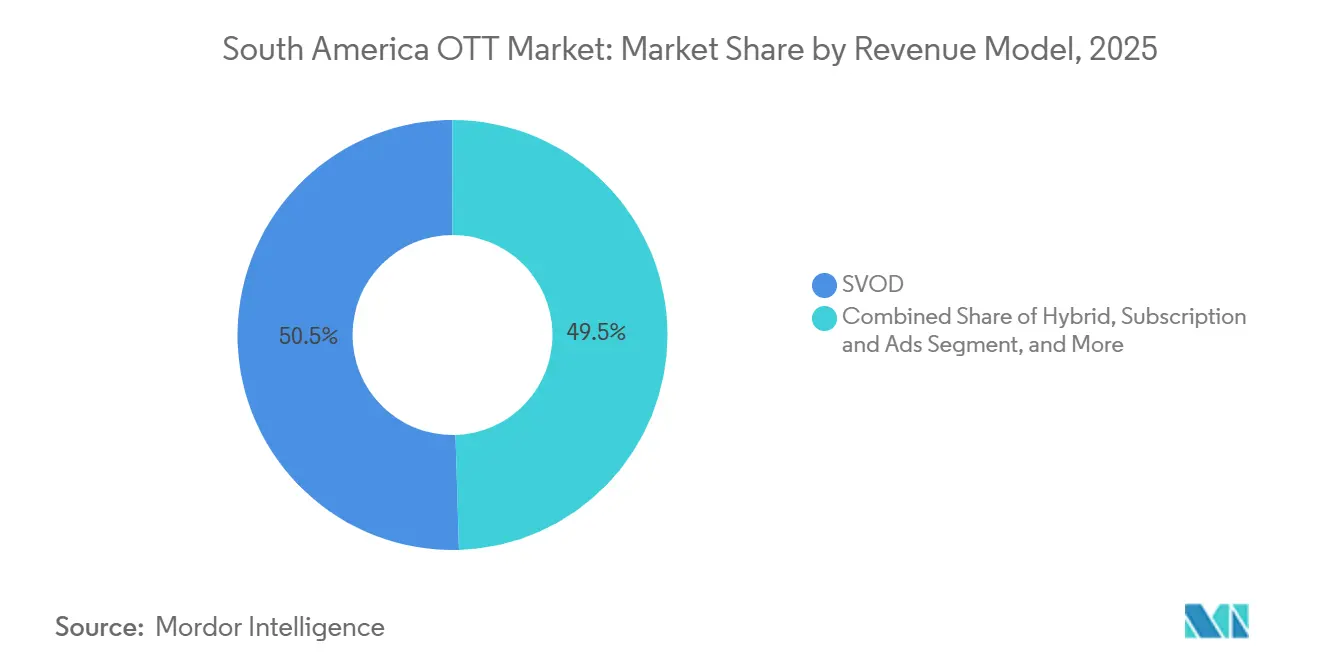
- By revenue model, SVOD held 50.48% of the South America OTT market share in 2025, while AVOD is projected to expand at a 11.42% CAGR through 2031.
- By device type, smartphones and tablets accounted for 52.50% of the South America OTT market share in 2025, while smart TVs are projected to grow at a 11.78% CAGR through 2031.
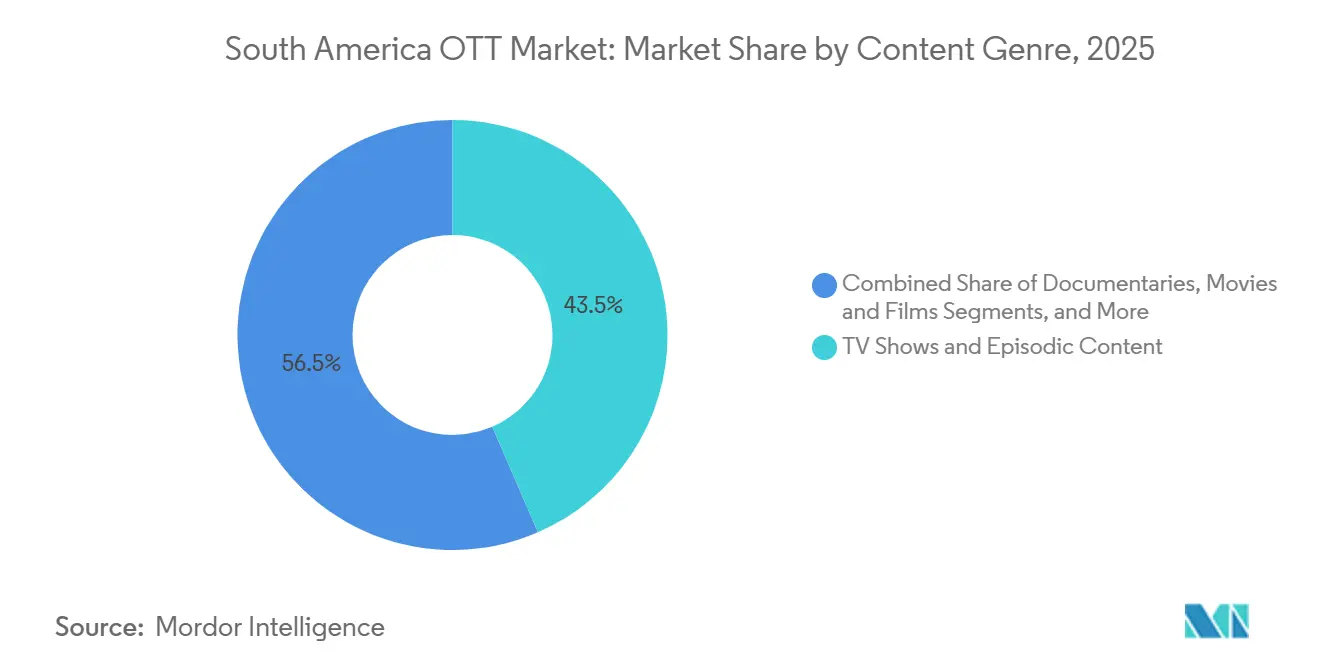
- By content genre, TV shows and episodic content held 43.50% of the South America OTT market share in 2025, while documentaries are projected to expand at a 11.27% CAGR through 2031.
- By country, Brazil held 53.10% of the South America OTT market share in 2025, while Colombia is projected to grow at a 11.97% CAGR through 2031.
Note: Market size and forecast figures in this report are generated using Mordor Intelligence’s proprietary estimation framework, updated with the latest available data and insights as of January 2026.
South America OTT Market Trends and Insights
Drivers Impact Analysis*
| Driver | (~) % Impact on CAGR Forecast | Geographic Relevance | Impact Timeline |
|---|---|---|---|
| Rising Smart TV and Connected Device Penetration | +2.5% | South America, with strongest gains in Brazil, and Colombia | Medium term (2-4 years) |
| Accelerating Broadband Expansion | +2.0% | Brazil, and Colombia, with effects in Chile and Peru | Medium term (2-4 years) |
| Shift to Ad-Supported Streaming and Hybrid Monetization | +1.8% | South America, with Brazil as early monetization leaders | Short term (≤ 2 years) |
| Demand for Live Sports and Event-Driven Streaming | +1.5% | South America, concentrated in Brazil, Argentina, and Colombia | Short term (≤ 2 years) |
| Growth of Local-Language Originals and Regional Bundling | +1.2% | South America, concentrated in Brazil, and Argentina | Medium term (2-4 years) |
| Rising FAST Adoption Among Price-Sensitive Households | +0.8% | South America, with Brazil and Colombia as primary adoption markets | Short term (≤ 2 years) |
| Source: Mordor Intelligence | |||
Rising Smart TV and Connected Device Penetration
Connected screens are changing how households use the South America OTT market. Smart TV penetration in connected South American households reached 65-70% in 2026. The installed base is expected to reach 193 million units, with 83.5% of those units actively connected. Connected TV advertising revenue is projected to reach USD 450 million in 2026. TCL, Hisense, and TPV together held 21% of the smart TV market in 2026, supporting lower price points for replacement purchases. Telecom bundles that combine fiber, set-top boxes, and connected devices can make larger-screen streaming easier for middle-income households.
Accelerating Broadband Expansion in Brazil, and Colombia
Broadband expansion lowers a practical barrier to video streaming in the South America OTT market. In 2025, 95% of households had internet access, and the rural connectivity gap narrowed to 7.8 percentage points from 41.5 percentage points in 2016. Colombia recorded 4.5 million fiber connections in the fourth quarter of 2024, up 19.5% from the previous quarter. Fiber accounted for 49.5% of the country's fixed internet connections at that time. Fiber subscriptions across Chile, Colombia, and Costa Rica grew 258% between 2020 and 2024, while more than USD 5 billion was invested in South American fiber infrastructure during 2025. Better access outside major cities gives platforms a larger potential audience, though affordability of services still determines whether connected homes become paying users.
Shift to Ad-Supported Streaming and Hybrid Monetization
Advertising-supported viewing is becoming an important entry point in the South America OTT market. Brazil generated USD 152 million in FAST revenue and ranked third globally in 2025. FAST household adoption in Brazil is projected to rise from 26 million households in 2024 to 52 million by 2029. Revenue in Brazil is projected to increase from USD 2.1 billion to USD 5.4 billion during the same period. The wider use of ad-funded tiers gives price-sensitive households an alternative to maintaining several full-price subscriptions. Hybrid bundles also allow platforms and distributors to combine advertising revenue with recurring fees, rather than relying on one funding model.
Demand for Live Sports and Event-Driven Streaming
Live sports give the South America OTT market a clear reason for viewers to join or retain a service. Amazon Prime Video streams Copa Libertadores matches for Brazilian audiences. Paramount+ began streaming all 104 FIFA World Cup 2026 matches in Argentina, Chile, Colombia, Ecuador, Peru, and Uruguay in June 2026 through its agreement with DSPORTS. The agreement also provides access to La Liga, Copa Sudamericana, and other sports properties across the year. CONMEBOL described the process for the 2027-2030 club competition rights as its most competitive bidding process, and it awarded packages to ESPN and Warner Bros. Discovery for the South American territory. These rights can support acquisition, advertising reach, and retention, but they also increase the cost and complexity of competing in the region.
Restraints Impact Analysis*
| Restraint | (~) % Impact on CAGR Forecast | Geographic Relevance | Impact Timeline |
|---|---|---|---|
| Subscription Fatigue Among Multi-Platform Households | -1.5% | South America, concentrated in Brazil and Argentina | Short term (≤ 2 years) |
| Fragmented Rights and Content Licensing Costs | -1.0% | South America, with highest impact in Brazil, and Argentina | Long term (≥ 4 years) |
| Piracy and Unauthorized Content Consumption | -0.8% | South America, with high penetration in Colombia, Ecuador, and Chile | Long term (≥ 4 years) |
| Uneven Monetization Outside Major Urban Centers | -0.5% | South America, with strongest impact in Peru, Bolivia, and Paraguay | Medium term (2-4 years) |
| Source: Mordor Intelligence | |||
Subscription Fatigue Among Multi-Platform Households
Subscription fatigue limits spending even as demand for streaming remains broad. By the end of 2025, 14% of streaming subscribers had canceled at least 1 service in the prior 6 months. That pattern reflects rotation around release schedules instead of a permanent exit from streaming. In Brazil, 39% of consumers intended to cancel at least 1 subscription in 2025 after price increases and content fragmentation. The South America OTT market, therefore, faces pressure to keep users engaged between major releases. Bundles can simplify household spending, but they can also shift customer ownership toward retailers, telecom operators, or other aggregators. This makes retention depend on a broader service relationship rather than just a platform's catalog.
Fragmented Rights and Content Licensing Costs
Rights fragmentation creates a recurring operating burden for regional platforms. Licensing agreements commonly use flat-fee or revenue-share structures because many OTT services cannot offer minimum guarantees for all titles.[1]World Intellectual Property Organization, “Study on the Audiovisual Legal Framework in Latin America,” WIPO, wipo.int Cross-border services also face currency mismatches when rights contracts are denominated in USD or EUR and local payments arrive in other currencies. The 2027-2030 CONMEBOL rights process required 10 months of technical analysis and multiple rounds of evaluation. That process shows why premium sports rights demand significant legal, commercial, and distribution planning. Brazil's proposed Bill 2331/22 also includes a 6% Condecine tax on streaming gross revenue, adding another factor to content and service planning.
*Our forecasts treat driver/restraint impacts as directional, not additive. The impact forecasts reflect baseline growth, mix effects, and variable interactions.
Segment Analysis
By Revenue Model: Subscription Services Lead While Advertising-Supported Viewing Expands
SVOD held 50.48% of South America OTT market share in 2025, making it the largest revenue model. The segment reflects subscription habits built as global and regional services expanded their libraries across Brazil, and Argentina. Brazil's subscription video market ranked fifth globally by revenue in 2025, showing the depth of established paid viewing in the country. TVOD continues to serve occasions where consumers pay for access to high-value releases. Hybrid subscription and advertising offerings serve households that want several services without paying separate full prices. These models are important because they can spread the monthly entertainment cost across a bundle.
AVOD is projected to expand at an 11.42% CAGR between 2026 and 2031, making it the fastest-growing revenue model in the South America OTT market. Brazil was among the heaviest FAST users in early 2026, with usage rates of 40% and 53%, respectively. Brazil's AVOD and FAST services generated 37% of the country's streaming revenue in 2025. 40% of South American subscribers paid for services they had previously accessed for free in 2025. This creates a reason for providers to maintain free and lower-cost access points. The model can attract new viewers, although advertising demand and the availability of suitable local programming remain important to its economics.



By Device Type: Mobile Viewing Leads While Smart TVs Gain Ground
Smartphones and tablets accounted for 52.50% of South America OTT market share in 2025. Their lead reflects a mobile-first viewing culture across countries with uneven fixed broadband access. Short videos, microdramas, social videos, and sports highlights are suited to the phone screen and fit for viewing in short intervals. Mobile internet users in South America increased from 220 million in 2014 to more than 450 million by 2025. Mobile technologies also accounted for more than 8% of regional GDP in 2025. Laptops, desktops, streaming sticks, and gaming consoles remain useful for particular viewing settings, but their role is narrower than the daily use of phones and tablets.
Smart TVs are projected to grow at an 11.78% CAGR between 2026 and 2031. This growth supports longer-form viewing, sports broadcasts, documentaries, and episodic series in the South America OTT market. Connected household penetration reached 65-70% in 2026, which gives services more direct access to large-screen viewing. Telecom operators such as Claro and Telefónica use set-top boxes with fiber plans to help households adopt connected television. Smart TV software remains divided among Tizen, Android, webOS, and several smaller systems. This fragmentation increases the work required to deliver and maintain streaming applications across the region and viewing models.
By Content Genre: Episodic Programming Leads While Documentaries Gain Attention
TV shows and episodic content accounted for 43.50% of the South America OTT market share in 2025. The category benefits from the region's long history of serialized storytelling, including telenovelas and drama series adapted for streaming. This content base helps platforms offer stories in Spanish and Portuguese that can travel across national markets. Movies and films remain a substantial category, but they share household attention with larger episodic libraries. Local series can also improve retention when viewers rotate subscriptions around individual releases.
Documentaries are projected to grow at an 11.27% CAGR between 2026 and 2031. The category reflects a stronger demand for factual programming with local relevance in the South America OTT market. Netflix announced a 2026 Brazilian documentary on maritime athlete Tamara Klink in partnership with Maria Farinha Filmes. The release formed part of a wider local slate that included scripted productions. Documentary programming can broaden a service beyond drama and comedy by using stories familiar to domestic audiences. Other content genres include sports, live events, music, and newer short-form formats. Those formats are becoming more relevant because they address viewers who do not fit traditional film or series categories.
Geography Analysis
Brazil held 53.10% of South America OTT market share in 2025. The country's scale reflects its large consumer base, established media companies, and active content production. Globo reached 196 million people across its platforms in 2025, and Globoplay had 30 million monthly active users. In 2025, 95% of Brazilian households had internet access.[2]Fiber Broadband Association, “FTTH Panorama for Latin America 2025,” Fiber Broadband Association, fiberbroadband.org This combination supports investment in programming, advertising products, and connected television distribution. Brazil's role is not limited to attracting viewers. It also gives streaming services a place to commission Portuguese-language titles, test advertising formats, and build distribution partnerships at scale. High household connectivity reduces a basic access barrier, but it does not remove the need for affordable plans or compelling local programming. The country's mix of broadcasters, global platforms, and newer digital outlets makes it a practical reference point for the regional South America OTT market. Its production role matters because Spanish-language titles can be offered across several countries without the same localization needs as a country-specific catalog. Brazil, therefore, performs different but complementary roles in the regional supply of programming and distribution.
Colombia is projected to grow at an 11.97% CAGR between 2026 and 2031. Fiber connections reached 4.5 million in the fourth quarter of 2024 and represented 49.5% of fixed internet connections. Greater fiber availability can improve the quality of household video streaming. It can also make shared household viewing more reliable when several devices are connected at the same time. Colombia also serves as a production location for Spanish-language titles that can reach audiences across South America. That role allows platforms to use locally commissioned content to support engagement across national borders. Argentina has an established streaming audience, but subscription rotation increases the importance of broad catalogs and sustained engagement. Services competing there need to balance high-profile releases with programs that keep subscribers watching between major events. Chile recorded an 11 percentage point increase in piracy during 2024-2025, which indicates continued price sensitivity and unmet access needs. Ad-supported options may address part of that tension, but they must offer a clear value proposition and dependable content availability.
Peru, Bolivia, and the rest of South America offer the next potential audience for the South America OTT market. These countries face lower broadband penetration and less local-language content supply than Brazil or Colombia. Their development path is likely to depend on practical improvements in connectivity, device access, and payment options. Digital terrestrial television transitions in Brazil, and Chile have created a household base that can move from basic television to connected devices. This installed base can support a gradual move toward streaming as smart television prices and broadband reach improve. Premium sports distribution can keep audiences engaged through established pay and streaming channels. CONMEBOL retained ESPN and DirecTV for Copa Sudamericana rights in the 2027-2030 cycle. These rights can give providers a familiar reason to maintain service availability in countries where paid streaming adoption is still developing. National broadcasting rules and local-content discussions continue to influence how international services approach smaller markets. Providers must therefore adapt catalog, pricing, distribution, and rights decisions to different national conditions rather than treat the region as one uniform audience.
Competitive Landscape
The South America OTT market is moderately concentrated among global services. One global platform accounted for nearly 50% of regional streaming revenue in 2026. National broadcasters, telecom operators, device companies, and commerce-linked services compete through distribution reach and local relationships. This creates different competitive conditions in each country. Global platforms have strong catalog scale, while national companies can use broadcast brands, billing relationships, and local rights. The result is a market where share is not determined solely by content investment.
Sports rights are an important part of competitive strategy in the South America OTT market. Paramount+ began streaming FIFA World Cup 2026 matches across 6 South American markets through its DSPORTS agreement. CONMEBOL awarded the 2027-2030 club competition rights following a competitive process involving ESPN and Warner Bros. Discovery.[3]CONMEBOL, “CONMEBOL Announces the Winners of the Broadcasting Rights for Its Club Competitions for the 2027-2030 Cycle,” CONMEBOL, conmebol.com Globo and ESPN also concluded an agreement to retain Copa Libertadores broadcast rights in Brazil for the 2027-2030 period. LiveMode took full control of CazéTV in July 2026, consolidating a rights portfolio that included La Liga, Ligue 1, Premier League sublicenses, Bundesliga, and the Los Angeles 2028 Olympics. These moves show that live rights can shape both subscriber demand and advertising reach.
Commerce-led bundling and free digital distribution are creating additional pressure on traditional subscription models. Mercado Libre launched Meli+ Mega in Brazil in July 2026 with Netflix, Disney+, HBO Max, and Apple TV+ in a single subscription tier. The bundle links video services with cashback and free shipping, which makes streaming part of a broader commerce relationship. CazéTV uses a free YouTube-first model and offers access to premium sports rights without a conventional subscription paywall. Its approach shows that reach and advertising can be used alongside, rather than only after, rights acquisition. Samsung TV Plus and Roku provide free ad-supported channel ecosystems that make device companies distribution intermediaries. These companies can affect how services manage placement, advertising, and revenue sharing on connected screens.
South America OTT Industry Leaders
Netflix, Inc.
Amazon.com, Inc.
The Walt Disney Company
Warner Bros. Discovery, Inc.
TelevisaUnivision, Inc.
- *Disclaimer: Major Players sorted in no particular order

Recent Industry Developments
- July 2026: Mercado Libre launched the Meli+ Mega bundle in Brazil, packaging Netflix, Disney+, HBO Max, and Apple TV+ into a single tiered subscription starting at BRL 39.90 per month (USD 7.20), alongside loyalty benefits including cashback and free shipping. The move positions Mercado Libre as a super-aggregator and introduces a commerce-driven bundling model that competes directly with telco-bundled OTT packages.
- July 2026: LiveMode completed a corporate restructuring to take full control of CazéTV, Brazil's creator-led sports streaming platform, consolidating a rights portfolio spanning LaLiga for 6 seasons, Ligue 1, Premier League sublicenses, Bundesliga, and the Los Angeles 2028 Olympics. Brazil's competition authority CADE reviewed the transaction. The consolidation signals a structural shift of premium sports inventory away from traditional pay-TV toward free digital-first distribution.
- May 2026: Netflix unveiled 5 new Brazilian original productions at Rio2C 2026, including Brazil's first medical drama series, Med, and a factual documentary on maritime athlete Tamara Klink, in partnership with Maria Farinha Filmes. The 5 new titles join 12 already-announced productions set to premiere in 2026-2027.
- December 2025: Globo and ESPN concluded a new deal with CONMEBOL to retain Copa Libertadores broadcast rights in Brazil through 2027-2030. Globo holds exclusive free-to-air rights, ESPN under Disney holds the main pay-TV and streaming package, and Globo's YouTube channel GE TV carries additional matches in digital-first distribution.


South America OTT Market Report Scope
The South America OTT market refers to the delivery of video, audio, and other media content directly to users over the internet, bypassing traditional cable, satellite, and broadcast television platforms. The report covers OTT services across South America, including subscription-based, advertising-based, and transactional models, and analyzes key market trends, growth drivers, challenges, competitive dynamics, and opportunities across the region.
The South America OTT Market Report is Segmented by Revenue Model (SVOD, AVOD, TVOD, and Hybrid, Subscription and Ads), Device Type (Smartphones and Tablets, Smart TVs, Laptops and Desktops, and Other Device Types), Content Genre (Movies and Films, TV Shows and Episodic Content, Documentaries, and Other Content Genres), and Country (Brazil, Argentina, Colombia, Chile, Peru, and Rest of South America). The Market Forecasts are Provided in Terms of Value (USD).
| SVOD |
| AVOD |
| TVOD |
| Hybrid, Subscription and Ads |
| Smartphones and Tablets |
| Smart TVs |
| Laptops and Desktops |
| Other Device Types |
| Movies and Films |
| TV Shows and Episodic Content |
| Documentaries |
| Other Content Genres |
| Brazil |
| Argentina |
| Colombia |
| Chile |
| Peru |
| Rest of South America |
| By Revenue Model | SVOD |
| AVOD | |
| TVOD | |
| Hybrid, Subscription and Ads | |
| By Device Type | Smartphones and Tablets |
| Smart TVs | |
| Laptops and Desktops | |
| Other Device Types | |
| By Content Genre | Movies and Films |
| TV Shows and Episodic Content | |
| Documentaries | |
| Other Content Genres | |
| By Country | Brazil |
| Argentina | |
| Colombia | |
| Chile | |
| Peru | |
| Rest of South America |


Key Questions Answered in the Report
What is the size of the South America OTT market?
The South America OTT market size is USD 11.98 billion in 2026 and is forecast to reach USD 19.36 billion by 2031, at a 10.08% CAGR.
Which revenue model leads streaming services in South America?
SVOD led with 50.48% share in 2025. AVOD is expected to be the fastest-growing revenue model, with an 11.42% CAGR through 2031.
Which devices are most important for OTT viewing in South America?
Smartphones and tablets led with 52.50% share in 2025, while smart TVs are projected to grow at an 11.78% CAGR through 2031.
Why are advertising-supported streaming services expanding in South America?
Advertising-supported and FAST services provide lower-cost access for households that rotate subscriptions or cannot maintain several paid plans.
Which country leads the regional OTT sector?
Brazil led with 53.10% share in 2025, supported by its large audience, content production, and high household internet access.
What is the fastest-growing country for OTT services in South America?
Colombia is projected to grow at an 11.97% CAGR through 2031, supported by fiber adoption and its role in Spanish-language content production.
Page last updated on:





