
South America Optical Transponder Market Size and Share
Market Overview
| Study Period | 2020 - 2031 |
|---|---|
| Forecast Data Period | 2026 - 2031 |
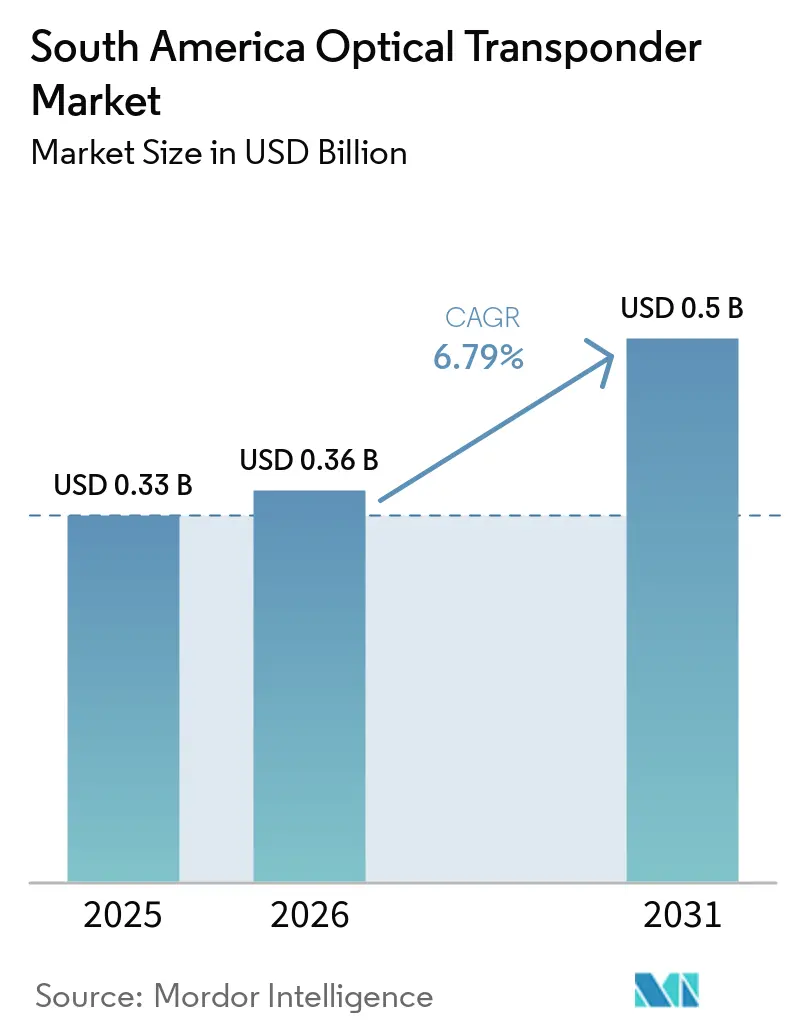
| Base Year Market Size (2025) | USD 0.33 Billion |
| Market Size (2026) | USD 0.36 Billion |
| Market Size (2031) | USD 0.5 Billion |
| Growth Rate (2026 - 2031) | 6.79 % |
| Market Concentration | Medium |
Major Players *Disclaimer: Major Players sorted in no particular order Image © Mordor Intelligence. Reuse requires attribution under CC BY 4.0. | |
South America Optical Transponder Market Analysis by Mordor Intelligence
The South America Optical Transponder Market size is projected to be USD 0.33 billion in 2025, USD 0.36 billion in 2026, and reach USD 0.5 billion by 2031, growing at a CAGR of 6.79% from 2026 to 2031. Capacity constraints on long-distance terrestrial routes support demand in the South America optical transponder market, planned subsea cable systems, and wider data center interconnection activity. Microsoft committed BRL 14.7 billion (USD 2.7 billion) to cloud and AI in Brazil, while Google pledged more than USD 1.2 billion in regional investment through 2027, reinforcing demand for high-capacity data center connections. The South America optical transponder market also benefits from two demand sources, telecom network upgrades and data center interconnection spending, which reduces dependence on a single customer group.
Key Report Takeaways
- By transmission technology, coherent transmission technology held 80.39% of the South America Optical Transponder Market in 2025 and is projected to expand at a 7.45% CAGR through 2031.
- By data rate, the above 100 Gbps to 400 Gbps tier accounted for 49.16% of the South America optical transponder market in 2025, while the above 800 Gbps tier is expected to record an 11.60% CAGR through 2031.
- By network application, long-haul applications held 35.67% of the South America optical transponder market in 2025, while data center interconnection is projected to expand at a 9.15% CAGR through 2031.
- By end-user, telecommunication service providers captured 67.15% of the South America optical transponder market in 2025, while cloud and hyperscale data center operators are expected to record a 9.40% CAGR through 2031.
- By country, Brazil accounted for 66.50% of the South America optical transponder market in 2025 and is projected to grow at a 7.25% CAGR through 2031.
Note: Market size and forecast figures in this report are generated using Mordor Intelligence’s proprietary estimation framework, updated with the latest available data and insights as of January 2026.
South America Optical Transponder Market Trends and Insights
Drivers Impact Analysis*
| Driver | (~) % Impact on CAGR Forecast | Geographic Relevance | Impact Timeline |
|---|---|---|---|
| 5G and Fiber-Backhaul Capacity Expansion | +2.0% | Brazil, Argentina, and Chile, with early gains in Sao Paulo, Buenos Aires, and Santiago | Short term (≤ 2 years) |
| Cloud, AI, and Data-Center Interconnect Traffic Growth | +1.8% | Brazil, including Sao Paulo and Fortaleza, and Chile, including Santiago | Medium term (2-4 years) |
| Hyperscale and Carrier Investment in High-Capacity Subsea Routes | +1.3% | Brazil, Argentina, and the Rest of South America | Long term (≥ 4 years) |
| Regional Migration From 100G to 400G and 800G Coherent Wavelengths | +0.9% | Brazil and Argentina | Medium term (2-4 years) |
| Brazil’s OPGW-Based Backbone and Edge-Data-Center Expansion | +0.6% | Brazil, including Para, Mato Grosso, and Acre | Short term (≤ 2 years) |
| Open Optical Networking Adoption Among Regional ISPs | +0.4% | Brazil and Argentina | Medium term (2-4 years) |
| Source: Mordor Intelligence | |||
5G and Fiber-Backhaul Capacity Expansion
5G mid-band deployment is increasing backhaul spectral requirements at aggregation nodes, where demand can be 10 times greater per sector than for 4G aggregation, and microwave links do not provide the capacity needed for denser traffic loads. Telecom Argentina closed 2025 with 1,000 5G sites and targets more than 2,000 sites by the end of 2026, while Claro Argentina committed USD 500 million to fiber and 5G during 2026. The "OpenRAN@Brasil" program is modernizing the RNP network from an MPLS architecture to SRv6 protocols, thereby supporting transport planning for more open radio access deployments. These deployments bring coherent transport requirements to secondary cities, where historically lower traffic density has supported fewer high-capacity optical investments. The South America optical transponder market, therefore, gains demand from access and aggregation networks as well as from established long-haul corridors.
Cloud, AI, and Data Center Interconnect Traffic Growth
AI workloads generate bursty traffic that requires low-latency, predictable optical capacity between data center locations. Equinix opened the AI-ready SP6 site in Santana de Parnaiba in April 2026 after investing USD 114 million, and Tecto Data Centers announced a USD 2 billion expansion plan for 5 facilities in Brazil through 2028. Brasscom projected USD 9 billion in Brazilian data center investment in 2025, including USD 7 billion for equipment, and a cumulative investment of USD 92 billion through 2031, including USD 69 billion in equipment, which establishes a strong base for interconnection capacity. Cirion is deploying Ciena WaveLogic 6 Extreme technology for 1.6 Tb/s single-carrier wavelengths through its DC Connect service, which connects more than 70 data centers in Brazil.[1]Cirion Technologies, “Cirion Accelerates Network Expansion in Brazil to Support the New Era of AI,” Cirion Technologies, ciriontechnologies.com The South America optical transponder market is consequently moving toward higher-capacity interconnection services, in which capacity, reach, and latency are assessed together.
Hyperscale And Carrier Investment In High-Capacity Subsea Routes
New cable systems create long planning cycles for optical equipment because landing stations need high-capacity line-terminating equipment for each fiber pair. V.tal announced the 9,700-km Synapse system between Brazil and the United States, with 16 fiber pairs designed to support 800 Gbps per pair, and construction scheduled to begin in the second half of 2026. Cirion is upgrading the eastern section of its South America Crossing system to 1.2 Tbps and plans to light the SAC-2 route on Google’s Firmina system at 800 Gbps. Sparkle and Entel Bolivia signed a memorandum of understanding in May 2026 for a 4,370 km Lima-to-Sao Paulo corridor designed to scale to 60 Tbps with latency below 60 milliseconds. These projects broaden the South America optical transponder market beyond conventional terrestrial links and create procurement opportunities at landing, amplification, and interconnection points.
Regional Migration From 100G To 400G And 800G Coherent Wavelengths
Operators with established 100G coherent systems are reaching refresh points and are increasingly considering direct migration to 400G platforms. Internet service providers accounted for 64% of Padtec TMD400G purchases, indicating that this transition extends beyond the largest carrier networks. BR.Digital deployed Ciena WaveLogic 6 Extreme in August 2025 and achieved 1.1 Tb/s over links exceeding 800 km on its Brazilian network.[2]Ciena Corporation, “BR.Digital Expands Network Capacity with Ciena WaveLogic 6,” Ciena, ciena.com Padtec plans to make its TMQ800G-NC platform commercially available in the second half of 2026. This migration gives the South America optical transponder market a path toward greater capacity without requiring operators to maintain separate single-rate product fleets.
Restraints Impact Analysis*
| Restraint | (~) % Impact on CAGR Forecast | Geographic Relevance | Impact Timeline |
|---|---|---|---|
| Currency Depreciation and Imported-Equipment Cost Inflation | -1.4% | Brazil and Argentina, with acute effects in São Paulo and Buenos Aires procurement markets | Short term (≤ 2 years) |
| Fragmented Certification and Type-Approval Requirements | -0.8% | Brazil and Argentina | Medium term (2-4 years) |
| Shortage of Coherent-Optics Engineering and Field-Service Skills | -0.5% | Brazil’s interior and the Rest of South America | Medium term (2-4 years) |
| Legacy-Fiber Reach, Power, and Site-Economics Constraints Outside Major Hubs | -0.4% | The Rest of South America and Brazil’s northern and western states | Long term (≥ 4 years) |
| Source: Mordor Intelligence | |||
Currency Depreciation and Imported Equipment Cost Inflation
More than 90% of coherent optical transponder equipment is sourced internationally, so depreciation of the Brazilian real can increase local-currency equipment costs by 10% to 15%. This pressure reduces available capital expenditure at smaller internet service providers and can lengthen their equipment replacement cycles. Telecom Argentina absorbed related pressure through a major increase in capital expenditure in 2025, but smaller regional providers have fewer options for managing currency volatility. Large carriers can use hedging arrangements or U.S.-dollar procurement contracts, whereas regional providers generally face the local cost increase directly. The South America optical transponder market, therefore, has uneven purchasing conditions between large operators and smaller providers.
Fragmented Certification And Type-Approval Requirements
Brazil and Argentina require separate approval pathways for active optical telecommunications equipment, with different testing and documentation requirements. ANATEL’s conformity and homologation framework applies to optical line terminal products.[3]Agência Nacional de Telecomunicações, “Resolução nº 715, de 23 de outubro de 2019,” ANATEL, anatel.gov.br The ANATEL approval process can take 8 to 12 weeks per product model, delaying the introduction of hardware variants or new operating modes. ENACOM can accept certain foreign test reports that meet international standards, but vendors still incur separate qualification costs for both national markets. The absence of a regional mutual-recognition framework requires vendors pursuing multicountry rollouts to maintain 5 or more approval portfolios, favoring suppliers with existing approval libraries and raising the entry cost for newer participants in the South America optical transponder market.
*Our forecasts treat driver/restraint impacts as directional, not additive. The impact forecasts reflect baseline growth, mix effects, and variable interactions.
Segment Analysis
By Transmission Technology: Coherent Platforms Lead Capacity Upgrades
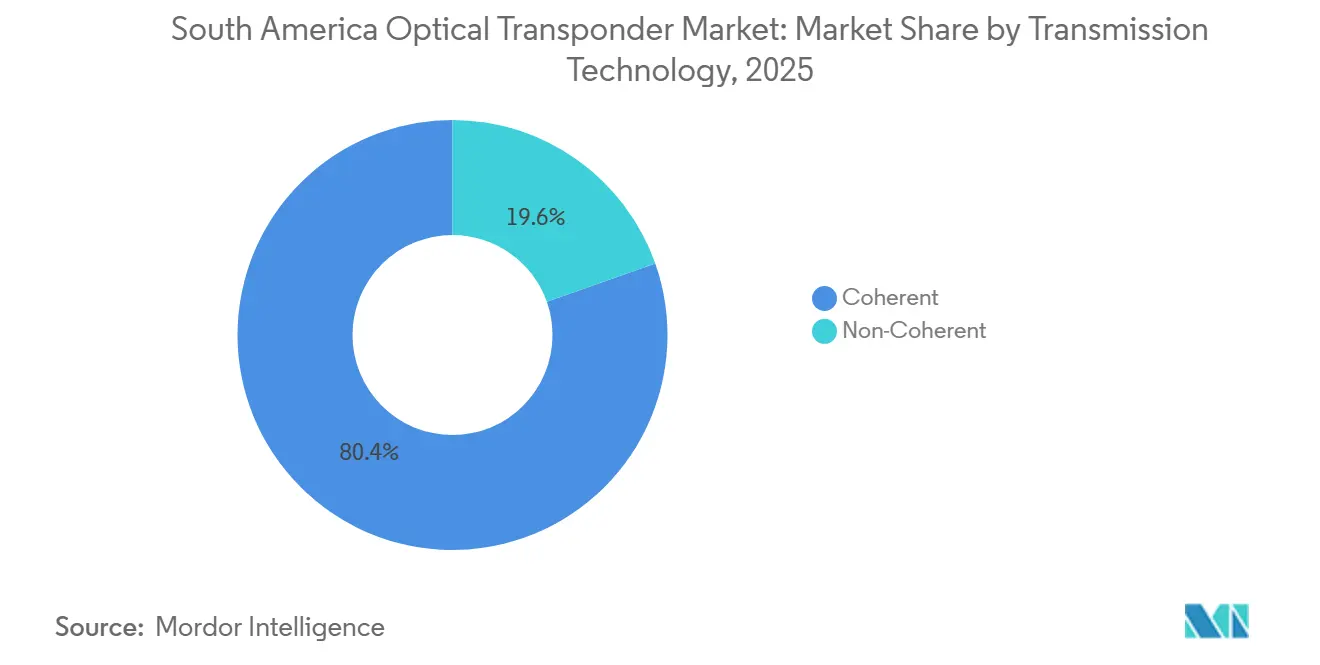
Coherent transmission technology accounted for 80.39% of regional revenue in 2025 and is projected to expand at a 7.45% CAGR through 2031. In the South America optical transponder market, the market position reflects the ability of digital signal processor platforms to provide spectral efficiency and adaptable reach over long network spans. Probabilistic constellation shaping supports these performance requirements by helping operators adjust capacity to link conditions. Network operators use these features where long distances and changing traffic patterns make fixed transmission settings less suitable. Coherent platforms also support the higher channel rates needed for backbone modernization and data center interconnection.
Non-coherent systems remain relevant for campus and intra-metro links below 80 km, where traffic volumes and distances do not always justify the costs of coherent digital signal processors. Their role is narrowing as coherent pluggable modules move closer to cost parity on a per-bit basis for capacity-intensive deployments. Eletronet selected Nokia 1830 PSS and 1830 GX platforms for its backbone modernization, enabling channel speeds of up to 1.2 Tb/s.[4]NEC Corporation, “NEC and Nokia to Expand Eletronet’s Optical Fiber Network in Brazil by 50%,” NEC, nec.com The project shows that coherent capacity above 800 Gbps is becoming a practical procurement option for Brazilian long-haul routes. This technology shift supports a more consistent equipment approach across carrier, internet service provider, and data center networks.


By Data Rate: 400G Supports Volume, While 800G Raises Capacity
The above 100 Gbps to 400 Gbps tier held 49.16% of regional revenue in 2025. Within the South America optical transponder market, this tier is the main commercial choice for carriers and internet service providers, replacing older 100G equipment. Padtec reported sales of 1,000 TMD400G units across South America, which indicates that the transition has reached regional internet service provider networks. Flexible-rate 400G systems allow operators to increase channel rates in place, reducing the need to procure separate single-rate 100G equipment. This capability makes the tier suitable for broad network refresh programs.
The up to 100 Gbps tier is losing value share as operators favor flexible platforms that can support higher rates when traffic rises. The above 400 Gbps to 800 Gbps tier serves as a transition stage for national backbone upgrades where capacity needs are rising, but deployment conditions vary. The above 800 Gbps tier is projected to record an 11.60% CAGR through 2031, supported by subsea terminations, hyperscale interconnection, and next-generation backbone projects. Eletronet’s modernization program enables up to 1.2 Tb/s per channel, indicating a shift toward higher-capacity backbone procurement. The South America optical transponder market has therefore retained 400G as its volume base while increasing adoption of higher-capacity platforms.
By Network Application: Long-Haul Revenue Leads While DCI Advances
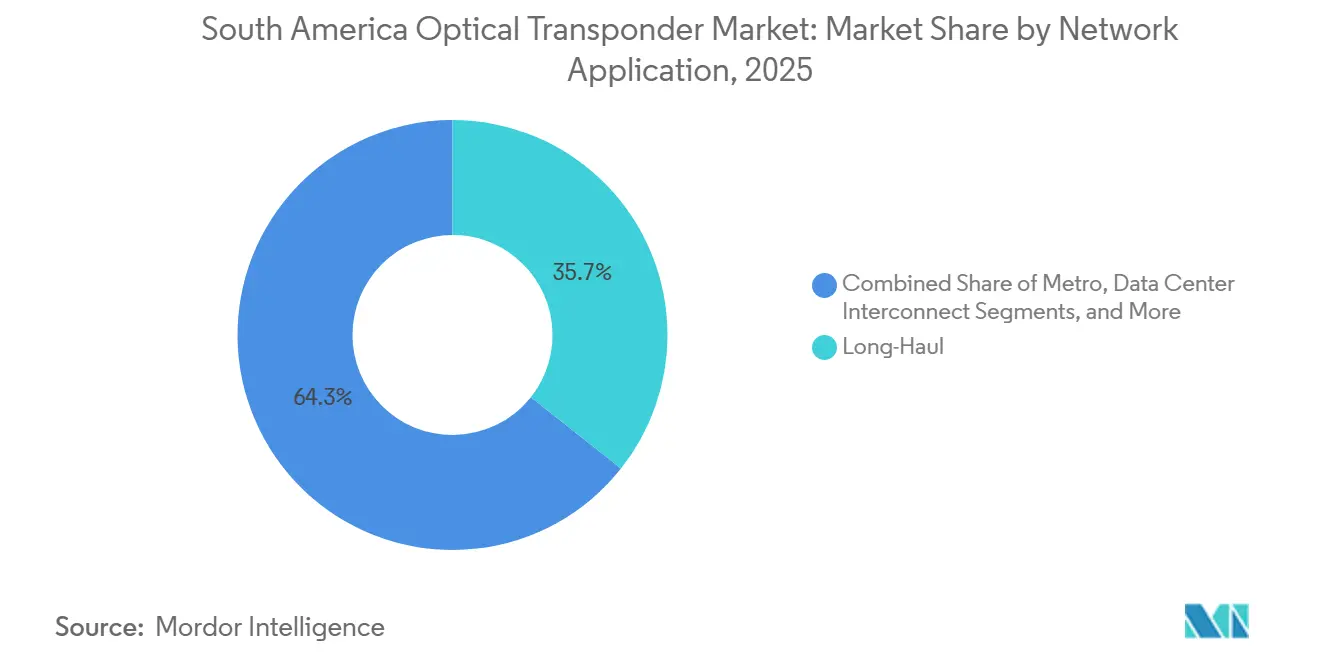
Long-haul applications held 35.67% of regional revenue in 2025. In the South America optical transponder market, the Sao Paulo-to-Fortaleza corridor spans 2,700 km, while key routes in Argentina exceed 1,000 km. These distances make coherent transmission the commercially viable choice for spans exceeding 500 km. Long-haul demand remains tied to the region’s dispersed population centers and the need to connect coastal hubs with inland networks. It also supports steady demand for replacement as operators upgrade capacity on established routes.
Metro applications are advancing as 5G densification increases pressure on network aggregation in city networks. Submarine demand is entering a multiyear spending cycle associated with Synapse, SAC-2 on Google’s Firmina system, and the Malbec cable extension to Porto Alegre. Data center interconnection is projected to expand at a 9.15% CAGR through 2031, making it the fastest-growing network application. Campus clusters in São Paulo and Santiago require predictable wavelength services for east-west traffic between facilities. Dedicated coherent transponders meet these requirements more directly than packet-layer statistical multiplexing, which supports the South America optical transponder market across both metro and intercity routes.

By End-User: Telecom Providers Lead While Cloud Operators Expand Faster
Telecommunication service providers accounted for 67.15% of regional revenue in 2025. The South America optical transponder market serves national carriers and regional internet service providers, which accounted for 64% of Padtec’s TMD400G volume. This broad customer base makes telecom network modernization the largest source of near-term equipment demand. Government and defense users provide stable revenue, where public networks require resilient national backbone capacity. Arsat is upgrading Argentina’s Refefo network to 800 Gbps core capacity and 1.2 Tbps peering capacity, using financing from IDB and Fonplata loans totaling USD 118 million.
Cloud and hyperscale data center operators are projected to record a 9.40% CAGR through 2031. Their expansion is linked to new South American points of presence serving AI and streaming workloads. These customers place particular importance on OpenROADM interoperability and sub-millisecond data center interconnection latency. Their procurement requirements limit the qualified supplier base to vendors capable of providing OpenROADM-compliant systems at rates above 400 Gbps. As a result, the South America optical transponder industry has different buying criteria for large cloud operators than for telecom providers, even when both groups deploy similar wavelengths.
Geography Analysis
Brazil accounted for 66.50% of regional revenue in 2025 and is projected to expand at a 7.25% CAGR through 2031. The South America optical transponder market in Brazil is supported by OPGW backbone buildout, hyperscale data center investment, and planned subsea cable activity. Eletronet is expanding its network from 8,000 km to 26,000 km across 23 states, supported by BRL 157 million (USD 30.4 million) in investment. The program also covered 255 edge data centers by the end of 2026, creating more locations where high-capacity transport can be required. ANATEL approval requirements remain a key market-entry consideration, as its 8- to 12-week process benefits vendors that already hold product approvals.
Sao Paulo remains the leading hyperscale hub in Brazil. Equinix opened SP6 in April 2026 with USD 114 million of investment, while Tecto Data Centers announced a USD 2 billion expansion plan through 2028. Terranova also began the first phase of a 216 MW campus in Campinas with USD 500 million in investment. These projects increase the procurement of data center interconnections across several metropolitan corridors.
Argentina is the most significant secondary source of regional demand, supported by accelerated investment in 5G, fiber, and backbone networks. Telecom Argentina spent ARS 1.48 trillion (USD 1.02 billion) on capital expenditure in 2025 and is targeting more than 2,000 5G sites and USD 1.3 billion in capital expenditure in 2026. Claro Argentina committed USD 500 million to fiber, 5G, and a new Buenos Aires data center in 2026, while Arsat’s Refefo upgrade introduces high-capacity coherent wavelength services into the federal backbone and provides regional operators with a national reference deployment. Chile, Peru, Colombia, Ecuador, and smaller markets are becoming more relevant as cross-border fiber transit routes and data center sites expand, while Conecta Infra announced USD 350 million for more than 6,000 km of carrier-neutral long-haul fiber between Chile, Argentina, and Brazil’s data center hubs through 2028. Santiago is the secondary hyperscale hub, while the Bio-Oceanic corridor extends transponder demand into Peru and Bolivia.
Competitive Landscape
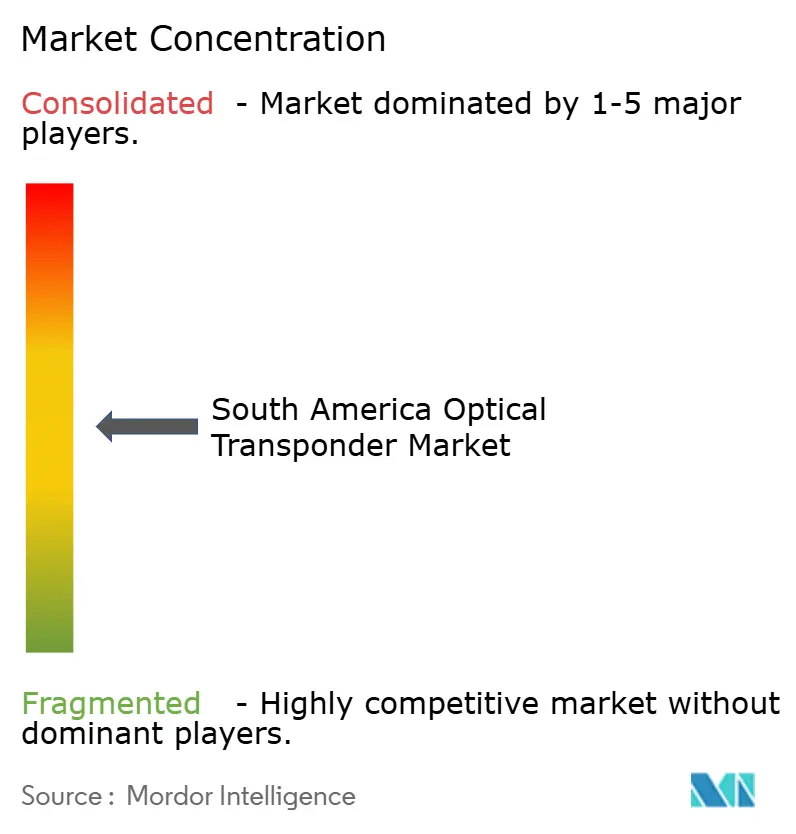
The South America optical transponder market has moderate concentration in the high-capacity tier. A small group of global suppliers from Europe, North America, and China accounts for over 400 Gbps in revenue across carrier and submarine cable applications. Price competition is stronger below 400 Gbps, where the internet service provider tier has more supplier diversity. Padtec is the most important regional supplier because it manufactures locally, holds ANATEL certification, and has an established customer base among internet service providers. Its local presence provides a regional option for operators that seek established approval coverage and direct access to support.
In June 2026, Padtec created Padtec Marine Networks and acquired an 85% stake in LEV Brasil, adding marine engineering and geosciences to its optical systems business. This move creates an end-to-end regional capability across terrestrial transponder manufacturing and submarine cable engineering. Padtec also presented the TMQ800G-NC at Abrint Global Congress 2026, with OpenROADM-standard optics and planned availability in the second half of 2026. These actions position the company to meet demand from hyperscale and AI data center customers requiring higher-capacity open optical platforms.
OpenROADM Multi-Source Agreement compliance is becoming an important qualification factor for large carrier contracts, as demonstrated by 4 vendors at OFC 2026, and it shifts competition toward reach performance, energy use, and software orchestration rather than proprietary equipment lock-in. Cirion launched its Network-as-a-Service offering in South America in 2026, using the Ciena Navigator Network Control Suite to automate wavelength provisioning via application programming interfaces. The model can shift value toward network automation and reduce reliance on manual provisioning. Opportunities are strongest in above-800 Gbps data center interconnections, utility-fiber routes outside Eletronet’s network, and secondary cities where 5G creates new coherent transport requirements. Vendors that improve automated optimization and fault recovery can reduce the field-service limitations that slow deployment outside major metropolitan areas.
South America Optical Transponder Industry Leaders
Ciena Corporation
Nokia Corporation
Cisco Systems, Inc.
Padtec S.A.
NEC Corporation
- *Disclaimer: Major Players sorted in no particular order

Recent Industry Developments
- August 2026: Tecto Data Centers and V.tal, in partnership with Lightera, interconnected the TFOR2 and TFOR3 data centers in Fortaleza using 864 optical fibers with rollable ribbon technology to support AI, cloud, and hyperscale workloads. The deployment advances high-density DCI optical interconnect practices at one of South America’s primary submarine cable landing hubs.
- August 2026: DE-CIX and Eletronet expanded Brazil’s interconnection infrastructure, providing Eletronet customers with access to DE-CIX’s global cloud and network ecosystem over high-capacity 100 GE and 400 GE links. The partnership spans Eletronet’s 26,000 km OPGW network and 255 edge data centers, reinforcing Brazil’s position as South America’s primary optical transport hub.
- June 2026: Padtec Holding S.A. created Padtec Marine Networks and acquired an 85% stake in LEV Brasil, integrating marine engineering and geosciences with Padtec’s coherent optical systems portfolio. The transaction makes Padtec the only South American company offering end-to-end capability spanning terrestrial transponder manufacturing and submarine cable engineering.
- May 2026: Cirion Technologies launched its Network-as-a-Service offering in South America, enabling API-based automated wavelength provisioning across its 105,000 km fiber and subsea network using Ciena’s Navigator Network Control Suite. The platform marks the first commercial Network-as-a-Service deployment at scale in the South American optical transport segment.


South America Optical Transponder Market Report Scope
The South America optical transponder market revenue is generated through the sale of optical transponders and related transponder-based transmission equipment across data rates ranging from 100 Gbps to above 800 Gbps, supplied to telecommunication service providers, cloud and hyperscale data center operators, enterprises, government and defense organizations, and other end users.
The South America optical transponder market report is segmented by transmission technology (coherent and non-coherent), data rate (up to 100 Gbps, above 100 Gbps to 400 Gbps, above 400 Gbps to 800 Gbps, and above 800 Gbps), network application (metro, long-haul, data center interconnect, submarine, and other network applications), end-user (telecommunication service providers, cloud and hyperscale data center operators, enterprises, government and defense, and other end-users), and country (Brazil, Argentina, and rest of South America). The market forecasts are provided in terms of value (USD).
| Coherent |
| Non-Coherent |
| Up to 100 Gbps |
| Above 100 Gbps to 400 Gbps |
| Above 400 Gbps to 800 Gbps |
| Above 800 Gbps |
| Metro |
| Long-Haul |
| Data Center Interconnect |
| Submarine |
| Other Network Applications |
| Telecommunication Service Providers |
| Cloud and Hyperscale Data Center Operators |
| Enterprises |
| Government and Defense |
| Other End-Users |
| Brazil |
| Argentina |
| Rest of South America |
| By Transmission Technology | Coherent |
| Non-Coherent | |
| By Data Rate | Up to 100 Gbps |
| Above 100 Gbps to 400 Gbps | |
| Above 400 Gbps to 800 Gbps | |
| Above 800 Gbps | |
| By Network Application | Metro |
| Long-Haul | |
| Data Center Interconnect | |
| Submarine | |
| Other Network Applications | |
| By End-User | Telecommunication Service Providers |
| Cloud and Hyperscale Data Center Operators | |
| Enterprises | |
| Government and Defense | |
| Other End-Users | |
| By Country | Brazil |
| Argentina | |
| Rest of South America |


Key Questions Answered in the Report
What is the South America optical transponder market size?
It is estimated at USD 0.36 billion in 2026 and is forecast to reach USD 0.5 billion by 2031, at a 6.79% CAGR.
What is driving demand for optical transponders in South America?
5G backhaul expansion, cloud and AI data center traffic, new subsea routes, and 100G-to-400G upgrades are increasing demand.
Which transmission technology leads regional demand?
Coherent transmission technology held 80.39% revenue share in 2025 and is projected to expand at a 7.45% CAGR through 2031.
Which data rate is expanding fastest in South America?
The above 800 Gbps tier is expected to record an 11.60% CAGR through 2031, supported by subsea, hyperscale, and backbone deployments.
Which application has the strongest outlook for optical transponders?
Data center interconnection is projected to expand at a 9.15% CAGR through 2031 as campus clusters need predictable high-capacity wavelengths.
Why does Brazil lead regional optical transport demand?
Brazil held 66.50% of regional revenue in 2025 because of OPGW backbone expansion, data center investment, and new subsea cable activity.
Page last updated on:





