
Market Overview
| Study Period | 2021 - 2031 |
|---|---|
| Forecast Data Period | 2026 - 2031 |
| Base Year Market Size (2025) | USD 364.45 Million |
| Market Size (2026) | USD 382.34 Million |
| Market Size (2031) | USD 502.36 Million |
| Growth Rate (2026 - 2031) | 5.61 % |
| Market Concentration | Low |
Major Players *Disclaimer: Major Players sorted in no particular order Image © Mordor Intelligence. Reuse requires attribution under CC BY 4.0. | |
South America Nut-based Spread Market Analysis by Mordor Intelligence
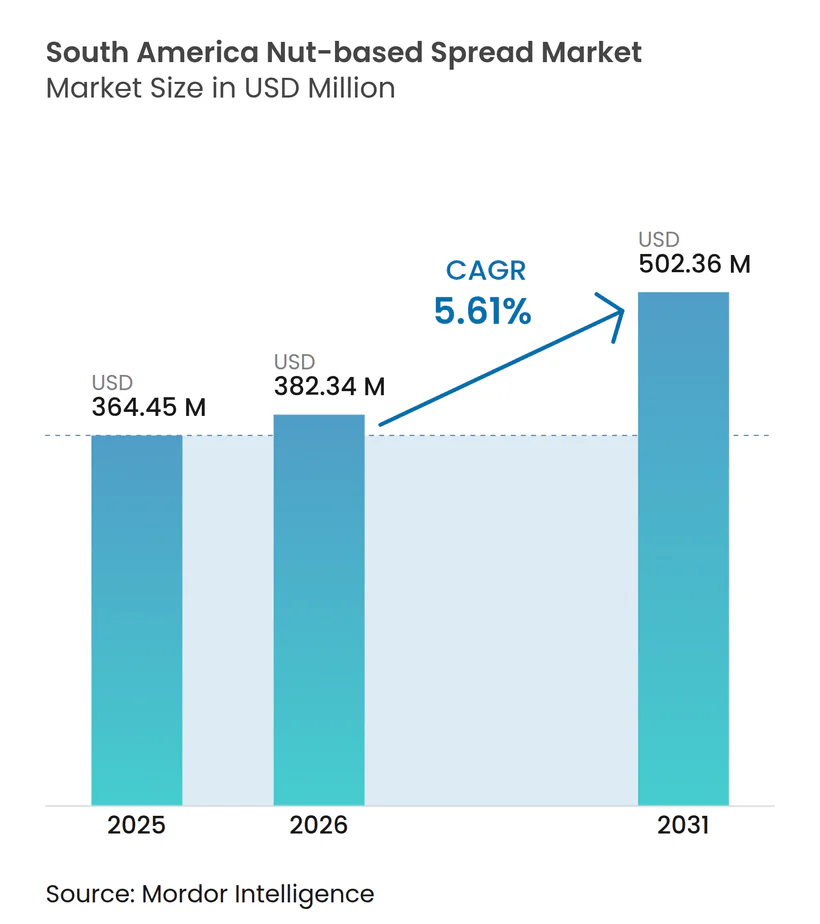
The South America nut-based spreads market size is projected to expand from USD 382.34 million in 2026, up from USD 364.45 million in 2025, to USD 502.36 million by 2031, registering a CAGR of 5.61% between 2026 and 2031. Demand is moving toward protein-rich, plant-based spreads as consumers reassess high-sugar jams, dairy spreads, and hazelnut-cocoa creams. The South America nut-based spreads market benefits from wider fitness participation, a larger base of online grocery shoppers, and stronger retail interest in differentiated formats. Retailers are assigning more shelf space to peanut, almond, and mixed-nut products as health and functional claims gain relevance. Suppliers are responding through no-added-sugar recipes, organic lines, single-serve packs, and digital-first distribution. Raw-material availability remains the central operating risk because domestic processors compete with export markets for peanuts and rely on imports for almonds.
Key Report Takeaways
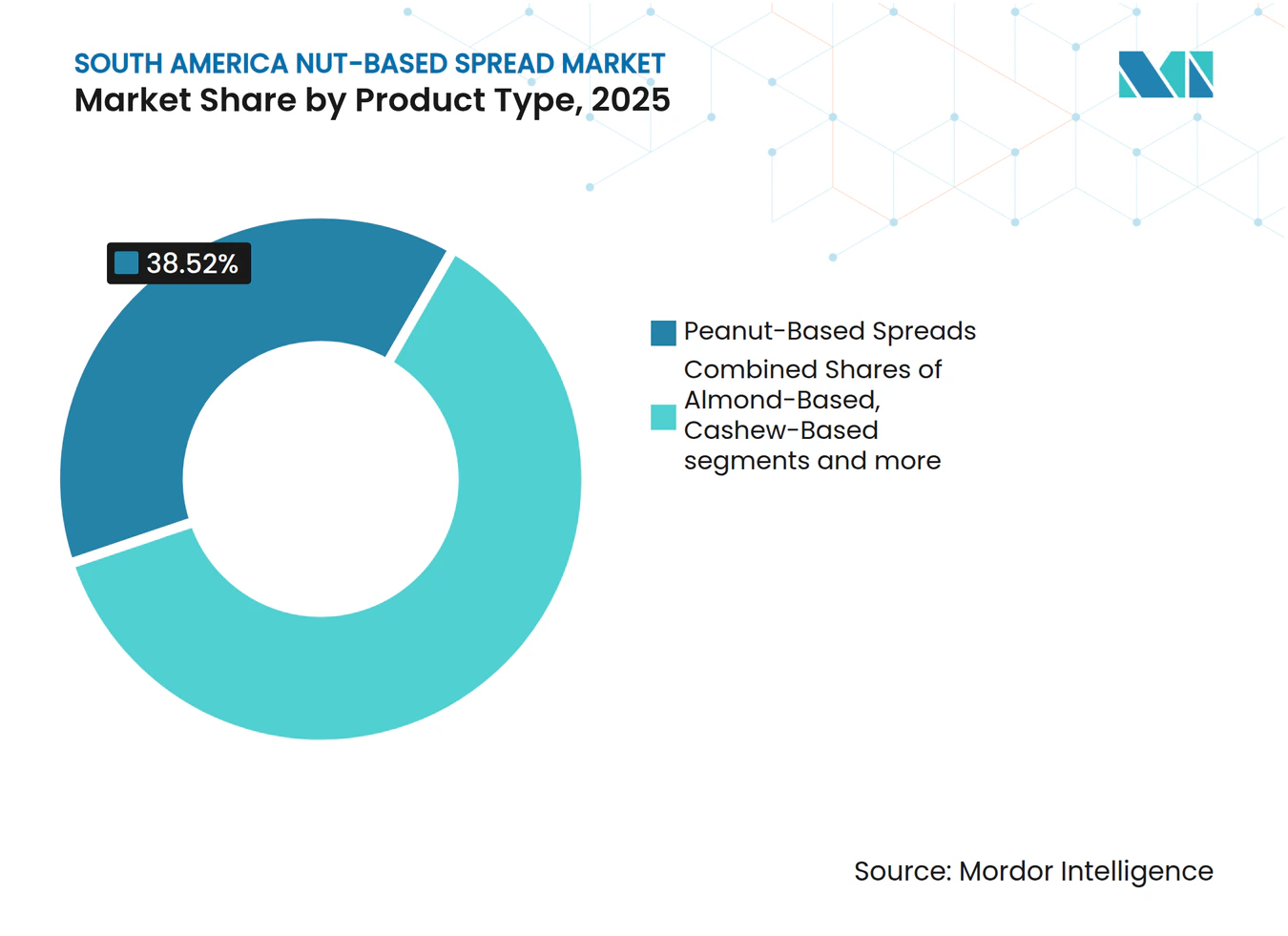
- By product type, Peanut-Based Spreads held 38.52% of the South America nut-based spreads market share in 2025, while Almond-Based Spreads recorded the highest projected CAGR at 7.11% through 2031.
- By nature, Conventional nut-based spreads held 67.21% of revenue in 2025, while Organic nut-based spreads recorded the highest projected CAGR at 6.84% through 2031.
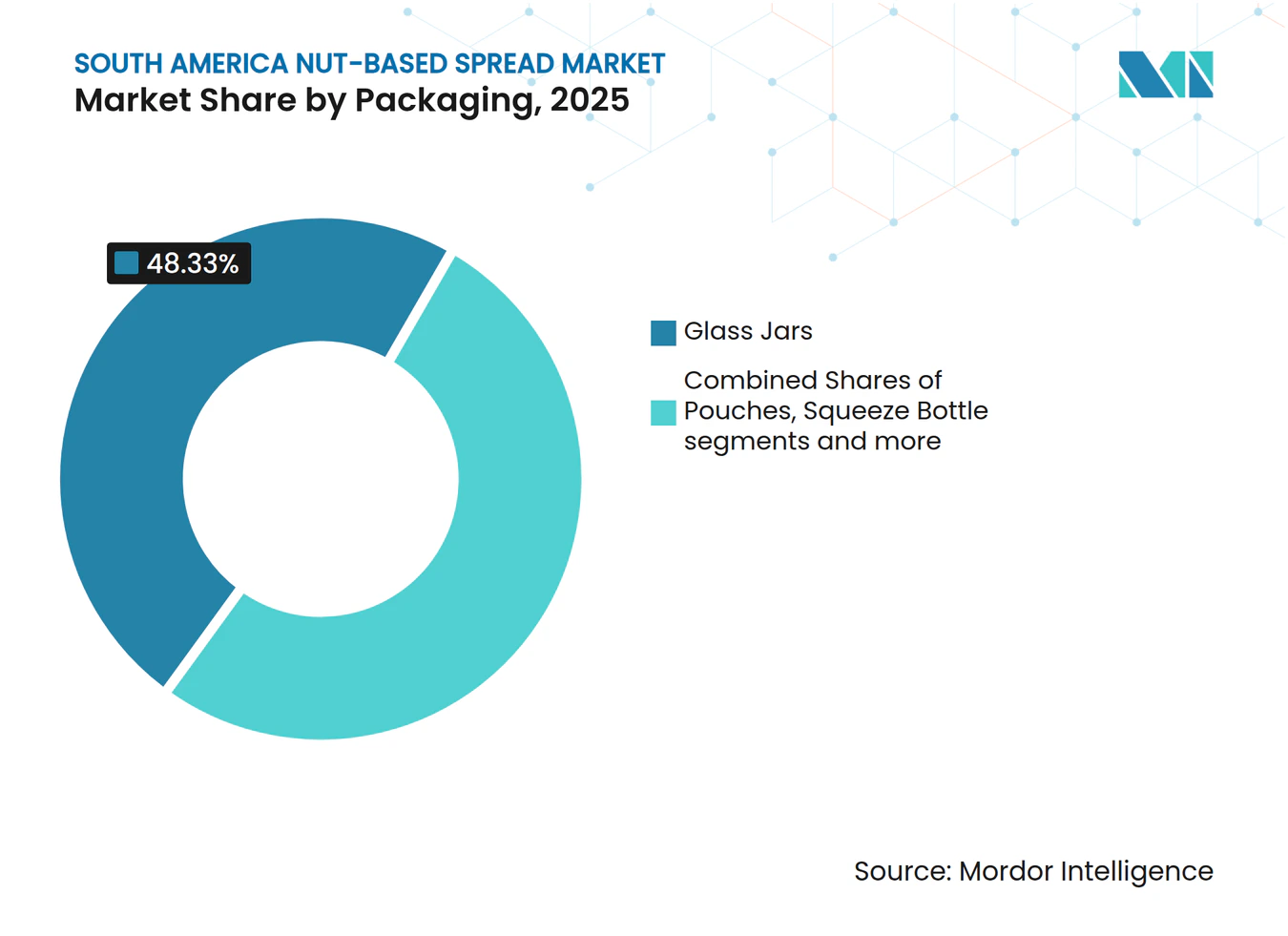
- By packaging, Glass Jars accounted for 48.33% of revenue in 2025, while Pouches and Sachets recorded the highest projected CAGR at 7.56% through 2031.
- By distribution channel, Supermarkets and Hypermarkets held 38.67% of revenue in 2025, while Online Retail Channels recorded the highest projected CAGR at 7.78% through 2031.
- By geography, Brazil held 42.38% of revenue in 2025, while Chile recorded the highest projected CAGR at 7.21% through 2031.
Note: Market size and forecast figures in this report are generated using Mordor Intelligence’s proprietary estimation framework, updated with the latest available data and insights as of January 2026.
Market Trends and Insights
Drivers Impact Analysis of South America Nut-based Spread Market*
| Drivers | (~) % Impact on CAGR Forecasts | Geographic Relevance | Impact Timeline |
|---|---|---|---|
| Growing demand for healthier alternatives to high-sugar jams and dairy spreads | +1.4% | Global, concentrated in Brazil and Chile urban markets | Short term (≤ 2 years) |
| Increasing adoption of protein-rich plant-based breakfast and snack options | +1.1% | Brazil, Argentina, Colombia | Medium term (2–4 years) |
| Expansion of modern retail and online grocery distribution channels | +0.9% | Brazil (primary), Chile, Colombia | Short term (≤ 2 years) |
| Rising demand for premium organic, natural, no-added-sugar, and functional nut-based spreads | +0.8% | Chile, Argentina, with spill-over to MERCOSUR premium retail | Medium term (2–4 years) |
| Growing demand for protein-fortified nut-based spreads through sports nutrition and supplement channels | +0.7% | Brazil (dominant), Argentina, Chile | Medium term (2–4 years) |
| Product innovation featuring local flavors such as paçoca, dulce de leche, cocoa, whey, and coffee | +0.5% | Brazil (primary), with spill-over to Argentina and Colombia | Long term (≥ 4 years) |
| Source: Mordor Intelligence | |||
Growing Demand for Healthier Alternatives to High-Sugar Jams and Dairy Spreads
The South America nut-based spreads market is gaining from a substitution pattern across breakfast and snacking occasions. Consumers are moving toward products that offer protein, plant-based ingredients, or lower added sugar in place of traditional sweet spreads. Retailers have expanded peanut butter assortments, and the South America nut-based spreads market has more access to mainstream shelf space formerly occupied by sweeter products. This change supports the entry of almond and cashew products that were once concentrated in specialty stores. Products with lower added sugar also fit retailer wellness programs and front-of-pack labeling rules[1]. This shelf-space shift gives suppliers more opportunity to present a broader range of nut-based products to routine grocery shoppers.
Increasing Adoption of Protein-Rich Plant-Based Breakfast and Snack Options
The South America nut-based spreads market is supported by demand for plant-based protein in both everyday breakfast and fitness occasions. Arla Foods Ingredients surveyed 4,000 consumers across Argentina, Brazil, Chile, and Colombia, and found protein content among the top 3 purchase factors. In Brazil, 40% of respondents said they wanted protein enrichment in more food categories. Single-serve pouches can serve buyers who eat between meals or around exercise without relying on confectionery positioning. Convenience stores, gyms, and fuel-retail formats can extend the category beyond planned household shopping. The South America nut-based spreads market can position sachets next to energy bars and protein drinks when brands communicate the functional benefit clearly.
Expansion of Modern Retail and Online Grocery Distribution Channels
Brazil is the main digital growth base for the South America nut-based spreads market. The U.S. Commercial Service estimated that Brazilian e-commerce reached USD 36.30 billion in 2025 and served 94.00 million online shoppers[2]. Digital shelves allow smaller brands to explain ingredients, compare pack sizes, and reach buyers outside the largest physical retail networks. Online product pages can support premium pricing when consumers can readily see the formulation, nutritional information, and flavor range. Direct sales also give manufacturers a faster way to test regional demand before broadening store distribution. Physical retail remains important because it provides routine household access and lets shoppers compare products on the shelf.
Rising Demand for Premium Organic, Natural, No-Added-Sugar, and Functional Nut-Based Spreads
Chile offers a strong setting for premium and organic products in the South America nut-based spreads market. Chilean organic food exports reached USD 344 million in 2025, increasing 40% in value and 28% in volume. Stronger organic supply chains can improve access to certified inputs for local food manufacturers. The USDA identifies health, wellness, and organic food as important demand priorities in Chilean retail. The South America nut-based spreads market has room for premium products when ingredient quality, certification, and nutritional positioning are clear to the buyer. Retailers can use these attributes to distinguish products from mainstream spreads without relying solely on flavor claims.
Restraints Impact Analysis of South America Nut-based Spread Market*
| Restraint | (~) % Impact on CAGR Forecasts | Geographic Relevance | Impact Timeline |
|---|---|---|---|
| Volatility in nut production and raw material supply | -0.8% | South America-wide, most acute in Brazil and Argentina | Short term (≤ 2 years) |
| High costs associated with allergen management, contamination prevention, and nutrition labeling compliance | -0.5% | Brazil (ANVISA-driven), MERCOSUR harmonization zone | Medium term (2–4 years) |
| Challenges in maintaining product texture and stability | -0.3% | National, with early-stage pressure in Chile and Peru | Long term (≥ 4 years) |
| Regulatory and food labeling compliance requirements | -0.4% | Brazil, Chile, MERCOSUR-wide | Medium term (2–4 years) |
| Source: Mordor Intelligence | |||
Volatility in Nut Production and Raw Material Supply
The South America nut-based spreads market is exposed to swings in peanut availability and import dependence for almonds. Brazil harvested 1.30 million tons of peanuts in the 2024/25 cycle, while the broader peanut value chain generated BRL 18.60 billion, equivalent to USD 3.26 billion. The following 2025/26 crop was projected at 1.10 million tons, 19% lower than the prior record. Argentina exported 322,000 tons of peanut products worth USD 487 million in the first half of 2025, and domestic processors must compete with export buyers when supply is tight[3]. Almond spreads face a separate import risk, while long-term supply contracts and diversified suppliers can limit, but not remove, commodity-price exposure. The South America nut-based spreads market is therefore vulnerable to price spikes across 2 distinct input streams.
High Costs Associated with Allergen Management, Contamination Prevention, and Nutrition Labeling Compliance Requirements
Compliance costs are a meaningful constraint for smaller producers in the South America nut-based spreads market. Tree-nut allergens require segregation, testing, documented sanitation practices, and, in some cases, dedicated production lines. Brazil's RDC 429/2020 requires a prominent front-of-pack warning for foods high in added sugar, saturated fat, or sodium, which can force reformulation or add a visible label warning. ANVISA also opened Consulta Pública nº 1357/2025 in November 2025 on country-of-origin declarations and stricter allergen identification, while RDC 843/2024 set a September 2026 re-registration deadline. These measures protect consumers but can slow launches and increase documentation costs for smaller manufacturers. Clear labeling and carefully formulated no-added-sugar products can build consumer trust while helping suppliers meet the requirements.
*Our forecasts treat driver/restraint impacts as directional, not additive. The impact forecasts reflect baseline growth, mix effects, and variable interactions.
South America Nut-based Spread Market Segment Analysis
By Product Type:
Peanut Dominance and Almond-Led PremiumizationPeanut-based spreads held 38.52% of the South American nut-based spreads market share in 2025. Brazil's peanut supply base and the familiar place of amendoim in snacks, sweets, and breakfast spreads support this position across both large cities and broader mass-market retail. The supplied research identifies more than 150.00 active peanut butter brands in Brazil, showing the depth of local brand activity and the low barrier to differentiation through flavors, proteins, or packaging. Peanut butter remains the entry point for many households because it is widely distributed, easy to understand, and available across several price points, from basic jars to functional varieties. A broad local supply base also supports frequent product launches and retail promotions. These features help peanut products maintain a clear availability advantage while premium nut varieties grow from a smaller base.
Almond-Based Spreads are projected to grow at 7.11% CAGR through 2031, the fastest rate within the product grouping. This part of the South America nut-based spreads market size can gain value from urban consumers who associate almond butter with premium ingredients and a different nutritional profile, even when it is not a regular household staple. Brands can use almond-peanut blends as a step up from core peanut butter while retaining the same shelf position, familiar usage occasions, and recognizable spread texture. Walnut-Based and Cashew-Based Spreads remain smaller but have growing relevance in premium grocery channels in Argentina and Colombia, where new flavors can complement health-oriented retail assortments. Hazelnut products have a stronger confectionery association, while mixed-nut and macadamia products offer specialty retailers a route to broader variety and help reduce dependence on a single product base.



By Nature:
Conventional Scale and Organic GrowthConventional products held 67.21% of revenue in 2025, reflecting their broad presence in supermarkets and atacarejo stores. The mass format is important for the nut-based spreads industry because price, availability, familiar flavor, and repeat household use remain central to recurring purchases. Large Brazilian brands support this segment through established processing, recognizable brands, and distribution that reaches more shoppers than specialized health-food stores. Conventional products provide a base from which suppliers can introduce lower-sugar, higher-protein, or locally flavored variants without requiring consumers to change their everyday purchasing habits. The segment will remain relevant as consumers seek more limited ingredients without necessarily moving to a higher-priced organic product or a specialty retail channel.
Organic nut-based spreads are projected to expand at a 6.84% CAGR through 2031. Chile's Law 20.089 certification framework supports the availability of certified organic inputs and finished foods, helping suppliers make credible claims in a market where certification can influence store placement. Chile's healthy foods segment was valued at USD 3.27 billion in 2025 and grew at 9.30% annually, according to the supplied USDA source, which supports demand for products with clear labels and reduced added sugar. No-added-sugar recipes may avoid the front-of-pack warning associated with high added sugar, giving organic and cleaner-label offerings a practical commercial advantage in stores and online searches. Established suppliers can use these features to extend their portfolio while keeping conventional products available to more price-sensitive buyers. The organic tier is therefore linked to both retail differentiation and product reformulation.
By Packaging:
Glass Jar Leadership and Single-Serve ExpansionGlass Jars accounted for 48.33% of revenue in 2025. The format suits pantry storage, family breakfast use, and standard presentation in the spread aisle, where consumers often expect to compare several brands and pack sizes in one place. Glass can also convey a premium position for products with visible pieces, simple recipes, or higher-value ingredients, and can support repeat household use after opening. Its wide use in Brazil, Argentina, and Chile reflects the continuing importance of supermarkets for regular household purchases and the established habit of buying larger multi-use packs. Breakage risk, transport weight, and less convenient portion control are the principal limits of the format, especially for direct shipment and use outside the home.
Pouches and Sachets are projected to grow at 7.56% CAGR through 2031. The nut-based spreads industry can use these formats in sports nutrition channels because portions align with pre- and post-workout consumption and fit alongside other portable protein products. Flexible packs reduce damage during direct-to-consumer shipment, lower the concern around glass breakage, and are easier to carry outside the home. These attributes make them suitable for event sales, convenience stores, and gym retail locations where consumers may want a product for immediate use. Squeeze Bottles serve family use, while tubs, spouted pouches, and club-pack formats can support foodservice, baking, and bulk demand across a wider set of consumption occasions. Packaging choice therefore allows suppliers to address both repeat household use and smaller on-the-go servings.

By Distribution Channel:
Store Scale and Digital AccessSupermarkets and Hypermarkets held 38.67% of revenue in 2025. These outlets give the South America nut-based spreads market a dependable route to routine household buyers and allow suppliers to reach shoppers who do not visit dedicated health-food stores. Large chains can display several brands, compare price points, and introduce new flavors within the same shelf set, which helps consumers move from familiar peanut products to premium or functional options. They remain the key platform for building broad recognition outside the health-food niche and for gaining a consistent presence in the weekly grocery basket. Assaí reported double-digit growth in nut-spread volume in 2023/24 and expanded its peanut butter range by 14.00%, according to the supplied research.
Online Retail Channels are projected to grow at a 7.78% CAGR through 2031. Digital sales help smaller brands reach buyers searching for specific ingredients, dietary formats, or flavors not stocked in nearby stores, while allowing companies to test products without immediately securing a place in a large chain. The South America nut-based spreads market can use online product pages to explain protein content, added-sugar status, pack formats, and serving ideas in more detail than a shelf label permits. Convenience Stores are gaining relevance for sachets and portable formats in urban transit areas, where products can be bought for immediate consumption. Gym and supplement retailers, health-food stores, and foodservice operators remain smaller channels, but they offer focused access to high-margin and health-oriented buyers with distinct needs.
Geography Analysis
Brazil Nut-based Spread Market
Brazil held 42.38% of the South America nut-based spreads market share in 2025. Its integrated peanut chain supports local processors and gives domestic brands a broad supply base. Brazil's 2024/25 peanut harvest reached 1.30 million tons, and the value chain generated BRL 18.60 billion, equivalent to USD 3.26 billion. E-commerce reached USD 36.30 billion in 2025, providing another route for specialized brands to reach consumers. Nestlé committed BRL 7 billion, equivalent to USD 1.27 billion, to Brazil from 2025 through 2028 for capacity, modernization, and premium category development.
Chile Nut-based Spread Market
Chile is projected to expand at a 7.21% CAGR through 2031, the fastest rate in the regional comparison. Its wellness-focused retail culture supports products with organic certification, lower added sugar, and clear labels. Organic food exports reached USD 344 million in 2025, rising 40% in value, which points to deeper local organic supply chains. Food e-commerce grew 12.00% in Chile in 2024, and the USDA identified health, wellness, and plant-based foods as priority areas for retailers. Chile's certification system and premium retail base provide a practical setting for higher-value nut spreads.
Broader South America Nut-based Spread Market
Argentina, Colombia, Peru, and the Rest of South America account for the remaining regional demand. Argentina exported 322,000 tons of peanut products worth USD 487.00 million in the first half of 2025, retaining its importance as a raw-material supplier. Economic volatility limits mainstream demand in Argentina, although premium retailers in Buenos Aires support almond and cashew products. Colombia is developing as a distribution location for sports nutrition and natural-food formats, while Peru remains an early-stage opportunity connected to Andean walnut and cashew supply. The Rest of South America is largely import served, with limited local manufacturing capacity.
Competitive Landscape
Market Concentration

The South America nut-based spreads market is fragmented, with local Brazilian brands competing through fitness-led positioning, e-commerce access, and product variety. Dr. Peanut, Power1One, DaColônia, and Santa Helena have greater local relevance than broadly positioned food multinationals in several channels. Local brands can react quickly to sports nutrition demand and use social and online sales to develop direct customer relationships. Santa Helena benefits from processing scale and established brand recognition in peanut products. Dr. Peanut uses functional positioning and flavor innovation to compete in a category that increasingly overlaps with snacks.
Supley acquired full control of Dr. Peanut in January 2025 and committed BRL 30.00 million, equivalent to USD 5.30 million, to research, distribution, and international branding. The company set a BRL 500.00 million, equivalent to USD 88.00 million, revenue objective within 5.00 years, compared with BRL 200 million previously reported. Santa Helena launched the Zero line in 2025, adding no-added-sugar spreads, bars, and sweets to its portfolio. Ferrero has continued to develop its hazelnut supply infrastructure in Chile, which supports its established Nutella-linked value chain. These moves show that scale, supply access, and differentiated product formats remain important competitive tools.
Multinationals without a clear regional category position have faced a more difficult path. Hormel agreed to sell its Brazilian Ceratti business in 2025, although that business was in processed meats rather than nut-based spreads. This transaction does not alter the direct nut-spread competitor set, but it shows the value of category focus in Brazil. White-space opportunities remain in multi-nut blends and foodservice formats, where broader brand portfolios have limited visibility. Entrenuts, Nat Nuts, and WAKEUP represent the type of smaller supplier seeking distinction through single-ingredient and novel-pairing formats.
South America Nut-based Spread Industry Leaders
-
The Kraft Heinz Company
-
Hormel Foods Corporation
-
The J.M. Smucker Company
-
Post Holdings
-
Unilever Plc
- *Disclaimer: Major Players sorted in no particular order
South America Nut-based Spread Market Companies Covered in this Report
- DaColônia
- Dr. Peanut
- Power1One
- Santa Helena
- Nutt's+
- Ferrero International
- The Kraft Heinz Company
- Hormel Foods Corporation
- The J.M. Smucker Company
- Post Holdings
- The Hershey Company
- Conagra Brands, Inc.
- Unilever Plc
- Nestlé S.A.
- The Hain Celestial Group, Inc.
- Manisel S.A.
- Entrenuts S.R.L.
- Nat Nuts
- Cacahuates
- WAKEUP
Recent Industry Developments in South America Nut-based Spread Market
- June 2026: Tell Alimentos introduced 20 new products in June 2026, expanding beyond its traditional seasonings and sauces portfolio. The new offerings included peanut butter and Tell Nutti, a hazelnut-based spread, developed by the company's internal team and manufactured in Blumenau, Santa Catarina.
- August 2025: Prodeman introduced VITA+, a fortified version of its Maní King peanut butter. The product contains vitamins B3, B12, D, and E, along with magnesium and zinc. It is available in a 350-gram jar and was developed by Prodeman's research and development, processing, and marketing teams.
- July 2025: Brazilian brand Dr. Peanut introduced a pistachio-flavored peanut butter at the Arnold South America 2025 fitness event. The product combines a peanut butter base with pistachio flavor, targeting consumers seeking differentiated flavors and innovative spreads. The launch was part of the brand's broader product innovation strategy.
South America Nut-based Spread Market Report Scope
Segmentation Overview
By Product Type
| Peanut-Based Spreads |
| Almond-Based Spreads |
| Walnut-Based Spreads |
| Cashew-Based Spreads |
| Hazelnut-Based Spreads |
| Other Product Types |
By Nature
| Conventional |
| Organic |
By Packaging
| Glass Jars |
| Squeeze Bottles |
| Poches and Sachets |
| Other Packaging Formats |
By Distribution Channels
| Supermarkets/Hypermarkets |
| Convenience Stores |
| Online Retail Stores |
| Other Distribution Channels |
By Geography
| Brazil |
| Argentina |
| Chile |
| Peru |
| Columbia |
| Rest of South America |
| By Product Type | Peanut-Based Spreads |
| Almond-Based Spreads | |
| Walnut-Based Spreads | |
| Cashew-Based Spreads | |
| Hazelnut-Based Spreads | |
| Other Product Types | |
| By Nature | Conventional |
| Organic | |
| By Packaging | Glass Jars |
| Squeeze Bottles | |
| Poches and Sachets | |
| Other Packaging Formats | |
| By Distribution Channels | Supermarkets/Hypermarkets |
| Convenience Stores | |
| Online Retail Stores | |
| Other Distribution Channels | |
| By Geography | Brazil |
| Argentina | |
| Chile | |
| Peru | |
| Columbia | |
| Rest of South America |
Key Questions Answered in the Report
What is the forecast growth rate for South America nut-based spreads?
The category is projected to grow at a 5.61% CAGR from 2026 to 2031, rising from USD 382.34 million to USD 502.36 million.
Which product type leads sales in South America?
Peanut-Based Spreads lead with 38.52% share in 2025, supported by Brazil's supply base and broad household familiarity.
Which product format is growing fastest?
Pouches and Sachets are projected to grow at a 7.56% CAGR through 2031, helped by sports nutrition and direct-to-consumer demand.
Why are organic nut-based spreads gaining traction?
Organic nut-based spreads are projected to grow at a 6.84% CAGR as consumers look for certified, clean-label, and no-added-sugar products.