
South America Neobanking Market Size and Share
Market Overview
| Study Period | 2020 - 2031 |
|---|---|
| Forecast Data Period | 2026 - 2031 |
| Base Year Market Size (2025) | USD 24.90 Billion |
| Market Size (2026) | USD 29.80 Billion |
| Market Size (2031) | USD 44.80 Billion |
| Growth Rate (2026 - 2031) | 8.50 % |
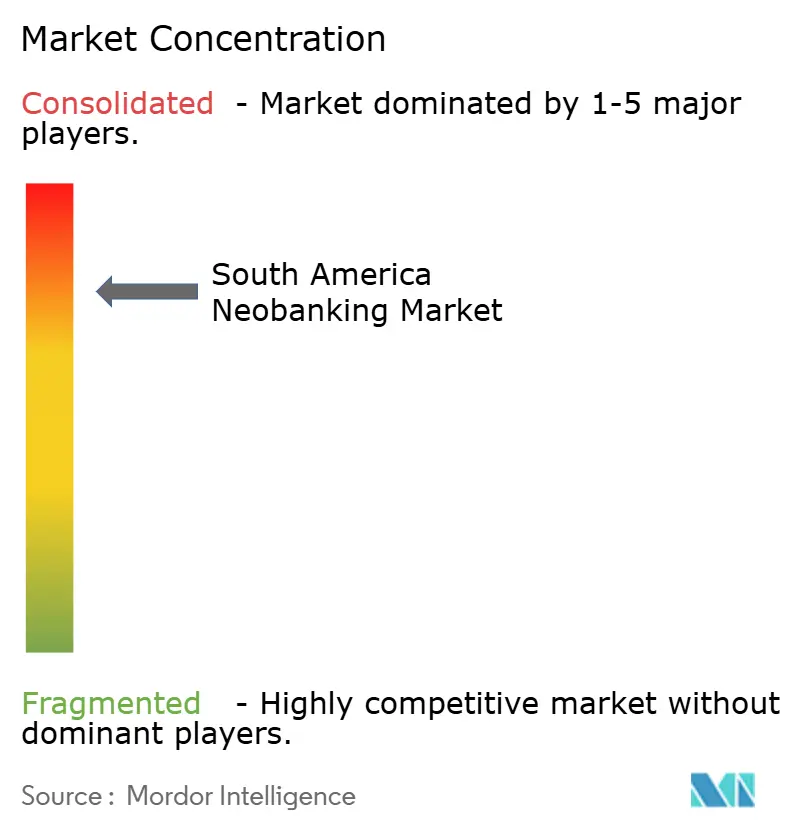
| Market Concentration | High |
Major Players *Disclaimer: Major Players sorted in no particular order Image © Mordor Intelligence. Reuse requires attribution under CC BY 4.0. | |
South America Neobanking Market Analysis by Mordor Intelligence
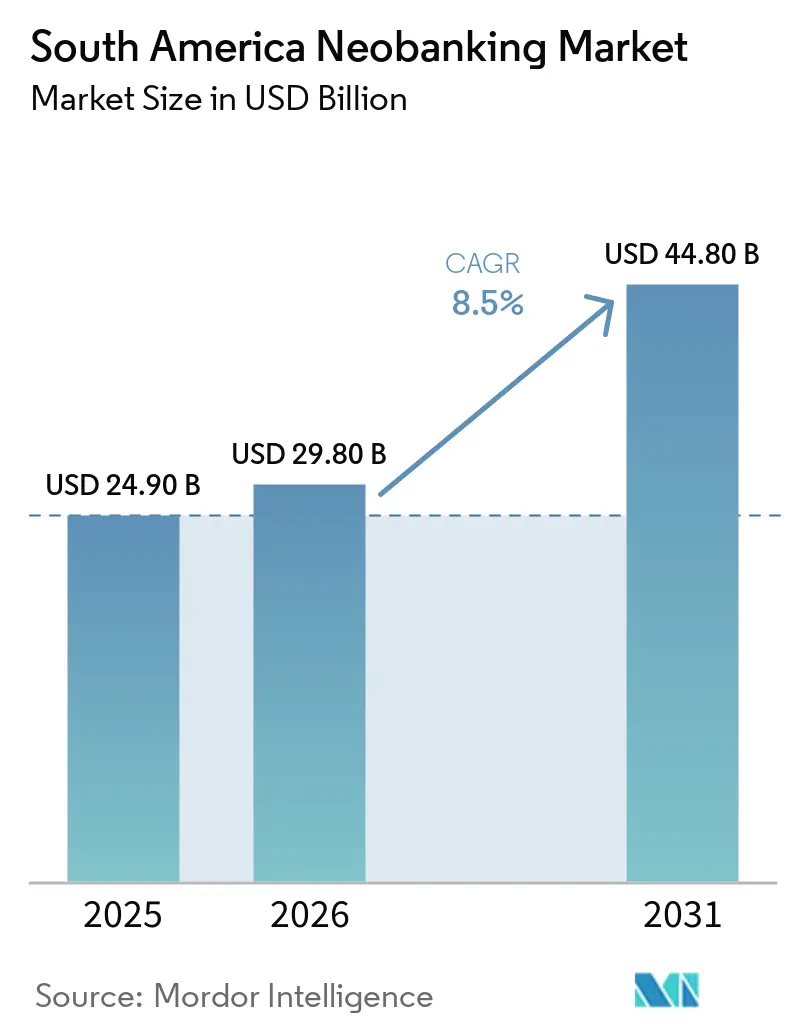
The South America Neobanking Market size is expected to grow from USD 24.90 billion in 2025 to USD 29.80 billion in 2026 and is forecast to reach USD 44.80 billion by 2031 at 8.5% CAGR over 2026-2031.
The South America neobanking market is moving beyond basic digital accounts as providers use payment relationships to offer credit, savings, and insurance. Brazil remains central to regional activity because its payment infrastructure and digital banking adoption support frequent account use. Instant payments reduce transaction friction and allow providers to compete without relying on branch networks. The South American neobanking market also offers room for providers that can serve underbanked consumers and small businesses with relevant financial products. Credit discipline, technology investment, and fraud prevention will shape how effectively leading platforms translate customer scale into sustainable returns.
Key Report Takeaways
- By service, lending and credit held 58.52% of the South America neobanking market share in 2025, while insurance distribution is forecast to grow at a 13.21% CAGR through 2031.
- By end user, retail individuals held 78.12% of the South America neobanking market share in 2025, while SMEs are forecast to grow at a 12.43% CAGR through 2031.
- By revenue stream, interest income accounted for 75.52% of the South America neobanking market share in 2025, while distribution commissions and other revenue streams are forecast to grow at a 14.53% CAGR through 2031.
- By license type, Multi-License Groups held 63.41% of the South America neobanking market share in 2025, while specialized credit and finance-company licenses are forecast to grow at a 13.52% CAGR through 2031.
- By geography, Brazil held 76.54% of the South America neobanking market share in 2025, while Colombia is forecast to grow at a 13.82% CAGR through 2031.
Note: Market size and forecast figures in this report are generated using Mordor Intelligence’s proprietary estimation framework, updated with the latest available data and insights as of January 2026.
South America Neobanking Market Trends and Insights
Drivers Impact Analysis*
| Driver | (~) % Impact on CAGR Forecast | Geographic Relevance | Impact Timeline |
|---|---|---|---|
| Smartphone And Internet-Based Banking Adoption | +2.0% | Global, most acute in Brazil and Colombia | Short term (≤ 2 years) |
| Financial Inclusion Demand Among Underbanked Consumers | +1.7% | Brazil, Argentina, Rest of South America | Medium term (2-4 years) |
| Instant Payments And Digital Payment Ecosystems | +1.8% | Brazil, Colombia, regional spillover | Short term (≤ 2 years) |
| Low-Cost Digital Financial Services Demand | +1.2% | Brazil, Colombia, Chile | Medium term (2-4 years) |
| Alternative Data And Digital Transactions For Credit Access | +0.8% | Brazil, Colombia, Peru | Long term (≥ 4 years) |
| Digital Banking Partnerships And Embedded Finance Ecosystems | +1.1% | Brazil, Colombia, Argentina | Medium term (2-4 years) |
| Source: Mordor Intelligence | |||
Rising Smartphone And Internet-Based Banking Adoption
Mobile banking volumes in Brazil increased by 169% over the 5 years through 2025, reaching 187.5 billion operations, which shows that daily financial activity is increasingly centered on digital interfaces. Customers who receive payments through a mobile account can use the same interface for savings, credit, or insurance, which reduces the practical advantage once provided by a physical branch network. Nubank reported that it had banked 31.5 million previously unbanked Brazilians by July 2026 and had a stronger presence in regions where many municipalities lack a physical bank branch[1]Nu Holdings Ltd., “Nu Holdings Ltd. Reports Fourth Quarter and Full Year 2025 Financial Results,” Nubank International. . Brazilian banking technology investment is expected to reach BRL 50.1 billion (USD 9.84 billion) in 2026, compared with BRL 46.8 billion (USD 9.19 billion) in 2025, supporting secure and high-volume mobile services. The South American neobanking market benefits as established institutions and digital specialists continue to expand the underlying technology base. Accessible onboarding can serve remote customers without replicating branch infrastructure and support wider product use after a primary account is established.
Financial Inclusion Demand Among Underbanked Consumers
Financial inclusion remains a major source of demand in the South America neobanking market, because digital products can reach customers with limited access to conventional banking. Nubank reported that its credit operations in Brazil’s Northeast equaled 6.8% of regional GDP in 2025, showing that digital credit has relevance beyond a conventional consumer product. Payment data can help platforms assess customers with limited traditional credit histories and bring first-time borrowers into the formal financial system. Yape has banked 6.6 million people since 2020 and surpassed 19 million users in Peru, demonstrating how a digital platform can reach customers with limited traditional access. A record of payments can support later savings, credit, and protection products, making customer activity as important as account opening. The South America neobanking industry can extend formal participation when product design reflects thin-file customers, while providers manage affordability and repayment risk.
Expansion Of Instant Payments And Digital Payment Ecosystems
Brazil’s Pix system reached more than 178 million unique users during its first 5 years, making real-time transfers a standard part of daily digital financial activity[2]Banco Central do Brasil, “Open Finance in Brazil Dashboard,” Banco Central do Brasil. . Fee-free, immediate transfers reduce a payment advantage previously held by established banks and make digital accounts more useful for everyday transactions. The South America neobanking market gains from this frequent account use because it can strengthen customer relationships before providers offer credit, savings, and other services. Open Finance payment initiation through Pix rose from 7.4 million transactions in 2024 to 64.5 million in 2025, while the associated volume increased from BRL 3.17 billion (USD 0.62 billion) to BRL 15.3 billion (USD 3 billion). Brazil also had 138.46 million unique Open Finance consents and 239.79 million active authorizations by August 2026. These developments can lower switching barriers while increasing pressure on providers that rely on closed customer relationships.
Growing Demand For Low-Cost Digital Financial Services Among SMEs And Consumers
Small businesses often face credit processes requiring collateral, extended operating histories, and formal documentation, which can exclude merchants with irregular income or limited fixed assets. Nubank introduced SME credit expansion and its Charging Assistant cash-flow tool during 2025, linking working-capital needs and payment collection within one customer relationship. Payment acceptance can give providers current information on business activity, allowing the South America neobanking market to offer more relevant small-business products. DaviPlata reported that its nanocredit portfolio grew 624% year over year in the first quarter of 2026 to USD 45.2 million. More than 1 million small merchants used the platform for payment acceptance, indicating strong demand for accessible merchant finance. The South America neobanking industry can benefit, as payment tools provide a foundation for credit and wider financial services without a separate acquisition process.
Restraints Impact Analysis*
| Restraint | (~) % Impact on CAGR Forecast | Geographic Relevance | Impact Timeline |
|---|---|---|---|
| Regulatory Fragmentation And Licensing Complexity | -0.5% | Colombia, Argentina, Rest of South America | Medium term (2-4 years) |
| Cybersecurity, Digital Fraud, And Customer Trust Risks | -0.5% | Brazil, Colombia, Argentina | Short term (≤ 2 years) |
| High Customer Acquisition Costs And Competition | -0.3% | Brazil, Colombia, Chile | Short term (≤ 2 years) |
| Macroeconomic Volatility And Credit Risk | -0.4% | Argentina, Brazil, Rest of South America | Medium term (2-4 years) |
| Source: Mordor Intelligence | |||
Regulatory Fragmentation And Licensing Complexity Across South American Markets
South American countries use separate supervisory structures for digital financial providers, with different requirements for capital, product permissions, deposit treatment, and data obligations. Nubank’s 2025 annual filing describes its regulated operations and the importance of approvals across operating markets[3]Nu Holdings Ltd., “Form 20-F Annual Report 2025,” U.S. Securities and Exchange Commission.. Providers may need distinct licenses as they expand from payments into lending, deposits, or investment distribution, increasing cost and entry preparation. A payment license can support account acquisition, while lending and deposit products require broader permissions and more capital. Multi-license structures can reduce product gaps, though smaller providers may have fewer resources for applications and ongoing compliance. The South America neobanking market is regionally connected through customer needs, but cross-border expansion must account for local rules.
Cybersecurity, Digital Fraud, And Customer Trust Risks
BioCatch reported that social-engineering scam attempts at covered South American financial institutions rose 155% in 2025, while malware attacks increased 225% and fraud involving stolen devices increased 344%[4]BioCatch, “Latin American Banks See 155% Increase in Scam Attempts,” BioCatch.. These threats can raise costs for providers that depend on digital onboarding and real-time transactions, while also weakening customer confidence. The South America neobanking market requires continued investment in identity controls, monitoring, and customer education, making fraud prevention part of the customer proposition. Real-time payment systems improve convenience but reduce the time available to identify and stop suspicious transfers. Smaller institutions may find it harder to maintain security investment at the level of larger platforms. Stronger risk controls can support customer retention and responsible expansion, while fraud events can reduce trust in digital transactions.
*Our forecasts treat driver/restraint impacts as directional, not additive. The impact forecasts reflect baseline growth, mix effects, and variable interactions.
Segment Analysis
By Service: Credit Leadership Supports Broader Product Distribution
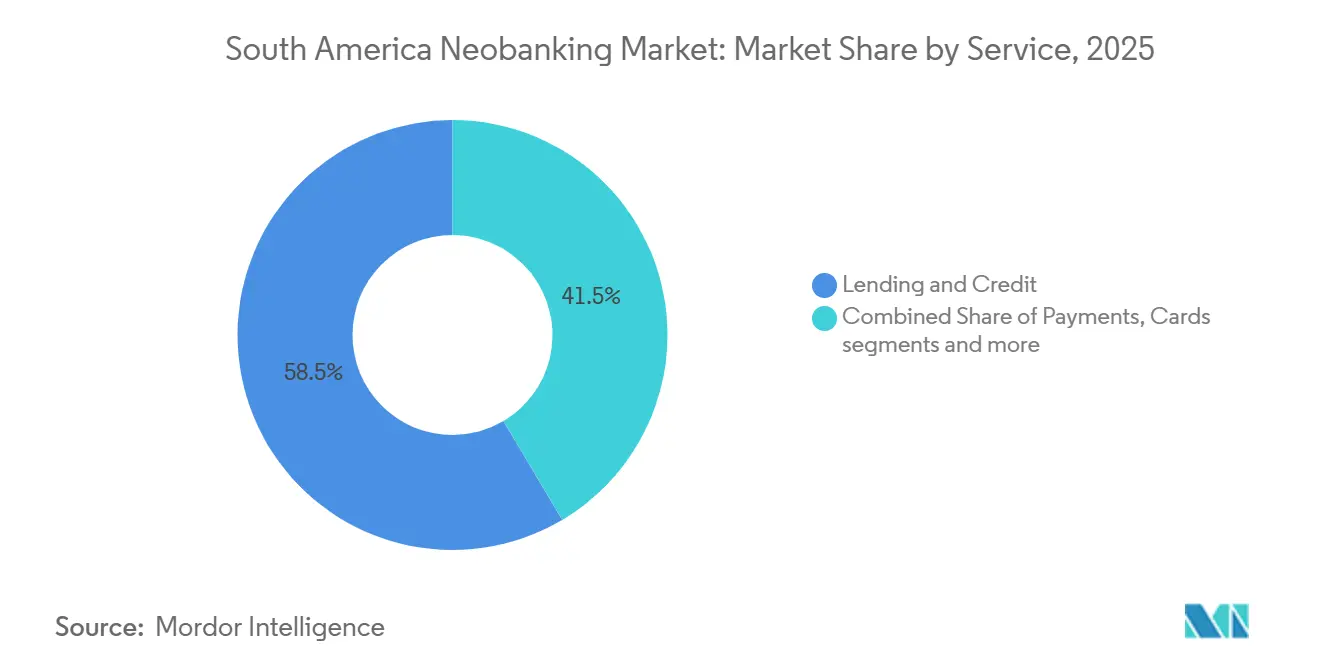
Lending and credit accounted for a 58.52% of the South America neobanking market size in 2025. Its position reflects platforms’ ability to use real-time payment behavior when assessing customers with limited formal credit records. Nubank reported a USD 32.7 billion total credit portfolio at the end of 2025, 40% above the prior year. The portfolio reached USD 37.2 billion in the first quarter of 2026, also 40% higher than the prior-year period. Unsecured lending represented 25% of that portfolio at the end of 2025.
Insurance Distribution is forecast to grow at a 13.21% CAGR through 2031. Providers can offer insurance inside applications that customers already use for payments and account management. This arrangement can widen access and reduce reliance on a separate distribution channel. Transactional accounts, deposits, savings, payments, transfers, and cards remain important entry and engagement products. Investments, securities distribution, and other services have smaller contributions but can broaden customer relationships. The South America neobanking market share is shifting toward a more diversified service mix, creating opportunities to expand lending and adjacent financial products while maintaining responsible product suitability.



By End User: Retail Accounts Create A Base For SME Services
Retail Individuals held a 78.12% of the South America neobanking market share in 2025. Free accounts, no annual-fee cards, and zero-commission transfers suit consumers with frequent basic financial needs. Retail activity also provides payment data and establishes trust in the provider’s interface. Nubank reported primary-institution incidence above 30% of the adult population in 17 Brazilian states during the fourth quarter of 2025. The company reported stronger penetration in lower-income states with lower branch density.
SMEs are forecast to grow at a 12.43% CAGR through 2031. Many small firms have limited access to collateral-based bank credit and need services aligned with their operating patterns. Payment acceptance tools can give providers visibility into receivables and business activity. DaviPlata’s first-quarter 2026 results illustrate demand for small-ticket merchant finance. Micro-businesses and sole proprietors can use payment tools that build records for later credit decisions, while large enterprises remain more dependent on established corporate banks. The growth of the South America neobanking market size is supported by providers combining payments, collections, and working-capital services while maintaining careful affordability assessment.
By Revenue Stream: Interest Income Remains Central While Fees Expand
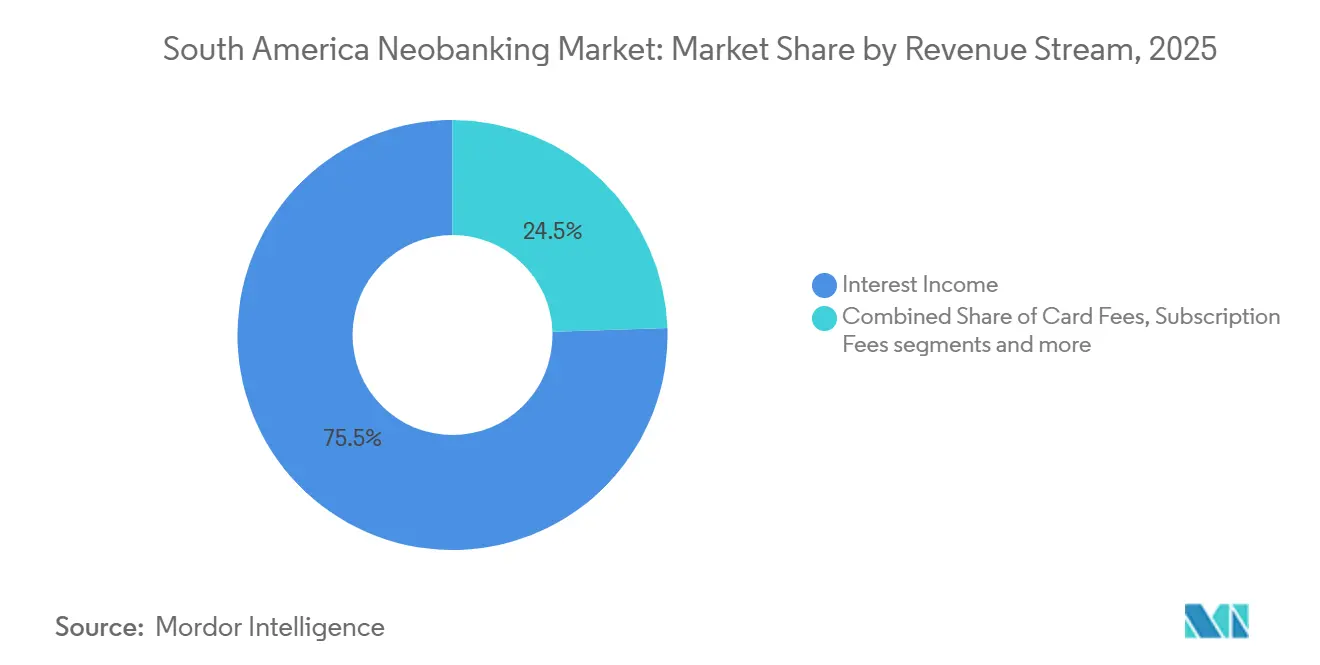
Interest Income accounted for a 75.52% of the South America neobanking market size in 2025. The result reflects the importance of credit products and the prevailing interest-rate environment across the region. Nubank reported USD 2.8 billion in net interest income during the fourth quarter of 2025. The company reported a 21.1% net interest margin in the first quarter of 2026. A credit-led revenue base remains sensitive to funding costs, lending yields, and repayment performance.
Distribution Commissions and Other revenue are forecast to grow at a 14.53% CAGR through 2031. Insurance, savings, investment distribution, and embedded finance can generate revenue without the balance-sheet use associated with direct lending. MercadoLibre identified insurance, savings, and investment cross-sell as strategic priorities for Mercado Pago during 2025. Card fees, transaction fees, foreign exchange services, and subscriptions remain relevant complementary income sources. Competitive and regulatory conditions can constrain card-related revenue, while remittance corridors can support foreign exchange activity. The South America neobanking market share can be strengthened by revenue diversity when pricing remains transparent, and products meet identifiable customer needs.
By License Type: Multi-License Providers Cover More Customer Needs
Multi-License Groups held a 63.41% of the South America neobanking market share by license type in 2025. These groups can combine payment, credit, deposit, and other regulated capabilities in a broader customer proposition. Payment licenses can support account acquisition and transactions, while credit licenses allow lending after customer and risk-management capabilities develop. Broader banking permissions can support insured deposits and more extensive product distribution. Nubank’s 2025 filing describes the importance of regulated entities and approvals across its markets.
Specialized Credit and Finance-Company Licenses are forecast to grow at a 13.52% CAGR through 2031. These licenses can allow platforms to expand direct credit activity without immediately operating as full banks. Payment-account and wallet licenses remain important for entry-stage providers and basic digital transactions. Full Bank Licenses represent a smaller group of entities but can support broader deposit and lending activity. License progression is a commercial choice as well as a regulatory process, requiring capital, governance, and compliance resources. The South America neobanking market size is supported by providers at different points in the licensing progression, with their product expansion dependent on regulatory approvals, capital resources, and customer relationship strength.
Geography Analysis
Brazil held 76.54% of the South America neobanking market share in 2025. Pix, broad mobile banking use, and a large digitally engaged customer base support the country’s leading position. Brazil had 138.46 million unique Open Finance consents and 239.79 million active authorizations by August 2026. This level of participation supports data sharing and payment initiation across the ecosystem. Banking technology investment is expected to reach USD 9.84 billion in 2026. Nubank had 114.7 million customers in Brazil in the first quarter of 2026. Brazil’s scale makes it the main source of regional customer activity and product development.
Colombia is forecast to record the fastest growth at a 13.82% CAGR through 2031. The country has a large user base for digital wallets and is developing its digital financial ecosystem. DaviPlata served more than 20 million customers and extended SME nanocredit to more than 1 million small businesses in 2025. Its nanocredit portfolio reached USD 45.2 million during the first quarter of 2026. Argentina made progress in financial inclusion during 2025 through its Sistema de Finanzas Abiertas. These markets demonstrate that growth depends on local infrastructure, financial access needs, and provider execution.
Peru’s Yape had 16.4 million monthly active users in the first quarter of 2026. The platform reported lending revenue growth of 3.6 times year over year and 5.7 million active borrowers. Chile remains a relevant digital financial services market through locally focused platforms and bank-backed wallets. Yape Bolivia surpassed 2 million customers during the first quarter of 2026. Uruguay, Paraguay, Bolivia, Venezuela, Ecuador, Guyana, and Suriname remain smaller corridors with distinct payment and remittance needs. The South America neobanking market size is likely to evolve at different rates across countries, reflecting variations in customer adoption and local regulatory frameworks.
Competitive Landscape
The South America neobanking market is concentrated among the largest platforms and fragmented across smaller operators. Nubank and Mercado Pago are the 2 largest regional platforms by customer scale and transaction activity. Nubank’s total credit portfolio reached USD 37.2 billion in the first quarter of 2026, 40% above the prior-year quarter. Mercado Pago had nearly 78 million monthly active users in the fourth quarter of 2025. Nubank reported 131 million global customers in December 2025, including 113 million in Brazil. Mercado Pago reported a USD 12.5 billion credit portfolio in the fourth quarter of 2025. These platforms use different starting points, but both seek to deepen customer financial relationships.
Nubank expanded SME credit offerings and introduced the Charging Assistant tool during 2025. This move linked business lending with cash-flow management for small customers. MercadoLibre continued to prioritize insurance, savings, and investment cross-sell through Mercado Pago during 2025. Mercado Pago also reported a 4.4% credit-card 15-to-90-day nonperforming loan ratio in the fourth quarter of 2025. Its credit portfolio grew 90% year over year in that period. The combination of customer data, underwriting, and fraud controls is becoming increasingly important for providers with credit ambitions. The South America neobanking market will reward firms that can expand services while protecting asset quality and customer trust.
DaviPlata’s first-quarter 2026 portfolio growth indicates that emerging providers can build meaningful positions in focused customer groups. Yape’s active user and borrower base shows the importance of high-frequency payment relationships in Peru. Smaller operators can address country-specific requirements or customer niches that larger platforms may not prioritize. SME banking, insurance distribution, and cross-border payments remain relevant areas for product development. Providers with stronger payment engagement may have more information for underwriting and personalized offers. However, expansion into additional services also increases regulatory and operational demands. The South America neobanking industry remains competitive because customer scale alone does not eliminate the need for careful product delivery.
South America Neobanking Industry Leaders
Nubank
Mercado Pago
PicPay
Banco Inter
PagBank
- *Disclaimer: Major Players sorted in no particular order

Recent Industry Developments
- July 2026: Nubank reported that it had banked 31.5 million previously unbanked Brazilians, while its primary-institution incidence exceeded 30% across 17 Brazilian states in the fourth quarter of 2025.
- May 2026: Credicorp disclosed first-quarter 2026 results showing that Yape reached 16.4 million monthly active users, had 5.7 million active borrowers, and generated lending revenue that was 3.6 times higher than the prior-year period.
- April 2026: Credicorp established a unified neobank business unit on April 1, 2026, bringing Yape Peru, Yape Bolivia, iO, and Tenpo Chile under a single leadership structure.
- April 2026: DaviPlata relaunched with remunerated accounts, debit cards, credit cards, and savings products for more than 20 million customers in Colombia.


South America Neobanking Market Report Scope
The South America neobanking market refers to the ecosystem of digital-first banking and financial service providers that deliver banking, payments, lending, savings, investment, and other financial products primarily through mobile applications and digital platforms, with limited or no reliance on traditional physical branches. The market is driven by high smartphone and internet penetration, demand for convenient and low-cost financial services, expansion of digital payments, and the need to serve underbanked and underserved populations.
The South America Neobanking Market is Segmented by Service (Transactional Accounts, Cards, Lending and Credit and More), End User (Retail, Micro-Businesses, SMEs, and More), Revenue Stream (Interest Income, Card Interchange and Fees, FX, and More), License Type (Full Bank, Payment-Wallet, and More), and Geography (Brazil, Argentina, Colombia, Chile, Peru, Others). The Market Forecasts are Provided in Terms of Value (USD).
| Transactional Accounts, Deposits and Savings |
| Payments and Transfers |
| Cards |
| Lending and Credit |
| Investments and Securities Distribution |
| Insurance Distribution |
| Other Value-Added |
| Retail Individuals |
| Micro-Businesses and Sole-Proprietor Firms |
| SMEs (Small & Medium Enterprises) |
| Large Enterprises |
| Interest Income |
| Card Interchange and Card Fees |
| Account, Payment and Transaction Fees (Non-Card) |
| Foreign Exchange and Cross-Border |
| Subscription and Membership Fees |
| Distribution Commissions and Other |
| Full Bank License |
| Payment-Account / Wallet License |
| Specialized Credit / Finance-Company License |
| Multi-License Group |
| Brazil |
| Argentina |
| Colombia |
| Chile |
| Peru |
| Rest of South America (Uruguay, Paraguay, Bolivia, Venezuela, and Ecuador) |
| By Service | Transactional Accounts, Deposits and Savings |
| Payments and Transfers | |
| Cards | |
| Lending and Credit | |
| Investments and Securities Distribution | |
| Insurance Distribution | |
| Other Value-Added | |
| By End User | Retail Individuals |
| Micro-Businesses and Sole-Proprietor Firms | |
| SMEs (Small & Medium Enterprises) | |
| Large Enterprises | |
| By Revenue Stream | Interest Income |
| Card Interchange and Card Fees | |
| Account, Payment and Transaction Fees (Non-Card) | |
| Foreign Exchange and Cross-Border | |
| Subscription and Membership Fees | |
| Distribution Commissions and Other | |
| By License Type | Full Bank License |
| Payment-Account / Wallet License | |
| Specialized Credit / Finance-Company License | |
| Multi-License Group | |
| By Geography | Brazil |
| Argentina | |
| Colombia | |
| Chile | |
| Peru | |
| Rest of South America (Uruguay, Paraguay, Bolivia, Venezuela, and Ecuador) |


Key Questions Answered in the Report
What is the forecast growth rate for South America neobanking through 2031?
The sector is forecast to grow at an 8.5% CAGR from 2026 to 2031 and reach USD 44.8 billion by 2031. The forecast reflects broader use of digital accounts, payments, credit, and related services.
Which service generates the most revenue for South American digital banks?
Lending and Credit led service revenue with a 58.52% share in 2025. Payment activity and customer information support credit products for customers with limited traditional credit histories.
Why are small businesses important to digital financial providers in South America?
SMEs are forecast to grow at a 12.43% CAGR through 2031 because many need simpler access to payments and working-capital products. Merchant payment flows can support credit assessments that reflect current business activity.
Which country leads regional neobanking activity?
Brazil led with 76.54% share in 2025, supported by Pix, mobile banking use, and Open Finance participation. Its scale supports regional customer activity and financial product development.
What is the fastest-growing revenue source for these providers?
Distribution Commissions and Other revenue are forecast to grow at a 14.53% CAGR through 2031. Insurance, savings, investments, and embedded finance can support income beyond direct lending.
What risks can affect digital banking adoption in South America?
Fraud, cybersecurity threats, licensing complexity, customer-acquisition costs, and credit risk can slow adoption and raise operating costs. Stronger controls are important for protecting trust in digital financial services.
Page last updated on:





