
South America Motorcycle Loan Market Size and Share
Market Overview
| Study Period | 2020 - 2031 |
|---|---|
| Forecast Data Period | 2026 - 2031 |
| Base Year Market Size (2025) | USD 8.45 Billion |
| Market Size (2026) | USD 9.19 Billion |
| Market Size (2031) | USD 12.61 Billion |
| Growth Rate (2026 - 2031) | 8.23 % |
| Market Concentration | Low |
Major Players *Disclaimer: Major Players sorted in no particular order Image © Mordor Intelligence. Reuse requires attribution under CC BY 4.0. | |
South America Motorcycle Loan Market Analysis by Mordor Intelligence
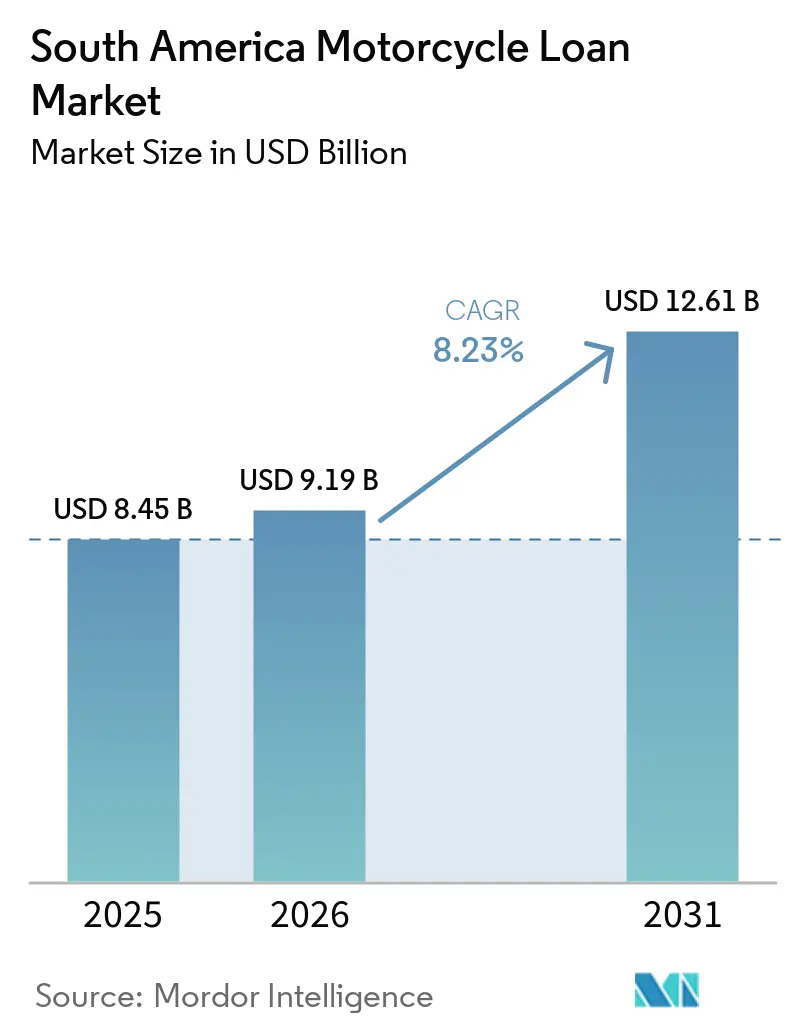
The South America motorcycle loan market size was valued at USD 8.45 billion in 2025, is estimated at USD 9.19 billion in 2026, and is forecast to reach USD 12.61 billion by 2031, registering a CAGR of 8.23% from 2026 to 2031. Motorcycle purchases remain closely linked to household mobility, delivery work, and small business activity across the region. Formal credit is reaching borrowers who previously relied on cash purchases, informal lenders, or dealer arrangements. The South America motorcycle loan market, therefore, benefits when lenders reduce upfront payment requirements and adapt repayment plans to income patterns. Dealer networks still shape loan origination, although digital providers are extending access beyond traditional branch networks. Public credit programs and platform partnerships are also focusing attention on borrowers who use motorcycles to earn income.
Key Report Takeaways
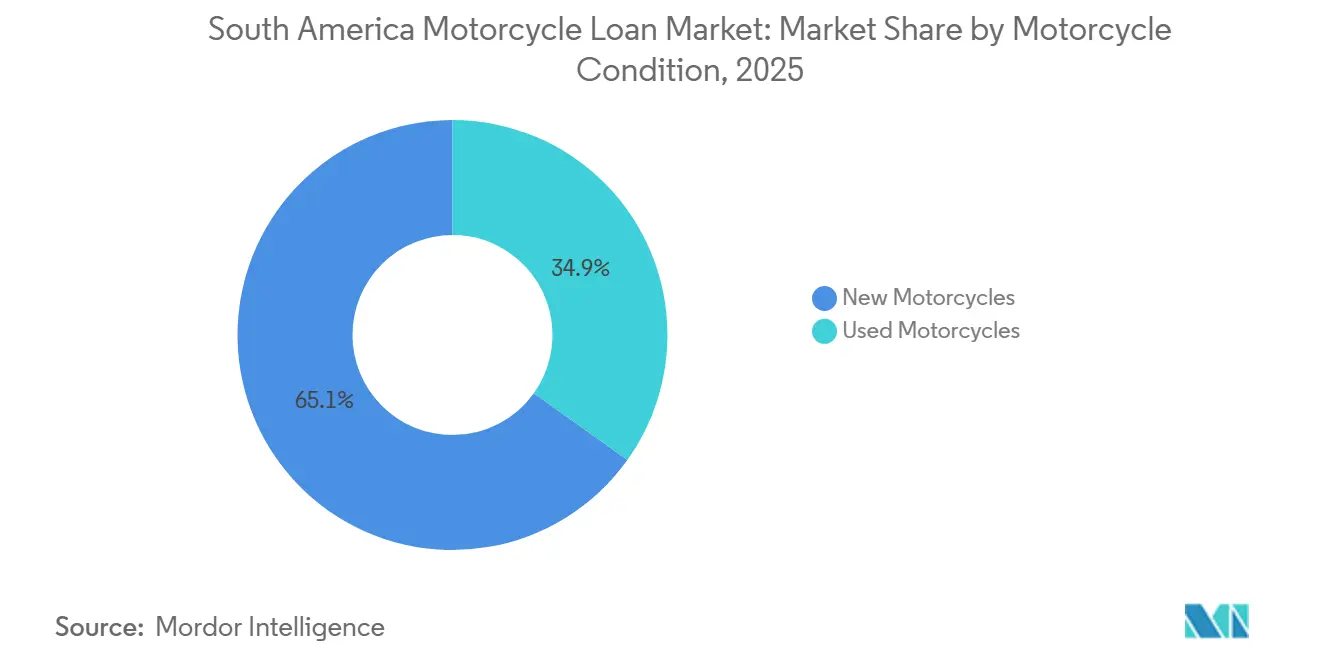
- By motorcycle condition, new motorcycles held 65.1% of the South America motorcycle loan market share in 2025, while used motorcycles are forecast to grow at a 9.8% CAGR through 2031.
- By provider type, banks held 39.5% of the South America motorcycle loan market share in 2025, while fintech and digital lenders are forecast to grow at an 11.5% CAGR through 2031.
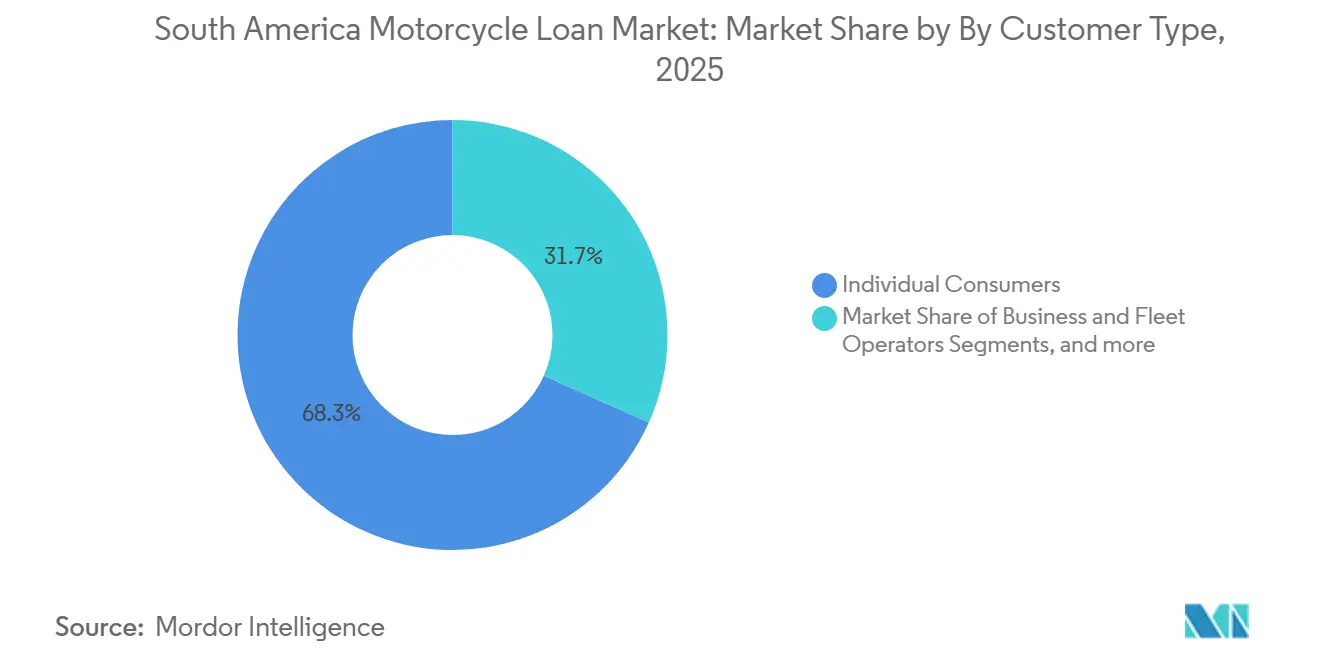
- By customer type, individual consumers held 68.3% of the South America motorcycle loan market share in 2025, while self-employed workers, gig laborers, and micro-entrepreneurs are forecast to grow at a 10.5% CAGR through 2031.
- By loan tenure, loans exceeding 36 months held 58.4% of the South America motorcycle loan market share in 2025, while loans of 36 months or less are forecast to grow at a 9.5% CAGR through 2031.
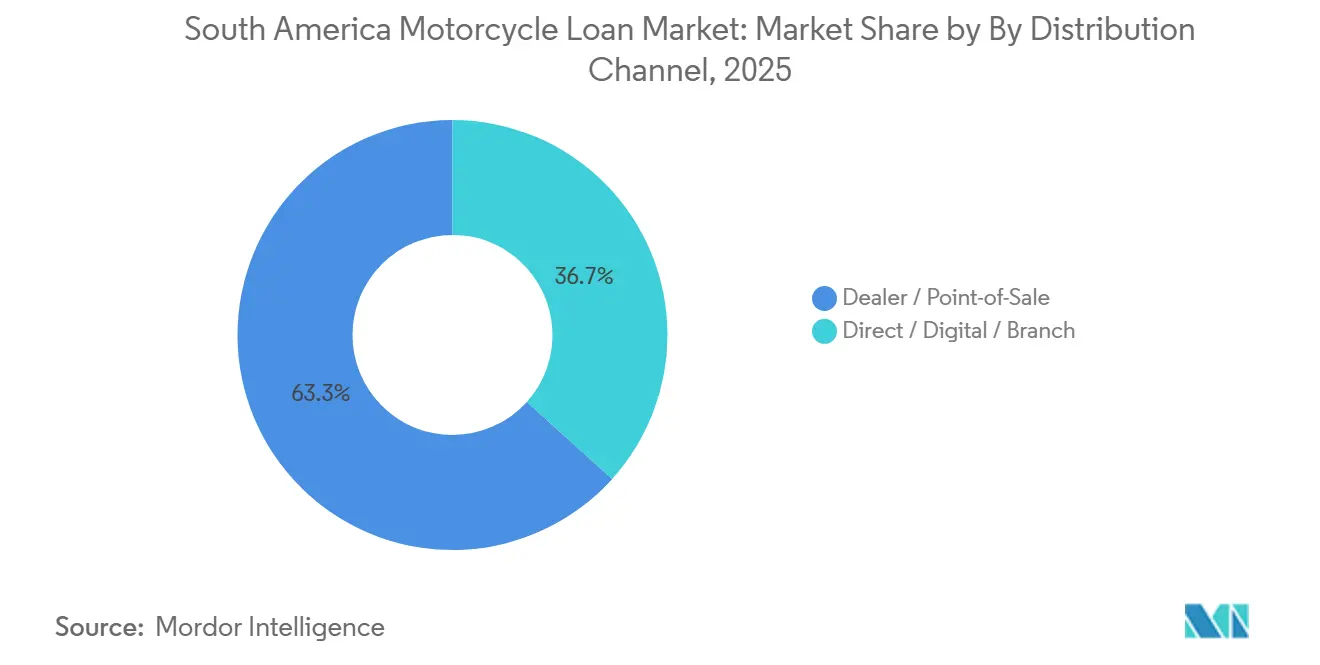
- By distribution channel, dealer and point-of-sale channels held 63.3% of the South America motorcycle loan market share in 2025, while direct, digital, and branch channels are forecast to grow at a 12.2% CAGR through 2031.
- By geography, Brazil held 65.6% of the South America motorcycle loan market share in 2025, while Colombia is forecast to grow at an 11.2% CAGR through 2031.
Note: Market size and forecast figures in this report are generated using Mordor Intelligence’s proprietary estimation framework, updated with the latest available data and insights as of January 2026.
South America Motorcycle Loan Market Trends and Insights
Drivers Impact Analysis*
| Driver | (~) % Impact on CAGR Forecast | Geographic Relevance | Impact Timeline |
|---|---|---|---|
| Affordable Motorcycle Ownership Through Financing | +2.1% | Brazil, Colombia, Argentina | Medium term (2-4 years) |
| Motorcycles as Essential Urban Mobility Solutions | +1.8% | Brazil, Colombia, Peru, Argentina | Short term (≤ 2 years) |
| Growth of Last-Mile Delivery and Motorcycle-Based Platform Work | +1.9% | Brazil, Colombia, Chile, Peru | Medium term (2-4 years) |
| Motorcycles as Income-Generating Assets | +1.4% | Brazil, Colombia, Argentina, Peru | Long term (≥ 4 years) |
| Expansion of Embedded, Dealer, and Alternative Credit Channels | +1.6% | Brazil, Colombia, Chile | Medium term (2-4 years) |
| Source: Mordor Intelligence | |||
Affordable Motorcycle Ownership Through Financing
Motorcycle credit has become an important route to ownership for lower-income and first-time buyers across South America. In Colombia, a significant share of motorcycles sold in 2025 were purchased on credit, and Hero reported that nearly 60% of its units were financed. Bajaj’s dealer network offered 16 financing partnerships, including Addi, Banco de Bogotá, and Sufi, which gave buyers several routes to secure a loan. Peru sold 425,880 motorcycles in 2025, supported by credit access, inventory availability, and Lima inflation of 1.51% [1]Motorcycle Market: Peru Leads Growth in South America and Sets Record in 2025 | ECONOMY | MANAGEMENT. These conditions support the South America motorcycle loan market because a motorcycle carries a lower purchase price and lower monthly payment than a car. Banco Finandina offered financing of up to 110% of a motorcycle’s purchase value and terms of up to 60 months, which reduced the initial payment barrier for first-time buyers.
Motorcycles as Essential Urban Mobility Solutions
Motorcycles serve daily transport needs for workers and households in cities where public transport, travel times, and income constraints shape purchase decisions. Brazil sold 2,197,851 motorcycles in 2025, its highest volume since 2003 and a 17.1% increase from 2024 [2]Abraciclo, “Projeção para 2026 Produção Estimada em 2.070.000 Motocicletas,” Correio Central, correiocentral.com.br.. Abraciclo expects Brazilian registrations to reach 2.3 million units in 2026, which keeps the vehicle base relevant for lenders and dealers. Colombia registered 1.1 million motorcycles in 2025, a record annual total. The South America motorcycle loan market gains from this role because access to credit determines whether many households can purchase the vehicle they use every day. Credit products that combine vehicle finance, insurance, and simple digital processing can make this purchase path easier for borrowers.
Growth of Last-Mile Delivery and Motorcycle-Based Platform Work
Delivery platforms have created a large group of riders whose income can be traced through completed trips and payment records. This borrower group often lacks a standard payslip but can provide a consistent record of activity through platform data. Motorcycle demand in Peru and Colombia increased sharply during late 2025 as delivery activity and easier credit access supported purchases. The South America motorcycle loan market has an opportunity to use these records alongside conventional credit checks. Brazil’s Move Brasil program uses platform participation as an eligibility criterion for subsidized motorcycle credit. The program applies to app-based delivery riders who meet the required activity conditions, showing that rider activity can be incorporated into financing decisions. Lenders that can verify income through these records can reach workers that branch-based underwriting has often excluded.
Motorcycles as Income-Generating Assets
A motorcycle financed for delivery, passenger transport, or micro-business use supports repayment through the income it helps generate. Borrowers using a motorcycle for work have a direct reason to keep the vehicle available and maintain loan payments. The International Finance Corporation identified alternative data as a way to support financial inclusion when conventional bureau records are limited. Its 2026 work describes how behavioral and operational data can supplement standard credit information for underserved customers. In Brazil, Move Brasil offers annual rates of 11.5%-12.5% for eligible delivery riders. The South America motorcycle loan market is consequently drawing attention from captive lenders, fintech firms, and public institutions that are targeting the same working borrower base.
Restraints Impact Analysis*
| Restraint | (~) % Impact on CAGR Forecast | Geographic Relevance | Impact Timeline |
|---|---|---|---|
| High Interest Rates and Borrower Affordability Constraints | -1.5% | Brazil, Argentina, Colombia | Short term (≤ 2 years) |
| Inflation and Household Purchasing-Power Pressure | -1.2% | Argentina, Brazil | Medium term (2-4 years) |
| Limited Credit Histories and Informal-Income Verification Challenges | -1.0% | Colombia, Peru, Bolivia, Ecuador | Long term (≥ 4 years) |
| Credit Default, Fraud, and Vehicle Recovery Risks | -0.8% | All geographies | Medium term (2-4 years) |
| Source: Mordor Intelligence | |||
High Interest Rates and Borrower Affordability Constraints
Interest rates remain a direct barrier for borrowers considering a motorcycle loan, as financing costs can vary significantly depending on the borrower's credit quality and lender terms. Argentina’s Mi Moto program offered rates of 40%-53% TNA in 2026 and terms extending to 72 months [3]Banco de la Nación Argentina, “El Banco Nación Lanza Financiamiento 100% Digital para la Compra de Motos,” Banco de la Nación Argentina, prensa.bna.com.ar.. Longer terms can lower monthly installments, but they also extend the borrower’s payment commitment. Delivery riders may be less sensitive to rates when the motorcycle supports regular earnings, while salaried first-time buyers face a firmer income limit. Full effective-cost disclosures in Brazil and consumer protection requirements in Colombia can make the total cost of borrowing more visible. The South America motorcycle loan market must balance loan access with clear pricing and payment structures that borrowers can sustain.
Inflation and Household Purchasing-Power Pressure
Household purchasing power affects the down payment, installment, and operating costs associated with a financed motorcycle. This pressure is especially important when borrowers also face higher food, rent, and fuel costs. Peru’s 2025 motorcycle volume was supported by Lima inflation of 1.51%, which helped preserve the conditions for consumer purchases. In contrast, markets facing elevated household cost pressure require longer tenures or lower rates to keep monthly payments manageable. The South America motorcycle loan market is more exposed when affordability weakens among first-time buyers with limited savings. Lenders can respond through the loan term, financing amount, and payment design, but these measures must remain consistent with credit performance requirements.
*Our forecasts treat driver/restraint impacts as directional, not additive. The impact forecasts reflect baseline growth, mix effects, and variable interactions.
Segment Analysis
By Motorcycle Condition: New Motorcycles Anchor Volume, Used Motorcycles Accelerate
New motorcycles held 65.1% of the South America motorcycle loan market share in 2025, supported by dealer networks and captive finance programs. Dealers can offer the motorcycle and the loan during the same customer visit. Banco Honda operated through more than 1,100 motorcycle dealership points in Brazil, and Honda Financial Services accounted for 47% of Honda motorcycle sales in Brazil during 2025 [4]. This link between purchase and financing supports new-unit loan volumes. It also gives captive lenders a direct connection to the customer, dealer, and vehicle brand. The South America motorcycle loan market continues to rely on this model for first-time buyers seeking a new vehicle with a clear warranty and dealer support. New motorcycle lending also benefits from standardized vehicle values, which can simplify loan approval and collateral assessment. The model remains strongest where branded dealer coverage is broad. It may be less accessible in smaller locations that have fewer formal dealerships.
Used motorcycles are forecast to expand at a 9.8% CAGR from 2026 to 2031, contributing to the growth of the South America motorcycle loan market size as more buyers seek lower-cost vehicles. Previously financed motorcycles enter the secondary market as original owners replace or sell their vehicles, creating a larger pool of potential borrowers. Banco Finandina finances motorcycles up to four years old, addressing a part of the used-vehicle buyer base. Fintech lenders can assess used-motorcycle collateral without relying on a single vehicle brand. Banco Central do Brasil research has indicated that vehicle lenders apply different pricing for used vehicles and lower-score borrowers. Heavy delivery use can lower the value of motorcycles that re-enter the secondary market. Lenders must therefore consider mileage, maintenance, and vehicle condition when assessing collateral. The used segment offers access to buyers beyond formal new-motorcycle dealer networks. It also requires stronger appraisal methods as secondary-market supply grows.


By Provider Type: Banks Lead, Fintech and Digital Lenders Expand Fastest
Banks held 39.5% of the South America motorcycle loan market share in 2025, reflecting their funding capacity and established compliance systems. Bank products remain important for customers with standard income documentation and established credit records. Their branch networks and dealer relationships also support regional distribution. Banco BV reported a BRL 5 billion (USD 1 billion) motorcycle and new-vehicle portfolio in the first quarter of 2026. Banks can compete through faster digital processing and broader dealer coverage. Their documentation requirements can still limit access for gig workers and first-time borrowers, creating room for providers with different underwriting methods. The South America motorcycle loan industry includes banks, specialized finance firms, captive lenders, and digital providers with distinct strengths.
Fintech and digital lenders are forecast to grow at an 11.5% CAGR through 2031, supporting the South America motorcycle loan market size as digital channels expand access to borrowers beyond traditional banking networks. Their model is suited to online applications, electronic verification, and data-led underwriting. CMN Resolution 5,159 widened the business options available to Brazilian credit fintechs in August 2024. The resolution supports direct origination by eligible digital entities at dealer points of sale. Non-bank financial institutions can offer flexible terms where commercial bank processes are less suited to the borrower. Captive finance companies retain an advantage because their loans are linked to the purchase decision at a branded dealer. The South America motorcycle loan market gives digital providers scope to reach borrowers outside leading cities. It also requires these lenders to manage risk without the long operating history of some incumbent banks. Stronger data systems may improve access for workers with informal but traceable earnings. Competition will depend on the speed, reliability, and affordability of each provider’s loan process.
By Customer Type: Individual Consumers Dominate, Gig Workers and Micro-Entrepreneurs Drive Growth
Individual consumers held 68.3% of the South America motorcycle loan market share in 2025 because personal transport remains the main ownership use case. Motorcycles provide a lower-cost alternative for commuting and daily travel. Many consumer borrowers use the vehicle for a combination of household mobility and occasional income generation. This makes the product relevant across varied income groups. Colombia recorded 1.1 million motorcycle registrations in 2025, demonstrating the broad role of motorcycles in personal transport. Credit-financed purchases accounted for 50% of Colombian motorcycle transactions in 2025. Consumer loan design, therefore, remains central to regional lending volumes. Business and fleet borrowers form a smaller customer group but serve formal delivery and logistics needs. Individual customers remain sensitive to down payments, term length, and total financing cost. These factors shape the availability of motorcycle credit across the region.
Self-employed workers, gig laborers, and micro-entrepreneurs are forecast to grow at a 10.5% CAGR through 2031, supporting the South America motorcycle loan market size as demand for income-generating vehicles increases. Their demand is linked to the need for a vehicle that supports delivery, ride services, or local commerce. Platform records can show completed work and payment activity even when a borrower lacks a conventional salary document. The IFC has highlighted alternative data as a tool for assessing underserved borrowers. Brazil’s public program for delivery riders confirms that this group is receiving focused credit support. More than 50% of Colombian motorcycle credit operations were directed to borrowers under 35 years old. Many customers in this age group are entering formal finance through a motorcycle loan. The South America motorcycle loan market can serve them when underwriting recognizes reliable activity beyond payroll records. Lenders must still assess income volatility and the operating condition of work vehicles. Products that align repayments with actual earnings can be useful for this customer group.

By Loan Tenure: Loans Exceeding 36 Months Lead, Short-Term Loans Grow Faster
Loans exceeding 36 months accounted for 58.4% of the South America motorcycle loan market share in 2025. Longer terms reduce the monthly installment for borrowers with limited disposable income. This can make a new motorcycle purchase possible when a shorter term would produce an unaffordable payment. Banco Nación offered Mi Moto financing with terms of up to 72 months. The program provided a digital route for eligible Argentine buyers. Longer terms are particularly relevant in high-rate lending environments. They help borrowers manage monthly payments but extend the period during which credit risk remains. The South America motorcycle loan market uses these structures to support broad consumer access. Lenders must balance the payment benefit against the age and expected condition of the motorcycle. This balance is important when the vehicle is used intensively for commercial activity.
Loans of 36 months or less are forecast to grow at a 9.5% CAGR through 2031, contributing to the South America motorcycle loan market size as lenders offer shorter repayment options for borrowers with higher repayment capacity or more intensive vehicle use. Daily delivery use can shorten a motorcycle’s practical replacement cycle compared with personal transport use. A shorter loan can align the financing term more closely with the period when the vehicle retains reliable operating value. Digital lenders may also structure payment schedules around weekly or daily worker cash flows. Such schedules differ from standard monthly bank installments. The South America motorcycle loan industry can use shorter terms for riders who expect to replace high-mileage vehicles sooner. These loans may suit borrowers who generate regular income through the financed motorcycle. The approach requires close monitoring of payment behavior and the condition of the underlying asset. It may not suit all lower-income buyers who need the smallest possible monthly installment. Tenure choice will continue to reflect the trade-off between affordability, asset life, and borrower income patterns.
By Distribution Channel: Dealer and Point-of-Sale Channels Lead, Direct and Digital Channels Grow Fastest
Dealer and point-of-sale channels held 63.3% of the South America motorcycle loan market share in 2025. Most new motorcycle purchases still begin at a physical dealer where buyers can inspect the vehicle. The loan offer can then be presented alongside the vehicle price, insurance, and delivery terms. This creates a straightforward process for first-time new-vehicle buyers. Captive finance providers benefit because they are connected to their brand’s dealer network. Honda Financial Services supported 47% of Honda motorcycle sales in Brazil during 2025. Dealer staff can also help customers complete documentation and understand payment choices. This remains a useful advantage in markets where borrowers prefer in-person support. The South America motorcycle loan market depends on these networks for high-volume new motorcycle origination. Dealer channels remain important even as digital applications become more common.
Direct, digital, and branch channels are forecast to grow at a 12.2% CAGR from 2026 to 2031, supporting the South America motorcycle loan market size as lenders expand digital access and alternative origination routes. Digital processing can reduce the need for a borrower to visit a branch before a loan is approved. Bancolombia offers motorcycle credit through Tu360Movilidad, which combines the financing process with related services online. Electronic identity checks and digital documentation can reduce delays in the credit journey. These capabilities are useful in secondary cities and rural areas where branch coverage is less dense. Direct channels can also help lenders reach used-motorcycle buyers outside a branded dealer network. The South America motorcycle loan market will continue to use both physical and digital channels because the customer journey differs by vehicle condition and borrower preference. A digital route does not eliminate the value of dealer relationships. Instead, it adds an alternative route for applicants seeking convenience or broader provider choice. Channel competition will depend on approval speed, customer support, and responsible risk assessment.
Geography Analysis
Brazil held 65.6% of the South America motorcycle loan market share in 2025 and remained the region’s largest lending base. The country sold 2,197,851 motorcycles in 2025, its highest annual volume since 2003. Abraciclo projects 2.3 million registrations in 2026 and motorcycle production of 2.07 million units in Manaus. Banco Honda maintains a substantial loan portfolio, reflecting its significant presence in motorcycle and automobile financing. JBIC has also entered into a co-financing agreement with Banco Honda to support motorcycle and automobile sales finance. Brazil's Move Brasil program provides dedicated motorcycle credit for eligible delivery riders, supporting financing through Caixa Econômica Federal and Banco do Brasil. The program also offers preferential lending terms to eligible borrowers. Additionally, Brazil's consumer credit regulations require lenders to provide borrowers with clear and transparent information regarding financing costs.
Colombia is forecast to grow at an 11.2% CAGR from 2026 to 2031, the fastest rate among the stated countries. The country registered 1.1 million motorcycles in 2025, a record level above 2024. Half of Colombian motorcycle sales in 2025 were financed through credit from Bancolombia, Sufi, Banco Finandina, BBVA Colombia, and Yamaha Motor Finance Colombia, which offer motorcycle lending products. Rayros Servicios Financieros joined Colombia Fintech in August 2025 and announced plans to expand to more cities by the end of 2026. Peru recorded 425,880 motorcycle sales in 2025, a record annual volume and 25.3% growth from 2024. Lower inflation and improved employment supported the conditions for lending and vehicle purchases in Peru. The Superintendencia de Banca, Seguros y AFP provides the regulatory setting for vehicle lending in Peru.
Banco Nación’s digital Mi Moto program offers terms of up to 72 months. Santander Consumer and Zanella launched a 48-month fixed-rate finance offer in 2025. Chile remains operationally relevant for digital motorcycle lending because it is the headquarters of Galgo+. Ecuador recorded 25.3% motorcycle sales growth in 2025, while Venezuela’s motorcycle sales declined 16.6% during the year. These varied country conditions show that motorcycle credit depends on both vehicle demand and the broader ability of households to borrow. The South America motorcycle loan market size reflects this mix of mature lending systems, fast-growing formal credit markets, and smaller countries with uneven demand conditions.
Competitive Landscape
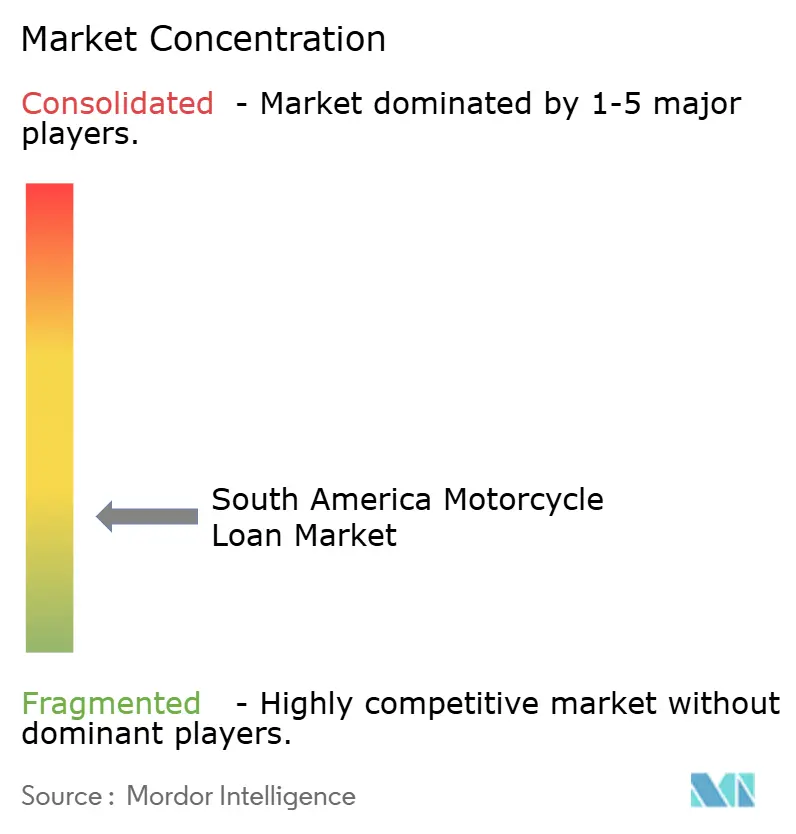
The South America motorcycle loan market has low provider concentration, with banks holding a significant share of loan value in 2025. OEM captive lenders hold a strong position because their financing is integrated with branded dealer networks. Banco Honda’s portfolio reached BRL 9.1 billion (USD 1.6 billion). Moody’s Local Brasil affirmed Banco Honda’s AAA—br long-term rating with a stable outlook in November 2025. Dealer access, brand relationships, and post-sale links support this captive model. Banco Yamaha Motor do Brasil also received a USD 100 million JBIC co-financing facility in March 2025 for financial services that include motorcycle sales finance. These relationships show continued institutional support for branded vehicle finance. Captive providers retain a clear advantage when customers buy a new motorcycle from a formal dealer.
Commercial banks compete through funding capacity, established compliance processes, and digital customer journeys. Banco BV reported a BRL 5 billion (USD 0.90 billion), supplied conversion value, motorcycle, and new-vehicle portfolio in the first quarter of 2026. Its motorcycle financing volume grew 22% from the first quarter of 2025. Bancolombia’s Tu360Movilidad platform provides a digital option for motorcycle finance applications. Banco Nación also provides a digital route through its Mi Moto offering. These moves focus on reducing processing friction for borrowers who prefer online services. Banks still face challenges when applicants have informal income or incomplete credit records. The South America motorcycle loan market gives them a reason to add data sources and repayment structures that better fit these borrowers.
Fintech firms are extending credit access to customers that standard branch models find costly to serve. CMN Resolution 5,159 provides a relevant policy change because it allows eligible Brazilian credit fintechs to support point-of-sale financing. Rayros Servicios Financieros has focused on motorcycle micro-loans in smaller Colombian municipalities. The Move Brasil program is another strategic development because it directs subsidized credit toward eligible app-based delivery riders. These examples reflect competition for platform workers, used-motorcycle buyers, and first-time borrowers. Lenders that use verifiable activity data may reach customers who lack conventional payslips. At the same time, consumer disclosure rules apply across provider types and limit the scope for opaque pricing. Competition is therefore increasing, but no evidence in the supplied material indicates that a small group of named lenders controls most regional loan value.
South America Motorcycle Loan Industry Leaders
Banco Honda S.A.
Banco Yamaha Motor do Brasil S.A.
Banco Finandina S.A.
Créditos Orbe S.A.S. (CrediOrbe)
Banco Santander Brasil
- *Disclaimer: Major Players sorted in no particular order

Recent Industry Developments
- May 2026: Banco BV disclosed that its motorcycle and new-vehicle loan portfolio reached BRL 5 billion (USD 1 billion). Motorcycle financing volumes grew 22% from the first quarter of 2025.
- March 2026: JBIC co-financed USD 100 million with Banco Yamaha Motor do Brasil S.A. for financial services that include motorcycle sales finance. The JBIC portion was USD 50 million.
- February 2026: JBIC signed a USD 180 million co-financing loan agreement with Banco Honda S.A. for Honda-branded motorcycle and automobile sales finance in Brazil. The facility included a USD 108 million JBIC portion.
- December 2025: Moody’s Local Brasil affirmed Banco Honda S.A.’s AAA.br long-term credit rating with a stable outlook. The rating communication cited 38% portfolio growth to BRL 9.1 billion (USD 1.6 billion) as of June 2025.


South America Motorcycle Loan Market Report Scope
| New Motorcycles |
| Used Motorcycles |
| Banks |
| Non-Bank Financial Institutions and Specialized Finance Companies |
| OEM / Captive Finance Companies |
| Fintech and Digital Lenders |
| Individual Consumers |
| Self-Employed, Gig Workers & Micro-Entrepreneurs |
| Business and Fleet Operators |
| Short-term (≤ 36 months) |
| Medium- to Long-term (> 36 months) |
| Dealer/Point-of-Sale |
| Direct/Digital / Branch |
| Brazil |
| Argentina |
| Colombia |
| Chile |
| Peru |
| Rest of South America (Uruguay, Paraguay, Bolivia, Venezuela, and Ecuador) |
| By Motorcycle Condition | New Motorcycles |
| Used Motorcycles | |
| By Provider Type | Banks |
| Non-Bank Financial Institutions and Specialized Finance Companies | |
| OEM / Captive Finance Companies | |
| Fintech and Digital Lenders | |
| By Customer Type | Individual Consumers |
| Self-Employed, Gig Workers & Micro-Entrepreneurs | |
| Business and Fleet Operators | |
| By Loan Tenure | Short-term (≤ 36 months) |
| Medium- to Long-term (> 36 months) | |
| By Distribution Channel | Dealer/Point-of-Sale |
| Direct/Digital / Branch | |
| By Geography | Brazil |
| Argentina | |
| Colombia | |
| Chile | |
| Peru | |
| Rest of South America (Uruguay, Paraguay, Bolivia, Venezuela, and Ecuador) |


Key Questions Answered in the Report
What is the projected value of South America motorcycle lending by 2031?
The South America motorcycle loan market is forecast to reach USD 12.6 billion by 2031, growing at an 8.2% CAGR from 2026.
Which country has the largest regional motorcycle financing base?
Brazil held 65.6% of the South America motorcycle loan market share in 2025 and has the region’s deepest dealer and lending infrastructure.
Which borrower group is growing fastest in motorcycle financing?
Self-employed workers, gig laborers, and micro-entrepreneurs are forecast to grow at a 10.5% CAGR through 2031.
Which provider type is growing fastest in South America?
Fintech and digital lenders are forecast to grow at an 11.5% CAGR through 2031, supported by online origination and alternative underwriting.
Are used motorcycles becoming more important for lenders?
Yes. Used-motorcycle loans are forecast to grow at a 9.8% CAGR through 2031 as more previously financed vehicles enter the secondary market.
What is the leading channel for motorcycle loan origination?
Dealer and point-of-sale channels held 63.3% of regional loan value in 2025, while direct and digital channels are growing faster.
Page last updated on:





